
KETOTEK Watt Meter Power Meter Plug
4.7Editor score
Five-button measurement interface
Overload and cost alarms
Data retained after power loss
Compare the best energy consumption monitors for PC, including accuracy, displays, smart features, compatibility, and installation methods for home or office.
Energy consumption monitors for PC can reveal how much electricity a computer, its peripherals, and connected accessories actually use. The right device may provide a simple wattage reading, track costs over time, automate schedules, or monitor complete home circuits, making it easier to identify wasteful loads and improve energy management.
This guide compares ten options across the provided category, from plug-in watt meters to whole-home systems with multiple circuit sensors, app-based reporting, and smart-home integration. The comparison emphasizes measurement capabilities, display readability, overload warnings, data retention, installation requirements, and suitability for PCs and other household electronics.
Each product review explains the monitor’s most useful strengths, practical limitations, and ideal buyer, while the comparison table makes the differences easier to scan. Ratings and product details reflect the supplied information, and pricing, availability, features, and promotional terms can change, so readers should verify current listings before purchasing.
4.7Editor score

4.6Editor score

4.3Editor score
The table below compares the included monitors by measurement scope, display, smart connectivity, and protective features, helping PC users identify either a focused outlet meter or a broader home energy system.


The Emporia Vue 3 is a comprehensive home energy monitor rated 4.6 out of 5 in the supplied information. It stands out for combining UL and CE listing, real-time app reporting, solar and net-metering support, and sixteen branch sensors in a single system. For PC users who want more than an isolated plug reading, it can place a desktop, gaming system, or nearby electronics within a broader household energy picture.
We may earn a commission when you buy through this link, at no additional cost to you.
Its strongest feature is the depth of information available through the Emporia Energy app. Users can examine real power, configure automation for time-of-use rates and peak demand, monitor excess solar, and receive notifications about consumption patterns. The supplied details state that sensors are accurate from ±2%, while one-second readings appear when the app is actively open, minute data is retained for seven days, hourly data is retained indefinitely, and cloud data can be exported.
The trade-off is installation complexity. The Vue 3 installs in the circuit panel using clamp-on sensors and supports several common residential configurations, including single-phase, split-phase, and certain three-phase systems. It is not automatically compatible with every panel, and some three-phase installations require an additional 200A sensor. The requirement for 2.4 GHz Wi-Fi and an internet connection also makes it less convenient as a completely offline or standalone display.
This is the strongest recommendation for readers who want to identify which circuits—including the one serving a PC—consume the most energy. It is particularly useful for a home office, a home with solar generation, or a household seeking long-term trend data and automated energy controls. Users seeking a simple one-outlet meter should instead consider a plug-in model.
Sixteen included branch sensors allow the system to distinguish major loads such as an air conditioner, water heater, washer, dryer, or range. A PC can then be evaluated within the electrical context of the equipment sharing its circuit, which is more useful than seeing only a single instantaneous wattage figure.
App-based settings can account for time-of-use rates, peak demand, excess solar, and rewards programs. Persistent minute and hourly history makes it possible to compare a typical workday against a weekend, isolate energy-heavy routines, and spot changes in consumption over time.
We may earn a commission when you buy through this link, at no additional cost to you.
The Upgraded Watt Power Meter Plug is a direct electrical usage monitor rated 4.6 out of 5. It is a practical choice for users who want to place a computer, monitor, console, or other device behind a meter without installing anything at the panel. Its seven display modes cover power, energy, voltage, current, frequency, power factor, cost, minimum and maximum power, and cumulative operating time.
We may earn a commission when you buy through this link, at no additional cost to you.
The upgraded 2.36-by-1.85-inch LCD uses a backlight and offers a 180-degree viewing angle, making the device easier to read from different positions. The backlight can remain off, activate for one, four, or eight hours, or stay on continuously. A separate data-memory function preserves consumption information when the plug is removed from the outlet or the attached appliance is disconnected, with automatic saving during a sudden power failure.
Its protection system is notable. The default overload threshold is 3680 watts and can be configured from zero to that maximum, while the supplied guidance recommends a lower general setting in many households. When the connected load exceeds the threshold, the screen displays an overload warning and the controls stop working until the load is reduced or removed. This is useful for a desktop system, though users should understand that the meter is a measurement and warning device rather than a substitute for correctly rated circuit protection.
Choose this model when you need an affordable, understandable, app-free way to examine an individual PC or peripheral. It is less suitable for long-term remote access, automated scheduling, or whole-home analysis. Because the meter records the load connected at the outlet, it will not show consumption from every computer component unless each item is measured separately or the PC is connected through the meter.
The wide backlit screen and seven operating modes make important values accessible directly on the plug. This is useful for quick checks, temporary energy audits, and users who do not want to create an account or depend on cloud services.
A configurable overload threshold adds an immediate warning when a connected device exceeds the chosen limit. Stored readings add continuity by preserving consumption data when the meter or appliance is disconnected or power fails unexpectedly.
We may earn a commission when you buy through this link, at no additional cost to you.
The SURAIELEC Outlet Watt Meter carries a 4.5-out-of-5 rating in the supplied information and emphasizes accurate, persistent outlet-level measurement. It tracks power, voltage, current, frequency, power factor, maximum and minimum power, cumulative use time, and energy in kilowatt-hours. Cost calculations can be configured for a particular electricity rate, making it relevant to PC users studying how much a high-performance system contributes to household consumption.
We may earn a commission when you buy through this link, at no additional cost to you.
Its stated measurement range is 90–250 volts AC, 0–16 amps, and 0–3680 watts. The device follows a Class 1.0 accuracy standard with resolutions of 0.1 watt, 0.1 volt, 0.001 amp, and 0.001 kilowatt-hour. An adjustable overload indication spans 680–3680 watts, while the wide-angle backlit display makes the readings legible in darker workspaces.
The major differentiator is its 90-day data hold, supported by a built-in rechargeable battery. That feature can preserve records during outages or while the plug is disconnected, reducing the chance of losing a long-running energy study. The compact enclosure also leaves the lower wall outlet accessible. One drawback is that it remains a local meter without remote control, voice integration, or Home Assistant functionality.
This is a good fit for someone who wants to leave a meter attached to a gaming PC, workstation, or always-on home server and later examine its accumulated energy use. It is less appropriate for users seeking scheduled operation or live remote access. The accuracy specifications and generous retention period make it especially appealing for careful comparisons between different PCs or operating states.
The combination of active power, energy, power factor, and minimum/maximum measurements helps distinguish a PC that is merely busy from one that is unusually inefficient. Users can compare idle, gaming, rendering, and other workloads with repeatable numerical information.
A rechargeable backup protects records for up to 90 days according to the supplied product information. That makes the meter practical for users conducting week-long or month-long tests without wanting to interrupt the monitored outlet each day.
We may earn a commission when you buy through this link, at no additional cost to you.
The Meross Smart Home Energy Monitor is rated 4.3 out of 5 and is the most feature-rich option for readers who already use Home Assistant or want local control over energy data. It tracks power, voltage, current, and power factor with a stated accuracy of ±1%, then organizes the results into minute, hour, day, month, and year charts. Up to five years of data can be stored, and hourly reports can be exported for deeper analysis.
We may earn a commission when you buy through this link, at no additional cost to you.
The installation uses clamp-on current transformers and supports common US single-phase, split-phase, and three-phase Wye arrangements. It can monitor two main circuits at 200A and sixteen branch circuits at 60A. Unlike many connected meters, it is designed to operate locally, supports Open API and Web Control, and is presented as having no subscriptions, cloud lock-in, or hidden fees.
Its most compelling feature is the potential to turn consumption data into action. Home Assistant integration can detect solar surplus and coordinate devices such as EV chargers and water heaters, while custom alerts notify users about unusual spikes or threshold breaches. This makes the system useful for a PC environment where flexible schedules, remote monitoring, and local automation matter, although it requires more configuration than a basic outlet meter.
This is the best recommendation for technically confident users who value privacy, local ownership of data, and long-term automation. It may be excessive for someone who only wants to check a desktop’s watts occasionally. Before buying, verify panel configuration, sensor placement, and Home Assistant compatibility against the supplied listing and local electrical setup.
Keeping data local supports fast, private operation and allows energy information to become part of a broader Home Assistant dashboard. The absence of subscription requirements also makes it easier to project long-term use without relying on a continuing service.
Custom threshold alerts can flag unusual consumption, while multi-period charts reveal patterns that an instantaneous display would miss. These features help PC users identify sustained inefficiency or coordinate larger household loads around available energy.
We may earn a commission when you buy through this link, at no additional cost to you.
The SEM-Meter Energy Monitor is rated 4.4 out of 5 and focuses on circuit-level visibility with sixteen 50A sensors. It is especially relevant to a rental house, shared apartment, or multi-room property where a landlord or tenant wants to attribute consumption to individual bedrooms, common areas, or an EV charger without installing a separate utility meter for every room.
We may earn a commission when you buy through this link, at no additional cost to you.
It supports single-phase systems up to 240 volts AC line-to-neutral, single and split-phase 120/240-volt arrangements, and three-phase systems up to 415Y/240 volts without Delta. The product information also mentions automatic branch-phase matching and a separate light-commercial three-phase bundle. Exported hourly data remains available for 90 days, while day, month, and year data can be retained permanently and exported from the application.
A notable feature is Super Privacy Mode. With the required Home Assistant and MQTT setup, the device can run on a local network without the vendor’s cloud or app. This gives technically capable users more control over data and automation. The standard connected workflow remains useful for ordinary households, with real-time views available through Android and Apple software and notifications designed to explain possible savings.
This system is a strong choice for shared spaces, landlords, and users with mixed electrical phases who want circuit-level allocation. It is less convenient for a quick PC measurement because the installation and configuration are considerably more involved than using an outlet plug. Panels with access only to busbars require compatible flexible sensors, so buyers should examine the panel before ordering.
Circuit-level monitoring can distinguish a bedroom computer from a common-area appliance or charging outlet. Custom templates for peak, off-peak, and holiday rates add context to the usage data, supporting fairer cost allocation when multiple occupants share a service.
The MQTT-based privacy mode can remove dependence on the vendor’s cloud and app. This is valuable for privacy-minded users and for smart homes designed to remain operational when an internet connection is unavailable.
We may earn a commission when you buy through this link, at no additional cost to you.
The HBN Watt Meter Plug has a 4.6-out-of-5 rating and is designed for straightforward energy checks around a computer or household appliance. Its nine display modes include active power, apparent power, kilowatt-hour consumption, operating time, frequency, power factor, voltage, current, and electricity cost. A single button makes cycling through the readings uncomplicated, which is useful when a desktop is operating in another room.
We may earn a commission when you buy through this link, at no additional cost to you.
The upgraded backlit LCD has a 160-degree viewing angle for easier reading from different positions. To conserve energy, the backlight turns off after 15 seconds of continuous use. The plug retains non-real-time data, helping preserve cumulative information following a sudden power outage, and provides a reset function when a new measurement period is needed.
Its stated electrical rating is 125 volts AC, 60 hertz, and up to 15 amps, with a maximum of 1875 watts for the listed resistive and tungsten applications. That rating makes it important to verify the connected equipment and outlet configuration. The product does not offer remote access, scheduling, smart-home integration, or whole-circuit monitoring.
Choose the HBN when you want a broad set of electrical parameters in a conventional plug-in format. It is a good match for checking a PC’s active and apparent power, comparing power factor, or monitoring a refrigerator and other always-on electronics. Users wanting automated control or remote history should look toward a connected smart plug or panel-mounted system.
A single control cycles among nine useful parameters, reducing the learning curve compared with more complicated plug meters. This makes the display practical for quick readings during a PC upgrade, a game, or a routine energy audit.
The plug preserves non-real-time readings if power is interrupted. Users can compare cumulative results over successive test periods, provided they reset the meter consistently before beginning each new evaluation.
We may earn a commission when you buy through this link, at no additional cost to you.
The KETOTEK Watt Meter is rated 4.7 out of 5, the highest supplied rating among the included products. It is a feature-rich plug meter that can measure a PC, game console, printer, television, refrigerator, washing machine, dryer, router, or another connected device. Its strong value comes from combining several electrical measurements with programmable alerts and persistent data in an accessible outlet format.
We may earn a commission when you buy through this link, at no additional cost to you.
Five buttons provide quick access to kilowatt-hours and cost, active and apparent power, true RMS voltage and current, frequency and power factor, maximum and minimum power, and accumulated operating time. The LCD uses wide viewing angles for easier reading, and a high-precision chip stores consumption data in the event of a power failure. Settings can be preserved while measurement data is reset or deleted for separate appliance tests.
Protections extend beyond a simple overload message. The meter can display warnings for excessive power, kilowatt-hour thresholds, and cost thresholds, with a flashing LED. Its default overload value is 3680 watts and is adjustable, although the supplied instructions recommend setting it to 1800 watts in many general-use situations. One important detail is that cost calculations occur only when the connected load exceeds two watts, so very low standby consumption may not contribute to the cost total.
This is the best budget recommendation for PC users who want more measurement depth than a basic kilowatt-hour counter without moving to a networked system. It is less suitable for automatic scheduling, remote readings, or circuit-level analysis. For dependable experiments, compare the same PC configuration, wait for it to reach a steady state, and record several readings rather than relying on one instantaneous sample.
True RMS voltage and current readings can provide a more representative view of a modern computer’s electrical load than a simplified estimate. The readings are useful when comparing different power supplies, graphics configurations, or workload states.
Separate overload, energy, and cost thresholds let users define meaningful limits for a particular test. These warnings make the meter more than a passive display and help prevent an extended high-load experiment from being overlooked.
We may earn a commission when you buy through this link, at no additional cost to you.
The Two-Pack Watt Meter is rated 4.6 out of 5 and includes two outlet meters, making it particularly useful for comparing a PC with another energy-consuming device. Each meter tracks power, energy, voltage, frequency, current, power factor, unit rate, and total cost through eight display modes. The ability to place two units on separate outlets is valuable for controlled comparisons or monitoring two workstations.
We may earn a commission when you buy through this link, at no additional cost to you.
The LCD uses white backlighting and black characters for clear daytime and nighttime readability. The backlight shuts off automatically after ten minutes without a button press, and it can also be turned off manually. A flashing overload message appears when the connected load exceeds the listed threshold of 1800 watts, giving users an immediate signal to disconnect the appliance.
Both cumulative information and configuration are stored when the meter is removed or the attached appliance is unplugged. The data-memory function also saves the records during a sudden power failure. Resetting is performed through the interface and clears the accumulated energy and cost while restoring factory settings. A potential limitation is that the two units do not synchronize or communicate, so simultaneous measurements still require a user to read and record each display separately.
This two-pack is a strong fit for users comparing an efficient workstation with a power-hungry gaming system, or monitoring a PC and its charging device across two outlets. It lacks wireless control and remote history, so it works best for focused testing rather than always-on remote management.
Two physical meters make it easier to place comparable hardware in similar test conditions. Measuring a system before and after an upgrade, or comparing a desktop with a laptop under equivalent workloads, can reveal meaningful consumption differences.
A five-second control sequence resets the cumulative readings and restores factory settings. Because configuration and consumption data survive disconnection, users can move a meter between test subjects without losing their configuration each time.
We may earn a commission when you buy through this link, at no additional cost to you.
The P4400 Kill A Watt is a recognizable plug-in electricity monitor designed to connect between an appliance and its outlet. It assesses efficiency, counts consumption in kilowatt-hours, and calculates expenses over day, week, month, or year intervals. A large LCD keeps the core information visible without navigating a dense interface, which makes it approachable for occasional PC energy checks.
We may earn a commission when you buy through this link, at no additional cost to you.
Its simplicity is the central advantage. A user can connect the meter, leave it in place, and return later to view accumulated consumption. The supplied information also notes compatibility with inverters and use with AC 115-volt appliances. The available product information does not include a numerical rating, so it should be evaluated on its documented functions rather than a star score.
The device does not provide the advanced measurements found in many newer meters. There is no mention of true RMS readings, programmable overload thresholds, detailed power factor, remote access, scheduling, or energy charts. It is therefore better for understanding total consumption over time than for diagnosing momentary peaks, standby behavior, or the electrical quality of a high-end workstation.
This monitor is best for readers who value a familiar appliance-energy display and want to estimate what a PC contributes over an extended period. It is less appropriate for modern smart homes or advanced component-level analysis. Always confirm that the connected appliance operates within the documented 115-volt AC range.
The primary display focuses on kilowatt-hour consumption, allowing users to understand an appliance’s total energy use without interpreting a large set of live electrical parameters. This simplicity is useful for long-term, set-and-forget observation.
Day, week, month, and year settings accommodate different analysis goals. A PC owner can begin with daily readings during a workload experiment, then use longer intervals to understand how its consumption contributes to recurring household use.
We may earn a commission when you buy through this link, at no additional cost to you.
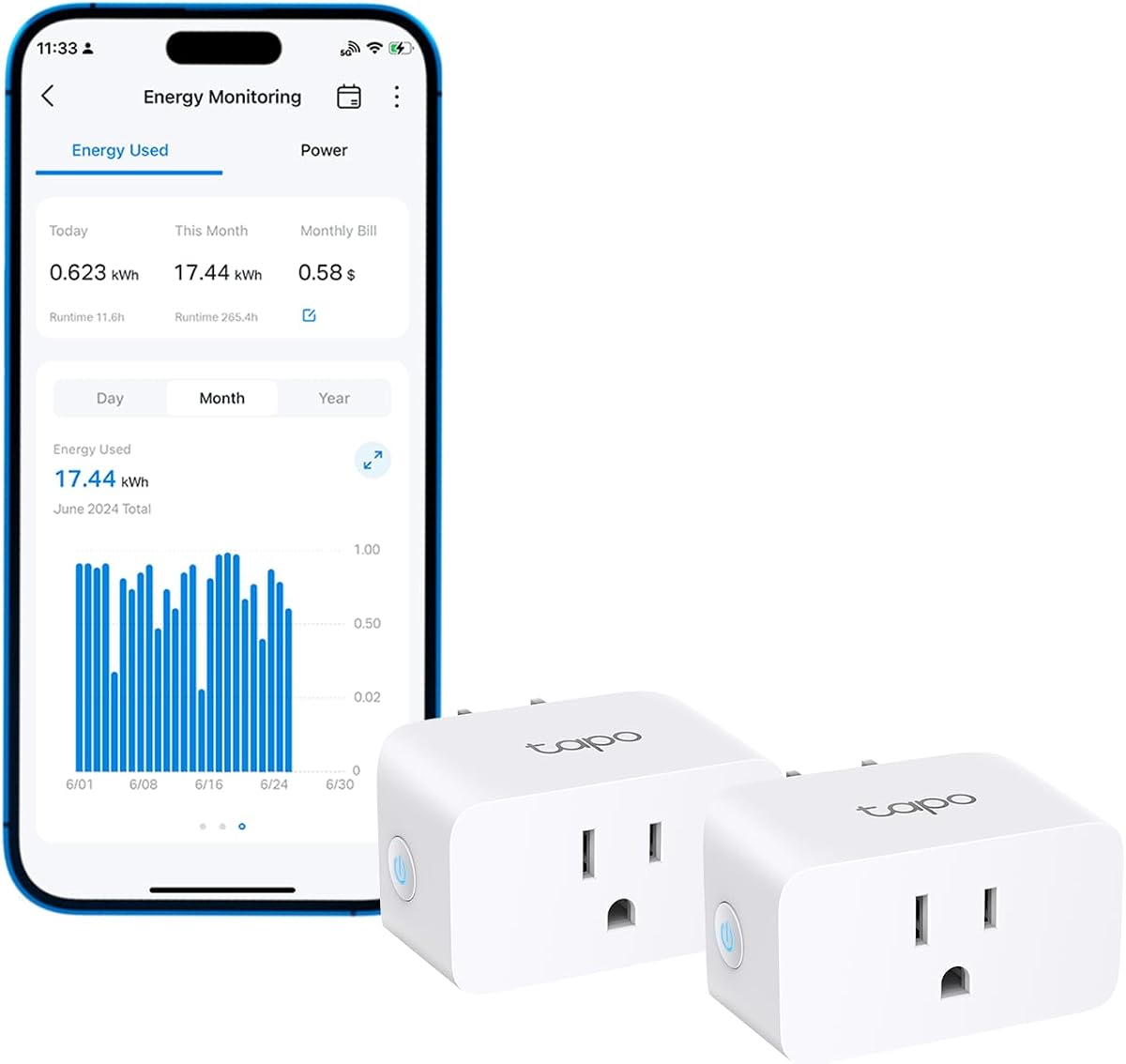
The Tapo P115 two-pack is rated 4.5 out of 5 and adds app-based energy tracking, scheduling, remote control, and voice-assistant support. It is a practical connected option for a PC setup when the goal is to review consumption over time, coordinate operation with off-peak electricity periods, or manage a device without remaining beside the outlet.
We may earn a commission when you buy through this link, at no additional cost to you.
The Tapo app provides statistics and intuitive charts that make historical use easier to interpret than a small local LCD. Programmable scheduling can place high-consumption devices in operation during periods associated with lower rates, while billing-system integration provides clearer cost visualization for single and periodic readings. Two plugs allow users to manage two separate loads or retain a spare for comparison.
The smart features extend beyond measurement. The plugs can cut power automatically when a connected device reaches a user-set low-battery limit and can shut off devices drawing excessive power. Built-in support for Alexa and Google Assistant enables voice commands for switching, settings, and supported functions. The trade-off is dependence on the Tapo app and network infrastructure for features that a local plug meter provides independently.
Choose the Tapo P115 for users who value convenience and automation more than a broad set of raw electrical parameters. It is especially useful for scheduling a gaming PC, server, or charger, and for viewing trends through charts rather than manual readings. The listed 15-ampere rating should still be checked against the intended device and outlet.
Programmable schedules make it possible to align PC or peripheral operation with preferred electricity periods. Combining schedules with cost visualization helps users connect an energy reading to a practical operating schedule rather than merely collecting numbers.
Automatic overload shutoff can protect a connected setup when power draw becomes excessive. Remote and voice control add convenience, allowing a user to turn off or inspect a connected device without physically returning to the outlet.
We may earn a commission when you buy through this link, at no additional cost to you.
The right monitor depends on whether you need an isolated outlet reading, app-based automation, or panel-level visibility. Consider electrical capacity, measurement detail, data continuity, privacy, installation, and the way you intend to use the readings.
A plug meter measures only the device connected to that outlet, which is ideal for a quick PC test or an A/B comparison between two systems. A panel-based system is broader because its current sensors can separate major circuits and reveal how a gaming room, office, or other area consumes energy. If your main goal is understanding one desktop, start with a plug; if the goal is household-wide allocation or solar awareness, consider a multi-sensor installation.
For a PC, match the scope to the question. A plug meter answers how much energy one connected setup uses, while a circuit monitor can reveal the influence of other equipment sharing the same branch.
Every monitor has defined voltage, current, and wattage limits. The included models range from a 125-volt, 15-amp HBN meter to broader 90–250-volt and up-to-3680-watt outlet meters, while panel systems support different arrangements and amperage ratings. Confirm that the PC, power supply, and intended outlet fall within those limits, and follow the manufacturer’s guidance for setting overload thresholds.
Capacity protects the monitor and makes its readings meaningful. Exceeding the supported range can produce warnings or inaccurate conclusions, even if the PC itself continues to operate normally.
Kilowatt-hours answer the basic question of how much energy was consumed. Active watts reveal instantaneous demand, while voltage, current, frequency, and power factor help diagnose the electrical behavior of a system. True RMS readings are particularly useful for modern electronics with switching power supplies. The P4400 focuses on total consumption, whereas the KETOTEK and SURAIELEC provide a more detailed set of electrical parameters.
Choose the simplest display that can answer your questions. Extra measurements add value during troubleshooting, but they are unnecessary if the goal is merely to compare monthly energy use.
Connected monitors can record history, display charts, issue alerts, and automate operation. Tapo provides app, schedule, voice, and automatic shutoff features, while the Meross and SEM-Meter systems target Home Assistant users. Local-only meters are easier to set up and can work without a cloud service. Think about whether remote visibility and automation justify account creation, network dependence, and a more involved setup.
Remote access is most valuable for always-on PCs, servers, and shared spaces. For a temporary measurement, a local display may be faster and simpler.
A reading is most useful when it can be compared with the next one. Some plug meters preserve cumulative data through outages or disconnection, while the SURAIELEC advertises up to 90 days of hold time. Panel systems can retain hourly records for set periods and retain or export broader summaries. Look for exportable data if you plan to build spreadsheets, compare PC configurations, or share household consumption reports.
Choose retention that matches the study. A weekend test needs little history, but seasonal efficiency work benefits from automatic logs and exportable records.
Plug meters require an available outlet and can limit access to a lower socket. Panel monitors offer more detail but require access to the breaker panel, placement of current sensors, pairing with a compatible electrical arrangement, and sometimes an app or network connection. The Emporia and Meross systems support several common US configurations, while some three-phase arrangements need additional sensors. SEM-Meter notes that busbar-only panels require compatible flexible sensors.
Verify panel type, phase, neutral, sensor range, and available space before ordering. A sophisticated device is only useful if it can be installed correctly in the intended environment.
Safety listings can provide reassurance about the monitor’s construction and operation. Emporia is described as UL and CE listed, Meross as ETL-certified and compliant with UL 61010 testing, while plug meters often include overload warnings. A warning is still not a substitute for properly rated breakers, surge protection, and sound electrical practice. The warnings should be treated as indicators to reduce or disconnect a load, not as permission to exceed a device’s limits.
Check certification, construction, and protective functions separately. A precise measurement is only helpful when the meter is operated within its intended electrical limits.
Energy data can reveal when a home is occupied and which appliances are active, so its storage and transmission model matters. Tapo uses an app and compatible connected services, whereas Meross emphasizes local data and no cloud lock-in. SEM-Meter offers a local MQTT mode and can run without the vendor’s cloud or app. Privacy-conscious users should confirm exactly where information is stored and which functions continue to work offline.
Local control generally provides more configuration depth but may demand greater technical involvement. Choose the balance that fits your privacy needs and smart-home experience.
Begin by deciding what you want to measure. For a focused PC experiment, connect the monitor directly to the computer or its intended power brick, let the system reach a stable state, and record the relevant values. For a broader study, identify the correct branch circuit and place each current sensor around the appropriate conductor according to the supplied instructions. Never assume a sensor position without matching the current direction and panel configuration.
Record controlled conditions whenever possible. Use the same PC components, power plan, peripherals, room conditions, and workload during each comparison, and allow several minutes for readings to stabilize. Reset cumulative data only when you intend to begin a new test, then save the result before disconnecting the meter. For app-based systems, configure cost rates and alerts with the actual information from the electricity provider or account.
Handle plug meters by the body rather than pulling them from the wall by the plug. Keep the display dry, avoid exceeding the voltage or current limits, and do not use a meter to justify operating a damaged appliance or unsafe outlet. Panel systems should be installed with the system unenergized according to the full manufacturer instructions, and any uncertain wiring task should be handled by a qualified electrician.
A plug-in watt meter can show the power and energy associated with the PC setup connected through it. Be aware that a gaming PC may draw power through more than one cable or use separate peripherals, so a single outlet meter may not capture the entire system. Measure each relevant connection or use a panel monitor to understand the circuit as a whole.
Choose a plug meter for a specific computer, monitor, server, or appliance when you want a quick or controlled measurement. Choose a whole-home system when you need circuit-level history, shared-home cost allocation, solar monitoring, alerts, or broader automation. Whole-home systems require panel access and more setup, while plug meters offer the simplest installation.
A smart monitor can be valuable when you want remote charts, schedules, alerts, or voice control, particularly for always-on equipment. A local plug meter is enough for occasional comparisons and may be easier to trust for isolated tests. The most useful choice depends on how much automation and historical access your routine requires.
Watts describe instantaneous electrical power, while kilowatt-hours measure energy consumed over time. A computer drawing 200 watts for one hour uses 0.2 kilowatt-hours, while the same computer drawing 200 watts for ten hours uses 2 kilowatt-hours. Short-term overload concerns and long-term energy planning therefore require different measurements.
Only when the meter’s voltage, current, wattage, and outlet specifications support the PC’s power supply and the connected load. Check the meter’s limits and the power brick label before use. Do not use a meter to support an outlet or extension that exceeds its rating, and never attempt to route mains power through an incompatible adapter.
Measure each computer under equivalent conditions, including the same peripherals, power plan, workload, and room environment. Wait for the readings to stabilize, compare both active watts and cumulative energy, and repeat the test because background activity can affect short samples. Record every configuration so the results remain interpretable.
Local plug meters generally display measurements and retain some data without internet access. Connected products such as Tapo need their app and network for remote features, while Meross emphasizes local Home Assistant use and SEM-Meter supports a local MQTT mode. Check the specific product’s requirements if offline operation is important.
No. An overload warning tells you that the connected load exceeds the meter’s configured threshold; it does not replace a properly rated breaker, surge protector, or safe wiring. The meter should remain within its own limits, and the PC should use a manufacturer-approved power supply and properly rated electrical connections.
The Emporia Vue 3 is the strongest all-around choice for readers who want real-time PC and household energy visibility across multiple circuits. The KETOTEK Watt Meter is the best budget option for focused testing because it combines a strong supplied rating, useful true RMS measurements, programmable alerts, and data retention in a simple plug.
The Meross Smart Home Energy Monitor is the most compelling premium system for local smart-home users, particularly those who value Home Assistant integration, private data handling, and long-term history. Prioritize measurement scope first, then confirm electrical compatibility, overload protection, retention, connectivity, and installation demands before choosing between a plug meter, panel system, or smart plug.
Current prices, availability, app behavior, and product configurations can change, so review the live listing and its instructions before buying. Also verify the monitor’s supported voltage, amperage, wattage, and connection type against your PC setup and electrical panel. With those checks completed, the right monitor can turn otherwise invisible electricity use into clear, actionable information.