
Crucial P310 500GB
4.7Editor score
Up to 6,600MB/s read speed
Broad modern device compatibility
Includes Acronis recovery software
Pcie SSD under 500 guide comparing ten NVMe drives for speed, capacity, compatibility, reliability, gaming, and everyday PC upgrades.
A Pcie SSD under 500 can transform the feel of an older laptop or desktop by adding faster boot times, quicker application launches, and more responsive file transfers. The best option depends on your computer, workload, storage capacity, and tolerance for different levels of NVMe performance.
This guide compares ten M.2 NVMe drives using the specifications and feature information supplied for each model. It covers PCIe generations, stated read and write speeds, capacity, form factor, intended use, software, warranty coverage, and compatibility considerations without relying on hands-on testing.
Each review explains who the drive is best suited for, while the top selections highlight strong options for general use, budget-conscious upgrades, and performance-focused buyers. Product availability and prices change, so compare the current listing and your computer's requirements before making a final purchase.
4.7Editor score

4.8Editor score

4.7Editor score
The table below compares all ten drives by interface, capacity, headline performance, and primary use. It makes it easier to separate PCIe 3.0 options, mainstream PCIe 4.0 drives, specialized gaming models, and NAS-oriented storage.


The Sandisk Optimus 5100 500GB is a PCIe 4.0 M.2 2280 NVMe drive positioned for creators, professionals, and users who want a modern performance upgrade. Its supplied 4.7 rating reflects strong customer reception, while the headline specifications emphasize fast project access, efficient operation, and expandable storage options across the broader product family.
We may earn a commission when you buy through this link, at no additional cost to you.
Its most appealing feature is the clear focus on creator workloads. Sandisk lists read speeds up to 7,100MB/s on the 1TB and 2TB models and write speeds up to 6,700MB/s on the 1TB through 4TB versions, so buyers should not automatically apply the highest family-level figures to the 500GB capacity. The stated use cases include 4K video, high-resolution images, application launches, and power-conscious mobile work.
The drive also includes useful supporting features. Sandisk Dashboard can be downloaded to monitor performance and check for updates, while the 500GB model belongs to a range that extends to 4TB. Endurance is described in terms of a maximum 1,200 TBW rating for the 4TB model, a figure that again belongs to the range rather than being a 500GB-specific claim.
This is a compelling choice for a desktop creator or a user moving from a SATA or slower PCIe 3.0 drive. The main limitation is capacity: half a terabyte can become restrictive when storing large source footage, project files, games, and applications together. For such a buyer, the combination of PCIe 4.0 capability, power efficiency, and drive-management software makes the Optimus 5100 a particularly complete option.
The supplied specifications specifically target fast application launches and room for 4K videos and high-resolution images. That makes this drive a better fit for active creative projects than a basic drive intended only for documents and web browsing.
An all-new power-efficient design supports mobile productivity, and Sandisk Dashboard provides a way to check updates and monitor the drive. These details are particularly useful for laptop users who care about both responsiveness and battery-conscious operation.
We may earn a commission when you buy through this link, at no additional cost to you.
The Kingston NV3 500GB combines a widely understood M.2 2280 design with a PCIe 4.0 Gen 4×4 interface and stated speeds of up to 5,000MB/s read and 3,000MB/s write. Its 4.7 rating places it among the stronger-reviewed options in this guide, and the included cloning software makes it a practical choice for moving data from an existing system.
We may earn a commission when you buy through this link, at no additional cost to you.
Rather than specializing in one narrow use case, the NV3 is positioned as high-speed, low-power storage for everyday PCs. The Gen 4×4 interface offers substantially more theoretical bandwidth than PCIe 3.0, while the five-year limited warranty provides useful coverage. Acronis cloning software can simplify a conventional drive-to-drive upgrade, reducing one common source of installation friction.
There are trade-offs to consider. Its stated write speed is lower than the speeds advertised by several other PCIe 4.0 drives in the list, including the Sandisk Optimus 5100, Fikwot FX910, and WD Black SN7100. In addition, 500GB is a moderate capacity for modern game libraries, and large creative files can consume it quickly.
The Kingston NV3 500GB is best for a general-purpose desktop or laptop refresh, especially for a buyer who wants a clear generation upgrade without a specialized heatsink or workload-oriented design. It is a sensible all-rounder for operating systems, applications, documents, and a moderate collection of games, provided its rated performance fits the budget and the capacity is sufficient.
With up to 5,000MB/s read speed and a PCIe 4.0 Gen 4×4 connection, the NV3 offers a clear technical step forward for systems that previously rely on SATA or PCIe 3.0 storage. It remains one of the more straightforward choices for everyday productivity.
Acronis cloning software is included according to the supplied product information. It can help users transfer an existing installation to the NV3, making the drive appealing for straightforward PC and laptop upgrades.
We may earn a commission when you buy through this link, at no additional cost to you.
The Crucial P310 500GB stands out for its combination of strong stated performance and unusually broad compatibility. It supports PCIe Gen4 NVMe, is designed for laptops, desktops, and select handheld gaming consoles, and can also operate in PCIe Gen3 systems. Its 4.7 rating reflects a favorable customer response.
We may earn a commission when you buy through this link, at no additional cost to you.
Crucial lists up to 6,600MB/s read and 5,000MB/s write performance, with improved results for game loading, system startup, and multitasking. The stated productivity benefits include faster Windows boots and quicker launches for programs such as Adobe Photoshop, Adobe Illustrator, Microsoft Excel, and Microsoft PowerPoint. Advanced G8 NAND and thermal control are also highlighted as reliability features.
Compatibility deserves close attention. The drive is listed for systems such as the ROG Ally X, Lenovo Legion Go, and AYANEO Kun, but that does not mean every console or handheld has a compatible enclosure, connector, firmware arrangement, or available M.2 slot. Backward compatibility with PCIe Gen3 systems is useful because it allows the same drive to serve older and newer platforms.
The P310 is an excellent general recommendation for someone who wants a fast drive without committing to a model designed around a narrow specialist use. It is particularly attractive for a desktop or laptop upgrade, while console owners should verify the exact hardware requirements. Acronis Data Recovery Software adds value for users who want a recovery option in addition to everyday performance.
The listed improvements over PCIe Gen3 storage are most relevant to tasks involving repeated file access, application loading, and multitasking. The P310's stated speeds give it ample headroom for a modern productivity PC.
Backward PCIe Gen3 compatibility makes the drive easier to reuse across systems, while support for selected handhelds extends its appeal. Buyers should still confirm slot format, physical clearance, and device-specific requirements.
We may earn a commission when you buy through this link, at no additional cost to you.
The Fikwot FX910 500GB is the most speed-focused entry in the list, with supplied specifications claiming up to 7,300MB/s read and 6,200MB/s write through a PCIe 4.0 Gen 4×4 interface. Its 4.7 rating indicates a strong response from buyers, and the integrated heatsink gives it a distinct identity within the category.
We may earn a commission when you buy through this link, at no additional cost to you.
Cooling is central to the product's proposition. The description says the drive can intelligently adjust power consumption and heating behavior during work, while also referencing high-conductivity graphite heatsink design in the broader product family. For sustained gaming, file transfers, and other demanding activity, a visible thermal solution can be reassuring in a compact desktop or console enclosure.
Gaming features include PS5 compatibility, DirectStorage support, HMB, and an intelligent SLC cache. The drive also supports TRIM, S.M.A.R.T., and AES-256 encryption according to the supplied information. Fikwot includes five years of after-sales service and round-the-clock customer support, adding some reassurance for buyers who may be less familiar with the brand.
The main issue is fit. A heatsink-equipped M.2 2280 drive needs enough clearance in the case, laptop, or console, and some systems provide a restricted installation area. Buyers should also ensure that their platform can exploit PCIe 4.0 performance. When clearance and device compatibility align, the FX910 is a compelling high-speed choice for gaming-focused systems.
The included heatsink and stated power-control behavior distinguish the FX910 from bare-drive alternatives. Thermal management can be especially relevant in a console, compact laptop, or desktop with limited airflow.
PS5 compatibility, DirectStorage support, HMB, and SLC caching target game storage needs. These features make the drive most relevant to gamers who have confirmed the physical and technical requirements of their console.
We may earn a commission when you buy through this link, at no additional cost to you.
The WD Green SN350 500GB is a straightforward NVMe upgrade for computers that support PCIe 3.0 but could benefit from replacing a hard drive or SATA SSD. It has a 4.7 rating and uses the familiar M.2 2280 form factor, making it relevant to a broad range of compatible desktop and laptop upgrades.
We may earn a commission when you buy through this link, at no additional cost to you.
Its listed read speed reaches up to 2,400MB/s in the product title, while the accompanying feature text references up to 3,200MB/s based on internal testing. Real results can vary with capacity, host device, workload, and usage conditions, so buyers should focus on the major benefit: a much faster storage interface than a conventional hard drive for everyday computing.
The drive is also described as shock resistant against accidental bumps and drops, which is a natural advantage of a solid-state design. Western Digital SSD Dashboard can be downloaded to monitor health and usage, and the product includes a three-year limited warranty. These support features make it a low-friction choice for a first SSD upgrade.
The SN350 is not the fastest choice in this comparison because it uses PCIe Gen3 rather than Gen4. However, interface generation alone does not determine real-world value. If the computer only supports Gen3, choosing a Gen4 drive may not deliver its full potential. The SN350 makes the most sense when affordability, familiarity, and straightforward compatibility matter more than headline performance.
Many older but still serviceable laptops and desktops support PCIe 3.0 rather than newer generations. In those machines, a faster compatible NVMe drive can still deliver a major improvement over a hard drive or SATA storage.
Western Digital SSD Dashboard helps users monitor drive health and usage, while a three-year limited warranty adds defined coverage. The software is a useful addition for buyers who want visibility into drive condition.
We may earn a commission when you buy through this link, at no additional cost to you.
The WD Blue SN5100 500GB carries a 4.8 rating, the highest numerical rating among the products supplied for this guide. It combines a PCIe 4.0 interface, M.2 2280 format, and read speeds up to 6,600MB/s, making it a strong candidate for modern PC and laptop upgrades.
We may earn a commission when you buy through this link, at no additional cost to you.
The product information is especially useful for workflows that involve AI-enabled projects, large files, and demanding applications. It is also designed to support capacity options across the family and is backed by a five-year limited warranty. Acronis True Image for Sandisk can be downloaded to assist with migrating files to the new drive.
A notable buying consideration appears directly in the supplied description: this product has been replaced by the latest generation, and the listing directs shoppers to search for the Sandisk Optimus 5100 NVMe SSD. That information may be important if you want the newest model in the product family or prefer the successor named by the manufacturer.
The SN5100 remains attractive for its strong rating, 6,600MB/s stated read speed, and simple upgrade proposition. It suits users upgrading a compatible PC or laptop and wanting modern NVMe performance without a specialized gaming heatsink. Check the current listing carefully because the replacement notice means availability may be limited and the successor may be the more logical purchase.
Up to 6,600MB/s read speed gives the drive ample potential for quick system startup, application access, and large-file operations on compatible PCIe 4.0 platforms. Its specification places it close to the fastest drives in this comparison.
The supplied listing states that this model has been replaced by a newer generation. Prospective buyers should read the current product page carefully and decide whether the successor offers a better overall fit.
We may earn a commission when you buy through this link, at no additional cost to you.
The WD Black SN7100 500GB is a high-performance PCIe Gen4 drive aimed particularly at serious gaming users, including people who play on laptops and handheld devices. It has a 4.8 rating, an M.2 2280 form factor, and supplied performance figures of up to 6,800MB/s read for the 500GB listing.
We may earn a commission when you buy through this link, at no additional cost to you.
The broader product family is described as reaching up to 7,250MB/s read and 6,900MB/s write on 1TB and 2TB models. It uses next-generation TLC 3D NAND and emphasizes efficient operation, with the product information claiming up to 100% greater power efficiency over the prior generation. Those claims position the SN7100 as a drive for fast, mobile-oriented gaming rather than a simple office upgrade.
WD_BLACK Dashboard is available for Windows users who want to keep the drive optimized and check its condition. The manufacturer also identifies the product as part of the flash portfolio manufactured by Sandisk Technologies or its affiliates and distributed under license from Western Digital Corporation, which provides useful brand and manufacturing context.
The supplied listing states that this model has been replaced by the latest generation and points buyers toward the Sandisk Optimus GX 7100 NVMe SSD. That status should be checked before purchasing. Even so, the SN7100's performance focus, power-efficiency emphasis, and strong rating make it an attractive option for a compatible gaming laptop or handheld, assuming a suitable M.2 slot is available.
The drive is explicitly designed with laptops and handheld gaming devices in mind. Its PCIe Gen4 interface and strong stated speeds suit systems that can take advantage of NVMe storage for game loading and application access.
The claimed improvement in power efficiency is meaningful for portable systems, while WD_BLACK Dashboard gives Windows users a way to manage the drive. Users should confirm that the utility and game platform support match their setup.
We may earn a commission when you buy through this link, at no additional cost to you.
The Kingston NV3 1TB is the capacity-focused alternative to the 500GB version. It retains a PCIe 4.0 Gen 4×4 interface and the same general strengths—high-speed, low-power storage and a five-year limited warranty—but offers twice the listed capacity and a higher stated maximum read speed of 6,000MB/s.
We may earn a commission when you buy through this link, at no additional cost to you.
Write performance is listed at up to 4,000MB/s, and Acronis cloning software is included for users who want to migrate an existing system. The combination of one terabyte and modern NVMe performance is particularly useful for buyers who want room for a large operating-system installation, creative files, applications, and games without managing constant storage pressure.
Capacity can affect practical usability more than raw speed once a drive is properly configured. A 1TB model gives users more breathing room for temporary files, game updates, media libraries, and project assets. The NV3 1TB therefore suits users who understand the value of storage headroom and want a drive that can grow with a larger collection of files.
This is not the dedicated choice for a NAS, and buyers should not confuse general-purpose NVMe use with specialized network-storage workloads. It is, however, a compelling desktop and laptop option for someone who wants more room than a 500GB drive without stepping outside the mainstream Kingston NV3 family. Its 4.7 rating and balanced specifications make it an easy recommendation.
One terabyte provides a meaningful increase over 500GB for large games, media, and project files. It reduces the need to delete or move content simply to keep the system from running out of space.
The 1TB version shares the NV3 family's PCIe 4.0 Gen 4×4 design, cloning software, low-power emphasis, and five-year warranty. It is the roomier choice for buyers who prefer the same general platform.
We may earn a commission when you buy through this link, at no additional cost to you.
The WD Red SN700 500GB is built for a different environment from most of the drives in this guide: network-attached storage. Its PCIe 3.0 M.2 2280 interface and stated read speed of up to 3,430MB/s support the emphasis on responsive I/O, while the product's 4.5 rating remains solid within the comparison.
We may earn a commission when you buy through this link, at no additional cost to you.
The supplied information highlights NAS workloads, virtualization, collaborative editing, and multitasking with multiple users. It also emphasizes exceptional reliability and endurance as core benefits, with the broader product family available in capacities up to 4TB. Those characteristics matter when a drive will contribute to a storage pool, handle constant activity, or serve several users over a network.
The key rule is to use the right drive for the job. A NAS-specific product can be a better fit than a general desktop SSD when the system is intended for continuous storage service, but the NAS itself must support the physical format, interface, and capacity. Buyers should check bay requirements, adapter needs, firmware compatibility, and the manufacturer's current NAS support list.
For a standard desktop or laptop, a mainstream PCIe 4.0 drive may offer a more appropriate combination of interface and features. Inside a compatible NAS, however, the SN700's specialized design makes it a more relevant recommendation than simply selecting the fastest general-purpose model. Its focus on endurance and workload resilience is the reason to choose it.
The WD Red designation and supplied NAS focus distinguish this drive from the general-purpose models in the list. It is intended for environments where consistent I/O, endurance, and reliability are more important than flashy benchmark results.
Virtualization, collaborative editing, and multi-user multitasking are specifically mentioned. These use cases can place sustained demand on a storage device, making workload-focused features and endurance claims more relevant.
We may earn a commission when you buy through this link, at no additional cost to you.
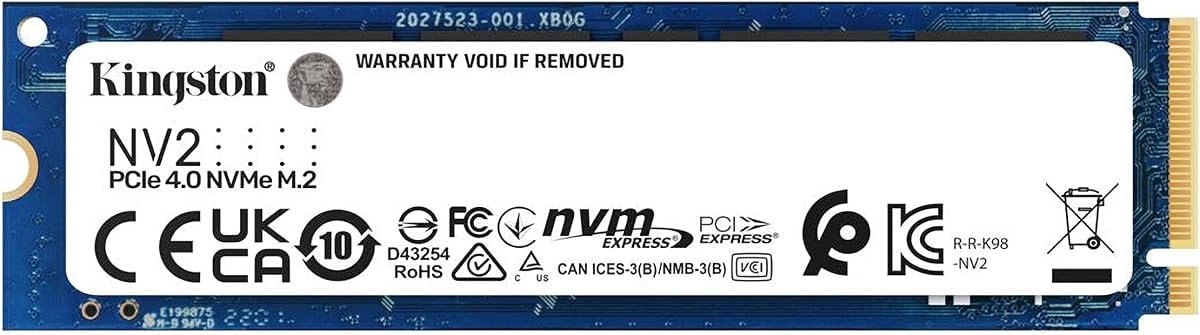
The Kingston NV2 500GB is a PCIe 4.0 Gen 4×4 drive aimed at laptops and small-form-factor PCs. Its 4.7 rating is strong, and the supplied description emphasizes low power requirements and minimal heat, making it a sensible choice when energy efficiency and compact-system fit matter alongside everyday speed.
We may earn a commission when you buy through this link, at no additional cost to you.
Stated read performance reaches up to 3,500MB/s. Although other PCIe 4.0 drives in this guide list higher maximum speeds, the NV2's defining appeal is its more restrained design emphasis. It offers modern NVMe connectivity in the common M.2 2280 format and is intended to fit systems where efficient operation and manageable thermals are useful.
The range is available in capacities up to 2TB, although this particular selection is 500GB. That distinction is important for shoppers comparing model numbers: a product family can span several capacities and performance levels. The supplied details for this exact listing should be treated as the basis for its stated read-speed claim and form-factor compatibility.
The NV2 500GB is most appropriate for a compact laptop, small desktop, or other system where lower power draw and minimal heat are priorities. A buyer seeking maximum sequential throughput can find stronger figures elsewhere in this guide, but a headline number does not guarantee a better experience on a system with a slower interface or limited thermal headroom. Verify slot support and clearance before ordering.
Lower power requirements and minimal heat are central to the NV2's positioning. These attributes can be valuable in laptops and small-form-factor PCs where component space and cooling options are limited.
The PCIe 4.0 Gen 4×4 connection provides a modern upgrade path, while up to 3,500MB/s read speed is sufficient for responsive everyday computing. Check the host system because older platforms may limit the benefit.
We may earn a commission when you buy through this link, at no additional cost to you.
A useful SSD choice balances interface generation, usable capacity, physical fit, sustained workload needs, and the features of the host device. Start with your computer's supported slot and operating requirements, then narrow the field by performance and capacity rather than comparing headline read speeds alone.
PCIe SSD and NVMe are related but not interchangeable from an installation perspective. The drive must physically fit an M.2 slot, and that slot must support NVMe rather than only SATA or a different M.2 protocol. Check the computer manual, service guide, or manufacturer specifications before purchasing. A desktop with an M.2 connector may still use SATA signaling, while some laptops may combine an M.2 slot for storage with a separate slot for wireless networking.
Confirm the 2280 dimensions as well. Every drive in this list uses the M.2 2280 form factor, but physical length does not guarantee that the drive will fit inside a laptop or compact enclosure. Some chassis also have a heatsink shroud, a support bracket, or a connector positioned close to the edge.
PCIe 4.0 drives can deliver substantially higher theoretical bandwidth than PCIe 3.0 models, but the host system must support that generation for the difference to be accessible. The Crucial P310 and several other models are backward compatible with PCIe Gen3 systems, which can make them flexible choices when hardware support is uncertain. Even with backward compatibility, available bandwidth and thermal conditions can affect the final result.
Do not pay for a generation you cannot use, but do not dismiss Gen3 without considering the comparison. For a Gen3-only laptop, the WD Green SN350 or WD Red SN700 may be more appropriate than a faster Gen4 drive. For a modern desktop, Gen4 models provide a larger performance ceiling and are generally the stronger starting point.
Read speed describes how quickly a drive can retrieve data, while write speed covers saving new data. Large file copies, application loading, and booting can benefit from fast reads, whereas creating files, importing media, and saving game data place importance on writes. The products here list maximum sequential figures, not guaranteed results in every application or workload.
Sustained performance also depends on factors beyond the headline number, including cache behavior, thermals, workload length, host hardware, and capacity. A short benchmark may look different from moving a large project folder. Use the advertised figures to establish relative performance classes, then consider thermal design and intended use.
A 500GB drive can feel roomy for a light user but restrictive for modern games, high-resolution media, and development environments. The operating system, applications, updates, temporary files, and personal content all consume space. Leaving additional headroom can help maintain responsiveness and makes future growth easier. The 1TB Kingston NV3 addresses this concern for buyers who need more room.
Capacity can also influence how a drive is marketed and configured. As with the Sandisk Optimus 5100, family-wide speed and endurance figures may refer to larger capacities rather than the 500GB model. Compare the exact capacity listing instead of assuming every specification applies equally across the range.
M.2 SSDs are small, but they can still generate meaningful heat under sustained workloads. The Fikwot FX910 includes a heatsink and highlights intelligent power and temperature control. For a desktop with airflow, a bare drive may be sufficient; for a compact laptop, console, or enclosed case, thermal design deserves closer attention. Higher performance and sustained loading make thermal management increasingly important.
Before buying a heatsink-equipped model, measure the available height and check for a motherboard heatsink or device cover. Some laptop bays allow only low-profile or bare drives. Conversely, a drive with a heatsink can be useful where sustained gaming or transfers are expected and clearance permits.
General desktop use, gaming, content creation, and NAS operation place different demands on a drive. The Crucial P310 emphasizes broad device compatibility, the WD Black SN7100 targets portable gaming, the Sandisk Optimus 5100 emphasizes creator workflows, and the WD Red SN700 is designed for NAS devices. Selecting by workload makes the feature set more relevant.
Software support is another use-case consideration. Acronis cloning is listed with both Kingston NV3 capacities, Acronis recovery is included with the Crucial P310, and WD_BLACK Dashboard supports drive management on Windows. These utilities can simplify migration or monitoring, although users should confirm the software's system requirements and current availability.
Warranty length can be a useful differentiator when every other factor is close. The Kingston NV3, WD Blue SN5100, and WD Black SN7100 are described with five-year limited warranties, while the Fikwot FX910 includes five years of after-sales service. The WD Green SN350 carries a three-year limited warranty, and the supplied WD Red information focuses on reliability and endurance without giving a comparable period in the provided text.
A warranty does not replace sensible data management. Keep important files backed up separately, avoid treating an SSD as the only copy of irreplaceable data, and use the available monitoring utilities to review drive health. The longer coverage is reassuring, but responsible backup habits remain more important than the warranty length alone.
Two listings in the supplied data identify their products as replaced by newer generations. The WD Blue SN5100 listing points buyers toward the Sandisk Optimus 5100, while the WD Black SN7100 points toward the Sandisk Optimus GX 7100. Replacement notices do not automatically make a drive unusable, but they can affect availability, support, and whether a successor better fits the buyer.
Review the current product page and compare the exact model number with the intended computer requirements. Avoid buying solely from a broad series name because capacity, speed, warranty, NAND type, and thermal configuration may differ. The product title and model number should be checked against the listing to ensure the purchase matches the features discussed in this guide.
Begin by backing up important data and confirming that the computer supports an M.2 2280 NVMe drive in the intended slot. If you are cloning an existing installation, install the supplied cloning software before changing drives, follow its instructions carefully, and verify that the cloned system boots correctly before retiring the original storage. Keep the original drive intact until important files and applications have been checked.
Install the new drive according to the computer manufacturer's procedure, secure it with the appropriate screw or retention clip, and replace any chassis panel or heatsink cover. For a bare M.2 drive, attaching a thermal pad or compatible heatsink can help dissipate heat when the manufacturer permits it. Do not force a connector, and do not tighten a retaining screw so aggressively that the drive bends.
After installation, boot the system and confirm that the new capacity appears in the operating system. Use the supplied or manufacturer-provided utility to check drive health, install firmware updates when offered, and review any migration or cloning software. Keep the operating system and applications updated, avoid abruptly removing the drive while it is in use, and maintain a separate backup of data that cannot be replaced.
No. M.2 describes the physical shape, while NVMe describes the communication protocol, and your computer must support both along with the drive's length and size. Some M.2 slots support SATA rather than PCIe NVMe, and some laptops have limited clearance or require a particular drive height. Check the system manual or manufacturer support page before ordering.
Often, yes, provided the slot supports NVMe and the physical dimensions fit. Several PCIe 4.0 drives are backward compatible with Gen3 systems, although they will operate within the older system's bandwidth limit. The Crucial P310 explicitly lists backward compatibility with PCIe Gen3 systems, while other models should be checked against their individual specifications.
It can be sufficient for a modest collection of games, but modern titles and updates can consume space quickly. You also need room for the operating system, applications, and temporary files. A 1TB drive such as the Kingston NV3 offers more headroom, while the 500GB models remain useful for systems with a lighter or more selective game library.
No. Advertised speeds are maximum sequential figures measured under particular conditions. Actual results vary with the host system, PCIe generation, workload, file size, cache state, thermals, and drive capacity. Sustained transfers may also differ from short bursts, so use the published number to compare product classes rather than predict a guaranteed transfer rate.
It depends on the drive, the workload, and the computer's cooling. A desktop with airflow and light use may handle a bare drive comfortably, while compact systems and sustained gaming or file transfers benefit from thermal management. The Fikwot FX910 includes a heatsink, but buyers should verify clearance before selecting any physically taller design.
Only if the device supports the drive's physical format, protocol, capacity, and cooling arrangement. The Crucial P310 lists selected handheld compatibility, and the Fikwot FX910 is described for PS5 use, but those statements do not guarantee universal support. Check the console or handheld manufacturer's requirements and any firmware or enclosure restrictions.
Not usually. Its supplied features focus on NAS workloads, including virtualization, collaborative editing, and multi-user activity, so it is most relevant inside a compatible network-storage system. For an ordinary desktop or laptop, one of the mainstream PCIe 4.0 models is likely a more natural fit. NAS support requirements should always be checked before installation.
Read the current listing and compare the stated successor with the model you were considering. A replacement can offer a newer generation, revised performance, different warranty terms, or a different recommended use. The supplied WD Blue SN5100 and WD Black SN7100 listings both include replacement notices, so buyers should confirm current stock and select the model that best matches their system.
The strongest general choice in this comparison is the Crucial P310 500GB, which pairs up to 6,600MB/s stated read speed with broad support for desktops, laptops, and selected handheld gaming systems. The Kingston NV3 500GB is a balanced budget-oriented choice, while the Sandisk Optimus 5100 stands out for creator workflows, power efficiency, and higher family-level PCIe 4.0 performance.
Prioritize compatibility and capacity before chasing the largest headline speed. Confirm the M.2 slot, NVMe support, physical dimensions, thermal clearance, and intended workload. The WD Black SN7100 is tailored to portable gaming, the WD Red SN700 to NAS use, and the WD Green SN350 to systems that operate on PCIe 3.0. A less specialized model may be the more satisfying choice for everyday computing.
Finally, check current product availability, model status, warranty details, and prices before ordering. The market changes, and the supplied listings include replacement notices for two WD models. Compare the exact capacity and model number rather than relying on the product family name, and keep a separate backup of any data that cannot be replaced.