
LED Light Parking Stop Sign, Smart Parking LED Garage Flashing Warning Stop Sign
4.3Editor score
Flashing red LED warning
Adjustable pole height
Portable four-section design
Stable weighted chassis
Garage stop lights help drivers judge distance, align a vehicle, and stop before a wall, shelf, or parked car. The most useful models combine an easy-to-read warning display with adjustable detection, flexible power options, and a mounting method suited to the available space. A physical stop sign, an ultrasonic sensor, or a combination of both can make parking more predictable.
We compared the ten products in this guide using their stated detection ranges, LED alert systems, calibration controls, installation requirements, power sources, adjustability, and overall user ratings. The list includes both sensor-based parking aids and pole-mounted flashing stop signs, so readers can compare distinct approaches rather than similar products with slightly different names.
Each review explains how the product works, who benefits most from its design, and where its limitations may matter. The top picks represent three practical priorities: a feature-rich sensor, a well-priced flashing sign, and a premium pole system. Product availability and pricing can change, so confirm the current listing and specifications before purchasing.
4.3Editor score

5.0Editor score
4.2Editor score
As an Amazon Associate we earn from qualifying purchases.
This side-by-side overview compares sensor-based parking aids with portable pole-mounted stop signs, focusing on alert style, detection or stopping method, power, and installation flexibility.




The Armor All Advanced Garage Parking Aid combines a wall-mounted sensor, a color-changing LED display, and audible proximity alerts. Its 3.5 rating is lower than most alternatives in this guide, but the feature set remains relatively comprehensive for drivers who want both visual and sound-based guidance before reaching a preset stopping point.
We may earn a commission when you buy through this link, at no additional cost to you.
The green, yellow, and red lights communicate increasing proximity, while the beeping frequency changes as the vehicle approaches the configured distance. Users can select a stop point from 1.5 to 5 feet, making the system useful for many compact and standard garage layouts. A 5.6-foot sensor cable connects the display to the sensing unit, providing some flexibility in placement.
The main compromise is the 9-volt battery backup, which is not included. The unit also uses a standard AC adapter and a 5-foot power cable, so an outlet must be within reach unless the user opts for backup power. Its supplied rating suggests that some buyers may have encountered installation, performance, or power-related concerns, although the provided data does not identify a specific cause.
This is a sensible option for users who prioritize audible alerts, a broad adjustment range, and outage protection. It is less ideal for anyone seeking a simple, battery-only unit or a highly compact display. Within the category, its combination of visual cues, sound, and backup capability gives it a practical advantage despite the moderate rating.
The system provides immediate visual feedback through green, yellow, and red indicators while audio beeps accelerate near the selected stop distance. Combining both signals is useful for drivers who may not always see the display clearly while reversing.
The adjustable 1.5-to-5-foot range accommodates different vehicle sizes and garage depths. Positioning the sensor and display carefully remains essential because the connected cable limits how far the two components can be placed apart.
We may earn a commission when you buy through this link, at no additional cost to you.
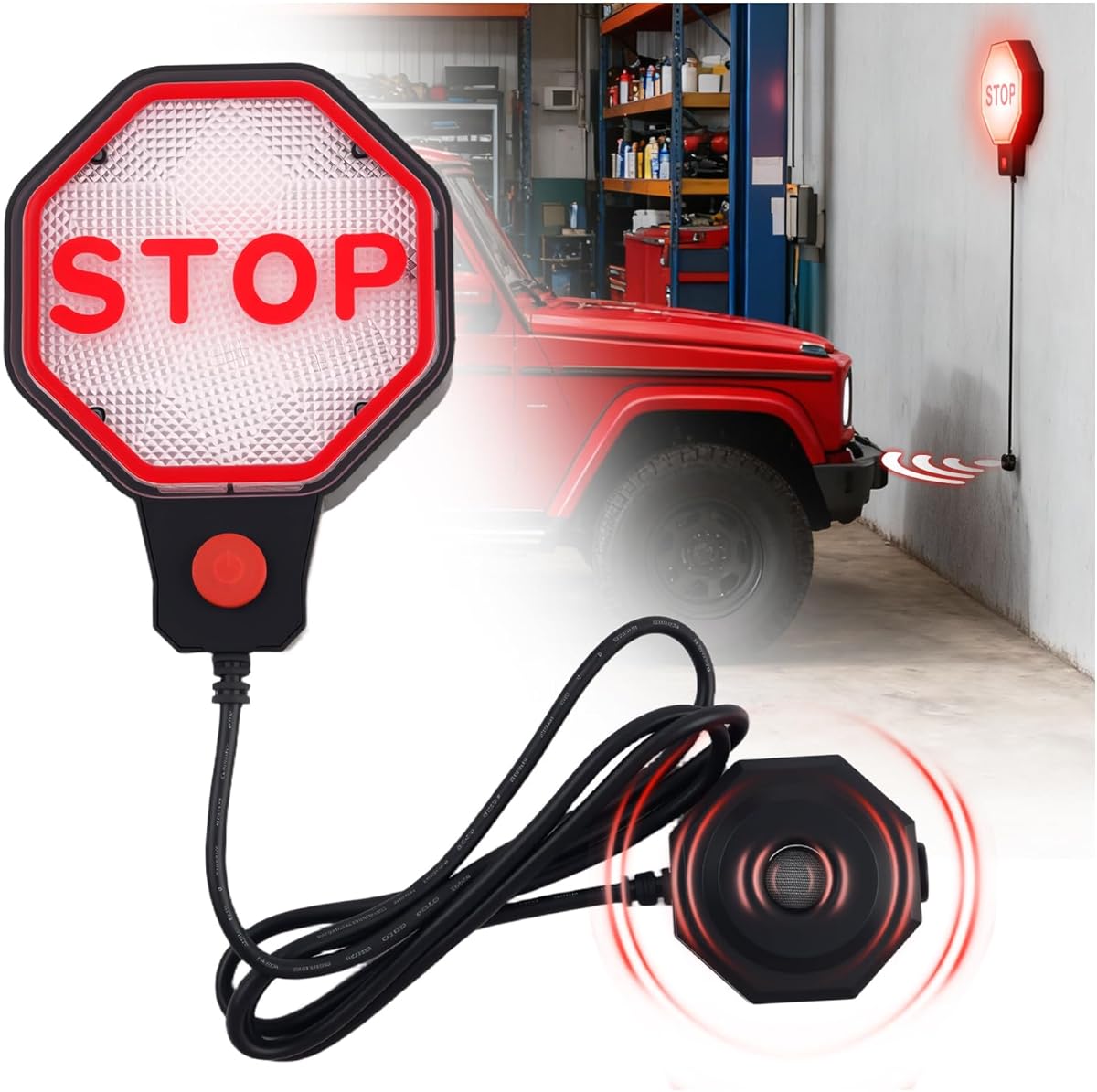
The STKR Garage Parking Sensor is a straightforward ultrasonic parking aid designed for wall mounting. It earns a 4.0 rating and offers the familiar green, yellow, and red color sequence, with a one-touch control for setting the desired stopping distance. The listed range extends from 6 inches to 6 feet, giving drivers considerable room to customize the warning zone.
We may earn a commission when you buy through this link, at no additional cost to you.
Installation is one of its strongest practical features. The unit can be attached with adhesive tape or Velcro, avoiding the need to drill into a wall. It also supports two power arrangements: four AA batteries or an optional USB connection. That flexibility makes it suitable for households with a nearby outlet as well as garages where the owner wants to avoid a permanently connected cable.
The trade-off is that neither the USB cable nor its charger is included. Buyers who prefer USB power must provide that accessory or use batteries instead. A wall-mounted sensor also needs an unobstructed detection path and careful alignment, so placement can influence how consistently the colors change as the vehicle approaches.
The STKR is a good fit for drivers who want straightforward color guidance, broad calibration, and tool-free setup. It may appeal particularly to renters or anyone who does not want permanent holes. The included one-year warranty also adds reassurance, though the need to source optional USB accessories should be considered before checkout.
After positioning the vehicle where it should finish, the user can set the preferred distance with a single button. The process is approachable and makes it easier to maintain a consistent parking position over time.
Adhesive tape or Velcro allows the sensor to be installed without tools or drilling. This is especially useful for temporary setups, rented spaces, or garages where permanent wall modifications are undesirable.
We may earn a commission when you buy through this link, at no additional cost to you.
The LED Stop Sign Parking Assistant offers a direct alternative to distance sensors: the driver stops when the vehicle's bumper contacts the pole and the internal LED begins flashing. It has a 4.3 rating, making it one of the stronger-rated products in the list, and its large flashing signal is especially noticeable in dim garages.
We may earn a commission when you buy through this link, at no additional cost to you.
The package includes two portable weighted bases that can be fixed together, a flexible rod, and the flashing LED unit. Its height can be adjusted to as much as 53 inches, accommodating different vehicle sizes. The sectional construction also allows the system to be disassembled for storage or moved between a garage, driveway, or another parking area.
Its core limitation is inherent in the design. It cannot warn a driver before contact, so the first signal arrives only after the bumper reaches the pole. The weighted bases also occupy floor space where a person may walk or maneuver, although that placement is what allows the sign to move with the vehicle and flash on contact.
Choose this model for a simple visual stop cue, especially in a dark garage or shared parking area. It works best for drivers who want a tangible stopping point rather than a predictive distance display. Its portability and strong stated rating make it a compelling option, but it does not replace a sensor for gradual, before-contact guidance.
The internal LED flashes when the vehicle reaches the pole, providing an immediate and highly visible cue. This makes the sign useful in low-light conditions where judging a physical stop position may be difficult.
Four connected sections and detachable weighted bases make the unit simple to assemble, disassemble, and relocate. The system can therefore serve temporary parking tasks without requiring a permanent wall-mounted installation.
We may earn a commission when you buy through this link, at no additional cost to you.
The Andalus Flashing LED Stop Sign uses bumper contact to activate a bright red warning. It carries a 4.1 rating and focuses on a clear, physical stopping point rather than continuous ultrasonic distance readings. The flexible LED rod rises from a weighted base and can be adjusted to a height of up to 53 inches.
We may earn a commission when you buy through this link, at no additional cost to you.
Its four-section design supports setup in different locations, while the weighted base helps keep the unit in position. The product includes two AG13 button-cell batteries, so the essential power supply is present in the package. This is convenient compared with sensor systems that may require batteries to be purchased separately.
Like other contact-activated signs, the warning only appears after the bumper reaches the pole. That means the system does not help a driver anticipate the correct stopping distance or avoid a first contact. The base must also be placed where it will not obstruct foot traffic, and repeated contact may cause the unit to move or lean even with its weighted construction.
The Andalus model is a practical choice for a user who wants a simple, portable sign with a visible contact warning and batteries in the box. It is less suitable for someone who needs gradual distance feedback before touching the vehicle. Adjustability and a user-friendly setup make it more versatile than a fixed, one-size stop marker.
Red LEDs illuminate when the vehicle contacts the sensor, creating a clear visual event. The alert is easy to notice after the stop and can help the driver reposition the vehicle before attempting again.
Two AG13 button cells are included, while the flexible rod can be raised to accommodate various vehicle sizes. This combination keeps setup straightforward and allows the sign to match the driver's preferred stopping height.
We may earn a commission when you buy through this link, at no additional cost to you.
The Adjustable Dual Power Garage Parking Sensor uses red, yellow, and green LEDs to show whether the vehicle remains safe, is approaching the selected point, or should stop. It has a 3.7 rating, and its defining strengths are the 6-inch-to-6.5-foot adjustment range, two power choices, and multiple installation methods.
We may earn a commission when you buy through this link, at no additional cost to you.
Calibration is performed by parking the car in the desired location, pressing the center red button firmly, and repeating the step whenever the preferred distance changes. The system can run from AAA batteries, which are not included, or from the included USB cable connected to wall power. For installation, the user can choose screws or adhesive strips and mount the unit on a wall, shelf, or another suitable surface behind the vehicle.
The primary inconvenience is that AAA batteries must be purchased separately for cordless use. The included adhesive strip may also be unsuitable on every wall texture, while screw mounting creates a permanent hole. As with other ultrasonic systems, placement, obstacles, and the angle of the vehicle can affect detection consistency.
This sensor appeals to users who want multiple installation and power options without using floor space. It is especially useful for tight garages where a hanging ball, laser line, or physical parking block would be inconvenient. Its moderate rating does not outweigh the broad feature set, but buyers should consider the adhesive and battery requirements before buying.
Parking the vehicle in the intended final position and pressing the central button makes the setup intuitive. The stop point can be changed later, allowing the same device to serve different drivers or parking adjustments.
Screws and adhesive strips give the owner a choice between a firmer and more reversible installation. Because the unit sits behind the car rather than on the floor, it reduces clutter around the driver's feet and wheels.
We may earn a commission when you buy through this link, at no additional cost to you.
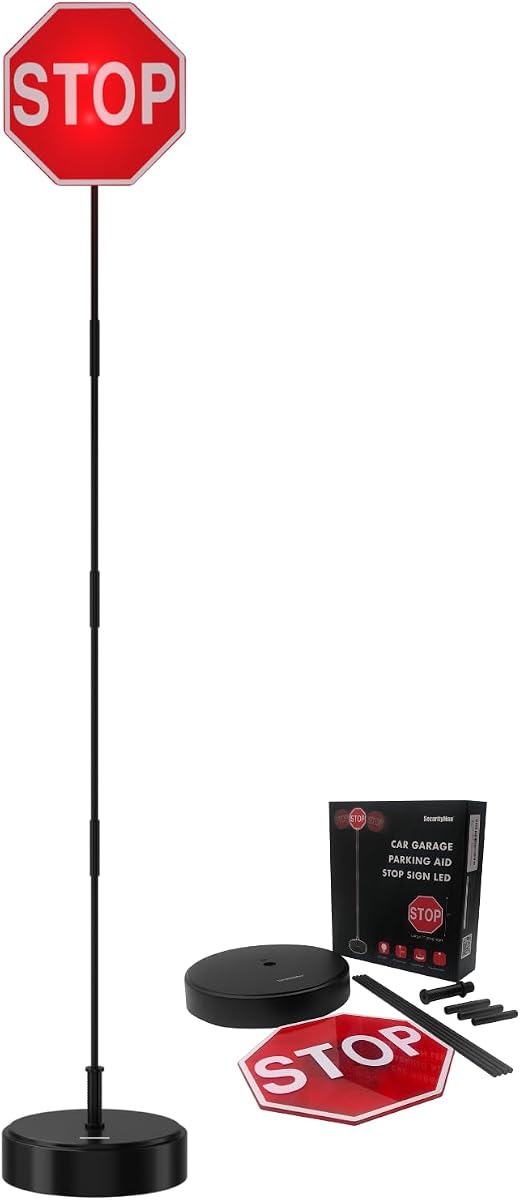
The Securityman Garage Parking Aid is the most substantial pole-mounted design in this guide, centered on a large 7-inch stop sign with bright red LEDs. Its 4.2 rating reflects a well-received product, while the upgraded base and large illuminated face distinguish it from smaller portable signs.
We may earn a commission when you buy through this link, at no additional cost to you.
Four 11-inch pole sections allow the sign to be adjusted to a maximum height of 55 inches, making it suitable for cars, trucks, and different driver sightlines. A spring-connected pole is designed to absorb bumper contact, and the weighted base is intended to keep the unit stable when bumped. Batteries are included, reducing the need for immediate extra purchases.
The most important trade-off is that the sign lights after contact rather than warning the driver beforehand. It is therefore a physical stopping aid, not an early distance-alert system. It also needs a clear floor location and stable surface, which may be inconvenient in a crowded garage with limited walking room.
For drivers who want a prominent, durable-looking visual target, this is a strong premium option. The large sign is easier to recognize than a small pole light, the spring connection softens contact, and the height adjustment supports multiple vehicle sizes. Choose it when a strong physical stop marker matters more than real-time proximity readings.
The 7-inch red LED sign creates a clear target that is visible from the driver's seat. Its size reduces the chance that a small pole light will be overlooked during a reverse maneuver.
The spring connection is intended to absorb the force of a light bumper touch. Together with the weighted base, it makes the sign more stable and less likely to topple after contact.
We may earn a commission when you buy through this link, at no additional cost to you.
The Adjustable Garage Car Stop Indicator provides continuous red, yellow, and green feedback as an ultrasonic sensor detects the vehicle. It holds a 3.8 rating and stands out for a calibration method that saves the driver's preferred parking position within a stated 6-inch-to-6.5-foot range.
We may earn a commission when you buy through this link, at no additional cost to you.
Users position the vehicle at the ideal stopping point and press the Set Distance button. The system then uses that location as its reference, which can be repeated if the garage layout, vehicle, or driver preferences change. The stated range supports compact cars, SUVs, pickups, and single- or double-car garages, giving it broad everyday relevance.
Power can come from the included cord or three AAA batteries, although the batteries are not included. Installation uses adhesive pads or plaster anchors, so no specialized tools are necessary. The manual should be followed carefully during setup: the product data notes that exceeding the calibration range may cause the button to fail, making correct positioning important.
This is a good option for drivers who want a warning before the vehicle reaches the physical stop point. It suits users who value a saved reference position and do not want a floor-standing device. Those willing to install the unit carefully, provide batteries when needed, and understand the calibration limits will receive a practical and tidy parking aid.
The Set Distance control records the location where the vehicle is parked, reducing the need to estimate clearance repeatedly. This is useful for shared garages because each driver can repeat the process for a different vehicle.
The unit can be mounted on walls, workbenches, or other suitable surfaces using adhesive pads or plaster anchors. Its cord-and-battery options also support locations where access to a nearby outlet may be limited.
We may earn a commission when you buy through this link, at no additional cost to you.
The PARKEZ Flashing LED Light Parking Stop Sign is a compact, contact-activated system with a 4.2 rating. Its four-section design, adjustable height, and weighted base provide a recognizable stopping point for many vehicle types, while the flashing LEDs illuminate when the car's bumper touches the pole.
We may earn a commission when you buy through this link, at no additional cost to you.
The sign is described as suitable for any garage and includes two AG13 button-cell batteries, making it ready to assemble without needing a separate power purchase. The weighted base helps prevent the light from toppling after contact, and the sectional pole allows the height to be customized for the vehicle and the driver's line of sight.
Its limitations match those of the other pole-mounted products. Because the alert occurs only after contact, the device does not provide early warning or help the driver judge remaining clearance. The base occupies floor space and can be moved by repeated bumps, so the placement should account for walking routes and the vehicle's full turning area.
The PARKEZ is a solid choice for a simple garage where the driver benefits from a visible physical reference. It is less complex than ultrasonic systems and requires no outlet or calibration. Buyers who need advance distance alerts should choose a sensor instead, but those who prefer a tangible stop sign will find this model direct and uncomplicated.
The sign gives the driver a physical location to align with, removing the need to interpret distance readings. That simplicity can make it easier to use consistently, especially for less experienced drivers.
A weighted base and four-section pole make the system manageable while allowing the sign to be raised or lowered. The included AG13 batteries keep the electrical setup simple.
We may earn a commission when you buy through this link, at no additional cost to you.
The Smart Flashing Warning Stop Sign is a portable parking aid that flashes when the vehicle's bumper contacts the pole. Its 4.3 rating ties it for the second-highest supplied rating in the guide, making it a strong value-oriented choice for drivers who want a visible physical stop marker without an ultrasonic display.
We may earn a commission when you buy through this link, at no additional cost to you.
Its package includes a load-bearing chassis, a spring, four support rods, three link sleeves, and a light plate. The chassis is designed to remain upright even when the rod is tilted to 30 degrees, which supports stability during use. The rod is also customizable for different vehicle heights, and the complete unit can be assembled, disassembled, and moved as needed.
Because the light activates only after contact, it cannot provide the gradual warning offered by a sensor model. It also requires a firm floor location and will occupy part of the parking area. The flashing light is most useful as an immediate signal that the bumper has reached the intended stopping position.
This product is best for garages and driveways where a simple, portable sign is preferable to a powered wall sensor. Its strong stated rating, stable chassis, and easy disassembly make it an attractive budget pick. Drivers who want to know how close they are before touching the pole should select an ultrasonic parking aid instead.
The flashing LED creates an unmistakable signal when the bumper reaches the pole. In a dim garage, this visual cue can be more noticeable than a small fixed marker.
The weighted chassis is built to resist tipping while the spring and sectional rods allow the sign to flex or be reconfigured. It can be packed away when the parking area is needed for other tasks.
We may earn a commission when you buy through this link, at no additional cost to you.
The LED Garage Parking Sensor Aid is the leading recommendation in this guide, combining ultrasonic detection, a high-visibility three-color display, and a broad 6-inch-to-6-foot adjustment range. It has a 5.0 supplied rating, the highest among the ten products, and its straightforward green, yellow, and red system is easy to understand.
We may earn a commission when you buy through this link, at no additional cost to you.
The calibration process is intuitive: park the vehicle in the desired final position, press the Set Distance button, and the sensor retains that reference. Real-time colors then indicate whether the car is safe, approaching, or ready to stop. The product can be powered by the included cord or optional batteries, while adhesive or screw mounting allows it to be fitted to walls, workbenches, shelves, or another flat surface.
The main compromise is that batteries are not included if the user wants cordless operation. Sensor performance also depends on correct placement and an unobstructed view of the vehicle's path. The unit should be mounted high enough and aligned so the vehicle passes within its useful detection area without confusing nearby walls or objects as the target.
This model is the most complete option for drivers who want advance guidance rather than a contact-only warning. It works for a wide variety of vehicles, garage sizes, and power arrangements, and its color-based display avoids the need to read precise measurements. The included cord, no-drill option, and adjustable range make it a versatile choice for everyday home parking.
Green, yellow, and red indicators communicate the vehicle's changing relationship to the saved stop point. The format can be understood quickly, which is valuable when the driver is focused on reversing.
Users can mount the unit with adhesive or screws and operate it with the included cord or optional batteries. These alternatives make it easier to accommodate different garage surfaces, outlet locations, and renter restrictions.
We may earn a commission when you buy through this link, at no additional cost to you.
Choosing a garage stop light means deciding whether you need advance distance guidance, a physical contact point, or both. Range, visibility, power, mounting method, and the layout of your parking area should guide the decision.
The usable detection range determines how much space the system can monitor behind the vehicle. Sensor products in this guide extend from approximately 6 inches to 6 feet or 6.5 feet, while the Armor All model offers an adjustable range of 1.5 to 5 feet. A broader range is useful for different vehicle depths, but the most important value is the ability to set a comfortable stopping point for the driver's normal garage position.
Look for a clear calibration control and enough adjustment to accommodate changes in vehicle size, cargo, or parking position. A narrow fixed range may be adequate for one driver but frustrating for a household sharing the garage.
Three-color LED systems provide information before contact: green indicates a safe distance, yellow warns that the vehicle is approaching, and red signals the stopping point. Pole-mounted products instead use a flashing LED that activates when the bumper reaches the sign. The first approach offers earlier guidance, while the second supplies a tangible reference and a clear event after contact.
Consider visibility in the actual garage. A large sign face, high-brightness LEDs, and an audio warning can make the system easier to perceive in dim conditions, especially when the driver cannot maintain a direct view of the display.
Sensor aids commonly offer AC adapter, USB cord, or battery operation, and some include more than one option. Corded power is convenient when an outlet is nearby, while batteries allow placement on a wall, workbench, or shelf without a permanent cable. Pole-mounted signs generally use small button-cell batteries and are therefore entirely portable.
Check whether batteries are included before buying. Also consider how often the unit will be used, how accessible the battery compartment is, and whether the garage has reliable outlet access. A backup option can be valuable in areas where power interruptions are common.
Sensor systems are usually mounted behind the parking space on a wall, shelf, or workbench. Adhesive pads or strips offer a reversible installation, while screws or anchors provide a more secure attachment. Pole-based signs stand on the garage floor and need enough clearance from the vehicle, walls, vehicles, and walking paths.
Measure the space before selecting a design. A compact wall sensor is advantageous in a crowded garage, while a weighted pole is easier to place directly in line with a vehicle. Verify the surface, mounting hardware, and cable length included with the product.
Stop distance depends on the bumper, rear camera, suspension, and how a particular driver reverses. A sensor that can be calibrated to a preferred position is more adaptable than a fixed marker, while a pole sign should be raised to a height that is visible from the driver's seat and appropriately matched to the vehicle.
Think about household vehicles as well as visitors. A compact sedan and a tall pickup may need different reference points. Recalibrate a sensor when the vehicle or parking arrangement changes, and adjust a pole's height before relying on it repeatedly.
Portable stop signs are useful for temporary parking projects, shared driveways, and garages where floor space changes throughout the week. Sectional poles, detachable weighted bases, and included batteries make these products easy to move. Wall sensors can also be relocated, although adhesive mounting may leave residue or perform less reliably on textured surfaces.
Choose a portable model if you need to reclaim the space frequently. For a permanent parking arrangement, a wall-mounted sensor may provide tidier daily use and no floor obstruction for pedestrians.
Pole-mounted products must remain upright despite accidental contact, so the base, spring, and pole connections are important. A weighted base resists toppling, while a spring connection can absorb light contact. Sensors need a stable mounting surface and a clear position relative to the vehicle's reversing path.
Inspect the included hardware and assembly method before installation. A well-supported unit is easier to use consistently, particularly in a busy household where the stop light is adjusted or moved only occasionally.
Begin by identifying the normal parking position and the point at which the vehicle should stop. For a sensor, mount the unit behind that position on a wall, shelf, workbench, or other flat surface. Keep the detection path clear and avoid placing the unit where a wall, storage bin, shelf support, or parked vehicle could interfere with the ultrasonic signal.
Calibrate a sensor by positioning the vehicle in the desired final location and pressing the Set Distance control according to the product instructions. Test the display while moving the vehicle a small distance forward or backward. For a pole-mounted sign, assemble the sections, secure the weighted base on a level floor, and adjust the pole to a height that remains clearly visible from the driver's seat.
Check the power source and mounting hardware regularly. Replace button cells or batteries as needed, keep cords from becoming snags, and confirm that adhesive pads remain firmly attached. Clean pole surfaces and light panels with a dry or lightly damp cloth, avoiding excessive moisture around electrical components. Recalibrate a sensor or reassess a pole's position whenever the vehicle, driver, or garage layout changes.
Ultrasonic sensors are generally better when the driver wants a warning before the vehicle reaches the stopping point. Their color-coded display can indicate a safe distance, an approaching distance, and a stop command. Physical stop signs are simpler and more portable, but their warning usually occurs when the bumper contacts the pole. The right choice depends on whether early guidance or a visible physical reference matters more.
Park the vehicle in the position where you want it to finish, leaving enough room for the bumper, walls, shelves, and any stored objects. Calibrate a sensor from that position or place the stop pole in line with the desired point. Test the setup by approaching slowly and making small corrections until the alert changes at a comfortable stopping distance.
Sensor-based products generally need a stable surface behind the vehicle, such as a wall, shelf, or workbench, while pole-based signs stand directly on the garage floor. Some sensors support adhesive installation, and some signs have detachable weighted bases. Check the floor and walking routes before choosing a freestanding design so the device does not create an obstruction.
Most sensor systems are designed for a range of common vehicles, including compact cars, SUVs, and pickups, but the correct sensor height and detection path still matter. Large or unusually shaped vehicles may need careful placement. Pole signs can be adjusted in height, allowing them to suit different vehicle sizes and driver sightlines.
Green generally means the vehicle is within a safe distance, yellow means it is approaching the configured stop point, and red means the driver should stop or adjust immediately. The exact sequence follows the product design, but the color progression gives a quick visual hierarchy. Users should still reverse slowly and check surroundings rather than relying exclusively on the display.
Battery power is useful when there is no convenient outlet or when a permanent cable would be inconvenient. It also makes wall sensors easier to relocate, while pole signs are generally portable by design. Battery life and replacement frequency depend on usage and the device, so checking the included batteries and keeping a spare set on hand can prevent interruptions.
Place pole systems on a level surface and use the supplied weighted base as intended. A spring-connected pole can also reduce movement when the vehicle makes contact. For wall sensors, choose screws or suitable anchors when the wall can support them, and use strong adhesive on appropriate smooth surfaces. Stable placement improves both the warning and the vehicle's clearance.
No. A garage stop light is an additional parking aid, not a substitute for checking mirrors, watching obstacles, or using a rear camera. Sensors can be affected by placement and environmental conditions, while contact signs only react at the pole. The safest approach is to use the device as a consistent reference while continuing to reverse slowly and inspect the space.
The LED Garage Parking Sensor Aid stands out for comprehensive real-time guidance, a 6-inch-to-6-foot calibration range, multiple mounting options, and a 5.0 supplied rating. The Smart Flashing Warning Stop Sign offers a simpler portable alternative with a 4.3 rating, while the Securityman LED Stop Sign offers a larger 7-inch face, spring-connected pole, and substantial base for drivers who prefer a physical stopping point.
Prioritize advance color guidance if you tend to reverse without a clear view or regularly share the garage with different vehicles. Choose a contact-activated pole if a visible physical marker and portability matter more. Before buying, measure the available space, identify a suitable mounting surface, check whether batteries are included, and confirm that the adjustment range suits your normal parking position.
Product specifications, availability, and pricing can change, so check the current listing before making a final decision. Read the included instructions, understand the available power options, and test the setup at a slow speed. Used with careful driving, a properly positioned garage stop light can make a crowded parking area more manageable and consistent.