
AstroAI 2000-Count Blue
4.5Editor score
Audible continuity buzzer
Backlit 1999-count display
Double-fuse overload protection
Best multimeter for checking fuses guide comparing 10 models for accuracy, safety, continuity testing, display visibility, and ease of use at home or on the
A multimeter designed for checking fuses should make it easy to distinguish a healthy circuit from a blown fuse, damaged component, or interrupted connection. The most useful models combine reliable continuity testing, readable displays, protected test leads, and a range of resistance and voltage functions that suit both household troubleshooting and professional electrical work.
We compared the ten products using their stated measurement functions, safety features, display characteristics, fuse protection, included accessories, and suitability for common fuse-checking tasks. The list includes general-purpose digital multimeters, True RMS models, a smart clamp meter, and a non-contact voltage detector whose role in the workflow is more limited.
Each review explains what the selected model contributes to a fuse-checking setup, from simple continuity checks to broader vehicle and household diagnostics. Ratings reflect the published customer feedback supplied for these products, while specifications and capabilities are based on the listed product information. Prices and availability can change, so compare the current listing before buying.
4.5Editor score

4.7Editor score

4.8Editor score
This side-by-side comparison highlights the measurement ranges, fuse-checking features, display options, and practical extras offered by each model, including one detector that can support a safe inspection workflow but is not a full multimeter.




The Klein Tools MM325 is a well-balanced manual-ranging digital multimeter for checking fuses and tracing simple electrical faults. Its 4.7 rating reflects strong published customer feedback, while the combination of continuity, diode, resistance, voltage, and battery testing gives it more diagnostic utility than a basic continuity tester.
We may earn a commission when you buy through this link, at no additional cost to you.
Its most helpful safety-oriented feature is the lead-alert system. LEDs illuminate when the test leads are placed incorrectly, reducing the chance of selecting the wrong input or losing track of which terminal is in use. A backlit LCD makes readings easier to see in dark panels, and the kickstand, rear test-lead holders, and optional magnetic hanger support more convenient hands-free work.
The main compromise is manual ranging. While that gives owners direct control over the selected range, it also requires more attention than an auto-ranging model. The MM325 is also not a True RMS instrument, so it is better suited to conventional residential, automotive, and controlled electrical tasks than advanced analysis of complex AC waveforms.
This is a strong all-around recommendation for someone who wants a straightforward meter for checking automotive blades, cartridge fuses, household circuits, batteries, and basic components. Choose it when readable results, setup guidance, and useful convenience features matter more than automatic range selection.
Continuity and resistance modes allow a user to confirm whether a fuse is electrically continuous before installing it. The lead-alert LEDs add a useful layer of guidance by showing when a probe is in the wrong socket or the meter is not configured as expected.
Diode, battery, voltage, and current functions make the MM325 useful after a fuse check. That broader range helps distinguish a bad fuse from a failed switch, blown lamp, open circuit, or weak battery.
We may earn a commission when you buy through this link, at no additional cost to you.
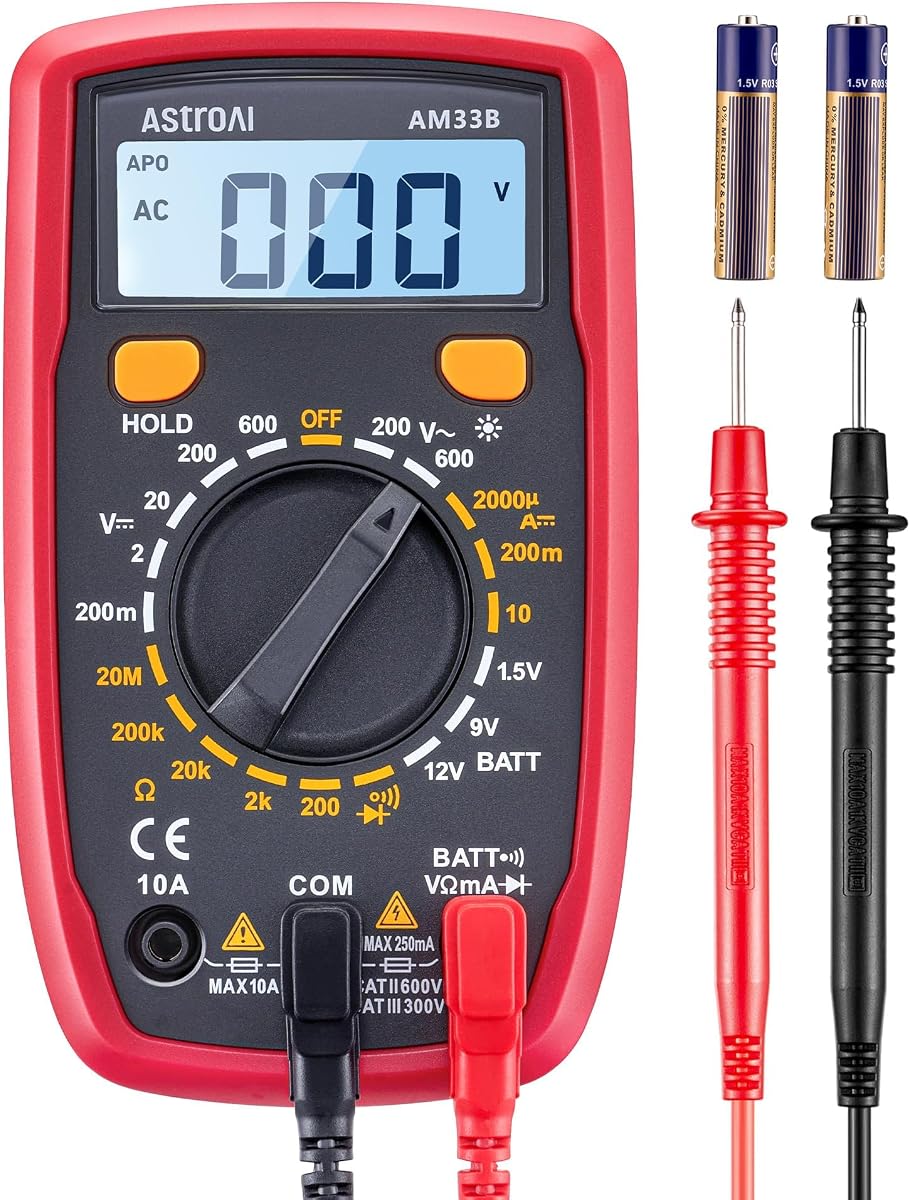
The blue AstroAI 2000-count model is a budget-focused choice for users who primarily need to check fuse continuity, test basic voltage, and troubleshoot common household or vehicle circuits. Its 4.5 rating makes it one of the less highly rated selections here, but the listed functions cover the core needs of an entry-level fuse-checking toolkit.
We may earn a commission when you buy through this link, at no additional cost to you.
The audible continuity buzzer is especially useful because it allows the user to concentrate on the fuse holder rather than repeatedly looking at the LCD. The 3.5-digit, 1999-count display includes a backlight, and the meter offers data hold, AC and DC voltage, DC current, resistance, and diode testing. Batteries, test leads, and a user manual are included.
Users should note two limitations stated in the product information. The rotary switch is manual, and the meter cannot test AC current or AC voltage below 100 millivolts. These restrictions do not undermine ordinary fuse checks, but they narrow its usefulness for advanced AC diagnostics. The silicone cover and double-fuse design are also notable protective features.
This model is most appropriate for a homeowner, hobbyist, or beginner who wants an inexpensive meter for checking common blade and cartridge fuses. It offers a useful combination of continuity feedback, illumination, and basic electrical measurements without requiring a more specialized instrument.
The continuity buzzer provides immediate audible feedback when an intact fuse presents a continuous path. This is particularly convenient when both hands are occupied holding a fuse or working inside a cramped vehicle electrical compartment.
The combination of backlighting, data hold, basic diode testing, and double-fuse protection gives this AstroAI more capability than a dedicated continuity pen. It can also help verify whether the suspected fuse is only one part of a larger electrical problem.
We may earn a commission when you buy through this link, at no additional cost to you.
The AstroAI True RMS 6000-count meter is a broad diagnostic instrument aimed at automotive and household troubleshooting. Its 4.6 rating reflects solid customer feedback, while auto-ranging, True RMS capability, and a large backlit screen distinguish it from simpler manual-ranging models.
We may earn a commission when you buy through this link, at no additional cost to you.
Fuse checking benefits from the meter’s continuity function, resistance measurement, and clear display. When a fuse is good, the user can move on to testing voltage, current, capacitance, frequency, duty cycle, resistance, diodes, continuity, and temperature. That makes it useful when determining whether a blown fuse is the actual cause of a system failure.
Safety and convenience features include overload protection, two ceramic fuse tubes, data hold, auto shutoff, and a kickstand. The removable lead cap should be taken off before using the probes, and the manual provides additional operating guidance. True RMS performance is especially relevant for users who may also test modified or less conventional AC circuits.
Choose this model when one meter needs to cover fuse checks, automotive diagnostics, household electrical work, and several component-level measurements. It may feel like more than a basic fuse tester, but that expanded capability is valuable for anyone trying to diagnose the circuit rather than simply replace a suspected fuse.
The wide measurement selection helps identify why a circuit failed. A user can compare voltage on both sides of a fuse, test continuity through related components, and check capacitance, frequency, or temperature without changing tools.
Auto-ranging automatically selects an appropriate measurement range, which can reduce setup errors for users who are still learning a multimeter. The 6000-count display also provides more resolution than the 1999-count budget model in this list.
We may earn a commission when you buy through this link, at no additional cost to you.
The Fluke 17B+ is the premium selection for users who want a dependable, feature-rich meter for fuse diagnostics and broader electrical troubleshooting. It has the highest listed rating in the group at 4.8 and a comprehensive set of measurements spanning voltage, current, resistance, continuity, capacitance, frequency, and temperature.
We may earn a commission when you buy through this link, at no additional cost to you.
For fuse work, continuity and resistance modes are central, but the 1000-volt AC/DC voltage capability allows useful verification across a broader range of circuits. The 10-amp current range helps with overload and short-circuit investigation, while the diode test can identify faulty components after a circuit stops working.
Its CAT III 600-volt safety rating is intended for common residential, commercial, and industrial electrical systems. A type-K thermocouple is included for temperature measurements up to 400 degrees Celsius. Although the listed product data does not identify True RMS measurement, the meter remains a highly capable general-purpose diagnostic tool.
The 17B+ is a strong recommendation for electricians, facilities personnel, serious automotive technicians, and advanced hobbyists who expect to use the same meter for many jobs. The additional cost reflects the premium positioning, but the broad function set and strong published rating support that choice for demanding users.
The 17B+ is not limited to testing whether a fuse is open. Its voltage, current, capacitance, frequency, resistance, and diode functions allow the same meter to investigate overloaded circuits, short conditions, and failed components.
The included type-K thermocouple provides temperature readings up to 400 degrees Celsius. That function can reveal overheating components or help assess equipment where an electrical fault is accompanied by abnormal heat.
We may earn a commission when you buy through this link, at no additional cost to you.
The Klein Tools MM420 is an auto-ranging True RMS digital multimeter designed for residential, business, HVAC, and light-industrial work. Its 4.7 rating puts it among the most well-regarded products in this list, while the 600-volt AC/DC range and broad function set support professional-looking troubleshooting tasks.
We may earn a commission when you buy through this link, at no additional cost to you.
Continuity, resistance, diode, capacitance, frequency, duty cycle, and temperature functions make it more than a fuse-specific tool. Lead-alert LEDs help prevent incorrect test-lead placement, and the backlit LCD supports readability in dim workspaces. A kickstand, rear test-lead holders, and an optional magnetic hanger improve hands-free operation.
Durability is another major selling point. The stated construction withstands a 6.6-foot drop, making the MM420 suitable for environments where a meter may be moved between vehicles, service areas, and mechanical rooms. The complete package includes protected test leads, a thermocouple, instructions, and two AAA batteries.
This is a good recommendation for a technician who wants a single meter for fuse checks, HVAC diagnostics, general electrical maintenance, and more advanced measurements. Buyers only seeking occasional continuity checks may find its extensive feature set unnecessary, but professionals gain room to grow.
The stated drop resistance, protective lead caps, test-lead storage, kickstand, and magnetic-hanger compatibility support use across vehicles, panels, and service environments. These details reduce the chance of losing the meter or its probes during active troubleshooting.
True RMS measurement is valuable for more complex AC analysis, while auto-ranging removes much of the manual setup involved in basic testing. A technician can therefore move from a simple fuse check to deeper circuit measurements with the same instrument.
We may earn a commission when you buy through this link, at no additional cost to you.
The Fluke 15B+ is a professional-oriented digital multimeter with a 4.8 rating, matching the highest customer-rating figure among the selected products. It is well suited to checking fuses in residential or commercial systems because continuity and resistance modes are supported alongside wide-range voltage and current measurements.
We may earn a commission when you buy through this link, at no additional cost to you.
The meter measures AC and DC voltage up to 1000 volts and AC and DC current up to 10 amps. Those ranges are useful for investigating overloading, short circuits, and faulty wiring after a protective fuse has opened. Diode and capacitance tests extend the diagnostic process to components commonly found in electronic and control circuits.
Its CAT III 600-volt safety rating is designed for common residential and commercial environments. Compared with the Fluke 17B+, the 15B+ list does not include a temperature function, so buyers who need thermocouple measurements should consider the 17B+ instead. Conversely, both provide a capable core meter for electrical troubleshooting.
Choose the 15B+ when reliability, a strong rating, professional safety positioning, and core electrical functions are priorities. It is a particularly sensible option for users who want more measurement authority than a basic household meter but do not need every advanced function found in higher-tier instruments.
A voltage measurement on each side of a fuse can help determine whether the supply reaches the device and whether voltage continues after the fuse. This is often more useful than continuity alone when the circuit is powered and the user needs to understand the full electrical path.
The combination of a CAT III 600-volt rating, 1000-volt measurement capability, and 10-amp current range creates a versatile foundation for diagnosing overloaded or shorted circuits. It also makes the meter useful beyond the immediate fuse replacement.
We may earn a commission when you buy through this link, at no additional cost to you.
The Proster TRMS 6000 is a feature-rich meter with a magnetic back and an unusually extensive accessory package. Its 4.6 rating indicates favorable customer feedback, and the 6000-count auto-ranging display supports accurate, clear measurements for both basic fuse checks and more involved diagnostics.
We may earn a commission when you buy through this link, at no additional cost to you.
The meter measures AC and DC voltage and current, resistance, capacitance, frequency, duty ratio, temperature, NCV, diodes, transistors, and continuity. That breadth makes it useful for users who want more than a simple household tester. A flashlight, backlight, data hold, overload protection, low-battery indication, auto power-off, and short-circuit protection add practical safeguards.
Its magnetic back is particularly relevant to fuse inspections. The meter can attach to ferrous metal near a breaker panel, car chassis, air-conditioning unit, or machine frame, while the kickstand and probe storage keep the display visible and the leads organized. The kit includes clips, a screwdriver, spare fuses, a temperature probe, batteries, and a carrying bag.
The Proster is a compelling choice for mobile technicians and serious enthusiasts who appreciate a ready-to-use diagnostic bundle. Its range of features may feel excessive for occasional fuse checks, but for users opening, testing, and replacing automotive or equipment fuses, the included tools and replaceable fuses can be genuinely convenient.
Attaching the meter to a nearby metal surface leaves both hands available for removing a fuse, holding probes, or working in a tight panel. The fold-out stand provides a practical viewing angle, and the rear probe slots reduce loose leads.
The included screwdriver, alligator clips, spare fuses, temperature probe, batteries, and storage bag make the package convenient for mobile work. Having replacement meter fuses available can also reduce delays after an overload or accidental range mistake.
We may earn a commission when you buy through this link, at no additional cost to you.
The black AstroAI 2000-count model is a practical entry-level meter for checking fuses, batteries, and common household or vehicle circuits. It carries a 4.6 rating and stands out from the similarly sized blue AstroAI through dedicated 1.5-volt, 9-volt, and 12-volt battery-test modes.
We may earn a commission when you buy through this link, at no additional cost to you.
Continuity testing with an audible buzzer provides a quick way to assess a fuse. AC and DC voltage, DC current, resistance, and diode testing provide enough additional capability to investigate what caused the fuse to open. A backlit LCD, data hold, and auto shutoff improve everyday usability, while the silicone cover and double fuse offer added protection.
There are two clear limitations in the listed specifications. The meter cannot test AC current, and users must select the correct range manually. Neither limitation prevents conventional fuse continuity checks, although they make the meter less suitable for advanced AC work. The included manual is important for understanding socket selection and operating procedures.
This AstroAI is a good match for DIYers and hobbyists who regularly check vehicle fuses and also want to test common batteries. It offers a wider practical feature set than a dedicated fuse tester while remaining simpler and less expensive than the professional-grade models in this guide.
Dedicated battery modes make this model attractive for vehicle work, where both a fuse and the battery may need checking. The 1.5-volt and 9-volt modes automatically display battery status according to the listed product information.
A backlit screen helps in dim compartments, while the continuity buzzer and data hold improve hands-on usability. Auto shutoff helps preserve the meter batteries during periods when the tool is not being used.
We may earn a commission when you buy through this link, at no additional cost to you.
The Klein Tools CL460S is a smart clamp meter that extends fuse diagnosis into current measurement without requiring a separate lead connection for every amperage check. Its 4.7 rating and smart mode technology make it an attractive option for users who work on both wiring and vehicle or equipment circuits.
We may earn a commission when you buy through this link, at no additional cost to you.
Instead of requiring dial adjustment between continuity, voltage, current, and resistance, the smart mode automatically switches among those functions. It measures AC and DC voltage up to 600 volts, AC and DC current up to 400 amps, and resistance up to 40 megohms, with capacitance, frequency, duty cycle, temperature, and diode testing as well.
The transflective reverse-contrast LCD is designed to remain visible in direct sunlight as well as ordinary lighting. Auto-ranging and True RMS technology support reliable measurement, while the built-in test-lead holder and optional magnetic hanger improve hands-free work. Its rugged, slim construction is aimed at demanding jobsite conditions.
The CL460S is not the most direct tool for probing the two ends of a tiny automotive blade fuse, because a conventional clamp meter is physically larger than a pocket multimeter. It is most valuable when the user needs to identify the source of an overload or monitor current in a conductor as part of a broader fuse-related diagnosis.
The clamp can measure up to 400 amps AC or DC without opening the circuit. That makes it useful for finding an unexpected load or investigating why a protective fuse has opened.
Automatic switching between continuity, voltage, current, and resistance reduces the need to stop and change a rotary setting. That streamlined workflow is valuable when tracing a fault through several related components.
We may earn a commission when you buy through this link, at no additional cost to you.
The Fluke 1AC II is a non-contact voltage tester rather than a multimeter, so it cannot directly measure fuse resistance or determine continuity. It earns a place in this guide because it is a useful safety and screening tool for checking energized circuits around fuse boxes, panels, and vehicle electrical systems.
We may earn a commission when you buy through this link, at no additional cost to you.
The tip glows red and an audible beeper sounds when AC voltage is detected. A continuous self-test provides confidence that the tester is operating, while audible and silent modes let the user adapt to different environments. The listed detection range is 90 to 1000 volts AC or 200 to 1000 volts AC.
Its pocket-sized form makes it easier to carry than a full digital multimeter. It can quickly indicate whether a circuit appears energized before the user touches a fuse holder, cover, probe, or test lead. However, absence of a detection signal should never be treated as a substitute for a properly rated meter and an appropriate verification procedure.
Choose the 1AC II as a companion tool when quick non-contact voltage screening is the priority. It is not the right standalone purchase for someone who needs to verify whether a fuse is blown, and it does not replace a multimeter for resistance, continuity, voltage, or current measurements.
The glowing tip and beeper provide immediate feedback when the tester is near an energized AC conductor. This can help guide a more cautious approach before a user removes a panel or handles a fuse.
This product does not test continuity or resistance, so it cannot tell the user whether a fuse is intact. A capable digital multimeter remains necessary for that specific diagnostic task.
We may earn a commission when you buy through this link, at no additional cost to you.
The right fuse-checking meter depends on the circuits you work with, the level of troubleshooting you expect, and the safety features you value. A basic continuity function is essential, while display quality, range selection, protection, and additional measurements determine how useful the tool will be over time.
A multimeter intended for fuse checks should provide continuity testing and resistance measurement. Continuity mode typically confirms whether a path exists through the fuse, while resistance provides a numerical indication of the component’s condition. An audible buzzer is especially convenient because the user can focus on holding the fuse or probes rather than watching the display continuously. The meter should also be capable of testing an unpowered fuse without creating an unsafe connection.
In short, prioritize dependable continuity and resistance modes with a clear display and audible indicator.
Voltage measurement lets you check whether power is present on either side of a fuse, which can distinguish a blown fuse from a downstream open circuit. Household, automotive, and commercial systems may present very different voltages, so a broader range provides more flexibility. Models listed here support ranges from 600 to 1000 volts for AC and DC, with some adding current and frequency measurements.
Choose a voltage range that covers your intended equipment and allows the meter to remain useful as your troubleshooting skills expand.
Auto-ranging meters detect an appropriate range automatically, reducing setup time and the chance of selecting the wrong range. Manual-ranging models give the user direct control and can suit someone who already understands range selection, but they demand more attention during each measurement. For occasional fuse checks, either approach can work; for frequent diagnostics, auto-ranging is usually more convenient.
Prioritize auto-ranging for speed and fewer setup errors, or manual control if you prefer selecting every range yourself.
Fuse checks often happen in cramped engine compartments, dark breaker boxes, and poorly lit service areas. A backlit LCD makes the reading easier to see, while a larger screen can display more information at once. The Klein CL460S adds a transflective display intended to remain visible in direct sunlight, and the Proster includes both a backlight and flashlight. Display resolution also matters when the result is a specific resistance value rather than a simple beep.
Look for a backlight, readable character size, and enough resolution to make the result unambiguous in your usual work environment.
The meter’s own protection matters because a fuse check can be performed near energized equipment. Look for overload protection, replaceable internal fuses, and a clearly stated safety category. The Klein MM325 and MM420 use LEDs to indicate correct test-lead placement, which can help prevent accidental setup errors. A protective silicone or rubber cover also improves grip and provides some defense against knocks.
Favor a meter with clear input guidance, overload protection, replaceable fuses, and an appropriate safety rating for the environment.
True RMS capability can provide more representative AC measurements than a basic meter using a simplified averaging method. It is most relevant to complex or modified AC waveforms and professional electrical analysis rather than the direct continuity test of a fuse. Other advanced modes, including capacitance, frequency, duty cycle, temperature, transistor testing, and non-contact voltage detection, can help identify the component or condition behind a failed circuit.
Choose True RMS for advanced AC work, but do not let extra functions distract from the essentials: safe leads, reliable continuity, and a readable display.
Test leads are fundamental, while accessories can make a meter more convenient in the field. The Proster includes alligator clips, a temperature probe, spare fuses, a screwdriver, batteries, and a storage bag. The Fluke 17B+ includes a type-K thermocouple, and the Klein MM420 includes protected test leads, a thermocouple, instructions, and batteries. Accessories do not replace a sound meter, but they can reduce setup time and improve access in difficult locations.
Check the bundle for usable test leads, appropriate protection, spare fuses, and accessories that match the work you actually expect to perform.
Fuse checks often involve holding the meter, a fuse, and probes at the same time. A kickstand, rear test-lead storage, magnetic back, or clamp-style design can make the task less awkward. The Proster’s magnetic back and Klein’s optional magnetic hangers can stabilize the meter near panels, while the CL460S clamp is useful for current measurements around a conductor.
Choose hands-free features that match your workspace, especially when you regularly work inside panels, vehicles, or machinery compartments.
Begin by identifying the circuit and shutting off its power whenever the fuse can be removed safely. De-energizing the circuit reduces shock risk and prevents unexpected equipment behavior. If the circuit must remain energized for a voltage check, use the correct meter category, insulated accessories, and the meter’s stated procedures rather than assuming a fuse holder is safe to touch.
For an unpowered fuse, set the meter to continuity or resistance mode, connect the probes to the meter’s correct sockets, and verify the meter with a known-good continuity path when appropriate. Place one probe on each end of the removed fuse. A healthy fuse should show continuity or a low resistance consistent with its specification. A reading of over open range or infinity indicates an open fuse, although physical inspection can also reveal a cracked element or scorched housing.
After replacing a fuse, restore power only if the cause of the failure has been identified. If the replacement blows again, the fault may be a short, overload, incorrect fuse rating, or damaged wiring. Keep the meter dry, replace damaged leads, observe the input limits, and allow the meter’s internal fuses to be replaced according to the manufacturer’s instructions. Store it with batteries removed during long periods of non-use if the manual recommends that step.
Yes. Set the meter to continuity or resistance mode and test across the two ends of an unpowered fuse. A continuous path or low resistance generally indicates an intact fuse, while an open-circuit result suggests that it has failed. Visual inspection can reveal damage that an electrical reading alone may not explain.
It is usually safer to remove the fuse and de-energize the circuit before testing it directly. Powered voltage tests can help locate a failed fuse within a circuit, but they require appropriate meter ratings and careful procedures. Never bridge or defeat a fuse merely to make equipment operate.
A good fuse normally produces continuity and a very low resistance reading, often close to zero ohms. The exact reading can vary with the meter and fuse type, so compare the result with the fuse specification and meter instructions. A clearly open or infinite reading is the more important diagnostic signal.
Continuity mode is faster because it generally provides a beep or other signal for a continuous path. Resistance mode provides a numerical value, which can be useful for checking rise, degradation, or a component that does not give a clean beep. Either function can be appropriate if the meter is operating and the probes are correctly connected.
A repeatedly blown fuse usually indicates an underlying overload, short circuit, or incorrect fuse rating rather than a defective replacement fuse. Disconnect or de-energize affected loads and use the meter to inspect wiring and components. A professional should evaluate circuits that remain energized or involve substantial current.
True RMS is not essential for a basic continuity or resistance test of a fuse. It becomes more relevant when measuring complex AC waveforms, particularly in professional diagnostics or modified equipment. If ordinary DC, AC, resistance, and continuity checks cover your needs, a simpler meter may be sufficient.
No. The 1AC II is a non-contact voltage detector and does not measure resistance or continuity. It can provide a quick indication that AC voltage is present near a fuse box, but a digital multimeter is required to determine whether the fuse itself is electrically intact.
Look for overload protection, replaceable internal fuses, a backlit display, clearly labeled inputs, and test-lead placement warnings. A suitable safety category matters when working on installations with known transient risk. Leads should be in good condition, and the meter’s measurement limits must match the circuit being investigated.
The Klein Tools MM325 is the strongest all-around choice because it combines continuity and diode testing with a readable backlit display, useful battery testing, and LEDs that help confirm correct test-lead placement. The blue AstroAI 2000-count model is the budget pick for simple household and automotive work, while the Fluke 17B+ leads the premium group with its broad professional measurement set and 4.8 rating.
Prioritize reliable continuity and resistance functions first, then match voltage range, safety rating, and current capability to the circuits you work with. Auto-ranging and True RMS are useful for frequent diagnostics, while a magnetic back, kickstand, or clamp design can make a major difference in awkward spaces. Remember that the Fluke 1AC II is a voltage detector rather than a true fuse-testing multimeter.
Before purchasing, verify the current listing, included accessories, measurement limits, and warranty information because product bundles and prices can change. The supplied ratings provide a useful starting point, but the correct meter ultimately depends on your experience, the equipment involved, and the safety requirements of the job.