
Infomir MAG544w3
4.0Editor score
4K playback at 60 FPS
Dual-band 2T2R Wi-Fi
HDMI 2.1 connectivity
Freeview Box guide comparing ten over-the-air tuners, antennas, DVR features, connectivity, recording, and compatibility to help you choose with confidence in
A Freeview Box is a television tuner that receives unencrypted over-the-air broadcasts, while a compatible antenna gathers those signals from local transmitters. The right setup can provide local news, sports, children's programming, and other broadcast channels without a conventional television subscription. Good models also need reliable reception, convenient outputs, and useful recording or media features.
This guide compares ten antennas and digital converter boxes selected for the Freeview Box market. We assessed each product using its supplied specifications, including broadcast compatibility, supported resolution, connectivity, recording capacity, output options, regional limitations, and practical installation features. The list includes both complete tuner solutions and antennas that pair with an existing television.
Each review explains the product's strongest capabilities, limitations, and ideal setup. The top three recommendations reflect the most useful balance of features for different needs, including advanced operator-focused hardware, affordable broadcast reception, and a tuner with recording controls. Product availability and prices can change, so confirm the current listing and compatibility before purchasing.
4.0Editor score

3.8Editor score

4.2Editor score
The table below compares the ten products by their core hardware, reception, recording, output, and connectivity features, making it easier to identify the right Freeview Box or antenna for your television setup.


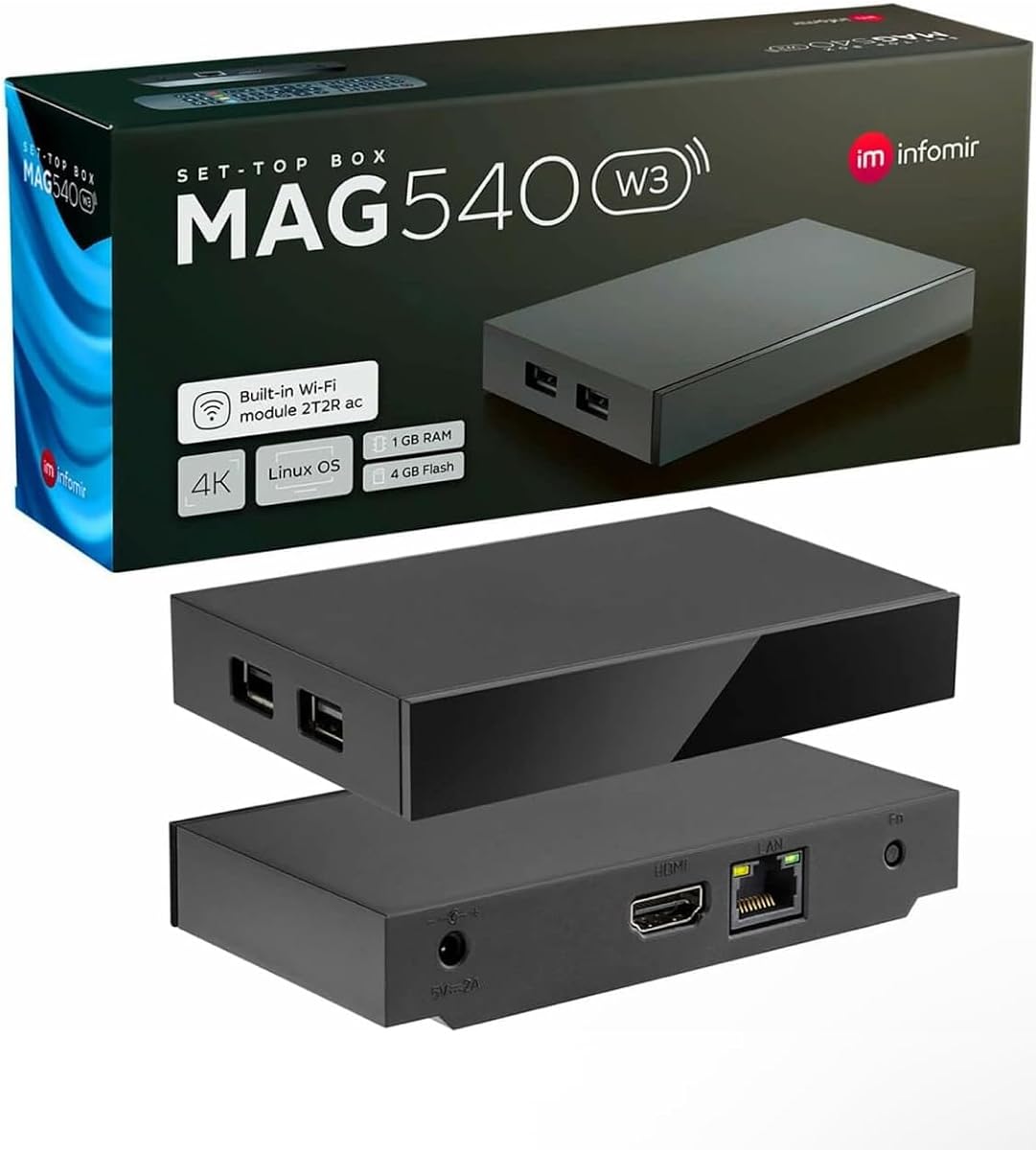


The Infomir MAG544w3 is an advanced 4K Linux set-top box aimed at users who want more processing power, modern connectivity, and broad support for authorized television services. It carries a 4.0 rating, which reflects a capable device with a more specialized purpose than a straightforward indoor antenna. Its standout qualities are the Amlogic S905Y4-B chipset, quad-core ARM Cortex-A35 processor, and support for 2160p video at 60 FPS.
We may earn a commission when you buy through this link, at no additional cost to you.
The hardware is designed to handle high-bitrate 4K content with 1GB of LPDDR4 RAM and 4GB of eMMC storage. HEVC and AV1 support can improve playback efficiency, while HDMI 2.1 provides a high-speed connection to compatible televisions. Networking options include a built-in 2T2R dual-band Wi-Fi module and a 100 Mbps Ethernet port, allowing users to choose between flexible wireless placement and a stable wired connection.
Its Linux 4.9 environment is optimized for official operator applications and Ministra PRO rather than functioning as a general consumer tuner. The supplied information lists support for MKV, MP4, AVI, FLAC, and APE formats, along with eight-channel Dolby Digital Plus audio and two USB 2.0 ports. This makes the MAG544w3 well suited to professional home cinema arrangements where authorized services, high-resolution playback, and network integration matter most.
This is the premium choice for buyers already using compatible operator infrastructure or seeking a robust 4K media platform. It is not the simplest option for someone wanting only free over-the-air channels, and a television with an integrated ATSC tuner could make the integrated receiver unnecessary. For compatible users, however, it delivers the most advanced combination of processing, video standards, and connectivity in this guide.
The S905Y4-B chipset, quad-core processor, and 1GB of LPDDR4 memory provide headroom for high-resolution media playback. Support for HEVC, AV1, HDR, and 4K at 60 FPS also makes it well suited to modern displays and carefully encoded content.
Dual-band 2T2R Wi-Fi offers a convenient way to connect without cabling, while the Ethernet port supports a more stable network path. HDMI 2.1 and two USB 2.0 ports provide the main interfaces needed for a modern television and external accessories.
We may earn a commission when you buy through this link, at no additional cost to you.
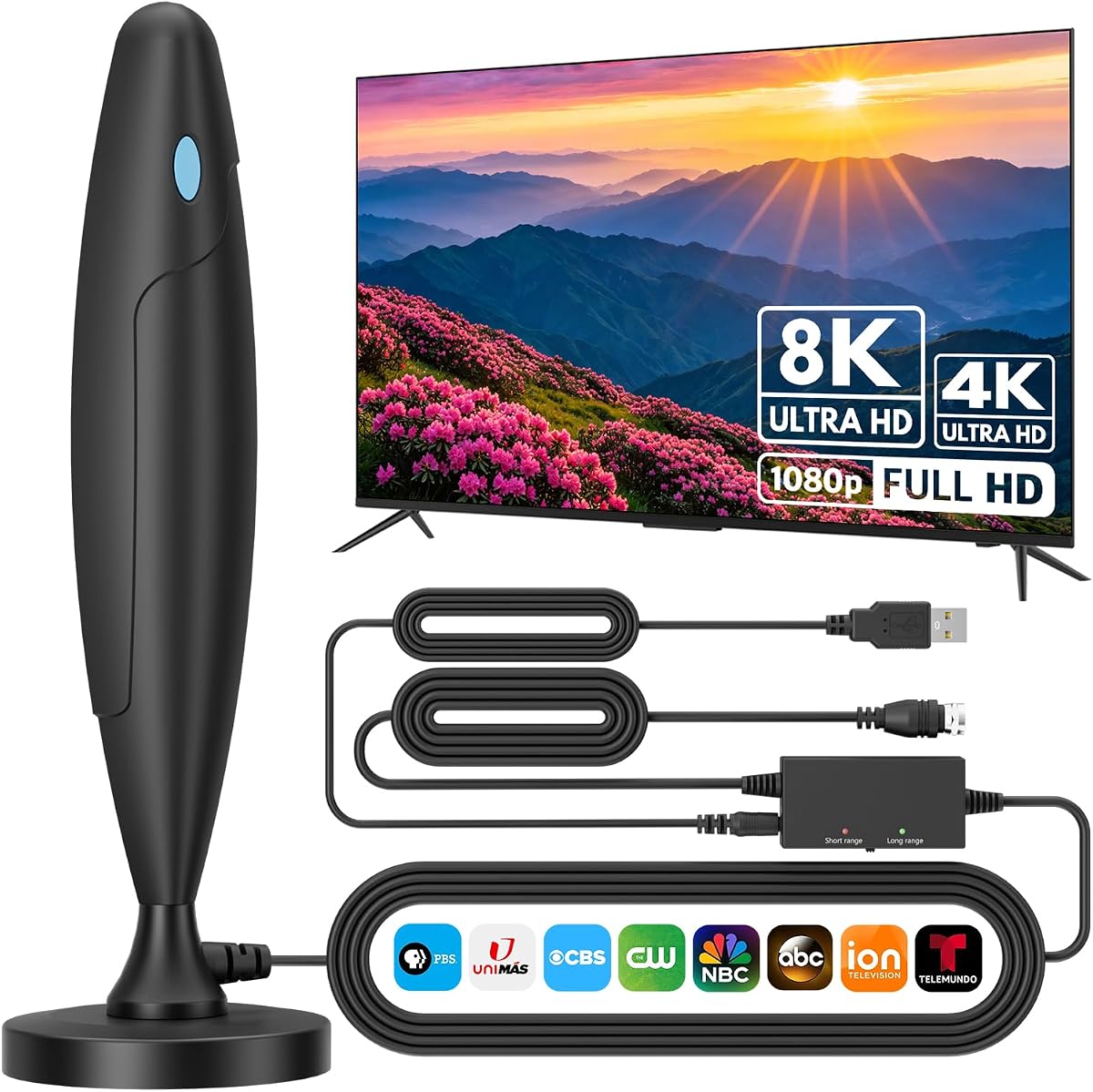
This indoor TV antenna is a straightforward way to receive available local broadcast channels without a cable subscription. It has a 4.2 rating, the highest established rating among the products in this guide, and stands out for its selectable short-range and long-range modes. Those modes make it easier to adapt the antenna to the distance between your home and local broadcast towers.
We may earn a commission when you buy through this link, at no additional cost to you.
The upgraded Smart IC chip is designed to improve gain and frequency performance while filtering cellular and FM interference. The antenna supports 4K, UHD, and 1080p broadcast signals where available, although actual picture quality and channel access remain dependent on local signal strength. It covers UHF and high-VHF frequencies, and a 16.5-foot cable gives users room to experiment with placement.
There are important limitations to consider. The product is not a tuner or set-top box, so it must be connected to a television or another compatible ATSC receiver through the ANT IN connection. It also may not receive low-VHF channels 2 through 6 without an additional compatible antenna. Reception can be reduced by terrain, building materials, metal objects, thick walls, and nearby electronics.
This antenna is best for viewers near strong broadcast towers who want a simple indoor solution with room to adjust placement. It is also a budget-friendly companion for a modern smart television with a built-in tuner. Checking tower distance before installation, selecting the appropriate mode, and rescaning after every major antenna move can make a substantial difference in the final channel list.
Short-range mode is intended for homes within 35 miles of a tower, while long-range mode covers locations from 35 to 250 miles. Selecting the correct mode based on the actual tower distance gives the receiver a better starting point than relying on one unrestricted amplification setting.
A high position near a window is generally more useful than a low or enclosed location. Keep the antenna away from metal and thick walls, and rescan the television after moving it, since even a small change in orientation can alter which stations appear in the channel scan.
We may earn a commission when you buy through this link, at no additional cost to you.
The ZJBOX digital TV converter box is a well-rounded option for receiving ATSC over-the-air broadcasts and sending them to an analog television, projector, computer monitor, or modern display. It has a 3.8 rating and combines live channel viewing with recording, favorites, parental controls, closed captions, and timer-based capture. Its 1080p output is useful where the source signal and viewing equipment support that resolution.
We may earn a commission when you buy through this link, at no additional cost to you.
Recording is one of the most useful features. The converter can save television programs to a connected USB hard drive and play them back later, while also serving as a media player for photos, MP3 music, and movie files. It does not include internal storage, so an external drive is essential for users who want to use these functions. The stated recommendation is a FAT32 hard drive up to 4TB or a flash drive up to 32GB.
The device does not amplify or receive signals on its own, and it cannot replace a cable television set-top box. An external antenna must be connected to it, adding a purchase requirement to the overall setup. Firmware updates are described as infrequent, with updates handled through the seller. These are meaningful constraints for buyers who want a completely self-contained system.
This is a strong recommendation for someone who needs more than simple channel viewing but does not require the advanced operator features of a premium Linux box. It is particularly suitable for a legacy television that lacks an ATSC tuner, or for users who want scheduled recording and USB media playback. Pair it with a well-positioned antenna and compatible storage for the most satisfying result.
The ZJBOX uses external USB media for captured programs, avoiding the need for built-in storage. Choose a compatible FAT32 drive, leave sufficient free space for the desired recordings, and connect the device safely before starting a scheduled recording session.
Its inclusion of both HDMI and composite connections broadens compatibility with older televisions as well as modern screens. The supplied package includes an HDMI cable, a composite cable, and a remote control, so the core connection can be completed without buying those items separately.
We may earn a commission when you buy through this link, at no additional cost to you.
The iView 3300STB is designed to bring digital broadcast channels to analog televisions or computer monitors while also functioning as a USB media player. Its 3.9 rating reflects a generally capable tuner package, and the built-in digital clock is a practical extra for scheduled viewing. It supports both ATSC digital broadcasts and unencrypted ClearQAM cable channels.
We may earn a commission when you buy through this link, at no additional cost to you.
Television saving is included, allowing users to retain programs for later viewing. The USB media player can handle videos, music, and photographs stored on a portable hard drive, with support stated for drives up to 4TB. This makes the 3300STB more versatile than a basic converter that only changes the television signal, especially for users who already maintain a local media library.
Regional compatibility is an essential consideration. The supplied information states that the converter works only in the United States, Canada, and Mexico. A firmware update is available to resolve existing issues and enhance performance, but the listing directs buyers to iView technical support rather than offering a self-contained update process. As with other tuners, an external antenna is required for over-the-air reception.
The iView 3300STB is a good fit for a North American household that wants recording, ClearQAM access, and USB media playback in one unit. It is less suitable for a buyer outside the stated regions or someone expecting a completely self-contained antenna system. Confirm the local broadcast standard and obtain the appropriate antenna before installation.
The combination of television saving and broad USB playback makes this useful as a basic home media center. It can serve stored movies, photographs, and music as well as live broadcasts, provided the files and storage format are supported.
ClearQAM compatibility can provide access to unencrypted channels offered by a cable provider. It does not unlock scrambled services, so its usefulness depends on what the local provider offers without additional equipment.
We may earn a commission when you buy through this link, at no additional cost to you.
The OWERSLYN ATSC tuner is a compact converter designed to bring over-the-air broadcasts to a television, projector, or monitor. It has a 3.9 rating and distinguishes itself with a small enclosure, a learning-capable 2-in-1 remote, and support for scheduled or real-time recording. It can be powered through a USB connection and tucked behind a television when space is limited.
We may earn a commission when you buy through this link, at no additional cost to you.
Video can be sent through HDMI, three-RCA composite, or component connections. The package includes both HDMI and 3RCA cables, reducing the need for extra accessories. In addition to live television, the tuner can play videos, music, and photographs from USB storage and play back recorded broadcasts. Timer scheduling allows users to plan recordings around a program schedule.
The tuner cannot connect directly to a television with only an RF input, and the specified 2-in-1 remote cannot perform channel switching for Channel 3 or Channel 4. It is also not a cable-box replacement: an external antenna is required and sold separately. Streaming services cannot be recorded by the television broadcast recording function.
This model works well for a small setup area, a secondary television, or a media room where a full-size set-top box would be inconvenient. Its three output methods make it adaptable to a range of displays, while DVR and media functions add value beyond basic conversion. Buyers should confirm their television connections and include a suitable antenna in the total setup.
Its small footprint and low-profile form make it especially useful behind a television or in a secondary room. The included USB power cable and multiple short connection options support a tidy installation without requiring a prominent shelf placement.
The real-time DVR and timer function provide two ways to capture broadcasts: start recording while watching or schedule a program in advance. A compatible USB drive remains necessary because the tuner does not include internal recording storage.
We may earn a commission when you buy through this link, at no additional cost to you.
The MAG 540W3 4K WiFi set-top box is positioned as a high-performance operator device with an ARM Cortex-A35 processor upgrade. Unlike many entries in this guide, its supplied information is brief, so the 4K capability, wireless connectivity, and processor platform are the main points on which it can be evaluated. It has no established numeric customer rating in the provided data.
We may earn a commission when you buy through this link, at no additional cost to you.
A Cortex-A35 processor represents a modern ARM architecture capable of handling contemporary set-top workloads when paired with suitable software and services. The product title identifies 4K output and Wi-Fi support, making it relevant to users who want a compact network-connected television platform rather than a basic broadcast-only converter.
The sparse technical information means buyers should not assume features that are not stated, such as specific HDMI version, memory capacity, storage, recording support, or interface selection. The product also appears intended for the MAG operator ecosystem, so an ordinary over-the-air user may find a dedicated ATSC converter or indoor antenna more direct.
The MAG 540W3 is best considered by an operator-focused buyer who already knows the MAG ecosystem and can verify service compatibility before buying. It may offer a more advanced platform than a basic converter, but the limited listing information makes careful comparison essential. It is not our leading general Freeview recommendation because the supplied evidence does not establish the same depth of feature detail as the Infomir model.
The ARM Cortex-A35 upgrade is the key technical differentiator stated for this model. It places the device in a modern class of compact network platforms, although buyers should confirm the exact software, service, and output support in the current listing.
A set-top box designed around operator services may depend on provisioning or authorized applications that are not relevant to a standalone Freeview setup. Confirming regional service compatibility before ordering avoids buying a capable processor for an ecosystem you do not intend to use.
We may earn a commission when you buy through this link, at no additional cost to you.
The Upgraded TV Antenna is an indoor digital antenna built around portable placement and electrical protection. It has a 4.1 rating and stands out for its strong magnetic base, eight-stage filter system, and built-in surge protection. It is intended to receive local broadcast channels through a smart television or another device with a compatible ATSC tuner.
We may earn a commission when you buy through this link, at no additional cost to you.
The upgraded amplifier chip and eight-stage filtering system cover VHF and UHF bands, with the listing describing stable 4K and 1080p reception where source conditions permit. A UV-resistant shell, rust-proof aluminum bracket, and flame-retardant 16.5-foot cable add durability for an indoor placement near a window or on a wall.
The product does not provide a stated reception distance, so buyers cannot compare it directly with antennas that publish long-range figures. It also cannot create signals in areas where broadcast coverage is weak. Since it is an antenna rather than a converter, it needs a television with a tuner or a separate digital converter box. The magnetic base makes repositioning easy, but the best location will still depend on the building and nearby obstructions.
This antenna is an attractive choice for users who prioritize flexible placement, physical protection, and broad supported frequency bands. It is especially convenient for renters or anyone who wants to move the unit between rooms without a permanent mounting arrangement. Confirm that the target television has ATSC capability, then experiment with the antenna's position and rescan channels after each major adjustment.
The surge protection, isolated construction, and lightning-oriented safeguards are unusual details for a compact indoor antenna. They do not guarantee immunity from every electrical event, but they make the unit better equipped for safe placement around a home entertainment setup.
A strong magnetic base lets the antenna attach securely to suitable metal surfaces and makes relocation simple. It also means users can quickly compare positions near a window, higher on a wall, or closer to a different television without assembling a permanent mount.
We may earn a commission when you buy through this link, at no additional cost to you.
The DP CTCB105 is an over-the-air digital television converter and DVR box with a 3.7 rating. The product's defining feature is its focus on converting digital video signals for use with a television, making it a candidate for users who have a legacy or tuner-free display and want to add access to local broadcasts. Its supplied information is limited, so the conversion function and over-the-air focus are the main confirmed details.
We may earn a commission when you buy through this link, at no additional cost to you.
The wording indicates support for digital television workflows rather than a general streaming platform. That makes the CTCB105 relevant to a household seeking a direct route from an external broadcast antenna to a television, particularly if the current display lacks a modern ATSC receiver. The DVR designation also suggests an emphasis on time-shifting or recording, although the supplied listing does not define storage capacity or supported file systems.
Because the output resolution, connection types, remote-control functions, and recording requirements are not provided, it would be unwise to assume parity with the more fully documented converter boxes in this guide. The device also cannot receive broadcast signals without an external antenna, and DVR use normally requires compatible storage. Those components must be confirmed in the current product documentation.
The DP CTCB105 is most appropriate for a buyer who values a straightforward over-the-air converter and DVR form factor, particularly when paired with an existing antenna. Its compact scope may suit a secondary room, but buyers wanting detailed assurance about media playback, hard-drive limits, or legacy television connections should review the final listing carefully before purchase.
The product is built around a clear task: receiving over-the-air digital television and converting the signal for a compatible display. That focus makes it more approachable for users who do not need streaming applications or a sophisticated media ecosystem.
The supplied information does not identify the physical outputs or supported recording media. Checking the current package contents and documentation is important for anyone using an older television, planning timed recordings, or expecting a particular hard-drive capacity.
We may earn a commission when you buy through this link, at no additional cost to you.
The iView 3300STBA is an updated version of an ATSC converter that combines broadcast conversion, program recording, and USB media playback. It has a 3.9 rating and can send digital channels to an analog television or computer monitor. Like the related 3300STB listed elsewhere in this guide, it includes a digital clock and supports ClearQAM channels that remain unencrypted.
We may earn a commission when you buy through this link, at no additional cost to you.
Television saving provides a way to retain programs for future viewing, while the USB media player expands the device beyond live broadcasting. Videos, music, and photographs stored on a portable hard drive can be played through the converter, with support stated for drives up to 4TB. HDMI and USB connections cover the principal modern links between the device, a display, and removable media.
The region limitation is significant: the supplied information says that the converter works only in the United States, Canada, and Mexico. It also requires an external antenna for over-the-air reception. The listing uses the same product image as the earlier 3300STB entry, which is reasonable for a closely related model but means buyers should read the model designation and package details carefully.
The 3300STBA is a practical choice for North American viewers who want live channels, a recording function, and local media playback without a large full-size set-top box. It is particularly useful for an older television that needs an external ATSC tuner. Ensure your broadcast area is within the supported region, connect a suitable antenna, and use storage that matches the device's stated format requirements.
The ability to switch from live television to files from a USB drive makes the converter useful throughout the day. It can function as a basic television hub rather than remaining dedicated only to scheduled broadcasts.
The 3300STBA designation and new-firmware wording distinguish this listing from the closely related 3300STB. Comparing the exact model number, included accessories, and firmware status can help ensure that the box received matches the features shown in the current listing.
We may earn a commission when you buy through this link, at no additional cost to you.
The Mediasonic HomeWorx HW250STB is a digital converter with recording, multimedia, and ClearQAM functions. It has a 3.8 rating and stands out through a metal enclosure, front display panel, large remote, and support for hard drives up to 2TB. The display can show the channel number, sub-channel, and clock while the unit is in standby, which adds useful feedback during daily operation.
We may earn a commission when you buy through this link, at no additional cost to you.
The converter receives ATSC over-the-air broadcasts for analog or digital televisions, projectors, and computer monitors. It can record and pause live television when connected to a USB 2.0 or USB 3.0 external hard drive, and it also plays photographs, music, and video from flash drives or hard drives. Video is delivered through HDMI at up to 1080p, with Dolby Digital audio support.
There are several important exclusions. It does not support ATSC 3.0 and cannot operate with TIVO or major cable systems such as Comcast, DirecTV, DISH Network, and Time Warner Cable. The product is intended for unencrypted ClearQAM signals and over-the-air ATSC broadcasts, not as a universal replacement for a provider's box. USB flash drives are also discouraged for recording, making a proper hard drive the better choice.
The HW250STB is a solid all-around converter for viewers who want a tuner, DVR, media player, and front-panel information in a metal enclosure. It is especially suitable for a modern television that lacks a usable tuner or an older display requiring a converter. Match it with a compatible external antenna and hard drive, and confirm that your local stations and cable options fall within the supported standards.
The tuner can pause live television and save programs to a USB 2.0 or USB 3.0 hard drive up to 2TB. A flash drive is not recommended for recording, so a suitable external hard drive is the safer choice for longer sessions and dependable playback.
The front panel displays the active channel, sub-channel, and standby clock. This visible feedback is convenient in dim rooms and makes it easier to confirm that the unit is tuned correctly without relying entirely on the on-screen television display.
We may earn a commission when you buy through this link, at no additional cost to you.
The right Freeview Box depends on whether you need an antenna, a broadcast tuner, an advanced operator platform, or a combination of recording and media functions. Broadcast standards, local coverage, television connections, and storage should guide the decision before aesthetics or secondary features.
Choose a device that matches your national broadcast standard and available station lineup.
Do not rely on the brand name alone; confirm regional compatibility first.
Choose an antenna for a tuner-equipped smart television.
Choose a converter when recording, legacy display support, or media playback is required.
Match the antenna's bands and range modes to local transmitters.
Treat amplification as helpful only when a usable signal reaches the antenna.
Confirm the ports on the television and included cables in the box.
Prefer HDMI for modern displays, but check legacy connections carefully.
Buy storage that meets the tuner's file-system and capacity limits.
Confirm that DVR applies only to incoming television broadcasts.
Choose an advanced platform only when its intended services are available to you.
For ordinary free broadcasts, prioritize a compatible tuner and good antenna.
Prioritize a placement process that suits your room and walls.
Rescan channels after moving the antenna or changing its mode.
Use ratings as context rather than the sole buying criterion.
Check update support, regional limits, and included accessories before ordering.
Begin by connecting the antenna to the ANT IN port on your television if it has a built-in ATSC tuner. If using a converter box, connect the antenna to the converter and then connect the converter to the television through HDMI or the appropriate legacy video cable. Power the equipment, open the television's channel menu, select an automatic channel search, and wait for the scan to finish. The first scan is only a starting point because channel availability changes with the antenna's position.
Place an indoor antenna high and near a window whenever possible. Keep it away from metal objects, thick walls, and electronics that could interfere with reception. If the antenna has selectable range modes, determine your approximate distance from local broadcast towers and use the appropriate setting. After changing the mode, rotating the antenna, or moving it to another wall, run a new channel scan so the television can identify the adjusted signal.
For a converter with recording features, connect a compatible USB hard drive before scheduling or starting a recording. Format the drive according to the manufacturer's instructions and maintain enough free space for the programs you intend to capture. Dust the antenna and converter lightly with a dry cloth, keep the devices in a ventilated area, avoid blocking ports, and inspect cables for damage. Update firmware through the stated support route when necessary rather than interrupting an active recording or setup session.
A Freeview Box in this guide receives unencrypted over-the-air television broadcasts using ATSC, while a cable box receives services delivered by a cable provider. Some converter models support ClearQAM, but only for channels that remain unencrypted. They do not replace a provider's box when the channel lineup requires decryption or proprietary equipment.
It depends on the device and television. A converter box needs an external antenna unless it specifically contains a receiver, while a modern television with a built-in ATSC tuner can connect directly to an indoor antenna. A separate converter is particularly useful for recording, media playback, or driving a television that lacks a compatible tuner.
Channel access depends on broadcast coverage, distance, terrain, building materials, antenna placement, and interference. Move the antenna higher or closer to a window, keep it away from metal and thick walls, select the correct range mode, and rescan after every change. Some low-VHF stations may also require an additional compatible antenna.
Yes, when the converter supports recording and the broadcast arrives through its tuner. Most models require a compatible external USB hard drive, and capacity and file-system limits vary. The listed products support different maximum sizes, so check the specific model's requirements before purchasing storage or scheduling recordings.
No. Amplification can improve a weak but usable signal, but it cannot create broadcast coverage that does not exist and may sometimes add noise. A correctly selected band, suitable range mode, high placement, and minimal obstruction are often more important than raw amplification.
No. ClearQAM support means the device can tune unencrypted cable channels that a provider makes available without additional scrambling. It does not unlock subscription packages, and the converter cannot replace the boxes required by Comcast, DirecTV, DISH Network, or other encrypted television services.
No. Most of the listed products use ATSC and are specifically associated with the United States, Canada, and Mexico. Other countries use different broadcast standards and frequencies, so confirm both the tuner standard and local antenna compatibility before buying. The region restriction on the iView models is especially important to verify.
Choose a 4K operator platform when you have compatible authorized services and want powerful media hardware, modern connectivity, and advanced formats. Choose a basic ATSC converter for uncomplicated over-the-air viewing, recording, and use with an existing television. A smart television with a built-in tuner plus a suitable antenna may be all your setup requires.
The Infomir MAG544w3 leads the list for buyers who need an advanced 4K operator platform with HEVC, AV1, HDMI 2.1, and dual-band Wi-Fi. The TV Antenna for Smart TV is the most practical budget choice for direct indoor reception using a television with a built-in tuner, while the ZJBOX converter earns the Editor's Choice position for users who want 1080p output, USB recording, and compatibility with both modern and older displays.
Prioritize regional broadcast compatibility, antenna coverage, and the connections on your television before comparing secondary features. A more advanced processor does not help if the device is outside your service region, and a high-gain antenna cannot overcome weak coverage. Choose a documented ATSC converter for ordinary free broadcasts, and consider a more advanced Linux set-top box only when its authorized ecosystem is genuinely available to you.
Prices, stock, firmware, and package contents can change over time, so check the current listing before buying. Confirm the required storage format, included cables, antenna range, and regional support at checkout. With those details verified, the right Freeview Box can deliver a practical mix of local television, recording, and media functions without the need for a conventional subscription.