
Eastman 25-Foot All Weather Cord
4.5Editor score
25-foot versatile length
Water and abrasion resistant
Three-prong construction
Visible power indicator
Our guide compares the best cold weather extension cords for low-temperature flexibility, durability, length, power capacity, safety features, and outdoor
A cold weather extension cord must remain flexible, reliable, and safe when temperatures fall, moisture is present, and the cable is handled around snow, ice, garages, workshops, or outdoor equipment. The right cord also needs sufficient wire gauge, practical length, grounded connections, and easy visibility in busy work areas.
We compared all ten options using the supplied specifications, including stated temperature limits, construction, resistance claims, amperage, length, outlet configuration, indicator lights, certifications, and intended uses. The guide covers short cords for nearby equipment, longer runs, high-capacity models, and options with multiple grounded outlets.
Each review explains the product's strongest qualities, practical limitations, and ideal user so you can choose by workload rather than brand alone. Ratings reflect the supplied customer feedback, while specifications and availability can change, so confirm current listing details before making a purchase.
4.5Editor score

4.8Editor score

4.8Editor score
The table below compares each cord by temperature rating, gauge, length, and practical electrical or safety features, making it easier to identify the model that matches your equipment, environment, and handling needs.




The Clear Power CP10075 combines a substantial 100-foot length with one of the most useful cold-weather specifications in this group: a stated operating range from -58°F to +140°F. Its 4.8 rating reflects strong customer satisfaction, while the 16/3 SJTW construction, three-prong grounded plug, and illuminated female connector make it a practical choice for outdoor tools, holiday lighting, and equipment positioned well away from an outlet.
We may earn a commission when you buy through this link, at no additional cost to you.
Temperature flexibility is the defining benefit. The SJTW jacket is described as resistant to water, weather, abrasion, and flame, allowing the cord to remain usable in demanding seasonal conditions. Nickel-coated brass connector blades are also designed to resist corrosion and help prevent arcing. The flashing connector light gives immediate visual confirmation that power is reaching the far end, which is especially helpful when the cable is routed around vehicles, snowbanks, machinery, or other visual obstructions.
The important limitation is its 10-amp, 1,250-watt capacity. That is ample for many lights, chargers, and lighter-duty tools, but it is not the appropriate choice for a high-output compressor, large heater, or other equipment that needs 12 or 15 amps. A long 16-gauge cord also creates more distance for voltage drop than a shorter run. Despite that constraint, the model is not marketed as a universal replacement for heavy-duty power distribution; it is a specialized cold-weather cord for appropriately sized loads.
Choose this model when you need maximum reach, winter flexibility, and obvious power-status visibility in one package. It is particularly attractive for connecting outdoor holiday displays, garage equipment, electric yard tools, or other compatible devices where the outlet is far away. For lighter-duty needs, the Clear Power is one of the strongest all-purpose choices in this guide because it balances length, cold performance, grounding, and user-friendly indicators without trying to be a triple-outlet system.
The stated -58°F operating range is the core reason this cord stands out. Its water-, weather-, abrasion-, and flame-resistant jacket is intended to withstand seasonal outdoor exposure, while the 100-foot length reduces the need to move a powered device merely to reach an outlet.
The flashing female-end indicator helps you confirm power without tracing the entire cable, and nickel-coated brass blades are designed to resist corrosion. Reinforced strain relief is particularly valuable when the connector is repeatedly plugged, unplugged, pulled, or routed around sharp edges.
We may earn a commission when you buy through this link, at no additional cost to you.
The Iron Forge Cable 10-Foot 16-Gauge extension cord is built for users who need cold-weather resilience without carrying a long cable. It has a 4.6 rating and a stated range from -58°F to +194°F, making it suitable for indoor or outdoor projects in severe seasonal environments. Its lighted female socket, slip-resistant exterior, reinforced strain relief, and UL certification add useful everyday convenience.
We may earn a commission when you buy through this link, at no additional cost to you.
The compact footprint is a major advantage. A 10-foot cord is easy to coil, store in a vehicle, and carry between a garage, workshop, or outdoor project. It is a practical option for a work light, moderately demanding tool, charger group, or appliance located near an existing receptacle. The jacket is described as resistant to oil, water, and flame, so it can serve both indoor and outdoor projects without requiring a separate short cord for every task.
The 16-gauge construction and 13-amp, 1,625-watt capacity require more attention than the 12-gauge alternatives in this list. They are suitable for many common tools and household devices, but the cord should not be pushed beyond its listed capacity. The 10-foot length also limits flexibility in reach. A setup that needs to cross a driveway, reach the far corner of a yard, or connect equipment near a detached building may be better served by a 25-, 50-, or 100-foot model.
This is a good pick for a nearby workbench, power tool within short range, or portable kit that must remain flexible in cold storage. The Iron Forge name and veteran-owned business description may also appeal to buyers who want established support. For light-to-moderate loads, it delivers a convincing mix of compact storage, broad temperature claims, and rugged resistance.
Ten feet is long enough to move a tool away from a wall outlet but short enough to avoid tangling, dragging across walkways, or taking up excessive space. That makes the cord especially useful for mobile kits used around a garage or worksite.
The illuminated female connector shows when the cord is energized, while reinforced blades and heavy-duty strain relief help the connection withstand repeated handling. UL certification provides a clear basis for evaluating the stated electrical rating.
We may earn a commission when you buy through this link, at no additional cost to you.
The US Wire and Cable 25-Foot cord stands out for its unusually broad stated temperature range of -94°F to 221°F. With a 4.5 rating, 12/3 heavy-duty construction, and SJEOOW cable, it is designed for demanding indoor and outdoor use where low-temperature flexibility and power delivery matter. A lighted plug and contrasting blue-and-red coloring improve visibility in work areas.
We may earn a commission when you buy through this link, at no additional cost to you.
The lower temperature figure makes this one of the most convincing options for genuinely frigid locations, remote northern properties, unheated garages, and cold-weather job sites. The manufacturer specifically describes the cord as flexible and kink-resistant in cold weather, addressing one of the most common shortcomings of ordinary vinyl extension cables. At the same time, its 12/3 construction provides a useful margin for heavier compatible tools and equipment.
One distinction to keep in mind is the SJEOOW jacket designation. SJEOOW is intended for severe service and includes oil resistance, but the product information does not make the same explicit waterproof or IP-rated claim found on a few competing models. Consequently, it should be treated as weather resistant rather than submersible, and powered connections should always be protected from standing water and direct precipitation. As with any outdoor extension cord, placement under a roof, in a canopy, or in a dry enclosure is the safer approach.
This model is well suited to buyers seeking a middle ground between high wire gauge and manageable 25-foot reach. It is a particularly logical choice for workshops, home projects, and outdoor jobs in severe cold where one dependable cord may be used for several compatible devices over time. Its combination of -94°F capability, 12/3 construction, lighting, and visible coloring makes it a strong specialist pick.
A stated -94°F rating gives this cord a clear advantage for severely cold environments. The flexible, kink-resistant design helps reduce the stiff or awkward cable behavior that can make installation and handling frustrating during winter.
The 12/3 gauge is more substantial than a typical 16-gauge extension lead, while the blue-and-red color treatment helps the cable stand out around equipment. A lighted plug adds another visible indication that the connection is active.
We may earn a commission when you buy through this link, at no additional cost to you.
The Iron Forge 10-Foot 12-Gauge cord combines heavy-duty electrical capacity with a very short, easy-to-manage length. Its 4.7 rating reflects a favorable customer reception, and the listed 15-amp, 1,875-watt capability places it among the stronger performers for compatible high-draw tools. It remains flexible from -58°F to +194°F and is described as resistant to oil, water, and flame.
We may earn a commission when you buy through this link, at no additional cost to you.
Where the 16-gauge Iron Forge cord emphasizes compactness and moderate capacity, this model offers a more robust conductor and a higher stated maximum load. That makes it more appropriate for power tools, shop equipment, and other devices that benefit from a lower-resistance cable. UL certification, reinforced blades, heavy-duty strain relief, and a slip-resistant exterior reinforce its suitability for repeated use in garages, workshops, and outdoor projects.
Ten feet is the cord's defining limitation. It is useful when equipment is close to a receptacle, but it offers little flexibility for larger yards, detached structures, or installations where the powered item cannot be moved. The short lead also means less exposed cable across a work area, which can be a safety advantage near traffic. Still, buyers should measure the actual distance, including routing space, before choosing it.
This Iron Forge model is an excellent fit for a dedicated high-draw tool used near a garage wall or portable workstation. It is less suitable as the only cord for a homeowner because the 10-foot length and single female connector limit expansion. For a buyer who values capacity, cold flexibility, and rugged construction in a compact package, however, it provides a clear and practical reason to choose this model over a lighter 16-gauge alternative.
The 12-gauge cable and 15-amp rating allow this cord to serve more demanding compatible equipment than a typical light-duty extension lead. Its short length keeps the heavier construction from becoming unwieldy during storage or transport.
Reinforced blades, slip-resistant construction, and heavy-duty strain relief focus on the connection points, where extension cords often experience the greatest wear. The lighted socket gives users a quick visual cue that power is present.
We may earn a commission when you buy through this link, at no additional cost to you.
The Watt's Wire 25-Foot Extreme Cold Outdoor Extension Cord is a versatile pick because it combines 12/3 heavy-duty construction with three grounded outlets in a single female end. Its 4.8 rating indicates strong customer approval, and the listed 15-amp, 1,875-watt capacity makes it useful for tools, work lights, generators, chargers, and seasonal displays when the combined load remains within specification.
We may earn a commission when you buy through this link, at no additional cost to you.
The lighted triple-tap connector is the feature that distinguishes this model from a conventional extension cord. Instead of adding a separate splitter, the end provides three grounded outlets for compatible devices. That arrangement is useful behind a generator, near a workbench, around lawn equipment, or in a garage where several low-to-moderate draw items need a nearby source. The illuminated end confirms that power is reaching the outlets, while the single male plug remains unlit.
As with all multi-outlet leads, total load is the critical consideration. The combined current across the connected devices must remain within the cord's 15-amp rating, and no outlet can exceed its own limits. High-draw heaters and compressors should not be connected together casually. A good practice is to distribute heavier tools onto separate suitable circuits or outlets rather than concentrating several large loads on the same triple tap.
The 25-foot length offers a useful balance of reach and manageability, and the flexible stranded copper is intended to withstand regular bending, pulling, coiling, and storage. A water-resistant SJTW jacket adds outdoor usefulness, though plug connections should still be kept dry. This model is an appealing choice for a garage, workshop, yard, or seasonal setup where one connection must feed several smaller devices.
The grounded triple tap eliminates the need for a separate splitter and gives you a convenient distribution point for tools, lights, chargers, and other compatible equipment. Its illuminated female end confirms that the entire assembly is receiving power.
Twelve-gauge stranded copper provides a substantial construction, while 25 feet is long enough to reach around common work areas without creating the bulk of a 50- or 100-foot lead. Reinforced strain relief and molded plugs support repeated handling.
We may earn a commission when you buy through this link, at no additional cost to you.
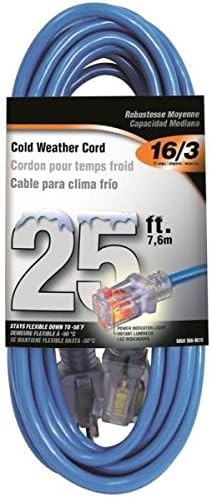
The Rocky Mountain Goods 25-Foot cord is a straightforward cold-weather option with a 4.5 rating and a stated ability to remain flexible down to -58°F. It is described as heavy duty, water resistant, and flame retardant, with a power indicator light and a lifetime warranty. Those qualities position it as a practical general-purpose cord for outdoor lights, snowblowers, and other seasonal equipment.
We may earn a commission when you buy through this link, at no additional cost to you.
A 25-foot length is one of the most versatile sizes in this guide. It reaches far enough to connect a snowblower, exterior work light, holiday display, or garage device without the weight and storage demands of a 100-foot cable. The flexible construction is the more important cold-weather feature, since a cable that becomes stiff is difficult to route and can be damaged through repeated bending. The indicator light reduces uncertainty when checking whether the far end is energized.
One limitation is that the supplied specifications do not state the wire gauge, amperage, or wattage. That makes it harder to compare with the precisely specified 12- and 16-gauge options. Buyers should consult the current product page and device requirements to confirm electrical capacity. The description also uses water-resistant language without an IP rating, so the cord should not be interpreted as waterproof or suitable for submerged connections.
This is a sensible pick for a homeowner who wants a conventional 25-foot cord, reliable seasonal flexibility, and an easy-to-see power indicator without paying for a multi-outlet design. The lifetime warranty adds reassurance, and the stated flame-retardant and water-resistant properties suit outdoor projects. It is most appropriate for equipment whose load requirements are verified and whose connections can remain protected from direct moisture.
The stated -58°F flexibility is the key seasonal benefit. A cable that remains supple is easier to route around snowbanks, equipment, and workshop obstacles and is less likely to develop troublesome kinks during routine use.
Water resistance, flame retardance, and an illuminated plug provide a useful safety-oriented feature set. The 25-foot length also makes the cord easy to carry, coil, and store between uses.
We may earn a commission when you buy through this link, at no additional cost to you.
The Eastman 25-Foot All Weather Extension Cord is a economical, uncomplicated option for everyday household and workshop use. It carries a 4.5 rating, uses a three-prong connection, and is listed for 125 volts and 1,875 watts. Its power indicator light makes it easy to determine whether the cord is in use, while the stated resistance to water, oil, abrasion, and corrosion supports outdoor applications.
We may earn a commission when you buy through this link, at no additional cost to you.
The main strength is its balanced, uncomplicated design. Twenty-five feet is enough to move a work light, vacuum, fan, charger group, or compatible tool into a more useful position, yet the cord remains relatively easy to store. Unlike a triple-tap model, it occupies only one receptacle and presents no risk of accidentally combining several loads on the same distribution block. The grounded three-prong design is preferable to an ungrounded option whenever the equipment supports it.
The supplied information does not identify a specific minimum operating temperature, even though the model is described as all weather. If true low-temperature flexibility is the central requirement, one of the models with an explicit -58°F or lower rating is easier to evaluate. Likewise, the absence of a stated wire gauge means users should verify the current listing and load requirements before pairing the cord with high-draw equipment.
Eastman appeals to buyers who want one versatile cord for routine indoor and outdoor chores without paying for advanced features. It works particularly well for garages, patios, seasonal lights, and general home projects where a 25-foot reach is useful and an indicator light adds convenience. For extreme cold applications, choose a model with a published temperature range; for ordinary all-weather use, this remains a compact and approachable option.
Twenty-five feet covers many common distances around a home, garage, or workshop without becoming difficult to manage. It is a versatile middle ground for lights, fans, chargers, and appropriately sized equipment.
Resistance to water, oil, abrasion, and corrosion helps the cord cope with demanding surroundings. The three-prong connection and visible indicator light support safer, more convenient daily use.
We may earn a commission when you buy through this link, at no additional cost to you.
The Southwire Coldflex 100-Foot extension cord is designed for long outdoor runs in cold environments, with a 4.7 rating and a strong emphasis on visibility. Its fluorescent blue jacket is easy to spot around snow, vehicles, tools, and work zones, while lighted ends at both connections provide immediate confirmation of cable status. The 16/3 SJTW construction keeps the product focused on lighter-duty extension needs.
We may earn a commission when you buy through this link, at no additional cost to you.
A 100-foot lead is useful when the nearest suitable receptacle is far from the equipment. Holiday lights, portable heaters within their allowed load limits, work lights, garage tools, and outdoor projects can all benefit from that reach. The illuminated ends are a meaningful convenience because users can identify a disconnected or unpowered cable without walking the entire route. Reinforced blades add protection at the connection points, where bending and impact commonly cause wear.
The primary constraint is the 16-gauge, light-duty classification. Long extension cords add resistance, and a 16-gauge conductor is not the best choice for the most power-hungry tools or appliances. Voltage drop can also become more noticeable over a 100-foot run. Buyers should avoid using the cord beyond its intended class and should not treat its long reach as a reason to operate loads that require a lower-resistance heavy-duty cable.
This model is well matched to users who value visibility and long reach more than maximum amperage. The bright jacket reduces trip-related risk in busy outdoor areas, and lighted ends make troubleshooting straightforward. It is an appealing choice for seasonal displays, lighting runs, and moderate loads in cold worksites, provided the connected equipment stays within the cord's intended electrical capacity.
The fluorescent blue jacket is easier to notice than a dark conventional cord, particularly against snow, pale concrete, or workshop clutter. That visibility can make routing decisions easier and reduce accidental contact during active projects.
Lights at both ends make it easier to see whether the cable is energized and connected. Reinforced blades and cold-flexible SJTW construction support dependable handling through seasonal use.
We may earn a commission when you buy through this link, at no additional cost to you.
The HUANCHAIN 50-Foot 14-Gauge extension cord provides a middle ground between lightweight 16-gauge leads and heavier 12-gauge models. It has a 4.7 rating, a 15-amp and 1,875-watt stated capacity, and an IP65 weather-resistant jacket. The bright yellow color improves visibility, while the long reach and cold resistance make it useful for outdoor projects, string lights, machines, and compatible heavy-duty equipment.
We may earn a commission when you buy through this link, at no additional cost to you.
The standout construction claim is the jacket's IP65 weather resistance, which provides a clearer protection level than a generic water-resistant description. The cord is also described as flame resistant, corrosion resistant, and cold resistant to -50°C. Its long strain-relief design is intended to withstand repeated bending, and the included storage straps help with organization. A visible power socket indicator confirms when the cord is ready for use.
The 14-gauge conductor is the trade-off. Although the amperage and wattage figures sound substantial, lower gauge numbers indicate thicker wire, and a 14-gauge cable is lighter than the 12-gauge alternatives here. That can be advantageous for portability but may be less appropriate for sustained high-current equipment. The 50-foot length also introduces more voltage drop than a shorter run, particularly under heavy load.
This cord is a good fit for medium-duty outdoor equipment, extension lighting, household appliances within the stated rating, and workshops where a visible 50-foot lead is useful. The instruction to use it fully extended and avoid coiling while energized is sensible because heat accumulation can damage insulation. For users who value clear weather protection and high visibility without moving to the heaviest 12-gauge construction, it offers a balanced option.
An IP65 rating gives this model a defined level of ingress protection, making it attractive for exposed outdoor tasks. As with every cord, the electrical connections should still be shielded from standing water, and the jacket should never be treated as submersible.
The shiny yellow jacket stands out around vehicles, equipment, and work areas. Long strain relief is designed for repeated bending, while storage straps make the 50-foot cable easier to unfold, coil, and transport.
We may earn a commission when you buy through this link, at no additional cost to you.
The POWGRN 50-Foot 12-Gauge Outdoor Extension Cord is the most feature-focused premium selection in this group. It has a 4.8 rating, a 15-amp and 1,875-watt stated capacity, ETL and CETL listing, and an IP65 weather-resistant SJTW jacket. The bright yellow cable, lighted indicator end, hook-style socket, and cold flexibility down to -58°F create a well-rounded package for serious outdoor use.
We may earn a commission when you buy through this link, at no additional cost to you.
Its 12-gauge construction supports higher-draw compatible equipment than the 14- and 16-gauge alternatives, while 50 feet provides enough reach for a garage edge, yard project, outdoor work area, or detached equipment. The jacket is described as wear resistant, heat resistant to 158°F, corrosion resistant, and flexible in extreme cold. These characteristics are particularly relevant when the cord must be routed outdoors, stored in a vehicle, or used around damp seasonal conditions.
The hook and strain-relief design deserves attention because it improves the physical connection. The socket can be hung in a humid environment, which reduces the need to prop it on a wet surface, and the reinforced strain relief is intended to withstand bending and repeated use. The bright PVC jacket also makes the cable easier to see. Nevertheless, IP65 does not mean the plug can be submerged, and exposed connections should be protected from direct water.
This is the premium recommendation for a buyer who wants more capacity than a light-duty extension cord, clearer weather-resistance specifications than generic models offer, and a balance of 50-foot reach and substantial 12-gauge construction. It is particularly suitable for high-output tools, major compatible appliances, outdoor work lighting, and seasonal equipment. The heavier cable may be less convenient to carry than a short or 16-gauge model, but its electrical and environmental specifications make it a convincing all-around specialist.
The 12-gauge, 15-amp construction provides more capacity than lighter alternatives, while ETL and CETL listing adds formal product certification. IP65 weather resistance, corrosion resistance, and cold flexibility make the cord suitable for demanding seasonal use.
The illuminated end confirms that power is present, and the socket hook provides a convenient way to hang it when not connected to a device. Reinforced strain relief helps protect the cable where bending and pulling place the greatest stress.
We may earn a commission when you buy through this link, at no additional cost to you.
The best cold weather extension cord is not determined by low-temperature claims alone. Length, wire gauge, amperage, environmental resistance, connector design, visibility, and intended equipment should all be considered before purchase.
Wire gauge is one of the most important choices because it affects how much current the cord can carry safely and how much voltage may drop over distance. Lower gauge numbers indicate thicker conductors: the 12/3 models here are heavier-duty choices, 14/3 is a middle ground, and 16/3 is better suited to lighter loads. Compare the cord's amperage and wattage limits with the equipment's requirements, and never assume a cord can support every device that physically fits its plug.
A useful cold-weather cord should have a published minimum temperature and remain flexible in that environment. The listed minimums range from -58°F to -94°F, with one model specifying cold resistance to -50°C. Check the wording carefully: a broad operating range supports cold-weather use, while resistance to water, oil, or abrasion addresses different environmental threats. The lowest temperature figure is useful for extreme climates, but the complete description matters more than one number.
Length should match the distance between the source and the device without leaving unnecessary cable across a route. Short 10-foot cords reduce clutter, 25-foot models suit nearby outdoor work, and 50- or 100-foot cords reach farther. Longer runs increase resistance and potential voltage drop, especially with lighter wire. Use the shortest practical length for the load, and do not attempt to compensate for excessive distance with an undersized conductor.
Water resistance helps a cord tolerate rain, damp ground, and routine outdoor exposure, while abrasion resistance protects the jacket during dragging, routing, and storage. Two models specify IP65 protection, giving a clearer standard than the term waterproof. No outdoor extension cord should be assumed safe for submersion, and powered connections must remain dry. Place connectors under a cover or in a sheltered location whenever possible.
Most models provide one female outlet, while the Watt's Wire model ends in a grounded triple tap. Multiple outlets are convenient behind generators, workbenches, or clustered seasonal equipment, but the combined current across all connected devices must stay within the cord's rating. A triple tap also occupies more receptacle space, which can matter in crowded outdoor outlets. Choose a multi-outlet end for convenience and a single end for simpler, more compact routing.
A bright jacket helps a cord remain visible around snow, machinery, vehicles, and dark work areas. Blue and yellow options are especially noticeable in this group. Indicator lights provide a quick way to confirm that power is reaching the far end, while lighted ends on both connectors make troubleshooting even easier. Reinforced blades, strain relief, and a hanging hook improve everyday usability at the points most exposed to pulling and bending.
Look for clear certification marks and complete electrical ratings. UL certification appears on the Iron Forge options, while ETL and CETL listing appears on the HUANCHAIN and POWGRN cords. A stated rating tells you the intended operating limit, but it does not replace careful handling. Inspect the jacket and connectors before use, avoid damage, and retire a cord that has cracked insulation, exposed conductor, or a loose prong.
Before each use, inspect the full cable and both connectors for cuts, cracks, discoloration, exposed copper, loose prongs, or damaged strain relief. Confirm that the cord's gauge and electrical rating suit the connected device. Unplug the source before inspection, and replace the cord rather than using damaged insulation or a connector that has been crushed or bent.
Unroll the cord fully before energizing it, and route it where people, vehicles, snowblower discharge, sharp edges, and hot surfaces cannot contact it. Avoid creating tight coils around a powered cable, because trapped heat can damage insulation. Keep connections dry, use a grounded receptacle, and do not exceed the cord's amperage or wattage limit or the combined capacity of a multi-outlet end.
After use, disconnect devices, wipe off moisture and debris, coil the cable without sharp bends, and store it in a dry place away from extreme heat and physical damage. Cold-rated jackets are designed for low temperatures, but proper storage still extends service life. Do not use a cord with a wet connector, and never attempt to bypass the grounding pin.
A cord intended for your climate should have a published minimum operating temperature below the expected low. Models in this guide state minimums of -58°F, -94°F, or -50°C, and the different figures reflect different construction and testing claims. Also check flexibility rather than temperature alone, because a cord that becomes rigid can be difficult and unsafe to route.
It is generally more capable because 12-gauge wire is thicker and can carry more current with less resistance than 16-gauge wire. The advantage matters most for high-draw tools, compressors, and long cable runs. A 16-gauge cord can still be appropriate for lighter equipment, but it should never be used beyond its listed amperage and wattage limits.
Many can tolerate rain or damp conditions, but the cable jacket and the electrical connections have different exposure limits. Keep plugs and receptacles dry even when the cord is rated IP65 or described as waterproof. Position connections under a shelter, use a weather-protective cover, and never immerse a connection unless the product specifically states that it is designed for that exposure.
Choose the shortest length that reaches the equipment without creating a trip hazard or preventing you from using the product comfortably. A 10-foot cord works well for nearby work, 25 feet is broadly versatile, and 50 or 100 feet suit more distant equipment. Remember that longer cables can create more voltage drop, particularly when paired with lighter wire.
It provides a visual indication that electricity is present at the indicated end of the cord. This is useful for confirming that a connection is live, but it does not prove that the entire cable or every connected device is operating correctly. A cord with illuminated ends is especially helpful in dark garages and outdoor areas where checking a distant connection would otherwise be inconvenient.
Yes, provided every connected device is compatible and the combined current remains within the cord's listed rating. High-draw tools such as heaters or compressors can exceed what is appropriate on one multi-outlet end. Distributing major loads across separate suitable circuits is safer than concentrating them on one triple tap.
No. Coiling a powered extension cord can trap heat and stress the cable and connections. Unplug it first, then coil it loosely for storage. The HUANCHAIN product information specifically recommends using the cord fully extended and avoiding coiling while power is on.
Replace it if the jacket is cracked, split, or deeply cut; if conductors are visible; if a plug or receptacle is loose, discolored, or deformed; or if the connector becomes unusually warm during normal use. Do not repair a damaged extension cord with electrical tape alone. Stop using it immediately and replace it with an appropriately rated, certified model.
The Clear Power 100-Foot cord is the strongest overall choice for buyers who need long reach, cold-weather flexibility, a grounded connection, and clear power indication. The Watt's Wire 25-Foot triple tap stands out when one connection must serve several smaller devices, while the Eastman 25-Foot model offers a straightforward and economical everyday alternative for routine indoor and outdoor tasks.
The POWGRN 50-Foot 12-Gauge cord is the most premium all-around choice, combining substantial conductor size, IP65 weather resistance, ETL and CETL listing, cold flexibility, high visibility, and a convenient hooked illuminated end. If cold performance is the overriding concern, the US Wire and Cable model offers the lowest stated temperature at -94°F, while the Southwire Coldflex is particularly useful for visible 100-foot runs.
Ultimately, prioritize the load, distance, and environment before focusing on minor connector features. Match the cord's gauge and electrical limit to your equipment, keep connections dry, route the cable where it cannot be damaged, and select a published cold-temperature rating appropriate for your location. Check current prices and listing details before purchasing, since availability and product information can change.