
Amazon Basics Boom Arm Stand
4.5Editor score
Folds into straight stand
Height reaches 85.75 inches
Clip-on cable management
Portable steel construction
A good microphone stand does more than hold a microphone upright. It places your mic at a consistent distance, reduces unwanted vibration, keeps cables under control, and leaves enough room for an efficient recording setup. The right home-studio stand should match your microphone, mounting method, desk space, and preferred recording posture.
We compared ten stands across the supplied product information, focusing on height adjustment, boom range, base stability, microphone compatibility, portability, cable management, and added acoustic features. The list covers traditional floor stands, compact desktop models, broadcast-style boom arms, weighted-base designs, and foldable isolation shields for home recording and podcasting.
Each pick highlights a different practical advantage, from flexible positioning to compact storage or stronger acoustic control. Ratings and specifications reflect the available product information, while availability and market conditions can change, so check the current listing and fit before making a final purchase.
4.5Editor score

4.4Editor score

4.7Editor score
As an Amazon Associate we earn from qualifying purchases.
This side-by-side comparison evaluates all ten options by stand type, adjustment range, stability system, mounting flexibility, portability, and acoustic-control features, helping you identify the most appropriate option for a compact desk, spacious home studio, podcast station, or mobile recording setup.




The InnoGear Adjustable Boom Stand is a versatile floor-stand option that combines a tall adjustable post, a rotating boom arm, and a detachable straight-stand configuration. Its supplied rating is 4.4 out of 5, reflecting a generally favorable balance of useful adjustment, sturdy construction, and portability. For a home studio that occasionally hosts vocals, podcasts, or live performance, it offers more positional freedom than a basic straight stand.
We may earn a commission when you buy through this link, at no additional cost to you.
Its most impressive feature is the range of movement. The main height extends from 28.1 to 89.8 inches, while the boom extends from 16 to 30 inches and rotates 360 degrees horizontally and up to 180 degrees vertically. That flexibility makes it possible to bring the microphone over a desk, pull it away for a performance, or change direction without moving the entire tripod. The 4.0-pound steel tripod provides a notably stable foundation.
The included hardware broadens compatibility further. Two microphone clip styles support common dynamic models such as the Shure SM58, Shure SM48, Shure PGA48, Samson Q2U, and ATR2100x-USB. A metal 3/8-to-5/8-inch adapter supports models including the Blue Yeti, Blue Snowball, HyperX QuadCast, SoloCast, Shure SM7B, Audio-Technica AT2020, and Fifine AM8. Removing the boom converts the unit into a straight stand for tighter placements.
The tradeoff is that this flexibility comes with size and several adjustment knobs. It will not occupy as little desk or floor space as a compact desktop model, and the moving sections require occasional tightening. Even so, the included carrying bag, detachable construction, and unusually broad height range make it a strong all-around choice for users who want one stand to serve recording, streaming, rehearsal, and occasional performance needs.
The combination of horizontal rotation, vertical tilt, telescopic height, and an adjustable boom gives this stand more reach than conventional straight stands. That makes it useful when a microphone must sit above a keyboard, beside a vocal performer, or close to a speaking position.
Although the assembled stand is substantial, it separates into several pieces and fits into the supplied 19.5-by-8.3-inch carrying bag. That makes moving it between a home studio, rehearsal room, or temporary recording location more manageable.
We may earn a commission when you buy through this link, at no additional cost to you.
The InnoGear Weighted-Base Stand is a straightforward microphone stand for singers, streamers, podcasters, and home-studio users who want a stable base without the large upper reach of a long boom stand. It carries a supplied rating of 4.3 out of 5 and emphasizes a weighted base, a strong arm, and uncomplicated positioning.
We may earn a commission when you buy through this link, at no additional cost to you.
The 4.5-pound round base has a stated diameter of 9.8 inches and uses non-slip pads to improve grip and reduce unwanted movement. A metal gasket between the base and upright helps prevent wobble, while the 1.5-millimeter-thickened steel arm is designed to resist deformation under load. Height adjustment from 34 to 60 inches covers seated speaking, standing vocals, and many instrument-recording positions.
The microphone clip rotates 180 degrees, allowing the microphone to be angled without moving the whole stand. Compatibility is extensive: the supplied information lists the HyperX SoloCast 2, QuadCast 2 S, QuadCast 2, Razer Seiren V3 Mini, Blue Yeti, Blue Snowball, Snowball iCE, Shure SM7B, MV7, Fifine AmpliGame, K669B without a shock mount, and Fifine AM8 among supported examples.
This model is less useful when the microphone needs to reach high above a seated performer or far over a desk. It also lacks dedicated cable holders. Even so, its smaller base, clean three-part breakdown, and stable weighted construction make it a practical option for a bedroom studio, rehearsal corner, or live vocal setup where moderate reach is sufficient.
The weighted base provides a reassuringly planted feel while remaining more compact than a long-boom tripod. It is especially suitable when the microphone only needs to move a short distance from its fixed upright.
The mounting arrangement supports common USB and dynamic microphones used in home studios. Confirm the dimensions and included shock-mount requirements of your particular microphone before setup.
We may earn a commission when you buy through this link, at no additional cost to you.
Hola! Music Telescopic Stand pairs a traditional straight upright with an adjustable telescopic boom and straightforward locking mechanisms. Its 4.7 out of 5 supplied rating is tied for the highest among the listed products, making it a strong candidate for performers and home-studio users who value conventional operation and organized cabling.
We may earn a commission when you buy through this link, at no additional cost to you.
The main upright adjusts from 40 to 63 inches, accommodating seated, standing, and instrumental applications. Separate clutches control the telescopic boom, which extends from 4 to 27 inches and changes angle independently. The patented leg housing locks the tripod legs when opened without requiring a separate screw, reducing setup steps compared with stands that rely on less convenient leg locks.
Cable management is one of this stand's most useful distinctions. Two clip-on holders keep leads from crossing the workspace, helping reduce visual clutter around a home studio. The standard US 5/8-27 thread is conventional for compatible microphone hardware, and the product description positions the stand for home, studio, office, and stage applications.
It does not provide the extreme vertical reach of a dedicated tall boom or the desktop flexibility of a clamp arm. It also lacks an integrated acoustic shield and a stated transport bag. Even with those limitations, the high supplied rating, quick leg locking, independent boom controls, and included cable holders make this a well-rounded floor stand for permanent or semi-permanent recording corners.
The automatic leg housing removes the need to manipulate a separate leg-locking screw. Combined with separate boom clutches, this lets a user establish the tripod shape and microphone reach with clear, individual controls.
Two included holders give XLR or USB leads a defined route away from the microphone position. This is especially helpful in compact rooms where loose cables can cross a desk, interfere with foot movement, or make a recording space look untidy.
We may earn a commission when you buy through this link, at no additional cost to you.
Amazon Basics Sturdy Portable Microphone Boom Arm Stand is a flexible floor option designed to transition between boom-arm and straight-stand configurations. Its supplied rating is 4.5 out of 5, and its appeal comes from broad height adjustment, a foldable design, and a lightweight steel structure suited to home studios that need to move equipment occasionally.
We may earn a commission when you buy through this link, at no additional cost to you.
The maximum height is 85.75 inches, allowing the microphone to reach a standing vocal position or be lowered toward an instrument. A molded counterweight on the long boom helps balance the microphone, while the tripod spans 21 inches at its base. The microphone clip is not included, giving buyers some control over the mounting hardware used with their specific microphone.
A 3/8-to-5/8-inch adapter supports common microphone threads, and a clip-on cable holder keeps the lead from hanging directly from the microphone. The base and arm fold flat, and the boom can be removed so the product can function as a straight stand. Its relatively light construction makes it easier to carry between rooms than a large fixed-base model.
The most important limitation is the stated maximum microphone weight of 2 pounds, or 1 kilogram. Heavy studio condensers, large broadcast microphones, and microphones fitted with substantial shock mounts may exceed that figure. For a typical dynamic microphone or a lighter USB model, however, the foldability, cable holder, broad reach, and multi-configuration design make this an economical and adaptable choice.
Removing or folding the boom converts the floor unit into a straight stand, offering a simpler option for close-miked instruments or seated voice work. This flexibility can reduce the need to own several separate stands.
The molded counterweight offsets the microphone at the end of the boom, while the steel construction keeps the overall product relatively light. It is a useful balance for a home studio where a larger stationary stand would be inconvenient.
We may earn a commission when you buy through this link, at no additional cost to you.
BILIONE Microphone Stand Floor with Tray & Boom Arm is built around stability, useful adjustment, and a tidy studio footprint. Its supplied rating is 4.4 out of 5, and the combination of a weighted square base, reinforced rod, adjustable boom, and cable-management components makes it well suited to podcasting, streaming, and voice recording.
We may earn a commission when you buy through this link, at no additional cost to you.
The stand uses a 1.5-millimeter steel arm and a 25-millimeter reinforced rod to support heavier broadcasting microphones with limited wobble. Height extends from 22 to 70 inches, accommodating users of varied statures and both seated and standing positions. The microphone clip swivels 180 degrees so the mic can be angled accurately without relocating the base.
The 5.2-pound base uses EVA pads for grip and floor protection, while its square shape aims to reduce the trip hazards associated with some broad tripod layouts. Dual-thread clips and a 3/8-to-5/8-inch adapter provide compatibility with the Blue Yeti, HyperX QuadCast, Audio-Technica AT2020, Shure SM7B, and similar microphones. Cable-management components help keep the working area cleaner.
It breaks down into portable parts in under 20 seconds, making setup and repositioning straightforward. The added tray provides a place for small accessories, although it also contributes to the overall bulk. The stated 5.5-pound weighted-base designation and reinforced construction make this an appealing choice for users who prioritize a planted setup over the smallest possible storage footprint.
The reinforced arm and weighted base are designed to limit movement under heavier microphones. This makes the stand more reassuring for broadcast-style recordings where a lightweight desk support may feel less planted.
The quick-detach structure can be dismantled in less than 20 seconds according to the supplied information. That makes it practical to clear a shared studio space or move the setup to another recording position.
We may earn a commission when you buy through this link, at no additional cost to you.
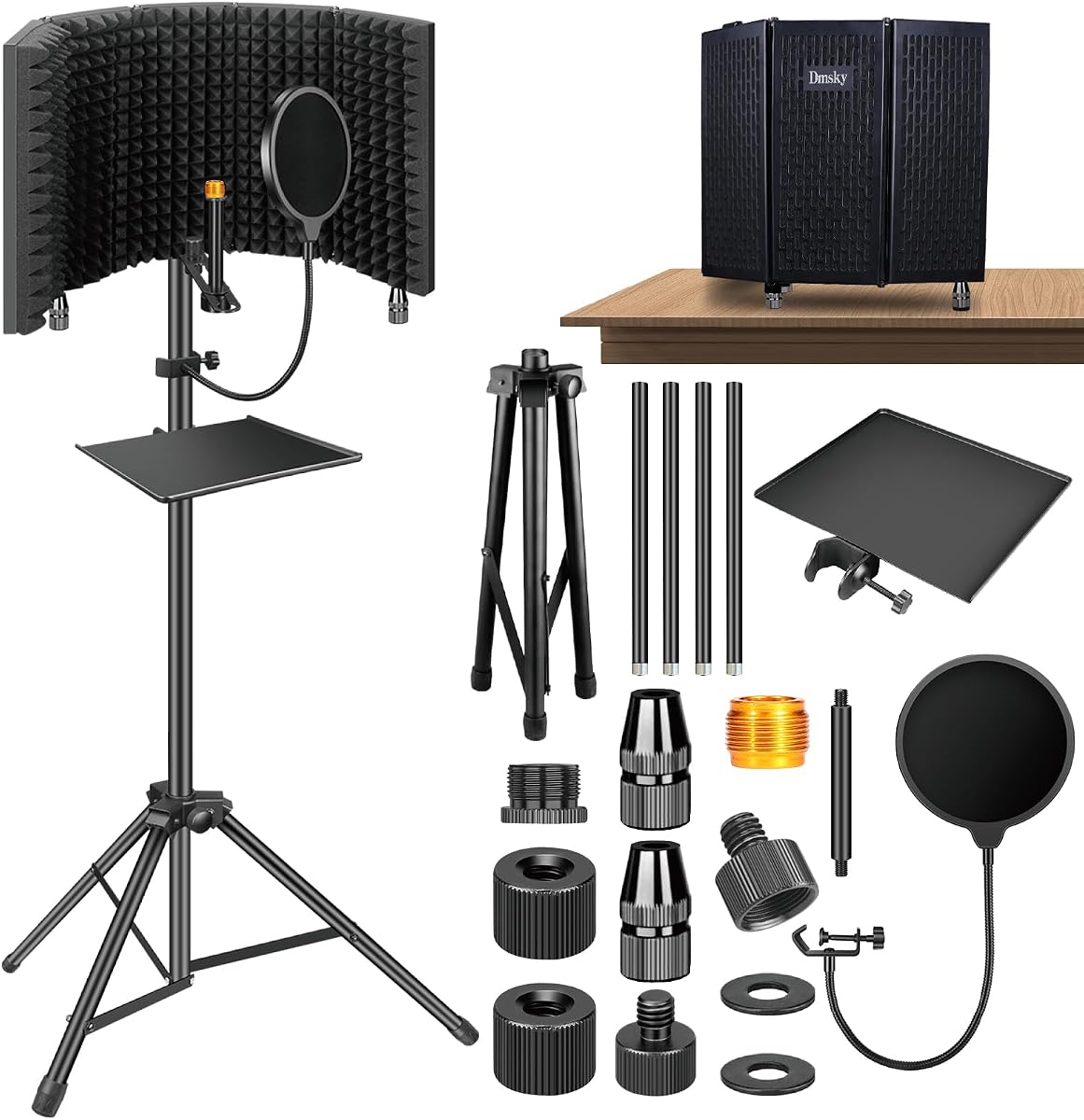
The Dmsky Microphone Isolation Shield with Pop Filter and Tripod Stand combines a floor stand with a large foldable acoustic screen. Its supplied rating is 4.6 out of 5, and it is aimed at podcasters, singers, broadcasters, and home-studio creators who need more control over reflections and ambient interference than a basic microphone stand provides.
We may earn a commission when you buy through this link, at no additional cost to you.
The shield uses three functional layers: a reflective layer, a filter layer, and an absorbing layer. High-density acoustic foam is intended to reduce audio-wave bounceback and external interference. Five panels fold at 180-degree intervals, allowing the user to shape the enclosure around the microphone rather than working with a completely fixed wall.
The stand is made from steel and reaches a stated 78.7 inches, while the shield itself adjusts from 42 to 71.5 inches. Anti-slip support points help keep the screen stable, and the shield can either sit on a table or install directly on the stand. The included pop filter supports clearer vocal pickup, and a storage tray provides room for items such as an external sound card or mobile phone.
This is a more involved system than a conventional stand, and the large shield demands desk or floor space. Its folding panels and dual-use configuration help offset that burden. For users working in untreated rooms, close to computers, or in shared spaces where reflections are troublesome, the added acoustic construction is the central reason to choose this model over a simpler boom or floor stand.
The five independently folding panels let the user open or close sections of the screen around the recording area. This flexibility is more useful than a fixed shield because rooms, microphones, and speaker positions rarely align perfectly.
The shield can function directly on a tabletop or attach to the supplied stand. That gives the product a path into compact podcast stations while retaining a full-height option for standing performances.
We may earn a commission when you buy through this link, at no additional cost to you.
Microphone Stand With Isolation Shield is a foldable acoustic-screen system with a steel stand, weighted triple-leg base, and quick-release adapters. Its supplied rating is 4.4 out of 5, and its strongest appeal is the combination of ambient-noise reduction claims with a relatively compact screen that can be used on a desktop or attached to the stand.
We may earn a commission when you buy through this link, at no additional cost to you.
The shield uses an acoustic sandwich of a sound-reflective layer, a precision filter layer, and an absorption layer. The supplied information states dual noise-blocking zones reduce ambient noise by 87 percent and attributes 26-decibel reduction to the front panel, which combines high-density studio-grade foam with lightweight ABS plastic. These figures describe the product design, though actual results depend on the room and microphone.
The folding shield has a stated 17.1-inch diameter and adjusts from 42 to 71.5 inches. An industrial-strength steel clamp and quick-release adapters simplify positioning. The package includes two universal adapters for 3/8-to-5/8-inch connections, an illustrated guide, and the shield and stand, but not a microphone. Desktop placement or boom-arm attachment gives users two ways to integrate it.
A weighted triple-leg base is intended to reduce tipping concerns during longer sessions. Even so, the foldable screen remains wider than a normal microphone clip and may crowd a small desk. For home studios that need stronger sound separation than a pop filter provides, the layered design and flexible mounting make this a more comprehensive solution.
The shield combines reflective, filtering, and absorbing materials rather than relying on a single foam panel. That layered approach is intended to address both reflections and unwanted ambient interference in an untreated recording space.
Quick-release adapters and dual desktop or boom configurations simplify changes to the microphone position. This allows the same acoustic screen to suit a compact desk session or a floor-standing recording arrangement.
We may earn a commission when you buy through this link, at no additional cost to you.
The RØDE PSA1+ Professional Studio Boom Arm is a premium desk-mounted arm designed for podcasting, streaming, voice-over work, and compact studio recording. Its supplied rating of 4.7 out of 5 is tied for the highest in the group, and the defining feature is an internal spring-damping system that allows the arm to move quietly.
We may earn a commission when you buy through this link, at no additional cost to you.
The arm supports microphones from 0.25 to 1.2 kilograms, including those fitted with shock mounts. That range covers many popular USB condensers, dynamic broadcast microphones, and heavier professional models. The desk clamp fits surfaces up to 70 millimeters thick, giving the microphone a broad reach without occupying floor space with a tripod.
A full 360-degree rotation provides easy access around the desk and supports a clean front-facing recording position. Integrated cable management helps conceal XLR runs, reducing loose cable movement and visual clutter. The arm is described as being used across professional podcast and streaming setups, which reflects its broadcast-oriented design rather than a basic utility stand.
The main limitation is the need for a compatible desk edge and sufficient clearance beneath it. A clamp cannot be installed on a thin platform that lacks a solid edge, and heavy desks may complicate the fitting process. For users who want premium reach, quiet adjustment, broad microphone support, and organized cabling without a floor base, the PSA1+ is an exceptionally polished choice.
Internal spring damping reduces creaks and handling noise when the arm is moved. This matters during live sessions because a conventional friction joint can transmit movement and mechanical sound directly into an active recording.
The desk clamp replaces a tripod with a space-saving mounting arrangement. Full rotation and a broad supported microphone weight range make it suitable for users who regularly change their microphone distance or angle.
We may earn a commission when you buy through this link, at no additional cost to you.
InnoGear Desktop Microphone Stand Holder is a compact, weighted stand for desks, offices, conference rooms, and small home studios. Its supplied rating is 4.6 out of 5, and the combination of a substantial metal base, screw-in adjustment knob, and broad device compatibility makes it a strong choice when a full-size floor stand would be excessive.
We may earn a commission when you buy through this link, at no additional cost to you.
The base measures 5.12 inches in diameter, weighs 1.85 pounds, and rests on four non-slip rubber pads. Those pads improve grip while helping protect the desk from scratches and scuffs. Height adjusts from 8.0 to 12.8 inches using a screw-in knob, which is described as more secure than a snap-on control and helps prevent gradual loosening.
The metal stand supports microphones and accessories up to 3.3 pounds. A 3/8-to-5/8-inch adapter allows use with the Blue Yeti, Blue Yeti Pro, Blue Snowball, HyperX QuadCast, SoloCast, Fifine, Audio-Technica AT2020, and Razer Seiren X. The included clip has a maximum diameter of 1.26 inches and fits common dynamic models such as the Shure SM58, SM48, Samson Q2U, and Shure PGA48.
The compact dimensions make it easy to reposition or carry, and the base can fit into a laptop bag or other case. Its limited height means it is best for seated recording, streaming, and voice-over work rather than standing vocals. For those applications, the weighted foundation and secure adjustment provide stability without the visual and physical footprint of a floor tripod.
A heavy metal base and four grippy pads help this stand remain planted on a desk. The five-inch-diameter round base takes up relatively little room while still supporting common studio microphones.
The screw-in knob holds a selected height more firmly than a snap mechanism. That stability is useful during long recording sessions, when a gradually drifting microphone would alter the distance from the speaker or instrument.
We may earn a commission when you buy through this link, at no additional cost to you.
K&M König & Meyer 21090.500.55 is a professional-grade heavy-duty tripod microphone stand with an adjustable telescoping two-piece boom and folding leg base. Its supplied rating is 4.6 out of 5, and the product information emphasizes German manufacture, a five-year product warranty, and long-term availability of replacement parts.
We may earn a commission when you buy through this link, at no additional cost to you.
The folding tripod base is designed for stability and easier transport. A two-piece telescoping boom allows the microphone to extend outward and change position, making the stand appropriate for stage performance, rehearsal, broadcast, and studio sessions where a higher level of durability is desirable.
The product's strongest documented benefit is its warranty commitment. A five-year product warranty provides more reassurance than is explicitly stated for most products on this list, while replacement parts are stated to remain available for ten years. That can be useful for owners who want a stand to remain in service rather than replace an entire unit after a damaged component is no longer supported.
The available product data is concise, so detailed dimensions, exact weight, and clamp specifications are not provided here. Buyers should verify those points for their intended microphone and space. Still, for a home-studio owner seeking a traditional professional floor stand with a heavy-duty base and long manufacturer support, this K&M model offers a compelling reputation focused on durability and longevity.
The five-year warranty and stated ten-year replacement-part availability make ownership support a notable feature. That is particularly relevant for frequently transported equipment used in rehearsals, stages, and studio spaces.
The folding leg base balances a planted recording position with the ability to collapse the stand for storage or transport. The telescoping boom adds reach for users who need more separation from the stand's central pole.
We may earn a commission when you buy through this link, at no additional cost to you.
The best microphone stand depends on your room, microphone, recording posture, and tolerance for setup complexity. Evaluate these factors together because stability, reach, accessory support, and portability often influence one another.
Floor stands offer the broadest height range and work well for standing vocals, instruments, and rooms where a tripod will not obstruct cables or foot traffic. Boom-arm desk clamps save floor space and make microphone distance easy to change, although the desk edge must be thick and strong enough for the clamp. Desktop stands are compact and best for seated recording, voice-over work, and close-range USB microphones. Isolation-screen systems add acoustic control but require more space and assembly.
A stand may fit a microphone physically while still being unsuitable for its weight. Check the manufacturer's maximum load rating, especially if the microphone includes a heavy shock mount or suspension. Amazon Basics supports up to 2 pounds, while the RØDE PSA1+ supports up to 1.2 kilograms. Also confirm whether your microphone uses a 3/8-inch or 5/8-inch thread and whether the required adapter is included.
A stable base prevents the microphone from drifting during a take and reduces the chance of a floor stand tipping when cables are moved. Weighted bases, non-slip pads, broad tripods, and reinforced arms are useful in busy rooms. Desktop users should also consider the surface and whether rubber pads are present. A heavier base is not automatically better, but adequate mass and surface grip are essential for an uninterrupted recording position.
Height requirements depend on whether you sit, stand, perform, or record an instrument. Compare the listed range with your actual posture rather than relying only on the maximum height. Long-boom models are useful when the microphone must extend over a desk or performer. Straight stands are easier to position, while telescopic booms add reach but create more joints that may require occasional tightening.
Measure the available area before buying, especially for models with broad tripods or large isolation shields. Boom arms need a suitable clampable edge and enough vertical clearance for the microphone. Desktop models should not sit where the base interferes with keyboard use, mouse movement, or a monitor stand. Foldable or detachable construction is valuable in multipurpose rooms where the same area must support recording and everyday activities.
Cable management keeps leads away from microphone movement and the user's feet. Some products include clip-on holders, while premium boom arms route XLR cables internally along the arm. Integrated routing is particularly useful in broadcast and streaming setups, but a separate holder can work nearly as well. Consider how much slack the cable needs, whether the microphone moves frequently, and whether the mounting point prevents a strain-free bend.
Acoustic isolation is useful in untreated rooms, but it cannot eliminate every environmental sound and should complement room treatment, microphone selection, and recording technique. Foldable shields offer more directional control than fixed panels, while desk and tripod stands are easier to move. Include the carrying bag, disassembly time, folded dimensions, and total room requirements in your decision rather than judging portability from weight alone.
A recording setup may need space for an external sound card, mobile phone, pop filter, headphone hanger, or small remote. Models with trays or storage compartments can consolidate these items, while integrated cable holders keep the desk cleaner. Make sure any tray does not interfere with the microphone arm, and confirm that included adapters and clips match the equipment you already own.
Begin by choosing a level location with enough clearance for the base, boom, and cables. Assemble the tripod fully, spread the legs evenly, and tighten each locking point. For a desk arm, secure the clamp to a solid edge and confirm that the desk can support the microphone's weight. Install the correct thread adapter before attaching the microphone clip, and avoid forcing incompatible hardware.
Set the microphone height and angle before making a recording. Speak or sing at your normal distance, then tighten the relevant knobs rather than leaving them slightly loose. Route the cable along the supplied holder or internal channel, leaving enough slack for arm movement without dragging the connector. When using an isolation shield, position the microphone within the reflective and absorptive sections where appropriate, then test for reflections before judging the final sound.
For storage, collapse floor stands, fold tripod legs, and loosen long-term tension only when the manufacturer permits it. Detach the microphone first and protect the clip and thread adapter from dust. Clean metal surfaces with a soft dry cloth, avoid abrasive cleaners on coated finishes or foam, and check adjustment knobs periodically for looseness. Treat the stand as part of the recording signal chain, because creaking joints and resonant bases can undermine otherwise clean captures.
A compact desktop stand is usually best for a small room used mainly for seated voice recording, streaming, or voice-over work. A desk-mounted boom arm offers more reach if the microphone needs to move closer to or farther from the speaker. The key is to avoid choosing a wide floor tripod or large isolation shield unless the available space can genuinely accommodate it.
A weighted base is useful for a fixed singing or speaking position because it resists small bumps and cable tugs. A tripod base is more portable and can be positioned around a desk or instrument. Whichever base you choose should sit level, use effective non-slip surfaces, and have enough weight for the microphone and mounting hardware.
They can be, but the manufacturer-stated load limit is decisive. The RØDE PSA1+ supports microphones from 0.25 to 1.2 kilograms, while the Amazon Basics stand has a maximum microphone weight of 2 pounds. Include the weight of a shock mount in the calculation, and confirm that the mounting thread and adapter match your microphone.
An isolation shield can help reduce reflections and lessen the influence of nearby ambient noise, but it is not a substitute for proper room treatment. It may be worthwhile for untreated rooms, close desk podcasting, and vocal recordings where a plain microphone might capture obvious reflections. In an acoustically treated room, a stable adjustable boom or floor stand may provide better value.
For vocals, the microphone should sit near mouth level, slightly off-axis if needed to reduce plosives or improve tone. Instrument recording positions vary by the instrument and desired sound, so the correct height is the one that produces a stable, repeatable tonal balance. Always set the position for the performer who will actually use the setup.
A straight stand keeps the microphone close to a vertical pole, making it simple and visually compact. A boom arm extends outward and usually allows quicker changes in angle and distance. Some products, including the InnoGear and Amazon Basics options in this guide, can convert between the two configurations for greater flexibility.
They are not automatically interchangeable because their diameters differ. A 3/8-to-5/8-inch adapter allows a stand with one thread size to accept hardware using the other, but you still need an appropriate microphone clip. Check the stand, adapter, and microphone mounting thread before assembly.
Use the stand's included cable holder or integrated routing system, and keep the cable loose enough to move with the boom. Secure excess length away from the base and foot traffic, but do not bend a cable sharply at the connector. If movement regularly transfers noise into the recording, check the arm joints and dampen any rattling hardware.
The BILIONE Weighted-Base Floor Stand stands out for its reinforced construction, wide height range, compact base, and quick-detach design. Amazon Basics Boom Arm Stand offers an economical mix of tall reach, folding portability, and cable management, while the RØDE PSA1+ provides premium spring damping, full rotation, and professional microphone support for desk-based setups.
Before deciding, prioritize the features your recordings actually require. Choose a desktop stand for a compact seated workspace, a floor boom for broad height and reach, or a premium desk arm when quiet adjustment and frequent repositioning matter. Add an isolation shield only when acoustic reflections justify the extra footprint, and always verify microphone weight, thread compatibility, and available desk or floor space.
Specifications, ratings, and availability can change, so review the current product listing before purchasing. Confirm that the included clip and adapter fit your microphone, and check the stand's load limit, maximum dimensions, and required mounting surface. With those checks completed, the right stand can improve positioning, reduce unwanted movement, and make every home-studio session more consistent.