
40W Solar Attic Fan
4.5Editor score
2000 CFM maximum airflow
12-inch metal fan blades
Controller-free solar operation
IP65 weather-resistant motor
A solar vent fan can remove trapped heat, humidity, dust, and stale odors from a shed without requiring a nearby outlet. The right model depends on shed size, available sunlight, airflow needs, and whether nighttime or automatic ventilation is important. Quiet motors, safe guards, weather-resistant construction, and simple installation deserve careful attention.
This guide compares ten solar-powered ventilation options ranging from compact fans for small enclosures to high-output systems for larger workshops and attics. The comparison considers airflow, solar-panel output, power-source flexibility, controls, noise, mounting requirements, weather resistance, and suitability for common shed and animal-housing applications.
Each review explains where a fan performs well and where another model may be a better fit. Special attention is given to battery-free versus battery-backed operation, daylight-only limitations, thermostat functions, and the importance of matching vent size to enclosure dimensions. Product availability and prices can change, so verify current listings before purchasing.
4.5Editor score

4.8Editor score

3.9Editor score
As an Amazon Associate we earn from qualifying purchases.
The table below compares fan size, airflow, power configuration, and major weather-protection features to help shed owners identify the most appropriate model for their enclosure and operating conditions.

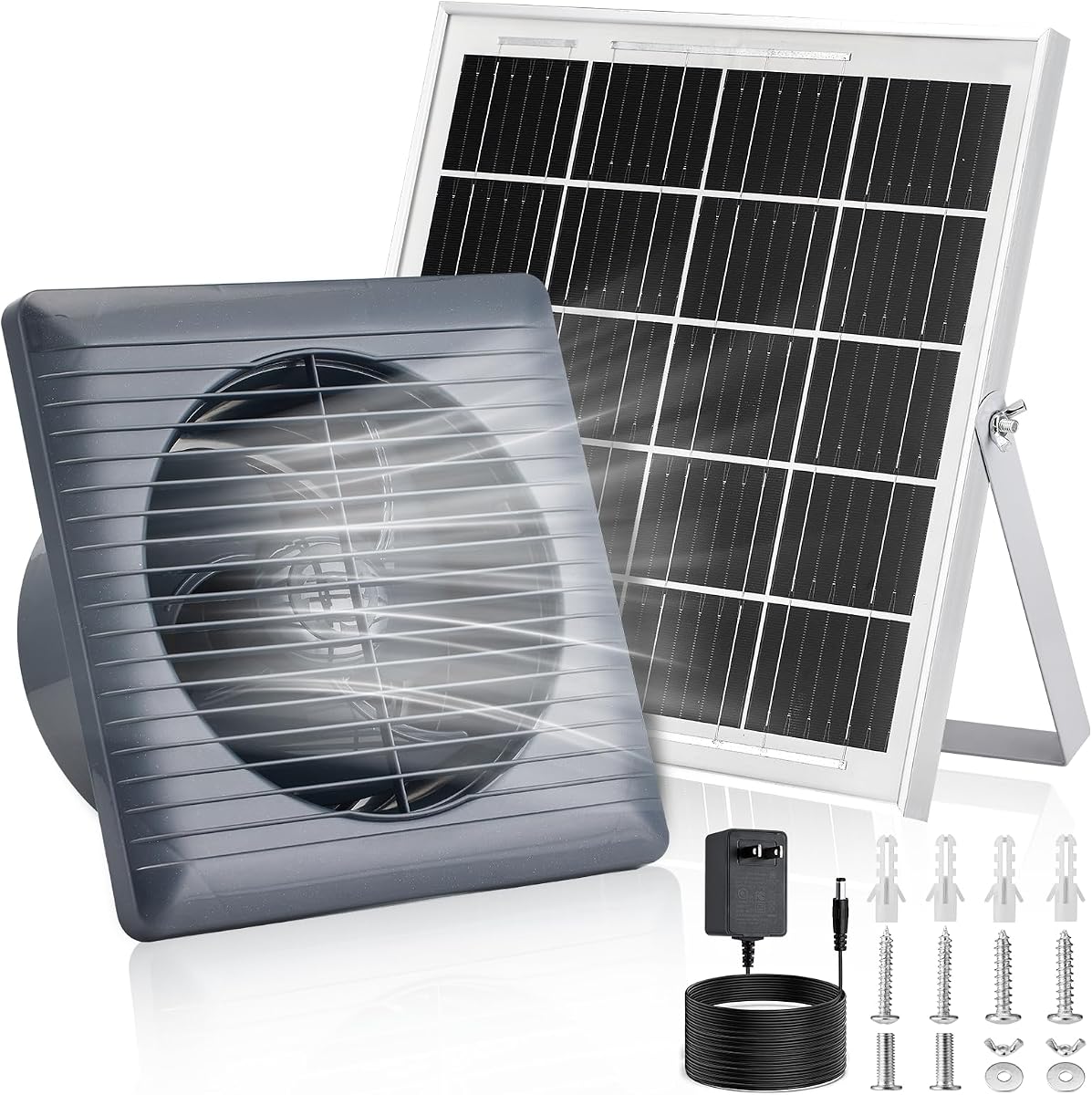




This 8-inch solar exhaust fan offers a balanced combination of airflow, flexible power, and straightforward installation. Its 4.1 rating reflects a generally capable design, with particular strengths in the 430 CFM airflow rating, 36 dB operation, and the ability to run from either its 25W panel or the included household-power adapter.
We may earn a commission when you buy through this link, at no additional cost to you.
The solar panel uses monocrystalline silicon and provides a stated conversion efficiency of up to 21.5%. A 16.4-foot panel cable allows the panel to sit where it receives the best sunlight, while the shorter adapter cable makes grid-powered operation practical. The built-in anti-backflow valve remains closed when the fan stops, helping block insects, debris, and unwanted outdoor airflow.
Its main compromise is the lack of intelligent controls. There is no thermostat, timer, or automatic night mode beyond the optional adapter, so owners must manage operation manually. Installation also calls for a 7-inch hole, and the bracket must be positioned carefully to capture useful sunlight. Even so, the 430 CFM output gives it more ventilation potential than many similarly compact options.
This is a strong general-purpose choice for medium-sized sheds, greenhouses, chicken coops, pet houses, and similar structures. Choose it when reliable daytime solar operation is desired but nighttime ventilation is needed only occasionally. Buyers prioritizing automatic control should look toward the HG Power system, while those needing an even smaller installation may prefer the 6-inch model.
The included adapter changes this from a strictly daylight-dependent fan into a system that can maintain airflow after sunset or during poor weather. This makes it especially useful in sheds where animals need consistent ventilation or where stored materials should not collect nighttime humidity.
A rated 430 CFM airflow makes the fan more capable than small hobby models without requiring the large 12-inch housing found in premium options. The stated 36 dB operating level also supports use near coops and pet houses where a louder motor could be distracting.
We may earn a commission when you buy through this link, at no additional cost to you.
This 8-inch solar exhaust fan combines a brushless motor with 430 CFM of airflow and a 4.0 rating. It is particularly useful for owners who want clearer guidance about enclosure size because the manufacturer recommends approximately 100–250 square feet and notes that coverage can vary with height, sunlight, and airflow resistance.
We may earn a commission when you buy through this link, at no additional cost to you.
The 25W monocrystalline panel is paired with a 16.4-foot cable and a 4.9-foot AC adapter cord. That arrangement lets the panel be positioned in direct sun while the fan remains close to the vent. Its anti-backflow valve helps prevent insects and debris from entering whenever the fan is stopped, and the included bracket and screws support a straightforward installation.
The brushless motor is rated at no more than 36 dB and is designed for smoother, quieter operation with less vibration than conventional brushed motors. The fan housing has an IP44 rating, while the toughened-glass solar panel carries an IP67 rating. There is no thermostat, timer, or adjustable speed, however, and performance will decline when sunlight is weak.
This model suits medium garden sheds, greenhouses, coops, and pet shelters needing dependable exhaust ventilation. It is especially attractive for buyers who value the explicit 100–250-square-foot recommendation and a manufacturer acknowledgment that actual performance depends on the enclosure. For highly compact spaces, the 6-inch alternative is easier to fit; for automated operation, the 12-inch HG Power model offers more controls.
The stated 100–250-square-foot recommendation helps narrow the field for shoppers comparing similarly sized fans. It also acknowledges that an enclosure's height and internal resistance can change real-world results, making airflow ratings more useful when they are paired with practical installation guidance.
The brushless motor reduces mechanical noise and vibration while supporting smooth, continuous operation. At a stated maximum of 36 dB, the fan is designed for installations where quiet ventilation matters, including animal housing and small greenhouses near frequently occupied areas.
We may earn a commission when you buy through this link, at no additional cost to you.
The HG Power 12-inch solar exhaust fan is the most feature-rich model in this comparison, earning a 4.8 rating. It combines a 40W bifacial solar panel, a 12-inch shutter fan rated for up to 764 CFM, dual power sources, two operating modes, and a thermostat with a selectable temperature range.
We may earn a commission when you buy through this link, at no additional cost to you.
Its intelligent controls make it suitable for more than a simple exhaust opening. Energy Saving mode varies fan speed with available sunlight while allowing the adapter to provide backup airflow. Performance mode offers speed settings from 1 through 4 when the adapter is used. Owners can set a target temperature from 68 to 113 degrees Fahrenheit, and a 10-minute delay after cooling prevents rapid on-and-off cycling.
The 10-minute delay is a deliberate motor-protection feature rather than a fault. The bifacial panel can collect sunlight from both sides, and the included 16.4-foot solar and adapter cables provide placement flexibility. The main drawback is physical size: a 12-inch shutter fan requires more wall or roof area than the smaller models, and the control system makes it less minimalist.
This is the best pick for owners who want solar ventilation with genuine automation. It works well in larger workshops, barns, basements, greenhouses, sunrooms, and sheds where temperature control is more important than finding the smallest possible vent. Choose the 6-inch model for a tiny enclosure, the 8-inch models for a simpler balance, or the 40W attic fan for maximum output without smart controls.
Setting a target temperature gives the fan a clear operating rule: start when the space becomes too warm and stop after it cools. The 10-minute continuation period reduces short cycling, which can be valuable in sheds where temperature changes gradually and motor longevity matters.
The system automatically favors solar energy when sunlight is available and can switch to the included AC/DC adapter when conditions are darker. Because it does not depend on a rechargeable battery, it avoids battery aging while still providing a way to maintain ventilation at night.
We may earn a commission when you buy through this link, at no additional cost to you.
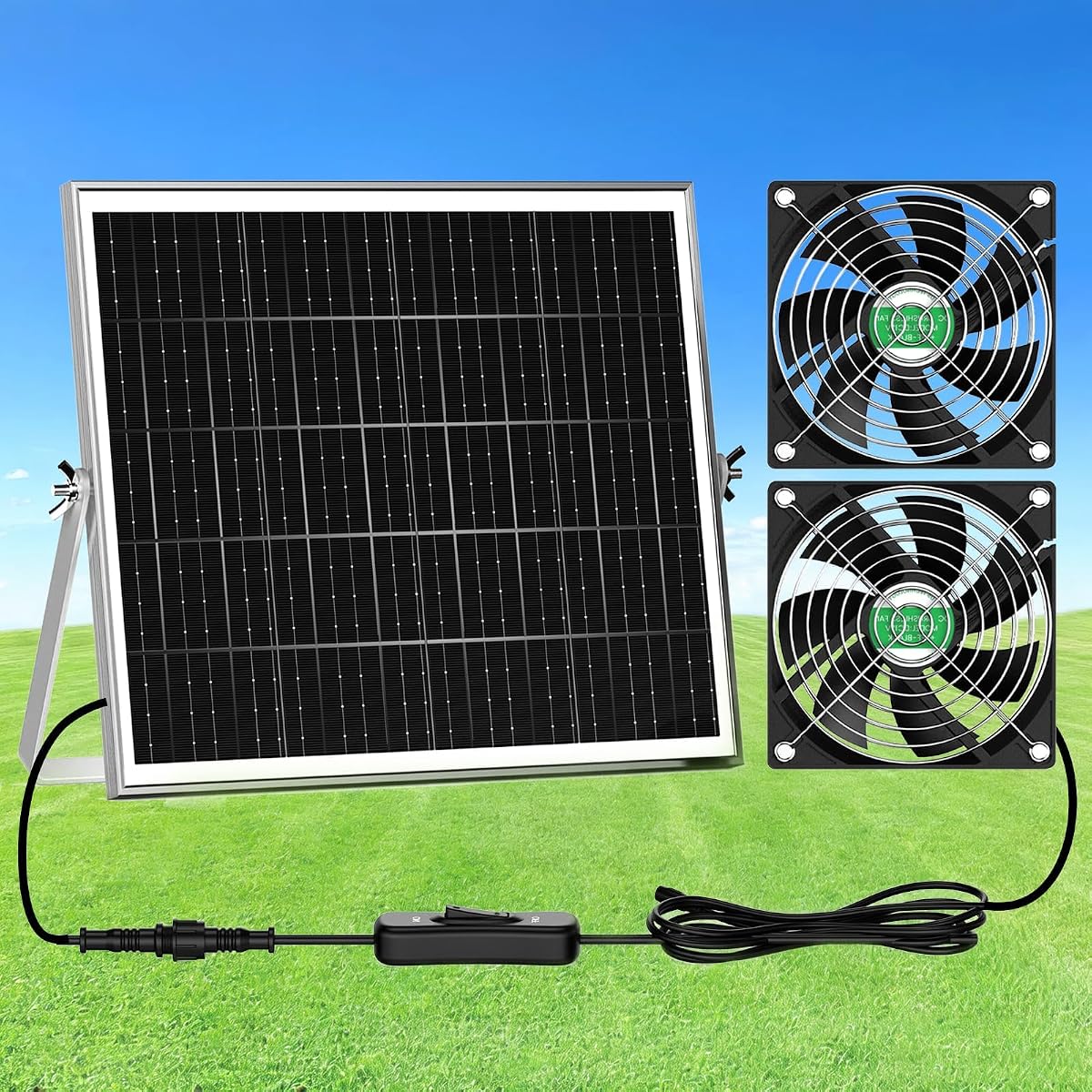
This 30W dual-fan solar panel kit offers straightforward daylight ventilation for small greenhouses, chicken coops, sheds, and pet houses. Its 3.9 rating is modest, but the design is approachable: the panel and fan connect with waterproof plugs, and no external power source, battery, switch, or speed setting is required.
We may earn a commission when you buy through this link, at no additional cost to you.
The dual-fan arrangement can move air actively while also improving circulation within the enclosure. A double-layer metal protective mesh helps prevent accidental contact with the blades and shields them from interference. The panel has pre-drilled holes for convenient wall or roof mounting, while the 8.2-foot extension cord provides some freedom between panel and fan placement.
Its largest limitation is that it is strictly solar and battery-free. The fan runs automatically in bright sunlight, produces stronger output as sunlight intensifies, and cannot provide power at night or in a dark indoor location. The absence of manual controls also means there is no way to force the fan off during unusually bright periods or adjust its output to suit changing conditions.
This kit is most appropriate for small spaces that need basic daytime cooling and circulation. It is a sensible starting option for a hobby greenhouse, compact coop, dog house, or garden shed where uncomplicated solar operation matters more than nighttime consistency. For larger enclosures, an 8-inch or 12-inch fan offers greater airflow; for after-dark ventilation, choose a battery or adapter-equipped model.
Two fans can distribute air more effectively across a compact enclosure than a single small unit. The arrangement is useful for coops and greenhouses where uneven hot spots can develop near the roof, particularly when the panel receives strong direct sunlight.
Waterproof connectors, pre-drilled mounting holes, and an included 8.2-foot cord reduce the need for complex wiring. The IPX7 panel is suitable for exposed outdoor placement, although the entire installation should still be positioned to minimize standing water and follow the manufacturer's guidance.
We may earn a commission when you buy through this link, at no additional cost to you.
The Compact 6-Inch Solar Fan is designed for enclosures under 30 square feet, making it a better spatial match than an 8-inch model for mini sheds, rabbit hutches, compact coops, and small pet houses. It has a 4.1 rating and combines a 25W panel with up to 380 CFM of airflow.
We may earn a commission when you buy through this link, at no additional cost to you.
Its brushless motor operates at no more than 28 dB, making it the quietest operating specification in the group. That low noise is valuable in animal enclosures where constant mechanical noise can add stress. The fan also supports both solar and household-power operation, using a 16.4-foot solar cable and 4.66-foot adapter cable for flexible positioning.
The backflow valve helps maintain the intended airflow direction and limits insect entry when the fan stops. Its solar panel has a stated 21.5% conversion rate, tempered glass, an aluminum frame, and an IP67 waterproof rating. The trade-off is capacity: 380 CFM is useful for small structures but may feel constrained in a tall, wide, or poorly sealed shed.
Buy this model when enclosure dimensions are tight and quiet operation is the priority. It is a sensible choice for small coops, hutches, pet houses, and mini sheds, particularly if household power is available as an after-dark fallback. Larger garden sheds and workshops are better served by the 8-inch or 12-inch alternatives.
The stated recommendation for areas under 30 square feet prevents buyers from assuming that a smaller fan automatically means weaker performance. In a correctly sized enclosure, 380 CFM can provide meaningful ventilation while occupying less wall space than larger alternatives.
At a stated maximum of 28 dB, the fan is designed to avoid disturbing nearby animals or household activity. The brushless motor also reduces vibration and supports durable operation, which is useful in coops and pet houses where the fan runs for extended periods.
We may earn a commission when you buy through this link, at no additional cost to you.
The 25W Metal Solar Powered Fan combines a rugged frame with a large 18,000mAh internal battery, giving it a 4.4 rating and a clear advantage for users who need ventilation after sunset. It can use stored solar energy during cloudy periods and at night, avoiding the complete shutdown associated with battery-free fans.
We may earn a commission when you buy through this link, at no additional cost to you.
The metal frame provides sturdiness and corrosion resistance for exposed outdoor use. The fan carries an IP65 waterproof rating, includes a steel mesh guard, and is described as suitable within a temperature range of 5 to 140 degrees Fahrenheit. A 16.4-foot waterproof cable allows the panel to be placed for strong sun exposure while the fan sits at the desired vent.
Installation is designed to be accessible, with pre-drilled holes, supplied screws, and instructions. The fan can be mounted on walls, roofs, or windows. Unlike products with thermostat controls, this system runs according to its power availability and does not offer a programmed shutdown or temperature threshold, so managing the battery and sunlight remains the user's responsibility.
This is a strong fit for chicken coops, sheds, greenhouses, barns, RVs, pet houses, and attics where overnight circulation is important. Its metal construction is appealing for buyers prioritizing durability, while the battery makes it more flexible than daylight-only kits. It does not match the HG Power model for automated control, but it may be more practical where simple solar charging is preferred.
The 18,000mAh battery preserves airflow after dark, provided the panel has received sufficient sunlight. This is an important distinction from battery-free models and makes the system better suited to coops where nighttime heat accumulation can remain a concern.
A metal frame and steel mesh guard suit outdoor installations where impact, corrosion, and weather exposure matter. The stated IP65 rating adds confidence during rain, while the wide operating temperature specification supports use across changing seasonal conditions.
We may earn a commission when you buy through this link, at no additional cost to you.
This two-fan kit uses a 20W monocrystalline panel and includes a detachable fan and solar panel for flexible exhaust or intake placement. It carries a 4.2 rating and is positioned for small greenhouses, chicken coops, sheds, pet houses, attics, and windows, with a stated suitability for spaces of about 130 square feet.
We may earn a commission when you buy through this link, at no additional cost to you.
Maximum speed is listed at 3,200 RPM, indicating a high-velocity design, although the manufacturer does not provide a CFM airflow figure. That distinction matters: RPM alone does not tell a buyer how much air is moved through a particular enclosure. The detachable arrangement allows the panel to remain outside while each fan is positioned to exhaust stale air or draw in fresh air.
Construction uses heavy-duty aluminum, an IP67 waterproof panel, and dual metal protective nets. The supplied accessories include mounting plates, screws, a solar-panel bracket for upright, wall, or roof installation, and nylon ties for pole hanging. Because the product has no battery, it operates only during daylight and slows as available sunlight weakens.
The kit is appealing for buyers who want two installation points or plan to use one fan for intake and another for exhaust. Its lack of a battery and relatively compact fans make it better for daytime cooling than continuous overnight ventilation. For a clearer airflow comparison, the 8-inch models provide stated CFM ratings; for automated ventilation, the 12-inch HG Power system is more versatile.
Two fans can be installed at different openings to create a more complete circulation path. This may be especially useful in a shed with an intake point on one wall and an exhaust point on another, although the listed operation should be confirmed during installation.
The 3,200 RPM specification indicates rapid blade rotation in suitable sunlight. Because no CFM rating is provided, buyers should judge the product primarily by enclosure size and installation geometry rather than comparing its motor speed directly with models that publish airflow volume.
We may earn a commission when you buy through this link, at no additional cost to you.
The 40W Solar Attic Fan is the highest-output model in this guide, with airflow stated at 1,800–2,000 CFM and a 4.5 rating. Its 12-inch metal blades and heavy-duty pure copper motor are designed for demanding ventilation applications such as attics, garages, workshops, barns, greenhouses, and larger sheds.
We may earn a commission when you buy through this link, at no additional cost to you.
The system has no thermostat or user controls. It starts operating with available sunlight and stops at dusk, creating a genuinely controller-free setup with fewer electronic components that could require service. The panel and fan arrive pre-connected, reducing the amount of wiring required during setup and making the system more approachable for straightforward installations.
Durability receives strong emphasis. The housing is described as hail-resistant metal, while the motor has an IP65 weather-resistant design. The manufacturer also describes the operating sound as comparable to a quiet conversation rather than a high-pitched hum. As with any large roof or wall fan, structural support and secure mounting remain important because the moving assembly is heavier than a small vent fan.
This is the appropriate choice for a large shed or workshop where maximum heat removal matters more than temperature-based automation. It can also ventilate an attic, garage, greenhouse, or barn. Buyers should not choose it for a tiny enclosure, where a compact model is easier to install and more proportionate. Those wanting a thermostat and selectable speeds should consider the HG Power system instead.
With a maximum airflow of 2,000 CFM, this fan is designed to move substantial volumes of air through larger structures. It is the most compelling option here for a high-ceiling workshop, broad garage, or sizable shed where smaller exhaust units would struggle to exchange air effectively.
The heavy-duty copper motor and metal housing address long-term outdoor exposure better than a lightweight plastic assembly. The stated IP65 motor protection and hail-resistant construction make the system suitable for seasonal roof or exterior-wall ventilation when installed according to the guide.
We may earn a commission when you buy through this link, at no additional cost to you.
The Solar Fan with Battery and Timer is designed for users who want both daytime solar operation and scheduled overnight ventilation. Its 3.9 rating reflects a useful feature set, particularly the 15,000mAh battery, 12–15-hour stated runtime after a full charge, and timer choices of three or six hours.
We may earn a commission when you buy through this link, at no additional cost to you.
The 25W panel is described as requiring six to seven hours of sunlight to fully charge the battery. During the day, the fan can run directly in response to solar power. At night, the timer controls how long it continues running, allowing owners to establish a predictable cooling period after sunset without leaving the fan on indefinitely.
The fan also supports both intake and exhaust configurations, which can improve circulation when paired with another vent opening. A metal protective grille helps shield the blades, and the product is described as corrosion-resistant, waterproof, and rustproof. Its 16.4-foot extension cord allows the panel and fan to be separated, while waterproof connectors support plug-and-play setup.
This is a useful choice for chicken coops, greenhouses, sheds, barns, RVs, attics, and pet houses where predictable nighttime operation matters. The timer is limited to nighttime, so it cannot provide the same general scheduling flexibility as a thermostat system. Buyers should also account for battery aging and ensure the panel receives enough daily sunlight to maintain the stated runtime.
The three- and six-hour settings provide a simple way to continue ventilation after sunset. This is useful where trapped nighttime heat could affect animals but there is no need for the fan to run indefinitely once the structure has cooled.
A 16.4-foot extension cord allows the panel to be mounted where sunlight is strongest while the fan occupies a practical wall or window opening. This separation also makes it easier to orient the unit for intake or exhaust without changing the sun exposure of the panel.
We may earn a commission when you buy through this link, at no additional cost to you.
The 7.1-Inch Solar Greenhouse Fan has a 3.7 rating, the lowest in the comparison, but it offers an attractive combination of size, high rotational speed, and straightforward exhaust or intake installation. It is intended for areas of approximately 80–120 square feet, including small greenhouses, coops, sheds, pet houses, and cabins.
We may earn a commission when you buy through this link, at no additional cost to you.
Its maximum speed of 3,800 RPM is among the highest listed, creating a high-velocity stream of air when sunlight is strong. The separate fan and panel can be positioned independently, and changing the fan's orientation allows it to exhaust stale air or draw in fresh air. It cannot perform both intake and exhaust functions simultaneously, so the installation must be chosen deliberately.
Durability comes from an IP65-rated construction, heavy-duty aluminum frame, and double-layer metal mesh guards. The adjustable panel bracket helps optimize sun exposure, and a 16.5-foot cord gives sufficient separation between the panel and fan. The tradeoff is that there is no battery, so the fan slows in cloudy conditions and stops after sunset.
This model is best for a small-to-medium shed or greenhouse that mainly needs daytime ventilation. It may appeal to buyers who prioritize fan diameter, rotational speed, and the ability to reverse intake and exhaust roles. For dependable nighttime cooling, add a battery or adapter model; for clearer airflow-volume comparison or automated control, consider one of the higher-ranked 8-inch or 12-inch systems.
The fan can be flipped to change its role, giving owners flexibility in how fresh air enters and stale air leaves the enclosure. This is useful when the best panel location and the most effective opening do not align with a fixed airflow direction.
The 3,800 RPM maximum speed is designed to generate vigorous airflow under strong sunlight. Since the unit has no stored-power system, performance is inherently tied to available light, making panel placement the most important installation consideration.
We may earn a commission when you buy through this link, at no additional cost to you.
A suitable solar vent fan should match the shed's dimensions, solar exposure, ventilation schedule, and structural constraints. Compare airflow and power configurations first, then examine installation, weather resistance, safety, and noise before making a final selection.
Fan size alone does not determine ventilation performance, but it provides a useful starting point. The 6-inch model is specifically recommended for enclosures under 30 square feet, the 7.1-inch model for about 80–120 square feet, and the 8-inch models for approximately 100–250 square feet. The 12-inch HG Power fan produces 764 CFM for a more substantial space, while the 40W attic model reaches 2,000 CFM for large or hot structures. Enclosure height, opening design, and internal resistance can alter real results.
Choose a model whose published guidance fits your shed, and avoid oversizing a small enclosure with an unnecessarily powerful fan.
Solar-only fans are inexpensive and simple but stop after sunset and may slow substantially under clouds. Battery-equipped systems can continue after dark, although runtime depends on sunlight and battery condition. Models with an AC adapter provide dependable nighttime power without a rechargeable battery, while the HG Power unit automatically transitions between solar and adapter power. Determine whether daytime cooling is enough or whether animals, plants, or stored materials require ventilation overnight.
Prioritize continuous power for overnight use, but account for the additional components and maintenance associated with batteries or electrical connections.
Thermostats, timers, and selectable speeds help prevent unnecessary energy use and short cycling. The HG Power fan provides a temperature range of 68–113 degrees Fahrenheit, a 10-minute shutdown delay, energy-saving and performance modes, and four speed levels when its adapter is used. The battery-and-timer model offers three- or six-hour nighttime settings. Simpler fans may include only a manual on/off switch or operate automatically with sunlight.
Choose advanced controls for workshops, greenhouses, or occupied animal areas, but verify how each mode is powered and when it is active.
Panel wattage influences how well a fan performs under limited light, but the panel's orientation and unobstructed sunlight access are just as important. The products use 20W, 25W, 30W, or 40W panels, with the 40W HG Power unit using a bifacial design. Mount the panel away from shadows and use the supplied cable to separate it from the fan. Adjustable brackets help maintain a favorable angle throughout the day.
A higher-output panel can be useful in shaded or variable weather, but no panel can fully replace direct sunlight.
Outdoor shed fans face rain, wind, dust, temperature changes, and long-term ultraviolet exposure. Look for a clearly stated panel rating, such as IP65, IP67, or IPX7, and consider the fan housing separately because a weather-resistant panel does not guarantee the same protection for the motor. The 8-inch Solar Exhaust Fan uses an IP67 panel, the 5.5-inch kit also lists IP67, and several other systems use IP65 ratings for the fan or motor.
Favor products with sealed connections, corrosion-resistant frames, and clearly described outdoor ratings, then install them according to the included guidance.
Solar ventilation usually requires a wall or roof opening, a separate panel position, and a cable route between them. The 8-inch models call for a 7-inch hole, while the 6-inch model uses a 5.6-inch opening. Larger 12-inch systems need more structural support and careful clearance around the shutter or blades. Some kits arrive with pre-connected components, while others require the fan, panel, controller, and cables to be assembled according to the manual.
Measure the opening, available wall space, roof pitch, and cable length before ordering to avoid an incompatible installation.
Coops, rabbit hutches, and pet houses are frequent places where ventilation fans operate, so noise and blade protection matter. Stated noise levels range from 28 dB on the 6-inch brushless model to 36 dB on the 8-inch models. Metal protective mesh or double-layer guards reduce accidental contact with the blades. A backflow valve can also limit insect and debris entry when the fan stops.
For animal housing, look for both a guarded fan and a low-noise motor, then confirm that the mounting position keeps the opening secure.
Long-term support can be valuable because wiring, controllers, batteries, and exposed fans may require troubleshooting. The 5.5-inch two-fan kit includes 24/7 support and a stated two-year warranty. The 40W attic fan includes 12 months of dedicated product support. For other models, review the current listing and manufacturer information carefully to understand what coverage and replacement service are available.
Save the installation instructions and keep proof of purchase, especially when adding a thermostat, battery, or permanently mounted roof assembly.
Begin by measuring the intended wall or roof opening, checking for electrical cables or structural members, and selecting a location that lets the fan pull air through the shed rather than recirculating stale air. Install the panel in unobstructed sunlight, angle it using the included bracket, and secure it with the provided hardware. Follow the product's manual for the exact cutout diameter and clearance requirements.
Connect the fan and panel with the specified waterproof connector, paying close attention to the direction of airflow. Products designed for intake and exhaust may use an arrow or require the fan to be flipped. Position the opening so rain is not driven directly into the shed, and confirm that guards, shutters, valves, and brackets cannot contact the fan blades.
For upkeep, disconnect the power before removing guards or adjusting the installation. Clean accessible blades and screens with a soft brush or damp cloth, avoid directing powerful water into the motor, and check the cable connections for dirt, corrosion, or damage. Keep the solar panel free of leaves and debris, inspect fasteners periodically, and monitor battery condition on models that store energy. If airflow becomes weak, first confirm that the panel receives direct sunlight and then check for obstructions.
That depends on the model. Battery-free fans stop after sunset and may run slowly under heavy cloud cover, while battery-equipped units can continue for several hours after the battery has been charged. Fans with an included AC adapter can also operate at night. Check the power configuration carefully if consistent overnight ventilation is a priority.
The correct size depends on the shed's floor area, height, existing openings, and how much heat needs to be removed. Compact 6-inch and 7.1-inch models suit smaller enclosures, while 8-inch options are more appropriate for medium spaces. Larger 12-inch fans are intended for workshops, attics, garages, and other areas that need substantially greater airflow.
The requirement depends on the enclosure and what is stored or housed inside. Published CFM ratings are useful for comparing products, but actual results also depend on the opening size, internal resistance, and whether the fan is used as intake or exhaust. Match the manufacturer's space recommendation and consider adding a complementary opening to create a clear airflow path.
Most will still operate under cloudy skies, but solar output and fan speed generally decrease as sunlight becomes weaker. Battery-equipped systems may continue longer because stored energy can supplement reduced generation. Grid-powered backup offers the most consistent alternative, and panel placement should prioritize the clearest available sunlight throughout the day.
No. Several models operate directly from the panel and use no battery at all. Others include a rechargeable battery for nighttime use, while some use a household-power adapter instead. Battery-free systems are simpler and avoid battery degradation, but they cannot provide consistent ventilation after dark.
Mount the panel where it receives direct sunlight for as much of the day as possible. Avoid tree shade, roof overhangs, and walls that remain dark. Use the supplied adjustable bracket and cable to place the panel separately from the fan, and periodically check whether seasonal changes require the angle to be adjusted.
A reversible fan can be oriented as either intake or exhaust, but most operate in only one direction at a time. A shed usually benefits from one opening drawing in fresh air and another releasing warm air. Installing a second fan can create a more balanced circulation path if the enclosure and roof structure allow it.
It is not essential for basic daytime ventilation, but it can make operation more efficient and consistent. A thermostat starts the fan when the shed reaches a chosen temperature and can delay shutdown to avoid rapid cycling. It is particularly useful in greenhouses, animal shelters, and workshops where temperature control is important.
The HG Power 12-inch system is the strongest all-around choice because it combines strong airflow, a thermostat, multiple operating modes, and seamless solar-to-AC backup. The 40W Solar Attic Fan leads in maximum output for large structures, while the 30W dual-fan kit provides a practical, uncomplicated option for smaller spaces that need daytime ventilation.
Prioritize enclosure size first, then decide whether your schedule requires daylight-only, battery-backed, or continuous nighttime operation. Also account for opening size, panel placement, weather exposure, noise, and whether thermostat control would add meaningful convenience. The right fan is the one that moves enough air for the structure without being oversized, difficult to mount, or unnecessarily complex.
Before purchasing, verify the current listing, included accessories, installation requirements, warranty terms, and latest product details because specifications and prices can change. For most medium sheds, an 8-inch model offers the simplest balance of capacity and flexibility, while compact structures and larger workshops have clearly better options elsewhere in this guide.