
Ozone Generator 45,000mg/h
4.7Editor score
45,000 mg/h ozone output
Coverage up to 2,500 sq ft
Long 35,000-hour lifespan
Our Ozone Generator for Crawl Space guide compares 10 models for output, coverage, safety, controls, and fit across common crawl-space odor problems and
An ozone generator for a crawl space can help remove persistent mustiness, smoke, pet, moisture-related, and household odors by treating the air throughout an enclosed area. The right unit should combine adequate ozone output, useful airflow, simple controls, and clear operating guidance, while always being used only in an unoccupied space.
We compared 10 ozone generators using the information supplied for each product, including rated output, claimed area coverage, timer design, fan configuration, portability, intended applications, and safety guidance. The guide covers compact household units, high-capacity machines for larger areas, and commercial models intended for demanding odor-removal work.
Each review explains where the model stands out, what trade-offs deserve attention, and which situations may suit it best. Ratings and product availability can change over time, as can selling prices, so readers should confirm the current listing details before making a purchase decision.
4.7Editor score

4.2Editor score

5.0Editor score
The comparison below places all 10 machines side by side, with particular attention to ozone output, stated coverage, controls, fan or core design, portability, and the applications each manufacturer identifies. These figures reflect the supplied product information and should be considered alongside the safety requirements for operating an ozone generator in an unoccupied crawl space.


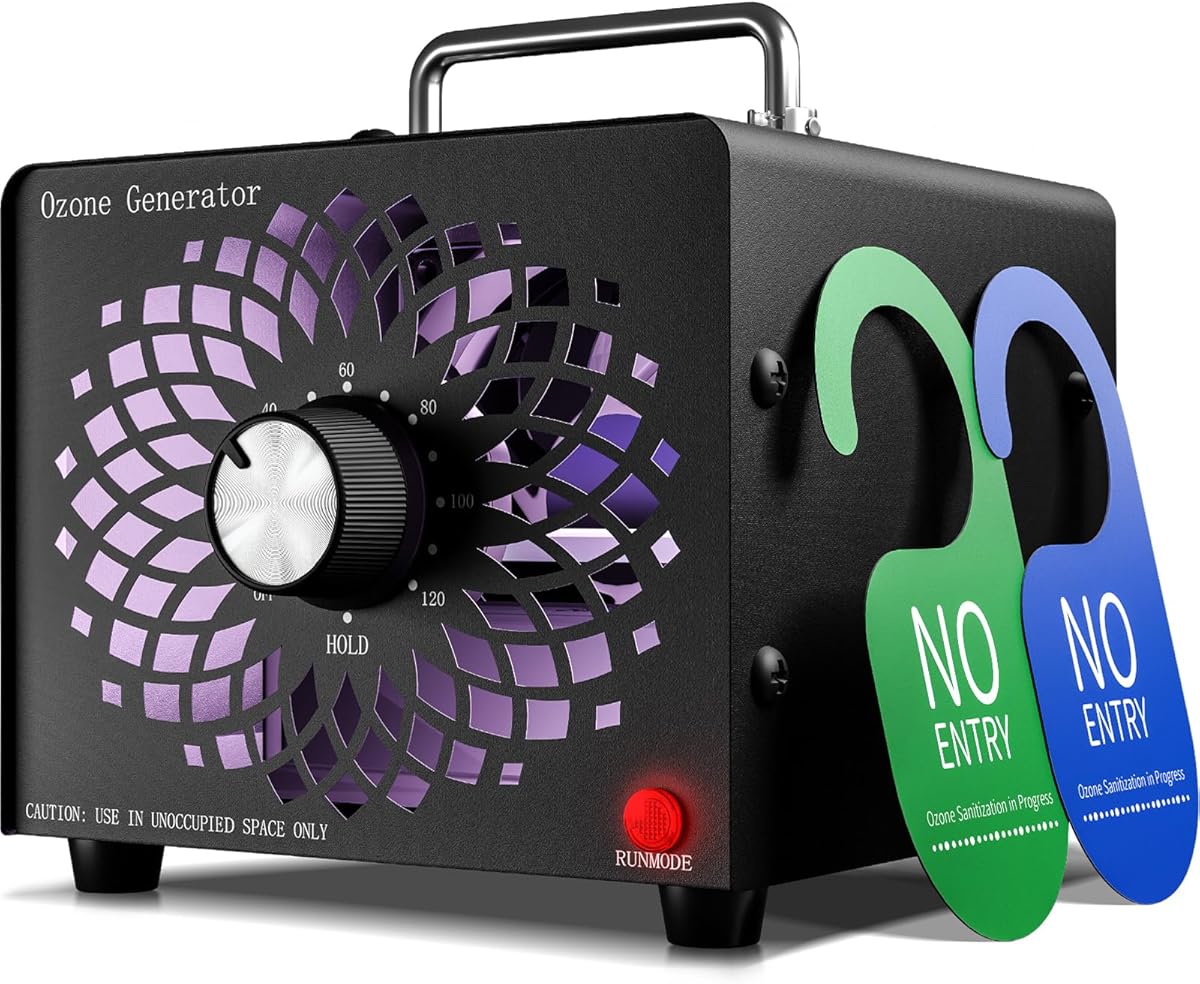


This home-and-industrial ozone machine pairs a 45,000 mg/h output rating with coverage for spaces up to 2,500 square feet, making it a practical option for many residential crawl spaces. Its 4.7 rating is among the strongest in this guide, and the listed applications include basements, cars, kitchens, bathrooms, boats, and pet areas. Its most useful trait for a buyer is the balance between substantial output and a relatively compact, non-commercial design.
We may earn a commission when you buy through this link, at no additional cost to you.
The manufacturer says a fully paved, upgraded single-layer ozone plate produces the 45,000 mg/h output, while the long claimed lifetime of up to 35,000 hours reduces the perceived need for routine replacement. Maintenance is straightforward because the product does not require complex internal parts beyond two pre-installed fuses. The listing also emphasizes cleaning the source of an odor before treatment, which is sensible because ozone can address airborne odor molecules but cannot repair a leaking pipe, damp material, or trapped waste.
Its main limitation is scale. A crawl space larger than the stated 2,500-square-foot area, or one with unusually heavy smoke, pet, or persistent musty odors, may benefit from a higher-output model with stronger airflow. The safety guidance is also demanding: people and pets must be absent, and the area should be ventilated for one hour after treatment so ozone can convert to oxygen before anyone returns.
This is a compelling choice for a homeowner addressing odor in a modest crawl space who wants more capability than a very small portable unit without moving to a commercial dual-core machine. It also suits people who want one machine for several enclosed areas, such as a crawl space, car, closet, gym bag, or pet zone. For those conditions, the 45,000 mg/h specification, simple construction, and strong customer rating make it the most balanced budget-oriented recommendation in this roundup.
A 45,000 mg/h rating and stated coverage of 2,500 square feet give the unit meaningful capacity for common residential applications. It is better matched to contained residential spaces than to large commercial environments, but that narrower scope makes the specification easier to match to a typical crawl-space footprint.
The single-layer ozone plate and two pre-installed fuses keep the internal design straightforward. The stated lifetime of up to 35,000 hours is a notable selling point for buyers who want a durable machine rather than a disposable treatment device.
We may earn a commission when you buy through this link, at no additional cost to you.
The HHGM 198,000mg/h Dual-Fan combines very high claimed output with front-and-rear turbo fans, giving it a strong technical foundation for larger crawl spaces. It is rated 4.2, which is lower than several alternatives, but its specification set is unusually well matched to broad odor-removal work. The listing identifies basements, homes, cars, offices, commercial spaces, boats, smoking areas, and pet rooms among its intended applications.
We may earn a commission when you buy through this link, at no additional cost to you.
Its dual-fan system is designed to move air more quickly and distribute ozone through irregular spaces. The manufacturer states that the design increases purification speed by 60%, extends coverage by 50%, and can reach up to 6,000 square feet. It also claims a service life of up to 40,000 hours and uses airflow and heat dissipation to reduce overheating and failure risks in hot, humid, or otherwise variable crawl-space conditions.
The controls are straightforward: a timer knob can be set for as long as 120 minutes, after which the machine shuts off automatically. That is useful for a planned treatment, although users must still leave the area and ventilate for at least 40 minutes before re-entering. The product is not available for sale in California, and its 4.2 rating may give cautious buyers more pause than the higher-rated models.
Choose this machine when the crawl space is large, odors are substantial, and stronger circulation is a priority. It offers a compelling combination of output, airflow, stated coverage, and timed operation for users who need more capacity than the budget recommendation. Those who prioritize a higher customer rating may prefer the Powerscale or Enerzen, while this model remains a practical editor-selected option for demanding residential and light commercial spaces.
The front-and-rear fan arrangement is intended to move ozone through a space more quickly and evenly than a single-fan layout. That makes the design useful for crawl spaces with irregular shapes, multiple low points, or heavier odor concentrations that require thorough circulation.
A knob-based timer with a 120-minute maximum and automatic shutoff makes it easier to establish a defined treatment period. The machine still requires a complete exit and at least 40 minutes of ventilation afterward, so automation should never be confused with unattended safe occupancy.
We may earn a commission when you buy through this link, at no additional cost to you.
This upgraded generator delivers a claimed 55,000 mg/h of ozone for spaces up to 6,000 square feet. Its 4.5 rating and below-30-decibel operating specification distinguish it from many of the louder industrial-style units in the guide. The product is positioned for strong odor removal in crawl spaces, basements, cars, boats, dumpsters, kitchens, and bathrooms, although no people, animals, or plants may be present during operation.
We may earn a commission when you buy through this link, at no additional cost to you.
A clear advantage is the combination of output and quiet operation. The low noise specification can be helpful in a residential setting because the machine can run through a planned cycle without producing the sharp operating sound associated with some high-output devices. Users can select a timer of up to 120 minutes or use the hold setting for continuous operation, while the simple control layout avoids the need for specialist setup knowledge.
The manufacturer says ozone reacts with odors in the air and on surfaces such as fabrics and walls rather than simply masking them. That distinction is helpful in a crawl space, where porous materials can retain odors, although source cleaning and moisture correction remain important. The listed post-treatment ventilation period is 30 to 60 minutes, and the product is not available for sale in California.
This model is a good middle ground for someone who wants substantial stated coverage and quiet operation without moving to the dual-core commercial class. It may appeal particularly to households with sensitive neighbors or animals nearby because low noise can reduce disturbance. It is less transparent than some competitors because the supplied information does not describe its fan arrangement in detail, but the combination of 55,000 mg/h output, 6,000-square-foot claim, and quiet operation remains appealing.
An operating level below 30 decibels makes the generator more considerate for planned residential use. Noise does not eliminate the need to leave the building, but it can make treatment timing easier to manage around nearby occupied areas.
The timer can run for as long as 120 minutes, while the hold option supports continuous treatment. Continuous use demands strict adherence to the unoccupied-space requirement and should never be treated as a substitute for the prescribed ventilation period.
We may earn a commission when you buy through this link, at no additional cost to you.
This blue ozone generator combines 200,000 mg/h of claimed output with a stated treatment area of up to 7,000 square feet, the largest area figure among the products compared. That makes it a natural consideration for larger crawl spaces, deep basements, or commercial areas where spreading ozone through a large volume is the priority. Its customer rating of 4.4 also places it above the middle of the group.
We may earn a commission when you buy through this link, at no additional cost to you.
The machine has a metal construction that the listing describes as elegant and sturdy. It can handle smoke, pet, car, cooking, and general odors, with boats, dumpsters, kitchens, basements, and bathrooms listed as suitable environments. Operation is based on a rotary control: a timed setting provides a defined cycle, while hold mode releases ozone continuously until the knob is turned off manually.
The continuous setting offers flexibility but is the main operational caution. Because the user must manually stop the machine, there is no automatic shutoff built into that mode. The product also instructs users to keep people, pets, and plants out of the enclosed area during operation and allow 30 minutes after treatment for residual ozone to dissipate. That waiting period must be respected even if the odor seems to have faded.
This generator fits buyers who prioritize maximum stated coverage and sturdy construction over a digital interface. Its 200,000 mg/h output gives it more than enough capacity for many residential crawl spaces, while the 7,000-square-foot claim broadens its potential use. For a smaller enclosed area, however, a lower-output model may be easier to control and could leave more room for a conservative treatment plan.
The 7,000-square-foot claim makes this one of the strongest options for large crawl spaces. A large footprint does not guarantee equal odor distribution, so the machine should still be positioned carefully and given enough time to treat the full enclosure.
Metal construction is useful in a crawl space or basement where the machine may encounter dust, temperature changes, and frequent handling. It also gives the unit a more substantial feel than lightweight plastic alternatives.
We may earn a commission when you buy through this link, at no additional cost to you.
The Enerzen 60,000mg Industrial O3 Air Purifier Deodorizer is a well-established option with a 4.6 rating, placing it among the most favorably reviewed machines in this guide. Unlike a conventional purifier that treats only air drawn through a filter, the listing says this ozone generator does not require air to pass through the machine to remove odors. That distinction can be useful when odor molecules are distributed throughout a crawl space.
We may earn a commission when you buy through this link, at no additional cost to you.
Its intended applications are unusually broad: cars, boats, dumpsters, kitchens, bathrooms, basements, flood- and fire-affected areas, and spaces with cooking, smoking, pet, musty, or general odors. This makes the machine relevant not only to routine residential crawl-space mustiness but also to remediation work following contamination, flooding, or smoke. A mechanical timer provides uncomplicated operation.
The main omission in the supplied specifications is a stated square-foot coverage figure. Buyers must therefore judge the machine primarily by its 60,000 mg/h output and intended applications rather than a manufacturer coverage claim. The unit also uses an older-style mechanical timer rather than a digital display, and it is not available for sale in California. As with all ozone generators in the roundup, people, pets, and plants must be removed.
The Enerzen is a good fit for buyers seeking a recognizable 4.6-rated machine for whole-space odor treatment without the complexity of digital controls. It may be especially appealing for basements, vehicles, and remediation-style jobs where treating the entire enclosure matters more than quiet operation or exact timing visibility. It is less suited to buyers who need a clear area-coverage number or a precise digital cycle readout.
Because the machine does not depend on contaminated air passing through a filter, it can treat odor-bearing air throughout an enclosed space. That whole-room approach is particularly relevant for distributed crawl-space odors and porous surfaces that release smells.
The listed use cases include flood- and fire-affected areas in addition to routine musty, smoke, and pet odors. That broad range gives the machine value for property maintenance, restoration, and contamination-control applications.
We may earn a commission when you buy through this link, at no additional cost to you.
This high-output ozone generator is rated 4.6 and combines a claimed 160,000 mg/h production rate with coverage for spaces up to 6,000 square feet. Its distinguishing feature is a temperature and humidity display, which can help users understand the environmental conditions during a treatment. Crawl spaces often have elevated moisture and uneven temperatures, making those readings practically relevant.
We may earn a commission when you buy through this link, at no additional cost to you.
The machine is described as industrial-grade and is intended for home, car, and pet odors. Its output and area figures place it above the compact residential units without reaching the 200,000 or 500,000 mg/h classes represented elsewhere in the guide. A reader looking for a clear readout in a damp or variable environment may find that more informative than a basic knob-only machine.
The supplied information is concise, however, and does not specify the timer range, automatic shutoff behavior, fan arrangement, ventilation interval, or detailed safety procedure. Those omissions do not change the product's stated purpose, but they make the operating instructions in the manual especially important for a crawl-space application. A crawl space should be closed to contain the ozone, yet adequate post-treatment ventilation is also essential before anyone returns.
This generator is most suitable for a buyer who values environmental monitoring and wants more capacity than a smaller unit. Its 4.6 rating, 160,000 mg/h output, and 6,000-square-foot claim make it a credible middle-high option for residential or light commercial spaces. Buyers who need more transparent timer specifications may prefer one of the models with clearly described timed and automatic shutoff features.
The built-in display gives users useful context about conditions in the treated space. In a crawl space, those readings can help reveal unusually damp or variable conditions that may require moisture control in addition to odor treatment.
A claimed 160,000 mg/h output and 6,000-square-foot coverage put the unit well above compact models. It offers a practical capacity tier for larger crawl spaces where stronger output and wider distribution are priorities.
We may earn a commission when you buy through this link, at no additional cost to you.
The Powerscale 500,000mg/h Dual-Core is the premium selection in this guide, offering the highest stated output and the only perfect customer rating at 5.0. It is engineered for serious commercial and industrial odor removal, but its dual-core architecture, sustained-output design, and 4,000-square-foot treatment claim also make it suitable for the most demanding large crawl spaces.
We may earn a commission when you buy through this link, at no additional cost to you.
The key technical distinction is the use of two independent high-voltage cores, each driving its own plate set. The manufacturer says this produces steadier performance and longer service life under heavy use than forcing a single module harder. The stated 500,000 mg/h figure is described as sustained output rather than a momentary peak, while a 90-minute cycle is stated to cover up to 4,000 square feet.
Its digital control system is another major advantage. Users can set exact cycles from zero to 300 minutes on an LCD, avoiding the uncertainty of a mechanical dial that might drift or remain in the on position. A built-in 10-second startup delay gives users time to leave the treated area before ozone production begins. The removable, washable filter is designed for repeated professional work, and the product is backed by a one-year protection plan.
Choose this model when odor severity, repeat treatment, and operational precision justify a premium machine. It is particularly relevant to restoration contractors, property managers, kennels, hotels, restaurants, warehouses, dealerships, and other professional settings, as well as unusually large or heavily contaminated crawl spaces. For a small residential area, the output and commercial design may be more than necessary, but among high-capacity models it offers the most refined control package.
Running two high-voltage cores and separate plate sets distributes the workload more evenly than a single core pushed to its limit. The result is intended to be steadier output, lower strain, and a longer useful life under demanding treatment schedules.
The LCD timer allows exact settings from zero to 300 minutes, which is useful when a maintenance team must repeat treatment cycles consistently. The 10-second startup delay adds another layer of control by allowing personnel time to exit before generation begins.
We may earn a commission when you buy through this link, at no additional cost to you.
The Hadlook combines 48,000 mg/h of claimed ozone output with a portable, compact design intended to move easily among cars, kitchens, bathrooms, offices, warehouses, rental properties, and other enclosed spaces. Its 4.4 rating reflects generally positive customer reception, while the 48,000 mg/h output places it in the same broad capacity tier as the budget recommendation.
We may earn a commission when you buy through this link, at no additional cost to you.
Its controls are among the easier ones to understand. A timer knob can be set from 30 to 120 minutes, and a hold function provides continuous operation. The product description says ozone changes the molecular structure of odors and can address smoke, pet, car, cooking, and general smells. That broad odor focus makes the machine more versatile than a specialized single-problem device.
The principal limitation is that the supplied listing does not provide a stated square-foot coverage figure. Without that information, a buyer must base expectations on the 48,000 mg/h output and the physical size of the crawl space. The safety instructions call for thorough ventilation of at least 60 minutes after treatment, and the product is intended for odor management only and is not available for sale in California.
This model is a good option for landlords, homeowners, and maintenance professionals who need one compact machine for several locations. It is easier to carry than full commercial equipment and provides enough output for many residential odor jobs, while the timer choices help prevent accidental continuous treatment. For very large or severely contaminated crawl spaces, a dual-fan or dual-core model would offer more capacity.
The portable and compact construction makes the machine practical for rental inspections, vehicle deodorizing, and other jobs that require moving between sites. Portability does not reduce the need to leave people and pets out of the treated area.
Selectable cycles from 30 to 120 minutes offer a controlled starting point, while hold mode gives experienced users flexibility. The ventilation guidance remains the same in either case: open the area and wait at least 60 minutes before re-entry.
We may earn a commission when you buy through this link, at no additional cost to you.
This portable ozone generator is the smallest-capacity option in the comparison, with output described as more than 500 mg/h, but it is also one of the easiest machines to carry. Its five timer levels—5, 10, 15, 30, and 60 minutes—make it particularly approachable for someone treating a small closet, vehicle, storage area, or limited section of a crawl space.
We may earn a commission when you buy through this link, at no additional cost to you.
The listed applications extend beyond conventional air odor removal. The product description says ozone water can be used to clean hands, skin, face, foods, vegetables, fruits, bath items, utensils, and feeding bottles, while the generator itself is also positioned for rooms, kitchens, offices, cars, hunting trips, vacations, and travel. This multipurpose approach differentiates it from the high-output machines dedicated primarily to whole-space odor removal.
Its limitations are significant for a large crawl space. At more than 500 mg/h, its output is far below the 48,000 to 500,000 mg/h options elsewhere in the guide, and the supplied information provides no area-coverage claim. It would be a poor choice for heavy smoke, widespread mustiness, or a large commercial enclosure. The listed 4.5 rating indicates positive customer reception, but rating cannot substitute for adequate capacity.
This is the pick for buyers seeking a lightweight, inexpensive-format machine for small enclosed spaces or travel. It may work as a supplementary tool for a small crawl-space access area, but it should not be expected to equal the distribution and treatment capability of a dedicated high-output unit. For a full residential crawl space with persistent odor, choosing one of the higher-output models would be the more realistic approach.
Presets of 5, 10, 15, 30, and 60 minutes allow users to match operation to a smaller treatment area. The granular early settings can be useful when experimenting with a confined space.
The supplied product information lists several non-air uses involving ozone water, along with travel and hunting applications. This broadens the machine's usefulness, although its low output still limits it when compared with dedicated high-capacity odor eliminators.
We may earn a commission when you buy through this link, at no additional cost to you.
The CrazyOne 120,000mg/h Dual Mode stands out for offering both ozone and negative-ion operation through separate red and green buttons. The ozone mode is intended for smoke, pet, and paint odors, while ion mode is presented as a continuous air-refreshing option. Its 4.5 rating, 120,000 mg/h output, and claimed 6,000-square-foot coverage make it a versatile middle-to-high capacity choice.
We may earn a commission when you buy through this link, at no additional cost to you.
The machine uses a four-layer ceramic ozone plate and a fan operating at 3,200 RPM. Its rugged all-metal shell weighs 4.4 pounds and includes a foldable handle, so it remains more portable than a stationary commercial unit. The two modes can operate separately or simultaneously, but users must keep the area unoccupied and ventilated. The negative-ion function should not be interpreted as making simultaneous ozone use safe for occupancy.
A rotary dial provides treatment times up to 120 minutes, and a hold function supports continuous operation with automatic shutoff after the selected period. The manufacturer advises powering off after 120 minutes of continuous use and allowing a 30-minute cooldown before restarting. Clean the odor source beforehand, ventilate for at least 60 minutes following each cycle, and observe the instruction to keep people, pets, and plants out of the area.
This generator is well suited to buyers who want flexibility between active ozone treatment and negative-ion operation. It can handle residential crawl spaces, basements, cars, hotel rooms, and post-renovation odor applications while remaining easier to transport than heavier commercial equipment. It may not be ideal for the most severe professional contamination jobs, but it provides a broad feature set and useful output for many property-maintenance scenarios.
Separate buttons let users choose ozone, negative ions, or simultaneous operation. This flexibility is useful across different odor types, but any session involving ozone must still follow unoccupied-space and ventilation rules.
The 4.4-pound metal body and foldable handle make the unit easier to carry between a crawl space, vehicle, and guest room. It offers a useful balance of durability and mobility for property maintenance.
We may earn a commission when you buy through this link, at no additional cost to you.
Choosing an ozone generator for a crawl space requires balancing capacity, space size, airflow, controls, portability, and safety requirements. Because the odor source may include moisture, pests, debris, smoke, or stored contaminants, a machine should complement—not replace—inspection and cleaning.
Start with the floor area, ceiling height, and volume of the crawl space rather than relying only on a generic square-foot number. A smaller enclosure can be treated by a modest 45,000 to 60,000 mg/h unit, while a large or unusually high crawl space may justify a 120,000 to 200,000 mg/h machine. The Powerscale also presents a useful more conservative model by tying its up-to-4,000-square-foot claim to a 90-minute cycle rather than presenting area coverage without a treatment duration.
Light mustiness and residual household smells may not require the highest-output machine, while smoke, pet contamination, or repeated damp odors often benefit from stronger generation and better circulation. The Enerzen is designed for a broad range of odor sources, including flood- and fire-affected areas, while the Powerscale targets serious commercial smoke, pet, and cooking odors. No ozone machine corrects standing water, leaking pipes, dead pests, mold-like conditions, or a structural moisture problem.
Ozone output is stated in milligrams per hour, while area coverage describes how much space a manufacturer says the machine can treat under particular conditions. The products range from more than 500 mg/h to 500,000 mg/h and from no stated coverage figure to 7,000 square feet. These numbers should not be compared without considering airflow, treatment time, enclosure, and the severity of the odor. A higher number may be useful for a large space, but excessive output in a small area makes careful timing and ventilation more important.
Airflow determines how quickly ozone is distributed through a crawl space, particularly where the enclosure is low, irregular, or divided by joists and ducts. The HHGM distinguishes itself with front-and-rear turbo fans, while the CrazyOne specifies a 3,200 RPM fan and the Powerscale uses a commercial dual-core design. Position the unit where air can move across the space, and avoid blocking its intake or outlet with stored materials.
Mechanical timers are simple and dependable, while digital controls allow more exact cycles and can reduce uncertainty about how long a machine has been running. The Powerscale offers a digital range up to 300 minutes and a 10-second startup delay. The CrazyOne provides a 120-minute rotary timer with automatic shutoff, whereas the 200,000 mg/h Blue model offers hold mode but requires manual shutoff. Whichever control design is selected, set the cycle before entering the crawl space and never depend on a timer to remind you to ventilate.
Crawl-space access can be tight, so weight, handles, and dimensions matter. The compact Hadlook and lightweight 4.4-pound CrazyOne are easy to carry between a crawl space, car, closet, or rental property. The Blue 200,000 mg/h model uses sturdy metal construction, while the Powerscale is designed for professional commercial work and may be better suited to a permanent treatment setup. Choose a machine you can position safely without damaging wiring, insulation, or vapor barriers.
The 160,000 mg/h model's temperature and humidity display can provide useful context in an environment where moisture and heat are common concerns. A digital timer gives another category of operational feedback, making cycles more repeatable. Displays do not measure ozone concentration or make a crawl space safe to enter, so they should support the process rather than replace the manufacturer’s warnings, a suitable timer, and generous post-treatment ventilation.
Post-treatment ventilation times differ across the products, ranging from about 30 minutes to a full hour or more. Follow the product-specific instruction because the shorter guidance on one model does not establish the correct waiting time for another. Several products are not available for sale in California, so buyers should confirm shipping and regulatory availability before ordering. Buyers must also follow all local rules, product instructions, and any relevant guidance applicable to ozone-generating equipment.
Begin by inspecting the crawl space and identifying the source of the odor. Remove standing water, correct leaks, clear debris and dead pests, clean visibly affected materials, and let the area dry when possible. Position the ozone generator on a stable, dry surface with its intake and outlet unobstructed, then close the access points so ozone remains concentrated during the treatment. Keep people, pets, plants, food, and other sensitive items out of the area.
Choose a treatment time according to the machine instructions, the space size, and the odor severity. Set the timer before entering, use hold mode only when the product supports it and the user fully understands the implications, and leave immediately. A 90-minute cycle on the Powerscale, a 30-to-120-minute range on the Hadlook, and the 120-minute maximum on the CrazyOne illustrate how different control systems can be, so the selected model’s own instructions should always control the treatment.
After the machine stops, ventilate the crawl space for the specified period before anyone re-enters. The stated guidance ranges from approximately 30 minutes to 60 minutes or more, with the 45,000 mg/h model recommending one hour and the CrazyOne recommending at least 60 minutes. If ozone odor remains, wait longer and ventilate again rather than shortening the interval. Turn the unit off, unplug it, and let it cool as directed before cleaning, moving, or restarting it.
Only when the area is completely unoccupied and the product is operated according to its instructions. People, pets, and plants should be removed before treatment, and the crawl space must be ventilated for the manufacturer’s specified period afterward. Do not enter immediately because the odor has faded; residual ozone may still be present.
The correct output depends on the crawl space’s size and the severity of the odor. The products reviewed range from more than 500 mg/h to 500,000 mg/h, and a high-output machine is not automatically the most practical choice for a small space. Consider coverage, airflow, treatment time, source cleaning, and your ability to ventilate the enclosure safely.
Yes. Several manufacturers specifically recommend removing or cleaning the odor source before operating the generator. Ozone can treat odor molecules in the air and on surfaces, but it cannot repair leaks, remove standing water, eliminate dead pests, or dry wet building materials. Cleaning and correcting the underlying issue will generally produce more durable results.
Follow the instruction for the exact model you purchased. The supplied product information specifies approximately 30 minutes for some models, 40 minutes for the HHGM, 60 minutes for the 45,000 mg/h and Hadlook generators, and at least 60 minutes for the CrazyOne. If any ozone odor remains, continue ventilating and wait before entering.
The treated crawl space itself must be unoccupied, and the product’s safety guidance calls for keeping people and pets out of that area during operation. A separate living area may also need to be isolated from the treated enclosure because ozone can migrate. Close access points and verify that the crawl space is not connected to occupied ventilation paths before treatment.
Several products in this guide are explicitly listed as not available for sale in California, including the HHGM, 2026 Upgraded generator, Enerzen, Hadlook, and CrazyOne. Regulations and availability can change, so buyers should confirm the current listing and applicable rules before ordering rather than assuming every product shown is eligible for delivery.
Not necessarily. Coverage is only one part of performance, and output, airflow, enclosure volume, treatment time, and odor concentration also affect results. Some listings connect the stated area to a particular runtime, such as the Powerscale’s 90-minute cycle, while other products state area and timer separately. Comparing all available figures gives a more useful picture than relying on area alone.
Many models in this guide list cars, basements, bathrooms, kitchens, and other enclosed spaces as suitable applications. Portable units such as the Hadlook, CrazyOne, and small multipurpose generator are particularly easy to move between locations. Higher-output machines can also serve vehicles, but their larger size may be less convenient for routine transport.
The 45,000 mg/h Ozone Generator is the most balanced budget recommendation for a modest residential crawl space, offering a strong 4.7 rating, 2,500-square-foot stated coverage, and a long claimed service life. The HHGM 198,000mg/h Dual-Fan is the editor’s choice for larger spaces because its dual turbo fans support fast, wide distribution, while the Powerscale 500,000mg/h Dual-Core is the premium option for serious odor loads and professional repeat use.
Prioritize more than raw output. Clean the odor source, measure the enclosure, verify that the machine can circulate air through the space, and select a timer you can manage without entering the treated area. For most homeowners, a 45,000 to 120,000 mg/h machine with clear controls may be sufficient; larger crawl spaces, heavy smoke, or demanding commercial work justify higher output and stronger airflow.
Finally, confirm the current product listing, instructions, regional availability, and operating requirements before purchasing. Prices and availability can change over time, and no generator should be operated in an occupied crawl space. Follow the model-specific ventilation period, keep pets and people away, and allow adequate airflow before re-entry to ensure odor treatment is performed responsibly.
