
Solar Dual-Stimulation Animal Repellent
4.5Editor score
Water and strobe response
Four sensitivity levels
IP65 weather rating
Compare the 10 best motion activated sprinklers for garden animal protection, including detection range, spray control, power options, and coverage.
A motion activated sprinkler can protect flowers, vegetables, lawns, and other outdoor spaces without relying on chemicals or fencing. The best models combine reliable motion sensing with a sufficiently strong water spray, flexible coverage, and simple installation, giving visitors an immediate reason to leave without causing physical harm.
The 10 products in this guide were compared using their stated sensor ranges, detection angles, spray controls, power systems, weather resistance, installation methods, and intended animal coverage. The list includes hose-powered units, battery-operated sprinklers, and solar models with flashing lights, giving readers several practical ways to approach garden protection.
Each review identifies the most useful strengths and the compromises that shoppers should consider. The leading options differ in detection reach, adjustment controls, and maintenance features, so the right choice depends on the size of the protected area and the types of animals involved. Product availability and prices can change, making a fresh check of the listing advisable.
4.5Editor score

4.7Editor score

3.7Editor score
The comparison below highlights each model's detection reach, spray behavior, power source, and outdoor design, making it easier to identify the option that best matches a particular garden layout and animal-control challenge.


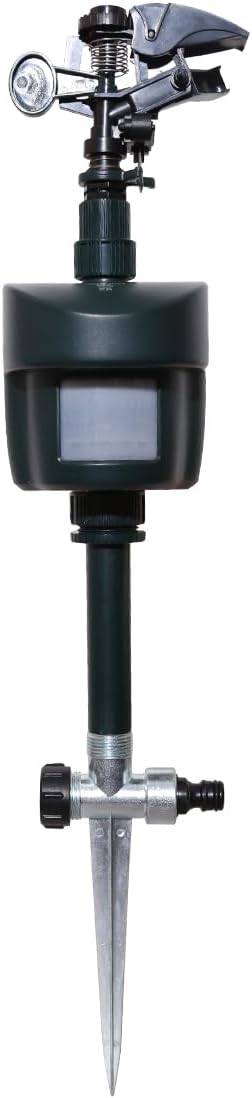

The Orbit Yard Enforcer is a conventional hose-connected motion sprinkler built for lawns, flower beds, gardens, and landscaping. With a 3.8 rating, it offers a balanced combination of adjustable detection, multiple operating modes, and flexible spray duration. Its passive infrared sensor detects heat-producing animals, allowing the sprinkler to respond only when movement is detected rather than watering continuously.
We may earn a commission when you buy through this link, at no additional cost to you.
Its strongest feature is the level of control offered for different times of day. Owners can select Day, Night, or Always-On operation, while the sensor range extends up to 40 feet and the spray duration can be adjusted from approximately three to ten seconds. These settings allow the same unit to target busy travel routes, respond differently after dark, or provide regular watering when a fixed schedule is preferred.
The trade-off is that it requires a water supply and does not offer the dual stimulation, selectable spray patterns, or maintenance routines found in several solar competitors. It also protects only the area reached by its sensor and water stream, so larger properties may still require more than one unit. Even so, the manual 30-minute watering function adds everyday value beyond animal deterrence.
This is the most broadly practical selection for a gardener who wants detailed adjustment and a useful manual watering mode. Place it near a high-traffic animal route, aim it toward vulnerable plantings, and adjust the sensor to minimize unnecessary activation. It is a strong all-around choice when dependable hose-powered operation matters more than cordless convenience.
Day, Night, and Always-On modes let the owner match response behavior to the garden's daily patterns. A shorter range during busy daylight hours may prevent excess watering, while broader nighttime coverage can discourage nocturnal visitors.
The 30-minute manual cycle turns the Yard Enforcer into a useful irrigation device for lawns, gardens, and planting areas. That dual purpose makes it easier to justify as part of an everyday outdoor setup.
We may earn a commission when you buy through this link, at no additional cost to you.
This solar motion-activated sprinkler combines a sudden water spray with flashing lights to deter unwanted animals, giving visitors both a visual and tactile reason to retreat. Its 4.7 rating is the highest among the ten products considered, while its 26-foot PIR range and 110-degree detection angle make it appropriate for flower beds, trash areas, and other targeted garden zones.
We may earn a commission when you buy through this link, at no additional cost to you.
The product offers a four-level sensitivity control and an adjustable spray head with 360-degree rotation, wide-angle, and focused-jet options. Those settings are particularly useful when one area needs broad coverage but a nearby flower bed should receive a gentler stream. Solar and DC charging support unattended operation for up to 60 days, reducing the need for frequent cable connections.
Its 26-foot detection distance is shorter than the 40-foot adjustment of the Orbit Yard Enforcer and the 60-foot animal detection stated by the Havahart. It also depends on sunlight for its most convenient charging method, so heavily shaded installations may need regular DC charging. Nevertheless, the flashing lights, three spray choices, and automatic brief spray after 24 hours without a trigger distinguish it from basic hose models.
Choose this model for a compact garden zone where cordless operation, visible stimulation, and detailed spray targeting matter most. It is especially attractive for users who do not want a permanent hose arrangement. Position the solar panel where it can receive light, begin with a moderate sensitivity level, and direct the focused spray along the route animals use to reach the protected plants.
The water burst provides the immediate physical interruption, while the flashing lights add a second visible stimulus. Together, they can make a protected zone feel less inviting to deer, cats, raccoons, rabbits, and other frequent visitors.
Wide-angle, focused-jet, and rotating settings let owners adapt the response to delicate planting, open lawns, or concentrated entry points. This flexibility is more useful than a single fixed stream when one unit must cover varied landscaping.
We may earn a commission when you buy through this link, at no additional cost to you.
The deep green two-pack version is designed for shoppers who need more than one protected zone. Each unit combines a motion-triggered water spray with flashing lights, and each has a 26-foot PIR sensor with a 110-degree detection angle. The 4.7 rating reflects a favorable combination of deterrence, cordless charging, and flexible spray control.
We may earn a commission when you buy through this link, at no additional cost to you.
The most obvious advantage is the ability to place units at separate entry points. One may cover a vegetable bed while another protects a flower border, trash cans, or a path where deer and raccoons regularly appear. Four sensitivity levels help reduce unnecessary activation, while the spray head supports 360-degree rotation, wide-angle coverage, and focused jets for each location.
Solar and USB charging offers more flexibility than a standard hose connection, although sunlight remains important for maintaining the solar charge. The stated 24-hour maintenance spray helps keep nozzles clear during long standby periods, a useful feature for unattended installations. The package requires more placement planning than a single unit, and both devices still have the same relatively compact detection reach.
This two-pack is well suited to medium or large properties with multiple vulnerable areas. Because a single sensor cannot protect widely separated beds, the added unit can provide a practical advantage over one compact sprinkler. Install the devices where each has a clear line of sight, place them in different animal routes, and use the focused mode near especially important plants.
Two units can cover separate garden beds, side yards, or approaches without trying to stretch one sensor across the entire property. This arrangement is especially useful when animal traffic follows more than one predictable route.
Solar and USB charging lets the units operate without a permanently connected hose. That makes placement around ornamental borders, isolated planters, and other areas where plumbing is inconvenient more practical.
We may earn a commission when you buy through this link, at no additional cost to you.
This motion sensor sprinkler uses a wide-angle PIR sensor, a synchronized water jet, and a bright strobe light to discourage animal movement through a protected area. Its 4.5 rating reflects a particularly detailed feature set, including a rotatable nozzle, four sensitivity grades, dual charging options, and an IP65 rating for outdoor use.
We may earn a commission when you buy through this link, at no additional cost to you.
Detection extends up to 26 feet across a 110-degree angle. The nozzle can be adjusted through a 1-to-360-degree range, and its stream can change between a concentrated jet and diffused mist, allowing the response to be matched to the target. The product also includes a 1,800 mAh lithium-ion battery, with the supplied information stating that a full DC charge takes around three hours and solar charging takes approximately nine hours.
Installation is designed to be straightforward, with an ABS-metal composite construction, metal ground stake, and standard 3/4-inch hose connector. Its self-maintenance spray activates after 24 consecutive hours without detected wildlife, which helps flush sediment and reduce nozzle blockage. The main compromises are the relatively compact detection range and the lengthy stated solar charging time.
This is the premium pick for a buyer who values fine spray adjustment, all-weather construction, and thoughtful maintenance features. It is particularly suitable for yards, orchards, vegetable plots, and other planted spaces where different plants may benefit from different water patterns. Provide clear space around the PIR sensor, position the stake securely, and keep the solar panel exposed to available sunlight.
Independent adjustment of spray distance, angle, and stream style provides a higher level of control than fixed-head models. A focused jet can discourage an animal crossing a path, while a mist can cover a broader, more delicate planting area.
The automatic 24-hour maintenance cycle is useful in seasonal gardens and orchards where equipment may remain connected for long periods. It also reduces the chance that sediment will leave a nozzle inactive when an animal approaches.
We may earn a commission when you buy through this link, at no additional cost to you.
This two-pack combines a motion-activated watering response with broad, adjustable detection for lawns and gardens. Each sprinkler covers a stated maximum area of 1,000 square feet, uses a 120-degree detection angle, and allows the head to rotate through 360 degrees. Its 3.8 rating places it among the stronger hose-connected options for multi-zone properties.
We may earn a commission when you buy through this link, at no additional cost to you.
Once movement is detected, the unit sprays for five seconds and can react again if another animal is found. That repeat-response behavior is intended to discourage persistent visitors without requiring continuous watering. Adjustable sensitivity gives the owner another way to balance reliable detection against unwanted activations, particularly where people or pets regularly pass through the area.
The product is marketed for a broad range of animals, including birds, foxes, herons, cats, dogs, squirrels, deer, and skunks. The two included sprinklers make it easier to establish a perimeter or protect separated beds. However, the feature set is less sophisticated than the solar models, with no flashing light, selectable stream patterns, self-cleaning routine, or stated IP65 rating.
Choose this pack when two hose-connected coverage points are more valuable than cordless placement. It may suit a large lawn, an orchard-like garden, or a yard with separate planting areas. Position both stakes securely, connect the hoses using the described 3/4-inch connection method, and adjust each sensor independently to reflect the actual approach routes.
A two-unit configuration can protect widely separated parts of a property without relying on a single device to cover an excessive distance. Each unit can also be tuned to a different sensitivity level.
A five-second spray is followed by another activation when an animal is detected again. This repeat response can make the deterrent more noticeable to visitors that do not leave after the first burst.
We may earn a commission when you buy through this link, at no additional cost to you.
The Rotating Yard Animal Repellent is a straightforward motion-activated sprinkler designed to combine irrigation with deterrence in yards and gardens. With a 3.7 rating, its appeal comes less from advanced electronics and more from a rotating water pattern, durable metal stake, and quick-connect fitting that make installation straightforward.
We may earn a commission when you buy through this link, at no additional cost to you.
Rotation can distribute water across a wider section of lawn than a fixed jet, and the same unit can be used for general yard watering as well as deterrence. The product information identifies deer, cats, raccoons, skunks, dogs, and rabbits among the types of visitors it is intended to discourage. Its simple design may appeal to owners who do not want to manage sensitivity levels or multiple operating modes.
Compared with the more technical models, it does not state a sensor range, detection angle, spray duration, or adjustable sensitivity. Buyers therefore have less information about how precisely it will fit a particular space. It also requires a hose and continuous water supply, and the lack of a stated weather rating or flashing light makes it less distinctive than several solar alternatives.
This sprinkler is most appropriate for a straightforward yard where a rotating spray pattern and simple setup matter most. Place it near an exposed flower bed, lawn edge, or route used by animals. Confirm that the rotating stream reaches the intended area without soaking paths that should remain dry, and secure the metal stake firmly in the soil.
A rotating head spreads the water around the unit, making the device useful for both ordinary lawn watering and animal deterrence. It is a practical option for buyers who prefer uncomplicated operation.
The metal stake provides a straightforward anchor in lawn or garden soil, while the quick-connect fitting reduces setup time. These details make repositioning the unit as garden priorities change relatively convenient.
We may earn a commission when you buy through this link, at no additional cost to you.
The Havahart Critter Ridder is a battery-powered motion sprinkler with a strong emphasis on adjustable detection. Its 3.7 rating reflects a practical, uncomplicated approach to humane animal deterrence, and the stated 60-foot animal detection plus distance control up to 100 feet give it unusually wide reach for a compact unit.
We may earn a commission when you buy through this link, at no additional cost to you.
Four sensitivity levels allow users to tune the sensor to different surroundings. It is designed to deter squirrels, cats, deer, raccoons, chipmunks, groundhogs, skunks, rabbits, birds, and other nuisance animals without chemicals. Another advantage is its stated water use of only two to three cups per activation, which can make it suitable for users who want targeted deterrence rather than continuous irrigation.
The device runs on two AA batteries, but the product information notes that batteries are not included and may self-discharge during storage. It also warns that full battery capacity may not be available initially and advises checking voltage or replacing batteries when necessary. The lack of solar charging, flashing lights, and selectable spray patterns means it is simpler and less versatile than the premium models.
This is the budget pick for someone who wants generous, adjustable sensing without installing a permanent hose. It can also function as a lawn and garden sprinkler, adding flexibility to the purchase. Choose fresh batteries, test the sensor before leaving it unattended, and begin with a moderate range that covers the vulnerable area without repeatedly detecting irrelevant movement.
Distance controls up to 100 feet and four sensitivity levels make it possible to narrow the monitored area. This helps focus the response around a garden bed or entry route rather than the entire property.
Using two to three cups per activation, the Critter Ridder delivers a noticeable interruption without the water use associated with continuous irrigation. It is a sensible choice where conservation and targeted protection are priorities.
We may earn a commission when you buy through this link, at no additional cost to you.
The Single Motion Sprinkler offers a direct approach to garden animal protection, with a stated detection area of up to 1,000 square feet and a 120-degree sensing angle. Its 3.8 rating is supported by adjustable sensitivity, a head that rotates through 360 degrees, and a five-second spray response when an animal is detected.
We may earn a commission when you buy through this link, at no additional cost to you.
The product can deter birds, foxes, herons, cats, dogs, squirrels, deer, skunks, and other animals without physical barriers or chemical controls. The five-second spray can repeat when another animal is found, allowing the unit to respond to animals that remain in the detection zone. Its 360-degree head adjustment helps users direct the water toward vulnerable beds rather than simply spraying in one fixed direction.
As a single-unit option, it is less convenient than the two-pack version for larger properties, and buyers may need to add another device to cover separate entry routes. It also lacks the solar power, flashing light, IP65 rating, and broad spray-pattern selection offered by more advanced models. Nevertheless, it covers the essential functions with fewer variables to manage.
This is a good match for a single lawn section, compact garden, or one well-defined animal route. It can be installed near a vegetable patch or flower bed where a broad 120-degree field of view is useful. Adjust the head and sensitivity independently, and use the stated 3/4-inch US-standard connection method to attach the appropriate hose.
A stated 1,000-square-foot range and 120-degree angle make the sprinkler practical for a single concentrated zone. It can watch a wide approach without requiring the sensor to be aimed at one narrow line.
The 360-degree rotating head lets the owner change the spray direction while retaining the sensor's broad detection area. This separation is useful for protecting an irregular bed or covering several nearby targets.
We may earn a commission when you buy through this link, at no additional cost to you.
This two-pack combines solar operation, flashing lights, and a water jet in two complete units. Each sprinkler has a 110-degree PIR sensor with a stated detection distance of up to 26 feet. Its 3.8 rating reflects a useful combination of cordless placement, dual stimulation, weather resistance, and maintenance features.
We may earn a commission when you buy through this link, at no additional cost to you.
Each unit offers four sensitivity levels and a nozzle adjustable through 1 to 360 degrees. The stream can be changed between concentrated jet and diffused mist, allowing owners to tailor the response to the planting area. The water and strobe light activate together, while the IP65 rating is intended to support use in rain and dust. Solar and DC charging offer both autonomous and backup charging methods.
The two-unit format requires separate placement and planning, and each sensor has a relatively limited range. Solar charging can also be less effective in heavily shaded areas, making the DC option important for occasional top-ups. In return, the package avoids a permanent hose connection and offers automatic spraying after 24 hours without detected wildlife to help keep the nozzle clear.
Choose this option for two medium-sized zones, such as a front flower bed and a rear vegetable plot. It is also appealing for farms or larger gardens where a hose is inconvenient. Give both units an unobstructed view of their intended approach routes, expose the panels to available sunlight, and use the different spray modes according to each location.
Each sprinkler can be positioned and adjusted separately, allowing different sensitivity and spray settings for different areas. This is useful when one zone has frequent traffic and another is a quieter flower border.
The IP65 rating and solar charging make the units practical for outdoor placement without an attached hose. DC charging supplies a backup option when sunlight is limited or a quicker top-up is needed.
We may earn a commission when you buy through this link, at no additional cost to you.
The final product is a compact solar sprinkler that combines a water spray, flashing lights, and PIR motion detection. It has a 3.4 rating, the lowest in this comparison, but it still includes several useful controls: a 26-foot range, a 110-degree detection angle, four sensitivity levels, and selectable spray modes.
We may earn a commission when you buy through this link, at no additional cost to you.
Users can choose 360-degree rotation, a wide-angle pattern, or a focused jet to cover an open lawn, a group of plants, or a specific route. Solar and DC charging support up to 60 days of operation according to the product information, while a brief automatic spray after 24 hours without activation helps clear the nozzle and gently hydrate the lawn.
Its strongest appeal is cordless convenience for a single protected location. The IP65 waterproof casing and leak-proof connections are useful for year-round outdoor use, and the metal stake simplifies installation. The limitations include a 3.4 rating, a detection distance shorter than several competitors, and reliance on sunlight for the most convenient charging method.
This sprinkler is worth considering for a small garden, patio-side planting area, or one isolated flower bed where a permanent water line is inconvenient. Compare its current customer feedback with the closely related 4.7-rated version because the listings share the same image and core feature description but carry different ratings. Position it in direct sun and begin with a narrower detection setting if nearby movement causes repeated activation.
The compact design is most practical around a single flower bed, vegetable patch, or frequently used outdoor feature. Solar charging removes the need to run a hose into the protected zone.
The 24-hour automatic spray is designed to flush the nozzle when no animal has triggered the sensor. That can help maintain readiness during extended periods of inactivity.
We may earn a commission when you buy through this link, at no additional cost to you.
The right model depends on the protected area, the animals involved, available power and water, and the level of control required. Comparing these practical factors is more useful than focusing on a single headline specification.
Detection range determines how early an animal can be sensed, while the field of view affects how much of the garden the sensor monitors. The products in this guide range from a stated 26 feet to 60 feet for animal detection, with some offering distance controls beyond that figure. The Orbit also provides a 40-foot adjustable range, and the Havahart adds controls up to 100 feet. Wider coverage can reduce the need for multiple units, but it may also detect movement outside the area that actually needs protection.
A powerful sensor is only useful if the water reaches the animal's route. Several products provide a rotating head, while the solar models add wide-angle, focused-jet, and mist settings. The two-pack hose models advertise a 360-degree head adjustment and a five-second spray. For broad lawns, rotation or a wide spray can cover more ground; for flower beds, a focused jet may be better suited to a specific approach path. The Orbit offers a separate 30-minute manual watering function for broader irrigation needs.
Power and water requirements strongly affect installation. Hose-connected models offer continuous watering but require permanent plumbing at the site. Battery-operated units avoid a hose but require battery monitoring, and the Havahart's two AA batteries are not included. Solar models provide cordless placement and use DC or USB backup charging in some configurations. Since the product data also states a DC full charge of around three hours and a solar charge of approximately nine hours for the feature-packed dual-stimulation model, shoppers should consider local sunlight and access to charging.
Sensitivity adjustment helps separate genuine animal movement from unwanted triggers caused by passersby, windblown objects, or other activity. Four levels appear on the Havahart and the solar models, while the hose-connected garden sprinklers also provide some form of sensitivity adjustment. More levels give the user a better chance of tuning the sensor to the site. A broad open lawn may tolerate higher sensitivity, while a narrow path near a door or pedestrian area may need a lower setting.
Most listed products are intended for a mixture of animals, including deer, cats, raccoons, skunks, squirrels, rabbits, dogs, birds, and other wildlife. A water burst provides a sudden, humane interruption, while flashing lights add a visual element. If the main problem is nighttime visitors or animals entering from a specific direction, a dual-stimulus model may be useful. If the primary goal is simply targeted watering and deterrence, a conventional hose unit may be sufficient.
A sprinkler remains outdoors through sun, rain, dust, and seasonal temperature changes. Several solar products specify an IP65 waterproof rating, and many use a metal stake or an ABS-metal composite body for ground stability. Hose models should also be checked for a sturdy stake and secure quick-connect fitting. The Orbit includes a metal step spike, while the listed solar units use metal ground stakes. Durability matters because a displaced or loose unit may fail to protect the intended area or water an unintended location.
Nozzles can collect sediment, and unattended devices may need regular inspection. Several solar products include a self-maintenance feature that triggers a brief spray after 24 hours without detected wildlife, helping flush the nozzle and hydrate the surrounding lawn. Even with that feature, periodic checks remain important. The metal stake should be firm, the sensor lens should be clear, and hose connections should not leak. Models with more moving spray modes also have more adjustment points that may need occasional review.
A compact sensor cannot cover every part of a large or irregular property. Single-unit options are convenient for one flower bed, vegetable garden, or narrow entry route, while two-packs allow the owner to protect separated areas. Wider detection systems may cover more open lawn, but large properties often contain multiple routes that call for multiple devices. Before buying a pack, map the garden and note where animals enter, where water can be directed, and whether sunlight or hose access is available at each location.
Begin by identifying the most vulnerable plants and the routes animals use to reach them. Place the sprinkler where its sensor has a clear view of the approach, but avoid aiming it directly at a walkway, neighboring property, or delicate planting that cannot tolerate extra water. For stake-mounted models, push the stake firmly into the soil and confirm that the unit does not lean. Connect the hose or charging system according to the included instructions and verify that every fitting is secure.
Test the motion sensor before relying on the device. Walk through the expected detection zone only when it is safe and appropriate for the installation, then observe whether the unit activates. Begin with a medium sensitivity setting and adjust the range, spray direction, and duration as needed. A lower sensitivity is useful where people or pets pass frequently, while a wider setting may be appropriate in an isolated garden. Solar units should be placed where their panels receive direct sunlight, and batteries should be checked before the unit is left unattended.
Inspect the device periodically, especially after storms, heavy rain, or seasonal changes. Clean the PIR sensor window, check the nozzle for sediment, confirm that the stake remains secure, and examine hose or quick-connect fittings for leaks. Solar models with a 24-hour maintenance spray can help keep nozzles clear, but that feature does not replace physical inspection. Adjust the aim as plants grow or animal routes change, and disconnect or protect the unit if freezing conditions or severe weather could damage its components.
They are generally designed to deter animals with water rather than physical harm, but safe placement still requires attention. Avoid directing a spray toward a frequently used path, play area, window, or neighboring property. Choose a sensitivity setting that does not repeatedly trigger on people, and check the area before operating the unit at night.
Detection distance varies considerably among the listed models. Some solar units use a stated 26-foot range, the Orbit adjusts up to 40 feet, the Havahart detects animal heat and movement within 60 feet, and its distance control extends to 100 feet. Actual performance can vary with animal size, environmental conditions, and sensor placement.
It depends on the model. Hose-connected units need a continuous water supply, while battery and solar models offer cordless placement even though they still use water for the spray. Solar models may also need periodic DC or USB charging depending on sunlight and the specific charging system.
No device can guarantee that every animal will avoid the area, but a well-positioned and properly adjusted sprinkler can make a location less appealing. The listed products are marketed for animals including deer, cats, raccoons, rabbits, squirrels, skunks, dogs, and birds. Combining water with flashing lights, maintaining the nozzle, and covering multiple approach routes can improve the overall deterrent effect.
Start with a lower or moderate sensitivity setting and avoid placing the sensor where it directly faces a busy walkway, road, or frequently moving vegetation. Clear the sensor window and keep the detection zone as focused as practical. If a nearby person or pet is repeatedly triggering the unit, reduce sensitivity or change its position.
Solar models are convenient for isolated flower beds, gardens without plumbing, and areas where avoiding a visible hose matters. Hose-powered models are straightforward when a water connection is already available and the unit will be used frequently. Solar performance depends on good sunlight, so assess the site's exposure and access to DC or USB charging before choosing.
A quick inspection every few weeks is sensible, with closer attention after storms, heavy rain, plant growth, or any change in animal traffic. Check the sensor, nozzle, fittings, and stake. Some solar models automatically spray after 24 hours without a trigger, which can reduce nozzle clogging but does not replace routine maintenance.
One unit is best for a concentrated garden bed, lawn section, or known animal route. Large properties with separated entry points usually benefit from multiple sprinklers, while an open area may be covered by a single model with a wider detection range. Mapping the property before installation helps determine how many units are needed and where they will be most effective.
The Orbit Yard Enforcer is the most versatile overall choice because it combines adjustable detection, three operating modes, variable spray duration, and a manual watering cycle. The solar model with lights stands out for flexible spray patterns and cordless operation, while the feature-packed dual-stimulation model adds detailed nozzle adjustment, IP65 protection, and an automatic maintenance routine. For simpler setups, the Havahart offers broad adjustable detection and low water use.
Prioritize the area that needs protection, the animals creating the problem, and the type of power available at the installation site. A hose unit is easy to maintain in a garden with plumbing, a battery model is simple to relocate, and a solar unit is convenient for remote planting beds. Sensor reach matters, but spray direction, sensitivity, ground stability, and maintenance are equally important to dependable performance.
Before buying, check the current listing for availability, included components, charging details, and any changes to the product information. Prices and promotions can change, and closely related solar listings may have different ratings or charging descriptions. Comparing the latest customer feedback with the stated specifications will help ensure that the selected model fits the intended garden.