
BESIGN Ground Loop Noise Isolator
4.4Editor score
3.5mm plug-and-play design
Portable battery-free operation
Broad consumer device compatibility
A ground loop noise isolator breaks the electrical path responsible for hum, buzz, hiss, and interference in analog audio systems. The right model depends on connector type, signal path, grounding behavior, portability, and whether the installation requires passive isolation, channel balancing, or compact 3.5mm convenience.
We compared all 10 products by examining their stated isolation methods, connection formats, supported equipment, installation requirements, response information, physical design, and customer ratings. The list covers options for car audio, home stereo, computers, phones, tablets, TVs, recording environments, and professional equipment.
Each review explains the strongest benefit, practical limitations, and ideal buyer for its particular isolator. The selections also show why a compact aux adapter and a professional dual-channel transformer are not interchangeable, while current pricing and product listings can change over time.
4.4Editor score

4.2Editor score

4.1Editor score
As an Amazon Associate we earn from qualifying purchases.
This side-by-side comparison highlights connector compatibility, isolation architecture, channel capacity, installation needs, and the most suitable environment for each ground loop noise isolator.




The BESIGN Ground Loop Noise Isolator is a compact 3.5mm solution for eliminating hiss, buzz, and interference caused by ground loops. Its 4.4 rating is the highest in this group, reflecting a generally favorable customer response. The product is especially useful when a phone, Bluetooth receiver, or other portable source shares power with a car audio system or home stereo.
We may earn a commission when you buy through this link, at no additional cost to you.
Its main strengths are simplicity and compatibility. The isolator uses a plug-and-play arrangement, requires no battery, and works with any device offering a 3.5mm jack. The included 3.5mm audio cable makes it practical for installations where the source and destination are not directly adjacent, while the lightweight housing is easy to conceal or carry.
The limitations are equally clear. It is designed around a 3.5mm audio path rather than RCA, XLR, or speaker-level wiring, so it cannot solve every form of electrical noise. It is a single-path accessory rather than a two-channel transformer box, and its best use is intermittent grounding noise in consumer aux connections rather than severe faults within an amplified system.
This is the strongest general recommendation for most readers who want a small, uncomplicated fix for aux hum. Buy it when the affected equipment uses 3.5mm plugs, particularly a phone connected to a car receiver or a Bluetooth adapter feeding a home stereo. It offers the most balanced combination of customer rating, portability, and ease of use in the roundup.
The BESIGN unit fits neatly into the connection between a portable audio source and a stereo, making it practical for drivers and listeners who encounter hum after connecting a phone or Bluetooth receiver. Its job is to interrupt the problematic electrical relationship while allowing the audio signal to continue.
No external power, controls, or complicated configuration are required. The mini enclosure and included cable allow the isolator to be positioned where it is convenient, although maintaining clearance from moving car components and tightly routed wiring remains important.
We may earn a commission when you buy through this link, at no additional cost to you.
The Summina Ground Loop Noise Isolator is a compact hum filter intended for speakers, amplifiers, stereo systems, TVs, and other audio equipment. Its 3.6 rating is the lowest among the listed products, so buyers should validate the exact connector arrangement and signal requirements before ordering.
We may earn a commission when you buy through this link, at no additional cost to you.
The device is built around straightforward installation and flexible placement. A built-in LED provides immediate status feedback, while the compact housing suits home entertainment, recording spaces, and other setups where an oversized box would be inconvenient. The stated compatibility with several types of audio equipment makes it a general-purpose option rather than one restricted to a single category.
Its product information does not detail the precise input and output connectors, channel count, isolation ratio, or frequency response. That makes direct technical comparison difficult and places more emphasis on fit. A buyer who requires a known RCA, XLR, TRS, or 3.5mm interface should confirm physical compatibility rather than assuming the device accepts every audio connection.
The Summina model makes sense when easy placement and visible operating status matter more than a heavily documented transformer specification. It may suit a user assembling a home or recording setup, but it is less compelling for a carefully engineered installation where channel balance, grounding topology, and signal path must be known in advance.
The LED indicator gives users a visible indication that the filter is operating. This is helpful in installations where the unit remains connected and a subtle audio change is difficult to distinguish from noise elsewhere in the signal chain.
The lightweight enclosure can be incorporated into home entertainment, recording, and general stereo arrangements. Confirm that its connectors match the source and destination before installation, since the supplied product information emphasizes broad device support without listing every interface.
We may earn a commission when you buy through this link, at no additional cost to you.
The Cable Matters Ground Loop Noise Isolator targets buzzing, hissing, humming, and static in car and home audio systems connected through 3.5mm ports. Its 4.3 rating places it near the front of the group, and the included aux cable makes it a self-contained option for correcting common grounding problems.
We may earn a commission when you buy through this link, at no additional cost to you.
Compatibility is the central advantage. The isolator can work with 3.5mm aux and line-in or line-out connections on phones, tablets, computers, TVs, headphones, speakers, and stereo equipment. Installation requires no tools, which means users can try it without dismantling a head unit or replacing a car stereo.
This is not a universal solution for every audible defect. It cannot address radio static, antenna noise, speaker distortion, damaged cables, or faults occurring in a wiring architecture that lacks the appropriate 3.5mm interface. Its specifications also focus on practical installation and device support rather than detailed transformer measurements.
The Cable Matters model is a strong pick for consumer users who want a reversible troubleshooting step. Choose it when both devices support 3.5mm connections and the unwanted sound is consistent with an aux grounding issue. It is especially useful for testing whether isolation restores clean audio before making a more permanent wiring change.
Phones, tablets, computers, televisions, headphones, and stereo inputs are all identified as compatible applications. This makes the isolator a reusable option for users who move between different aux-based equipment rather than installing it permanently in one car.
Adding isolation to the existing connection can be a less disruptive way to address interference than replacing a stereo. The included cord simplifies the test, while the tool-free design allows quick removal if the source of the noise lies elsewhere.
We may earn a commission when you buy through this link, at no additional cost to you.
The Pyle PHE400 is a passive, two-channel hum eliminator designed for 1/4-inch TRS and XLR connections. Its 4.2 rating reflects a solid user response, while dual 1:1 isolation transformers and balanced-signal support make it the most versatile professional-style unit in this roundup.
We may earn a commission when you buy through this link, at no additional cost to you.
The device is engineered to reduce 60 Hz ground-loop hum and other unwanted noise by electrically isolating connected components. It accepts mono or stereo connections, provides inputs and outputs for two channels, and automatically converts unbalanced signals to balanced signals with minimal signal loss. Because it is passive, no power supply is required.
Trade-offs include its larger footprint and connector limitations. It will not directly fit an RCA installation or a consumer 3.5mm aux system without suitable adapters and careful signal-routing decisions. Users should also understand that balancing and isolation are related but distinct functions, and neither corrects a faulty cable or a badly matched amplifier.
Choose the Pyle PHE400 for home studios, recording rooms, live or professional audio systems, and serious home installations using XLR or TRS. It is our editor's choice because the dual-transformator, dual-channel architecture provides a clear technical advantage for users who need more than a simple inline aux adapter.
Each channel uses a 1:1 isolation transformer to break the ground relationship that can turn an audio cable into a loop antenna. The same architecture also balances an unbalanced input, giving users a useful tool for reducing noise and improving signal compatibility.
TRS and XLR inputs and outputs support common studio and live-sound practices without the need for an external power supply. The enclosure is described as rugged and portable, which makes it easier to integrate into a permanent rack arrangement or a mobile setup.
We may earn a commission when you buy through this link, at no additional cost to you.
The RECOIL MGLI is a two-channel RCA isolator designed specifically for ground-loop hum and alternator whine between car audio head units and amplifiers. Its 4.1 rating and highly specific engineering claims make it a strong specialist option for carefully considered car installations.
We may earn a commission when you buy through this link, at no additional cost to you.
Its high-fidelity permalloy transformers are intended to minimize signal loss, and the stated response of plus or minus 0.03 dB from 2 Hz to 20,000 Hz provides a more technical basis for comparison than most compact alternatives. Split-pin RCA connectors use pure oxygen-free copper spiral shielding, while the compact enclosure is intended for installation in tight vehicle spaces.
The limitations are important because RECOIL explicitly states that the product is not designed for radio static, antenna noise, or speaker distortion. A more expensive isolator cannot repair a poor antenna connection, damaged speaker, overloaded amplifier, or incorrectly adjusted gain. Diagnosis should precede purchase.
This is the premium recommendation for drivers with a properly installed car audio system whose remaining issue is hum or alternator whine. It is especially relevant to installers who value frequency-response specifications, high-fidelity transformer construction, two-channel RCA support, and a compact form designed for real vehicle constraints.
The MGLI targets the electrical conditions common in vehicle audio installations, where a head unit and amplifier may create a ground-loop path. Its dual-channel structure fits standard left and right RCA signal runs without forcing a single-channel workaround.
The stated 2 Hz to 20,000 Hz response and permalloy transformer construction suggest attention to low-frequency integrity and signal consistency. The split-pin, oxygen-free copper spiral shielding also points to a considered approach to the cable interface within the unit.
We may earn a commission when you buy through this link, at no additional cost to you.
The WisWinDa Mini Ground Loop Noise Isolator is a small RCA-based filter designed for both car and home audio systems. Its 4.1 rating indicates a generally positive reception, and its most distinctive qualities are the gold-coated connectors, aluminum shell, and space-conscious construction.
We may earn a commission when you buy through this link, at no additional cost to you.
The product provides a straightforward route for addressing ground-loop noise in an RCA signal path. Plug-and-play operation reduces installation friction, while the mini enclosure is valuable beneath dashboards, behind component cabinets, or inside crowded home stereo furniture. Gold-coated contacts are also intended to maintain a clean connection over repeated insertion and removal.
The supplied details are limited compared with more technically documented models. They do not identify the number of channels, transformer type, isolation ratio, or frequency response, so the product's precise technical performance is less transparent. Buyers should also verify whether they need one isolator for a mono signal or separate units for stereo channels.
The WisWinDa is a practical choice when space is the deciding factor and the installation uses standard RCA connections. It is better suited to straightforward troubleshooting and compact car or home arrangements than to a professional installation where exact channel balance and transformer specifications are essential.
The mini aluminum shell is the main attraction for vehicle dashboards and tightly packed entertainment cabinets. Its small footprint reduces the chance of cable strain or a protruding module interfering with trim panels and nearby equipment.
The RCA format matches many car and home amplifier connections, allowing the filter to be inserted without converting the entire signal chain. Confirm stereo requirements first, as the available product information does not state whether one enclosure isolates both channels.
We may earn a commission when you buy through this link, at no additional cost to you.
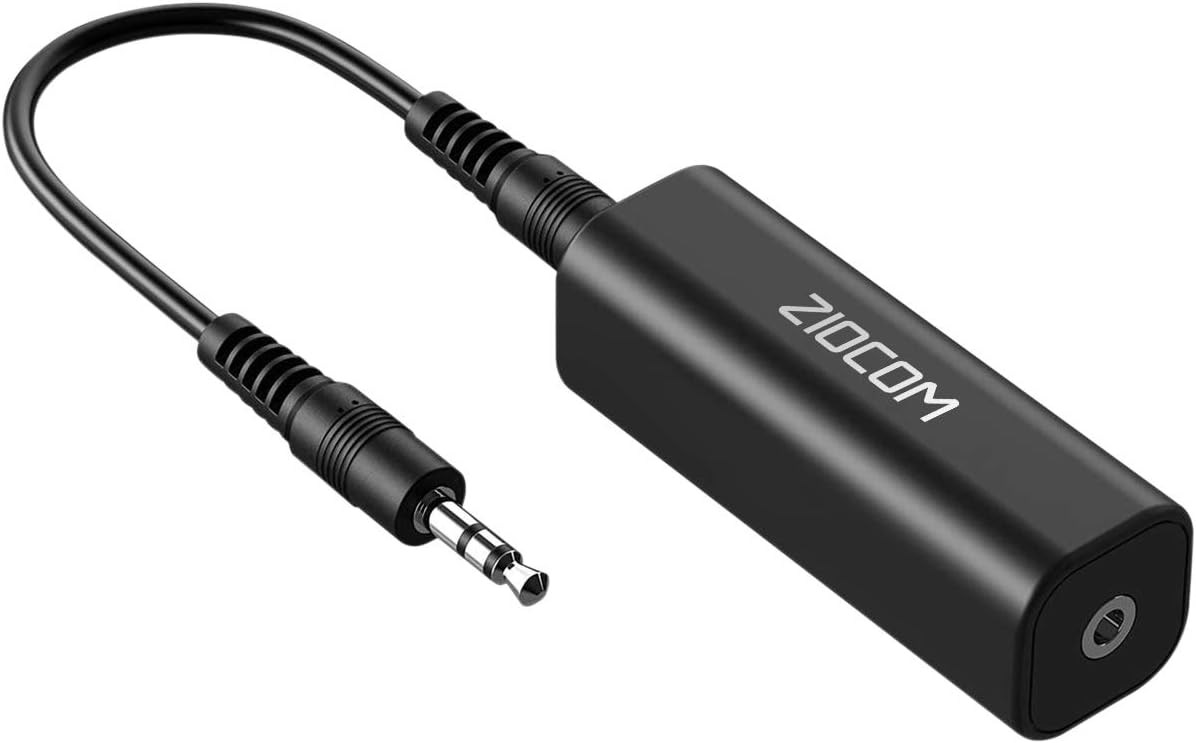
The ZIOCOM Ground Loop Noise Isolator is a compact inline accessory for reducing buzz caused by ground loops in car and home stereo systems. Its 4.3 rating matches several stronger-reviewed options, while the no-configuration installation makes it approachable for users troubleshooting an aux connection.
We may earn a commission when you buy through this link, at no additional cost to you.
The product is particularly relevant when a Bluetooth receiver or another portable source is connected to speakers that share the same power source. Its isolator filters current noise while preserving the intended audio, and the simple plug-in design avoids controls, battery requirements, and complicated setup procedures.
The format is limited to equipment with a 3.5mm connection and represents one audio path. It cannot be expected to correct hum inside a multiwire amplifier, speaker-level RCA installation, or digital-only connection. The product information also provides fewer technical performance details than several competing transformer-based designs.
ZIOCOM is a solid choice for a straightforward aux installation, especially one involving a Bluetooth receiver in a vehicle. It offers proven customer feedback, simple operation, and broad relevance to consumer stereo systems, although buyers requiring a dual-channel or professional connector format should look elsewhere.
The isolator is designed to remove current noise when a source and speakers share a power supply. That makes it a logical first step for users who notice buzz only after adding a particular receiver, adapter, or phone.
Because no controls or setup are required, the module can be inserted directly into the aux connection and removed just as easily. This makes it convenient for testing different cable routes and source combinations without altering the permanent wiring.
We may earn a commission when you buy through this link, at no additional cost to you.
The InstallGear Ground Loop Noise Isolator is designed to reduce humming and alternator noise in car audio while remaining usable in a home stereo system. Its 3.8 rating is moderate, but the stated compatibility with RCA cables and stereo systems gives it broad relevance for conventional installations.
We may earn a commission when you buy through this link, at no additional cost to you.
Installation is described as a quick process requiring no professional tools. The listed dimensions of 2 by 1.5 by 1 inches help it fit into tight spaces, which matters in dashboards, under seats, and inside crowded cabinets. A complete kit format is also convenient for users who want the required connection pieces in one package.
The principal concern is the lack of more precise technical information. The product description uses broad phrases such as working with most setups and improving clarity without signal loss, but it does not provide an isolation ratio, transformer specification, or frequency response. Buyers should compare those omissions against models that publish specific engineering data.
InstallGear is most appropriate for a conventional RCA setup in a car or home system where the audible defect is hum or alternator noise. It is a straightforward first line of defense, provided the physical connectors and channel configuration match the equipment. It is less compelling for users who require balanced XLR routing or guaranteed low-frequency specifications.
The same basic noise problem can occur in both environments, and this isolator is positioned to address it in either location. Its compact size and simple installation make it useful for temporary troubleshooting as well as semi-permanent placement.
The small enclosure can be concealed near the receiver or amplifier without taking up much room. Secure the connected cables so they do not move sharply, and avoid placing the module where heat, moisture, or physical pressure could compromise the connection.
We may earn a commission when you buy through this link, at no additional cost to you.
The Two-Pack Ground Loop Noise Isolator provides two complete 3.5mm isolation units for car audio or home stereo systems. Its 4.2 rating is solid, and the two-unit format is especially useful for separating a car installation from a home setup or keeping a spare available.
We may earn a commission when you buy through this link, at no additional cost to you.
Each isolator uses an audio isolation transformer to help filter buzz, hiss, and interference. The package includes 3.5mm cables and a user manual, and each unit measures 2.36 by 0.75 by 0.75 inches while weighing 0.05 pounds. That compact profile makes the modules easy to store, transport, and hide.
The trade-off is that the package does not create a true stereo box. Each product is a single 3.5mm path, so a stereo system may require a suitable connection arrangement rather than one unit serving all channels. It also lacks the technical detail available from models that publish transformer ratios, channel structure, and frequency response.
This two-pack is a practical choice for users who want flexible 3.5mm coverage in more than one location. It works particularly well for phone, tablet, laptop, MP3 player, or radio connections where a source and speaker share a power supply. The included manual and simple source-to-speaker arrangement reduce setup uncertainty.
The package suits users who need isolation in two separate places, whether that means a daily car system and a home setup or a primary and backup source. Each module includes the cable needed to connect it to compatible 3.5mm equipment.
At less than an inch across in two dimensions and 0.05 pounds in weight, the isolators are easy to carry in a glove compartment, media cabinet, or travel kit. Their small size also reduces strain when the connected leads bend near the source.
We may earn a commission when you buy through this link, at no additional cost to you.
The PAC SNI-1/3.5 is an inline ground loop isolator with a female 3.5mm input and male 3.5mm output. Its 4.2 rating and published frequency-response and gain details make it a technically informative option for portable music players and other compatible consumer sources.
We may earn a commission when you buy through this link, at no additional cost to you.
The isolator uses proprietary audio transformers and has a stated response of plus or minus 0.03 dB from 2 to 20,000 Hz. Transformer gain is listed at 1.3 dB. Those specifications make it easier to evaluate than many basic adapters, particularly for listeners who care about response consistency across the audible range.
Its interface is necessarily narrow. The female and male 3.5mm arrangement suits portable players and aux inputs, but it does not accept RCA, XLR, TRS, or speaker-level wiring. The original product positioning also references iPod, Zune, and iRiver devices, so modern buyers should confirm that their current source and destination are physically compatible.
Choose the PAC when a compact 3.5mm transformer solution with explicit electrical specifications is preferred. It is a focused option for reducing grounding-related noise in portable-player and aux arrangements, rather than a broad professional box designed for home studios or multi-channel car amplifier installations.
The stated 2 Hz to 20,000 Hz response and 1.3 dB transformer gain provide useful reference points. These details do not guarantee a particular listening result, but they make the design easier to compare with other transformer-based isolators.
A female input accepts a male aux plug while the unit's male output connects to a conventional female aux input. The arrangement is easy to remove and reposition, which makes it convenient for testing whether a grounding problem is present in a particular system.
We may earn a commission when you buy through this link, at no additional cost to you.
The correct isolator depends on the source of the noise, the connectors in the signal path, channel requirements, and the environment in which the equipment operates. Use the following factors to narrow the field before purchasing.
Ground loop isolators are designed for interference created by an unintended electrical path, which often appears as hum, buzz, hiss, or alternator whine. A product cannot fix radio static, antenna noise, loose connections, damaged cables, clipping, overloaded amplifiers, or speaker distortion. The RECOIL model explicitly distinguishes itself from products aimed at those unrelated problems, and the same diagnostic discipline should guide every purchase.
Count the inputs and outputs on the source and destination before choosing a model. Consumer aux products generally use 3.5mm plugs, car systems commonly use RCA, and professional equipment may use XLR or 1/4-inch TRS. Adapters can bridge some differences, but they may introduce new grounding paths or fail to carry the signal correctly. Exact connector matching is the safest starting point.
A single inline 3.5mm isolator represents one signal path, and a single-channel RCA module may not be appropriate for a left-right pair. Some compact RCA products may require one unit per channel, while larger designs explicitly provide two isolated channels. Confirm whether the product is mono, stereo, or dual-channel and whether separate units are needed for multiple installations.
A passive isolation transformer breaks the direct ground relationship while passing the audio signal. Professional units may also balance an unbalanced input, while simpler consumer modules may provide a basic inline isolation path. Transformers with documented isolation ratios and frequency responses offer greater transparency for critical installations, though the right specification still depends on the source, destination, and intended use.
Signal level and format matter as much as connector shape. A line-level aux filter is not the same as a speaker-level or microphone-level isolator, and a device designed to reduce vehicle hum may not suit a balanced studio connection. Check the product's stated applications, transformer architecture, supported input and output types, and any channel-balancing behavior before installation.
A mini 3.5mm module is easy to carry, conceal, and move between systems. A compact RCA filter is more useful in a fixed car installation, while a professional transformer box may be positioned near a rack or console. Consider available space, cable bending, ventilation, heat, moisture, and the need to keep connectors under tension without strain.
Published frequency response, transformer materials, shielding, and connector construction offer clues about expected performance. The PAC and RECOIL models provide explicit response information, while the Pyle unit identifies 1:1 isolation transformers and balanced conversion. More detail does not automatically make a product appropriate, but it can make a technical comparison more meaningful and reveal whether the design fits a demanding setup.
Plug-and-play products are ideal for quick troubleshooting and portable systems. A box with status feedback, balanced outputs, or multiple professional interfaces may require more careful routing but offers better control in a permanent installation. Decide whether the priority is fast testing, a tidy permanent build, balanced operation, or simply carrying one adapter between several locations.
Begin by disconnecting power from the affected equipment and identifying the exact connection where the noise appears. Confirm that the isolator's input and output connectors match the source and destination, then inspect the existing cable for damage, looseness, pinching, or poor contact. A noise problem caused by a faulty cable may remain even after isolation is added.
Install the unit in line with the audio path according to its connector orientation. For a typical 3.5mm setup, connect the source to the isolator's input and the isolator's output to the aux input of the stereo. For RCA, XLR, or TRS systems, maintain left and right channel consistency and avoid forcing an adapter into an incompatible socket. Power the equipment only after both ends are secure.
Route the connected cables away from power wiring, engine components, dimmer controls, and other high-interference sources where practical. Secure the cables without creating sharp bends, and leave the isolator accessible for testing. If the unwanted noise continues, reconnect the original cable to confirm that the isolator is the relevant variable, then recheck grounding, source compatibility, and whether the actual defect is radio static, clipping, or speaker distortion.
A ground loop noise isolator is intended to interrupt an unintended electrical path that can introduce hum, buzz, hiss, or related interference into an audio connection. It is most useful when the unwanted sound appears after connecting a phone, Bluetooth receiver, amplifier, or another powered device. It will not repair damaged wiring, poor speakers, radio static, clipping, or speaker distortion.
Only if the relevant connection path actually uses 3.5mm plugs. Many car amplifier installations use RCA or speaker-level connections, in which case a purpose-built RCA isolator is more appropriate. Using adapters between 3.5mm and RCA can work in some arrangements, but connector and signal compatibility must be checked carefully to avoid introducing another fault.
That depends on the product. A dual-channel box with separate isolation transformers can handle left and right signals together, while a single inline 3.5mm or RCA unit normally isolates only one path. If the manufacturer specifies one unit per channel, buy two or select a two-channel model. Stereo signal integrity is easier to maintain when the same type of isolator is used consistently across both channels.
It may make the perceived result sound clearer by removing interference noise, but it is not primarily a distortion-control device. The Pyle unit's balanced conversion and the RECOIL model's frequency-response claims are relevant technical features, but neither can correct an overloaded amplifier, a clipped source, or a failing speaker. Diagnose those conditions separately.
A passive design is useful because it requires no external power and generally adds fewer active components to the signal chain. The products in this guide include passive inline modules and transformer boxes suited to different connection formats. A powered design may be appropriate in specialized applications, but for many consumer and car audio problems, a correctly matched passive transformer is simpler and sufficient.
The sound may not be caused by a ground loop, or the isolator may be installed in the wrong part of the signal path. Test with the original cable to confirm the change, inspect all connections, and move cables away from power sources. If the problem is radio static, antenna noise, clipping, or speaker distortion, an isolator is not the appropriate fix.
Yes, provided the product supports the required connectors and signal type. The Pyle PHE400 is especially relevant for TRS and XLR studio connections, while simpler 3.5mm and RCA models can serve aux, home entertainment, and car applications. Verify channel count, signal level, and grounding configuration before integrating any unit into a recording chain.
Place it directly in the signal path between the source and the affected destination, using the correct input and output orientation. Keep it away from power cables, dimmer circuits, motors, and other interference sources, and avoid sharp cable bends. If the noise changes when the isolator is moved, note the new configuration and use that information to identify the problematic connection.
The BESIGN Ground Loop Noise Isolator is the most practical general recommendation for 3.5mm car and home systems, combining a 4.4 rating with simple, battery-free operation. The Pyle PHE400 stands out for dual-channel professional connections and 1:1 isolation transformers, while the RECOIL MGLI offers the most technically focused choice for a refined car amplifier installation.
Prioritize the correct connector, signal level, and channel configuration before considering any other feature. A 3.5mm module cannot replace an RCA or XLR isolator, and a physically compact model may not isolate both stereo channels. When diagnosing a fault, also rule out damaged cables, loose grounds, radio interference, clipping, and speaker problems before treating hum as a grounding issue.
Customer ratings provide useful context, but the most important purchase decision is technical fit. Review the current product listing, connection directions, included accessories, and any updated specifications before buying. Current prices and availability can change, so compare the complete signal path and select the model that solves the specific noise problem without unnecessary complexity.