
DDMALL CEV-2K
Compact 1080p60 design
USB-powered operation
Broad streaming protocols
Real-time OSD editing
Remote cloud monitoring
Our expert guide compares H265 H264 HDMI Iptv Encoders for 4K quality, protocol support, latency, overlays, audio, and live streaming setup.
H265 H264 HDMI IPTV encoders turn an HDMI source into a network-ready video stream for IPTV, live production, monitoring, digital signage, and online platforms. A useful encoder balances resolution, frame rate, protocol compatibility, audio handling, latency, and dependable management rather than focusing on one headline specification.
We compared the ten models using their stated hardware capabilities, supported codecs, streaming protocols, output options, customization features, physical design, and user feedback. The list includes 4K and 1080p devices, compact portable units, multi-stream encoders, and models designed for direct browser or network control.
Each pick highlights a different path for a particular workflow: high-resolution input, broad platform compatibility, inexpensive deployment, portable operation, or specialized connectivity. Product listings and specifications can change, so readers should verify the current features, included accessories, and listing details before making a final purchase.

4.4Editor score

5.0Editor score
The table below compares all ten encoders by their most consequential stated features, including maximum video format, codec flexibility, streaming protocols, output capability, audio or installation features, and intended use.




The URayCoder B07D78L3SZ is a feature-rich HDMI encoder aimed at users who want one box to handle high-resolution input and several distribution destinations. It carries a 4.5 rating and stands out for supporting 4K UHD input and output through dual H.265 and H.264 encoding. The maximum stated frame rate is 30fps at 4K, with support for up to 120fps at lower resolutions.
We may earn a commission when you buy through this link, at no additional cost to you.
Protocol breadth is one of its strongest attributes. The encoder supports HTTP, RTSP, RTMP and RTMPS, SRT, HLS, MP4, multicast over UDP and RTP, FLV, WebRTC, TRTC, and ICECAST. It can produce four streams using different protocols at the same time, making it useful for simultaneous delivery to platforms such as YouTube, Facebook, Twitch, and Vimeo without requiring a separate encoder for each destination.
Customization is also unusually thorough. Static text, scrolling captions, logos, and timestamps can be added, while resolution, frame rate, and bitrate can be adjusted. Cropping, rotation, flipping, and mirroring are supported, as are HDMI embedded audio and line-in audio. The main tradeoff is operational complexity: several simultaneous high-quality streams require suitable network capacity and some configuration discipline.
This is a strong general recommendation for live producers, churches, event teams, integrators, and advanced IPTV users who want 4K capability without limiting themselves to one protocol. It is especially attractive when simultaneous outputs and branded overlays matter more than the smallest possible enclosure.
The ability to output four streams with different protocols is especially useful when a production must reach several types of receivers. One source can be prepared for web platforms, local players, and IPTV or surveillance infrastructure without stacking multiple single-purpose devices.
Text, scrolling captions, logos, and timestamps help viewers identify the source and event. Simultaneous HDMI embedded and line-in audio adds flexibility for camera feeds, mixers, computers, and other sources that carry audio differently.
We may earn a commission when you buy through this link, at no additional cost to you.
The URayCoder B07P5WT3F1 is the highest-rated model in this group at 4.7, combining 4K UHD input and output with H.265 and H.264 encoding. It supports up to 30fps at 4K and up to 120fps at 2K and lower resolutions, offering useful headroom for high-frame-rate applications below 4K.
We may earn a commission when you buy through this link, at no additional cost to you.
The protocol list is extensive. RTSP, RTMP and RTMPS, HTTP, HLS, SRT, MP4, multicast over UDP and RTP, ONVIF, FLV, WebRTC, TRTC, and ICECAST are all supported. Four simultaneous outputs can use different protocols, and the stated platform compatibility includes YouTube, Facebook, Twitch, and Vimeo. That makes this model a strong option for mixed infrastructure rather than a single-platform streamer.
It also provides static text, scrolling captions, logos, timestamps, resolution controls, frame-rate controls, bitrate controls, cropping, rotation, flipping, and mirroring. HDMI embedded audio and line-in audio are both supported. Compared with simpler one-output boxes, it demands more careful network and stream planning, but it also provides much more freedom once configured.
The B07P5WT3F1 is recommended for integrators, broadcasters, and technically confident live-streaming users who need broad protocol support, four outputs, and 4K capability. It is a particularly sensible choice when different destinations require different stream formats.
Compatibility with RTSP, RTMP, WebRTC, ONVIF, multicast, and other delivery methods means the encoder can sit within an existing IP video workflow. This is more versatile than relying only on a web-oriented streaming protocol.
Supporting 120fps at 2K and lower resolutions creates options for fast motion, detailed observation, and production feeds. Operators can match the encoder's output to the practical frame rate of the source and network.
We may earn a commission when you buy through this link, at no additional cost to you.
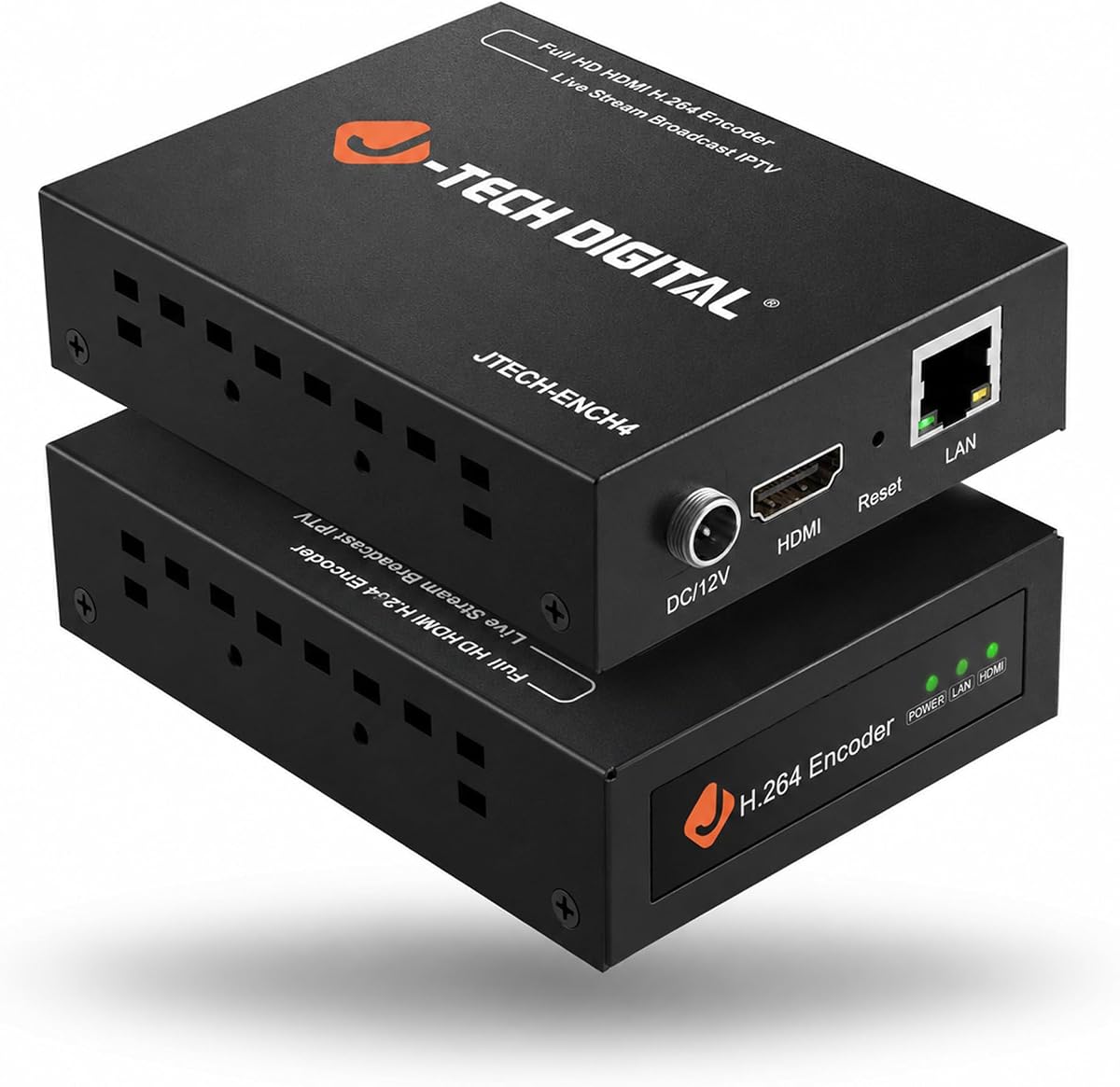
The J-Tech Digital JTECH-ENCH4 accepts HDMI input up to 4K at 60Hz and encodes to a maximum output of 1080p at 60Hz. That distinction is important: it can ingest a high-frame-rate 4K source while distributing Full HD streams. It carries a 4.1 rating and supports both H.264 and H.265.
We may earn a commission when you buy through this link, at no additional cost to you.
A main stream and three substreams can run simultaneously, allowing different quality levels for separate recipients. Supported formats include RTMP and RTMPS, HLS, FLV, TS, MP4, RTSP, UDP, SRT, and TRTC, with VLC compatibility through a simple HTTP stream address. Remote web-GUI controls cover bitrate, frame rate, IP settings, and visual adjustments.
OSD text and logos provide basic branding, and the image can be flipped, rotated, cropped, and adjusted for contrast and brightness. Audio features include MPEG1 Audio Layer 2 and CBR or VBR rate management. The lower rating and lack of a stated 4K output may make it less attractive for users who require the original 4K format at the destination.
This model is best suited to facilities that want to capture 4K60 from a camera or computer but distribute 1080p60 to displays, NVRs, streaming services, or other endpoints. Its combination of high-rate input, substreams, and detailed web controls is particularly practical for professional AV installations.
Capturing 4K60 and distributing 1080p60 can reduce demands on recipients and networks while preserving smooth motion from the source. The encoder's stream architecture makes this conversion straightforward.
Remote bitrate, frame-rate, brightness, contrast, crop, rotate, and flip settings reduce the need to return to a workstation. OSD text and logo overlays help label cameras, departments, or channels.
We may earn a commission when you buy through this link, at no additional cost to you.
The B0CLV1HYKG is a dedicated 1080p60 hardware encoder designed to make live streaming more approachable. Its 4.0 rating reflects a capable yet focused product, and its browser-based setup avoids the need for a connected computer, platform-specific drivers, or operating-system compatibility work.
We may earn a commission when you buy through this link, at no additional cost to you.
Both H.265 and H.264 compression are supported. The listing describes H.265 as potentially reducing bandwidth use by as much as 50% compared with legacy H.264-only solutions, although actual results depend on content, bitrate, network conditions, and receiver compatibility. Streaming protocols include SRT, RTMP and RTMPS, RTSP, UDP, HTTP, HLS, WebRTC, TRTC, Icecast, and SHOUTcast.
The enclosure is approximately 90 by 54 by 29mm, making it easy to place behind a monitor or on a shelf. HDMI embedded audio and external 3.5mm audio are supported, while the OSD generator can add scrolling text, logos, and timestamps. The main limitations are the 1080p ceiling and the continued need to understand basic IP and streaming concepts, even though setup happens in a browser.
This is our best budget recommendation for small events, classrooms, house-of-worship streams, remote monitoring, and digital signage. It gives users dedicated encoding, broad delivery options, and a practical compact form without requiring a full production computer.
Keeping the encoder at the source removes the need to leave a computer running solely for capture and encoding. That simplifies deployments where the encoder can remain connected near a camera, display, or playback device.
The small enclosure can fit behind displays or within crowded installation spaces. Low power consumption also makes the device appropriate for continuous operation in live-event and signage environments.
We may earn a commission when you buy through this link, at no additional cost to you.
The URayCoder B07TJ76C82 is built for installations managing more than a single uncomplicated video source. It is described as a compact, multi-channel MPEG4, H.265, and H.264 encoder with 1080p streaming and a 4.3 rating. Each HDMI input can output two video streams simultaneously, and those streams may use different protocols.
We may earn a commission when you buy through this link, at no additional cost to you.
Supported delivery methods include HTTP, RTSP, RTMP and RTMPS, SRT, HLS, UDP, RTP, MP4, ONVIF, multicast, Unitcast, and FLV. The stated platform list covers YouTube, Facebook, Ustream, Livestream, Twitch, Vimeo, Streamspot, Dacast, Tikilive, and Netrmedi. Multiple stream types allow administrators to balance bandwidth consumption against picture quality.
Output customization includes static text, scrolling text, logos, time displays, and adjustments to resolution, frame rate, and bitrate. Crop, rotate, flip, and mirror functions are available, while audio output can also be adjusted. For developers, the inclusion of SDK, API, and CGI control protocol documentation adds meaningful integration value.
This is a strong recommendation for multi-camera facilities, educational campuses, houses of worship, broadcast operations, and developers embedding encoders into larger control systems. A simple one-source stream may find a smaller device easier to manage, but this model offers greater room for centralized distribution and custom development.
Producing a main and alternate stream allows administrators to direct high-quality output to one group and a more efficient stream to another. This is valuable where receiving devices have different bandwidth or processing capabilities.
SDK, API, and CGI documentation can help integrators incorporate the encoder into broader management systems. Secondary-development support and customization options make the product more relevant to specialized enterprise workflows.
We may earn a commission when you buy through this link, at no additional cost to you.
The URayCoder B07CBMZ24P is a Full HD encoder with a 4.5 rating and a 1080p60 input and output specification. It is aimed at users who want high frame rates and multiple destinations but do not require 4K resolution. H.265 and H.264 encoding are supported through a dedicated hardware platform.
We may earn a commission when you buy through this link, at no additional cost to you.
It can produce four streams with different protocols, including HTTP, RTSP, RTMP and RTMPS, SRT, HLS, MP4, multicast over UDP and RTP, ONVIF, and FLV. That supports simultaneous distribution to YouTube, Facebook, Twitch, Vimeo, and other destinations. HDCP 1.4 decoding is included for compatible HDMI ultra-HD and high-definition sources.
Text, scrolling captions, logos, and timestamps can be applied to the output. Users can adjust resolution, frame rate, bitrate, crop, rotation, flip, and mirror settings, while HDMI embedded audio and line-in audio offer flexible sound sources. The main limitation is obvious but important: the listed workflow is 1080p rather than 4K.
Choose this model for Full HD production, simultaneous multi-platform broadcasting, or organizations that value 60fps motion and protocol flexibility over Ultra HD output. It is a well-rounded encoder for events, education, worship, and general live production.
The 1080p60 format is well suited to live events, presentations, gameplay, and camera feeds where smooth motion matters. It also places less pressure on many networks than 4K.
Four protocol-selectable outputs make the encoder efficient for organizations that need to publish simultaneously to web platforms, local IPTV, and network-based recording or viewing systems.
We may earn a commission when you buy through this link, at no additional cost to you.
The J-Tech Digital JTECH-ENCH4AP stands apart through its combination of PoE networking and analog audio input. It has a 4.4 rating, accepts 4K60 HDMI input, and encodes to 1080p60 output with H.264 or H.265. It also supports MJPEG as one of its compression options.
We may earn a commission when you buy through this link, at no additional cost to you.
Power over Ethernet allows both power and data to travel through a single network cable, although installation requires a PoE network switch. The 3.5mm analog audio connection can be embedded into the HDMI video for synchronized streaming, a useful feature when the source has separate audio, such as a mixer, mixer, presentation system, or event sound feed.
Protocol support includes UDP, HTTP, RTSP, RTMP, RTMPS, SRT, HLS, FLV, RTP, TS, and ONVIF. Up to four platforms can be streamed simultaneously, including YouTube, Facebook Live, and Twitch. Text overlays, logos, and a custom no-signal image help maintain a professional appearance and provide clear status information when the source disappears.
The ENCH4AP is our top choice for installations seeking cleaner cabling and more flexible audio. It is particularly suitable for churches, live events, and professional AV setups where the PoE switch is already available and 1080p60 distribution is sufficient.
Power and data travel over one Ethernet connection, reducing the number of cables near the encoder. This can simplify rack wiring, furniture installations, and temporary event setups where a PoE switch is accessible.
Embedding a 3.5mm audio source into the video stream creates a synchronized package for receivers. It is especially practical when the HDMI source carries video without the desired program audio.
We may earn a commission when you buy through this link, at no additional cost to you.
The URayCoder B07CP3G86L delivers 4K UHD input and output with H.265 and H.264 encoding, earning a 4.4 rating. It supports up to 30fps at 3840 by 2160 and up to 120fps at 2K and lower resolutions, making it appropriate for high-detail streams where Ultra HD output is genuinely required.
We may earn a commission when you buy through this link, at no additional cost to you.
Its four-stream capability is a major advantage. Each output may use a different protocol, including HTTP, RTSP, RTMP and RTMPS, SRT, HLS, MP4, multicast over UDP and RTP, FLV, WebRTC, TRTC, and ICECAST. That makes it easy to send one production to online platforms while also serving local players, web-based monitoring, or multicast destinations.
The customization set includes static text, scrolling captions, logos, timestamps, and adjustable resolution, frame rate, and bitrate. Cropping, rotation, flipping, and mirroring are supported, together with HDMI embedded audio and line-in audio. Remote management through computers or mobile phones and real-time stream status viewing make ongoing operation more convenient.
This encoder is best for technically experienced users who need 4K and four outputs. It is less intuitive than a compact browser-only model, and multiple 4K streams can place serious demands on both network capacity and destination devices. When those requirements align, its combination of resolution and distribution options is compelling.
Maintaining 4K output can suit premium displays, high-detail production feeds, and demanding IPTV workflows. The H.265 option can help preserve quality while managing bandwidth more efficiently in suitable conditions.
Viewing stream status through a URL helps operators identify connectivity or configuration problems. Browser and mobile management access also supports remote operation across distributed sites.
We may earn a commission when you buy through this link, at no additional cost to you.
The DDMALL CEV-2K is the most portable product in this guide, with dimensions of approximately 75 by 32 by 22mm and a stated weight of 32g. It encodes HDMI input to 1080p60 using HEVC and AVC and supports video bitrates up to 16Mbps. No customer rating is supplied for this model, so its comparison relies on the stated specifications rather than a numerical review score.
We may earn a commission when you buy through this link, at no additional cost to you.
Its power requirements are unusually convenient. The encoder consumes 2.4W and can draw power from compatible HDMI ports or through USB from the signal source or a mobile power bank. This removes the need for a separate power adapter in suitable setups and makes the device useful for mobile production, temporary installations, and space-constrained locations.
SRT, RTSP, RTMP, RTMPS, TCP, and UDP are supported for low-latency IP distribution. Real-time OSD editing lets operators add text, images, or logos at any location while streaming. Management through the web interface and DDMALL Cloud System allows remote control and monitoring whenever an internet connection is available.
The CEV-2K is a compelling recommendation for mobile operators and users who need a tiny, low-power encoder with remote monitoring. Its 1080p ceiling excludes it from true 4K projects, and the absence of a published rating means buyers should review current customer feedback carefully.
The tiny enclosure is easy to carry between venues and discreet enough to position beside a laptop, camera, or display. Its low weight makes it particularly practical for temporary live locations.
USB and compatible HDMI power options can simplify field deployment. A mobile power bank also provides a practical fallback when the source cannot supply sufficient power.
We may earn a commission when you buy through this link, at no additional cost to you.
The TBS2604v2 is a 4K UHD HDMI encoder with a perfect 5.0 listed rating. It encodes at up to 3840 by 2160 resolution and 30fps using either H.264 or H.265. The product description specifically positions it for lower-bitrate transfer over LAN or WAN environments while maintaining high image quality.
We may earn a commission when you buy through this link, at no additional cost to you.
Protocol support covers HTTP, HLS in M3U8 form, RTSP, UDP unicast and multicast, RTMP and RTMPS, and SRT. These are meaningful choices for IPTV, local playback, web distribution, and contribution workflows. The encoder can also create dual streams with different resolutions and bitrates, allowing a main feed and a substream to serve different endpoints.
Remote operation is available through a web interface and Telnet access. The dual-stream function is particularly useful for devices with different decoding strengths or network conditions. Its main video limitation is a maximum 4K frame rate of 30fps, so it is not intended for 4K60 workflows.
The TBS2604v2 is our best premium recommendation for IPTV operators and professional integrators seeking 4K output, dual-stream flexibility, and broad protocol support. It is especially appropriate when a primary high-quality stream and a separate adaptable stream must be delivered from one HDMI source.
Main and substreams can use different resolutions and bitrates. This lets a high-capacity receiver receive the best available image while other devices receive a more efficient stream.
HTTP, HLS, RTSP, multicast, RTMP, RTMPS, UDP, and SRT cover a broad mix of managed and local delivery methods. This variety supports both centralized platforms and direct network viewing.
We may earn a commission when you buy through this link, at no additional cost to you.
The right HDMI encoder depends on your source resolution, destinations, network environment, audio setup, and operational experience. Reviewing these factors before buying helps prevent an expensive mismatch between encoding features and real production requirements.
Begin by distinguishing input resolution from output resolution. Some encoders accept 4K at 60Hz but encode to 1080p, while others preserve 4K output at up to 30fps. The JTECH-ENCH4 and ENCH4AP accept 4K60 input but list 1080p60 output, whereas the URayCoder 4K models and TBS2604v2 support 4K UHD output at a maximum of 30fps. The DDMALL CEV-2K and the URayCoder B07CBMZ24P focus on 1080p60. Match the encoder to the actual source and receiver rather than assuming 4K input means 4K distribution.
H.265 can provide strong quality at lower bitrates, but the receiving device must understand the codec and container being used. H.264 remains broadly practical for web platforms, local players, NVRs, and older infrastructure. Every encoder here supports both H.265 and H.264, giving operators a way to match the codec to the destination. Test the final stream in the actual playback environment and avoid choosing a codec solely because it is advertised as more efficient.
Protocol support determines where the encoder can send video. RTMP and RTMPS are common for web live platforms, RTSP is widely used by network cameras and media players, SRT is useful for contribution over challenging links, HLS supports web playback, and UDP multicast or unicast can serve local IPTV systems. WebRTC, ICECAST, ONVIF, FLV, and MP4 broaden the possible workflows. The broader the protocol list, the easier it may be to integrate the encoder with existing infrastructure.
A single output may be sufficient for a straightforward event, while simultaneous streams save time in multi-destination installations. Several URayCoder models can output four streams, the J-Tech models can run a main stream and three substreams, and the TBS2604v2 supports dual streams. Consider resolution, frame rate, and bitrate for each output because the sum of all streams determines network requirements. A four-output encoder does not guarantee four independent 4K feeds.
Check whether the HDMI source already contains the desired audio. Many encoders support HDMI embedded audio and line-in audio, while the ENCH4AP specifically adds a 3.5mm analog input for embedding separate program audio. The J-Tech ENCH4 also offers MPEG1 Audio Layer 2 and configurable CBR or VBR rate management. For a camera or presentation system whose audio arrives separately, an analog or line input can be more useful than assuming audio will be present in the HDMI connection.
OSD controls add static text, scrolling captions, logos, timestamps, and sometimes a custom no-signal screen. These features help distinguish channels, identify events, label monitoring feeds, and maintain a consistent visual identity. The URayCoder products offer particularly extensive customization, including crop, rotate, flip, mirror, and basic picture controls. Before selecting these features, check that they can be applied to the streams and outputs your production actually uses.
Browser-based management is the most accessible option for operators who do not want to depend on command-line tools. Web interfaces are available across the list, while remote management through computers and mobile phones adds convenience for distributed systems. For custom systems, the URayCoder multi-channel model includes SDK, API, and CGI control documentation. The TBS2604v2 also supports Telnet remote access, though web control is generally more approachable for routine administration.
The correct physical design depends on the location. The DDMALL CEV-2K measures approximately 75 by 32 by 22mm and can use USB or compatible HDMI power, making it highly portable. The 1080P60 Hardware Encoder has a roughly 90 by 54 by 29mm enclosure for space-conscious installations. The ENCH4AP uses PoE to send data and power over one Ethernet cable, but it requires a compatible PoE switch. Fixed installations should prioritize network access, ventilation, cable reach, and serviceability over compact dimensions.
Begin by connecting the intended HDMI source to the encoder and checking that its resolution, refresh rate, and color format are supported. Connect the encoder to the same network segment as the receiving computer, player, NVR, CDN endpoint, or live platform. Power the unit using its specified adapter, USB connection, compatible HDMI source, or PoE network switch. Do not connect outputs and inputs in a way that creates an unsupported loop, and keep ventilation openings unobstructed.
Access the web interface using the encoder's local or assigned IP address. Select the output resolution and frame rate first, then choose H.265 or H.264 according to receiver compatibility. Configure the required protocol, destination address, stream key, port, or multicast settings, and add the relevant audio source. Apply OSD text or logos only after confirming that they appear correctly in the final stream. A short test to a local player or private destination is useful before committing to a public platform.
For ongoing care, keep the enclosure clean and away from excessive heat, moisture, and direct impact. Review stream status, network utilization, and temperature during extended events. Save the current configuration or note important settings, especially if the unit is managed through a browser. When performance declines, check bitrate, network congestion, source refresh rate, cable integrity, and receiver compatibility before assuming the encoder has failed.
H.265 can generally achieve comparable visual quality at lower bitrates, which can help on bandwidth-constrained networks. Compatibility is the main consideration because some web platforms, players, NVRs, and IPTV systems only accept H.264. Every encoder in this guide supports both codecs, so the safest choice is the format supported by all required receivers.
No. Some encoders accept 4K60 input but encode their network output at 1080p60. The J-Tech ENCH4 and ENCH4AP are examples, while the TBS2604v2 and several URayCoder models provide 4K output up to 30fps. Always check the separate input and output specifications.
Several models can. The 4K URayCoder encoders can output four streams with different protocols, the J-Tech models support a main stream and substreams, and the TBS2604v2 supports dual streams. Simultaneous destinations still require enough bandwidth and compatible receiving services.
A computer is generally not required for encoding, but one is useful for configuration and monitoring. All selected devices use browser-based control, allowing a phone or computer on the same network to change settings. Basic knowledge of IP addresses, RTMP or RTSP configuration, and network routing remains helpful.
The best protocol depends on the destination. RTMP or RTMPS is common for many online platforms, RTSP works with network players and compatible cameras, SRT is useful for contribution links, and HLS supports browser playback. Local multicast may suit closed IPTV networks, while ONVIF-oriented workflows require compatible ONVIF devices.
Yes. Most devices in this roundup support OSD overlays such as static text, scrolling captions, logos, and timestamps. The URayCoder products provide extensive overlay and image controls, while the DDMALL CEV-2K allows real-time placement of custom text, images, and logos.
PoE sends both power and network data through one Ethernet cable, reducing installation clutter and the number of required connections. It is particularly useful in fixed AV installations where a PoE switch is available. The J-Tech ENCH4AP offers this feature, but a compatible PoE network switch is still required.
Required bandwidth depends on output resolution, frame rate, codec, bitrate, protocol, and network overhead rather than on the encoder model alone. A multi-output 4K setup can require far more capacity than one 1080p stream. Test the intended resolution and bitrate on the actual network, and include headroom for retransmission and other traffic.
The URayCoder 4K HDMI Encoder is the strongest all-around option for buyers who want 4K, four simultaneous outputs, extensive protocols, audio flexibility, and detailed branding controls. The J-Tech ENCH4AP stands out for PoE and analog audio, while the TBS2604v2 offers a focused premium 4K IPTV package with independent dual streams.
For simpler requirements, prioritize the protocol your receiver actually uses, then verify input versus output resolution, audio behavior, simultaneous stream capacity, and management access. Compact models are easier to deploy temporarily, while fixed installations may benefit more from PoE, multiple outputs, and remote administration than from minimal size.
Specifications and listing availability can change, so check the current product page and technical documentation before ordering. Current prices should also be compared alongside warranty terms, included accessories, and the support requirements of your chosen streaming destination.