
BLUETTI 350W Portable Solar Panel
4.4Editor score
23.4% cell efficiency
ETFE protective surface
Wide power-station compatibility
Compare 350W solar panels for efficiency, durability, compatibility, portability, and outdoor power, helping campers and off-grid users choose confidently.
A 350W solar panel offers a practical balance between meaningful power generation and manageable size. The best model depends on where you will use it, which power station you own, how you transport it, and whether portability or permanent installation matters more. A capable panel can recharge a battery system, keep essential equipment running, or support an off-grid lifestyle.
This guide compares ten panels using the information available for each product, including power rating, cell technology, efficiency, weight, environmental protection, connector support, mounting options, and intended use. The list includes foldable charging panels, rigid modules, and four-panel kits so readers can compare several approaches rather than relying on wattage alone.
The top selections balance charging capability, construction, compatibility, and portability for different users. ZOUPW stands out for its high-voltage charging design, BLUETTI for a straightforward portable option, and GRECELL for broad power-station connector support. Product availability and pricing can change, so readers should verify the latest specifications and accessories before purchasing.
4.4Editor score

4.4Editor score

4.2Editor score
This side-by-side comparison highlights the major differences among portable chargers, rigid modules, and multi-panel kits, including cell technology, efficiency, environmental protection, and charging connections.



ZOUPW's 350W portable solar panel combines N-type monocrystalline cells, a 50.2V open-circuit voltage, and a stated efficiency of 25%. Its 4.4 rating reflects a strong overall reception, while the most notable feature is its ability to provide high-voltage input to compatible high-capacity power stations. It is designed for campers, RVers, overlanders, and users seeking more output than a typical lightweight charging panel.
We may earn a commission when you buy through this link, at no additional cost to you.
The four-in-one cable includes XT60, Anderson, DC7909, and DC8020 connections, covering several popular portable power station connection formats. Its compatibility list includes EcoFlow Delta 2 and Delta 3, BLUETTI AC200L and Elite 200 V2, Anker Solix C1000 and C2000 Gen2, and JACKERY 2000 V2, 2000 Plus, and 3000 Pro. Buyers should still confirm the input rating of their own power station because the panel is not suitable for small 12V to 20V systems.
The panel is protected by an ETFE coating and carries an IP68 rating, while its junction box is rated IP67. Four reinforced kickstands provide a 45-degree positioning option that the manufacturer says can capture 30% more sunlight than placing the panel flat. At 22.2 pounds, it is still substantial, but the folding briefcase format, magnetic handle, and stated 10-second deployment make it more practical than a permanently installed module.
This is a strong recommendation for owners of compatible high-capacity power stations who want a balance of modern cell technology, broad connector support, and field portability. Its limitations are significant but clear: it needs adequate direct sunlight, should not remain in long-term series or parallel arrangements, and should not be shaded or placed under heavy objects. Subject to those requirements, it offers one of the most sophisticated portable charging designs in this guide.
The 50.2V open-circuit design is the panel's defining advantage. It targets higher-capacity solar generators that can accept the relevant input range, reducing the need to use several smaller panels when more charging capacity is desired.
Four reinforced kickstands and a folding briefcase design make the panel practical for moving between campsites. Users should adjust the angle toward the sun and keep the surface clean to avoid reduced output.
We may earn a commission when you buy through this link, at no additional cost to you.
BLUETTI's 350W portable solar panel is a straightforward, well-specified option with a 4.4 rating. It uses monocrystalline solar cells capable of converting up to 23.4% of incident sunlight into usable electricity. The result is a portable charger aimed at users who want meaningful output without the complexity of a permanently installed solar array.
We may earn a commission when you buy through this link, at no additional cost to you.
MC4 connectivity provides compatibility with most solar generators, including BLUETTI AC70, AC180, AC240, AC200L, Elite 200 V2, AC300 with B300K, and AC500 with B300K. The ETFE surface is intended to resist scratches and water splashes, making the panel suitable for camping, fishing, hiking, and other outdoor activities where the surface will be exposed to dirt and changing conditions.
Portability is the main trade-off. The panel weighs 30.6 pounds and folds to 35.6 by 24.1 inches, so it is substantial for a carryable device but still designed to move between outdoor destinations. The package contains the solar panel and user manual, which means users may need their own compatible cable or adapter depending on the power station and other accessories they intend to connect.
BLUETTI is a particularly sensible choice for owners of one of the listed BLUETTI stations, especially those who value a familiar MC4 connection and a compact 23.4% efficiency specification. People who frequently carry panels by hand should account for the weight, while those needing permanent service should consider a rigid module instead. For portable power with established high-capacity compatibility, it remains an excellent pick.
The stated 23.4% conversion efficiency makes the panel well suited to campers who want useful charging performance from a compact folding format. Actual output still varies with sunlight, temperature, angle, and power-station input limits.
MC4 offers a familiar route into a wide range of solar generators. Users should verify their station's solar input voltage and connector requirements before deployment, particularly when using third-party cables.
We may earn a commission when you buy through this link, at no additional cost to you.
GRECELL's 350W portable solar panel has a 4.2 rating and focuses on flexible charging arrangements. It produces up to 350W at 37.4V, uses monocrystalline silicon cells, and advertises conversion efficiency of up to 23%. XT60 and Anderson outputs make it a practical match for many mainstream power stations, including models from Jackery, EcoFlow, BLUETTI, and Anker.
We may earn a commission when you buy through this link, at no additional cost to you.
The folding panel includes a built-in zipper accessory bag for cable storage, a nonslip rubber handle, and button-style lightweight stands. Its stated folded dimensions are 26.53 by 36.41 by 1.49 inches. The bracket angle can be adjusted as sunlight changes, and the included Y-cable allows series or parallel expansion when a larger power station and an appropriately compatible arrangement are used.
Construction uses one-piece lamination and an ETFE surface, with an IP65 rating for protection against water splashes. That makes it suitable for camping, hiking, picnics, caravans, RVs, cars, and boats. IP65 is not the same as complete waterproofing, and the panel should still be protected from standing water, heavy impact, and prolonged submersion.
GRECELL is a good fit for budget-conscious buyers who own a power station using XT60 or Anderson connections and want room to expand the array. Its 4.2 rating is slightly lower than the leading portable options, and its stated protection level is not the strongest in the group. Even so, the connector range, 23% efficiency, folding format, and expansion support make this a versatile and accessible choice.
Series and parallel support can help users scale a setup around a larger battery system. The Y-cable and additional panel must satisfy the power station's electrical requirements, and compatible equipment should never be mixed without checking voltage and connector specifications.
XT60 and Anderson outputs cover widely used portable power connections. The smart chip is designed to identify connected devices and help maximize conversion while protecting against overcharging and overloading.
We may earn a commission when you buy through this link, at no additional cost to you.
This solar panel kit is positioned as a rigid 350W monocrystalline option, with a 400W polycrystalline alternative available for different installation needs. Unlike folding charging panels, it is intended for outdoor systems such as fishing boats, remote structures, and power stations. No customer rating is provided, so the decision should rely on fit and construction requirements rather than social proof.
We may earn a commission when you buy through this link, at no additional cost to you.
The product description highlights durability in outdoor environments, including resistance to wind, rain, and hail. It is aimed at applications spanning pastures, boats, and solar power stations, giving it broader relevance to users building a fixed generation system. The available 350W and 400W choices also make it possible to match output more closely to a planned battery or inverter setup.
The supplied information does not provide detailed efficiency, weight, dimensions, connector type, voltage, or mounting hardware. Those omissions matter for a permanent solar installation because the electrical requirements of the charge controller, battery bank, and inverter must align. Buyers should request the full technical sheet and confirm the selected configuration before mounting the module.
This kit makes the most sense for someone who wants a permanently installed 350W panel rather than a field-carried charger. Its monocrystalline configuration is appropriate for users prioritizing output per unit area, while the stated environmental resistance is relevant for exposed installations. The lack of a published rating and detailed specifications makes advance verification essential, but it remains a practical option for a well-planned fixed system.
Rigid construction is better suited to a fixed location than a portable briefcase design. Boats, sheds, and remote installations benefit from a panel that can remain positioned toward the sun without being unfolded and packed away repeatedly.
The listing offers both 350W monocrystalline and 400W polycrystalline variants. Buyers should confirm which option is actually included, since their efficiency, physical requirements, and compatibility with the rest of the system may differ.
We may earn a commission when you buy through this link, at no additional cost to you.
This 350W foldable monocrystalline solar module is marketed as a complete set for outdoor and emergency use. It has no published customer rating, but its main appeal is the combination of a foldable format, monocrystalline cells, adjustable positioning, and protection against short circuits and power surges. It is intended to serve both portable devices and larger off-grid environments.
We may earn a commission when you buy through this link, at no additional cost to you.
The description says it can connect to a power bank, smartphone, MP3 player, or other USB device, although the specific included charging interfaces are not fully itemized. It also identifies gardens, balconies, garage roofs, weekend houses, RVs, camping, boats, and mountain cabins as suitable applications. That versatility makes it useful for users who want one panel to serve several settings.
Its adjustable rear bracket allows the tilt to be changed according to the sun's position, a basic but important step for improving usable output. Short-circuit and surge protection are valuable for connected electronics. However, the absence of detailed information about output voltage, connector types, operating current, and the contents of the complete set should prompt buyers to verify system compatibility.
This panel is most appropriate for a user who values flexibility across devices and locations more than highly specialized power-station charging. A user planning to run a larger battery bank should request exact electrical specifications and include compatible charge controllers and connectors. For simpler charging, the foldable monocrystalline design and adjustable bracket provide a solid foundation.
The folding design can be moved between a campsite, balcony, or temporary RV setup. That flexibility is valuable for users who do not need a permanently installed solar array.
An adjustable rear bracket helps direct the panel toward usable sunlight, while short-circuit and surge protection add safeguards for connected devices. Exact electrical ratings should still be confirmed before connecting larger equipment.
We may earn a commission when you buy through this link, at no additional cost to you.
The SUNGOLDPOWER kit contains four 370W monocrystalline panels rather than one 350W portable unit. It carries a 4.1 rating and is designed for off-grid, on-grid, or hybrid solar systems. Users can consider it for charging stations, households, marine installations, RVs, tiny houses, and commercial buildings, giving it much broader system potential than a foldable suitcase panel.
We may earn a commission when you buy through this link, at no additional cost to you.
Each panel uses mono PERC half-cut cells with a stated module efficiency of up to 20.3%. The half-cell wiring arrangement is described as improving shade tolerance by dividing the module into smaller electrical sections. IP68 waterproofing and Grade A cell construction support long-term outdoor deployment, while the four-panel format provides substantial generating capacity when installed and wired correctly.
The kit includes meaningful warranty coverage: 12 years for materials and workmanship and a 25-year linear performance warranty. It is also listed as TUV certified, UL61730 compliant, and CEC listed. Those claims are particularly relevant to permanent installations because safety certifications and long-term performance terms matter more when a panel remains connected to a building or battery system for years.
This product is best for someone building a serious fixed array rather than carrying solar power to a campsite. Installation requires compatible racking, safe wiring, appropriate charge controls, and a design that accounts for the system's total voltage and current. The four-panel format increases complexity and hardware needs, but it also offers a clear path to substantially more generation than a single portable charger.
Half-cut cell technology divides each panel into more electrical sections, which can reduce the effect of partial shading. Actual performance still depends on where the obstruction falls and how the modules are connected.
A 12-year workmanship warranty and 25-year linear performance warranty make this kit more appropriate for permanent projects. Buyers should retain documentation and follow the manufacturer's installation requirements.
We may earn a commission when you buy through this link, at no additional cost to you.
This 340W monocrystalline module is a rigid solar option designed for battery charging in boats, caravans, sheds, and RVs. It also supports rooftops, cabins, yachts, trailers, vans, ground mounts, and both on-grid and off-grid inverters. Although its rated output is slightly below 350W, its 21% conversion efficiency and detailed environmental tolerances make it relevant to the broader guide.
We may earn a commission when you buy through this link, at no additional cost to you.
Bypass diodes are included to reduce power loss caused by partial shade, and a back sheet is used to dissipate heat. A preinstalled corner protector helps reduce the risk of accidental damage. The aluminum frame is corrosion resistant, while the low-iron tempered glass provides transparency, stiffness, and impact resistance.
Mechanical specifications are particularly strong: the module is rated for 2,400Pa wind loads and 5,400Pa snow loads. Its IP65 junction box protects against environmental particles and low-pressure water jets. The listing also mentions a positive output tolerance of 3%, providing buyers with some stated allowance for output variation.
The module is a strong candidate for a permanent installation where long service life and environmental durability are priorities. It lacks a published customer rating, and the 340W rating makes precise system planning essential. Buyers should still verify dimensions, weight, exact electrical characteristics, and included mounting hardware before selecting an inverter or controller.
The aluminum frame, impact-resistant glass, corner protection, and high wind and snow load ratings suit rooftop, marine, cabin, and ground-mounted systems. Site selection remains important because mechanical limits do not eliminate the need for secure mounting.
Bypass diodes can limit the performance penalty from partial shade, while the stated 21% efficiency provides a useful baseline. Users should avoid obstructed locations and check the system's voltage configuration for consistency.
We may earn a commission when you buy through this link, at no additional cost to you.
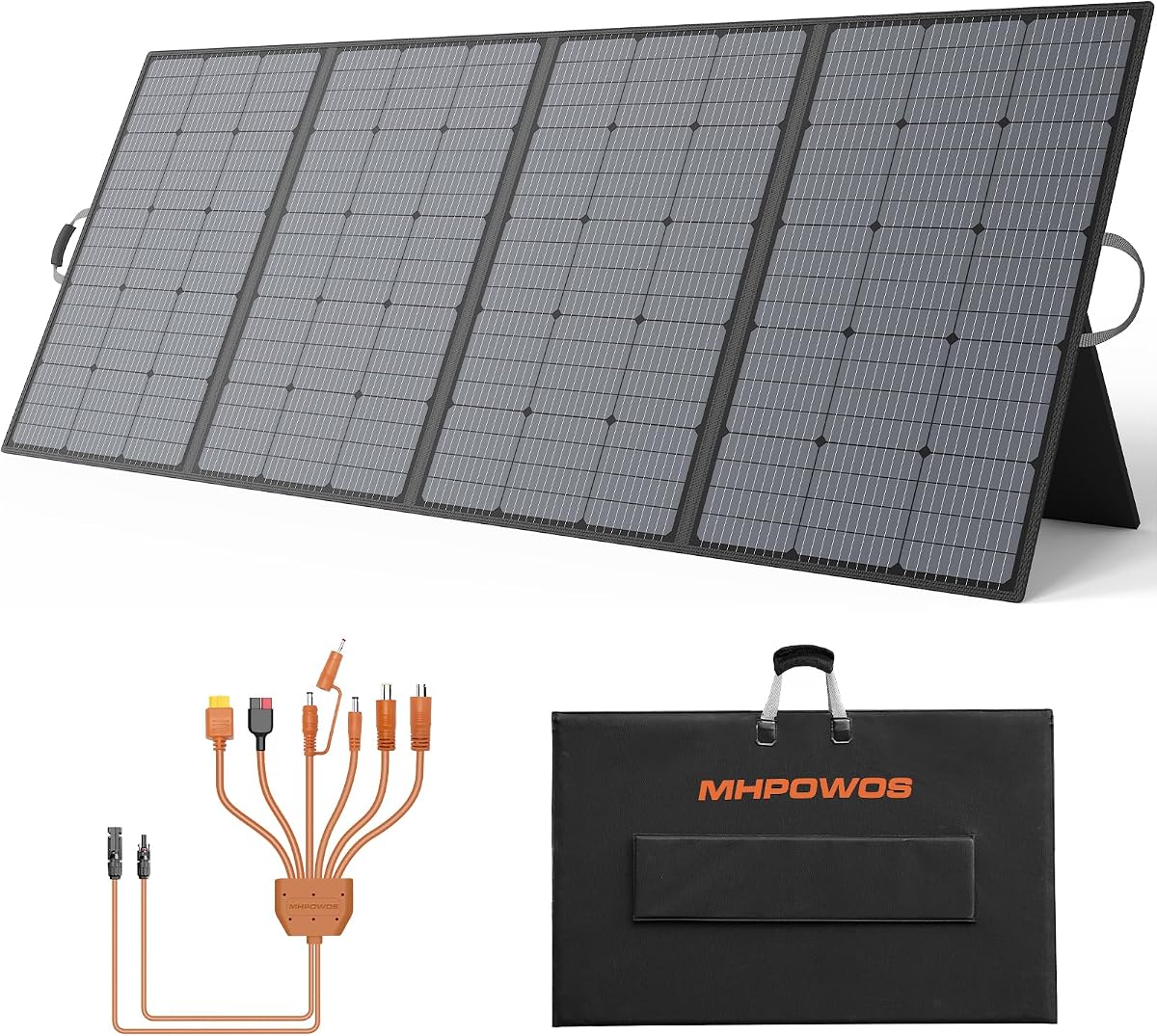
The MHPOWOS 400W portable solar panel is a higher-output alternative included for shoppers comparing closely related capacity levels. It has a 4.1 rating and uses A-grade monocrystalline cells with a stated conversion efficiency of 23.5%. The foldable construction and multiple kickstands make it suitable for RV travel, camping, fishing, and mountain activities.
We may earn a commission when you buy through this link, at no additional cost to you.
Its standout feature is connector flexibility. The supplied connection options cover Anderson, XT60, DC7909, DC5521, DC8020, DC5525, and DC35135, allowing the panel to work with a wide range of portable power stations. The four built-in kickstands provide stable placement on a flat surface, and the adjustable design allows the panel to be repositioned as the sun moves.
IP67 protection covers the panel against dust and water, while professional solar output interfaces support plug-and-play use. A zippered accessory pouch helps organize cables and accessories. As with any portable panel, however, output depends heavily on direct sunlight, positioning, temperature, and the power station's maximum solar input limit.
This panel is worth considering when connector compatibility is uncertain or when a power station accepts more than 350W. The manufacturer specifically notes that the station may limit the amount it receives even under optimal sunlight, so users should check the station's maximum input rating before ordering. For those who need broad adapter support and a high-output foldable design, it offers strong practical flexibility.
Seven listed connector formats reduce the chance of finding the correct power-station cable. The included adapter still needs to match both the panel's output and the station's supported solar input specifications.
Four integrated stands make the panel easy to position on a flat surface. Adjusting the angle throughout the day can improve energy capture, while the zippered pouch keeps accessories together during transport.
We may earn a commission when you buy through this link, at no additional cost to you.
E-POWO's 400W foldable solar panel has a 4.3 rating and combines monocrystalline cells, ETFE lamination, and a stated 23.5% conversion efficiency. Although it is 50 watts above the guide's central capacity, its design makes it a relevant alternative for users whose power stations can accept high solar input or who want additional charging headroom.
We may earn a commission when you buy through this link, at no additional cost to you.
The panel weighs 15.57 kilograms, or about 34.3 pounds, and folds to 37.76 by 24.96 by 1.3 inches. Once unfolded, the design uses built-in kickstands and provides 40-, 50-, and 60-degree angle options. Reinforced grommets add another mounting option for RVs or tents, giving users more ways to position the panel in the field.
Its seven-in-one cable supports Anderson, XT60, DC7909, DC5521, DC8020, DC5525, and DC35135 connections. ETFE lamination and an IP67 rating provide dust and water resistance, while the Oxford-fabric casing and fiberglass structure contribute durability, corrosion resistance, and thermal stability. The package includes the panel, seven-in-one cable, and user manual.
This is a compelling option for a user with multiple power stations or a system that accepts the panel's output. It carries an 18-month warranty and the seller states that support inquiries will receive a response within 24 hours. Its main disadvantages are weight and the fact that it exceeds 350W, so buyers should consider carrying logistics and their station's maximum solar input before choosing it.
Three selectable angles allow the panel to be adjusted for different sun positions. Reinforced grommets also allow alternate mounting where kickstand stability may be limited.
The seven-in-one cable provides broad compatibility with popular portable power stations. Because a higher nominal wattage does not override station limits, the receiving device's input specification remains essential.
We may earn a commission when you buy through this link, at no additional cost to you.
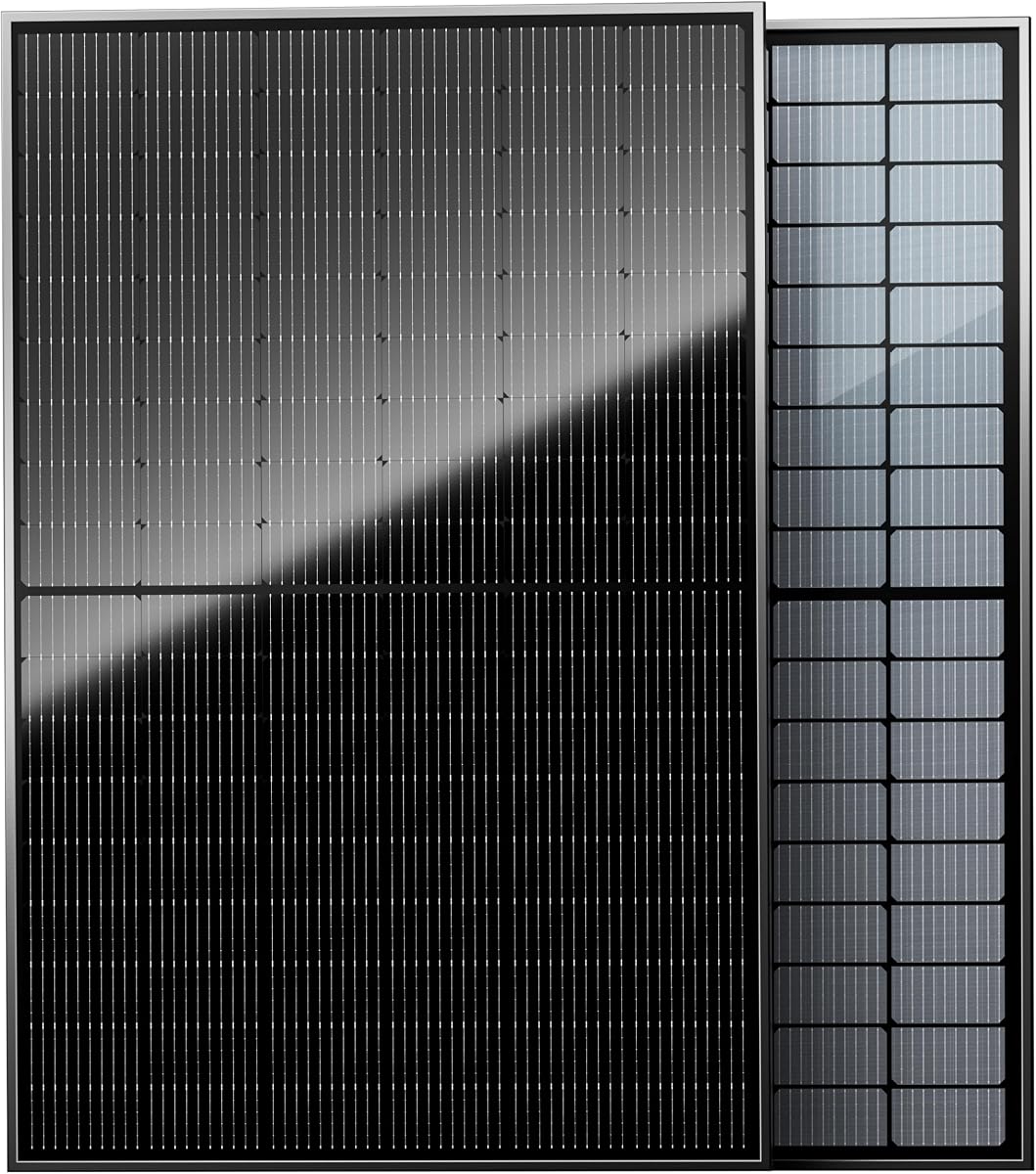
The EPOCH 430W bifacial panel is a rigid N-type monocrystalline module with a 4.5 rating, the highest published customer rating among the portable and rigid options in this guide. It uses Grade A+ cells, half-cut cell construction, bypass diodes, and a 16-busbar design intended to support stronger output and long-term performance.
We may earn a commission when you buy through this link, at no additional cost to you.
The bifacial configuration can collect sunlight from both sides of the module. The stated maximum conversion efficiency is 25%, supported by glass transparency of up to 91.5%. Rear-side gains depend on the installation: a bright reflective surface, suitable spacing, and an unobstructed rear side can make bifacial operation more effective than a placement against a dark or obstructed surface.
Durability specifications include 2,400Pa wind tolerance and 5,400Pa snow-load tolerance. The junction box is rated IP68, while the MC4 connectors are rated IP67 for resistance to dirt, dust, debris, and low-pressure water jets. These protections suit RVs, rooftops, cabins, yachts, and other exposed off-grid applications.
Pre-drilled holes allow rapid mounting with common ground mounts, Z brackets, corner brackets, pole mounts, and tilt mounts. The product is particularly attractive for a permanent system where a second illuminated face can add value. It is not the appropriate choice for someone seeking a light folding charger, and users should confirm 12V or 24V system requirements and charge-controller compatibility before installation.
A bifacial panel can generate from its front and rear surfaces. Leaving space below the panel and choosing a reflective ground surface can improve rear-side output, while obstructions or a dark surface can limit the benefit.
Pre-drilled mounting holes support several common bracket types, helping installers create a secure fixed setup. Correct tilt, spacing, and grounding are as important as the panel's headline efficiency.
We may earn a commission when you buy through this link, at no additional cost to you.
The right solar panel depends on electrical compatibility, portability, installation method, and the environment where it will operate. Use the following factors to narrow the field before comparing connectors, efficiency, and construction details.
A panel's nominal wattage is only half of the compatibility equation. The power station must also accept the panel's operating and open-circuit voltage within its specified input range. The ZOUPW option operates at a stated 50.2V open-circuit voltage, while the GRECELL model is listed at 37.4V, illustrating why two 350W panels may not connect safely to the same station. Review the station manual, solar-input label, and connector type before buying.
Monocrystalline cells are used throughout the strongest selections in this guide, while N-type and half-cut designs appear in several premium options. Higher conversion efficiency can be valuable when panel area is limited, but it does not guarantee more energy in every condition. Output also depends on irradiance, angle, temperature, shading, dust, and system losses. Treat efficiency as one specification within a larger performance calculation rather than the only buying criterion.
Connector formats such as MC4, XT60, Anderson, DC7909, and DC8020 appear across the guide. A panel advertised as compatible may still require the correct cable, and adapter cables must match both the panel's output plug and the power station's input. Some products include a broad multi-connector cable, while others include only a panel and manual. Check the package contents rather than assuming every necessary cable is supplied.
Folding panels are easier to move and store, making them suitable for camping, fishing, and RV travel. Their kickstands may still be less stable than a rigid roof or ground mount. Rigid modules generally suit boats, cabins, sheds, tiny houses, and other permanent installations, but they require compatible racking, wiring, and electrical controls. Select the form that matches the intended use rather than optimizing for a specification that will not be exploited.
IP65, IP67, and IP68 ratings describe different levels of protection against dust and water under specified test conditions. A higher rating is helpful for exposed outdoor equipment, but no panel should be assumed immune to prolonged submersion, severe impact, or standing water. Also consider wind, snow, corrosion, UV exposure, and the possibility of accidental impact. ETFE surfaces and aluminum frames are useful indicators of outdoor durability when paired with suitable mounting.
Portable panels range from foldable suitcase formats to large briefcase-style units, and their weights can materially affect a trip. ZOUPW lists a 22.2-pound weight, BLUETTI lists 30.6 pounds, and E-POWO lists 15.57 kilograms. Consider not only the panel but also its size, handles, cable storage, and whether one person can position it safely. For frequent hand-carrying, a lighter option may be more practical than one with a higher headline rating.
GRECELL supports series and parallel expansion and includes a Y-cable, while higher-capacity rigid kits may support larger systems. Expansion only works safely when every panel has compatible electrical characteristics and the charge controller and battery system are designed for the resulting configuration. Mixing panels of different ages, voltages, or ratings can create problems. For larger arrays, include a properly sized charge controller, disconnects, grounding, and cable management in the project plan.
Warranty terms can indicate how a manufacturer expects the product to be used. ZOUPW lists a three-year warranty, E-POWO provides 18 months, and the SUNGOLDPOWER kit carries 12 years of material and workmanship coverage plus a 25-year linear performance warranty. Certifications such as TUV certification, UL61730 compliance, and CEC listing can also matter for permanent electrical systems. Retain receipts and follow installation instructions to preserve coverage.
Before connecting a panel, read both the solar panel and power station instructions. Confirm that the station's solar input voltage and maximum wattage are compatible, select the correct cable, and power down the station if its manufacturer recommends doing so during connection. For fixed installations, use appropriate mounting hardware, grounding, a compatible charge controller, and a battery system designed for the intended voltage and current.
Place the panel in direct sunlight with no trees, buildings, vehicles, fabric, or equipment casting shade across it. Foldable models should be unfolded fully and positioned with their kickstands on a stable surface. Adjust the angle as the sun moves, and avoid placing heavy objects on the cells. Do not touch the panel's active surface while it is operating, and keep it clean of dust, debris, and grass.
For care, wipe the surface gently with a soft, clean cloth and avoid harsh chemicals, sharp tools, and abrasive materials. Let the panel dry before folding it, and never pack it while the surface is wet. Disconnect cables before storage, coil them without sharp bends, and use the supplied storage bag where available. Periodically inspect connectors, fabric, frames, brackets, and mounting points for damage before the next deployment.
No. The power station must support the panel's voltage, connector, and acceptable input wattage. For example, a model with a 50.2V open-circuit voltage is intended for compatible high-voltage stations and is not suitable for small 12V to 20V units. Check the station's solar input specifications before purchasing.
The answer depends on battery capacity, available sunlight, panel efficiency, charging losses, and the power station's input limit. A panel's rated wattage is the maximum under ideal laboratory or specified conditions, not a guarantee of continuous real-world output. Cloud cover, heat, shading, and angle can reduce charging time substantially.
A bifacial panel can be beneficial when its rear side receives useful reflected light and remains unobstructed. On a boat or RV, the installation geometry, reflective surface, spacing, and mounting orientation determine the benefit. A conventional front-only panel may be simpler and more effective if the rear side is blocked or receives little light.
It depends on the panel and power station. The GRECELL model states support for series and parallel connections, and the included Y-cable enables expansion. Other models warn against long-term series or parallel use. Panels should have compatible characteristics, and the battery, charge controller, cables, and power station must support the resulting configuration.
The ratings indicate increasing levels of protection against dust and water under defined test conditions. IP65 is designed to resist dust and water splashes, IP67 protects against temporary immersion in suitable conditions, and IP68 offers a higher stated level of water protection. They do not make a panel immune to every weather condition or mechanical impact.
Some portable power stations include charging electronics that manage incoming solar power, so a separate controller may not be needed for a supported direct connection. Fixed installations often require a controller sized for the array and battery bank. Always follow the power station or battery manufacturer's charging instructions, particularly for lithium batteries.
A foldable panel is better suited to temporary or mobile charging because it is designed to unfold, position, and pack away. A rigid panel with secure roof or ground mounting is generally more appropriate for permanent service. Choose mounting that resists wind, protects cables, allows ventilation, and follows local electrical requirements.
Efficiency affects how effectively the panel converts available sunlight, but it is only one factor. Irradiance, panel angle, temperature, partial shading, dust, electrical losses, and the power station's input limit can all change the result. Comparing efficiency is useful, but matching the installation and receiving equipment matters just as much.
ZOUPW is the leading pick for users of compatible high-voltage power stations because its 50.2V design, N-type cells, 25% stated efficiency, and four-in-one cable create a strong portable charging package. BLUETTI offers a refined 23.4%-efficient alternative for established MC4-compatible systems, while GRECELL provides broad XT60 and Anderson support plus useful expansion options.
The right choice for everyone else depends on the installation. Portable users should compare weight, folding size, kickstand stability, and connector support, while fixed-system buyers should examine mounting requirements, environmental tolerances, certifications, and warranty coverage. Always confirm that the power station, charge controller, battery, cables, and panel form one compatible electrical system.
Product specifications, included accessories, availability, and pricing can change over time. Review the current listing and manufacturer instructions before ordering, especially for open-circuit voltage and maximum input limits. Those final checks can make the difference between a productive solar setup and a connection that cannot safely deliver its advertised capacity.