
Basic Starter Kit for ESP32 ESP-32S
5.0Editor score
Beginner-focused component selection
Arduino IDE programming support
Hands-on IoT learning design
Compare the best ESP32 Starter Kit options for beginners, camera projects, STEM learning, Wi-Fi, sensors, and hands-on electronics development.
An ESP32 Starter Kit combines a wireless microcontroller with sensors, displays, motors, breadboards, and other components for learning embedded electronics and building connected projects. A worthwhile kit should make setup approachable, include accurate instructions, and provide enough variety to support both first circuits and more advanced Wi-Fi or IoT experiments.
This guide compares ten kits based on their included components, microcontroller capabilities, project guidance, programming options, and practical learning structure. The selections range from compact beginner sets to large camera-based systems and modular kits designed for C++, MicroPython, Arduino IDE, Scratch, and ESP-IDF development.
Each review explains what the kit is best suited for, while badges identify the overall, budget, and premium choices among the top picks. Ratings and product details reflect the supplied listing information, and prices can change, so readers should confirm the current cost, component list, and availability before purchasing.
5.0Editor score

4.3Editor score

4.6Editor score
The table below summarizes the board type, included learning materials, component scale, and programming focus of all ten kits, making it easier to match a set to your experience and intended projects.




The ELEGOO ESP-32 Super Starter Kit is the strongest all-around recommendation for learners who want meaningful variety without moving directly into a highly specialized camera or modular robotics system. It carries a 4.3 rating and places the emphasis on accessible learning: the included ESP32 board has a dual-core processor, Wi-Fi, and Bluetooth 4.2, while the kit supplies more than 35 modules and components. That mix gives users a credible starting point for circuits, sensors, displays, motors, input devices, and connected projects.
We may earn a commission when you buy through this link, at no additional cost to you.
The package is particularly attractive because it includes LEDs, buttons, an OLED display, a servo motor, and a keypad rather than limiting the first experiments to basic wiring. Its online tutorial provides more than 30 projects with complete code, circuit diagrams, and step-by-step instructions. This structure can reduce the early friction of deciding what each component does and how to connect it, while Arduino IDE compatibility gives learners a familiar route from the guide to original code.
The main compromise is that this is not a camera-focused kit. It also depends on downloadable instructional material rather than providing a fully self-contained learning path in the box, which may be inconvenient for users who prefer offline books. Some tutorials may be more useful for someone starting with basic circuits than for an experienced developer seeking advanced board-level information. Even so, the range of components and the progression toward IoT applications make it a more versatile choice than a minimal introductory set.
Choose this kit if you are a student, hobbyist, or early-stage maker who wants a balanced mix of electronics practice and wireless development. It is particularly well suited to weather stations, smart-home controllers, remote-controlled devices, and interactive gadgets. Buyers who need an onboard camera, a huge reference manual, or standardized plug-in sensor ports should compare one of the Freenove or Lonely Binary alternatives instead.
The more than 30 projects move beyond a single demonstration, allowing learners to progress from basic circuits and coding toward practical IoT applications. Complete code and diagrams make each experiment easier to reproduce and adapt.
Displays, a servo, keypad, buttons, LEDs, and multiple sensor types create a useful component foundation. This variety supports both structured lessons and independent experiments after the basic skills are established.
We may earn a commission when you buy through this link, at no additional cost to you.
The LAFVIN Basic Starter Kit offers a direct route into programming the ESP32S and connecting it to common modules. Its 4.5 rating reflects a generally well-received compact learning set, and the stated purpose is introductory rather than comprehensive. The kit is built around an ESP32S Wi-Fi IoT development board, familiar Arduino IDE compatibility, and a tutorial that explains assembly and programming for users who may be new to electronics.
We may earn a commission when you buy through this link, at no additional cost to you.
The included modules can be used to explore practical control tasks involving items such as LEDs, the DHT11, and an OLED display. That makes the set more focused on transferable foundational skills than on sheer component quantity. The tutorial includes code and lessons, while the listing explicitly directs buyers to download the material after receiving the kit. For a beginner, having a defined sequence involving board setup, module connections, and program uploads can be more useful than opening a box filled with unfamiliar modules.
The tradeoff is a narrower learning horizon. A basic kit will not offer the same range of camera, robotics, motor, or environmental experiments as the larger Freenove, LAFVIN Ultimate, or ACEBOTT packages. Its tutorial also appears to be delivered online rather than as a paper manual, and the supplied description offers fewer details about the exact number and type of included parts. Experienced makers may find that they need to add sensors, displays, or wiring supplies later.
This is a sensible choice for someone who wants a manageable first ESP32 system rather than an enormous parts collection. It is also useful for learners who already have some electronics access and only need a board, several essential modules, and a concise introduction. If your goal is to compare sensors, build camera systems, or explore dozens of advanced circuits immediately, a larger kit would offer a better fit.
Controlling an LED, reading a DHT11, or displaying information on an OLED introduces the basic input-output workflow clearly. These modules make the connection between physical components and uploaded code easier to understand.
The included lessons are designed to guide assembly and programming in sequence. That structure is valuable for learners who want a repeatable path before experimenting with components independently.
We may earn a commission when you buy through this link, at no additional cost to you.
The Freenove ESP32 Camera Board Ultimate Starter Kit is the most expansive premium option in this guide, combining a capable camera board with 242 items and 122 documented projects. Its 4.6 rating makes it one of the strongest-rated selections here. The board uses a dual-core 32-bit processor reaching 240 MHz, includes 4 MB of flash and 8 MB of PSRAM, and provides 2.4 GHz Wi-Fi, Bluetooth 4.2 LE, a USB code uploader, and a memory card slot. A 1 GB memory card and reader are included.
We may earn a commission when you buy through this link, at no additional cost to you.
Its educational depth is a major advantage. The downloadable English tutorial contains 795 pages and is also available online, with browser-based translation support. Projects are organized with schematics, wiring diagrams, complete code, and detailed explanations. Three code collections cover MicroPython, C, and Processing, allowing learners to move between embedded Python, traditional C, and computer-side graphical interfaces. The large inventory includes commonly used components, modules, sensors, wires, and supporting items.
The size and complexity may be excessive for someone who only wants a first blinking-light exercise. The camera also introduces storage, image handling, and board-specific setup concerns that can be more involved than a plain sensor circuit. The tutorial is not supplied as a paper book, so online access is important. Furthermore, the number of parts can make inventory and component identification less intuitive for a complete novice.
Despite those considerations, this kit is a compelling choice for makers who want a camera-capable ESP32 platform and a deep reference library. It is especially appropriate for learning image-related IoT concepts, working with multiple programming languages, and progressing through a long sequence of increasingly complex circuits. Those wanting the newest controller generation may also consider the closely related ESP32-S3 version listed later in this guide.
The integrated camera, PSRAM, USB uploader, and memory card support create a platform for image-capture experiments rather than a generic sensor-only board. The supplied storage card allows users to begin handling captured media.
A 795-page tutorial, 122 projects, wiring diagrams, schematics, and complete code provide a substantial learning reference. It can help users progress gradually instead of forcing isolated demonstrations without supporting theory.
We may earn a commission when you buy through this link, at no additional cost to you.
The Freenove ESP32-S3 Camera Board Ultimate Starter Kit is built for learners who want more current wireless capabilities and are comfortable with a large, technically rich project set. It has a 4.6 rating and includes 243 items alongside 121 projects. The central ESP32-S3 board provides a dual-core 32-bit processor up to 240 MHz, 8 MB of flash, 8 MB of PSRAM, 2.4 GHz Wi-Fi, Bluetooth 5 LE, USB-OTG, a USB code uploader, a camera, and a memory card slot.
We may earn a commission when you buy through this link, at no additional cost to you.
The bundle includes a 1 GB memory card and card reader, allowing learners to work with an onboard camera from the beginning. Its 828-page downloadable English tutorial exceeds the length of the standard ESP32 camera kit, and the online version can be translated through a browser. MicroPython, C, and Processing code collections broaden the development perspective, while the project library provides schematics, wiring diagrams, full code, and detailed explanations.
This is not the easiest kit to unpack for someone who has never handled a microcontroller. Bluetooth 5, USB-OTG, the S3 controller, camera storage, and a very large component inventory can create several points of friction. As with the related Freenove camera set, the tutorial is found on the product box rather than printed on paper. Users who need the newest board features should accept that trade-off; absolute beginners may find the standard ESP32 version more approachable.
The kit is best suited to makers, engineering students, and technically curious hobbyists who want a camera-based IoT platform with extensive supporting material. It is also a logical option for users who may later need more advanced wireless or USB behavior than the original ESP32 offers. Choose it when future project potential matters more than a minimal parts count or the simplest possible introduction.
Bluetooth 5 LE and USB-OTG distinguish the S3 platform from the original ESP32 camera board. These interfaces create a stronger foundation for users exploring contemporary connected-device behaviors.
The 121 documented projects span simple to complex work, supported by diagrams, code, and explanatory material. The 828-page guide gives users a detailed reference for both initial assembly and later experimentation.
We may earn a commission when you buy through this link, at no additional cost to you.
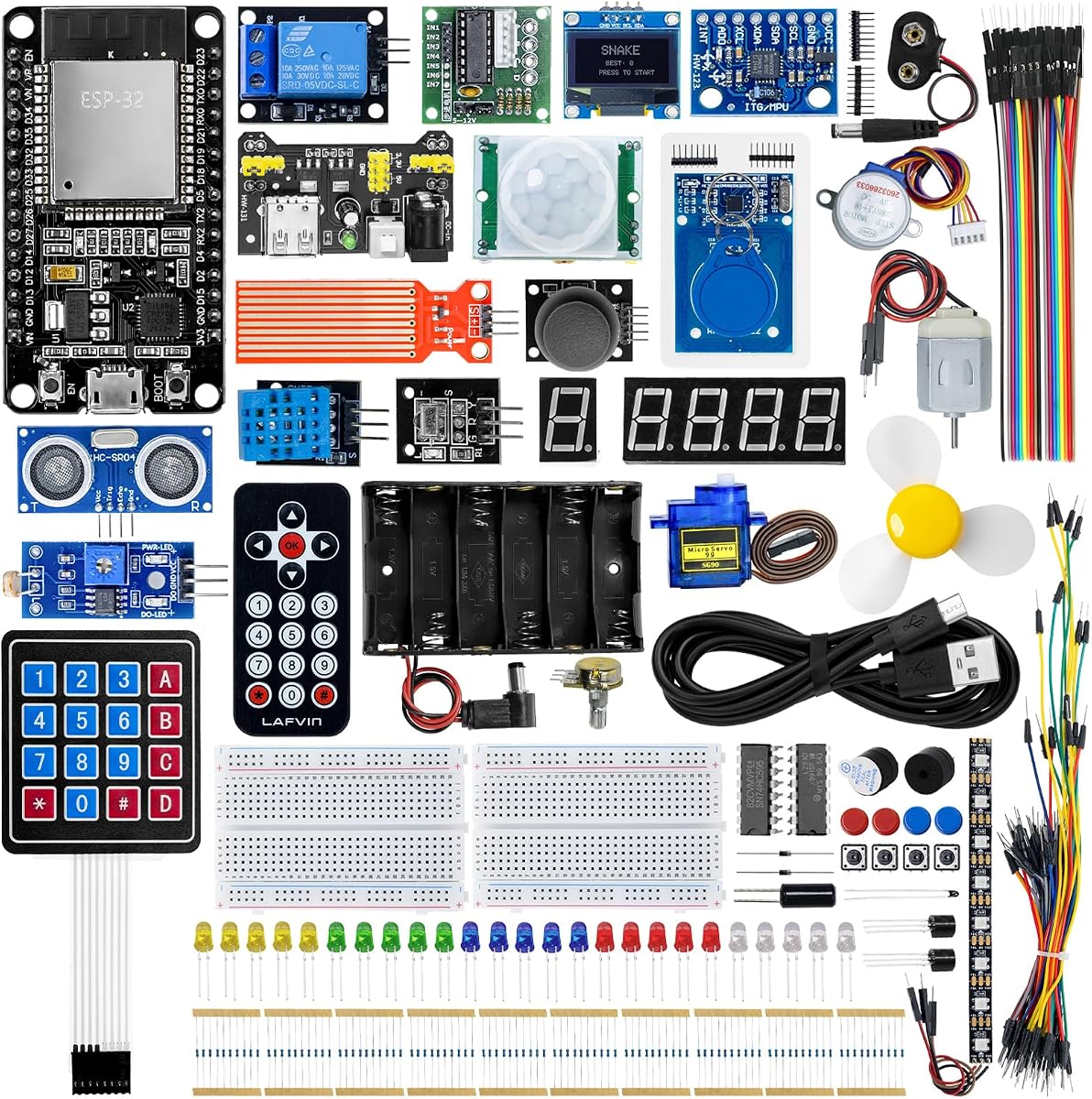
The Basic Starter Kit for ESP32 ESP-32S is the top budget recommendation for beginners, students, and makers who want a focused way to learn electronics, programming, and basic IoT concepts. Its listed rating is 5.0, the highest numerical rating among the featured products. The package is built around an ESP32S development board with integrated Wi-Fi and combines that board with essential electronic modules for practical, hands-on experiments.
We may earn a commission when you buy through this link, at no additional cost to you.
The kit is explicitly compatible with the Arduino IDE, giving users a familiar programming environment in which they can write, upload, and test programs. Its modules support sensor readings, output control, and basic circuit functions, making it possible to connect physical behavior with embedded code. The design is also positioned for STEM education, classroom activities, electronics practice, and home DIY work, which gives it broad practical appeal without requiring a specialized camera or robotics platform.
The provided listing does not state a precise number of components or offer the same depth of project-library information as the larger Freenove and ACEBOTT kits. That means buyers should review the current contents carefully, particularly if they need a particular display, motor, or sensor type. It is also a basic set rather than a comprehensive laboratory, so larger ambitions may require additional parts later. The value of this option lies in focused instruction and accessible experimentation rather than an enormous inventory.
This kit is a strong choice for first-time users who want to understand microcontroller programming through sensors, outputs, and wireless communication. It can also suit clubs or families that need several approachable sets without buying a specialized platform. Users who want extensive written guidance should favor a kit with a clearly enumerated tutorial, while those ready for camera work should examine the Freenove alternatives.
The kit deliberately concentrates on essential modules and straightforward programming tasks. That makes it easier for a new learner to understand how sensors, outputs, and the development board work together.
Integrated Wi-Fi allows the board to move beyond blinking LEDs into connected experiments. Learners can explore basic IoT applications in a familiar Arduino IDE environment.
We may earn a commission when you buy through this link, at no additional cost to you.
The Freenove ESP32 Camera Board Basic Starter Kit provides a middle ground between a conventional sensor kit and a sprawling component library. It has a 4.6 rating and includes 143 items, 58 projects, and a 400-page downloadable tutorial. The central board combines a dual-core 32-bit processor reaching 240 MHz with 4 MB of flash, 8 MB of PSRAM, 2.4 GHz Wi-Fi, Bluetooth 4.2 LE, a USB code uploader, and an onboard camera.
We may earn a commission when you buy through this link, at no additional cost to you.
A 1 GB memory card and card reader are included, which is important for projects that capture or store images. The kit supports both MicroPython and C, giving users a choice between approachable Python workflows and the classic embedded C language. Each of the 58 projects is supported by schematics, wiring diagrams, complete code, and detailed explanations, and the tutorial can be downloaded or viewed online. Browser translation is available when the original English material is not sufficient.
Compared with the Freenove Ultimate Camera Kit, this version asks users to manage fewer parts and work through a shorter project sequence. That can be helpful for people who want camera capabilities but do not need the largest possible inventory. The tradeoff is less breadth: advanced robotics, extensive sensor arrays, and the Processing language are not part of this package. The downloadable-only guide also means that reliable internet access is useful from the beginning.
This kit fits learners who want a camera-capable ESP32 experience with a substantial but more manageable course. It is a good bridge between simple electronics kits and comprehensive professional-style inventories, particularly for users interested in image capture, wireless control, and embedded Python or C. Buy it instead of the Ultimate edition when curriculum depth and component volume are not your main priorities.
The onboard camera, 8 MB of PSRAM, USB uploader, storage slot, card, and reader form a ready-made image platform. Beginners can focus on learning rather than sourcing core board accessories separately.
Fifty-eight projects create a clear route from simple to complex circuits. Diagrams, complete code, and explanations maintain the educational structure while keeping the collection smaller than an ultimate kit.
We may earn a commission when you buy through this link, at no additional cost to you.
The LAFVIN ESP32 Ultimate Starter Kit is designed for learners who want an expansive introduction to programming, electronics, robotics, and Wi-Fi IoT development. It carries a 4.4 rating and presents itself as an all-in-one STEM learning package containing varied modules and sensors. Unlike a simple LED-and-breadboard set, the kit is built to show how the ESP32's wireless communication can support real control and monitoring tasks.
We may earn a commission when you buy through this link, at no additional cost to you.
The included lessons reportedly contain detailed tutorials, wiring diagrams, sample code, and project courses. Users can create browser-based control interfaces, remotely operate components such as LEDs and motors, and publish sensor readings through a phone, tablet, or computer. The module collection includes ultrasonic and PIR sensors, RFID, a servo, an MPU6050, an OLED, a temperature and humidity sensor, and many other parts. Listed project ideas include access control, environmental monitoring, three-dimensional motion animation, a Snake game, motion alarms, and smart-home systems.
Its breadth is the main attraction and the main challenge. A large inventory gives users more room for independent experimentation, but it can also make the first session feel overwhelming. The specific number of included parts is not stated, and the learning materials are not identified as a printed manual, so users should check the current contents and guide access before buying. Some ambitious projects may also require careful attention to wiring, code, and compatible voltage assumptions.
This is a strong option for students and hobbyists who already understand basic circuit handling or want a kit that progresses toward web-connected controls. It is especially attractive for classes, STEM programs, and makers interested in RFID, motion detection, environmental sensing, or servo-driven projects. Choose a simpler set for gentle introduction, or a camera-specific model if visual projects are the main goal.
The curriculum connects sensor data and actuator control to browser-based interfaces viewed on common devices. This gives learners a practical way to understand the connection between an ESP32 and an accessible user interface.
Ultrasonic, motion, environmental, orientation, RFID, and input modules cover several useful sensing categories. That variety supports both classroom exercises and original IoT inventions.
We may earn a commission when you buy through this link, at no additional cost to you.
The ESP32 Starter Kit V2 is a versatile prototyping package centered on a 38-pin ESP32 development board and a separate expansion board. Its 5.0 rating is among the highest in the guide, and the 21-in-1 configuration includes a half-size breadboard, male-to-female and female-to-female jumper wires, a display, sensors, modules, wires, and essential control parts. This is a practical foundation for building temporary circuits and then transferring ideas toward more permanent projects.
We may earn a commission when you buy through this link, at no additional cost to you.
The component list covers several common needs. Sensors include an HC-SR501 motion sensor, HC-SR04 ultrasonic sensor, LDR, potentiometer, DS18B20, and piezo buzzer. A 16×2 I2C LCD, SG90 servo, tactile button, button caps, LEDs, resistors, and expansion board support output, display, and physical interaction. Online tutorials are available for Arduino IDE using C/C++ and for MicroPython, allowing learners to compare a conventional compiled environment with a more compact Python workflow.
One practical limitation is that the guide is found by searching for the product name rather than supplied directly through a clearly stated link. That extra step can interrupt the learning flow, particularly for a first-time user. The separate expansion board also needs deliberate pin planning, and the half-size breadboard offers less workspace than a full-size model. Nevertheless, the included jumper types and core components reduce the need to source basic prototyping accessories immediately.
This kit is well suited to learners who want to experiment with both C++ and MicroPython and who value physical prototyping tools. It also works for students building projects around displays, motion, distance, temperature, sound, or servo control. Choose it when a flexible breadboard-based setup matters more than an onboard camera or a fixed, standardized sensor connection system.
The half-size breadboard and two jumper-wire types provide the basic tools for temporary construction. Users can connect the 38-pin board, expansion board, sensors, and outputs without assembling every circuit from loose components.
Separate online tutorials support both Arduino IDE C/C++ and MicroPython. This gives learners a way to compare approaches while working with the same family of hardware and components.
We may earn a commission when you buy through this link, at no additional cost to you.
The ACEBOTT ESP32 Electronics Kit combines a wireless ESP32 board with 96 components, more than 40 tutorials, and a deliberately structured learning path. Its 4.4 rating reflects a kit designed for students, coding beginners, makers, and future engineers. The lessons progress from understanding individual electronic parts to building basic circuits, completing practical systems, and finally exploring more advanced IoT applications, which helps prevent tutorials from feeling like disconnected demonstrations.
We may earn a commission when you buy through this link, at no additional cost to you.
Programming options are one of the strongest features. The set supports beginner-friendly graphical coding, Arduino IDE programming, and Python programming. Learners can begin with drag-and-drop activities, then transition into handwritten code and wireless development. The component range includes an ultrasonic sensor, PIR motion sensor, motors, RGB lights, buttons, and a breadboard, enabling more than 40 projects that range from simple circuits to smart-home and wireless-control concepts.
Organization deserves attention because a 96-piece collection can feel dense to a novice. The listing notes that key components are individually labeled and protected in anti-static packaging, which should help with sorting and assembly. A compact portable design also makes the kit practical for home learning, classrooms, clubs, and educational programs. The limitation is not capability but prioritization: three programming methods and many project directions can overwhelm a user who wants a single prescribed path.
This is a compelling choice for STEM programs and families seeking a transition from visual coding toward real embedded development. It also works well for learners who want a structured curriculum rather than a loose collection of parts. Select it when progression and organized teaching matter most. Camera-focused work, standardized sensor ports, and extensive printed-scale reference material are not the central strengths of this package.
The tutorials connect component understanding, basic construction, practical projects, and advanced IoT work. That progression can make the learning process feel more coherent for students and self-directed beginners.
Graphical coding, Arduino IDE, and Python allow users to begin with a lower barrier and gradually take on more complex code. The same kit can therefore support different stages of programming confidence.
We may earn a commission when you buy through this link, at no additional cost to you.
The Lonely Binary TinkerBlock ESP32-S3 Starter Kit takes a different approach from breadboard-centered kits by providing a dedicated expansion board and 12 standardized sensor modules. It has a 4.5 rating, and its flagship board uses a dual-core 240 MHz processor, Wi-Fi, Bluetooth 5.0, native USB, secure boot, and 16 MB of flash. The combination targets IoT, robotics, education, and development work where repeatable connections and a defined hardware platform are valuable.
We may earn a commission when you buy through this link, at no additional cost to you.
The S3 expansion board provides dedicated plug-in ports for each sensor, reducing the need to create individual breadboard circuits. Its 12 modules connect through standardized cables and cover visual, audio, input, environmental, infrared, and lighting functions. The collection includes a Jumbo LED, push button, microphone, active and passive buzzers, potentiometer, WS2812 RGB LED bar, thermistor, optical sensor, infrared transmitter and receiver, and ambient light sensor. This selection supports common interactive and responsive project behavior.
The modular design trades some freedom for consistency. A breadboard-based kit lets learners improvise arbitrary circuits, whereas TinkerBlock encourages the use of the supplied ports and modules. The ESP32-S3 platform and secure boot capability also represent a more specialized commitment than a basic ESP32S board. Buyers who need many additional components, including extensive motor drivers or unrelated peripherals, may need to supplement the supplied collection. Camera functionality is also not listed among the included modules.
This is a strong option for educators and makers who want tidy, repeatable sensor assemblies and a modern ESP32-S3 foundation. It suits projects involving RGB lighting, sound, motion-like optical response, infrared communication, and environmental sensing. Choose it when standardized modularity and multiple software ecosystems matter more than free-form breadboard experimentation or a large collection of miscellaneous electronic parts.
Dedicated expansion-board ports and standardized sensor cables reduce setup complexity. Learners can connect modules consistently and spend more time understanding program behavior than recreating basic wiring.
Compatibility with C++, MicroPython, and ESP-IDF supports different levels of embedded development. The ESP32-S3 board also provides Wi-Fi, Bluetooth 5.0, native USB, and secure boot for connected work.
We may earn a commission when you buy through this link, at no additional cost to you.
The right ESP32 Starter Kit depends on your programming experience, preferred software environment, project goals, and appetite for managing components. Compare the board, lessons, included modules, and physical connection system before deciding which educational format fits you best.
The original ESP32 remains a versatile Wi-Fi and Bluetooth platform, while the ESP32-S3 adds a newer controller architecture and capabilities such as Bluetooth 5, USB-OTG, or native USB depending on the kit. These differences matter only if your intended projects will use them. A standard ESP32 or ESP32S board is sufficient for many sensor, display, lighting, and basic Wi-Fi experiments, while an S3 platform may provide a more modern foundation for robotics, camera work, or advanced USB projects.
Choose the board based on your learning goal, not simply on the newest processor name. Confirm the board’s documented connectivity, memory, flash capacity, and programming support before purchasing.
A kit can include dozens of parts without covering the exact projects you have in mind. Beginners generally benefit from LEDs, buttons, a breadboard, jumper wires, basic sensors, and clear display options. More advanced work may require servos, RFID, ultrasonic sensing, motion detection, temperature and humidity measurement, or camera hardware. Compare the module list carefully and identify whether essential items are included or must be purchased separately.
Prioritize a balanced component set over the largest count. A smaller collection of clearly documented and correctly supported parts is usually more useful than miscellaneous extras that do not match the tutorial.
A useful tutorial should show complete wiring, explain the purpose of each component, provide working code, and lead from simple to more advanced exercises. The Freenove camera kits emphasize long downloadable references, while the ELEGOO kit offers a broad online project collection and the ACEBOTT kit is organized around progressive lessons. Some listings provide only a general description of the guide, so check the current contents before buying if structured instruction is important to you.
Prefer material with schematics, wiring diagrams, and complete code over screenshots or isolated snippets. A progressive course is usually easier for beginners than a loose project archive.
Most kits are designed around Arduino IDE, which uses a C++-like environment and is familiar to many electronics learners. MicroPython can make embedded experimentation more approachable because it resembles standard Python. Graphical coding tools such as Scratch-based workflows may help younger students or complete beginners begin with logic and control. Advanced developers may prefer ESP-IDF for a native framework. Several products in this guide support more than one environment, allowing a gradual transition between approaches.
Confirm that your preferred environment is explicitly supported. Avoid assuming that a kit advertising Python support includes the same board, libraries, and example quality as a dedicated MicroPython course.
Breadboard kits are flexible and familiar: sensors and modules can be placed exactly where a lesson requires, and components can be rewired for original experiments. Expansion-board systems are tidier and use dedicated ports or standardized cables, reducing repetitive wiring but limiting arbitrary layouts. A fixed sensor platform is useful for repeatable lessons and robotics, while a solderless breadboard is better for learning circuit construction and quick prototypes.
Think about how you will learn. Frequent rewiring favors a breadboard, while a sequence of repeatable sensor exercises may favor a modular expansion board.
Camera-equipped ESP32 kits are a distinct category because the board includes an image sensor, PSRAM, storage support, and typically a memory card and reader. The Freenove camera options support image-related learning but carry more setup and component-management demands. Kits without cameras are often better for first-time users, display experiments, environmental monitoring, and wireless controls. Choose a camera kit only when visual capture is central to your planned work.
Do not pay for camera complexity merely because the board sounds advanced. Confirm that image storage, tutorials, and example code match your intended projects.
Several premium kits provide extensive downloadable or online tutorials rather than printed manuals. This keeps the package flexible, but it requires internet access and makes it harder to learn away from a computer. Buyers who work in classrooms, remote locations, or shared clubs should investigate whether downloadable files can be saved for offline use. It is also useful to confirm whether a tutorial link appears on the product box and whether the guide is available in the buyer’s preferred language.
A downloadable guide can be excellent when searchable and well organized. Ensure you have a suitable device and enough storage to keep the material available.
Large kits are not automatically better for every learner. A compact beginner set can reduce cost, clutter, and decision fatigue, while a comprehensive kit can sustain months of study. Consider the projects listed in the guide, the age and experience of the intended user, and whether the goal is one weekend exercise or a sustained STEM program. A structured path that you will actually complete is more valuable than an enormous collection that remains half unused.
Choose the smallest kit that covers your next several projects. You can always add specialized modules later as your skills and ambitions grow.
Begin by organizing the included components before connecting the development board to a computer. Read the relevant tutorial section, identify the board pins, and verify the required voltage, pin, and communication details for every module. Begin with the supplied basic example, such as a button, LED, or sensor reading, rather than immediately assembling a complex project. Keep the board disconnected from external power while rewiring and confirm each connection against the published diagram.
Install the board support and development environment specified by the tutorial, then upload a minimal program before adding peripherals. Follow the lesson order when one is provided, because later examples often depend on skills or libraries introduced earlier. If a sketch does not compile, check the selected board type, connected port, library version, and pin definitions first. For kits with cameras, format the included memory card as required by the guide and verify that the board and code agree on the storage path.
Care for the kit by keeping the board away from conductive dust, liquids, static discharge, and short circuits. Handle small sensors, buttons, jumper wires, and cables without pulling on their leads. Store loose parts in labeled compartments, and use the supplied anti-static protection where provided. Disconnect power before changing a circuit, avoid forcing connectors, and keep unused expansion-board ports covered if the design encourages it. Periodically confirm that jumper wires remain secure and that the breadboard has not accumulated bent or damaged contacts.
An ESP32 Starter Kit is a bundle built around the ESP32 wireless microcontroller, usually including a development board, breadboard or expansion board, jumper wires, sensors, displays, buttons, LEDs, motors, and other modules. The exact collection varies, but the purpose is to let learners connect physical components to code and begin exploring electronics, IoT, robotics, or camera applications.
The ESP32 offers built-in Wi-Fi and Bluetooth, more processing capability, and greater memory than many common introductory Arduino boards. However, those features add complexity, so beginners should consider the quality of the kit’s tutorials and whether their first projects require wireless control. A guided ESP32 kit can be approachable, while a bare board with no instructions may be challenging.
Most beginner kits are designed around a development board, breadboard, jumper wires, and plug-in modules, allowing projects to be assembled without soldering. Some advanced projects may require soldering or additional hardware, but the standard lesson sequence in the featured kits is intended to use accessible connections. Check the included connection system and tutorial if you want a strictly solder-free experience.
Arduino IDE is a familiar choice for learners who want C/C++-style embedded programming, while MicroPython can make quick experiments more approachable with Python-like syntax. Several kits support both, which is ideal for comparing workflows. Choose the environment emphasized by the supplied tutorials, especially when you are starting out, and confirm that all required libraries and board definitions are available.
Typical projects include environmental monitors, motion alarms, Wi-Fi-controlled LEDs, servo controls, RFID access systems, OLED dashboards, temperature displays, web-based sensor interfaces, and RGB lighting effects. Camera kits can also support image capture and storage. The available components determine the practical project range, so identify your goal before buying and verify that the required sensors, outputs, and controller features are included.
No. A larger kit offers more hardware and potentially more lesson material, but it can also be harder to organize and may overwhelm a first-time learner. A compact, well-guided set is often better for learning the fundamentals, while a comprehensive kit makes more sense for a classroom, club, or maker with specific advanced projects in mind. Choose the smallest set that supports your planned curriculum.
Many basic sketches use similar programming concepts, but an ESP32 is not identical to every Arduino board. It has different available pins, communication peripherals, libraries, and sometimes different voltage or pin-handling rules. Use board support and examples written for the ESP32 model included in the kit, and verify pin assignments before adapting code from another platform.
The Freenove ESP32 Camera Board kits are the clearest options in this guide because their boards include a camera, PSRAM, a memory card slot, a 1 GB card, and a reader. The Ultimate edition offers more components and projects, while the Basic edition provides a smaller, more manageable course. An ESP32-S3 camera board may be preferable for users who need newer wireless or USB capabilities.
The ELEGOO ESP-32 Super Starter Kit is the most versatile overall recommendation because it combines a capable wireless board with more than 35 components and a substantial online project library. The Basic ESP32S Wi-Fi Kit stands out as the budget choice for accessible first steps, while the Freenove ESP32 Camera Board Ultimate Starter Kit leads the premium group for users who want extensive hardware, a camera, multiple programming approaches, and deeply documented projects.
Prioritize the learning experience that matches your goals. Choose a camera kit for image work, a modular expansion-board system for tidy repeatable sensor connections, a breadboard kit for flexible circuit construction, and a structured curriculum for students. Make sure the included components cover your immediate plans, and confirm the tutorial format, board capabilities, and software support before ordering.
Product contents, availability, and prices can change over time, so review the current listing before making a final decision. Comparing the board, components, project count, and instructional depth against your own learning plan will produce a more satisfying result than choosing solely by the number of parts.
