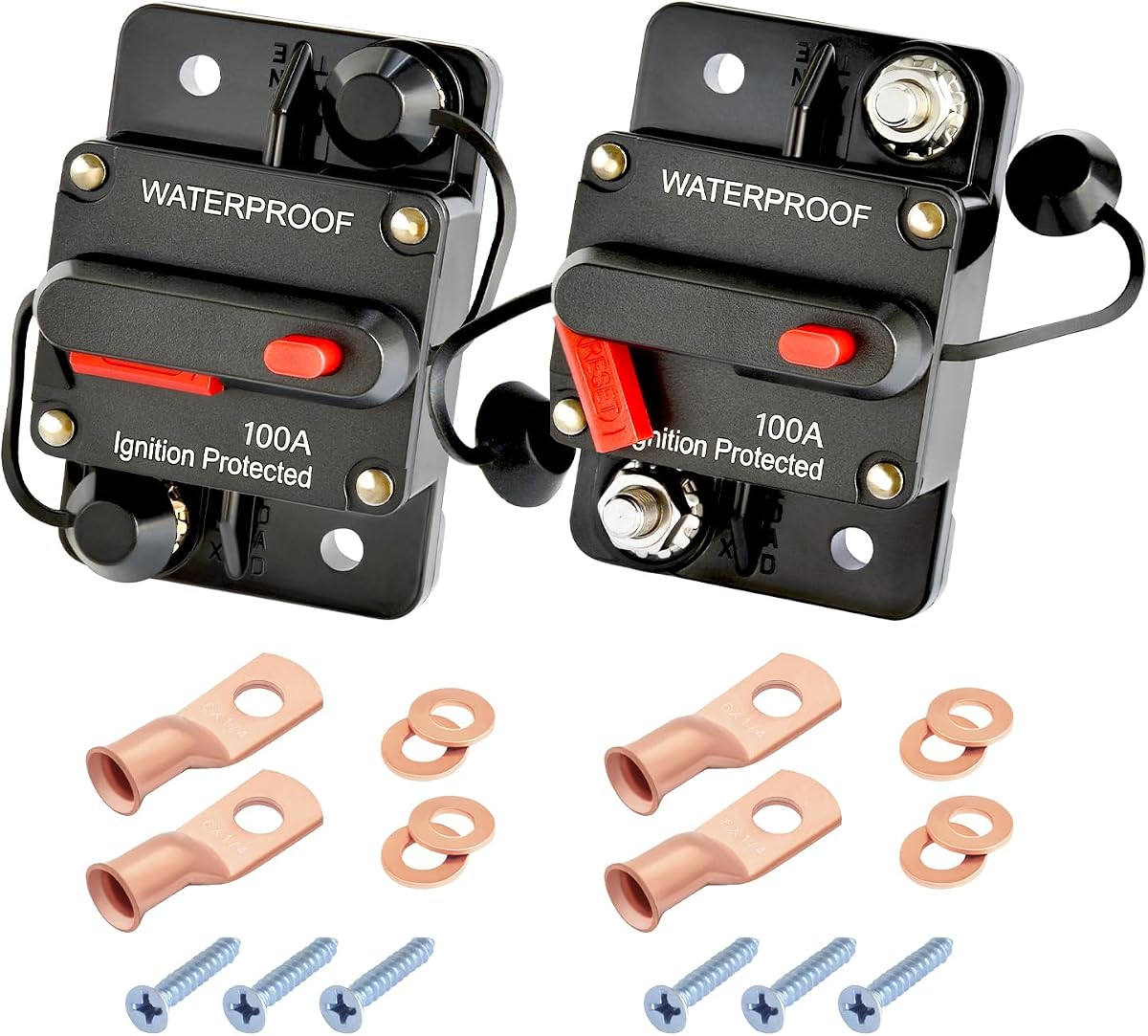
Bolipoeq 100Amp Circuit Breaker DC
4.6Editor score
Waterproof IP67 housing
12V–48V operating range
Manual reset and disconnect
Two breakers with hardware
Compare the best 100 Amp DC Circuit Breaker options for marine, automotive, solar, battery, RV, and trailer electrical systems.
A 100 Amp DC Circuit Breaker is a high-current protection device used in direct-current battery systems where a standard blade fuse may be inconvenient or inadequate. The right model combines dependable overload and short-circuit protection with manual reset, suitable mounting, safe terminal access, and compatibility with the voltage, conductor size, and environment of your installation.
This guide compares ten options ranging from waterproof surface-mounted breakers to DIN-rail miniature units and a UL 489 panel-style rocker. The evaluation considers the documented current rating, voltage range, pole count, installation method, reset behavior, marine and automotive suitability, enclosure characteristics, and intended DC applications rather than treating every breaker as interchangeable.
Each review reveals the features that distinguish one model from another and clarifies where a breaker may be a better fit than another. The list includes products for trolling motors, boats, RVs, trailers, ATVs, trucks, solar systems, battery chargers, and auxiliary circuits. Product availability, configurations, and prices can change, so verify the current listing and technical requirements before purchasing.
4.6Editor score

4.8Editor score

4.6Editor score
The comparison below highlights the documented voltage range, mounting style, reset configuration, and most suitable application for each breaker, making it easier to narrow the field before checking exact terminal and conductor requirements.


The Bolipoeq 100Amp Circuit Breaker DC earns the Best Overall position because it combines a broad 12V–48V operating range, manual reset control, IP67 waterproofing, and a pack of two. Its 4.6 rating reflects a strong balance of protective features and installation convenience for marine, automotive, RV, trailer, and solar applications.
We may earn a commission when you buy through this link, at no additional cost to you.
The listed standards include SAE J1625, SAE J1171, and UL1500 ignition protection, which makes the breaker particularly relevant to trolling-motor circuits and other high-current battery installations. Its reset lever and disconnect button make it possible to restore operation without replacing a fuse or fully disconnecting every battery cable. The supplied package includes two breakers, four wire lugs, eight washers, and six mounting screws.
The main limitation is its 48V maximum operating voltage, which is ample for common 12V, 24V, and 48V DC systems but does not suit higher-voltage DC distribution. It also requires a sound mounting surface and correct cable lug torque. Those constraints are acceptable for the vehicle and marine use cases the product targets.
This is an appealing selection for a boat owner or overland builder who wants two protected high-current circuits, a reversible disconnect function, and a weather-resistant housing without moving to a DIN-rail panel. Verify wire size, lug compatibility, and the system voltage before installation.
The breaker is designed to interrupt excessive current and isolate the connected circuit. Its visible manual-reset lever provides a practical way to turn the circuit back on after correcting an overload, while the reset control also serves as a local kill switch during service.
The IP67 enclosure and stated marine-related standards suit exposed installations, while the surface-mount format allows placement on a panel or firewall. Included copper washers and wire lugs help create secure, conductive connections when installed according to the manufacturer's instructions.
We may earn a commission when you buy through this link, at no additional cost to you.
The DIHOOL Main 100 Amp DC Circuit Breaker stands out with a 4.8 rating, a stated 500V maximum rating, and a two-pole thermal-magnetic design. It is presented as a battery disconnect and master switch for boats, trolling motors, ATVs, and trailers, as well as photovoltaic, UPS, battery, and datacenter applications.
We may earn a commission when you buy through this link, at no additional cost to you.
Thermal-magnetic operation combines overload protection with magnetic short-circuit interruption. That makes the device more broadly useful than a simple resettable fuse holder, particularly in a fixed power-distribution installation. Its listed dimensions of 73 by 163 by 86 millimeters indicate a substantially larger enclosure than the compact surface-mount models in this guide.
The main trade-off is physical size. A larger two-pole body may require more panel space than an inline breaker or single-pole miniature unit. The supplied information also provides fewer details about terminals, included hardware, and environmental ratings than some competing listings, so installers should confirm compatibility before cutting conductors or modifying an enclosure.
The DIHOOL is a strong candidate for a permanent DC distribution panel, high-voltage battery system, or project that needs both interruption and isolation functions. It is especially attractive for users who prioritize a high voltage rating and front accessibility over the compact footprint of a panel-mounted breaker.
The thermal-magnetic trip provides a direct response to overload and short-circuit conditions. This makes the breaker useful as a protective switching component rather than only an inline fuse replacement.
Front-accessible installation is useful when the breaker must be reached for isolation or reset without dismantling the entire electrical enclosure. Confirm that the stated dimensions fit the intended panel.
We may earn a commission when you buy through this link, at no additional cost to you.
This DC Miniature Circuit Breaker is a 4.8-rated, two-pole 100 Amp unit rated up to 500V. It targets solar photovoltaic systems and other DC distribution applications where a DIN-rail device can provide organized protection and circuit isolation.
We may earn a commission when you buy through this link, at no additional cost to you.
A magnetic system assists with arc extinguishing, while silver alloy contacts and a flame-retardant shell support dependable operation. The color indicator makes the breaker's state easier to identify, an important convenience in a crowded power-distribution panel. Installation uses a 35mm DIN rail and screw-clamp terminals.
The product's apparent trade-off is installation method. DIN-rail mounting is excellent for new panels but less convenient for a simple inline upgrade where there is no rail or spare enclosure space. The listing does not describe a manual-reset lever, so buyers wanting an accessible battery-disconnect control may prefer one of the resettable surface-mount options.
Choose this breaker for a structured DC distribution cabinet, photovoltaic installation, or other system where rail mounting, two-pole interruption, and a high voltage rating are more important than a compact inline format. Soft silicone wire should have properly crimped copper terminals before being placed in the screw clamps.
DIN-rail mounting creates a consistent layout for miniature protective devices. It is particularly practical in a new distribution enclosure where several circuits and controls are planned around the breaker.
The magnetic arc-extinguishing system assists interruption, and the color indicator gives installers a quick visual reference. These features suit installations where safe isolation and status checks are routine.
We may earn a commission when you buy through this link, at no additional cost to you.
The E9 100 Amp Circuit Breaker combines a compact, lightweight body with Type III manual reset, IP67 waterproofing, and a 12V–48V operating range. Its 4.6 rating and extensive listed compatibility make it a credible option for marine, trolling-motor, RV, truck, bus, charger, and DC audio installations.
We may earn a commission when you buy through this link, at no additional cost to you.
Its certification references SAE J1625, SAE J1171, and UL1500 ignition protection. The housing uses UL 94V0 thermoplastic, and the device functions as a resettable replacement for a standard 100 Amp fuse. Threaded 1/4-inch-28 studs and an extended surface-mount design simplify attachment to an appropriate panel.
A limitation is that the device cannot be used above its stated 48V maximum operating voltage. Correct terminal torque is especially important because loose high-current connections can create heat and unreliable protection. The reset mechanism also needs to remain accessible if the breaker is intended to serve as a disconnect.
The E9 is best suited to installers who want a small, waterproof, manually resettable breaker for a standard 12V, 24V, or 48V circuit. It is especially relevant to boat and RV builders looking for a fuse replacement with an integrated switch.
The small footprint and IP67 housing make this model practical where space is limited and moisture exposure is likely. Its resettable design avoids routine fuse replacement after a temporary overload.
The 1/4-inch-28 studs accept compatible ring terminals and provide a straightforward panel connection. Proper torque is essential to maintain conductivity and prevent heating.
We may earn a commission when you buy through this link, at no additional cost to you.
The DZ47NZ-125-2P is a two-pole, 100 Amp miniature breaker with a stated 500V DC rating and a 4.7 customer rating. It is designed for DC power supply systems, solar photovoltaic installations, and other distribution equipment requiring overcurrent and short-circuit protection.
We may earn a commission when you buy through this link, at no additional cost to you.
Its built-in magnetic field and auxiliary arc-extinguishing features support stable interruption, while the non-polarity format simplifies certain DC wiring arrangements. The listing also notes use with AC systems up to 100V, although this guide evaluates the product primarily as a DC circuit breaker. DIN-rail installation keeps it organized within a suitable panel.
Buyers should pay close attention to the model designation and its stated 100A rated current. Although the product title includes 125Amp, the detailed specifications identify the DZ47NZ-125-2P model with a 100A rated current. The distinction should be checked against the seller's current documentation before purchase.
This breaker is a strong fit for high-voltage DC distribution, solar power systems, and structured marine power panels where 500V capability is important. It is less suitable for an inline vehicle upgrade because DIN-rail hardware and an enclosure are required.
The stated 500V DC rating makes this model relevant to higher-voltage solar and distribution systems. It also supports AC use at or below 100V, although DC suitability should remain the priority when selecting it.
The non-polarity configuration can simplify installation where conductor orientation is not critical to the breaker. It remains important to follow the complete wiring diagram and terminal instructions.
We may earn a commission when you buy through this link, at no additional cost to you.
The 100 Amp Waterproof Circuit Breaker with Manual Reset is a compact option for 12V–48V marine and automotive circuits. It holds a listed 4.6 customer rating and has no published customer rating, so its performance should be evaluated primarily through the documented specifications rather than review history.
We may earn a commission when you buy through this link, at no additional cost to you.
The integrated on/off push-button provides manual reset and emergency cutoff functions. The housing is described as waterproof-resistant, with a cover intended to reduce rust and support operation in wet or off-road environments. Stated compatibility includes SAE J1625, SAE J1171, and UL1500 ignition safety standards.
The key uncertainty is the precise level of environmental sealing. The listing uses waterproof-resistant language rather than providing a clearly stated IP rating, so it should not automatically be assumed equivalent to a formally rated IP67 assembly. Buyers should also confirm that the breaker is sold as a single unit rather than a multipack.
This model is a practical choice for a trolling motor, ATV, truck, RV, trailer, bus, charger, or auxiliary circuit that needs a reachable reset and emergency disconnect. For exposed marine locations where sealed ingress protection is essential, verify the enclosure specification before final installation.
The integrated push-button makes the breaker easy to reset after a temporary overload and useful as a local kill switch. Keeping it accessible improves control during routine service.
The weather-resistant housing and rust-prevention cover suit demanding marine and off-road environments. Users needing a certified IP rating should confirm the product's enclosure details.
We may earn a commission when you buy through this link, at no additional cost to you.
This 12V–110V DC Miniature Circuit Breaker is a compact one-pole option for battery, solar, RV, electric moped, and other DC systems. Its 4.4 rating is the lowest among the rated products in the list, but the specifications remain suitable for applications where rail-mounted overcurrent protection is the priority.
We may earn a commission when you buy through this link, at no additional cost to you.
The breaker uses a magnetic system to assist arc extinguishing and includes silver alloy contacts, a flame-retardant shell, and a color indicator. Its single-pole format takes less panel width than a two-pole model, while the stated voltage range extends to 110V DC.
The product lacks a manual-reset control and requires a 35mm DIN rail. That makes it less convenient as a user-facing battery disconnect, particularly for a boat or vehicle owner who wants to turn the circuit off without accessing a distribution panel. Soft silicone wire also requires a suitable crimped copper terminal before insertion.
Choose this breaker when panel space is limited and controlled isolation or reset is not required. It can work well for compact battery, RV, solar, and mobile electrical systems where a DIN-rail enclosure is already part of the design.
The one-pole design saves panel width compared with two-pole alternatives. It is especially useful in compact distribution boards where several circuits need organized protection.
The listed uses span battery systems, solar photovoltaic installations, RVs, and electric mopeds. Its 12V–110V range provides flexibility across several common mobile and stationary DC systems.
We may earn a commission when you buy through this link, at no additional cost to you.
The Inline 100 Amp Breaker Holder has the highest published customer rating in this comparison at 4.9. Its Type 3 manual-reset design, 12V–48V operating range, and 100 Amp load capability make it a direct alternative to an inline high-current fuse holder.
We may earn a commission when you buy through this link, at no additional cost to you.
It can serve both as a circuit breaker and battery disconnect, allowing a battery to be charged or maintained without disconnecting every wire. The manual-reset button also functions as a kill switch. For installation, the product supports surface mounting on a panel or firewall and includes two self-tapping screws.
The device's water-resistant housing and protective stud insulator target splash and dust exposure, though the listing does not state a formal IP rating. Its 48V ceiling and surface-mount format may be less suitable for high-voltage distribution or projects designed around DIN-rail equipment.
This breaker is a strong choice for a boat, RV, truck, trailer, ATV, solar system, battery charger, or amplifier installation that currently uses a 100 Amp inline fuse. It offers the most immediately appealing user-accessible reset while retaining a familiar surface-mounted installation.
The breaker preserves the familiar inline protection position while replacing a consumable fuse with a manual-reset device. It can be checked and restored without replacing another fuse after a temporary overload.
Using the unit as a local disconnect can simplify battery charging and maintenance. Keeping the reset button accessible makes routine isolation and system checks more convenient.
We may earn a commission when you buy through this link, at no additional cost to you.
The Blue Sea Systems 7446 is the premium panel-style selection, featuring a 100 Amp DC rating, UL 489 construction, a stated 10,000A interrupting capacity, and a 4.6 customer rating. Its documentation is unusually precise about operating limits and hardware installation.
We may earn a commission when you buy through this link, at no additional cost to you.
Maximum operating voltage is 80V DC, and the specified temperature range is minus 40 to 85 degrees Celsius. The breaker uses a 1/4-inch-20 stud with a stated terminal torque of 30 to 35 inch-pounds. A number 6-32 stainless-steel mounting screw is specified with a torque range of 7 to 9 inch-pounds.
Its most important premium feature is suitability where UL 489 specifications are required, including Navy, Army, or Coast Guard vessels and other vessels covered under CFR 46. That formal standard distinguishes it from many general-purpose marine breakers, although its 80V maximum limits it to lower-voltage DC systems.
The Blue Sea 7446 is the strongest choice for regulated vessel applications, high-interrupting-capacity installations, and owners who prioritize documented standards and terminal specifications. It is less versatile for DC systems above 80V, and the precise stud and torque requirements call for careful installation.
UL 489 suitability is the key distinction for buyers working on covered naval, Coast Guard, Army, or other regulated vessels. Confirm that the broader installation also satisfies the relevant requirements.
A stated 10,000A interrupting capacity gives designers useful information when evaluating fault-current demands. The operating temperature range also supports use across widely varying marine and vehicle environments.
We may earn a commission when you buy through this link, at no additional cost to you.
The RED WOLF 100A Amp Circuit Breaker combines a 4.7 rating with a visible reset lever, push-button reset, and a 12V–48V operating range. It is positioned as an inline breaker and battery disconnect for boats, trolling motors, marine systems, RVs, trailers, ATVs, vehicles, solar systems, and audio installations.
We may earn a commission when you buy through this link, at no additional cost to you.
Its visible reset lever shows when the circuit is open, while the push button allows manual restoration and can act as a master disconnect. The product listing mentions professional electrical performance and aging testing and describes a durable, weather-resistant housing. A 6-gauge battery ring terminal connector is included for compatible battery-side installation.
The breaker is not a formal DIN-rail miniature unit, so it cannot be directly substituted for one in a panel built around rails. Its 48V maximum is suitable for common marine and vehicle electrical systems but not higher-voltage DC distribution. Ring-lug sizing and conductor capacity still need to match the actual cable installation.
The RED WOLF is a good fit for a boat or vehicle owner who values clear visual status, flexible reset controls, and a supplied battery terminal. It is especially attractive for auxiliary and accessory circuits where an inline fuse holder previously required frequent replacement.
The visible reset lever provides immediate visual confirmation that the circuit is open. This is useful during troubleshooting because the cause of an interruption can be recognized without dismantling the installation.
Users can restore the breaker with the push button after correcting an overload, while the same control can serve as a master disconnect. The included ring terminal simplifies compatible battery-side wiring.
We may earn a commission when you buy through this link, at no additional cost to you.
The best 100 Amp DC Circuit Breaker is determined less by the current label alone than by the electrical system, fault conditions, mounting method, and service requirements surrounding it. Use the following factors to narrow the selection before comparing conductor size and installation details.
Start with the actual voltage present in the circuit. Most vehicle, trolling-motor, and RV systems operate at 12V or 24V, while 48V systems are also common in larger marine and solar installations. The breaker must be rated for the system and must not exceed its documented maximum operating voltage. A 48V device can be appropriate for a 12V system, but a 48V-only product is unsuitable for a higher-voltage circuit. The 500V miniature models offer more voltage headroom for photovoltaic and distribution applications, while the Blue Sea Systems 7446 is limited to 80V despite its UL 489 construction.
A 100 Amp label should match the conductor, loads, and upstream protection scheme used in the installation. Continuous loads, motor startup currents, inverter output, and simultaneous accessory loads can affect the appropriate breaker size. Do not treat the purchaser's current rating as permission to run a 100 Amp load through undersized wiring. Review the breaker specification, wire ampacity, fuse or fusible-link arrangement, and any manufacturer guidance for the connected equipment.
Interrupting capacity describes the fault current a breaker is intended to interrupt safely. The Blue Sea Systems 7446 lists a 10,000A interrupting capacity and UL 489 compliance, which makes it notable for applications that require that standard. Several resettable surface-mount models instead list SAE J1625, SAE J1171, or UL1500 ignition-related standards. These certifications address different requirements, so they should not be treated as interchangeable labels. For regulated vessels or professionally engineered systems, compare the standard required by the governing specification with the exact breaker documentation.
Surface-mounted breakers are convenient for vehicles, boats, and retrofit projects because they can attach to a firewall or equipment panel without a DIN rail. DIN-rail miniature breakers are better organized within new power-distribution panels and provide clear visual status, but they require compatible rail space and an enclosure. The DIHOOL model has especially substantial stated dimensions, while the single-pole DIN model saves width. Measure the available panel area, breaker depth, cable bend space, and clearance around moving controls before ordering.
A manual-reset breaker can be restored after the underlying overload or fault is corrected, avoiding routine fuse replacement. The Bolipoeq, E9, Waterproof Manual-Reset model, Inline 100 Amp Breaker Holder, and RED WOLF offer user-accessible reset controls, although their mechanisms differ. The DIHOOL and DIN-rail miniature options are primarily protection and isolation devices rather than convenient panel-mounted kill switches. If the breaker must provide emergency shutdown, place it where the control remains visible and reachable without opening the entire enclosure.
Two-pole breakers may be useful when both conductors of a DC circuit need coordinated switching or isolation. Single-pole devices can reduce panel width and suit systems where only one conductor is switched. The DIHOOL and two 500V miniature options are two-pole designs, while the 12V–110V unit is a single-pole model. Pole count alone does not determine suitability; check the wiring diagram, grounding arrangement, conductor layout, and the instructions for the equipment being protected.
Marine and off-road installations expose breakers to spray, dust, vibration, temperature changes, and corrosion. An IP67 label provides a defined level of dust and water ingress protection, while descriptions such as waterproof-resistant or splash-proof do not necessarily carry the same certification. The Bolipoeq and E9 products explicitly state IP67, whereas other listings emphasize weather-resistant housings. Position the breaker away from standing water where possible, use a suitable enclosure if exposure is severe, and ensure that any control or reset mechanism remains operable after aging and environmental exposure.
A breaker can only perform safely if its terminals create secure, low-resistance connections. Thread size, stud material, lug dimensions, and included hardware vary considerably. The Blue Sea 7446 specifies a 1/4-inch-20 stud and exact torque ranges, while the Bolipoeq package includes wire lugs and washers and the RED WOLF listing mentions a 6-gauge ring terminal. Verify that the cable and lug match the breaker, that the conductor is rated for the load and environment, and that soft or silicone wire is properly crimped when required.
Before installation, disconnect the source of power and verify that the circuit is de-energized with appropriate test equipment. Identify the correct input and output conductors, confirm the breaker's voltage and current specifications, and inspect the terminals, housing, and mounting area for damage. Plan the cable route so the breaker is accessible, protected from excessive heat and moisture, and mounted to a rigid surface without stressing the studs.
Install the breaker using the specified hardware and torque. Clean the conductor surfaces, use compatible ring terminals or lugs, and tighten each connection evenly. For DIN-rail models, verify that the rail is properly seated and that soft silicone wire has a correctly crimped copper terminal before insertion. Route positive and negative conductors in a way that minimizes accidental contact and preserves clear separation from sharp edges.
After wiring, visually inspect the installation and perform an appropriate functional check in accordance with local electrical practice. The reset lever, button, or color indicator should show the expected state. If the breaker trips, do not simply reset it without finding the cause: disconnect unnecessary loads, inspect for a short, damaged wiring, an oversized motor or inverter, or a loose connection. Keep the enclosure dry, periodically check terminal tightness, and avoid using the breaker as a substitute for a properly engineered fuse or distribution system.
A resettable 100 Amp DC circuit breaker can often replace an appropriately rated inline 100 Amp fuse because it provides manual reset and isolation. The replacement must have compatible voltage, current, mounting, terminal, and environmental ratings. It is not a direct substitute if the original fuse holder uses a different physical format or if the installation requires a specific interruption certification.
A breaker rated for 12V DC can be used in a 12V system, but the breaker alone does not make the circuit safe. The wiring, terminals, battery, and connected loads must all be appropriate for the load and environment. Marine applications also warrant attention to ignition-protection requirements, corrosion, ingress protection, and accessible emergency disconnection.
Manual-reset breakers generally expose a lever, button, or switch that pops or moves to show an open circuit and can be pushed back after the cause is corrected. Some miniature circuit breakers may also reset automatically after tripping. In either case, a reset should happen only after investigating and correcting the overload or fault.
IP67 indicates protection against dust ingress and temporary immersion in water under defined test conditions. It does not mean the breaker can remain submerged, nor does it address every chemical, salt, vibration, or corrosion exposure. Proper mounting, sealing, cable strain relief, and regular inspection remain important in a working marine environment.
It can interrupt a fault on the conductors connected to it, but it should not automatically serve as the sole protection for multiple branch circuits. Each branch may require its own appropriately sized breaker, fuse, or other protective device, while the 100 Amp unit protects the feeder. The conductor sizes and load calculations must be designed together.
No. UL 489 is a circuit-breaker standard associated with specific construction, performance, and installation requirements. The Blue Sea Systems listing specifically highlights suitability where UL 489 specifications are required, including certain covered vessels. Other installations may require different standards, so the complete project requirements should determine which breaker and enclosure are acceptable.
The label may represent the breaker's rated current rather than a promise that it will carry every possible load continuously without nuisance tripping. Motor inrush, an inverter overload, conductor problems, or an unsuitable load can create excess current. Confirm the trip behavior, inspect for faults, and review the load manufacturer's guidance before changing breaker ratings.
Select conductors and lugs based on the load, breaker rating, ambient conditions, installation method, and applicable electrical code, not only the stud diameter. The correct lug must match the terminal type and size, and the connection must be tightened to the specified torque. Proper crimping and strain relief are especially important for high-current mobile and marine systems.
The Bolipoeq pack is the best overall choice for a value-conscious installer seeking two waterproof 12V–48V breakers with manual reset and disconnect capability. The DIHOOL leads for high-voltage, thermal-magnetic protection and a master-switch format, while the Blue Sea Systems 7446 is the premium pick where UL 489 requirements and a documented 10,000A interrupting capacity matter.
For low-voltage marine and vehicle projects, the E9, RED WOLF, Inline 100 Amp Breaker Holder, and waterproof manual-reset options prioritize accessible reset controls and practical surface mounting. For organized DC panels and photovoltaic systems, the 500V two-pole DIN-rail models offer stronger voltage headroom, while the single-pole breaker conserves panel width. Confirm IP rating, pole configuration, terminal dimensions, and required safety standards before finalizing a purchase.
Prices, availability, package contents, and product configurations can change after publication, so review the current listing before buying. Compare the seller's latest specifications with the wiring plan, environmental conditions, conductor size, and load requirements to ensure that the chosen 100 Amp DC Circuit Breaker is genuinely compatible with the installation.