
BENFEI 4-in-1 Card Reader
4.5Editor score
USB-C and USB-A
Four simultaneous card slots
UHS-I transfer support
This Compact Flash Card Reader guide compares ten readers for card compatibility, connection options, transfer speed, portability, and ease of use.
A Compact Flash Card Reader is useful whenever images, videos, or other files remain trapped on a camera card. The best model should accept the formats you actually use, connect without adapters, transfer files quickly, and be easy to carry. A multi-slot reader is especially convenient for photographers working with CF, SD, and microSD cards.
This guide compares ten card readers using the specifications and feature details supplied for each product. The comparison considers supported card formats, USB connections, simultaneous card access, stated transfer capabilities, operating-system compatibility, physical design, and useful extras such as hot swapping. It also distinguishes basic readers from models aimed at professional CFast workflows.
Each review explains who the product is best suited for, along with its most important strengths and limitations. The three leading selections cover budget, overall versatility, and premium workflow needs. Product ratings and availability can change over time, and prices fluctuate, so readers should confirm current details and compatibility before making a purchase.
4.5Editor score

4.6Editor score

4.7Editor score
The table below compares all ten readers by their physical interfaces, supported media, simultaneous-read capabilities, and highest stated performance level, making it easier to identify the right reader for a particular device or card workflow.


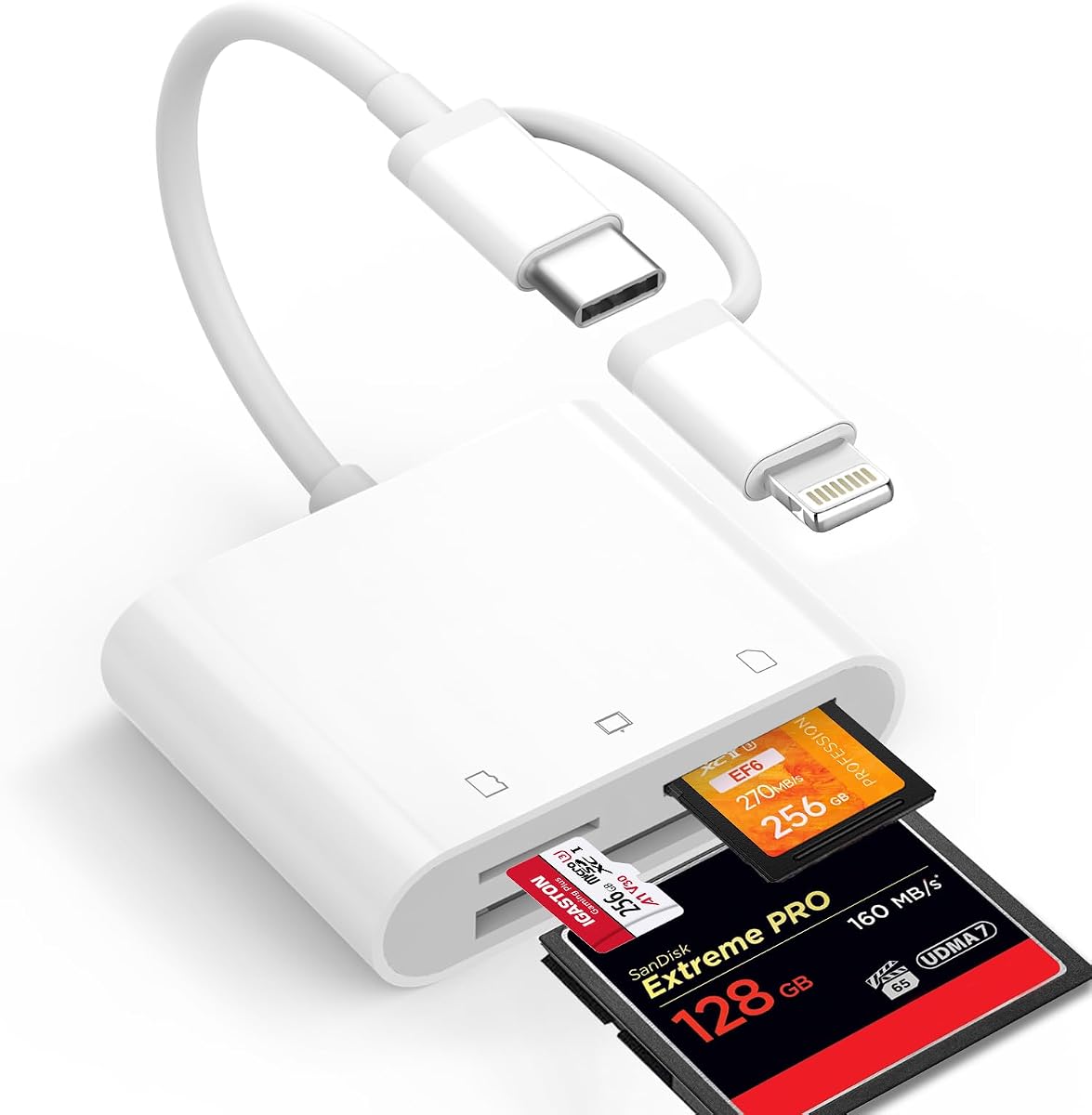

The BENFEI 4-in-1 card reader is a strong all-around choice for users who want one device to handle several common camera-card formats. It carries a 4.5 rating and stands out for its integrated USB-C and USB 3.0 connectors, four distinct card slots, and ability to read and write four cards at the same time. Those qualities make it more versatile than a basic single-slot adapter.
We may earn a commission when you buy through this link, at no additional cost to you.
Its primary appeal is the combination of portability and broad compatibility. The reader accepts SD, microSD or TF, Memory Stick, and Compact Flash cards, while its two-in-one connector design can be used with modern USB-C devices or traditional USB-A computers. The supplied information also lists broad compatibility with MacBook, iPad, Surface, Samsung Galaxy, Pixelbook, and Dell XPS systems. An integrated chip is designed to maintain stable high-speed transfers, while UHS-I operation can reach up to 160MB/s when the card and host device support that level.
There are some important limitations. The description specifically says that Standard Memory Stick, Memory Stick Micro M2, and CF Type I are incompatible, so a buyer should verify the exact card label before ordering. It also notes that large SDXC cards formatted as exFAT may not work with very old operating systems, including Windows XP, early Windows Vista, and Mac OS X versions before 10.6.6. Finally, even when the reader and card support fast modes, the final result depends on the connected USB slot and the card itself.
This reader is a sensible recommendation for a photographer, traveler, or mobile worker who wants CF and SD support without carrying several adapters. It is particularly attractive for USB-C laptop owners who also need a USB-A fallback. The simultaneous-card capability is useful when files from several cards must be backed up in one session, while plug-and-play use keeps the setup uncomplicated. Overall, it provides the broadest useful mix of connections and card support in a travel-friendly design.
Dedicated slots for SD, microSD, Memory Stick, and Compact Flash reduce the need to swap adapters. The ability to read and write four cards at once is especially convenient for users managing footage across multiple cameras or storage cards.
The integrated USB-C and USB-A connectors make the reader useful with both modern and conventional computers. This reduces cable clutter and makes it easier to move from a USB-C laptop to a USB-A desktop without buying a separate reader.
We may earn a commission when you buy through this link, at no additional cost to you.
The UGREEN 4-Slot USB 3.0 reader is an adaptable option for desktop computers and laptops with conventional USB-A ports. It has a 4.6 rating and combines a compact 2.17-by-2.68-by-0.59-inch body with four format-specific slots. The device can read and write four different memory cards at once, eliminating repeated unplugging when several cards are active.
We may earn a commission when you buy through this link, at no additional cost to you.
The supported-media list is broad: SD, SDXC, SDHC, microSD or TF, microSDXC, microSDHC, UHS-I, Compact Flash, and Memory Stick are included, with MMC also named in the product title. The reader supports cards up to 2TB, and its USB 3.0 connection is stated to reach up to 5Gbps. Compatibility extends across Windows, Mac OS, Linux, and Chrome OS, and the plug-and-play design does not require users to install software for routine transfers.
The main compromise is its connector. Unlike several leading alternatives, this model is presented as a USB-A reader rather than one with integrated USB-C and USB-A plugs. That makes it highly practical for legacy desktops and many laptop setups, but a USB-C-only user would need an appropriate adapter or a different model. Its stated 5Gbps is an interface maximum, so card performance, host controller, and the file being copied will determine real transfer times.
UGREEN's reader is ideal for users who want a straightforward, durable workflow without an app or complicated setup. It is a particularly good fit for offices, home studios, and computers that still rely heavily on USB-A. Its four-card access, wide format support, and stated large-card capacity make it a strong all-purpose recommendation. For modern USB-C-first systems, however, a reader with a native USB-C connector may offer less friction.
Accessing four cards concurrently can save time during card sorting, backup, or footage review. The reader supports both reading and writing, so it is not limited to one-way photo viewing.
Its small body and short attached cable make it straightforward to carry between a home computer and a laptop. Broad operating-system support and plug-and-play operation further reduce setup time.
We may earn a commission when you buy through this link, at no additional cost to you.
The Lexar Multi-Card 3-in-1 reader is the strongest choice in this group for users whose priority is fast SD and microSD transfers. It has the highest listed rating at 4.7 and the most ambitious stated card-transfer figure, reaching up to 312MB/s for SD and microSD. Its dedicated design covers the three most relevant formats here: SD, microSD, and Compact Flash.
We may earn a commission when you buy through this link, at no additional cost to you.
CompactFlash support is rated at up to 160MB/s, while the reader remains backward compatible with UHS-I SD and microSD cards up to 170MB/s. That distinction matters because the headline 312MB/s applies to compatible cards rather than every format. USB 3.1 and USB 2.0 compatibility allows the device to work with newer and older ports, while the included two-year limited warranty provides one of the longer coverage periods explicitly mentioned in the supplied data.
This model offers less breadth than the four-, five-, and six-slot alternatives. It does not list Memory Stick or XD-Picture Card support, and simultaneous multi-card reading is not specified. It is therefore better viewed as a focused high-speed solution for photographers using SD, microSD, or CF rather than a universal archive reader for obsolete media. As with all advertised interface speeds, the actual result will depend on the card, computer, cable path, and file size.
Photographers and videographers who regularly move large image libraries should give this reader strong consideration. It is particularly compelling for users of UHS-II-capable SD or microSD cards who want a reader designed to preserve fast transfer performance. The trade-off is reduced format coverage, but for a modern SD-centric workflow, the speed focus and two-year warranty make Lexar the premium selection in this roundup.
A stated transfer rate of up to 312MB/s is particularly useful when moving large batches of high-resolution images or video. The advantage will be most visible when the inserted card, host port, and computer all support the same high-speed standard.
Keeping the design to SD, microSD, and CF makes its purpose clear. Users who need Memory Stick, XD-Picture Card, or simultaneous access to several cards should choose a broader multi-slot model instead.
We may earn a commission when you buy through this link, at no additional cost to you.
The 6-in-1 Compact Flash card reader is built for users who have accumulated several generations of camera media. Its 4.3 rating is the lowest in this group, but its format coverage is the most extensive: CFast, Compact Flash, SD, microSD, Memory Stick, and xD-Picture Card all have dedicated support. It can read up to six cards simultaneously, making it useful for large archival or multi-camera sessions.
We may earn a commission when you buy through this link, at no additional cost to you.
The reader uses a 5Gbps USB 3.0 interface and includes both USB-C and USB-A connectors. The supplied description compares a claimed 10GB transfer in roughly 16 seconds with more than three minutes over USB 2.0, although actual results remain dependent on the card and devices involved. It supports CFast 2.0, high-capacity SDXC and microSD cards, Memory Stick Pro Duo, and Olympus XD Picture Cards. That combination makes it particularly relevant to photographers or archivists who still use older cameras.
Its aluminum-alloy housing is described as durable and effective at dissipating heat during prolonged transfers, a meaningful consideration during large transfers. The tradeoff is that six slots and multiple legacy formats make this more substantial than a three-format reader. The lower 4.3 rating may also give cautious buyers more reason to scrutinize long-term reliability. In addition, while the product title mentions several phone and tablet models, buyers should confirm that their exact device supports the necessary connection and file-access behavior.
This is the best match for an archive room, repair bench, or photographer who moves among modern and legacy media. It eliminates the need for several separate adapters when CFast, CF, SD, microSD, MS, and XD cards are all in play. Those who only need SD and microSD can find a smaller, faster-focused alternative, but the 6-in-1 reader earns its position through exceptional format breadth and simultaneous access.
The six-slot layout covers both current camera cards and formats associated with older cameras. This makes the reader useful when the goal is to consolidate media from several devices rather than merely move files from one modern camera.
The aluminum body is intended to withstand repeated use and move heat away from the electronics. That design suits extended transfer sessions better than a lightweight plastic adapter.
We may earn a commission when you buy through this link, at no additional cost to you.
The ZIYUETEK 5-slot reader combines broad media support with a compact aluminum design. It has a 4.5 rating and accepts SDXC, SDHC, SD, microSDXC, microSD, microSDHC, M2, MS, CF, and UHS-I cards. Its five physical slots can be used together, while the USB 3.0 interface is stated to offer transfer rates up to 5Gbps.
We may earn a commission when you buy through this link, at no additional cost to you.
One of its most useful features is hot swapping, which lets users change cards without repeatedly disconnecting the reader. It also supports plug-and-play operation on Windows XP, Vista, 7, 8, 8.1, and 10, as well as Mac OS, Linux, and Chrome OS. The product description highlights protection against over-current, over-voltage, leakage, short circuits, and clutter, adding a layer of reassurance for a device that connects directly to valuable equipment.
Its USB-A connection and older operating-system support make it feel like a conventional desktop accessory. Actual transfer speed depends on the specific card and connected device, so the 5Gbps interface figure should not be treated as a guaranteed media speed. The aluminum cover is described as aiding heat dissipation and durability, but the multi-slot design remains bulkier than a dedicated three-format reader. Buyers who only need a modern phone or USB-C tablet may prefer a compact USB-C model.
This reader works well for users who regularly alternate between CF, SD, microSD, and Memory Stick media and value the ability to swap cards quickly. It is also a practical choice for older Windows systems that may not work with newer interface combinations. For a contemporary USB-C-only setup, its advantages remain in card breadth and hot swapping, but connectivity may be the deciding factor.
Hot swapping allows cards to be exchanged while the reader remains connected. This is useful when moving between several sources of footage without repeatedly restarting the connection.
The listed safeguards cover several common electrical faults. While no reader can eliminate every risk, these protections make the adapter more suitable for repeated use around computers and cameras.
We may earn a commission when you buy through this link, at no additional cost to you.
The UGREEN USB-C 4-in-1 reader is designed for people who want to move camera files directly into modern phones, tablets, and computers. It has a 4.5 rating and uses a native USB-C connection, with slots for SD, microSD, Compact Flash, and Memory Stick. Up to four connected cards can be accessed at the same time for browsing, downloading, and storing files.
We may earn a commission when you buy through this link, at no additional cost to you.
Its compatibility list includes the iPhone 18, iPhone 18 Pro and Pro Max, MacBook, iPad, Samsung Galaxy S23, S20, S10, Note 20, Note 10, Google Pixel 4 XL, Moto G8, G7, Trail Camera Viewer, and Game Deer Camera. Transfer rates are stated at up to 5Gbps, while plug-and-play operation is offered across Windows, Mac OS, Linux, and Chrome OS. The combination of mobile compatibility and no-driver use is especially useful for checking images immediately after a shoot.
The principal limitation is the absence of a stated USB-A plug. Users with older computers may need an adapter, whereas a dual-connector reader would be more immediately flexible. The product information also does not explicitly describe simultaneous writing in the same way as some alternatives, although it does say that four connected cards can be accessed. As always, the 5Gbps number reflects the connection rather than guaranteeing identical results for every card or host device.
This is a strong recommendation for a USB-C-centered kit, particularly for someone who wants to import Compact Flash or Memory Stick media without first transferring it to a computer. It also works for photographers who alternate between a modern smartphone, tablet, and USB-C laptop. Those who need a universal USB-A fallback should choose a dual-connector design, but for modern mobile workflows this UGREEN reader is direct and convenient.
A native USB-C plug makes the reader straightforward to attach to compatible phones and tablets. This is helpful when photographers want to review or transfer images without routing them through a desktop first.
Simultaneous access can simplify the process of importing media from several cards. The four slots cover the formats most commonly found in compact cameras and older pro cameras.
We may earn a commission when you buy through this link, at no additional cost to you.
The SmartQ C368 is a straightforward four-in-one reader for travel and everyday card management. It carries a 4.6 rating and supports SD, microSD, Memory Stick, and Compact Flash cards. The data can be read independently, while plug-and-play operation removes the need to install drivers on Windows, Mac OS, Linux, or other supported systems.
We may earn a commission when you buy through this link, at no additional cost to you.
A blue LED indicates when the reader is powered, giving the user immediate visual confirmation that the device is active. The USB 3.0 interface is stated to support transfer speeds up to 5GB per second when operating at USB 3.0 speed, and it remains compatible with USB 2.0 multi-card readers for CF and microSD. The product is described as especially suitable for mobile use during travel, where avoiding a complicated setup matters.
Its cable and reader are built around a conventional USB-A connection, which may require an adapter with newer USB-C-only computers. The description also distinguishes independent reading from simultaneous reading, so buyers wanting all four cards visible or working together at once should not assume that capability. The unusual wording around transfer speed should also be understood as a maximum interface capability rather than a guarantee for every memory card.
SmartQ is best for a user who values simplicity, recognizable status feedback, and broad basic format support. It is easy to keep in a camera bag and connect to a laptop when sorting pictures from a trip. The included cable organizer, user manual, and reader make the package convenient for travel. For a desktop with USB-A and a straightforward card-transfer task, it is a compelling pick; USB-C-only users should account for an adapter or choose a native USB-C alternative.
The illuminated blue LED provides a simple indication that the reader is receiving power. This reduces uncertainty when connecting the device during a busy travel workflow.
No-driver operation makes the reader convenient for temporary use on borrowed computers. It can be packed with a camera kit and connected when needed without completing a software setup process.
We may earn a commission when you buy through this link, at no additional cost to you.
The 5-in-1 CFast reader is positioned for photographers and videographers who need to move substantial media from modern and older cards. It has a 4.4 rating and includes dedicated support for CFast 2.0, Compact Flash, SD, microSD or TF, and XD-Picture Card. Up to five cards can be read simultaneously, helping reduce repeated connection changes during a backup or review session.
We may earn a commission when you buy through this link, at no additional cost to you.
Its USB 3.0 interface is stated to reach 5Gbps, and a supplied USB-A-to-USB-C cable allows connection to modern MacBooks, PCs, laptops, and tablets. The aluminum housing is designed to dissipate heat during large transfers and add durability. Driver-free operation is listed for Windows 10, Windows 11, macOS, and Chrome OS. A user manual and two-year warranty round out the package.
Although CFast 2.0 is the headline feature, the data does not provide a separate maximum read speed for that format. The 5Gbps figure should therefore be understood as the connection's stated maximum, not a promise that every CFast card will reach it. The format list also does not include Memory Stick, so this model is less comprehensive than some five- and six-slot readers. Those limitations are reasonable for a design centered on CFast and common photographic media.
This reader is a strong option for video creators who regularly work with CFast 2.0 and need to consolidate several cards. It also appeals to photographers with XD-Picture Cards or Compact Flash who want a modern USB-C-and-USB-A connection. Compared with a basic three-slot adapter, it offers better workflow flexibility and a more durable body. Its two-year coverage and professional format focus make it a well-targeted choice for serious media handling.
A dedicated CFast 2.0 slot makes this model relevant to cameras used for demanding video workflows. The additional CF, SD, microSD, and XD slots let it handle mixed media without changing readers.
The included USB-A-to-USB-C cable provides flexibility for computers with either type of port. Its plug-and-play approach also reduces the time needed to begin a backup after returning from a shoot.
We may earn a commission when you buy through this link, at no additional cost to you.
The Denlane dual-connector reader is unusual because it includes both USB-C and Lightning connections in one compact body. It has a 4.3 rating and offers three slots for Compact Flash, SD, and microSD cards. This makes it a practical option for someone moving between Lightning-based Apple devices and modern USB-C phones, tablets, or computers without carrying two separate readers.
We may earn a commission when you buy through this link, at no additional cost to you.
The product is listed as compatible with the iPhone 5 through 14, iPhone 15 and 16, iPad, Mac, MacBook, and USB-C Android Galaxy devices. Transfers require no app, network connection, driver, or additional power. The fixed short cable and built-in connectors are designed to stay stable and avoid the loss of small removable adapters. The included Apple MFi certification is another positive signal for buyers who regularly use Apple hardware.
The two connectors cannot be used simultaneously, and the fixed construction prevents users from positioning the reader at a different angle. Although bidirectional transfer is supported, results can vary with the device's available storage and operating-system behavior. Because compatibility changes across device generations, users with an older or newer model should verify support before purchasing. The reader also offers fewer media slots than the broad multi-format alternatives.
Denlane is best for mixed-device users who need both Lightning and USB-C connectivity in one accessory. It is especially useful for quickly viewing photos, videos, music, and other files from a camera card while traveling. Users who only need a modern USB-C connection can choose a smaller dedicated reader, but those who switch between Apple and USB-C systems will value the dual-connector approach.
The built-in Lightning and USB-C connectors cover two common mobile-device standards. While only one can operate at a time, the reader avoids carrying a separate adapter for each ecosystem.
Direct, plug-and-play operation is convenient while traveling or reviewing media away from a desk. The absence of app and driver requirements also reduces dependence on software support.
We may earn a commission when you buy through this link, at no additional cost to you.
The ChiaoPio USB-C reader is a straightforward adapter for users who need Compact Flash, SD, and microSD access from a modern USB-C device. It has a 4.5 rating and uses a built-in USB-C cable that is positioned not to block adjacent ports. The reader works without drivers or additional power, making it suitable for quick transfers to iPads, MacBooks, iMacs, and Windows computers.
We may earn a commission when you buy through this link, at no additional cost to you.
Its compatibility list includes the iPhone 15, 15 Plus, 15 Pro, and 15 Pro Max; several iPad Pro, Air, and Mini generations; MacBook Pro, MacBook Air, MacBook, iMac, Samsung Galaxy Tab Pro, and Galaxy S20 and S21 models. Because the connector is built in, users do not need a separate cable for the listed compatible devices. The design is especially useful for moving photos and videos from a camera card directly into a USB-C tablet or laptop.
Its limitations are clear. There is no Lightning connector, so it is not suitable for older iPhone or iPad models that rely on that interface. The reader also supports only three major formats, without Memory Stick, XD-Picture Card, CFast, or a separate USB-A connection. Users with a broader media archive may need a more expansive multi-slot reader. As with the other products, the support list is not necessarily exhaustive of every operating-system behavior or accessory configuration.
ChiaoPio is a good pick for a simple, modern USB-C kit where CF, SD, and microSD are the only required formats. Its integrated cable reduces loose pieces, while the three-slot design keeps the adapter focused and easy to carry. It is particularly attractive to iPhone 15, current iPad, and USB-C laptop owners who want a no-driver, no-app way to access camera media.
The fixed USB-C lead is shaped to avoid blocking other ports and eliminates the need for a separate adapter. That makes the reader convenient for travel and quick laptop transfers.
Three dedicated slots cover Compact Flash, SD, and microSD. The streamlined format list is a benefit for users who do not need legacy or specialized media support.
We may earn a commission when you buy through this link, at no additional cost to you.
The best Compact Flash Card Reader depends on your card formats, computer ports, and workflow. Prioritize confirmed compatibility and the connection your equipment actually uses, then consider speed, simultaneous access, construction, and portability.
Choose a reader that matches your actual collection rather than paying for unused slots. More formats improve versatility but usually add size and complexity. Compatibility is more important than a long feature list.
Buy the connector your primary device already has, unless you routinely move between several port types. A USB-C-only reader can require an adapter on an older computer, while a USB-A reader may need an adapter on a USB-C-only machine.
For large media libraries, prioritize the reader with the strongest card-specific speed claim. For occasional transfers, a reliable multi-slot design and broad compatibility may matter more than the headline number.
Simultaneous access is a workflow accelerator, not a substitute for card compatibility. Confirm both the number of cards you use and the formats involved before choosing a multi-slot design.
Look for a rigid housing, strain relief, and heat dissipation if transfers are long or frequent. A small reader is more convenient, but it should still feel solid at the connector and card slots.
Confirm the operating system, card capacity, and file system before relying on a reader. The hardware may be plug-and-play while the operating system still lacks support for a particular format.
For travel, balance the number of slots against the size of the reader. A compact three-format model is easy to carry, while a six-slot archive reader is better kept in a larger camera bag.
A meaningful warranty is a useful tiebreaker, but it should not outweigh an incorrect connector or unsupported card format. Check the complete package and coverage terms before checkout.
Begin by identifying the card format and the reader slot designed for it. Insert the card gently until it is fully seated, then connect the reader to the correct USB port on the computer, tablet, or phone. For models with both USB-C and USB-A connectors, use only the connector appropriate for the host device. Open the file manager or compatible app, locate the removable drive, and copy files before removing the card or disconnecting the reader.
Before starting a large transfer, make sure the card is healthy, the host has enough free storage, and important files are backed up elsewhere. Avoid removing a card or changing cards while data is being copied, especially with the readers that support hot swapping. If files do not appear, reconnect the reader, try another port, confirm the correct filesystem, and check whether the operating system supports the card's format. Users of older computers should also verify exFAT support for high-capacity SDXC cards.
To extend the life of the reader and card, keep the device dry, avoid forceful card insertion, and do not leave it connected in an unattended vehicle or exposed to extreme temperatures. Store cards in labeled cases and move the reader gently by its housing rather than by a short cable. For long file transfers, leave ventilation around the device and avoid placing it under books or other objects that can trap heat.
A regular SD reader is designed primarily for SD and microSD media, while a Compact Flash card reader includes a slot that accepts CF cards. Some multi-card readers support both formats, allowing users to transfer images from newer and older cameras without changing adapters. Always confirm that the reader includes the exact CF variant used by the camera.
It depends on the connector and operating-system support. The Denlane reader includes USB-C and Lightning connectors, while the BENFEI, UGREEN USB-C, 6-in-1, and ChiaoPio readers support USB-C devices. Older Lightning-only iPhones and iPads may require a compatible Lightning reader, and users should verify that their device can browse the card's file system.
A 5Gbps figure describes the maximum theoretical throughput of the USB 3.0 connection. Actual transfer speed also depends on the memory card, its format and speed class, the host port, the computer, and the size of the files. A reader can have a fast interface while still being limited by an older or slower card.
It can be valuable when you routinely work with several camera cards or need to compare and sort multiple media sets. Simultaneous access reduces repeated plugging and unplugging, but the total speed may be shared among connected cards. For a single card, a focused high-speed reader may provide a better experience.
No. CF cards come in different variants, and some readers exclude specific types. The BENFEI reader explicitly states that CF Type I is incompatible even though it supports other CF cards. Check the reader's exact compatibility list, card thickness, generation, and file system before purchasing.
Most of the listed readers are described as plug-and-play and use the operating system's built-in file system. That means many users can copy files through the normal file manager without installing dedicated software. Mobile-device compatibility can still vary, so confirm that the reader appears as a storage device on the specific phone or tablet.
Large SDXC cards often use exFAT, which may not be supported by older Windows or Mac OS X installations. The BENFEI product information specifically notes compatibility limitations in Windows XP, early Windows Vista, and Mac OS X before 10.6.6. Updating the operating system or using a computer with current filesystem support can resolve the issue.
Choose the interface used by your primary computer. USB-C suits modern MacBooks, recent iPads, and compatible Android devices, while USB-A remains common on older desktops and laptops. A dual-connector reader is the most flexible option if you switch between modern and legacy systems regularly.
The BENFEI 4-in-1 reader is the best overall value for its combination of USB-C and USB-A connectors, four card formats, and simultaneous access. The UGREEN 4-Slot USB 3.0 reader is a balanced alternative for USB-A computers, while the Lexar 3-in-1 reader leads when fast SD and microSD transfers are the priority. Each serves a distinct need without requiring unnecessary format support.
Start with the connector and the exact cards in your collection, then choose based on workflow. Broad archive users may prefer the six-format reader, professional video creators may prioritize CFast support, and travelers may value a compact three-slot adapter. For frequent multi-card backups, simultaneous access, a sturdy body, and an appropriate warranty can be more valuable than a marginally faster interface.
Finally, confirm the product specifications and current availability before purchasing. Ratings, device compatibility, and prices can change, and the best reader is ultimately the one that connects cleanly to your devices, recognizes your cards, and fits the way you actually transfer and archive media.