
Vantrue N4 Pro S
4.4Editor score
Triple-channel recording
Triple STARVIS 2 sensors
Rotating 360-degree camera
Up to 1TB storage
A dash cam for a big truck should provide dependable evidence without interfering with the driver’s view or creating installation headaches. The most useful systems combine front and rear coverage, readable nighttime footage, GPS tracking, secure loop recording, and a power design that tolerates long operating periods. Three-channel and four-channel models can also monitor the cab, cargo area, sides, or blind spots.
This guide compares ten camera systems using the features and specifications available for each product. It examines recording resolution, sensor performance, viewing angles, storage support, wireless transfers, parking modes, installation requirements, and special navigation functions. The comparison includes conventional front-and-rear systems, cabin cameras, multi-camera systems, mirror-style displays, and a truck-focused GPS navigator with an integrated camera.
Each review explains where that model stands out and where buyers should make compromises. The three featured selections are the ROVE R2-4K Dual for strong overall coverage, the Vantrue N4 Pro S for advanced three-channel recording, and the ROVE R2-4K for a simpler single-camera approach. Product configurations, availability, and prices can change, so confirm the current listing before purchasing.
4.4Editor score

4.5Editor score

4.3Editor score
As an Amazon Associate we earn from qualifying purchases.
The table below compares resolution, camera coverage, navigation or tracking features, and recording storage across all ten products. It makes it easier to identify the right balance between basic front-and-rear evidence, expanded cab monitoring, truck-specific routing, and multi-angle coverage.



The ROVE R2-4K Dual is the strongest all-around choice in this guide for a big truck because it combines front-and-rear recording, built-in GPS, fast wireless transfers, and several parking options without asking the driver to manage separate accessories. Its listed user rating is 4.5 out of 5. The front camera records at 2.5K and upscales to 2160P, while the rear camera records at 1080P. That combination is especially useful when a truck spends extended periods behind other vehicles on a highway.
We may earn a commission when you buy through this link, at no additional cost to you.
The front camera uses a Sony STARVIS 2 IMX675 five-megapixel sensor, an F1.5 aperture, and HDR. The rear camera has an F1.8 aperture. These specifications support clearer low-light recording, which matters during predawn departures, overnight runs, tunnels, and poorly illuminated loading areas. The camera also records GPS-based route, location, and speed information, providing useful context beyond the visual evidence captured by the lenses.
Wireless management is another strong point. Dual-band 5GHz and 2.4GHz Wi-Fi support transfers to the ROVE app at up to 20MB/s, making it practical to retrieve a relevant clip without repeatedly removing the memory card. A three-inch IPS screen displays speed and compass direction, while the included 128GB card is ready for immediate use. The system supports loop recording, emergency locking, motion detection, and microSD cards up to 1TB. Its parking mode can use time-lapse, motion detection, or collision detection, although permanent parking operation requires a separate hardwire kit.
The main compromise is that the advertised 4K front image is upscaled from 2.5K rather than captured natively at 4K. The rear camera also records at 1080P rather than 2.5K or 4K. For most truck operators, however, the front sensor, wide aperture, HDR, GPS, and rapid app access create a more balanced package than a model that offers high resolution without equivalent low-light performance or navigation features. Choose this model when dependable front-and-rear evidence, fast retrieval, and flexible monitoring matter more than having the highest resolution in every channel.
Recording the road ahead and behind at the same time gives a more complete account than a forward-only camera. This is valuable when following distance, lane position, or a disputed low-speed event is central to an incident.
Built-in GPS adds route, location, and speed stamps to recordings. The included ROVE GPS Player can display this information on a PC or Mac, helping establish when and where a clip was recorded.
We may earn a commission when you buy through this link, at no additional cost to you.
The Garmin dezlCam OTR725 is the most purpose-built option for a commercial truck because it combines a large 7-inch truck navigator with an integrated 1080P dash cam. Its listed rating is 3.4 out of 5, which is lower than the other products in the list, but that figure should be considered alongside its broader navigation purpose. It is designed to support long-haul drivers with route guidance, truck-specific warnings, and in-cab reference tools.
We may earn a commission when you buy through this link, at no additional cost to you.
The integrated camera records at 1080p HD through a wide 140-degree lens. It automatically saves incident video to the pre-installed memory card, reducing the work required to preserve important evidence. The 7-inch high-resolution touchscreen provides a large view for route review, but it also occupies more dashboard space than a compact camera and may not suit every truck windshield or mounting position.
Its navigation functions are the defining advantage. Custom truck routing accounts for truck size and weight where supported, while the device can alert drivers to bridge heights, sharp curves, and other relevant road conditions. BirdsEye Direct Satellite Imagery provides high-resolution overhead views for navigating loading docks, truck entrances, and security gates. The companion app also supports community information about truck parking, loading docks, security gates, and truck entrances.
This renewed unit trades away some camera-system flexibility. There is no listed rear or interior camera, high-resolution multi-channel recording, or broad storage-capacity support comparable to the dedicated camera systems. Some features are location-dependent, and the manufacturer notes that jurisdictions may regulate or prohibit use of the device. It is most appropriate for drivers who value truck-specific routing and a large display nearly as much as dash cam footage, and less suitable for operators who need comprehensive multi-camera coverage.
Custom truck routing, bridge-height alerts, sharp-curve warnings, CAT Scale lookup, and satellite arrival views address practical needs that ordinary car navigation may overlook. Always follow posted signs and current road conditions.
The integrated camera automatically stores incident video on the pre-installed memory card. That simplifies preservation, although it does not provide the flexible multi-channel recording offered by dedicated three- and four-camera systems.
We may earn a commission when you buy through this link, at no additional cost to you.
The REDTIGER F7NP is a capable front-and-rear system for drivers who want a 4K forward image without moving to a larger three-channel setup. Its listed rating is 4.1 out of 5. The front camera records at 4K through a 170-degree lens, while the rear camera records at 1080P through a 140-degree lens. That creates broad road coverage with more detail in the primary forward view.
We may earn a commission when you buy through this link, at no additional cost to you.
A STARVIS 2 sensor, F1.5 aperture, six-layer optical lens, WDR, and HDR support balanced images in bright daylight and difficult low-light conditions. The app provides live preview, playback, downloads, GPS information, and settings management. Its built-in 5.8GHz Wi-Fi is listed at up to 20MB/s, making it faster than many conventional 2.4GHz-only systems when moving several high-resolution clips to a phone.
The F7NP supports seamless loop recording and locks important events, while a free memory card is included. Parking protection offers time-lapse and G-sensor collision modes. Permanent parking use requires a hardwire kit, so that item must be considered as an additional installation requirement. A supercapacitor replaces a lithium battery and is designed to improve heat resistance and long-term reliability.
Compared with three-channel models, the F7NP does not record the passenger compartment, which may limit its usefulness for delivery, rideshare, or driver-monitoring applications. It also competes directly with the ROVE R2-4K Dual, whose upscaled 4K front feed, rear camera, 5.8GHz connectivity, 128GB card, and 1TB support make it a more complete package for many buyers. The F7NP remains compelling when native 4K front recording and a 170-degree field of view are the leading priorities.
Unlike an upscaled 4K mode, the F7NP records its front channel at 4K. The wide lens and HDR processing help preserve context across lanes and the roadside when footage is reviewed after a sudden event.
The 5.8GHz Wi-Fi connection supports transfer speeds listed at up to 20MB/s. That speed is especially helpful when downloading the front and rear files together or preparing an incident clip for sharing.
We may earn a commission when you buy through this link, at no additional cost to you.
The Vantrue N4 Pro S is the most advanced dedicated camera in this guide, offering front, interior, and rear recording with a rotating rear camera. It has a listed rating of 4.4 out of 5. In three-channel mode, it records at 4K, 2.5K, and 1080P at 30 frames per second, using three STARVIS 2 sensors. That makes it well suited to a truck requiring visibility through the windshield, around the cab, and behind the vehicle.
We may earn a commission when you buy through this link, at no additional cost to you.
The lens coverage is listed at 155 degrees for the front, 160 degrees for the interior, and 165 degrees for the rear. The rear camera can rotate through 360 degrees, allowing it to monitor traffic behind the vehicle or pivot inward toward cargo, passengers, or pets. This flexibility is useful in larger vehicles where the rearward view may include more than a conventional passenger car. Front-and-rear mode records at 4K and 2.5K while reducing heat and power use.
Vantrue’s PlatePix technology and triple HDR are designed to improve license-plate capture under night lighting and strong backlight. The listed PlatePix results apply at speeds up to 31mph under the stated conditions. Buffered parking mode can preserve ten seconds before a detected event, while all three channels remain active. 5GHz Wi-Fi, high-precision GPS, voice control, loop recording, and a supercapacitor round out the feature set. Storage can be expanded to 1TB, with 37 hours of continuous three-channel 4K recording cited by the manufacturer.
The main disadvantages are installation complexity and resource use. Three simultaneous high-resolution channels create more heat and consume more power than a basic front-and-rear setup, although the front-and-rear mode helps reduce that burden. No SD card is included, and the manufacturer recommends industrial-grade U3 cards for reliability. The 20-foot rear camera cable and stated compatibility with trucks, buses, and other large vehicles make this a strong choice when complete coverage justifies a more involved setup.
Each channel uses a STARVIS 2 sensor, combining better light sensitivity with HDR exposure control. The result is a flexible system for long nights, tunnels, open highways, and loading zones with abrupt changes in brightness.
The 360-degree rotating rear camera can point toward following traffic or turn inward. That makes the system more versatile than a fixed rear-only camera when a truck’s cab or cargo space also needs monitoring.
We may earn a commission when you buy through this link, at no additional cost to you.
The REDTIGER F17 delivers one of the more complete three-channel packages in the guide, with a listed rating of 4.4 out of 5. Its front camera records at 4K using a STARVIS 2 IMX675 sensor, while the interior and rear cameras record at 1080P. The 150-degree front, 160-degree cabin, and 155-degree rear lenses provide broad coverage around a large vehicle.
We may earn a commission when you buy through this link, at no additional cost to you.
WDR and HDR are included to balance highlights and shadows, while the STARVIS 2 sensor is designed to improve low-light brightness and motion detail. This matters when a truck is moving through poorly lit industrial roads, city streets, or overnight highways. The system can also record at 2.5K in dual-channel mode, giving drivers another option when they want to reduce recording load.
Connectivity includes both 5GHz and 2.4GHz Wi-Fi, with the faster band used for transfers through the Redtiger app. The app can replay all three camera feeds, monitor recording information, and display GPS data. A 64GB memory card is included, which reduces the need for an immediate extra purchase. Time-lapse and collision-detection parking modes are supported, and important files are protected through the G-sensor.
Compared with the Vantrue N4 Pro S, the F17 provides similar three-channel thinking at a different resolution tier. The interior and rear cameras remain at 1080P, and the listed parking system requires an extra hardwire kit. A supercapacitor is used for more stable operation in extreme temperatures. The F17 is a good fit for a big truck operator who regularly needs cab and road coverage but does not require the N4 Pro S’s 2.5K rotating rear channel or larger storage maximum.
Recording the interior can document passenger activity and the driver’s operating environment, while the rear channel adds evidence behind the vehicle. Those secondary views are valuable in delivery, passenger, and fleet applications.
The F17 supports 4K front and 1080P rear recording with the interior camera disabled, as well as 2.5K dual-channel capture. Buyers can prioritize detail, coverage, or a balance between the two.
We may earn a commission when you buy through this link, at no additional cost to you.
The WOLFBOX G840S is built for drivers who want the recording functions of a dash cam combined with a large mirror-style display. Its listed rating is 4.3 out of 5. The 12-inch curved screen provides a viewing area reported as 1.5 times that of a standard mirror, while the front camera records at 4K UHD and the rear camera at 1080P.
We may earn a commission when you buy through this link, at no additional cost to you.
A 170-degree front lens and 140-degree rear lens create broad road and backup coverage. Smart split-screen mode displays both camera views simultaneously, making the unit useful during reversing and when a driver wants rear and forward context on one screen. The low-reflectivity LCD is intended to reduce daytime glare, a meaningful detail for a large display mounted where windshield reflections can interfere with visibility.
The included external GPS antenna displays real-time positioning information and supports route tracking. Wi-Fi connectivity allows the WOLFBOX app to provide live viewing, playback, and sharing on iOS or Android devices. WDR and HDR balance challenging exposures, while a professional-grade sensor, six-glass lens, F1.5 aperture, and Super Night Vision support low-light performance. Loop recording and a 24-hour parking time-lapse mode add everyday protection, though the parking mode requires a hardwire kit.
The mirror-style format is the central trade-off. A 12-inch assembly needs enough room around the truck’s original rearview mirror, and its dimensions may be cumbersome in some cab layouts. It also lacks a separate cabin camera, so it cannot match the three-channel coverage of the Vantrue and REDTIGER systems. Nevertheless, it offers a distinctive solution for a large truck that values an expansive rearview display and simple front-and-rear monitoring.
The split-screen layout combines the 4K front and 1080P rear views on the large curved display. It can reduce the need to switch between separate screens while reversing or reviewing nearby traffic.
A low-reflectivity LCD is especially useful in daylight when a conventional mirror or glossy replacement display can create distracting reflections. The effect is most valuable on long daytime routes in strong sunlight.
We may earn a commission when you buy through this link, at no additional cost to you.
The Vantrue N4S is a well-rounded three-channel system for a truck that needs more than front-and-rear coverage. Its listed rating is 4.3 out of 5. It records at 2.7K for the front camera, 1440P for the interior, and 1440P for the rear. The front, cabin, and rear lenses cover 158, 165, and 160 degrees respectively.
We may earn a commission when you buy through this link, at no additional cost to you.
Triple STARVIS 2 sensors, HDR, and PlatePix technology support detail in dim conditions. The PlatePix feature is described as improving license-plate sharpness, while triple HDR handles strong contrast such as headlights against a dark road. The rear camera rotates 360 degrees, allowing it to monitor traffic behind the truck or pivot inward toward cargo, luggage, or pets. This makes the system more adaptable than a fixed three-channel arrangement.
Installation uses a magnetic mount, static-cling film, and cable clips, allowing a clean, wire-hidden setup. Four parking modes give the driver choices involving motion detection, collision detection, and reduced bitrate or frame rates. Motion events can include ten seconds of pre-event video. 5GHz Wi-Fi supports quick downloads, and quad-mode GPS with BeiDou positioning records route, speed, location, and time information.
Compared with the N4 Pro S, the N4S offers a more accessible 1440P rear channel and the same rotating-camera concept, but it does not reach the premium model’s 4K front resolution. Memory is sold separately, and the system still requires thoughtful placement of three cameras and the necessary power connections. It is best suited to operators who value balanced resolution, flexible rear-camera positioning, and detailed app-based review across several viewpoints.
Rotating the rear camera outward captures following traffic, while turning it inward provides a view of the cab or cargo area. That adaptability is particularly useful when a vehicle’s interior needs change from day to day.
Four proprietary parking modes allow a driver to favor event pre-recording, impact detection, or lower-data continuous monitoring. The appropriate choice depends on how much storage and recording activity the vehicle is expected to generate.
We may earn a commission when you buy through this link, at no additional cost to you.
The ROVE R2-4K is the simplest featured recommendation and a practical budget choice for a big truck that mainly needs a clear forward record. Its listed rating is 4.3 out of 5. It captures up to 2160P Ultra HD video through an eight-megapixel Sony IMX415 sensor, and its 150-degree lens provides a broad view of the road ahead.
We may earn a commission when you buy through this link, at no additional cost to you.
Super Night Vision combines the Sony sensor, a six-glass lens, and an F1.5 aperture to improve low-light recording. Built-in GPS logs location and speed, while the ROVE app can display routes on Google Maps or allow review through the supplied GPS Player. Wi-Fi 6 supports phone transfers at up to 6MB/s, and free over-the-air firmware updates help keep the camera current.
The camera includes loop recording, emergency locking, motion detection, parking mode, and time-lapse capture. A supercapacitor is used for reliability, and supported Class 10 or U3 microSD cards can reach 512GB. The simple one-camera design means fewer wires and a smaller installation burden, which can be appealing in a large cab where dashboard space and cable routing require attention.
Its limitations are substantial for a truck roundup. There is no rear or interior camera, and the required memory card is not included. The 6MB/s Wi-Fi transfer is also slower than the 20MB/s figure listed for the ROVE R2-4K Dual and several other models. Nevertheless, it delivers native 4K, GPS, and a broad lens in a straightforward package. It is a sensible selection when forward visibility and low cost matter more than multi-angle coverage.
The 2160P recording is captured directly rather than produced by upscaling a lower-resolution feed. Combined with the 150-degree lens, it offers a strong combination of detail and road context.
Wi-Fi 6, the ROVE app, and built-in GPS reduce the need to remove the card and connect the camera to a computer. Free firmware updates can also be managed over the air through the app.
We may earn a commission when you buy through this link, at no additional cost to you.
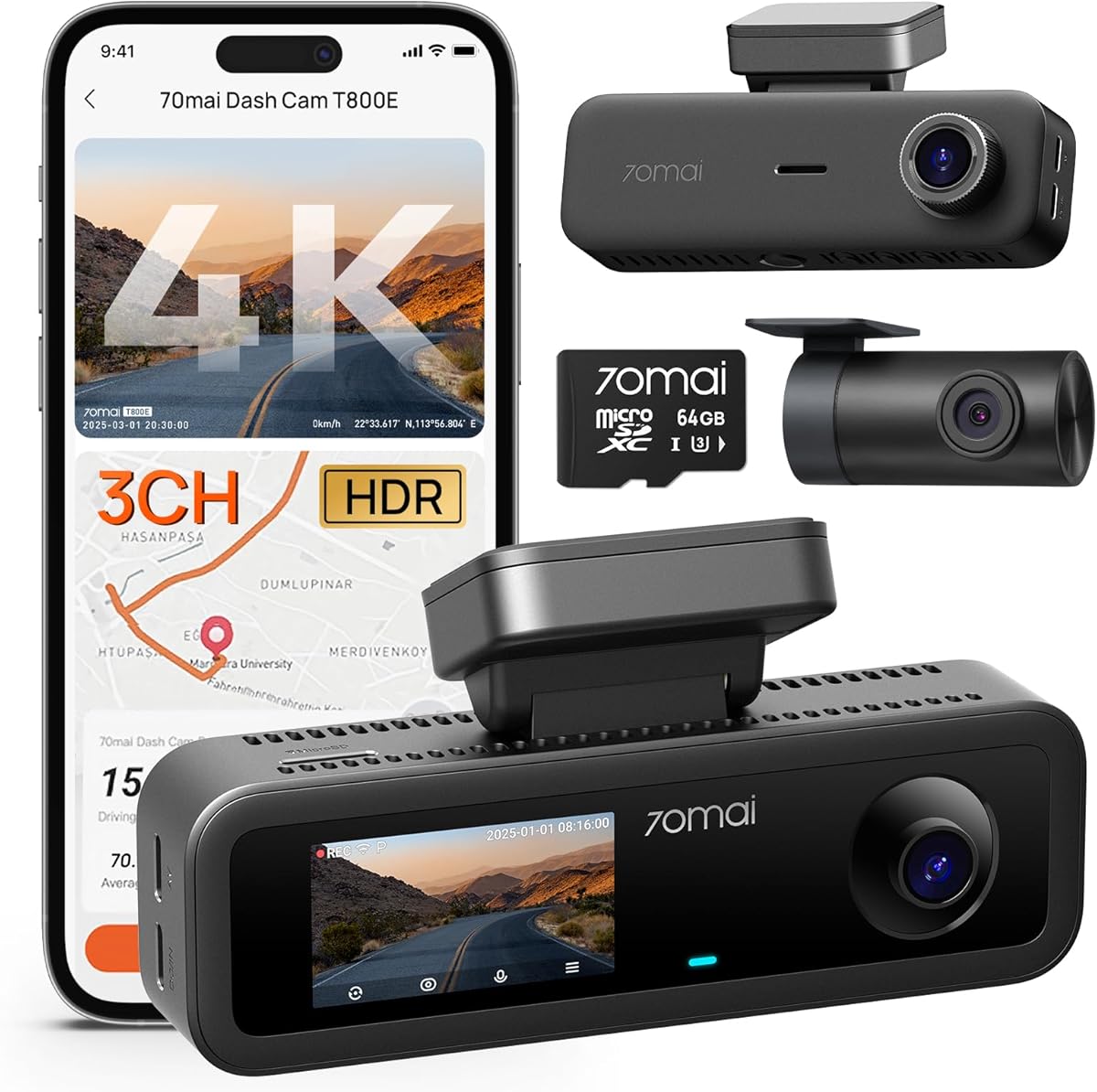
The 70mai T800E combines 4K front recording with 1080P interior and rear cameras, earning a listed rating of 4.5 out of 5. Its three fixed views are well suited to a truck that needs documentation of the road, passenger compartment, and area behind the vehicle. Ultra-wide lenses and an F1.55 aperture support visibility in daylight and at night.
We may earn a commission when you buy through this link, at no additional cost to you.
One distinguishing feature is the interior camera’s switchable infrared. Turning infrared on can improve visibility inside the cab during nighttime operation, while turning it off allows the driver to choose the appropriate setting. HDR and three-dimensional noise reduction support overall image quality, including low-light and high-contrast scenes. This makes the T800E particularly relevant for commercial, delivery, or passenger-carrying operations.
The system includes five-mode GPS, Wi-Fi 6, and hands-free voice control. App transfers are listed at up to 10MB/s, while voice commands can take photos, start recording, or lock important clips. A 64GB memory card is included, and storage can be expanded to 512GB. The rear camera uses a Type-C interface, and the supercapacitor is rated for operation from 14°F to 140°F.
Continuous parking monitoring requires a compatible hardwire kit, and 4G connectivity is not supported. The fixed rear camera does not rotate inward like those on the Vantrue N4S and N4 Pro S. Even so, the T800E’s switchable interior IR, included storage, 4K front channel, and voice controls form an attractive package. It is especially well matched to a big truck that spends time operating at night or needs clear cabin evidence.
The switchable IR gives the interior channel an additional tool for low-light recording. This is a meaningful distinction for trucks that carry passengers, make frequent stops after dark, or need to document the cab.
Voice commands allow important actions without requiring prolonged attention on the display. Wi-Fi 6 transfers at up to 10MB/s also help move clips to a phone more quickly than standard Wi-Fi 4 systems.
We may earn a commission when you buy through this link, at no additional cost to you.
The BOTSLAB G980H is the most extensive coverage option here, using four cameras to record the front, both sides, and the rear simultaneously. Its listed rating is 4.3 out of 5. The system is described as offering 560 degrees of combined coverage, with a 170-degree front camera, two 120-degree side cameras, and a 150-degree rear camera. This arrangement is particularly relevant to a large vehicle with substantial side blind spots.
We may earn a commission when you buy through this link, at no additional cost to you.
The side cameras use detachable magnetic mounts and can be removed to operate the unit in a three-channel configuration. A 3.18-inch touchscreen supports settings and four-way split-screen playback, allowing all camera angles to be reviewed together. Voice control can start recording or take photos, and a built-in GPS module records location, speed, and route information for animated playback in DVplayer.
For parking protection, the camera offers time-lapse recording, a sentry mode that responds to movement within five meters, and collision detection. A G-sensor also preserves eight seconds before an impact, providing context that begins before the collision. The 5.8GHz Wi-Fi connection supports faster transfers than traditional 2.4GHz networks, although its stated range is only three to five meters and remote access is unavailable.
This breadth comes at the cost of complexity. Four simultaneous cameras require careful placement, additional wiring, and a dedicated hardwire kit for parking mode. The system supports cards up to 512GB, uses a supercapacitor rated from -20°C to 70°C, and includes a 128GB card. For a big truck where side visibility and complete situational coverage are the priorities, it is a distinctive and capable choice.
Two side cameras create a level of lateral visibility that front-and-rear systems cannot provide. That can help during lane changes, parking, loading, or maneuvering in congested yards.
The eight-second pre-recording function preserves footage from before a detected collision. Including the sequence leading into an impact may provide more useful context than a clip that begins only when the sensor reacts.
We may earn a commission when you buy through this link, at no additional cost to you.
The right dash cam for a big truck should balance recording quality with the physical realities of a large cab, extensive storage needs, and long operating periods. The most important factors are channel count, low-light performance, power installation, storage endurance, and the ease of retrieving an incident clip.
A front-only camera is the easiest to install and can still document the road ahead, but it cannot show what happened behind the vehicle. Front-and-rear systems provide more complete incident coverage and are a sensible baseline for a big truck. Three-channel models add an interior view, which can be useful in delivery, passenger, and fleet operations. The BOTSLAB G980H goes further with separate side cameras, creating the broadest field of view but also the most wiring and placement work. Choose the number of channels based on the areas you actually need to monitor rather than assuming more cameras are always better.
Trucks often operate at night, making low-light clarity a major factor. STARVIS 2 sensors appear throughout the higher-end systems in this guide and are designed to improve light sensitivity and dynamic range. F1.5 and F1.8 apertures admit more light, while HDR and WDR help balance bright headlights against dark surroundings. Plate-recognition features can make plates easier to review in suitable conditions, but they should not be treated as a guarantee that every plate will be readable. A wide aperture, capable sensor, and exposure controls generally provide a more dependable foundation than resolution alone.
Resolution determines the amount of fine detail in the image, while the lens angle determines how much of the scene is included. A 150- to 170-degree front lens can cover neighboring lanes and roadside activity, but very wide views can also stretch the edges of the picture. The ROVE R2-4K Dual records at 2.5K and upscales the front feed to 4K, whereas the REDTIGER F7NP, Vantrue N4 Pro S, 70mai T800E, and WOLFBOX G840S offer native 4K front channels. For a large truck, 2.5K can be adequate, but native 4K is desirable when fine road details and signs are important.
Multi-channel 4K recording consumes storage quickly, making card capacity and endurance essential. Several products include a card, while the ROVE R2-4K and Vantrue N4 Pro S require separate purchase. Supported capacities range from 512GB to 1TB, with the largest options providing the most room for extended trips. Dash cam cards should meet the stated speed and application requirements; Vantrue specifically recommends industrial-grade U3 media for the N4 Pro S. Format the card according to the camera instructions, use a card of adequate capacity, and replace it if recording reliability declines.
A truck may spend long periods in direct sun, and multi-channel systems create additional heat. Supercapacitors are used across this guide because they are designed to handle heat better than internal lithium batteries and can preserve operation during abrupt power loss. For parked monitoring, a hardwire connection to the vehicle’s fuse box is usually required. None of the listed hardwire kits are generally included with these products, and the BOTSLAB requires a specifically dedicated kit for all three parking modes. In-cab installers should also route long cables securely and check that the camera and mounting point do not obstruct the driver’s view.
GPS records route, location, and speed information that can establish the context of a clip. Wi-Fi makes evidence much easier to retrieve without removing the memory card, while 5GHz, 5.8GHz, and Wi-Fi 6 systems generally support faster transfers than 2.4GHz-only alternatives. Listed transfer rates range from 6MB/s to 20MB/s for some systems. App quality also matters: look for easy replay, simultaneous channel viewing, route display, and straightforward export. A faster connection cannot compensate for a confusing app, and remote access is not available on every model.
A large truck may need navigation guidance that reflects vehicle dimensions, weight, bridge clearances, and industrial entrances. The Garmin dezlCam OTR725 is the only dedicated truck navigator in the list, with custom routing, a seven-inch display, overhead destination imagery, and community truck information. The other products focus on recording and can display speed or route data through their apps. A large mirror-style screen, as on the WOLFBOX G840S, can improve rear visibility but takes up more space. Compare the camera, screen, and navigation functions together rather than assuming a larger display is always preferable.
Useful parking features include time-lapse monitoring, motion detection, collision-triggered recording, and pre-event buffering. These modes help protect a parked truck, but they usually require a hardwire kit and can fill storage quickly. The Vantrue N4 Pro S and N4S preserve ten seconds before an event, while the BOTSLAB records eight seconds before a detected impact. The ROVE R2-4K Dual locks a one-minute event video after motion or collision detection. Compare buffering, file length, and event locking, and use a sufficiently large card for continuous monitoring.
Begin by reading the camera’s manual and checking the included mounting hardware before attaching anything to the truck. Clean the windshield or mounting surface, position the camera outside the driver’s sight line, and confirm that the lens is not blocked by a visor, tint band, sunshade, or cab structure. For multi-camera systems, plan the cable route before installation so the main camera, rear camera, side cameras, and power lead can be secured without crossing sharp edges or obstructing controls.
Install the appropriate microSD card, format it using the manufacturer’s recommended procedure, and confirm that the camera recognizes it before a long trip. Connect the supplied or manufacturer-approved power cable to a stable source, and use a properly sized fused hardwire kit when enabling parking mode. After installation, power the system on and verify the front, rear, interior, or side images. Test wireless connection, GPS acquisition, timestamp accuracy, loop recording, emergency locking, and every parking mode the model supports.
Review footage periodically through the app or computer software, download important clips, and back them up outside the dash cam when they must be preserved. Check that the camera remains firmly mounted, connectors are secure, and the lens stays clean. Inspect the card and cables for damage, avoid exposing the unit to excessive heat, and disconnect it if overheating occurs. Replace the storage card when recording errors appear, and update firmware through the official app when updates are provided.
A front-and-rear system is the practical minimum for a truck because it records both the road ahead and the area behind the vehicle. A three-channel system adds an interior camera, which is useful for documenting passenger activity, driver behavior, or the cab at night. Choose three channels when that interior evidence is relevant, and keep in mind that the additional camera requires another mounting point, more power, and more storage.
Native 4K generally preserves more detail because it is captured directly by the sensor rather than created by enlarging lower-resolution footage. That difference may help when reviewing distant signs, vehicles, or road markings. However, sensor quality, aperture, HDR, and lens performance also influence clarity, so a strong 2.5K system can still produce more useful nighttime footage than a 4K system with a weaker sensor.
A hardwire kit is generally needed for 24-hour parking monitoring because it supplies continuous power after the vehicle is switched off. It may also be necessary for the fullest parking features, depending on the model. The kit should connect through an appropriate fuse and be installed so excess cable cannot interfere with pedals or other controls. Ordinary driving and plug-in operation may not require permanent wiring.
Three-channel 4K recording can consume storage much faster than a single-camera setup, particularly during continuous driving. Cards with 256GB or 512GB can be practical for regular use, while 1TB support offers more room for long-haul routes or parking time-lapse recording. Actual recording duration depends on resolution, bitrate, frame rate, number of active channels, and loop settings, so check the manufacturer’s guidance before selecting a card.
Yes, but it requires a system with dedicated side cameras. Most products in this guide focus on front, rear, and interior views, while the BOTSLAB G980H uses four channels to add two side cameras. Side coverage can help with lane changes, wide turns, reversing, and nearby traffic, although the mounting and wiring become more involved and each additional camera increases storage and power demands.
GPS is not required to record video, but it adds useful location, route, speed, and time context to a clip. That information can help establish where and when an incident occurred. Models such as the Garmin dezlCam OTR725 go further by using a large display for truck-specific navigation, including size and weight routing, bridge-height alerts, and satellite arrival views where supported.
A mirror-style system can be useful if the truck has sufficient space around its original mirror and the larger display does not obstruct the driver’s view. The WOLFBOX G840S provides a 12-inch curved screen, 4K front recording, 1080P rear recording, and a split-screen view. Before buying, compare the assembly’s dimensions with the cab layout and check local rules concerning windshield-mounted displays.
Use a card approved for dash cam recording and meet the camera’s stated capacity and speed requirements. The Vantrue N4 Pro S specifically recommends industrial-grade U3 cards because sustained multi-channel recording places greater demands on a card. Format it according to the manual, avoid low-quality or damaged media, and keep a separate backup of important incident footage because loop recording can eventually overwrite unprotected files.
The ROVE R2-4K Dual stands out as the most balanced selection, combining a low-light-capable front camera, 1080P rear camera, GPS, fast 5.8GHz transfers, flexible parking modes, and an included 128GB card. The Vantrue N4 Pro S is the premium option for drivers who need three detailed channels, a rotating rear camera, and extensive storage. The ROVE R2-4K is the straightforward budget choice when native 4K forward recording is enough.
Prioritize the coverage your truck actually needs, then consider installation, storage, and heat management. A multi-camera system is only valuable if every camera is securely mounted and correctly powered. Confirm hardwire-kit requirements, choose a reliable card, and test the app before relying on the system for evidence. Drivers who need truck-specific navigation should also examine the Garmin dezlCam OTR725 rather than expecting a conventional camera to perform that role.
Before purchasing, recheck the current product listing, included accessories, supported storage capacity, and compatibility with the intended mounting locations. Product configurations and prices can change, but the core buying priorities remain consistent: dependable recording, useful field of view, accessible footage, secure power, and a clean installation that does not interfere with driving.