
GL.iNet GL-MT3000 Beryl AX
4.5Editor score
Compact travel-friendly design
OpenVPN and WireGuard support
2.5G multi-gigabit WAN
Our Router with Vpn Built guide compares ten capable models across VPN performance, wireless speed, coverage, ports, security, setup, and everyday usability.
A router with VPN built in can protect an entire home or travel network without requiring a separate VPN on every phone, laptop, television, and smart-home device. The strongest choices combine useful encrypted throughput, capable wireless hardware, flexible client and server support, and an interface that remains approachable for everyday users.
This guide compares ten routers based on the supplied specifications, including VPN protocols, Wi-Fi generation, port configuration, coverage claims, processor and memory details, device capacity, security features, and setup options. It covers home routers, travel routers, gaming-focused models, and a wired VPN option for users who do not need Wi-Fi.
Each review explains who the model is likely to suit, what makes its VPN and networking features stand out, and where compromises may arise. The top picks represent the strongest all-around option, a value-oriented alternative, and a premium high-performance choice. Prices and product availability can change, so compare current listings carefully before purchasing.
4.5Editor score

4.5Editor score
4.3Editor score
The table below provides a direct view of the ten recommended routers, emphasizing their wireless standards, VPN capabilities, wired connectivity, and intended use. It makes the differences between portable OpenWrt models, full-size Wi-Fi 6 and Wi-Fi 7 systems, and a dedicated wired VPN router easier to understand.




The GL.iNet GL-MT6000 Flint 2 is the strongest all-around router in this guide, combining a 4.5 rating with high-speed Wi-Fi 6 networking, two 2.5G Ethernet ports, and capable OpenVPN and WireGuard performance. Its listed maximum of 6Gbps wireless throughput and support for 8-stream Wi-Fi make it suitable for demanding homes, particularly those mixing high-resolution media, gaming, remote work, and numerous connected devices.
We may earn a commission when you buy through this link, at no additional cost to you.
The standout feature is its VPN capability. WireGuard is listed at up to 900Mbps and OpenVPN at up to 880Mbps, giving users meaningful headroom for encrypted access without forcing every connected device to run its own VPN application. The router also supports AdGuard Home for DNS-based ad and tracker blocking, while 1GB of DDR4 memory and 8GB of eMMC provide more room for customization and plugins than many conventional routers.
There are still practical considerations. The supplied information says to update the firmware during initial setup, which should be treated as an essential step rather than an optional refinement. Users can use the web admin panel after connecting by Ethernet, but those interested in OpenWrt packages may need to navigate more advanced controls than they would with a simplified consumer interface. The 2.5G port count is generous, yet it is not as extensive as that offered by the Flint 3.
This is the most balanced recommendation for a user who wants meaningful VPN speed, modern wireless performance, and advanced network control in one device. It is particularly well suited to households that want network-wide encryption, users who already understand basic router configuration, and gamers seeking more performance headroom than a basic travel router can provide.
Because the Flint 2 can establish the encrypted connection at the router level, compatible devices connected through it can share one VPN session. This is more convenient than installing and managing VPN software separately across every laptop, phone, smart television, and other connected product.
Wi-Fi 6 can reach up to 6Gbps under ideal conditions, while the two 2.5G Ethernet ports support faster wired connections than standard Gigabit interfaces. This combination gives the router useful flexibility for modern broadband plans, local file transfers, and high-bandwidth devices.
We may earn a commission when you buy through this link, at no additional cost to you.
The TP-Link AXE5400 Archer AXE75 is a 4.3-rated tri-band router that pairs Wi-Fi 6E with VPN server and client support. It is a strong fit for households that want to separate 2.4, 5, and 6GHz traffic across dedicated bands, particularly when many devices operate simultaneously and reducing congestion is a priority.
We may earn a commission when you buy through this link, at no additional cost to you.
The router offers up to 5,400Mbps aggregate wireless speed: 2,402Mbps on 6GHz, 2,402Mbps on 5GHz, and 574Mbps on 2.4GHz. OFDMA and true tri-band operation increase capacity, while a 1GHz dual-core processor and 512MB of memory support more demanding networking tasks. The supplied specifications also highlight EasyMesh compatibility, allowing compatible routers, extenders, or wireless powerline adapters to expand coverage.
Its VPN functionality supports OpenVPN, PPTP, and L2TP in both server and client roles. That versatility can be useful for accessing a home network remotely or directing connected devices through a remote VPN server. TP-Link HomeShield adds basic network security, IoT identification, parental controls, quality of service, and scheduled reports. The tradeoff is that this is still Wi-Fi 6E rather than Wi-Fi 7, and the product data does not list 2.5G Ethernet ports.
Choose the Archer AXE75 when a balanced tri-band design, familiar consumer features, and mesh expansion matter more than the newest wireless standard. It is especially suitable for homes with mixed modern devices that can benefit from a dedicated 6GHz band and for users who prefer a broadly approachable interface over extensive OpenWrt customization.
Separating 2.4, 5, and 6GHz traffic among dedicated radios allows compatible devices to use the band best suited to their range and bandwidth needs. The result is generally more predictable performance when many devices connect at once.
EasyMesh compatibility gives households a practical route to reduce dead zones without relying on one vendor-specific mesh system. Users can add compatible networking hardware while preserving a more unified whole-home wireless experience.
We may earn a commission when you buy through this link, at no additional cost to you.
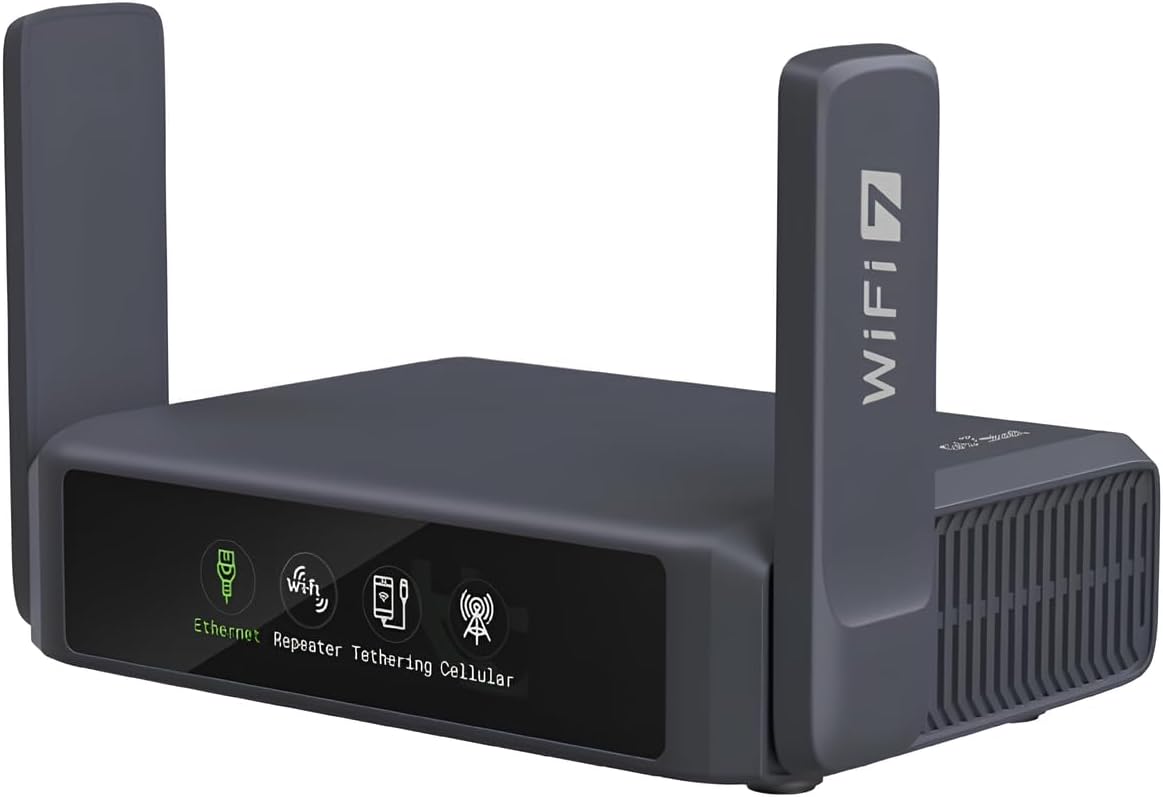
The GL.iNet GL-BE3600 Slate 7 is a 4.4-rated Wi-Fi 7 travel router whose defining feature is its color-coded touchscreen. The display can show QR codes, monitor speed, switch VPN providers, toggle encryption, and indicate Ethernet, tethering, repeater, and cellular modes, making it a convenient option for travelers who want fewer administrative steps.
We may earn a commission when you buy through this link, at no additional cost to you.
Its dual-band wireless system provides up to 688Mbps at 2.4GHz and 2,882Mbps at 5GHz. It includes one 2.5G WAN port, one 2.5G LAN port, and a USB 3.0 port. OpenVPN and WireGuard are pre-installed and compatible with more than 30 VPN providers, while stated maximum VPN speeds reach 100Mbps for OpenVPN and 540Mbps for WireGuard on local network tests.
The Slate 7 can run a VPN client and server simultaneously, allowing access to local network resources while connected to a public VPN. It also supports AdGuard Home, WPA3, DNS over HTTPS, DNS over TLS, and IPv6. Its limitations are understandable for a portable device: there is only one LAN port, and its listed OpenVPN throughput trails the stronger WireGuard result. Real-world performance will depend on the network, provider, and selected server.
This is an excellent match for frequent travelers, remote workers, and privacy-conscious users who want a screen-assisted way to manage a private network. It is less suitable for a large home needing numerous wired connections, but for hotels, temporary workspaces, and compact travel setups, the touchscreen adds genuine convenience.
A display with color-coded status indicators can make network changes easier than searching through a small web interface, especially when connecting in unfamiliar locations. QR-code scanning also reduces the need to type long network details manually.
Simultaneous client and server operation is useful when travelers need both outbound encryption and remote access to a local resource. The supplied information specifically identifies access to local printers and local web servers as possible use cases.
We may earn a commission when you buy through this link, at no additional cost to you.
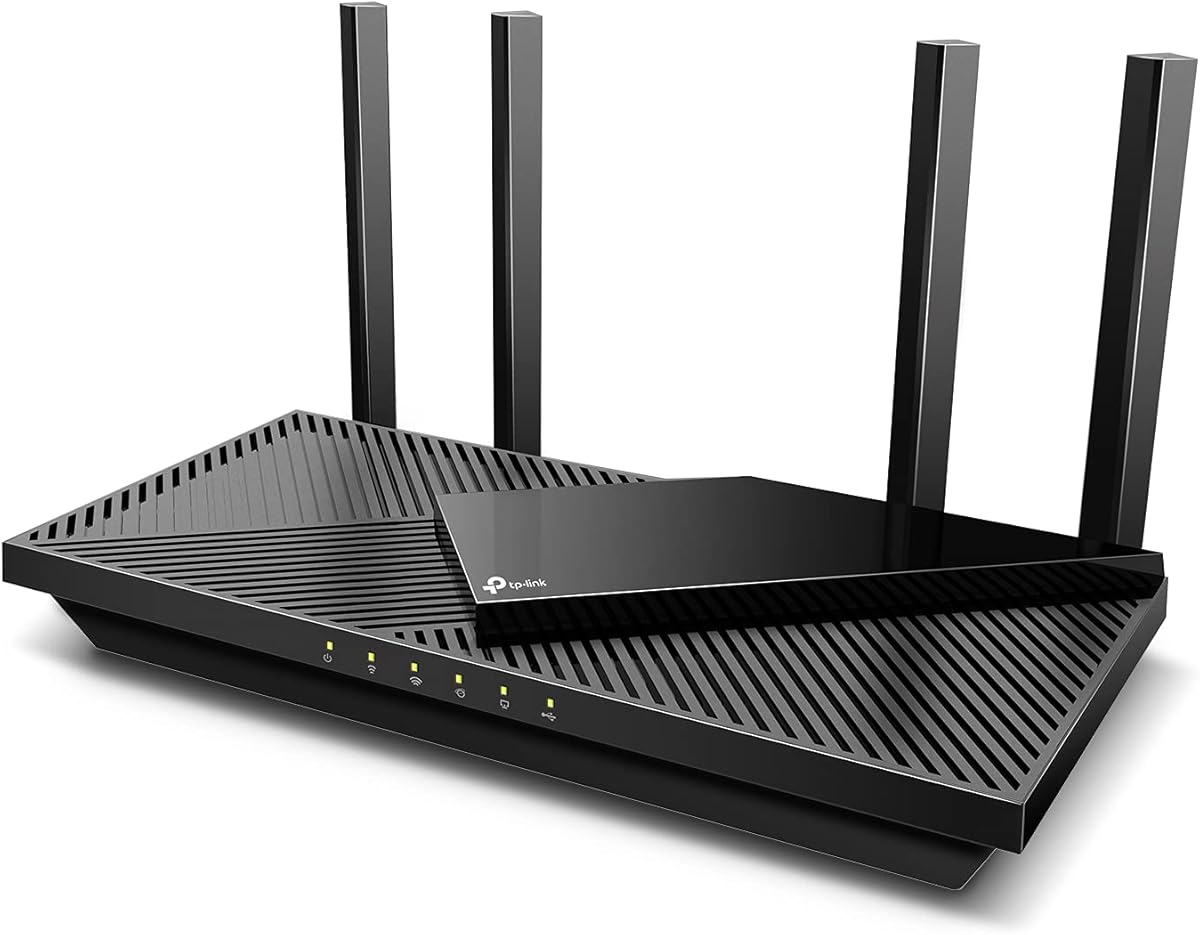
The TP-Link Archer AX3000 is a 4.4-rated dual-band Wi-Fi 6 router that includes VPN server and client functionality. It offers a broad 2,976Mbps combined wireless rate, with up to 2,402Mbps on 5GHz and 574Mbps on 2.4GHz, making it a practical mainstream option for everyday homes that want centralized protection.
We may earn a commission when you buy through this link, at no additional cost to you.
OFDMA allows multiple clients to share a band more efficiently, which can improve responsiveness when phones, computers, televisions, and smart-home products are active together. Four high-gain external antennas and beamforming are intended to expand coverage, while Target Wake Time helps devices communicate more efficiently. A larger heat sink and revised enclosure are designed to manage heat and reduce throttling.
The product data does not specify individual VPN throughput figures or advanced VPN protocol speed, so it should not be compared directly with the high-speed WireGuard claims of the GL.iNet models. Its advantages are simpler: a 4.4 rating, familiar TP-Link management features, HomeShield tools, Alexa compatibility, and broad ISP compatibility. It is also limited to dual-band Wi-Fi and does not list a multi-gigabit Ethernet option.
Buy the Archer AX3000 when you need a straightforward, full-home router with VPN support and do not require travel portability, OpenWrt customization, Wi-Fi 7, or the highest encrypted speeds. It is a sensible starting point for users who value simplicity and everyday wireless capacity over advanced enthusiast features.
OFDMA lets supported clients share spectrum more efficiently than older contention-based Wi-Fi arrangements. This can be valuable in busy homes where several devices are streaming, gaming, or making video calls at the same time.
Four high-gain antennas and beamforming are intended to direct wireless signals toward connected devices. Their practical result depends on placement, walls, interference, and the capabilities of client devices, so central positioning remains important.
We may earn a commission when you buy through this link, at no additional cost to you.
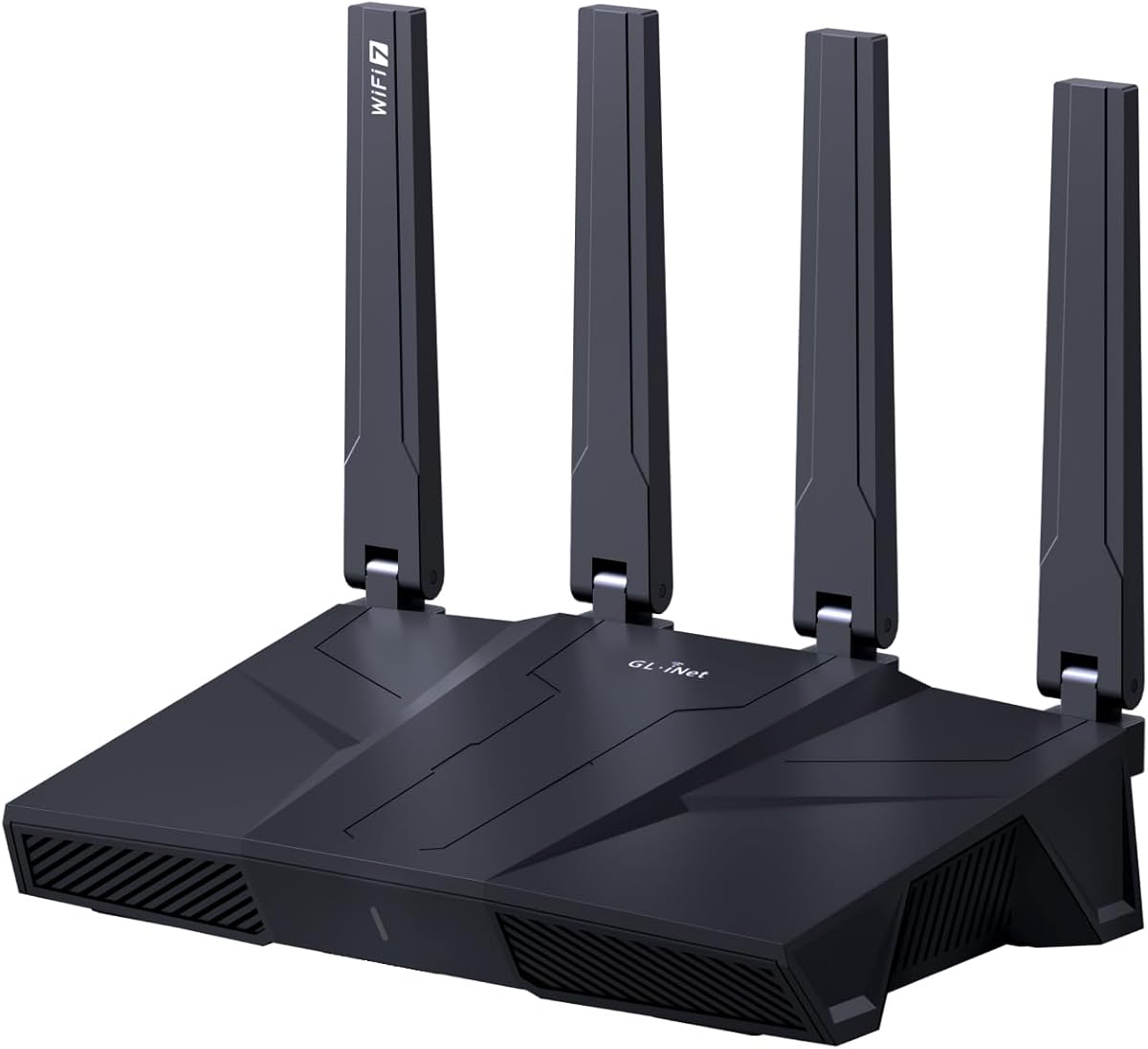
The GL.iNet GL-BE9300 Flint 3 is the premium selection, earning a 4.3 rating and offering tri-band Wi-Fi 7, up to 9Gbps wireless speed, and an unusually generous five 2.5G Ethernet ports. It is designed for demanding homes that need more high-speed wired connectivity alongside modern wireless features and network-wide VPN support.
We may earn a commission when you buy through this link, at no additional cost to you.
Its Wi-Fi 7 implementation includes Multi-Link Operation, enhanced OFDMA, 4K-QAM, and preamble puncturing. Coverage is stated for areas up to 2,000 square feet, while the hardware is designed to support more than 100 devices. A 1GB DDR4 processor memory allocation and 8GB eMMC storage provide capacity for plugins and added functionality, and AdGuard Home is supported for DNS filtering.
OpenVPN and WireGuard are listed at up to 680Mbps. That is below the Flint 2 and Flint 3e figures, but the Flint 3 compensates with five 2.5G ports and broader high-end wireless hardware. Integrated Bark support adds website filtering, safe search, and usage limits. The instruction to update the firmware at initial setup is another point users should not overlook.
Choose the Flint 3 when future-facing wireless performance, plentiful 2.5G connections, and expandable open-source functionality are the main priorities. It is best suited to technically comfortable owners of large or active homes. Users who mainly need a small travel router should consider the Slate 7 or Beryl AX instead.
The five 2.5G Ethernet ports make this model especially useful for homes with several high-bandwidth wired devices. They can support modern local networking without requiring a separate collection of multi-gig switches.
Multi-Link Operation, enhanced OFDMA, 4K-QAM, and preamble puncturing provide a stronger platform for newer clients. Actual gains vary by device, environment, internet service, and the number of connected users.
We may earn a commission when you buy through this link, at no additional cost to you.
The GL.iNet GL-MT3000 Beryl AX is the best budget pick because it combines a 4.5 rating with meaningful VPN performance and a compact travel-oriented design. It supports OpenVPN and WireGuard, includes a physical toggle for VPN or AdGuard Home, and can run client and server functions at the same time.
We may earn a commission when you buy through this link, at no additional cost to you.
Wireless performance reaches up to 574Mbps on 2.4GHz and 2,402Mbps on 5GHz. Its 2.5G multi-gigabit WAN port is especially valuable for users connecting to a modern fiber or other fast internet service, while the 1G LAN port and USB 3.0 connection expand practical use. The listed VPN maximum is 300Mbps for WireGuard and 150Mbps for OpenVPN on local network tests.
OpenWrt 21.02 provides access to more than 5,000 ready-made plugins, including configuration through the router's admin interface. Security features include WPA3, DNS over HTTPS, DNS over TLS, and IPv6. The tradeoff is portability: the Beryl AX has only one Ethernet LAN port, and its encrypted throughput is lower than that of the larger GL.iNet routers in this guide.
This is a compelling choice for travelers, renters, students, and anyone who wants a private, encrypted connection without installing a VPN application on every device. It also makes sense as a secondary router for a home network. For users needing several wired endpoints or the highest VPN throughput, a larger full-size model is a better fit.
The Beryl AX is designed to turn an unfamiliar wired or wireless connection into a private network. That makes it useful in hotels, offices, temporary rentals, and other locations where users want consistent device-wide protection.
A physical switch makes it easy to change among VPN and AdGuard Home functions without navigating the entire administration menu. The function must first be assigned in the admin panel, after which the toggle provides straightforward daily control.
We may earn a commission when you buy through this link, at no additional cost to you.
The GL.iNet GL-BE6500 Flint 3e is a 4.2-rated Wi-Fi 7 router built around speed, gaming, and broad coverage. It has the highest stated VPN throughput in the group, with both OpenVPN and WireGuard reaching up to 1,100Mbps under the supplied conditions. Its wireless speed is listed at up to 6.5Gbps.
We may earn a commission when you buy through this link, at no additional cost to you.
Coverage is designed for spaces up to 2,500 square feet, and the router supports more than 100 devices. Wi-Fi 7 features include Multi-Link Operation, enhanced OFDMA, 4K-QAM, preamble puncturing, and Multi-RUs. A 1GB DDR4 memory allocation supports the hardware, while AdGuard Home and Bark integration provide ad filtering and parental-control options.
The number should be treated as a maximum rather than a guaranteed experience. The product information explicitly notes that actual VPN speed depends on the internet service provider, network environment, VPN server location, and VPN service provider. It also advises updating the firmware during initial setup. These caveats matter because encryption, remote servers, and internet bottlenecks can all reduce the achieved rate.
Buy the Flint 3e if your priority is the highest potential encrypted throughput in a Wi-Fi 7 home router. It is particularly relevant to gamers and households with many connected clients, provided the surrounding network and VPN service can support the advertised maximum.
The listed 1,100Mbps ceiling for both protocols makes this the leading VPN-speed recommendation in the guide. Users with fast local connections, capable VPN servers, and an uncrowded network have the most to gain from that capability.
The stated coverage of up to 2,500 square feet and support for more than 100 devices suit active homes. Placement, construction materials, wired backhaul, and client capabilities will still determine the real-world experience.
We may earn a commission when you buy through this link, at no additional cost to you.
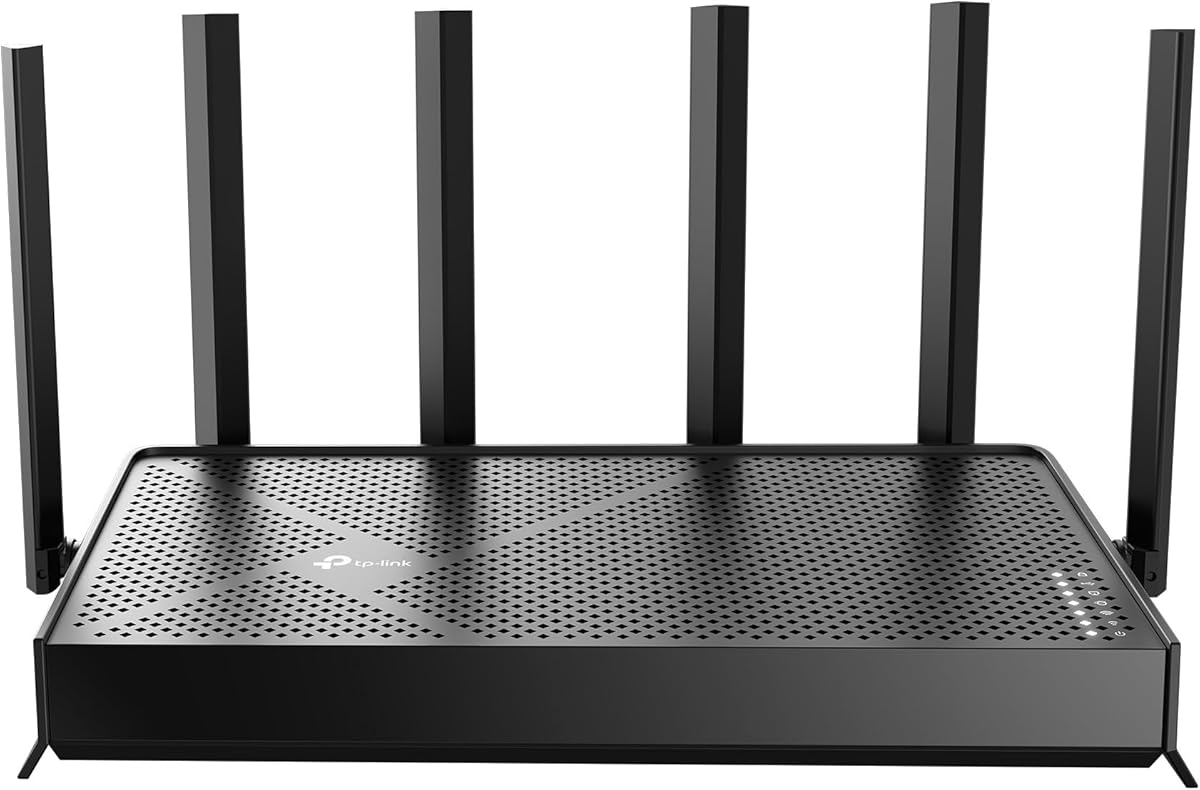
The TP-Link Archer BE600 is a 4.2-rated tri-band Wi-Fi 7 router with an emphasis on high-speed wired networking. It includes one 10Gbps WAN/LAN port, one 2.5Gbps WAN/LAN port, and three 2.5Gbps LAN ports, making it one of the strongest options for homes with multi-gig internet, local storage, or demanding wired devices.
We may earn a commission when you buy through this link, at no additional cost to you.
Its stated wireless speeds reach 5,765Mbps on 6GHz, 2,882Mbps on 5GHz, and 1,032Mbps on 2.4GHz. Multi-Link Operation, Multi-RUs, 4K-QAM, and support for channels up to 320MHz target modern Wi-Fi 7 devices. Six antennas and beamforming are designed to cover areas of up to 2,600 square feet and serve as many as 120 devices.
Its VPN client and server support allows home devices to reach remote VPN servers without installing individual VPN software. The router can maintain simultaneous VPN and regular internet connections, which adds flexibility. However, the supplied data does not state an encrypted throughput figure or identify the supported VPN protocols, so performance cannot be compared numerically with the GL.iNet models.
The Archer BE600 is a strong choice for a future-oriented home whose main internet connection is fast enough to use a 10Gbps port. Its advanced network controls, security focus, and excellent port selection suit experienced users, while the Tether app helps make setup and management accessible to less technical household members.
The 10Gbps port can serve a multi-gig connection or a high-speed local link, reducing a potential bottleneck between the router and modern equipment. The remaining 2.5G ports provide a flexible mix for storage, computers, and other wired clients.
Keeping VPN and ordinary traffic active at the same time can make the router useful for both protected and standard connections. This is more convenient than disconnecting one path whenever a protected session begins.
We may earn a commission when you buy through this link, at no additional cost to you.
The TP-Link ER605 is a 4.4-rated wired Gigabit VPN router for users who need reliable site-to-site or remote access without wireless features. Its security capabilities go well beyond basic routing, supporting up to 20 LAN-to-LAN IPsec connections and 16 each of OpenVPN, L2TP, and PPTP.
We may earn a commission when you buy through this link, at no additional cost to you.
Five Gigabit Ethernet ports include one Gigabit WAN port, two Gigabit WAN/LAN ports, and two Gigabit LAN ports. Supporting up to three WAN connections can help distribute bandwidth or separate network paths. A USB port can also accept a compatible 4G or 3G modem as WAN backup, adding resilience when a primary connection fails.
The router provides advanced firewall policies, denial-of-service defense, IP, MAC, and URL filtering, VPN pass-through, and a local management option. Its main limitation is obvious but important: there is no built-in Wi-Fi. Every device must connect through Ethernet or use separate access points, making it most appropriate for an office, small business, or already-wired home.
Choose the ER605 when dependable VPN throughput and connection counts matter more than wireless speed or portability. Its broad protocol support and multiple WAN options make it a specialist choice for administrators who want clear control over encrypted network paths.
The ability to use up to three WAN ports offers more flexibility than a basic single-WAN router. A USB-connected compatible cellular modem can also provide a backup path when the primary WAN service is unavailable.
Support for numerous IPsec, OpenVPN, L2TP, and PPTP connections is more appropriate for a small office or advanced home lab than a typical single-user travel scenario. The separate LAN-to-LAN IPsec capacity is especially notable.
We may earn a commission when you buy through this link, at no additional cost to you.
The GL.iNet GL-AXT1800 Slate AX is a 4.4-rated pocket-sized Wi-Fi 6 router for people who prioritize portability. It supports OpenVPN and WireGuard, runs on OpenWrt 21.02, and can create a private network from public wired or wireless connections, including networks that use a captive portal.
We may earn a commission when you buy through this link, at no additional cost to you.
Its combined wireless rate is up to 1,800Mbps, consisting of 600Mbps on 2.4GHz and 1,200Mbps on 5GHz. MU-MIMO, OFDMA, and BSS coloring improve efficiency and reduce interference, while the router can handle up to 120 simultaneous devices. Listed VPN speeds reach 500Mbps with OpenVPN and 550Mbps with WireGuard.
The Slate AX also includes a physical toggle for VPN and AdGuard Home, IPv6 support, and Cloudflare encryption. An attached USB drive can become a private file-sharing location through SAMBA or WebDAV. As with other GL.iNet travel routers, the toggle function must first be configured in the admin panel. The device does not include the higher multi-gigabit port selection found on the Beryl AX.
This is a strong pick for travelers, students, and remote workers who want a pocketable private network with strong protocol support. It is also a reasonable compact secondary router. Users with a faster broadband connection or several wired devices may prefer the Beryl AX, while the Slate 7 offers a newer Wi-Fi 7 platform and touchscreen.
Repeater mode can convert a public wired or wireless network into a private one for connected devices. This helps travelers avoid placing a separate VPN client on every product and creates a more controlled local environment.
With an external USB hard drive connected, SAMBA and WebDAV support turn the router into a small private file-sharing hub. This adds useful functionality for travelers working with locally stored documents.
We may earn a commission when you buy through this link, at no additional cost to you.
The right router depends on how much VPN throughput you need, the size and device density of your network, the wired ports you require, and how comfortable you are with advanced configuration. The following factors help separate simple home protection from portable, enthusiast, and business-oriented VPN systems.
WireGuard and OpenVPN are the two most relevant protocols to compare in this category. WireGuard is generally designed for lean, modern operation, while OpenVPN is widely established and supported across many providers. Some TP-Link models also list PPTP and L2TP, while the wired ER605 adds IPsec. The best router for you should support the protocols offered by the VPN service you already use or intend to use.
Check both the protocol list and the stated maximum speed. A router can support a protocol without delivering a satisfying result on a slow internet connection, congested Wi-Fi network, or distant VPN server. Select a model with room above your expected everyday throughput.
A VPN client sends or receives traffic through a remote VPN server. A VPN server lets authorized users connect into the local network. Several GL.iNet models support both at once, which is useful for accessing printers, local servers, or other home resources while outbound traffic is protected.
If your needs are limited to ordinary browsing and streaming, a client mode may be enough. Remote workers, administrators, and households with local network resources are more likely to value simultaneous client and server operation.
Wi-Fi 6, Wi-Fi 6E, and Wi-Fi 7 differ in band availability, theoretical throughput, and client compatibility. Wi-Fi 6E adds the 6GHz band, while Wi-Fi 7 introduces features such as Multi-Link Operation, 4K-QAM, Multi-RUs, and wider channels. The highest number does not guarantee the fastest result for every device because clients, distance, walls, and interference all matter.
Choose a standard that matches the hardware you actually own now and expect to own soon. A fast internet connection also needs compatible clients and a sufficiently capable processor to move data efficiently.
Coverage claims offer useful guidance, but no specification can account for every home layout. Dense walls, multiple floors, neighboring networks, and the position of the router can change results substantially. Device-capacity figures are equally approximate because each client uses a different amount of bandwidth and radio time.
For larger homes, place the router centrally and consider mesh-compatible systems when a single unit cannot cover the required rooms. For high-density use, prioritize a tri-band design, good memory, and processors rated for simultaneous traffic.
Standard Gigabit ports support up to 1Gbps, while 2.5G and 10G ports offer more capacity for modern broadband, local storage, and demanding computers. A multi-gig WAN port matters only when the internet service and connected equipment can use the extra bandwidth, but additional multi-gig LAN ports can improve local transfers.
Count the devices that genuinely need wired connections. A travel router with one LAN port may be ideal for a small traveling group, while a full-size home router should offer enough 2.5G or 10G ports to avoid unnecessary adapters.
WPA3, DNS over HTTPS, DNS over TLS, IPv6, firewall tools, and URL or device filtering can complement a VPN without replacing it. AdGuard Home provides DNS-based ad and tracker blocking, while HomeShield and Bark support focus on household security, IoT identification, and parental controls. A VPN primarily protects traffic routed through the encrypted tunnel; local network protections remain relevant.
Look for features that match your household. Privacy-conscious users may prioritize encrypted DNS and modern authentication, while parents may favor content filtering and time controls.
OpenWrt provides a powerful operating system with packages, plugins, and configuration options that can extend a router considerably. It is particularly attractive to users who want AdGuard Home, advanced routing, additional services, or fine-grained control. The same depth can make initial configuration more demanding than on a simplified consumer router.
Check whether the product includes a no-code interface for common tasks and whether setup instructions are available. Users who want a one-screen installation should prioritize the consumer-oriented TP-Link options, while technically confident buyers may value GL.iNet's flexibility.
Travel routers need to be easy to carry, quick to configure, and capable of using different connection types. Repeater mode, Ethernet connectivity, cellular tethering, and international plug availability broaden their usefulness. A larger home router may offer better sustained performance and more ports, but it will be less convenient to carry.
For a compact setup, consider size, USB support, multi-gig WAN capability, and how easily the VPN can be toggled. For a permanent installation, prioritize Ethernet layout, wireless capacity, and thermal design over portability.
Begin with the supplied initial setup guide and update the firmware before configuring advanced options, particularly on GL.iNet models whose product information specifically recommends it. Connect the router to the modem or source connection, use Ethernet for the initial web-panel access where advised, and complete the wireless password, administrator password, time zone, and firmware steps before moving devices.
For VPN use, install the appropriate client profile or sign in through the provider options supplied by the router. Select WireGuard or OpenVPN according to your service, confirm that connected devices are using the protected route, and test access to the local network, streaming services, and work resources. Leave a recovery path or direct Ethernet connection available in case a VPN configuration prevents normal administration.
Care for the router by placing it in a central, open, ventilated position and avoiding enclosed cabinets or crowded surfaces. Update firmware when instructed, back up important VPN and network settings before major changes, and use secure administrator credentials. Periodically review connected devices, update the VPN provider's software, and check whether new client hardware would benefit from a newer router or mesh expansion.
It can, provided the device sends its traffic through the router's VPN client and is not configured to bypass that route. This is one of the main advantages over installing a VPN application on each phone, laptop, or television. You should still confirm which local devices remain visible and review the router's routing and DNS settings.
The client connects the local network to a remote VPN server and encrypts outbound traffic. The server accepts incoming encrypted connections so authorized users can reach local resources. Several models in this guide support both functions simultaneously, which is useful for remote work and accessing a local printer or server.
WireGuard is often favored for its lean design and strong performance on compatible hardware, while OpenVPN has broader long-standing support. The best choice depends on your VPN service and local conditions. In this list, WireGuard generally has a higher stated maximum, but actual speed depends on the provider, remote server, internet connection, and network configuration.
Yes, the Slate AX and Slate 7 are designed to use public wired or wireless connections. The router can create a private local network, and its VPN client can encrypt traffic from connected devices. You may need to reconnect if the hotel's captive portal or session time limit interrupts access, and you should obey the property's terms of service.
You need one if your internet plan, local network, or connected equipment routinely exceeds the limits of Gigabit Ethernet. A multi-gig WAN port also helps prevent a fast fiber connection from being limited by the router's internal interface. For basic browsing and typical home use, the available Gigabit or 2.5G ports on many models remain sufficient.
Encryption adds processing work, and the remote VPN server can become a bottleneck, so some reduction is normal. The effect varies with router hardware, protocol, provider, server distance, and internet speed. Models such as the Flint 2 and Flint 3e list especially high VPN maximums, while travel-oriented models prioritize compactness over maximum encrypted throughput.
No. Models with simplified interfaces can configure built-in VPN features without showing the wider OpenWrt environment. OpenWrt is most relevant when you want additional packages, custom routing, or deeper control. If a product is based on OpenWrt, you can still use its ready-made interface and need not install custom software.
Choose a full-size model for permanent home coverage, numerous Ethernet devices, stronger Wi-Fi specifications, and larger households. Choose a travel model for compactness, quick network setup, public Wi-Fi use, and easy portability. If both needs apply, buying one capable full-size router and using a smaller portable model as a secondary device can cover more situations.
The GL.iNet GL-MT6000 Flint 2 is the strongest overall recommendation because it balances Wi-Fi 6 performance, two 2.5G ports, fast WireGuard and OpenVPN throughput, and extensive customization. The GL.iNet GL-MT3000 Beryl AX is the more compact value choice for travelers, while the GL.iNet GL-BE9300 Flint 3 is the premium option for users who prioritize Wi-Fi 7 and five 2.5G connections.
Your next priority should be the type of network you actually need. Choose the Slate 7 when a touchscreen makes travel setup easier, the Slate AX when maximum portability is paramount, the Archer AXE75 for tri-band Wi-Fi 6E and EasyMesh, and the ER605 for a wired small-office setup. Match the protocol support, port configuration, coverage, and management complexity to your devices rather than choosing only by the largest speed number.
Finally, check current prices, availability, warranty terms, and the latest setup documentation before purchasing. Router specifications, firmware, VPN services, and promotional offers can change, and the hardware performance figures in this guide are maximum claims subject to network conditions. Verify that your chosen service supports the router's protocols and that your connected devices are compatible with its wireless standard.