
Lowrance Active Imaging 3-In-1
4.6Editor score
CHIRP, SideScan, DownScan
FishReveal target identification
Medium and high CHIRP
Our Down and Side Imaging Transducer guide compares 10 leading models for compatibility, sonar coverage, installation, target detail, durability, and fishing
A down and side imaging transducer gives anglers a more complete view of the water by combining detailed sonar directly beneath the boat with wide scans to either side. The best unit is not simply the one with the longest range; compatibility, frequency support, image clarity, mounting design, and cable length all influence whether it performs well in your particular fishing setup.
We compared ten transducers using the supplied specifications, customer ratings, supported frequencies, imaging capabilities, installation features, and listed display compatibility. The guide covers compact transom-mount options, all-in-one CHIRP and imaging packages, and complete fish finder bundles, giving particular attention to the units that best balance coverage, detail, and practical installation.
Each pick highlights a different way to approach the category, from broad all-in-one imaging to focused down imaging for legacy systems. Ratings and technical details reflect the available product information, while prices can change at any time, so confirm the transducer, connector, display model, and mounting requirements before making a final purchase.
4.6Editor score

5.0Editor score
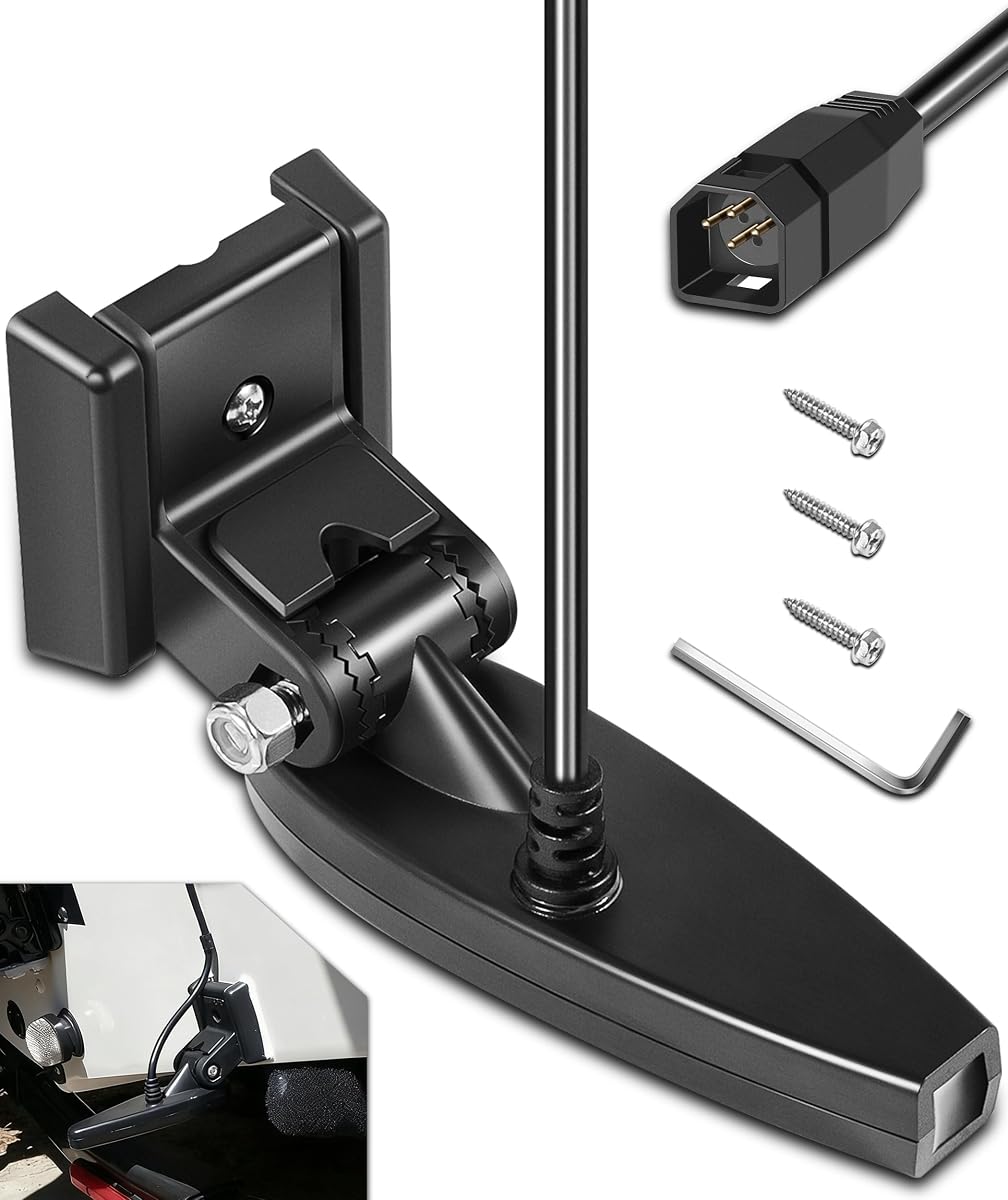
4.5Editor score
The comparison below highlights the most important distinctions among the ten available units, including imaging mode, frequency coverage, side-to-side range, installation format, and display compatibility. Because a transducer must electrically and physically match the fish finder, these specifications should be considered together rather than in isolation.


The Humminbird XM 14 HW CMSI T stands out as the most complete imaging transducer in this guide, carrying a 5.0 rating while combining MEGA Side Imaging+, MEGA Down Imaging, and Dual Spectrum 2D CHIRP sonar. Its headline specifications are unusually ambitious: side coverage extends up to 400 feet, while maximum down scanning reaches 400 feet. That combination makes it a strong candidate for anglers who want to inspect a large area without replacing multiple specialized functions.
We may earn a commission when you buy through this link, at no additional cost to you.
The transducer operates at 455 kHz and 1.1 MHz for the imaging channels, providing the kind of frequency flexibility associated with high-resolution structural views. Its 2D CHIRP section supports full, narrow, and wide spectrum modes, including 150–220 kHz in full mode, 180–240 kHz in narrow mode, and 140–200 kHz in wide mode. The result is a unit designed to cover both broad searches and close inspection of contours, cover, and fish-holding structure.
Compatibility is limited to the specified Humminbird XPLORE, APEX, and SOLIX G3 families, and buyers should confirm their exact unit before ordering. The product also depends on a proper screw-on connection and secure transom placement. These are meaningful restrictions, but they are reasonable for a specialized premium unit whose main advantage is its unusually long imaging reach. The included 20-foot cable and durable transom mount make the package practical for a typical permanent installation.
Choose this model if your boat uses one of the listed Humminbird systems and you want side imaging, down imaging, conventional sonar, and temperature data in one compact unit. It is particularly suitable for anglers searching wide areas for drop-offs, channels, weed edges, and submerged structure. For everyone else, verify compatibility first; when it fits, however, this is the most feature-rich transducer in the comparison.
The combination of 400-foot side coverage and 400-foot down coverage gives this unit a strong all-around search envelope. A single transom-mounted transducer handles lateral structure, deep bottom contours, conventional fish arches, and water temperature.
Dual-frequency MEGA imaging is supported by adjustable Dual Spectrum CHIRP modes. This gives the display several ways to balance scan width, target separation, and structural detail rather than forcing one fixed operating mode.
We may earn a commission when you buy through this link, at no additional cost to you.
The Lowrance 000-14489-001 Active Imaging 3-In-1 earns a 4.6 rating by bringing CHIRP, SideScan, and DownScan together with FishReveal target identification. It is a premium choice for anglers who want more than raw image width: the system is designed to help distinguish fish from rock piles, standing timber, weed beds, ditches, and drop-offs by presenting structure and targets with greater clarity.
We may earn a commission when you buy through this link, at no additional cost to you.
The strongest feature is the integration of medium and high CHIRP at 83/200 kHz with SideScan and DownScan operation at 455/800 kHz. CHIRP supplies conventional sonar information, SideScan examines the area beside the boat, and DownScan creates a detailed view directly below it. FishReveal then works with the DownScan presentation to make individual targets easier to recognize against surrounding cover.
Its compatibility with Lowrance HDS LIVE, Elite FS, and Simrad NSS evo3s and GO series displays makes it versatile across current multi-brand setups. The limitation is equally clear: this is not a universal transducer, and an older HDS Carbon or other unit may require a different model or adapter. Exact model verification remains essential, particularly when connecting through a Simrad interface.
This is an excellent choice for boaters seeking a single premium sonar package with side, down, and CHIRP functions. It is especially valuable when fish-holding structure is difficult to interpret on a conventional display. Choose it only after confirming the display model and connector requirements, but for compatible systems it provides a versatile and well-rounded imaging setup.
FishReveal is the key interpretive advantage of this package. Rather than asking anglers to rely on a raw image alone, it helps a display separate recognizable fish targets from the structure and cover surrounding them.
CHIRP, SideScan, and DownScan cover complementary parts of the underwater picture. That makes the transducer a convenient choice for anglers who want to search below, beside, and conventionally through the boat without carrying separate sonar components.
We may earn a commission when you buy through this link, at no additional cost to you.
The Humminbird XM 14 20 MSI T combines MEGA Side Imaging, MEGA Down Imaging, and DualBeam PLUS sonar in a transom-mounted package. Its 4.3 rating reflects a capable middle ground in the lineup, offering 125 feet of side coverage and the deeper view directly beneath the boat while retaining a separate two-dimensional sonar mode.
We may earn a commission when you buy through this link, at no additional cost to you.
The main appeal is compatibility with several Humminbird product families, including XPLORE, APEX, SOLIX, and ONIX. The side-imaging returns extend 125 feet on either side, which is enough to inspect nearby structure while remaining more approachable than the maximum reach claimed by the rank-one model. DualBeam PLUS combines two sonar beams to balance detail with a generous coverage area.
One important caveat concerns the ONIX SI series, which supports only the 455/800 kHz frequencies available for SI and DI. Other buyers should still confirm the exact display and required frequencies. The lower rating also suggests the product may not deliver the same level of customer satisfaction as the more highly rated alternatives, although its technical feature set remains substantial.
This transducer makes sense for Humminbird users who want broad, established compatibility and a balanced combination of side, down, and 2D sonar. It is less attractive for someone who needs the longest possible side reach, but it is a practical choice for general fishing, structure hunting, and boats already equipped with one of the listed Humminbird systems.
Support for XPLORE, APEX, SOLIX, and ONIX broadens the potential audience for this unit. The key is checking the exact fish finder and any model-specific frequency limitations before installation.
A 125-foot return on each side is a practical search width for finding drop-offs, weed edges, channels, and submerged debris. It also gives the angler a clearer view of structure than a conventional 2D display can provide.
We may earn a commission when you buy through this link, at no additional cost to you.
The Humminbird XNT 9 SI 180 T is a transom-mount side and down imaging transducer with a 4.6 rating. Its defining strength is the breadth of listed compatibility, which includes HELIX 5 SI GPS, HELIX 5 CHIRP SI GPS G2, several HELIX 7 and HELIX 9 SI configurations, and older 899CI HD SI, 798ci, 698ci, 598ci, and 398C SI models.
We may earn a commission when you buy through this link, at no additional cost to you.
That support makes this a valuable option for anglers who own a display outside the newest product generation. Rather than replacing the entire fish finder, a compatible transducer can provide the side and down views the selected unit is designed to display. The transom arrangement is familiar and straightforward, allowing the transducer to be mounted behind the boat where its sonar can reach the surrounding water.
The supplied information does not assign a specific side-scanning distance or detailed frequency set for this model, so buyers should not assume the same coverage or resolution offered by newer MEGA units. Instead, its key advantage is the ability to bring side and down imaging to a wide collection of compatible legacy displays. Compatibility should be checked against the complete fish finder model rather than the product family alone.
Choose this transducer when your boat has one of the many listed HELIX or legacy SI units and you want to add two-dimensional structural awareness without replacing the display. It is a compatibility-led purchase rather than the reach leader, making exact model verification the most important step before ordering.
This model extends modern-style side and down views to a lengthy list of older Humminbird units. It can therefore be a practical way to modernize an existing installation without buying a complete new display package.
A transom-mounted transducer keeps the installation accessible for inspection and adjustment. Correct positioning remains important because the unit must remain submerged and unobstructed to produce reliable sonar returns.
We may earn a commission when you buy through this link, at no additional cost to you.
The Humminbird Helix 7 G4 GPS is the only complete fish finder and transducer bundle in this list, earning a 4.5 rating. It includes MEGA Side and Down Imaging, Dual Spectrum CHIRP sonar, enhanced navigation, and real-time mapping, making it a broader solution for someone building a new electronics setup rather than simply replacing a standalone transducer.
We may earn a commission when you buy through this link, at no additional cost to you.
The imaging system reaches 125 feet to each side and 125 feet directly beneath the boat, while Dual Spectrum CHIRP offers wide and narrow modes. A low-Q transducer supports 2D target separation, and the side and down views are intended to show fish, contours, and structure with more definition than standard imaging sonar. This coverage is substantial without approaching the maximum range of the top transducer.
Beyond sonar, the unit includes Humminbird Basemap coverage for more than 10,000 lakes and the continental U.S. coastline. AutoChart Live can build maps with depth contours, bottom hardness, and vegetation, using eight hours of built-in recording time, while compatibility with premium chart providers expands navigation options. A keypad and softkey interface provide control of views and settings in changing weather.
This bundle is best for a new installation centered on a HELIX 7 G4 system. It avoids the need to source a display and transducer separately, while providing far more functionality than a transducer-only purchase. It is less appropriate if you already own a compatible fish finder or if the included charting and recording features are not important to your fishing needs.
The fish finder, imaging transducer, mapping, and recording tools arrive as one package. This simplifies initial setup for a new boat or a major electronics upgrade and reduces the need to match a separate transducer with the display.
AutoChart Live records depth contours, bottom hardness, and vegetation to develop custom maps. Preloaded coastal and lake coverage and support for premium chart options make the unit useful for both navigation and structure hunting.
We may earn a commission when you buy through this link, at no additional cost to you.
The Humminbird XNT 9 HW SI T is a purpose-built transducer for HELIX 7 CHIRP SI GPS G4 displays, with a 4.5 rating. It combines CHIRP Side Imaging, CHIRP Down Imaging, and Dual Spectrum CHIRP 2D sonar, giving compatible boats a three-mode package in one transom-mounted unit.
We may earn a commission when you buy through this link, at no additional cost to you.
Side and down views operate at 455 kHz to reveal structure and fish below and beside the boat. Dual Spectrum CHIRP adds a conventional sonar view with a 150–220 kHz range, useful for target separation and broader search patterns. The transducer also carries a built-in temperature sensor, mounting hardware, and a 20-foot cable, making it a more complete installation package than a bare imaging element.
A significant limitation is that MEGA Side Imaging models are not supported. That restriction narrows the ideal audience and means the exact HELIX 7 variant must be confirmed before purchase. Compared with the XM 14 HW CMSI T, this unit also lacks the same claimed maximum side and depth coverage, making it better viewed as a focused upgrade for a particular generation of HELIX displays.
This transducer is a good fit for an owner of a compatible HELIX 7 CHIRP SI GPS G4 who wants side, down, and 2D CHIRP functionality. Its included mounting hardware and temperature sensor make installation more convenient, provided the model requirements are met.
This unit is designed around the HELIX 7 CHIRP SI GPS G4 platform rather than broad compatibility. That focused approach can be convenient when the display is already known, but it makes exact model verification essential.
A 20-foot cable, built-in temperature sensor, and mounting hardware cover several common installation needs. These details reduce the need to source separate accessories before mounting the transducer.
We may earn a commission when you buy through this link, at no additional cost to you.
The Lowrance 000-14814-001 Black combines CHIRP, SideScan, and DownScan in an Active Imaging 3-in-1 transducer rated 4.2. It supports HDS LIVE, HDS Carbon, and Elite Ti2 displays, giving it access to several popular Lowrance families while including a compact six-foot cable for close-range installations.
We may earn a commission when you buy through this link, at no additional cost to you.
The transducer's imaging functionality covers both the water beside the boat and the area directly below it. Its CHIRP support adds conventional sonar information, creating a flexible three-part package. A nine-pin connector is included, but the product information states that an adapter cable is required, so compatibility should be confirmed with the exact display and connector arrangement before purchase.
The six-foot lead distinguishes this model from the longer-cabled alternatives. It can be useful on compact boats or installations where a short run is preferable, although it offers less routing flexibility on larger vessels. The 4.2 rating is lower than those of the leading Lowrance 3-in-1 and several Humminbird options, making it worth comparing installation needs and connector requirements carefully.
Choose this model for a compatible Lowrance setup where a short cable and transom mount suit the boat. It delivers the same broad Active Imaging concept as the premium three-in-one option, but buyers should account for the required adapter and ensure that six feet is sufficient to reach the mounting position safely.
The six-foot cable can simplify routing on small boats and tightly arranged transoms. It may be less convenient when the display cable path requires a longer run, so measure the installation before ordering.
CHIRP, SideScan, and DownScan provide complementary views without a separate transducer for each mode. The nine-pin connection and required adapter mean that display compatibility must be resolved before installation.
We may earn a commission when you buy through this link, at no additional cost to you.
Despite the abbreviated product title, the supplied listing describes an Active Imaging 2-in-1 transducer with SideScan and DownScan. Its 4.1 rating reflects a focused alternative for Lowrance and Simrad users who want structural imaging but do not need a separate conventional CHIRP channel.
We may earn a commission when you buy through this link, at no additional cost to you.
Operating at 455/800 kHz, the unit is designed to clarify rock piles, standing timber, weed beds, ditches, and drop-offs. The emphasis is on target separation and detail rather than simply displaying an image. Compatibility extends to Lowrance HDS LIVE, Elite Ti, and Simrad NSS evo3 and GO series displays, giving it relevance across both Lowrance and selected Simrad installations.
The product naming is unusual, and the supplied information does not state a cable length, connector type, or specific included hardware. Those omissions make the listing less straightforward than the clearly identified model numbers elsewhere in the guide. The lack of a stated CHIRP mode also makes it a less versatile option for anglers who want all three sonar types in one housing.
This transducer makes sense when SideScan and DownScan are the priority and the connected display is listed as compatible. It may be a practical choice for a clean two-mode setup, but buyers should inspect the package details and verify the exact part identity before ordering.
The 2-in-1 design concentrates on the side and down views most useful for locating fish-holding habitat. This simplicity can appeal to anglers focused on rock piles, timber, weeds, ditches, and drop-offs.
The generic title and limited installation details make a careful listing review especially important. Confirm the connector, cable, mounting pieces, and exact transducer number against the unit required by the fish finder.
We may earn a commission when you buy through this link, at no additional cost to you.
The Humminbird 710226-1 XNT 9 DI T offers a focused combination of Down Imaging and DualBeam PLUS sonar, earning a 4.5 rating. It is the best value-oriented choice for boaters who need a detailed view beneath the boat but do not require the lateral search range of a side-imaging transducer.
We may earn a commission when you buy through this link, at no additional cost to you.
Its sharp Down Imaging uses 75-degree and 45-degree beam angles with 455/800 kHz frequencies, while DualBeam PLUS pairs 25-degree and 16-degree beams with 200/455 kHz for broader conventional coverage. This mix supports detailed vertical views and a wide search area, helping users distinguish fish from structure and identify the direction fish are facing.
Compatibility is broad, covering HELIX 12, 10, 9, 7, and 5 DI GPS variants, select PiranhaMAX models, and legacy units such as the 788ci HD DI Combo, 597ci HD DI Combo, 596c HD DI Combo, and 570 DI. The 20-foot cable, impact-release bracket, and required mounting hardware create a more complete package. The listing also stresses that the transducer must remain fully submerged during operation because air pinging can damage it.
This is a strong pick for a compatible Humminbird Down Imaging system, especially when the budget is better spent on reliable local structure coverage than maximum side-scan range. It lacks a side-imaging function, so anglers searching drop-offs or channels beside the boat should look to the side-imaging alternatives instead.
The 45-degree and 75-degree Down Imaging beams create detailed coverage directly below the hull. That makes this transducer practical for locating fish over structure, reading bottom contours, and understanding habitat beneath the angler.
Compatibility ranges across current HELIX DI GPS families and several older DI units. It is still essential to verify the exact display because a shared product family does not always guarantee identical connector or frequency support.
We may earn a commission when you buy through this link, at no additional cost to you.
The Humminbird XNT 9 DI T is a transom-mounted Down Imaging and DualBeam PLUS transducer with a 4.6 rating. It delivers the traditional two-channel formula used by many compatible Humminbird fish finders: a detailed fish-eye view beneath the boat and conventional dual-beam sonar for target separation and broad coverage.
We may earn a commission when you buy through this link, at no additional cost to you.
Down Imaging operates at 455/800 kHz, while DualBeam PLUS combines two beams to provide detail across a generous area. The product supports select HELIX Down Imaging models, PiranhaMAX Down Imaging models, and legacy Down Imaging systems. Specific listed units include the 788ci HD DI Combo, 597ci HD DI Combo, 596c HD DI Combo, and 570 DI, giving buyers several clearly identified installation targets.
The unit includes a built-in temperature sensor and a 20-foot cable, covering two common installation needs. It does not provide Side Imaging, so it should be viewed as a down-imaging specialist rather than a complete answer for anglers who need wide lateral coverage. Its 4.6 rating is nevertheless strong, indicating favorable customer reception within the listed compatible systems.
Choose this transducer when your Humminbird display supports the XNT 9 DI T and you want detailed beneath-boat imagery with DualBeam PLUS support. It is a dependable lower-cost path to Down Imaging, while the broader side-and-down options are better for boats that need both viewing directions.
The 455/800 kHz Down Imaging channel creates a detailed vertical picture of fish, cover, and bottom contours. It is especially useful when anglers need to understand what lies directly beneath the boat.
This transducer supports a recognizable range of HELIX, PiranhaMAX, and older DI systems. Confirming the full fish finder model before ordering will prevent an incompatible installation.
We may earn a commission when you buy through this link, at no additional cost to you.
Choosing a transducer begins with the fish finder you already own. After confirming connector and frequency support, compare imaging range, CHIRP capability, physical mounting requirements, cable length, and the type of structure you intend to fish.
A transducer is not a universal accessory, even when it belongs to the same brand as the display. Supported frequencies, connector styles, and software generations can vary among products that share a family name. The XM 14 HW CMSI T is specified for XPLORE, APEX, and SOLIX G3 models, while the Lowrance Active Imaging options support particular HDS LIVE, Elite, HDS Carbon, and Simrad families. The two Lowrance 3-in-1 listings also differ in connector, cable length, and supported Elite generation. A buyer should locate the exact model number of the fish finder, identify its connector, and compare it with the transducer documentation before ordering. Relying only on the brand name creates a substantial risk of an incompatible purchase.
Side Imaging is valuable when the target lies beside the boat rather than directly underneath it. The available range varies sharply: the Humminbird XM 14 HW CMSI T claims up to 400 feet of side-to-side scanning, the XM 14 20 MSI T reaches 125 feet on either side, and the HELIX 7 G4 package also provides 125 feet to each side. Range should be balanced against image detail, display processing, and the type of terrain being searched. A wider theoretical reach can help locate a distant drop-off, but the fish must still be identified among structure. An angler fishing close to weeds, rocks, or timber may receive more value from a smaller area rendered with strong separation.
Down Imaging looks beneath the hull and is often most useful for understanding bottom contours, submerged cover, and the position of fish relative to structure. The XNT 9 DI T options use 455/800 kHz Down Imaging, with one listing specifying 75-degree and 45-degree beam angles for detail. The XM 14 HW CMSI T supports MEGA Down Imaging at 455 kHz and 1.1 MHz with maximum depth scanning stated at 400 feet. More features and frequencies do not automatically guarantee better results on every display, so the transducer should be matched to the image processing and menus of the connected unit. For a legacy system, a straightforward 455/800 kHz DI transducer may be the more natural fit.
CHIRP changes the frequency across a sweep rather than transmitting a single fixed frequency, helping the sonar separate targets and reduce interference from nearby objects. The Humminbird XM 14 HW CMSI T includes adjustable Dual Spectrum CHIRP modes, and the XNT 9 HW SI T combines CHIRP side and down imaging with Dual Spectrum 2D sonar. Lowrance's Active Imaging 3-in-1 products add medium and high CHIRP at 83/200 kHz to SideScan and DownScan. By contrast, the XNT 9 DI T units and the two-in-one Lowrance option do not present the same complete CHIRP package. Decide whether a dedicated conventional sonar channel is important for searching water between the detailed imaging areas.
Some anglers fish one tight area beneath the boat and need only Down Imaging. Others want to compare the open water to both sides, while still checking the area below. A 3-in-1 Active Imaging package combines CHIRP, SideScan, and DownScan and is appropriate for broad sonar coverage. The XM 14 HW CMSI T and XM 14 20 MSI T likewise combine side, down, and two-dimensional functions. A dedicated XNT 9 DI T is more focused and does not provide side imaging. Choosing a more capable combination can simplify the installation, but choosing too much beyond your normal fishing pattern may add cost without improving the results you actually need.
Most products here use a transom mount, but the details of the bracket, lead length, and routing environment vary. The XM 14 HW CMSI T includes a 20-foot cable, as do the XNT 9 HW SI T and both XNT 9 DI T choices. The Lowrance 000-14814-001 uses a six-foot cable, which may be convenient on a compact boat but restrictive on a larger transom. The 710226-1 XNT 9 DI T includes an impact-release bracket and required hardware. Measure from the chosen mounting point to the display connection, leave enough slack for cable routing, and consider how the bracket behaves in rough water. A secure, unobstructed mount is as important as the sonar specification.
Raw pixel detail is only useful if the display helps the angler distinguish fish from the habitat around them. Lowrance's 3-in-1 option includes FishReveal Smart Target view, intended to make fish easier to recognize in detailed DownScan images. The Active Imaging 2-in-1 product emphasizes target separation and structural clarity for rock piles, timber, weeds, ditches, and drop-offs. Humminbird's newer packages focus on MEGA detail, beam flexibility, and separate imaging channels. The right feature depends on the display's image-processing tools. A specialized target view can be very helpful when structure is visually busy, but compatibility must be confirmed before relying on it.
Down and side imaging depends on a consistent water interface. The transducer should remain fully submerged during operation, and the warning attached to the 710226-1 XNT 9 DI T explains that air pinging can damage the unit. Inspect the face for debris, confirm that the cable is free from sharp edges, and ensure the mounting bracket holds the transducer at a stable angle. Avoid powering the sonar while the element is exposed. A built-in temperature sensor adds convenience, but it does not replace proper mounting. Routine care and correct positioning are simple safeguards that help preserve image consistency and protect the electronics.
Begin by identifying the correct connector, supported frequencies, and mounting requirements for your fish finder. Position the transducer on the transom so it remains fully submerged and has an unobstructed path toward the water. Connect the cable without forcing it, route it away from hinges and sharp edges, and secure the excess with ties or clips so that movement cannot pull on the connector.
Power the unit while the transducer is in the water, as operating it in air can cause damaging air pinging. Begin with a moderate sonar range and gain setting, then compare the down view with the side views. Use CHIRP or narrow modes for detailed target separation and wider modes when searching more area. Adjust mounting angle only in small increments and move slowly enough to recognize whether the image improves.
After each outing, wipe the transducer face with fresh water and inspect it for slime, weeds, fishing line, or damage. Check the bracket, screws, cable, and connector for looseness, especially after rough water. If the image becomes weak or inconsistent, verify that the element is not partially exposed and that no obstruction has accumulated. Replace damaged mounting hardware rather than forcing a stressed bracket back into position.
Yes. Several choices in this guide combine the two functions, including the Humminbird XM 14 HW CMSI T, XM 14 20 MSI T, and XNT 9 HW SI T, along with Lowrance's Active Imaging products. These units can save installation space by using one transom-mounted housing. However, the additional functions do not mean every display can operate every mode, so compatibility must be verified before purchase.
A 3-in-1 unit typically combines CHIRP, SideScan, and DownScan, giving the angler conventional sonar plus both imaging directions. A 2-in-1 unit focuses on SideScan and DownScan. The Lowrance Active Imaging 3-in-1 options therefore provide broader sonar versatility, while the listed 2-in-1 product concentrates on structural views from the sides and below the boat.
The supplied information specifically says that the Lowrance 000-14814-001 with the six-foot cable has a nine-pin connector and requires an adapter cable. Other products may also have model-specific connection requirements, even when they use the same brand. Check the transducer number, display model, and connector type rather than assuming a cable will fit.
MEGA Imaging can provide greater detail and side-to-side coverage in the listed Humminbird packages, but it is not automatically the right choice for every boat. The newer display must support the transducer and its frequencies. For many older HELIX, PiranhaMAX, and legacy systems, a compatible XNT 9 DI T is the more realistic way to add Down Imaging.
Choose a lead that reaches the fish finder with enough slack to route around hinges, supports, and other obstructions. Twenty feet provides more flexibility on many installations, while the Lowrance six-foot cable can be convenient on compact boats. Measure the intended path before ordering and avoid leaving excess cable loose where it can snag or be damaged.
A dedicated down-imaging unit concentrates on the area below the boat, while a side-imaging transducer scans to the left and right. If the objective is to locate fish beside a channel, weed edge, drop-off, or submerged structure, a side-and-down model will generally be more suitable. A down-only unit remains valuable for direct beneath-boat structure and contour work.
The first check is whether the transducer is fully submerged, because an exposed element cannot send a normal sonar return through air. Next, inspect the face for slime, weeds, line, or other debris, and confirm that the mounting angle is stable. Also verify that the display is set to a supported mode and frequency, since an incompatible setting can prevent the expected image from appearing.
A transducer replacement is usually the simpler route when a current unit has a compatible connector and supports the desired imaging frequencies or modes. If the display lacks the necessary software, frequency range, or connector, a transducer alone may not solve the problem. The Humminbird Helix 7 G4 GPS package is one option for buyers who prefer a complete matched display-and-transducer system.
The Humminbird XM 14 HW CMSI T is the strongest all-around choice in this guide, combining the broadest claimed side coverage with MEGA down imaging, adjustable CHIRP, temperature monitoring, and a 5.0 rating. The Lowrance Active Imaging 3-In-1 is the premium alternative for compatible HDS LIVE, Elite FS, and Simrad users, while the Humminbird 710226-1 XNT 9 DI T delivers the best budget-focused route to detailed down imaging.
Compatibility should remain the first filter because no transducer can outperform a display that does not support its connector, frequency, or imaging mode. From there, choose based on how you fish: side and down imaging for structure around the boat, dedicated down imaging for beneath-boat detail, and CHIRP when conventional target separation and broad search coverage are priorities.
Prices and product availability can change, so review the current listing before purchasing. Confirm the exact fish finder model, required frequencies, connector, mounting position, and cable length. A careful compatibility check will prevent an otherwise capable transducer from becoming an expensive accessory that cannot be used with your existing electronics.