
Ridge Tracker Card
4.4Editor score
MFi certified design
Up to 300-foot range
Five-month rechargeable battery
Our GPS Wallet Tracking Card guide compares 10 slim trackers for compatibility, range, alerts, durability, battery life, privacy, and ease of use in 2026.
GPS wallet tracking cards combine a discreet card shape with the location-finding capabilities of Bluetooth and connected item trackers. A good model should fit without creating an obvious bulge, work with the phone ecosystem you already use, provide helpful separation and lost-item alerts, and remain easy to recharge or maintain.
This guide compares ten wallet tracking cards based on platform compatibility, slimness, speaker output, alert features, water resistance, battery approach, sharing options, and intended uses. The list includes Apple Find My, Google Find Hub, and cross-platform choices, with attention to both practical travel needs and everyday wallet tracking.
Each pick highlights a different balance of features, from long-life maintenance-free cards to rechargeable models with high-volume speakers. Ratings and specifications reflect the supplied product information, while prices and availability can change, so readers should confirm current details before purchasing.
4.4Editor score

4.5Editor score
4.7Editor score
The comparison below organizes all ten cards by the factors that most affect daily usability: device support, physical size, alert capability, endurance, and environmental protection.

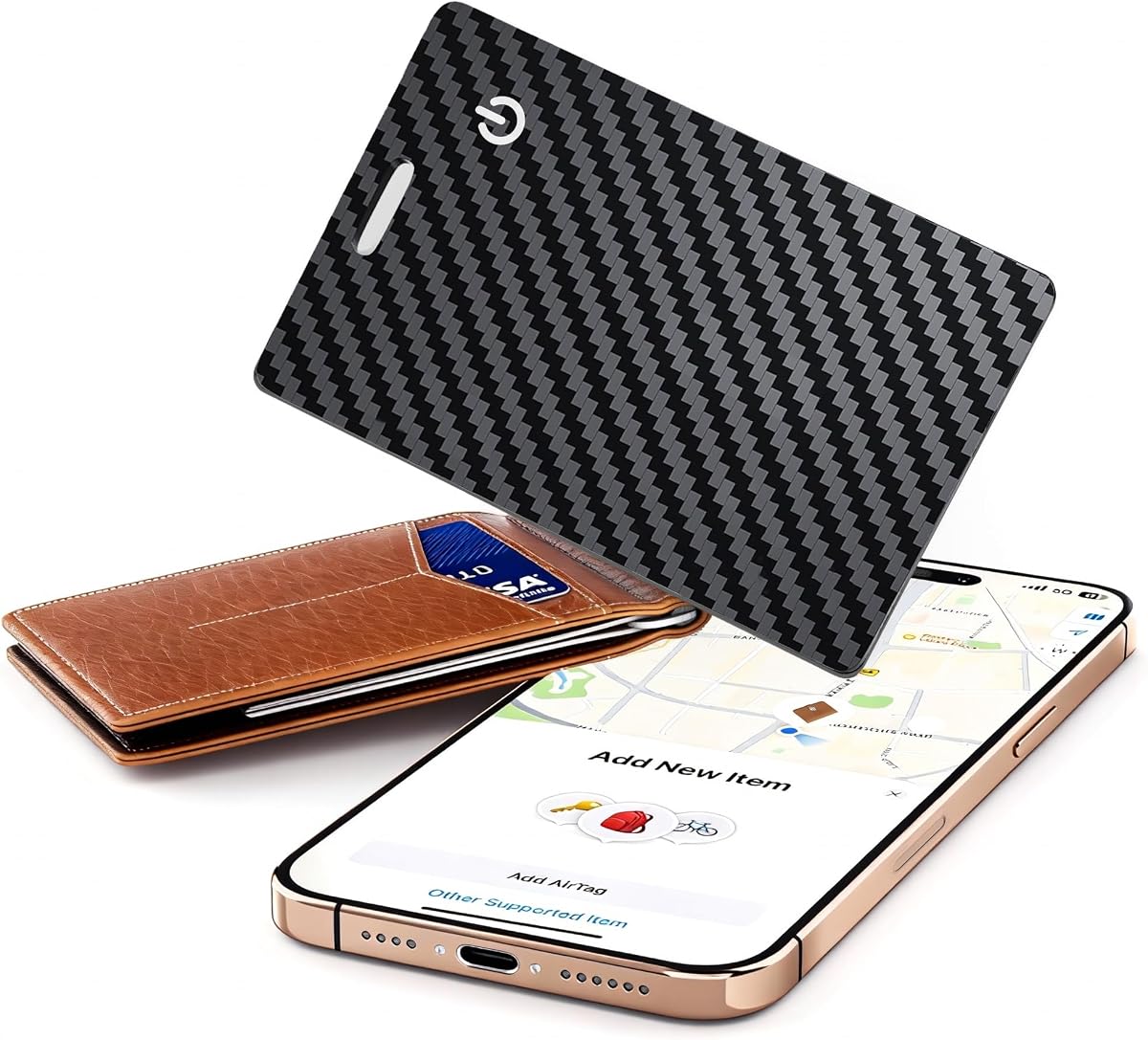




This 0.06-inch tracker is the strongest all-around recommendation because it combines an unusually thin design with support for both Apple Find My and Google Find Hub. Its 4.5 rating reflects a broadly capable product, while the 120dB speaker, IP68 protection, sharing capability, and UWB distance display make it practical for wallets, luggage, backpacks, keys, and vehicles.
We may earn a commission when you buy through this link, at no additional cost to you.
The most appealing feature is its ability to adapt to different phone users. Instead of locking buyers into one ecosystem, it works with compatible iPhones and Android phones through their native tracking applications. Its claimed five-to-ten-year battery life also removes the inconvenience of frequent charging, while data encryption through the selected network helps protect location information.
There are important limits. The product is not compatible with GPS or Huawei devices, and its UWB distance visualization applies within Bluetooth range rather than serving as a universal precision-finding function. In addition, the ten-year claim should be understood as a stated product characteristic rather than a guarantee for every usage pattern or environment.
This is the card to choose for a mixed-device household, frequent travelers, or anyone who wants a tracker thin enough to blend into a normal card slot. It offers the broadest platform support in the list while retaining the strong speaker and durability expected from a premium wallet tracker.
At 0.06 inches, the card adds very little bulk to a wallet, card holder, passport sleeve, or travel pouch. Supporting both major mobile ecosystems makes it especially useful for families or users who switch between iPhone and Android devices without needing separate tracking software.
The 120dB speaker is among the loudest listed, which helps when a wallet is buried beneath furniture or inside a bag. UWB distance visualization adds another nearby search aid, while separation and shareable location features make the card useful for trips and group travel.
We may earn a commission when you buy through this link, at no additional cost to you.
The Ridge Tracker Card earns the premium recommendation through its combination of cross-platform support, MFi certification, a stated 300-foot alert range, and a 155mAh rechargeable battery. Its 4.4 rating and refined feature set make it a strong option for users who want flexible network access and polished integration.
We may earn a commission when you buy through this link, at no additional cost to you.
It can work with Apple Find My or Google Find Hub, offering real-time tracking, lost-mode features, alerts, and the ability to share access with as many as five trusted contacts. The built-in speaker reaches a claimed 300 feet in open areas, while IP68 protection and wireless charging through Qi or MagSafe-compatible chargers suit frequent travel use.
The principal trade-off is maintenance. Unlike long-life non-rechargeable cards, the Ridge model is expected to last up to five months per charge and must be returned to a charging pad regularly. The listed range also depends on surroundings; placing it in a wallet, money clip, or other enclosure may reduce performance.
Choose this tracker if broad platform support, Apple-certified design, long open-area range, and refined family sharing matter more than completely maintenance-free operation. It is especially compelling for frequent travelers who already own a wireless charging setup and want a slim, capable wallet accessory.
Unlike trackers tied permanently to one operating system, the Ridge card can be added to Apple Find My or Google Find Hub. MFi certification adds confidence for iPhone users, while cross-platform support prevents a technology lock-in when changing phones or sharing tracking duties with family.
Qi and MagSafe compatibility eliminates the need for a dedicated cable. A claimed five months between charges balances sustained availability with relatively low maintenance, and location sharing for up to five trusted contacts expands its usefulness beyond individual recovery.
We may earn a commission when you buy through this link, at no additional cost to you.
The SPOTMINDERS Tracker PRO is built specifically for travelers who want a wallet tracker that resembles an ordinary card. Its 0.07-inch thickness fits neatly into card slots without the localized bulge associated with round tags. The 4.4 rating reflects solid Apple integration, a 100dB speaker, and IP68 protection.
We may earn a commission when you buy through this link, at no additional cost to you.
One-tap pairing with Find My makes setup direct, and the product supports map location, sound activation, Siri requests, and left-behind notifications without a separate application. A rechargeable battery provides up to eight months per charge according to the product information, and it can be replenished with a standard wireless charger.
The trade-offs are specific and important. It works only with Apple devices and does not support Precision Finding or UWB. It is also slightly thicker than the thinnest entries in this list, although still very slim, and the stated battery interval means it is not a completely maintenance-free choice.
This is a strong recommendation for iPhone users who regularly travel with a passport, place valuables in luggage sleeves, or want their tracker to blend among payment cards. It is less suitable for Android households or anyone who prioritizes an Apple-independent setup.
The 0.07-inch credit-card design makes the tracker less conspicuous than a hanging tag or round puck. It slides into an everyday wallet or passport holder without drawing attention, which is valuable in airports, hotels, restaurants, and crowded public places.
Find My integration covers map viewing, sound playback, Siri requests, and left-behind notifications. The 100dB speaker is designed to cut through common household noise, while eight months of stated use per charge reduces charging frequency.
We may earn a commission when you buy through this link, at no additional cost to you.
At 1.7mm, this MFi-certified wallet tracker card is among the most compact options in the guide. It holds a 4.4 rating and offers Apple Find My map tracking, an 80dB alarm, lost-item notifications, IP68 protection, and sharing with up to five iPhone devices.
We may earn a commission when you buy through this link, at no additional cost to you.
Its strongest advantage is how little it adds to a wallet. The product can also track bags, passport holders, jackets, camera bags, and other everyday items. A standard Qi charger restores the battery, and the supplied information states that a charge can support up to four months of use.
The limitations are straightforward. It requires iOS 14.5 or later and offers no Android support. Its 80dB speaker is less forceful than the 100dB or 120dB alternatives, and users with RFID-blocking wallets may need to place the tracker in an outer pocket for best operation.
This card is best for Apple users who prioritize extreme slimness over maximum speaker volume. It is especially appropriate for frequently carried passports, compact wallets, and travel documents where a few extra millimeters would be noticeable.
The 1.7mm profile is small enough to remain visually inconspicuous beside standard cards. That makes the tracker useful for slim wallets and passport holders where a round tag could create an uncomfortable projection.
Map tracking, last-known-location notifications, lost-item alerts, and up to five-person sharing work through Find My. The product states that location history is not publicly stored or shared and is protected with end-to-end encryption.
We may earn a commission when you buy through this link, at no additional cost to you.
The BFADEHA smart card focuses on low-maintenance tracking. Its 4.2 rating reflects a capable Apple Find My product with a 100dB speaker, left-behind alerts, IP68 protection, and a stated service life exceeding five years without charging or battery replacement.
We may earn a commission when you buy through this link, at no additional cost to you.
The card-style body is designed to blend into a wallet, passport holder, or luggage sleeve, although its 2.5mm thickness is not among the thinnest. One-tap pairing, map location, sound activation, and automatic separation notifications cover the core functions most users need.
Its non-rechargeable design is both its main appeal and its main compromise. Buyers avoid chargers and battery replacements, but cannot top up the battery when power declines. It also supports only Apple devices, so Android users should look elsewhere.
Choose the BFADEHA card for iPhone users who want a tracker they can install and largely forget. It suits travel, commuting, and everyday wallets where the combination of a loud speaker, long stated life, and zero recurring charge is worth more than a thinner rechargeable design.
The non-rechargeable battery removes cables, charging pads, and replacement reminders from the ownership experience. According to the supplied information, the card is designed for more than five years of steady service after activation.
A 100dB speaker helps locate a wallet in nearby rooms, while left-behind notifications warn when it is left in a taxi, café, hotel, or airport seating area. The credit-card appearance also reduces the chance that the device attracts unwanted attention.
We may earn a commission when you buy through this link, at no additional cost to you.
The Life360 Tile Slim is the clearest family-oriented option because it supports both iOS and Android and works directly with the Life360 safety platform. Its 4.4 rating and compact format make it a practical choice for shared households, while the included one-pack suits wallets, passports, and luggage tags.
We may earn a commission when you buy through this link, at no additional cost to you.
The card can be rung through the free app or located on the map, and it can also make a hidden phone ring even when that phone is silenced. The SOS feature can discreetly alert loved ones in unsafe situations, and the Life360 integration brings people and objects together on one family map.
Compared with the specialized Find My models, the supplied information provides less detail about speaker volume, water-resistance level, and battery intervals. It is therefore difficult to position it as the loudest or most rugged card in the list, even though its broader family-safety functions are distinctive.
This tracker is ideal for users who already rely on Life360 or want one shared platform for family location and item finding. It is also a sensible cross-platform option for a wallet shared between iPhone and Android users, provided its app-based workflow appeals to them.
Adding the Tile to Life360 allows relatives to see tracked belongings and family members together. That shared view is more useful for group travel and multi-generational households than a standalone wallet tracker focused only on personal recovery.
Users can ring the tracker to locate a misplaced wallet, or use the tracker to ring a phone hidden under cushions. The SOS alert function adds a separate safety layer, making the card useful beyond ordinary item recovery.
We may earn a commission when you buy through this link, at no additional cost to you.
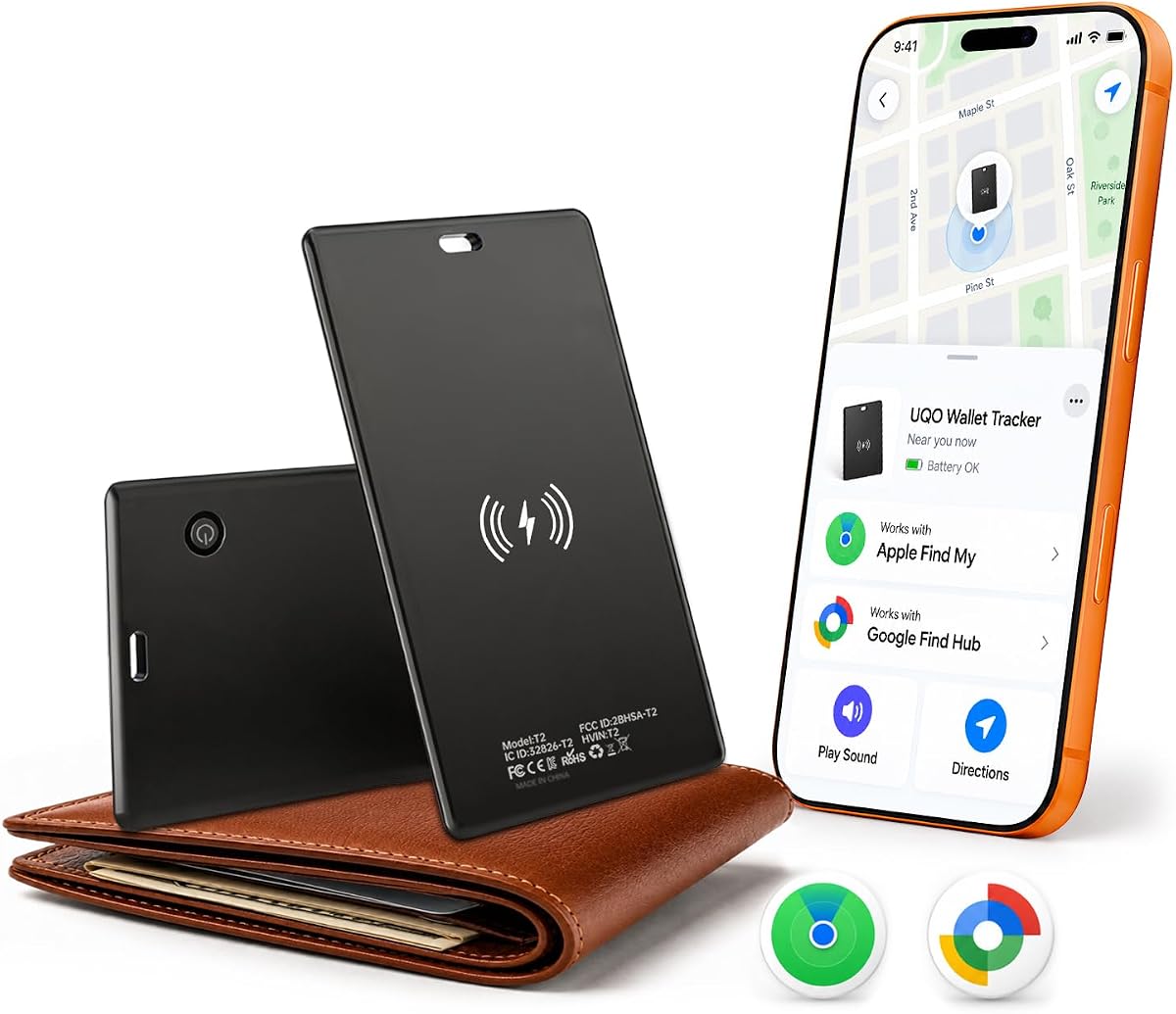
The T2 combines the highest rating in the list, 4.7, with support for both Apple Find My and Google Find Hub. Its 85dB speaker, separation alerts, lost mode, sharing, and cross-platform setup create a balanced feature set, while the 0.11-inch body still fits most ordinary wallets.
We may earn a commission when you buy through this link, at no additional cost to you.
Setup takes place through the selected native application, with no additional app or subscription required. A compatible Qi pad takes about an hour to charge the card, and the orange and green indicators make its status easy to understand. The product also supports a lanyard or keyring through its top hole.
The two-to-three-month battery interval is shorter than that of several competitors, and the card is thicker than options measuring around 0.06 to 0.07 inches. Its environmental protection is not specified with the same detail as products carrying an IP68 or IPX7 designation.
This is the best budget pick for buyers who want flexible platform support, a high rating, and essential tracking features without paying for a more specialized premium card. It is a particularly good fit for everyday wallets, card holders, and travel users who already own a Qi charger.
The T2 can be added through Find My as another supported item or paired through Find Hub on Android. This makes it straightforward to move between ecosystems while retaining the core map, ring, separation, and lost-mode functions.
A Qi pad replenishes the battery in roughly an hour, and two indicator colors show charging and full status. Users can expect to recharge every few months depending on activity, which is more frequent than long-life non-rechargeable alternatives.
We may earn a commission when you buy through this link, at no additional cost to you.
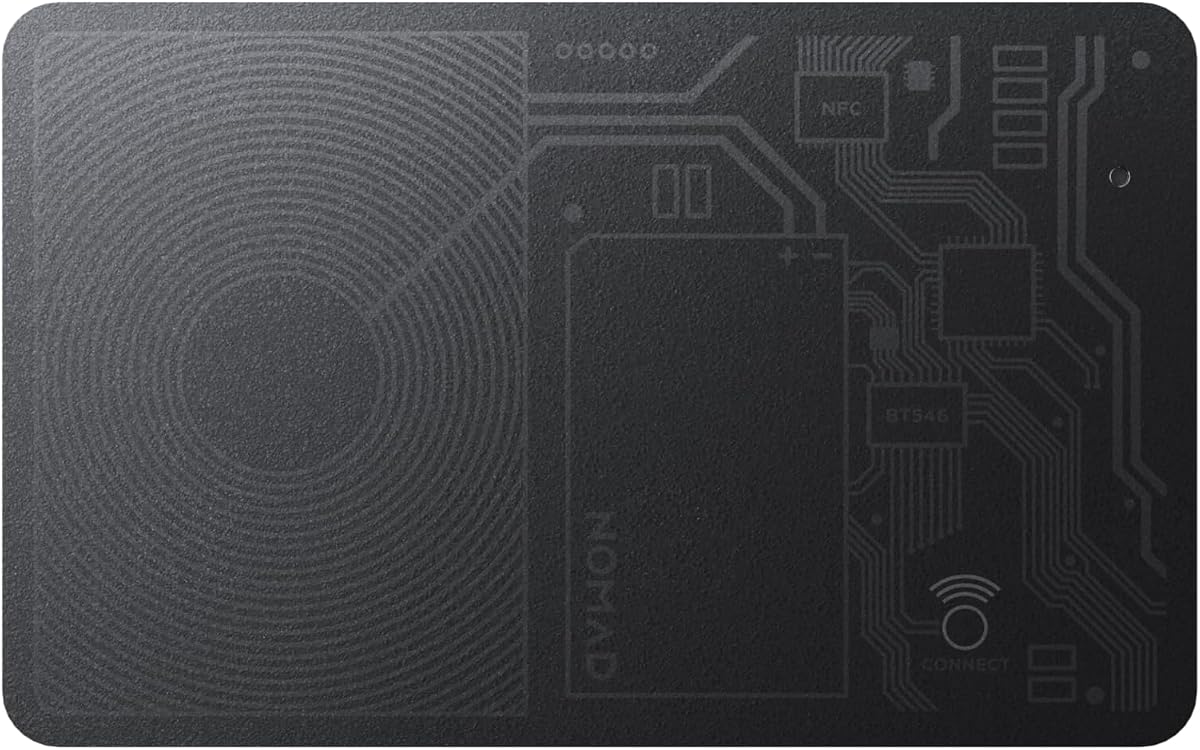
The Nomad Tracking Card Carbide is a slim, rechargeable Apple Find My card designed for wallets and luggage. Its 4.2 rating, card-like proportions, and five-month stated battery life make it a straightforward travel companion, particularly for users who already charge devices wirelessly.
We may earn a commission when you buy through this link, at no additional cost to you.
The card is roughly as thick as two standard credit cards, so it remains easy to insert into a wallet without the bulk of a round tracker. It works through Apple's native Find My application and accepts Qi or MagSafe wireless charging, including upright MagSafe models.
The card is restricted to iOS, so cross-platform households cannot use it with Android devices. Its IPX7 protection handles water and dust, but it does not offer the same IP68 rating stated for several alternatives. The supplied information also does not specify a speaker output, which limits detailed comparison with loud-sound models.
This is a good choice for iPhone users who value understated design, native Apple setup, and five months between charges. It works especially well for travelers who carry a MagSafe charging setup and want their wallet or luggage tracker to remain nearly indistinguishable from a regular card.
At approximately two credit cards in thickness, the Nomad card preserves the proportions people associate with payment cards. It can be slipped into a wallet, luggage sleeve, or travel organizer without looking like a conventional electronic tag.
Qi compatibility covers standard charging pads, while MagSafe support allows use with compatible Apple charging arrangements. A stated five-month battery life provides a long operating interval between those charging sessions.
We may earn a commission when you buy through this link, at no additional cost to you.
The Credit Card Tracker PRO is an Apple-focused wallet finder whose defining feature is a 100dB speaker. It carries a 4.5 rating, fits into slim wallets, cardholders, and other flat storage, and includes IP68 protection for daily splashes, spills, and dust.
We may earn a commission when you buy through this link, at no additional cost to you.
Setup occurs through Find My, and the product supports map location, sound playback, left-behind alerts, and lost mode. Lost Mode can display contact information to help someone who finds the item return it. The product description emphasizes encrypted handling of location data without publicly storing the tracker's history.
It supports only iOS, and the supplied battery information does not provide a clear charging interval or identify the power source. Consequently, prospective buyers may need to confirm power-management details in the current listing, particularly if long intervals between charges are important.
This tracker is a strong fit for iPhone users who want an audible search signal in noisy or cluttered environments. It is especially useful for wallets, purses, bags, and luggage that could be buried in a larger compartment, while its thin profile preserves the appearance of a normal card.
The 100dB output is designed to remain audible from inside a bag, beneath a cushion, or within a crowded room. Activating it from Find My turns the card into a practical last-resort locator when the visual map is not precise enough.
Automatic notifications warn when the wallet is left behind, reducing the chance of walking away from it. Lost Mode adds contact details for recovery while the product's encrypted location handling supports privacy-focused ownership.
We may earn a commission when you buy through this link, at no additional cost to you.
The Rechargeable AirTag Card is a 1.8mm Apple Find My tracker that combines a discreet profile with a 100dB speaker. Its 4.3 rating, IP68 protection, rechargeable battery, left-behind alerts, and Lost Mode make it a capable alternative for iPhone users who prefer wireless charging over disposable-style power.
We may earn a commission when you buy through this link, at no additional cost to you.
At just 1.8mm, it fits into wallets, passport holders, gym bags, pool bags, and luggage sleeves. The Find My app displays the last recorded location, plays the alert sound, and can be used to mark the card lost. A finder can then see the shared contact details and attempt to return it.
As an Apple-only product, it has the same ecosystem limitation as several other entries. The five-month battery life also requires regular charging, and buyers should not interpret the product title's broad staying-power language as a guarantee of a completely maintenance-free card.
Choose this model when a very thin rechargeable design, loud sound, and native Apple setup are the priorities. It is a versatile travel and everyday option for people who want to maintain their tracker through a compatible wireless charger rather than rely on a non-rechargeable cell.
The 1.8mm profile is slightly thicker than the 1.7mm MFi Wallet Tracker Card but remains extremely discreet. It is suitable for users who routinely place their wallet or passport in a narrow sleeve and want minimal added bulk.
Find My provides map guidance, sound activation, departure notifications, and Lost Mode without another application. Contact details can be attached to a lost item, while the product states that location information remains encrypted and that only the paired Apple account controls access.
We may earn a commission when you buy through this link, at no additional cost to you.
The most important choice is the tracker that fits your phone and routine. Compatibility determines setup and network access, while thickness, battery design, alert capability, durability, and sharing features determine whether the card remains convenient in daily use.
Begin by checking whether you use an iPhone, an Android phone, or a combination of both. Apple Find My-only cards offer tight native integration but are useless to Android users, while Google Find Hub and dual-platform cards provide more flexibility. MFi certification can be reassuring for iPhone buyers because it indicates the card meets Apple's standards for Made for iPhone accessories.
Slimness matters most when the tracker sits in a front wallet pocket, a passport sleeve, or a luggage organizer. Options range from approximately 1.7mm to 2.85mm, and the thinnest cards are least likely to create a visible edge or uncomfortable bulge. Users with RFID-blocking wallets should also check whether the blocking material can interfere with the tracker and whether an outer pocket is recommended.
Bluetooth range determines how reliably the card can play a sound, while speaker output affects whether that sound can be heard through a bag, cushion, or closed wallet. Listed outputs range from 80dB to 120dB, and the Ridge card lists up to 300 feet in open areas. Real results vary because walls, wallet materials, interference, and battery condition can all reduce effective range.
Battery design involves a clear tradeoff between longevity and convenience. Rechargeable cards are simple to maintain with Qi or MagSafe chargers and commonly provide several months per charge, while non-rechargeable cards can offer a much longer stated service life with no routine charging. Confirm the charging interval, expected battery life, and whether a wireless charger is included before deciding.
Useful alerts help prevent a loss rather than merely document it later. Look for separation or left-behind notifications, map updates, a loud sound command, and Lost Mode. Sharing lets family members view a card's location, with some models supporting several trusted contacts. These features are particularly valuable for travel, children, older relatives, and frequently shared bags.
Wallet trackers are exposed to rain, spills, dust, gym bags, and travel environments. IP68 appears on many of the recommended models and indicates stronger resistance to dust and temporary water immersion, while the Nomad card carries IPX7 protection. A rating does not make a card indestructible, but it provides useful reassurance for a device likely to travel in unpredictable conditions.
Location records are sensitive, so privacy should be part of the purchase decision. Look for end-to-end encryption, anonymous network reporting, restrictions on public location history, and Apple ID-based pairing. Also consider whether the card supports lost-item contact sharing without exposing more information than necessary, and review the relevant native app's privacy settings after setup.
A wallet card can be moved between a purse, suitcase, backpack, passport holder, or luggage sleeve, but the best model is one that will actually remain in those locations. Consider speaker volume for noisy transit areas, water resistance for outdoor trips, battery life for long journeys, and a card-like appearance that discourages unwanted attention.
Start by confirming your phone and operating system, then pair the card through Apple Find My or Google Find Hub as instructed. Give the tracker a name that identifies the item rather than the card itself, such as Travel Wallet or Everyday Purse. Place the card in a wallet, passport holder, luggage sleeve, or other intended location and confirm that the app recognizes it.
Test the basic functions before relying on the tracker. Open the map, check the connection, activate the sound, enable separation alerts, and review the battery status. Configure lost mode and add trusted contacts if applicable. For a new trip, move the card between locations only after confirming the relevant separation zone and update the item name so its current purpose remains clear.
Keep the card clean and dry, avoid bending or crushing it, and follow its charging instructions. Rechargeable models should be placed correctly on a compatible Qi or MagSafe pad, while non-rechargeable models need no charging routine. Inspect the card for damage, keep Find My and phone software updated, and replace or remove the card if its battery becomes unreliable or its electronics stop responding.
Many cards marketed as GPS wallet trackers determine their position through a phone or nearby devices participating in the Apple Find My or Google Find Hub network. Direct satellite positioning may not be available in the same way as on a dedicated vehicle GPS unit. Their strongest everyday functions are nearby sound activation, map updates, separation alerts, and last-known location information.
Only if the selected card supports both Apple Find My and Google Find Hub, or if it uses a separate cross-platform application. Several slim cards in this guide are Apple-only, while the 0.06-inch tracker, Ridge card, Life360 Tile Slim, and T2 support both major mobile ecosystems. Confirm the current ecosystem requirements before sharing a tracker with family.
Most models are designed to resemble a standard payment card and fit in a wallet's main card slot. Thickness ranges from roughly 1.7mm to 2.85mm among the listed options, so a very tight wallet may favor one of the ultra-thin cards. RFID-blocking wallets may also affect performance, and the relevant product instructions may recommend an outer pocket.
It depends on the model and usage. Rechargeable cards in this guide list intervals ranging from approximately two to three months to eight months, while some non-rechargeable options are designed to last more than five years. Activity levels, background alerts, and battery condition can affect actual performance, so check the indicator and app status during regular travel preparation.
The Life360 Tile Slim explicitly supports this two-way function: users can make a hidden phone ring even when it is silenced. Other Apple Find My cards primarily focus on locating the card and may offer limited or platform-dependent phone-finding features. Check the specific product description if two-way finding is central to your needs.
Both ratings indicate resistance to dust and water, but they represent different test conditions. IP68 is generally associated with a higher dust rating and protection under specified immersion depths and durations, while IPX7 focuses on temporary immersion in water without necessarily assigning the same dust level. The cards in this guide describe the practical conditions under which their protection applies.
The featured Find My and Find Hub models rely on native applications and the supplied information generally indicates that no subscription is required. Life360 may offer optional paid features, so users interested in that broader safety platform should review current account terms. The core use of the listed cards centers on native item-finding functions rather than a recurring tracker-specific fee.
Enable lost mode, add a phone number or email that a finder can use, and share access with trusted family members when the product permits it. Keep the card in a predictable location and avoid placing it with an item that is regularly discarded. A loud speaker and clear item naming also improve the chances of a quick recovery.
The 0.06-inch universal tracker is the most complete cross-platform choice, combining a discreet body, a 120dB speaker, IP68 protection, and a long stated battery life. The Ridge Tracker Card is the premium alternative for shoppers who value MFi certification, long open-area range, MagSafe charging, and refined sharing, while the T2 offers a budget-friendly route into both Apple Find My and Google Find Hub with a strong listed rating.
Most buyers should begin with ecosystem compatibility and then decide between rechargeable convenience and long-life non-rechargeable power. Add loudness, separation alerts, water resistance, and sharing only after those core requirements are satisfied. Apple-only models are best for committed iPhone households, whereas dual-platform cards are more adaptable for families, travelers, and mixed device collections.
Ratings, specifications, availability, and prices can change over time, so review the current listing before ordering. Confirm the exact dimensions, battery claims, charging requirements, regional compatibility, and environmental rating for the model you choose to ensure it fits your wallet and supports the way you actually travel.