
SmartQ C368 USB 3.0 Card Reader
4.6Editor score
Four supported card formats
USB 3.0 and USB 2.0
No driver installation required
An SSD card reader for a PC should make transferring photos, videos, and files fast, simple, and dependable. The right model combines broad memory-card compatibility, a connector that fits your computer, and transfer speeds that suit your workflow rather than merely adding another generic adapter to your desk.
This guide compares ten current options by examining card formats, USB interfaces, simultaneous reading, file support, portability, and intended use. It covers conventional external readers, multi-slot adapters, an internal desktop expansion card, an NVMe enclosure, and a portable creator-oriented storage device.
Each selection below highlights a distinct way to manage SSD and memory-card storage, while noting important limitations such as unsupported card types or device-specific requirements. Product details and pricing can change, so confirm the current specifications, computer ports, and card format before purchasing.
4.6Editor score

4.6Editor score
4.5Editor score
As an Amazon Associate we earn from qualifying purchases.
The comparison below highlights the principal differences in connector design, card support, transfer capability, and physical format. It is intended to make it easier to identify the reader that matches your computer, storage cards, and workflow.


The SmartQ C368 is a general-purpose external reader with a 4.6 rating and a feature set that fits most PC workflows. It supports SD, microSD, Memory Stick, and CompactFlash cards through a four-in-one design, while its USB 3.0 connection is intended for quick movement between cameras, drones, and computers. Plug-and-play operation also makes it useful to people who do not want to install device-specific software.
We may earn a commission when you buy through this link, at no additional cost to you.
Its most appealing quality is the balance between card coverage and simplicity. The reader can work with USB 3.0 or USB 2.0 systems, so it remains useful when moving between a newer desktop, an older laptop, or a USB-C-equipped device that accepts a suitable adapter. The stated transfer speed reaches 5GB per second under USB 3.0 conditions, although the actual result depends on the card, host interface, files, and computer.
There are a few constraints to understand. The listed formats do not include every type of memory card, and the package contains the reader, cable organizer, and manual rather than a memory card. The product description also places emphasis on independent card reading rather than explicitly advertising simultaneous multi-card operation, so buyers with an intensive parallel workflow should verify that need separately.
The SmartQ C368 is a strong recommendation for a home PC user, travel photographer, or Windows or Mac owner who wants broad compatibility without unnecessary complexity. It offers the most conventionally balanced approach in this guide: familiar USB 3.0, several widely used slots, easy setup, and strong portability. For readers needing the newest USB-C design or explicitly documented simultaneous card handling, one of the specialized alternatives may be a closer fit.
Supporting SD, microSD, MS, and CF cards covers many common camera, action-camera, and older-device workflows. Windows, macOS, and Linux compatibility further reduces the chance of driver friction when the reader moves between computers.
The compact reader and included cable organizer suit a camera bag or laptop sleeve. A blue LED makes it easier to confirm that the device has power while a card is being accessed.
We may earn a commission when you buy through this link, at no additional cost to you.
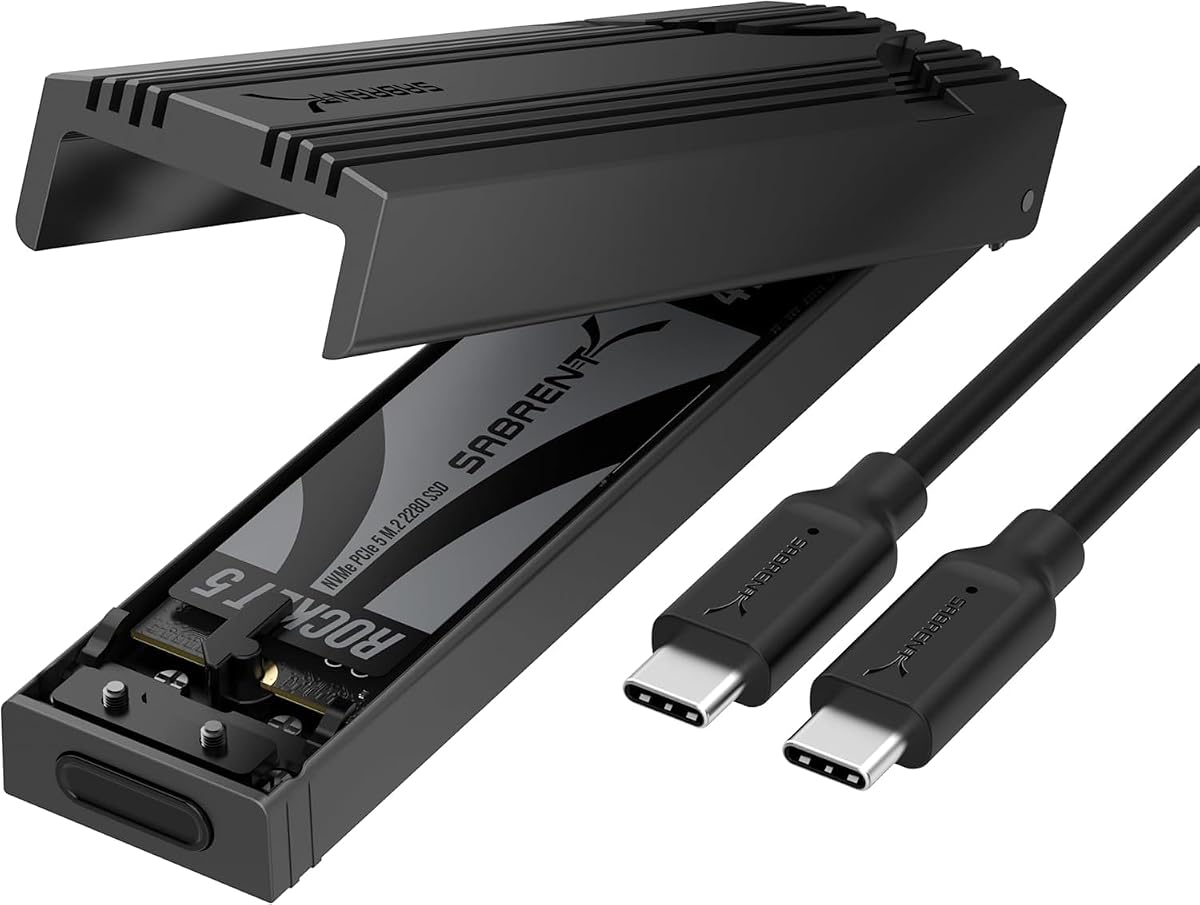
The SABRENT EC-PNVO is technically an enclosure rather than a conventional SD-card reader, but it earns inclusion because some PC users need direct access to a removable M.2 NVMe drive rather than removable flash memory cards. Its 4.5 rating reflects a capable, portable storage solution with USB-C connectivity and no need for external power. It is particularly relevant to photographers, editors, technicians, and gamers who already own compatible NVMe SSDs.
We may earn a commission when you buy through this link, at no additional cost to you.
The flip-open, tool-free design makes installation refreshingly uncomplicated. Open the cover, insert an M.2 drive, lock it into place, and close the enclosure. The aluminum construction and direct thermal-pad contact are intended to dissipate heat effectively, supporting more stable 10Gbps performance during extended transfers or demanding workloads. Support for 2230, 2242, 2260, and 2280 sizes broadens the pool of compatible drives.
Compatibility boundaries are important. This enclosure handles M.2 PCIe NVMe SSDs and does not support M.2 SATA drives. It also lacks SD, microSD, CF, or Memory Stick slots. Although the product works with laptops, desktops, gaming handhelds, and other USB-C devices, it should be selected as an NVMe access solution, not misrepresented as a universal memory-card adapter.
This is the premium pick for users who want a fast, durable way to put an existing NVMe SSD in their pocket and connect it directly to a PC. It is less suitable for someone whose primary goal is importing camera cards. For that need, a dedicated multi-card reader with explicit format and simultaneous-read support remains the more logical purchase.
The 10Gbps interface gives compatible NVMe SSDs a practical path to fast file access without installing them permanently inside a desktop or laptop. It is especially useful for recovery, cloning, troubleshooting, and transporting working files.
Opening the enclosure requires no screws, while the reinforced frame and aluminum top protect the installed drive. A thermal pad pressed against the SSD supports steadier performance during sustained transfers.
We may earn a commission when you buy through this link, at no additional cost to you.
This 7-in-1 multi-card reader is designed for users who need access to more removable formats than a conventional two-slot reader can offer. Its 4.5 rating is backed by a generous selection of slots: CF, two SD positions, TF, microSD, XD, and MS. The most useful feature is the stated ability to read and write five different cards at the same time, reducing repeated swapping during large import or backup sessions.
We may earn a commission when you buy through this link, at no additional cost to you.
Its integrated USB-C and USB 3.0 connectors provide more flexibility than a reader relying on one interface and a separate adapter. The stated 5Gbps transfer rate supports modern media workflows, and backward compatibility with USB 2.0 and 1.1 ports extends its usefulness. It also works with macOS, Android, Linux, Chrome OS, and a broad list of Windows versions without requiring extra drivers.
The card support is extensive rather than universal. Listed formats include CF, high-speed CF using UDMA, SD, SDXC up to 2TB, SDHC, microSD, microSDXC, microSDHC, TF, MS, and XD. The duplicated SD and microSD positions allow different card families to be connected concurrently, but users should still check the exact form factor and capacity of their cards before relying on a particular slot.
This reader is an excellent choice for a multi-device creative workstation that still handles older media. If you routinely work with several card types, appreciate simultaneous transfers, and want one adapter to cover cameras, older devices, and modern USB-C systems, it is hard to dismiss. For a smaller, simpler setup using only SD and microSD, a more compact dual-interface reader will usually be more convenient.
The seven positions accommodate both modern SD-family media and older formats such as XD and MS. This makes the adapter useful for mixed archives, inherited camera footage, and professional workflows that do not rely on one standardized card.
The ability to read and write five cards concurrently is the standout feature. A photographer can ingest footage from several cameras or copy media from multiple card families without constantly removing and replacing each device.
We may earn a commission when you buy through this link, at no additional cost to you.
The 4-in-1 USB-C reader focuses on moving media between removable cards and modern devices, including PCs, Macs, tablets, and compatible phones. It carries a 4.5 rating and combines a direct USB-C connector with a detachable USB-C-to-USB adapter. That arrangement is particularly useful for a user who alternates between a current USB-C computer and an older USB-A port.
We may earn a commission when you buy through this link, at no additional cost to you.
The card slots support SD, TF, microSD, and MS-family media, including several SD and microSD capacity standards, CF, Memory Stick Pro Duo, and RS MMC. Wi-Fi-enabled SD cards are explicitly excluded, which is an important distinction because their network features require compatible card-reader hardware and software. The reader handles common JPEG and RAW images as well as SD and HD video formats including H.264 and MPEG-4.
Its plug-and-play approach requires no additional drivers, software, or network connection. The product is marketed broadly around OTG compatibility with iPhone 16 and 15 families, iPad Pro models, Macs, Android devices, and PCs. That makes it a flexible choice for sharing, but actual phone support depends on the device's USB-C or OTG behavior, so the current device requirements should be checked.
This is a practical pick when your priority is direct access from a USB-C device rather than maximum read speed or internal PC installation. The included adapter preserves usability with USB-A computers, while the four slots cover most everyday media workflows. Photographers working only with SD and microSD may prefer a smaller dedicated reader, but users carrying mixed card formats will appreciate the broader design.
The detachable adapter removes the need to carry a separate cable for older PCs. Newer systems can use the direct USB-C plug, making the reader useful for shared workflows across several generations of equipment.
Plug-and-play OTG operation allows compatible phones and tablets to access photos and videos directly. No network setup or dedicated desktop application is required for the stated transfer workflow.
We may earn a commission when you buy through this link, at no additional cost to you.
The BENFEI 4-in-1 combines SD, microSD, Memory Stick, and CompactFlash support with an integrated USB-C and USB 3.0 design. Its 4.5 rating makes it a strong all-around option for PC users who want more than a basic SD adapter without moving to a large seven-slot hub. A particularly useful feature is the ability to read and write four cards at the same time.
We may earn a commission when you buy through this link, at no additional cost to you.
Transfer performance is specified for UHS-I mode at up to 160MB per second when connected through USB Type-C or USB 3.0. The result also depends on the memory card and host port, which is an important distinction from readers advertising theoretical interface bandwidth. Backward compatibility with USB 2.0 and 1.1 allows continued use with slower systems.
The supported card set is extensive but has notable exceptions. Standard Memory Stick, Memory Stick Micro M2, and CF Type I are incompatible with the reader. Larger SDXC cards at 64GB or more use exFAT, which is unsupported by Windows XP, Windows Vista before SP1, and Mac OS X versions before 10.6.6. Legacy computer users should check those operating-system limitations before buying.
The BENFEI is well suited to a modern laptop or desktop that has both USB-C and USB-A, especially for users who copy media from several devices in one session. Its combination of simultaneous operation, broad compatibility, and an 18-month stated warranty makes it a confident general recommendation. It is less appropriate for collectors who need the uncommon card formats excluded by the design.
Concurrent reading and writing reduces card swapping during imports, backups, and multi-camera transfers. This makes the reader more useful for active creative work than a single-card adapter.
The stated UHS-I performance is meaningful for photos and ordinary video files. Actual results still depend on card capability, USB port generation, computer storage, and the size and number of files being transferred.
We may earn a commission when you buy through this link, at no additional cost to you.
The UGREEN reader is a streamlined choice for photographers and PC users who primarily work with SD and microSD cards. Its 4.6 rating, slim design, and dual-interface construction make it especially convenient for daily travel. It connects through USB-C or USB-A, accepts SD and microSD simultaneously, and supports many of the card capacities encountered in cameras, action cameras, dash cams, and surveillance systems.
We may earn a commission when you buy through this link, at no additional cost to you.
The stated SuperSpeed USB 3.0 interface reaches up to 5Gbps, allowing large photo collections and video files to move efficiently when the card and host port can sustain that rate. The reader is also compatible with USB 2.0 systems, so it can travel between current and older computers without relying on a separate adapter. Its stated operating-system coverage includes Windows, macOS, and most Android devices.
The trade-off is format focus. This model does not advertise CF or Memory Stick support, which makes it less versatile than the SmartQ, BENFEI, or seven-slot reader. It also does not promise the newest high-end card performance; the card itself remains the limiting factor. For users who only handle SD and microSD, however, the simpler design avoids unused slots and unnecessary complexity.
The UGREEN is an excellent recommendation for someone who wants an uncomplicated reader for a camera bag or laptop sleeve. It offers enough speed for everyday media transfer, allows two cards to work together, and works with both USB-C and USB-A PCs. Choose it when portability and clean design matter more than support for rare or legacy card formats.
The slim, lightweight enclosure is intended to fit easily into a camera bag or laptop sleeve. Its two interfaces mean the same device can suit modern USB-C computers and conventional USB-A ports.
SD and microSD cards can be read at the same time, helping users avoid repeated reconnects. That convenience is valuable when consolidating footage from multiple devices or maintaining separate media sets.
We may earn a commission when you buy through this link, at no additional cost to you.
The GRAUGEAR front-panel hub is a fundamentally different option from a portable reader. Instead of connecting through a USB cable, it installs in a desktop PC's standard 5.25-inch drive bay. Its 4.3 rating reflects a specialized solution that combines front-access card reading, USB expansion, and dedicated SATA storage mounting in one internal assembly.
We may earn a commission when you buy through this link, at no additional cost to you.
The built-in SD and microSD slots use UHS-I and place removable-media access directly at the front of the computer. The hub also includes a 20Gbps USB-C port, USB-A connectivity, and internal headers for USB 3.2 Gen2x2 Type-E, USB 3.0 19-pin, and SATA power. Two tool-free 2.5-inch bays can hold compatible 7mm or 9.5mm SATA SSDs and hard drives.
This installation requirement is the decisive consideration. It is designed for compatible Windows desktop systems and most cases with an available 5.25-inch bay, rather than laptops or a simple USB connection. A buyer should verify case clearance, motherboard header availability, SATA power connections, and whether the included front USB-C port matches the desired internal header before purchasing.
For a builder who wants media access and extra drive capacity without external adapters spread across the desk, the GRAUGEAR is highly appealing. It is particularly useful for a photo-editing or backup workstation where card import and hot-swappable storage are regular tasks. Users wanting a portable reader should choose an external model, while desktop builders gain an unusually integrated solution here.
Built-in card slots remove the need to reach around the rear of a desktop for every import. The result is a more accessible workflow for photographers, editors, and users who routinely back up removable media.
Internal USB headers, a high-bandwidth front USB-C port, and dual 2.5-inch SATA bays extend the device's value. It can serve as a central expansion point for both media access and internal storage.
We may earn a commission when you buy through this link, at no additional cost to you.
The Lexar dual-slot reader is built around faster card access, with read speeds stated up to 312MB per second. Its 4.5 rating makes it an attractive option for PC users who regularly work with demanding SD or microSD media and want to minimize waiting during imports. The reader uses USB 3.2 Gen1 Type-C and supports backwards compatibility with USB 2.0 ports.
We may earn a commission when you buy through this link, at no additional cost to you.
Both SD and microSD slots are present, allowing two compatible cards to be handled at once. Performance for UHS-I cards is listed at up to 170MB per second, providing useful context for what the adapter can achieve with common cards. An activity LED gives immediate visual confirmation that the reader is powered and working, while the two-year limited warranty adds reassurance.
Its scope is narrower than readers with CF or Memory Stick slots. The faster headline figure also should not be interpreted as a guarantee for every card, since the card's rating, host connection, file size, and computer storage all affect results. Connecting it to a USB 2.0 port will significantly limit performance even though the device remains usable.
This Lexar model suits a modern workstation or laptop with USB-C where rapid imports are important and SD-family media dominate the workflow. It is less suitable for a photographer who still relies heavily on CompactFlash or older Memory Stick formats. For those users, a broader multi-format reader is the better choice, but for fast SD and microSD handling this model stands out.
The stated 312MB per second read rate is designed for modern, high-performance cards. It is particularly relevant when importing large video batches or maintaining a large working collection on a desktop.
The LED provides a quick visual indicator of reader activity. Separate SD and microSD slots also support efficient use of two cards without choosing between formats.
We may earn a commission when you buy through this link, at no additional cost to you.
The Insta360 Quick Reader is a 512GB portable SSD designed to move footage between compatible action cameras, phones, and PCs. It does not read SD or microSD cards, so it is not a conventional card reader. Its 4.2 rating and creator-specific accessories nevertheless make it worth considering for the narrow but valuable goal of offloading Insta360 camera footage rapidly.
We may earn a commission when you buy through this link, at no additional cost to you.
Its stated read and write performance reaches 420MB per second, which can shorten the time needed to transfer substantial video files. The USB-C connection supports direct access from compatible iOS and Android devices, and no separate power or wireless connection is required. At 5.4 grams, the device is small enough to remain attached to a camera setup or fit into a nearly empty pocket.
The important distinction is that the storage is built in rather than supplied through memory-card slots. The included covers for Insta360 X5, X4 Air, and Ace Pro 2 models and the USB-C spacer indicate a tightly integrated camera workflow. PC users can still use the reader as portable external storage, but someone whose main goal is importing a general SD card will need a separate reader.
This product is best for an Insta360 creator who wants a lightweight, high-speed offload device with substantial capacity. It is less compelling for general PC expansion or camera-card compatibility because those functions are not its focus. Consider it alongside the Sabrent enclosure: the Insta360 model offers integrated storage and mobile convenience, while the Sabrent gives PC-focused users direct access to their own removable M.2 NVMe drive.
The 420MB per second read and write capability is designed to reduce pauses between recording and transferring. Integrated storage avoids the need to swap tiny cards repeatedly in a field environment.
A weight of only 5.4 grams and a coin-like footprint reduce the burden of carrying extra media. USB-C connectivity allows compatible phones and computers to use the same drive.
We may earn a commission when you buy through this link, at no additional cost to you.
The Lexar dual-slot reader combines a 4.6 rating with a practical mix of speed, portability, and connector flexibility. It supports SD and microSD cards, with performance stated up to 205MB per second, and includes USB-A and USB-C connectivity. The result is a straightforward reader suited to PCs that may have either connector type.
We may earn a commission when you buy through this link, at no additional cost to you.
Both card slots can operate at the same time, allowing an SD card and a microSD card to transfer together. Plug-and-play design means no extra drivers are required, and compatibility with USB 3.1 and 2.0 ports lets the reader work across newer and older systems. Its compact form also makes it easier to carry than a larger multi-format hub.
The reader does not support CF or Memory Stick media, so it is less comprehensive than several alternatives in this guide. The 205MB per second figure is a maximum capability rather than a guaranteed rate for every card. A lower-rated card, USB 2.0 connection, small files, or a slower target drive will all affect the result.
For a user who works primarily with SD and microSD, this Lexar offers an attractive balance of speed, compactness, and broad PC compatibility. It is especially useful when you want one reader for a USB-C laptop and a USB-A desktop. Users needing rare legacy formats can look to the larger SmartQ or BENFEI, while those prioritizing the newest card standards may prefer a higher-end dedicated reader.
Separate USB-A and USB-C connectors remove the need to carry an adapter for most modern and older PCs. That makes the reader especially convenient for a mixed desktop and laptop setup.
SD and microSD cards can work together, shortening the time needed to consolidate separate media sources. The stated performance also supports faster workflows when used with compatible cards and ports.
We may earn a commission when you buy through this link, at no additional cost to you.
The right choice depends on the cards you already own, the ports available on your computer, the volume of data you move, and whether portability or permanent installation matters most. These factors help narrow a large range of readers and storage adapters to the option that fits your actual workflow.
Start with the physical format and capacity of the cards you need to access. SD and microSD are the most common modern choices, but photographers may also use CompactFlash, older cameras may use Memory Stick, and some specialist devices use XD or other formats. A reader with more slots is not automatically better, yet a reader missing your primary format cannot perform the required import. Check both the card family and any important capacity or generation distinctions.
Choose a reader that explicitly supports the formats in your regular rotation rather than one that merely looks universal.
Your PC's available ports determine how the reader will connect. USB-C is common on current laptops and desktops, while USB-A remains useful with older systems and many desktop peripherals. Some readers integrate both connectors, while others use one fixed connector and include a detachable adapter. A reader with native USB-C is convenient, but it may be less useful if your working computer exposes only a full-size USB port.
Prioritize a reader that connects directly to the ports you use most often without requiring a separate adapter.
A headline interface rate does not guarantee the same result for every file. The memory card's rating, the reader's controller, the host port, computer storage, file size, and operating-system overhead can all limit performance. For example, a 5Gbps interface can be advertised by a reader that operates at up to 160MB per second with a specific UHS-I card, while higher-end SD and microSD media may support greater throughput. Compare claims carefully and distinguish interface bandwidth from actual media speed.
Buy for the speed of the cards you own rather than selecting a reader solely by its largest stated number.
Readers with two or more slots may allow multiple cards to be recognized at once, which can streamline imports from several cameras. This feature is especially valuable for working photographers, drone operators, and editors who frequently consolidate media. A single-card reader may be simpler and more compact, but it requires more repeated plugging and unplugging. Confirm simultaneous reading and writing where both are important rather than assuming every multi-slot device handles multiple tasks concurrently.
Choose dual or multi-card operation when time saved during imports outweigh the need for the smallest possible reader.
Most modern readers are plug-and-play and compatible with Windows or macOS, but broad operating-system support does not guarantee universal file-format support. Large SDXC cards often rely on exFAT, which older versions of Windows and macOS cannot use. Phone and tablet access may also require OTG behavior or a compatible USB-C port. Reviewing the reader's operating-system and file-system notes can prevent a frustrating discovery after the purchase.
Confirm both operating-system version and card capacity requirements before committing to a model.
A portable reader should be small, light, easy to store, and connected by either an integrated interface or a short cable. The UGREEN, SmartQ, and Lexar dual-slot options emphasize this kind of daily convenience. An internal desktop card reader offers permanent front access and can reduce cable clutter, but it requires compatible case space, internal headers, and installation. Portable and internal designs solve different problems and should not be judged by the same convenience criteria.
Choose a portable model for travel and temporary backups, or an internal model for a dedicated workstation.
Some products marketed for SSD access read removable M.2 NVMe drives rather than memory cards. A portable NVMe enclosure can be excellent for accessing an existing internal drive, cloning, troubleshooting, or transporting files, but it will not import an SD card. Other modern options integrate flash storage directly and are optimized for particular camera workflows. These products solve valuable problems, yet they should be chosen only when their storage architecture matches your need.
Verify that the product actually reads the exact media type you plan to use before focusing on transfer speed.
For frequent travel, a compact housing, reinforced frame, and stable card insertion are useful. For an internal enclosure, cooling matters during sustained transfers; direct thermal-pad contact can help maintain stable performance. Activity LEDs provide basic confirmation that a reader is powered, while a stated warranty can add confidence for long-term use. These features should complement the core decision about card formats and connectors rather than replace it.
Prioritize durability, thermal management, and warranty terms after confirming basic compatibility.
Begin by checking the card format, capacity, and file system against the reader's specifications. Insert the card into the appropriate slot with the device powered off, then connect the reader directly to a USB port on the PC. Avoid hubs during the first transfer if possible, because extra connections can reduce stability or speed. Let the operating system detect the reader before opening its files, and always use the system's safe eject command before removing the device.
Before copying important media, create a backup on the computer or another drive. If you plan to edit files directly from the card, keep the reader connected and avoid forcing removal during an active transfer. For the best results, match the card's rated generation to the reader and the host port. High-speed SD and microSD cards are more likely to deliver strong performance on a modern USB 3.x connection, while older USB 2.0 ports remain functional but substantially slower.
Protect the reader by keeping it dry, away from extreme heat, and clear of strong impacts. Do not move a connected internal SSD while it is operating, and ensure that a portable NVMe drive has adequate cooling during long transfers. Clean exposed connectors gently with a dry, lint-free method, and store cards in protective cases. Periodically verify that copied files open correctly, particularly after using the reader in a new computer or operating system.
A conventional SD card reader accepts removable flash-memory cards such as SD and microSD. An SSD reader or enclosure is designed for solid-state storage, often an M.2 NVMe drive, although some creator-oriented products use built-in portable SSD storage. The terminology can be confusing, so confirm whether the product reads memory cards or SSDs before purchasing.
It depends on the ports available on your computer. A USB-C reader is convenient for current laptops and many desktops, while USB-A remains common on older systems. Readers with both interfaces can serve multiple computers. If your PC only has USB-A, choose a USB-A reader or a USB-C model supplied with a suitable adapter.
Most dedicated readers support both formats, usually through separate slots. Many can also handle SD and microSD cards simultaneously. Compatibility still depends on card capacity, generation, and physical format, so verify those details before importing an older or high-capacity card.
The slowest part of the connection usually determines the result. That may be the memory card, the reader's controller, a USB 2.0 port, small individual files, or the computer's storage. Advertised figures often represent theoretical interface or maximum media performance, so compare the card and reader specifications together.
Many USB-C readers support compatible phones and tablets through OTG, but support varies by model and operating system. Check the product's device list and your phone's USB-C or OTG requirements. Some cards, particularly Wi-Fi-enabled SD cards, may also require dedicated hardware and software that a basic reader does not provide.
Most readers in this guide are designed for plug-and-play operation and work with standard operating-system drivers. Older Windows versions and less common card formats can introduce exceptions, while a few specialized products may require separate software. Reading the compatibility notes before buying is the safest approach.
Most current USB 3.x readers can connect to USB 2.0 ports, and the products here generally provide backward compatibility. The reader will remain usable, but transfer speeds will be limited by the slower port and may also depend on whether the memory card itself supports that older standard.
An external reader is more portable and works with laptops, desktops, and sometimes mobile devices. An internal reader provides permanent front-panel access but requires a compatible desktop case, motherboard headers, and SATA power. Choose external for travel and flexible use, or internal for a dedicated workstation where convenient permanent access matters most.
The UGREEN USB-C reader stands out as the most practical daily choice because it combines a 4.6 rating, dual USB-C and USB-A connectivity, 5Gbps interface capability, and simultaneous SD and microSD operation in a portable design. The SmartQ C368 is a balanced alternative for people who also need Memory Stick or CompactFlash, while the SABRENT EC-PNVO serves a different premium need by providing fast, tool-free access to removable M.2 NVMe storage.
Prioritize the formats you already use, then confirm connector compatibility and realistic transfer performance. A broad multi-slot reader is worthwhile for mixed media, a dual-slot model is cleaner for SD-focused work, and an internal hub makes sense for a compatible desktop that benefits from permanent front access. Creators needing integrated mobile storage should also examine the Insta360 Quick Reader despite it not being a conventional removable-card adapter.
Always recheck current product specifications, computer ports, operating-system requirements, and pricing immediately before buying. Storage compatibility and performance depend on both the reader and the cards connected to it, so a quick final comparison can prevent unnecessary returns and ensure a smoother transfer workflow.
