Eldercozy Twin Size Wireless Bed Alarm
4.8Editor score
Waterproof soft TPU pad
Four customizable alert modes
Replaceable battery system
A bed alarm for elderly and dementia patients can provide caregivers with timely notice when someone leaves bed, approaches the floor, or begins wandering. The right device balances early detection with comfort, quiet operation, dependable wireless communication, and simple everyday setup.
We compared all ten options by examining the sensing method, notification options, wireless range, caregiver controls, placement requirements, material, power source, and suitability for nighttime monitoring. The guide covers pressure-sensitive pads, under-bed motion sensors, and floor mats designed for fall-risk and wandering situations.
Each pick highlights a different practical advantage, including budget monitoring, discreet paging, broad household coverage, and systems that can support multiple care areas. Ratings and product details reflect the supplied listings, while current prices and availability can change at any time.
4.8Editor score
4.7Editor score

4.5Editor score
As an Amazon Associate we earn from qualifying purchases.
The comparison below organizes all ten systems by sensing method, alert delivery, coverage, and installation style, helping readers identify the option that best matches a bedroom, nighttime routine, or broader wandering-risk plan.



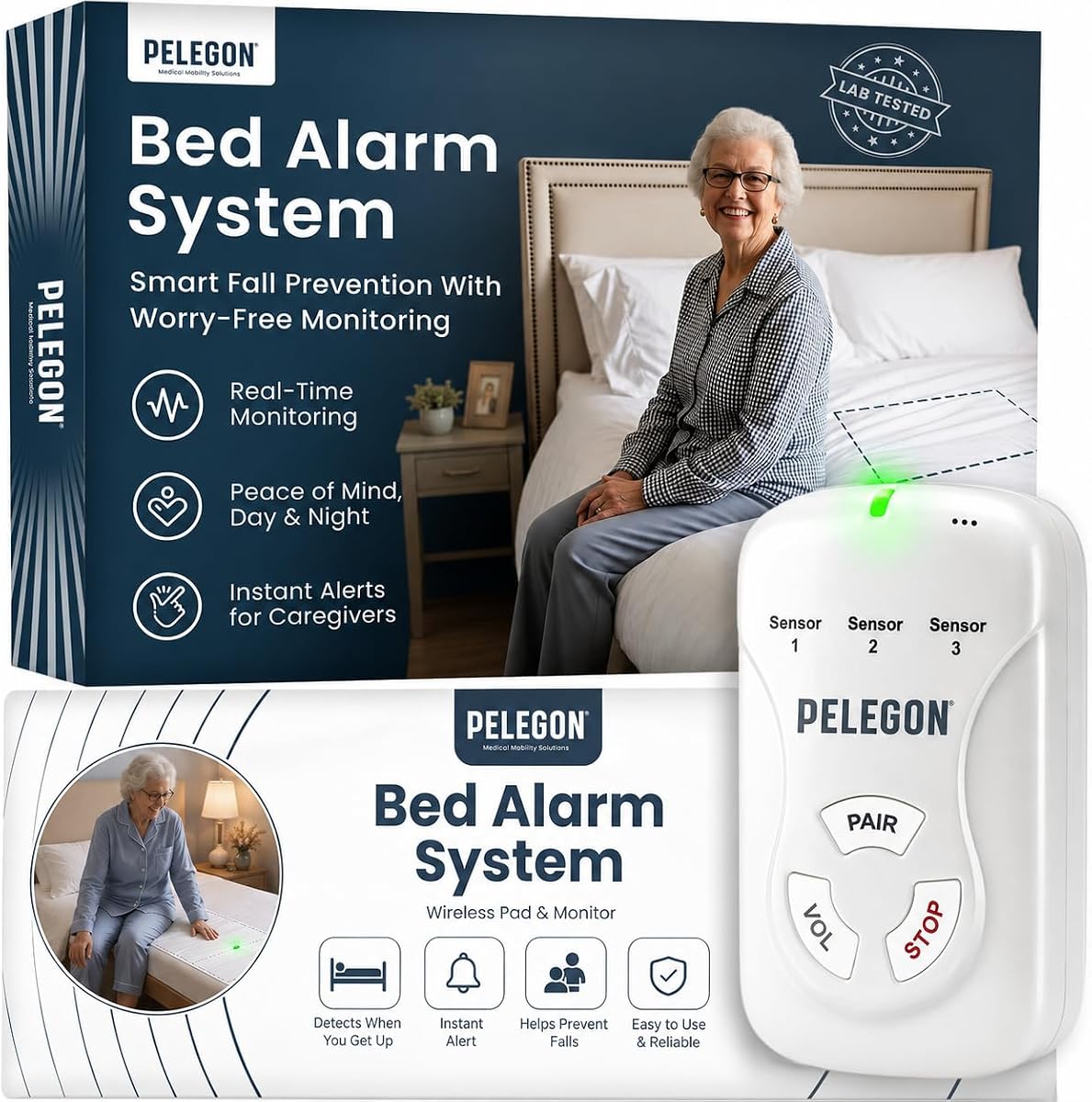
The PELEGON bed alarm is a wireless sensor-pad and pager system designed to notify a caregiver when a loved one begins to rise. It holds a 4.7 rating, placing it near the top of this guide while offering a balanced combination of early notification, long-range coverage, and straightforward installation. The included pager can be carried in a pocket or clipped to a caregiver's belt, allowing the caregiver to continue other tasks while remaining reachable.
We may earn a commission when you buy through this link, at no additional cost to you.
Its strongest feature is the ability to select among alert styles. Caregivers can use an audible sound, adjust the volume, or choose vibration-only operation when a loud alert could disturb the patient or another sleeper. The listed wireless range of 328 feet makes the system suitable for monitoring across a home, although walls, floors, and other obstructions can affect real-world reception. Placing the sensor pad under the sheet keeps the hardware largely out of sight, supporting a less intrusive caregiving environment.
The trade-off is that a pressure pad must be positioned where it can detect meaningful movement, and the exact level of sensitivity may not match every patient or sleep pattern. Users should test the setup before relying on it during unattended nighttime periods. Wireless paging also depends on functioning batteries in both components. Even so, the PELEGON system avoids complicated installation and gives caregivers several practical notification choices without requiring an app or network connection.
This is a strong choice for families seeking a comprehensive, portable alert with a balance of range, discretion, and ease of setup. It is particularly useful when a caregiver can respond after receiving a pager signal but does not want to remain beside the bed continuously. For the most broadly balanced option in this comparison, the PELEGON system is the recommendation to prioritize first.
The vibration-only setting is valuable in shared rooms or during quiet nighttime monitoring because it communicates with the caregiver without creating a loud sound beside the patient. Sound alerts remain available when a more noticeable prompt is needed.
The sensor pad is placed under the sheet, allowing the system to monitor movement without requiring a device attached directly to the patient's body. Tool-free setup also makes repositioning the alarm simpler as care routines change.
We may earn a commission when you buy through this link, at no additional cost to you.
The Smart Caregiver Bed Alarm uses a pressure-sensitive pad to notify a caregiver when a patient leaves the bed. Its 4.2 rating reflects a straightforward monitoring solution with two volume levels, a front reset button, and status indicators. The alarm unit can be mounted on the bed, a wall, or another nearby surface, making it adaptable to different bedroom layouts and caregiver workflows.
We may earn a commission when you buy through this link, at no additional cost to you.
The ten-by-thirty-inch soft vinyl sensor pad includes a foam interior and is sealed for incontinence protection. It can be placed under the lower fitted sheet, with the supplied data recommending placement around the shoulder blades or hips. The cord connects the pad to the monitor, allowing the alerting unit to remain where it is easiest for a caregiver to hear or reach. A reset button on the front silences the alert after a caregiver has responded.
The main limitation is that the standard system is designed around an in-room audible alarm. That may be sufficient for a caregiver working in the same room, but it may be less useful for someone who wants to move around the home. An optional wireless add-on kit can send alerts to a caregiver, though that kit is sold separately. The monitor also works with one included 9-volt battery or the AC-02 adapter, which is not included.
This product suits caregivers who value a familiar wired pad, straightforward local control, and an easy-to-clean sensor. It is less suitable for households wanting a complete wireless package from the outset. For those who need mobility without a separate purchase, one of the bundled wireless systems may offer a more convenient starting point.
The direct pad-to-monitor connection makes operation easy to understand and provides a clear option for caregivers who prefer not to manage paired wireless components. The monitor can then be positioned wherever it is most accessible.
The sealed vinyl pad is designed for routine cleaning with a wet cloth, which is useful in caregiving environments where spills and incontinence are concerns. Its low-profile placement under the sheet keeps it out of the patient's immediate view.
We may earn a commission when you buy through this link, at no additional cost to you.
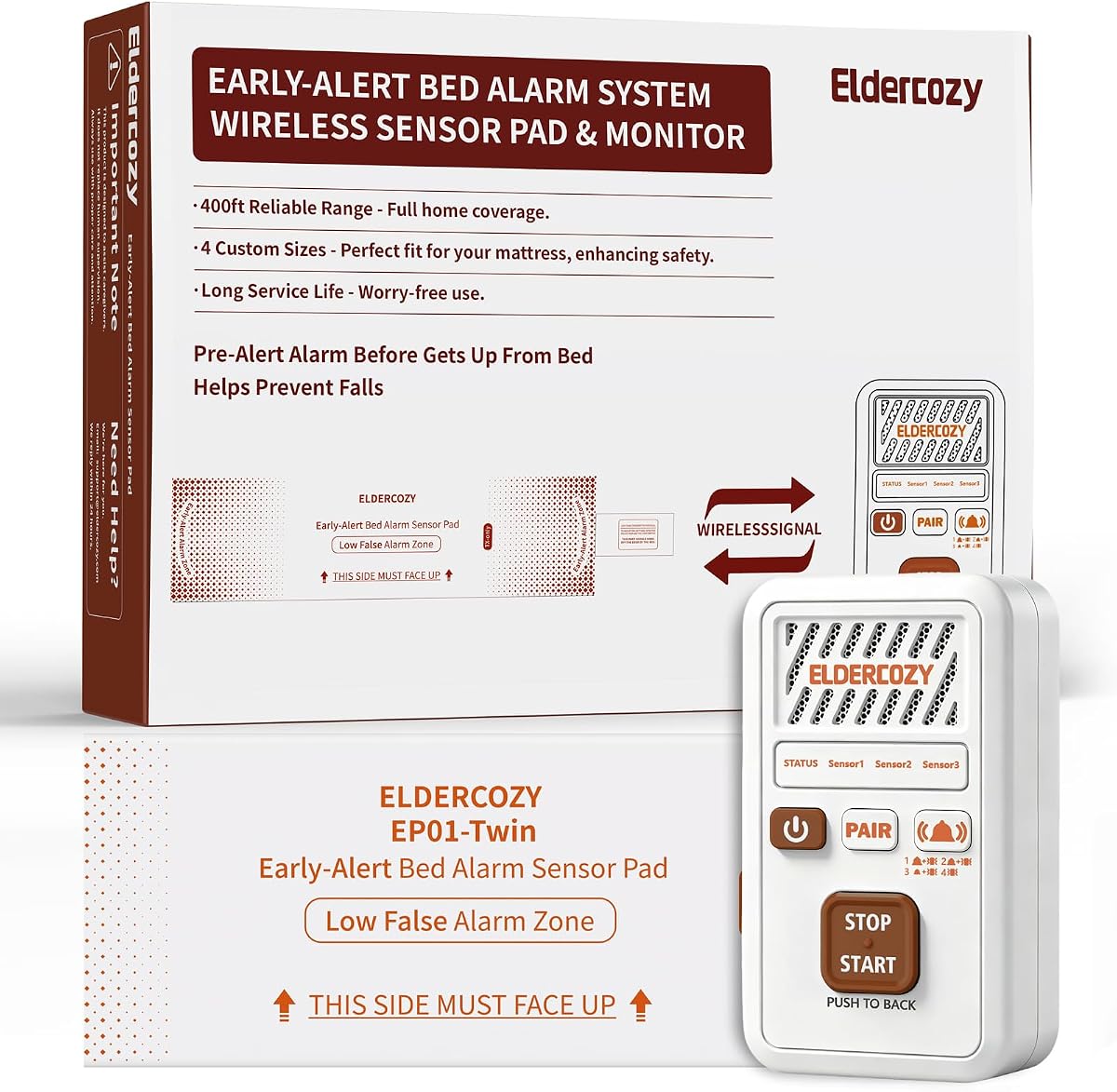
The Eldercozy Twin Size Wireless Bed Alarm is a feature-rich early-alert system with a 4.8 rating, the highest among the products reviewed. It combines a soft TPU sensor pad, a wireless pager with a listed range of 400 feet, replaceable batteries, and a caregiver mode designed for nighttime assistance. The pad is also described as waterproof and easy to wipe clean, addressing two common concerns in home-care environments.
We may earn a commission when you buy through this link, at no additional cost to you.
Unlike a traditional pad positioned beneath the shoulders, this system is designed around hip-level detection to identify when a patient sits at the edge of the bed. The listing emphasizes this approach as a way to provide an earlier warning before standing. Caregiver mode temporarily pauses the exit alarm for 20 minutes when direct assistance is needed, helping prevent an avoidable alert while the caregiver resets the situation.
The pager supports four alert modes, including adjustable volume and vibration-only operation. A receiver can connect with up to three transmitters, expanding monitoring beyond one bed without requiring separate pagers for each location. Replaceable 1.5-volt AAA batteries in both transmitter and receiver avoid dependence on disposable sensor components, while dim status lights help limit nighttime disruption. A 12-month warranty is also included.
This system is best for households that want a refined, comfortable pad and extensive caregiver controls in one package. The main consideration is choosing the appropriate mattress size, since the product is specifically offered in Twin, Full, Queen, and King configurations. It may also be more feature-rich than a simpler household needs. Even so, its strong rating, quiet materials, and thoughtfully designed night mode make it the most premium-oriented choice here.
The TPU composite is designed to remain quiet during movement and wipe clean easily. This makes the pad better suited to overnight monitoring than a noisy or easily soiled surface, particularly for people with incontinence concerns.
The pager's ability to connect with up to three transmitters allows a caregiver to monitor several sleep locations using one receiver. That scalability is useful in shared rooms, homes with multiple patients, or rooms containing more than one bed.
We may earn a commission when you buy through this link, at no additional cost to you.
The Upgraded Bed Sensor Alarm and Pager offers motion-based monitoring without requiring a pad beneath the patient. It has a 4.5 rating and can be installed on the floor under the bed to detect a foot approaching the ground. The same sensor can also be positioned near a doorway to monitor a patient leaving the room, giving the system broader fall-prevention and wandering applications.
We may earn a commission when you buy through this link, at no additional cost to you.
The listed open-area transmission range reaches 918 feet, which is the largest figure among the products in this guide. A caregiver pager receives the signal, while the system offers LED and sound reminders plus five volume levels. Both the sensor and receiver can use alkaline batteries or micro-USB power, reducing reliance on wall outlets. The package includes the pager, motion sensor, three AA batteries, three AAA batteries, a micro-USB cable, double-sided tape, a screw kit, and a manual.
Because the listed range applies to an open area, walls and household obstacles can reduce actual signal distance. The device also begins with a self-test in which the indicator light flashes for 20 seconds. The manufacturer advises testing sensing range and direction before fixing the unit in place. These are important setup steps rather than shortcomings, but they mean installation requires a few minutes of attention.
This is a compelling choice for caregivers who want wireless monitoring without a mattress pad or a device attached to the patient. It is especially useful where incontinence, restless sleep, or pad displacement could lead to unwanted alerts. The extensive listed range and multiple mounting options distinguish it from many compact systems, making it our best budget-oriented recommendation.
Placing the sensor under the bed allows it to detect a foot approaching the floor while avoiding pressure-pad alerts caused by turning, repositioning, or moisture. It also leaves the sleeping surface undisturbed.
Battery and micro-USB options make it easier to position the receiver where it is convenient. Included mounting hardware supports both adhesive and screw-based installation, depending on the location.
We may earn a commission when you buy through this link, at no additional cost to you.
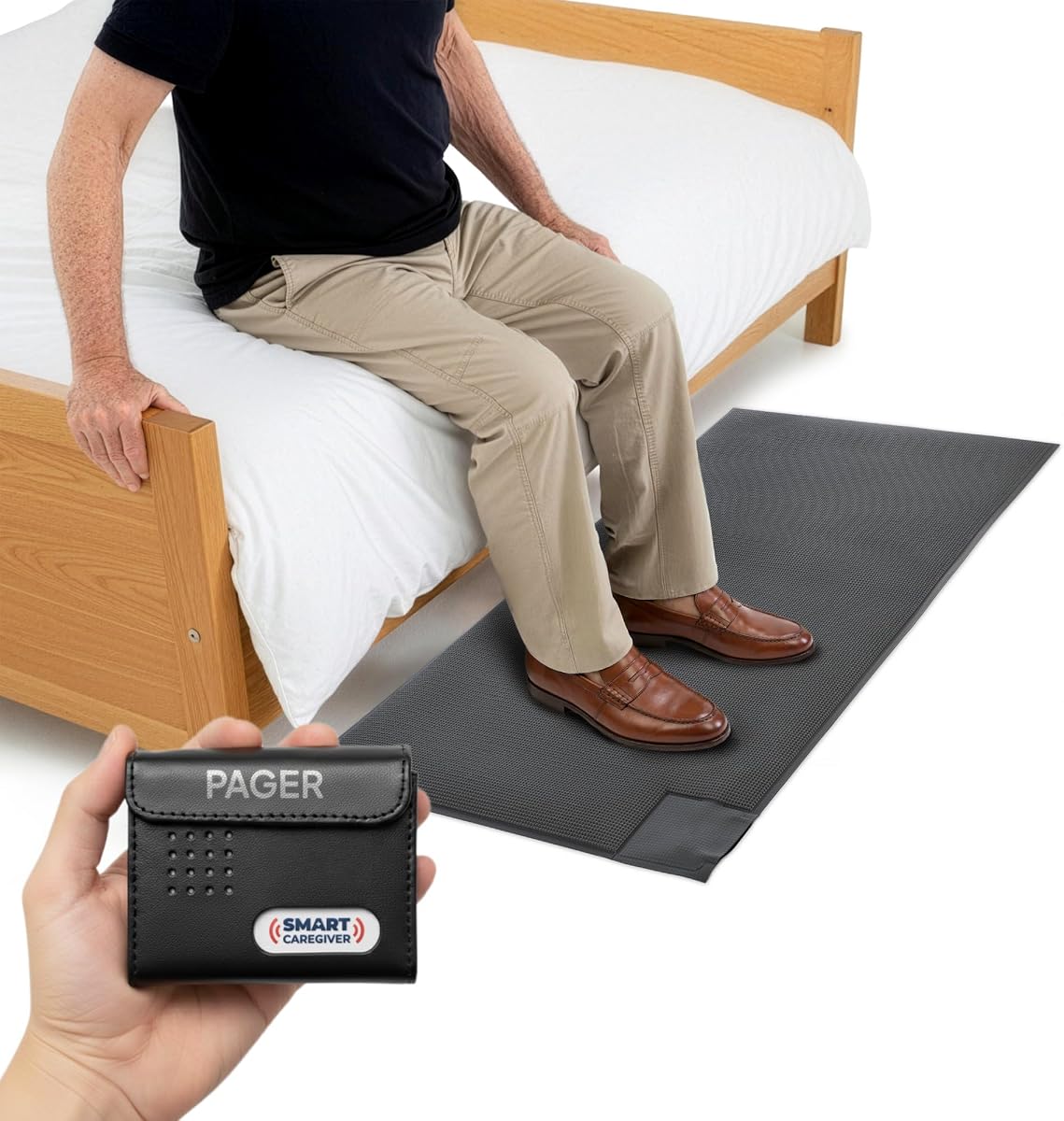
The Smart Caregiver Floor Mat Alarm uses a weight-sensing mat to notify a caregiver when someone steps onto it. With a 4.6 rating, it is one of the stronger choices for households that want to monitor a specific exit route rather than the entire bed. The mat measures 24 by 48 inches, giving it a broad detection area suitable for placement beside a bed or near an exit door.
We may earn a commission when you buy through this link, at no additional cost to you.
The included caregiver pager supports audible and vibration alerts, allowing the notification to be received without producing a loud alarm in the patient's room. Its listed wireless range is 300 feet, enough for monitoring within many homes. The pager can be carried or placed in a convenient location, and the system is designed to work with other Smart Caregiver monitors, call buttons, motion sensors, bed pads, and chair pads sold separately.
A floor-mat system depends on the person actually crossing the monitored area. Obstacles, alternative walking paths, or a doorway that does not match the mat's position can limit coverage. The pager also requires two AA batteries, which are not included. The mat itself can be difficult to place in a narrow bedroom or along a heavily traveled route, so its footprint should be considered before installation.
This product is ideal for a clearly defined wandering point, such as the threshold of a bedroom or the side of a bed. It also fits caregivers who want quiet paging rather than an alarm in the patient's room. Buyers should ensure the mat can be laid flat and that the person being monitored reliably crosses it. Those conditions make the system a strong targeted solution rather than a universal monitor.
A floor mat is especially useful where a doorway or bedside represents a predictable path. Caregivers can use the alert as one layer in a broader wandering-prevention plan involving supervision and other sensors.
Because the caregiver receives the alert through a separate pager, the patient does not hear a potentially startling alarm in the room. Vibration mode adds another discreet option for quiet environments.
We may earn a commission when you buy through this link, at no additional cost to you.
The Smart Caregiver Wireless Bed Alarm uses a ten-by-thirty-inch weight-sensing pad to alert a caregiver when a patient leaves the bed. Its 4.4 rating reflects a practical balance of wireless paging, large sensor coverage, and network expansion. The included pager offers both sound and vibration, so families can choose an audible reminder during active daytime care or a quieter signal at night.
We may earn a commission when you buy through this link, at no additional cost to you.
One of the system's most useful features is the pager's support for up to six different Smart Caregiver sensors. A single receiver can therefore be used with devices placed around beds, chairs, and doorways, creating a broader monitoring network without requiring the caregiver to carry several pagers. The large contact sensor is engineered to reduce false alerts, while the listing recommends placing the pad under the shoulders for notification as the patient begins getting up.
The listing does not provide a specific wireless range, so buyers should consider testing the system in the rooms where it will be used before depending on it for overnight monitoring. The pad itself must also be positioned carefully to balance early warning against unwanted alerts from ordinary repositioning. In addition, expanding the network beyond the bed requires compatible sensors, which are presented elsewhere in the Smart Caregiver product range.
This alarm is best for caregivers who want one pager to coordinate several monitoring points. It is less suitable for someone who needs a clearly stated maximum range or prefers a completely self-contained system for each bed. The sensor network and dual alert modes make it a strong middle-ground choice for homes managing more than one fall or wandering risk.
Supporting up to six sensors allows a caregiver to receive alerts from several beds, chairs, or doorways. This makes one receiver a central hub for a broader home-safety setup.
The pager can use an audible alert when a stronger prompt is appropriate or vibration when quiet monitoring is preferable. This flexibility helps the same system serve daytime and nighttime routines.
We may earn a commission when you buy through this link, at no additional cost to you.
The CallToU Portable Bed Alarm is a compact floor-sensor and receiver system designed to detect feet touching the ground as a patient begins to rise. It has a 4.1 rating and distinguishes itself through a portable Type-C charging receiver, numerous ringtones, and adjustable volume settings. The sensor is positioned beside the bed and can detect movement before the person is fully standing.
We may earn a commission when you buy through this link, at no additional cost to you.
Its documented detection range is three to 10 feet from the sensor, making careful placement important. The sensor supports 360-degree rotation, which can be used to direct the detection field and help avoid false triggers associated with minor movement, incontinence, or restless sleep. The receiver offers five volume levels and 18 ringtones, along with vibration-only and silent modes for different caregiving environments.
The compact format is a benefit, but the shorter listed detection range makes the system less forgiving than products advertising much broader transmission or sensing distances. Caregivers should test the sensor before relying on it and confirm that its position corresponds to the usual route from the bed. The infrared sensor uses three replaceable AAA batteries, which avoids disposable sealed transmitters, while the receiver's Type-C port simplifies charging.
This product is a good fit for homes that value portability, precise alert customization, and a relatively small floor sensor. It is especially appropriate where the patient exits from a predictable side of the bed. Buyers should not interpret the receiver's portability as unlimited monitoring distance; its usable performance depends on positioning the sensor within the stated three-to-ten-foot range.
Eighteen ringtones and five volume levels make it easier to select a signal that is noticeable to the caregiver without being unnecessarily loud. Silent and vibration modes support quiet monitoring when needed.
The lightweight receiver can move around the home, while the small sensor avoids adding bulk beneath the mattress. Rotating the sensor allows the caregiver to shape the useful detection area around the bed.
We may earn a commission when you buy through this link, at no additional cost to you.
The Professional Bed Motion Alarm is a wireless floor-sensor system designed to monitor when a patient's feet approach the floor or when someone passes through a doorway. It carries a 4.5 rating and shares several useful characteristics with the other upgraded motion-alarm option, including a listed 918-foot open-area range, battery or micro-USB power, and a portable caregiver receiver.
We may earn a commission when you buy through this link, at no additional cost to you.
The sensor and receiver arrive factory paired, reducing the setup process to inserting batteries in each component. A self-test begins when the sensor is turned on, with the indicator light flashing for 20 seconds before normal operation starts. The receiver provides four alert configurations: sound with flashing light, flashing light only, LED light, and a high-volume alarm. Continuous presses on the mode and volume buttons adjust the selected behavior.
The broad transmission specification is most relevant in open areas, and walls, doors, and floors can reduce actual coverage. The device is therefore best evaluated in the intended home or care setting. The visual-only options are useful when a loud sound would be inappropriate, although they still require the caregiver to notice the light. As with any motion-based system, placement and testing are essential to confirm that the expected movement falls within the sensor's field.
This is a good option for caregivers who want long-range wireless movement alerts and do not want a sensor pad under the patient. It also works as a doorway monitor for wandering concerns. The ready-paired components and dual power modes improve convenience, but users should treat the open-area range as an upper specification rather than a guaranteed indoor distance.
Factory pairing removes the need to manually match sensor and receiver. A short self-test then confirms that the components have entered their working state before the system is placed in service.
Sound, flashing-light, and LED modes cover different levels of attention and noise. The highest-volume setting is available when a caregiver needs a more prominent prompt, while visual modes can reduce disturbance.
We may earn a commission when you buy through this link, at no additional cost to you.
The Smart Caregiver Bed and Chair Alarm System includes both a ten-by-thirty-inch bed pad and a ten-by-fifteen-inch chair pad. Its 4.2 rating makes it a practical two-location package for caregivers monitoring someone who alternates between sleeping and sitting. The pressure-sensitive pads notify the caregiver when the person attempts to get out of bed or rise from a chair.
We may earn a commission when you buy through this link, at no additional cost to you.
The bed pad is placed on the mattress under the fitted sheet, and its cord runs along the mattress to a monitor that can be clipped to the headboard or set on a nearby table. The chair pad can be placed on a chair seat, while a phone-style clip makes it easier to move the monitor between locations. High and low volume controls sit inside the battery compartment, and the front reset button silences the monitor after a caregiver responds.
The pads are made of soft vinyl with foam interiors and are sealed for incontinence protection. Placement affects sensitivity: aligning the bed pad with the shoulder blades is recommended for earlier notification, while positioning it under the hips can reduce sensitivity for a restless sleeper. These options give caregivers useful control, although they may require testing. The corded monitor connection is another factor for buyers who want a completely untethered bedroom setup.
This kit is a good choice when one person uses both a bed and a chair and the caregiver does not want two separate monitors. It is less convenient if the bed and chair are monitored simultaneously, since an extra monitor is required for that arrangement. Overall, it offers a flexible, familiar system with clear placement guidance and responsive status lights.
Including both a bed and chair pad makes the kit useful across a full daily routine. The monitor can move between locations when only one area needs active supervision at a time.
The bed pad can be positioned under the shoulders for earlier warnings or under the hips for a restless sleeper who may generate more movement. Testing helps identify the best balance for the individual.
We may earn a commission when you buy through this link, at no additional cost to you.
The Bed Sensor Pad and Pager is a wireless pressure-monitoring system with a 3.7 rating. It uses a 32-by-13-inch sensor pad and a portable pager with a listed range of 300 feet. The system is marketed for home, hospital, nursing-home, and rehabilitation settings, giving it a broader stated range of intended environments than many bedside-only products.
We may earn a commission when you buy through this link, at no additional cost to you.
The pad monitors patient movement and triggers an alert when the person attempts to leave the bed. Its material is described as latex-free, tear-resistant, and water-resistant, while the easy-clean surface is intended to support routine caregiving hygiene. Secure clips attach the pad under a fitted sheet, and the wireless pager lets a caregiver move around the care environment while remaining reachable.
The pager includes adjustable volume, music, and vibration modes, allowing the caregiver to select the notification that best fits the setting. The main drawback is that the product has the lowest customer rating in this comparison, making it important to consider recent customer feedback and the exact care scenario before choosing it. The supplied details also provide less information about trigger timing and false-alert controls than some competing systems.
This product may appeal to buyers seeking a large, portable pad and a broad selection of alert sounds in a wireless format. It is best for a caregiver who values easy cleaning and mobility more than extensive multi-device expansion. Because it has the lowest listed rating here, it should be compared carefully with the higher-rated wireless and motion-sensor alternatives before making a final decision.
The 32-by-13-inch pad provides a larger sensing surface than the ten-by-thirty-inch pads included with several other systems. Its size may be useful for positioning across a wider portion of the sleeping area.
The wireless pager can be carried between rooms, and the stated use across homes, hospitals, nursing homes, and rehabilitation centers gives the system broad practical relevance. Alert modes help adapt it to different environments.
We may earn a commission when you buy through this link, at no additional cost to you.
The most useful alarm is one that detects the relevant movement, reaches the caregiver reliably, remains comfortable during sleep, and fits the home without creating unnecessary disruption. These factors determine which sensing method and feature set deserve priority for the individual care situation.
Pressure-sensitive pads detect a change in weight and may provide an early warning as someone shifts toward the edge of the bed. Under-bed motion sensors focus on feet approaching the floor and avoid attaching a sensor to the patient, while floor mats identify a person crossing a defined location. Each approach has different blind spots, so the patient's normal movement and exit route matter more than a general claim of early detection.
A useful alarm should notify the caregiver early enough to intervene but should not repeatedly trigger from ordinary turning, repositioning, or restless sleep. Look for placement guidance, adjustable sensitivity options, caregiver pause functions, or design features intended to reduce false alerts. Even after reviewing those features, test each configuration under realistic sleep conditions before relying on it for overnight supervision.
Wireless range figures are most meaningful in open areas. Walls, doors, floors, furniture, and other obstructions may reduce actual reception, so a large headline range should not be treated as a guaranteed indoor distance. Place the receiver in the room where the caregiver usually spends time and perform a real test from the bedroom. Systems intended to monitor doorways or multiple rooms require more careful range verification than a bedside-only setup.
Audible alarms are easy for a caregiver to notice but may startle a patient, disturb another sleeper, or create anxiety. Vibration-only operation is quieter and can work well when the pager is carried close to the body. Some systems also provide visual alerts, multiple ringtones, volume levels, and silent modes. The best configuration depends on whether monitoring occurs beside the bed, across a home, or in a shared care environment.
A mattress pad should be quiet, soft, and unobtrusive for people who are sensitive to texture or sound. Waterproof, water-resistant, sealed, or wipe-clean materials are useful where incontinence or spills are possible. Check the listed pad dimensions against the mattress and confirm that the material can be cleaned according to the manufacturer's instructions. A larger or wider pad may offer more coverage, but it must still fit without bunching or creating an uneven sleeping surface.
Rechargeable, replaceable-battery, and micro-USB systems offer different convenience. A replaceable battery can be changed without a wall outlet, which is useful during travel or in rooms with limited access to power. Low-battery indicators and visible sensor-status lights make routine checks easier. Caregivers should establish a schedule for inspecting batteries, cleaning the sensor, checking placement, and confirming that the alert reaches the receiver.
A bed alarm addresses only part of a fall-prevention plan. Caregivers may also need to monitor a chair, doorway, bathroom route, or another bed. Systems that support multiple transmitters or are compatible with broader sensor networks can provide a unified way to receive alerts. Confirm compatibility before buying extra sensors, and make sure the caregiver can distinguish the location associated with each notification.
Advanced systems can offer caregiver modes, multiple ringtones, expandable paging, and selectable power sources, but more controls do not automatically mean better monitoring. Select features that solve a clear problem, such as a 20-minute pause for hands-on assistance or vibration mode for nighttime. Keep the controls accessible to the person who will actually respond, and document the normal setup so temporary changes do not compromise coverage.
Before the first monitoring period, read the included instructions, identify each sensor, pager, receiver, power source, and mounting accessory, and test the complete system. For a pad, check that the sheet does not shift the sensor away from its intended position. For a motion sensor, complete the stated self-test and verify that it detects the expected direction. For a floor mat, place it flat in the person's normal path without creating a trip hazard.
Introduce the alarm gradually while the caregiver remains nearby. Explain to the patient that the system is intended to help someone respond quickly rather than restrict movement, when appropriate. Test normal turning and repositioning, then simulate a bed exit without forcing the person to move. Confirm that the caregiver receives the alert from the intended room and can reach the patient safely. If the system offers pause, silent, vibration, or caregiver modes, explain how to use and reset each one.
Add the device to a regular care checklist. Replace batteries as required, clean the sensor according to the manufacturer's guidance, and inspect clips, cords, adhesive mounts, and floor placement for looseness. Recheck sensitivity and range after moving furniture, changing rooms, or changing the patient's sleep position. Keep the alert system as one layer of supervision rather than a replacement for a safe environment, nighttime checks, mobility support, or professional clinical advice.
The best type depends on how the individual moves and where wandering or fall risk occurs. A pressure-sensitive pad is useful for detecting changes on the mattress, an under-bed motion sensor can identify feet approaching the floor, and a floor mat is effective at a predictable exit location. The most reliable choice is the one that can be tested successfully in the patient's actual routine and maintained consistently.
Bed alarms cannot prevent every fall and should not be treated as a guarantee of safety. They can provide caregivers with earlier notice when someone begins to rise or leaves a monitored area, creating time to offer assistance. They work best alongside a safe bedroom layout, appropriate lighting, mobility support, supervision, and an individualized care plan.
Wireless performance depends on the listed range, building materials, placement, and interference from other devices. Open-area range figures may be considerably greater than the range achieved inside a home. Test the receiver from the bedroom and other important locations, and reposition either the sensor or receiver if alerts are delayed or inconsistent.
A loud alarm in the patient's room may be startling, particularly for someone with dementia. That is why several products in this guide provide vibration, visual, silent, or adjustable-volume options. Choose a mode that remains noticeable to the caregiver while minimizing unnecessary noise beside the patient, and test it before relying on it overnight.
The most common location is under the fitted sheet, where it will remain relatively stable without interfering with sleep. Different products recommend placement around the shoulders or hips because those locations affect sensitivity and alert timing. Follow the included instructions, test ordinary movement, and adjust the position until the system responds to a meaningful attempt to leave the bed.
Begin by securing the pad or sensor according to the instructions and avoiding areas where the patient's clothing, bedding, or body can shift the device. Use caregiver pause features only during active, supervised assistance, and test sensitivity with the patient in a typical resting position. Persistent false alerts should be investigated through placement, power, and configuration checks rather than ignored.
Some systems can connect one pager to multiple transmitters or compatible sensors, while others are designed for a single bed or monitor. The PELEGON, Eldercozy, and Smart Caregiver options in this guide provide different levels of expansion. Confirm compatibility, assign a clear location to each alert, and test the expanded network before using it for essential monitoring.
Check the system at the beginning and end of each caregiving shift, with additional attention after a battery warning, an unusual number of alerts, or a change in placement. Routine maintenance should include battery replacement when needed, sensor cleaning, secure mounting checks, and a test of the caregiver alert. A device that has not been tested should not be treated as a reliable safety layer.
The PELEGON sensor pad and pager is the strongest all-around choice because it combines early movement alerts, a 328-foot listed range, tool-free placement, and multiple notification styles. The Eldercozy Twin system stands out as the best premium option with a quiet waterproof TPU pad, caregiver pause mode, replaceable batteries, and support for three transmitters. For a more economical motion-based approach, the Upgraded Bed Sensor Alarm offers floor-level detection, flexible power, and a long listed open-area range.
Prioritize the type of monitoring that matches the individual's actual behavior. Choose a pressure pad when mattress-weight changes are meaningful, an under-bed sensor when foot-level detection fits the exit route, or a floor mat when a specific doorway needs monitoring. Then test alert timing, false triggers, range, noise, comfort, battery maintenance, and nighttime usability in the real care environment before depending on the system.
Product ratings, features, and availability can change, and current prices should be checked before purchasing. Compare the listed specifications with the needs of the patient and caregiver rather than selecting solely on range or rating. A well-positioned, regularly tested, and properly maintained alarm is most useful as part of a broader, thoughtfully designed dementia and fall-prevention plan.