
Robot Arm Kit for Ages 8-14
4.2Editor score
Wooden mechanical construction
Motors and circuit board included
No soldering required
Discover the best Robotic Arm Kits for kids, teens, and adults, compared for control options, build complexity, programmability, learning value, and more today.
Robotic arm kits combine mechanical assembly, electronics, and programmable movement into a hands-on project that can entertain, teach, and inspire future engineers. A worthwhile kit should feel challenging without becoming confusing, respond smoothly, and offer learning opportunities that extend well beyond the initial build.
We compared all ten kits across build complexity, degrees of freedom, control methods, programming support, construction materials, attachment options, and intended age range. The list covers beginner wooden models, hydraulic STEM toys, app-controlled machines, Arduino platforms, and advanced open-source systems.
Each review identifies the experience that makes a kit stand out and explains any compromises to consider. Ratings reflect the supplied customer feedback, while availability and prices change, so compare the current product details before making a final purchase decision.
4.2Editor score

4.8Editor score
4.3Editor score
This side-by-side comparison covers ten distinct approaches to robotic arm construction, from simple wooden electronics kits to advanced six-axis platforms designed for AI experimentation. Compare degrees of freedom, control methods, construction style, and programming support to find the best match for your experience level.


The TEACH TECH Hydrobot Arm is a mechanical STEM project that uses water pressure instead of electric motors to create movement. It holds a 4.5 rating and stands out for its unusual hydraulic mechanism, six axes of motion, and ability to rotate up to 270 degrees. The model offers a more tactile way to understand how pressure, levers, and mechanical linkages work than a conventional motor-driven arm.
We may earn a commission when you buy through this link, at no additional cost to you.
Its strongest quality is the honest build experience. This is not a pre-assembled toy, and the supplied information specifically notes that it is an in-depth project involving detailed step-by-step instructions and multiple hours of assembly. The arm can open and close its gripper, and the gripper can be replaced with suction components for lifting objects. Those interchangeable functions give the final model a broader range of practical experiments than a fixed-action model.
The main trade-off is that hydraulic operation requires water and careful setup. It also has a recommended age of 12 and older, making it less approachable for younger children than the wooden kits in this guide. Nevertheless, the lack of batteries is genuinely useful for repeated STEM sessions because the learning experience does not depend on replacing a power source. Buyers should also expect more patience during assembly and alignment than with a simple snap-together model.
This is a strong recommendation for a child or adult who wants to understand mechanisms rather than simply operate a finished robot. It suits family projects, classroom demonstrations, and anyone interested in fluid power. For younger builders, adult supervision is advisable, while experienced learners will appreciate the six-axis design and replaceable suction system.
Water pressure gives learners a visible mechanical cause and effect. Watching the arm move as the control levers are used helps connect abstract ideas about fluid power and mechanical advantage to the completed model.
The replaceable gripper and suction components turn the project into more than a single demonstration. Builders can compare different ways of approaching, holding, and lifting an object with the same powered structure.
We may earn a commission when you buy through this link, at no additional cost to you.
This wooden robotic arm kit offers an approachable introduction to electronics, circuits, and mechanical movement. Its 4.2 rating reflects a generally favorable reception, and its appeal lies in the combination of a 3D wooden puzzle with motors, wires, a printed circuit board, and a microcontroller. The listed age range extends from eight to fourteen and older, making it suitable for a wide mix of young builders.
We may earn a commission when you buy through this link, at no additional cost to you.
Assembly is described as challenging but rewarding, and the natural wooden pieces provide a visual contrast to the plastic robot kits that dominate the category. Because no soldering is required, it offers a safer and less intimidating path into electronics. Builders can learn how circuits and motors cooperate to produce mechanical action while developing patience, fine motor control, and problem-solving skills along the way.
The principal inconvenience is the need for six AA batteries, which are not included. That requirement should be considered before purchase, particularly if the kit is intended as a gift. Another consideration is that the supplied product information emphasizes the introduction to basic robotics rather than advanced autonomous behavior, so buyers seeking sophisticated sensors or extensive coding support should look toward the Arduino-oriented options. For a first robot build, however, those limitations are reasonable.
We recommend this model for families introducing STEM, children who enjoy woodworking and gadgets, and anyone seeking a rewarding project without a difficult soldering setup. It offers enough complexity to occupy an interested builder while remaining understandable for younger users with guidance. The completed arm also provides a useful platform for showing how motors and circuits translate into visible movement.
The included motors, wires, circuit board, and microcontroller let learners observe an entire basic control system rather than a disconnected motor. No soldering makes the kit more accessible while still preserving meaningful circuit-building experience.
Wooden components give the build a handcrafted appearance and make assembly steps easier to distinguish visually. The result feels more like a construction puzzle than a conventional plastic electronics set.
We may earn a commission when you buy through this link, at no additional cost to you.
The VANLINNY 4DOF Robot Arm has a 4.6 rating, the highest among the ten listed products, and combines a metal mechanical structure with programmable robotic functions. It is designed for children around eight to twelve and older, but its range of capabilities also makes it attractive to teens. The supplied information describes arm and excavator movement, multiple operating angles, grabbing functions, programming, and simulated sound effects.
We may earn a commission when you buy through this link, at no additional cost to you.
A major strength is its durable metal structure, which gives the build a more substantial feel than many lightweight toy arms. The included battery, USB charging cable, DIY tools, and remote control also make the package fairly self-contained. Programmable movement adds educational depth, allowing a child to connect input instructions with a physical sequence rather than relying exclusively on manual operation.
The robot-car and excavator elements broaden the product beyond a single arm, though that can also make the build more complicated than a focused desktop model. The supplied listing contains a reference to multiple functions and a robotic arm within a larger kit, so buyers should be comfortable with a more expansive project. The stated age range should be considered alongside the amount of assembly and programming involved.
This is an excellent choice for builders who want a sturdier, programmable construction with multiple functions. It can support home STEM activities, school projects, and gift occasions for an older child or teen. Those seeking a straightforward single-purpose arm may prefer a simpler wooden model, but anyone interested in movement, programming, and a metal mechanism will find this kit especially compelling.
Programming allows the completed model to perform repeatable movements rather than serving only as a manually controlled toy. That makes the kit more useful for demonstrating sequencing, cause and effect, and basic automation.
The metal structure contributes rigidity and a more realistic mechanical feel. It is particularly useful for builders who want their arm to remain stable while handling small objects.
We may earn a commission when you buy through this link, at no additional cost to you.
The 3 in 1 Technical Robotic Arm Building Kit earns a 4.8 rating and offers the most varied mission-oriented design in this roundup. Its centerpiece is a tracked, motorized robot arm assembled from 975 ABS pieces, with interchangeable gripper, bucket, and drill-bit attachments. That versatility allows the same completed machine to pick, scoop, or simulate drilling without requiring a separate build for each task.
We may earn a commission when you buy through this link, at no additional cost to you.
Control is another major strength. The kit includes a 2.4 GHz remote controller and supports companion app operation through tracked driving, arm lifting, and attachment movement. Its three smart modes cover drag-and-drop programming, gyroscope steering, and custom path drawing. These features offer a logical progression from direct remote operation to visual programming, allowing users to explore sequencing and cause and effect at different levels.
The scale and complexity are the main trade-offs. At 975 pieces and approximately 15 by 7.9 by 12 inches, this is not a quick, compact starter set. Builders should expect a substantial assembly process and verify that their mobile device is compatible with the app before purchase. The tracked platform also requires enough room for movement, and the interchangeable tools may be less useful for delicate real-world tasks than for demonstrations and playful engineering missions.
Despite those considerations, this is the most versatile kit reviewed. It is ideal for older children, teens, adults, and families who want one build to support remote play, coding exploration, and multiple physical tasks. It also makes an impressive display model. For buyers seeking the strongest blend of features, control methods, and educational replay value, it is our top overall recommendation.
The quick-swap gripper, bucket, and simulated drill transform the arm from a display mechanism into a test platform. Each attachment creates a distinct reason to experiment with approach angles, movement paths, and payload handling.
Drag-and-drop sequences, gyroscope control, and drawn paths provide three approachable ways to program behavior. This gives beginners visual entry points while also supporting more systematic experimentation with logic and sequencing.
We may earn a commission when you buy through this link, at no additional cost to you.
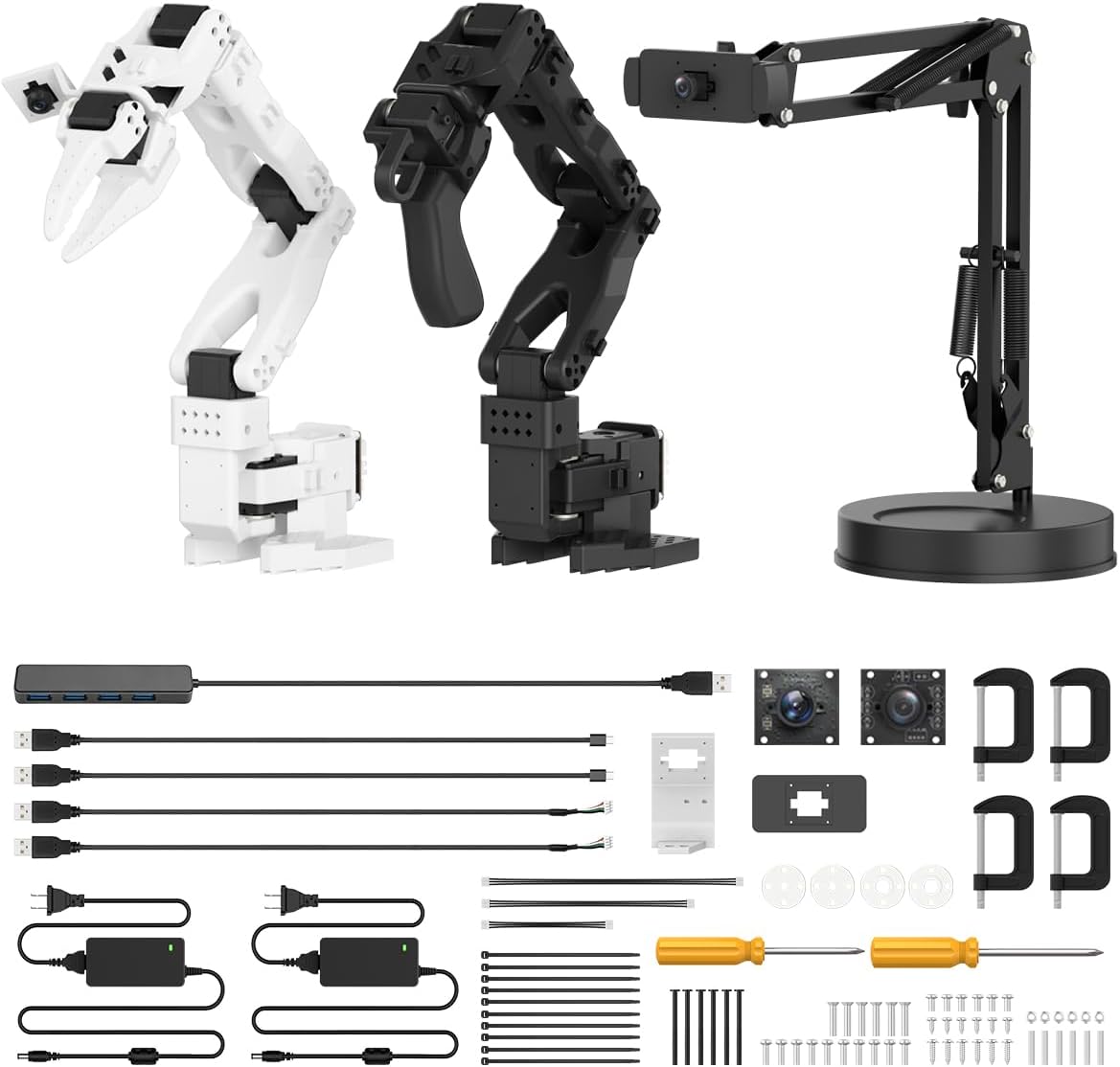
The Hiwonder SO-ARM101 is an advanced robotic arm platform designed around embodied imitation learning rather than simple toy play. It carries a 4.3 rating and provides a six-axis arm, 12 high-torque bus servo motors with magnetic feedback, and a two-camera vision arrangement. The supplied product information identifies compatibility with the LeRobot open-source framework, shared code, templates, and pre-trained models.
We may earn a commission when you buy through this link, at no additional cost to you.
The dual-camera system is the defining feature. One camera is mounted near the gripper for precise manipulation, while the external camera provides environmental awareness. That arrangement is well suited to experiments where understanding both the robot's position and the surrounding scene matters. The 12 servos support smooth movement, while magnetic feedback helps provide stable positioning and reduce jitter-related concerns.
This is also a professional development platform. The integrated Hiwonder BusLinker V3.0 debugging board supports servo scanning, real-time status monitoring, trajectory control, calibration, and PC-based debugging. Open-source compatibility gives experienced users a route into shared tools and custom development, but it also creates a steeper learning curve than a kit controlled through a dedicated phone app. Buyers need to be comfortable installing software, connecting hardware, and interpreting control information.
The SO-ARM101 is the best premium choice for researchers, advanced hobbyists, engineering students, and ambitious builders who want to explore imitation learning and vision-based robotics. It is less suitable as a first robotic arm or as a simple gift for a young child. Those who can navigate the software and debugging workflow, however, gain a considerably deeper experimental platform than the educational kits in this list.
Separate gripper-mounted and external cameras provide complementary views of manipulation and surroundings. That dual perspective is valuable when developing methods that depend on object recognition, positioning, or environmental context.
Compatibility with the LeRobot ecosystem gives developers access to shared code, templates, and pre-trained models. The platform is therefore better viewed as a starting point for custom research than a closed, fixed-function appliance.
We may earn a commission when you buy through this link, at no additional cost to you.
The Arduino miniArm 5DOF is a compact coding platform with a 4.6 rating and a strong emphasis on secondary development. It uses the Atmega328 platform, supports Arduino programming, and includes open-source miniArm programs, learning tutorials, and development examples. That combination makes it more approachable for students ready to move beyond preset commands while still providing a foundation for custom projects.
We may earn a commission when you buy through this link, at no additional cost to you.
The supplied hardware list includes a six-channel knob controller, Bluetooth module, high-precision digital servos, and several expansion ports. Compatible additions include an ESP32 camera module, accelerometer, touch sensor, and glowing ultrasonic sensor, depending on the selected package. These ports are important because they allow the arm to develop beyond simple joint movement into ranging, pose control, and other sensor-driven behaviors.
Control options are versatile. Users can operate the arm through an app, use knob potentiometers for real-time control, or edit actions offline. The trade-off is that the Starter Kit does not include the glowing ultrasonic sensor, touch sensor, acceleration sensor, or ESP32 camera module, while the Standard Kit includes those items along with a Type-C cable and 4PIN wire. Buyers should therefore compare package variants carefully before deciding which configuration meets their project plans.
This is an excellent choice for learners interested in Arduino, sensor integration, and iterative coding. It is less ideal for a child wanting immediate play with no software setup, but more valuable for a student or hobbyist who intends to modify the arm continuously. Among expandable coding platforms in this guide, miniArm offers a particularly clear path from basic control to individual experiments.
Open-source programs and secondary-development examples let users inspect how the arm works and adapt it for new tasks. This is particularly valuable for learners who want to understand the code as well as the mechanism.
Expansion connections allow the mechanical arm to grow into more specialized experiments. Camera, touch, motion, and ultrasonic modules can each introduce a different relationship between sensed information and robotic action.
We may earn a commission when you buy through this link, at no additional cost to you.
The LewanSoul LeArm is a six-degree-of-freedom desktop robot arm with a 4.2 rating. It is positioned as an accessible platform for students, engineers, university courses, and robot enthusiasts, with six digital servos, a metal bracket structure, and a mechanical claw. The arm can grasp objects, transport them, execute custom actions, and participate in graphical programming exercises.
We may earn a commission when you buy through this link, at no additional cost to you.
Its mechanical design deserves attention. The base uses a high-torque servo and industrial-grade bearings for stability, while three anti-blocking servos with gear clutches are positioned at the arm's end. The stated anti-stall protection is intended to reduce the chance that a servo remains under strain when movement is blocked. These details make the kit more purposeful than a lightweight model assembled mainly for visual imitation.
Users can choose among PC, app, mouse, and wireless handle controls, which makes the system flexible for different users and environments. The included tutorials and programming software help bridge the gap between assembly and meaningful use. However, it is not as focused on AI vision or open-source robotics as the SO-ARM101, and its physical design may feel less futuristic than the tracked 975-piece kit. Its appeal lies more in balance, stability, and accessible programming.
We recommend LeArm for a first programmable desktop arm, a school or university project, or a hobbyist who wants several control methods without an advanced research workflow. It is particularly suitable for users who want a physical gripper and stable multi-axis movement. Buyers who prioritize advanced sensing, open-source compatibility, or app-based visual programming may find a more specialized model better suited to their goals.
Metal brackets, industrial-grade bearings, and a high-torque base servo help the arm remain steady during grasping and transport. Stability is essential when an educational model needs to perform repeatable actions rather than simply move.
PC, app, mouse, and wireless handle control let users choose the interface that best fits the lesson. A new programmer can use visual tools, while more experienced users can explore custom actions and offline editing.
We may earn a commission when you buy through this link, at no additional cost to you.
This wooden robotics circuit kit is a hands-on introduction to electronics and movement for children around eight to twelve and older. It has a 4.2 rating and includes motors, a microcontroller, and circuit boards within a natural wooden construction. The arm supports lifting, steering, and full 270-degree rotation, providing visible mechanical results while teaching how electronic inputs can control movement.
We may earn a commission when you buy through this link, at no additional cost to you.
The educational value comes from the complete build process. Step-by-step instructions support patience and fine motor development, while the completed structure gives learners a tangible example of circuits, motors, and mechanical control. It is suitable for individual projects, parent-child teamwork, family STEM nights, and classroom programs. The wooden parts also make it feel distinct from the many all-plastic robotics sets available.
This kit is better suited to a first hands-on robotics experience than to advanced programming. There is no indication that it supports the extensive sensor ecosystems, open-source frameworks, or custom code found in the Arduino-oriented products. Its value instead comes from accessible assembly, understandable movement, and the balance between entertainment and learning. Buyers should also note that similar wooden kits are included in this list, making the available features and included electronics important points of comparison.
We recommend this model for younger builders, parents seeking a manageable first STEM project, and teachers who need an approachable classroom activity. It can also serve as a birthday or holiday gift for a child interested in circuits, construction, or gadgets. For children ready to write programs or add sensors, the miniArm or ACEBOTT options provide a more advanced path.
The visible wooden framework helps builders follow how each part contributes to the final arm. That clarity makes circuits and mechanical movement easier to connect with a physical result.
Full 270-degree rotation creates a useful range of motion for basic demonstrations. Builders can experiment with where the arm points and how that changes its ability to reach or hold an object.
We may earn a commission when you buy through this link, at no additional cost to you.
The ACEBOTT 4 in 1 Smart Robot is a modular robotics system with a 4.1 rating. It includes a base robot car, tank-track expansion, and a robotic arm module, allowing users to create a standard robot, an arm-equipped vehicle, a tracked tank, or a combined arm tank. This multiple-configuration design makes it more varied than a conventional single-purpose desktop arm.
We may earn a commission when you buy through this link, at no additional cost to you.
The arm has five degrees of freedom and uses an ESP32 controller. Compatibility with Arduino and Scratch gives learners both lower-level and more approachable programming paths. Sixteen guided tutorials and HD assembly videos provide structure during assembly and coding, while an IR remote and smartphone app support direct play. The supplied information also describes the rubber tracks as capable of handling grass, gravel, slopes, and carpet, although care is still needed with debris and delicate surfaces.
Its main trade-off is focus. A kit that can become several different robots has to cover a wider range of mechanical and electronic tasks, so buyers seeking one polished desktop arm may find it less concentrated. It also ranks lowest by customer rating in this group at 4.1, although that difference is modest and should be interpreted alongside the substantial feature set. Users should also account for setup time and confirm that they want a vehicle-based platform as well as an arm.
ACEBOTT is a strong choice for older children and teens who want coding, modularity, and outdoor-style movement. It works well for STEM classes, family projects, and science fair development because the tutorials and multiple forms support repeated challenges. For a young child focused primarily on building a claw, a simpler kit may be easier to finish. For a motivated teen ready to combine code, tracks, and an arm, it provides unusually broad creative potential.
Separate car, track, and arm modules allow the same core components to produce multiple configurations. Each rebuild introduces a different mechanical purpose and gives completed models more than one way to demonstrate their capabilities.
Arduino and Scratch compatibility support structured programming, while the app and IR remote make the robot immediately controllable. This combination lets users alternate between free play and more deliberate coding exercises.
We may earn a commission when you buy through this link, at no additional cost to you.
The Hiwonder xArm1S is a full-metal, six-axis desktop robot arm with a 4.0 rating. It is designed for remote-control grasping, object transportation, custom actions, and graphical programming. Six high-precision intelligent serial-bus servos provide position, voltage, and temperature feedback, while the aluminum bracket structure and industrial-grade bearings create a stable platform for manipulation tasks.
We may earn a commission when you buy through this link, at no additional cost to you.
One of the clearest benefits is the reported 500-gram grasping capacity, giving the arm more practical reach than lightweight toy mechanisms. Servo feedback also helps users understand the operating condition of individual joints rather than treating the arm as a black box. Construction combines a high-torque base servo with metal supports to improve stability, which is especially valuable when the gripper is carrying an object.
The arm supports PC, phone app, mouse, wireless PS2 controller, and fingertip control, offering considerable flexibility. Offline manual editing and action editing through PC or app help users create custom sequences. The trade-off is complexity. This is not a quick beginner build, and its capabilities make it more involved than the wooden electronics sets. Its 4.0 rating is the lowest in this roundup, so buyers should review current customer feedback carefully for their specific priorities.
We recommend the xArm1S for students, adult hobbyists, and engineering educators who want a durable arm with serious programming options. It is well suited to grasping, transport, and repeated custom actions, provided the builder has enough patience for assembly and calibration. A first-time buyer focused on simple STEM discovery may prefer the Hydrobot or a wooden kit, while experienced users will appreciate the feedback-rich servo system.
Position, voltage, and temperature information gives users visibility into each joint. That transparency is useful when diagnosing movement, refining calibration, or teaching the relationship between commands and mechanical behavior.
Aluminum components, a reinforced base, and industrial-grade bearings provide the stability needed for grasping and transport. The construction is better suited to sustained mechanical tasks than a lightweight decorative model.
We may earn a commission when you buy through this link, at no additional cost to you.
The right robotic arm kit depends on the builder's age, interest, and desired level of control. Compare motion range, programming demands, construction, power requirements, and available learning resources rather than judging only by appearance.
Degrees of freedom describe how many independent directions the arm can move. A four-degree-of-freedom model can still lift, turn, and position an end effector, while five or six degrees provide more natural reach and orientation. Buyers should consider whether a compact four-axis arm is enough for their intended demonstrations or whether they need the flexibility of a six-axis mechanism. More axes generally create a more immersive model but also add structural complexity, assembly work, and opportunities for alignment errors.
Choose enough movement for the planned tasks without paying for unnecessary complexity. A basic classroom demonstration may work well with four axes, while grasping varied objects or experimenting with advanced manipulation benefits from five or six.
Control methods determine how approachable and versatile a kit will be. Remote controllers and phone apps are convenient for direct play, while graphical programming helps younger or newer builders learn sequencing. PC software, open-source examples, and Arduino compatibility provide deeper code access for students and hobbyists. Advanced platforms may also offer path drawing, gyroscope control, trajectory editing, or debugging tools, but these features require more setup and patience.
Match the interface to the user rather than selecting the most feature-heavy model. Begin with a kit that offers clear visual instructions, then consider moving toward open code, sensors, and custom trajectories as skills develop.
Wood, metal, and ABS components create different building and operating experiences. Wood provides a tactile, puzzle-like construction that can make electronics more approachable. Metal brackets improve rigidity and are often favored for stable multi-axis arms, while durable ABS supports large piece counts and detailed models. A heavier base may also reduce vibration when the arm lifts or carries an object. Match the construction to the workspace and the level of handling it will receive.
Prioritize a sturdy base, well-supported joints, and clear assembly instructions over decorative appearance. A mechanically solid model is easier to program and more satisfying to operate.
Some kits are designed as first robotics projects, while others involve hundreds of pieces, detailed gears, and extensive wiring. Younger builders benefit from step-by-step instructions, natural wooden components, and manageable subassemblies. Older users may prefer the deeper challenge of a tracked platform or a six-axis arm. Check the stated age range carefully, since it usually reflects the complexity of construction as well as the difficulty of operating the finished model.
Estimate the full project honestly and build in stages. A complex kit is more rewarding when each mechanism is checked before the next stage is added, rather than when the entire model is assembled at once.
A kit that supports sensors can respond to touch, distance, orientation, camera images, or other environmental information. Expansion ports, camera modules, and documented examples matter for long-term projects. However, advanced sensing also introduces more setup and troubleshooting. Beginners can still learn meaningful concepts from a simple motor and circuit system, while students and researchers may need vision, motion sensing, or programmable inputs. Confirm both the included sensors and the availability of compatible add-ons before purchasing.
Choose expansion potential when the arm is intended to become a platform. For a single demonstration or gift, prioritize reliable included functions and straightforward controls instead.
Robotic arms use several power approaches. The Hydrobot relies on water-driven hydraulics, wooden kits generally use AA batteries, and larger electronic systems may include rechargeable batteries with USB charging. Battery-operated kits should be checked for the required cell count and whether batteries are included. Hydraulic models need regular water maintenance and careful alignment. Rechargeable systems reduce routine battery replacement but still need their power connections maintained.
Account for the ongoing care required by the selected mechanism. A model is a better gift when its power system is easy for the intended user to maintain.
Grippers are common, but a bucket, suction system, drill, or tracked platform can give the arm different purposes. Interchangeable tools make a single build more useful and create opportunities to compare how each attachment changes approach, carrying, and positioning. Some kits are specialized desktop manipulators, while others combine the arm with a mobile robot. The best choice depends on whether the priority is precise handling, programming experiments, or mobile interaction.
Look for attachments that support clear demonstrations. A tool should create an observable engineering task rather than simply adding another decorative component.
Good instructions can determine whether a complex kit feels educational or frustrating. Step-by-step assembly guides, software tutorials, sample code, and lesson concepts make it easier to move from construction to meaningful experiments. Open-source resources are particularly useful when users intend to modify the arm, while graphical software may be more accessible for younger learners. Verify that the supplied resources cover not only assembly but also programming, calibration, and troubleshooting.
Prioritize a kit with a complete learning path. A clear first project should lead naturally into a first program and then a custom modification.
Begin by sorting the parts, reading the complete instructions, and identifying the base, powered joints, controller, and end effector before assembly. Build the structure in stable sections, test each motor or movement axis as it is connected, and avoid forcing misaligned pieces. For programmable kits, complete the mechanical build before attempting calibration so that wiring and alignment errors are not mistaken for software problems.
Use the intended power source and keep hands, loose clothing, and small objects away from exposed gears or pinch points. Operate the arm within the movement limits established by the manual, especially when carrying an object or changing attachments. When programming, begin with short motions and small movement ranges, then increase speed, reach, or sequence length after confirming that the arm responds predictably.
Store powered models dry, unplugged, and away from direct heat. Remove batteries from toys that will not be used for an extended period, clean wooden parts with a lightly damp cloth, and avoid moisture around circuit boards. Hydraulic models need the water system checked for leaks and kept topped up as directed. For geared systems, keep the arm free of dust and debris, and follow the included calibration procedure whenever a joint appears less precise than usual.
A wooden construction kit with clear instructions is usually a strong starting point. It keeps the build tactile while introducing motors, wires, a microcontroller, and mechanical movement without requiring advanced coding. A supervised hydraulic model can also be engaging for a child around age 12 or older, although the more complex kits with programming and app controls are better suited to motivated tweens and teens.
Four degrees of freedom can provide basic lifting, turning, and positioning, while five or six degrees offer more natural reach and object orientation. More axes are useful for advanced manipulation, but they also add complexity to the build and programming. Choose the simplest model that can perform the movements your project requires rather than selecting the highest number available.
That depends on the model. The wooden introductory kit in this guide specifically requires no soldering, while several other systems use prewired modules and graphical programming. Advanced Arduino and AI-oriented products still involve software setup, code interpretation, or calibration, although many include tutorials and sample programs to reduce the learning curve.
Yes, many are designed specifically for STEM learning, classroom demonstrations, science projects, and guided tutorials. The ACEBOTT model includes story-based lessons and assembly videos, while miniArm and the Hiwonder products provide more advanced programming resources. For group work, choose a kit with clear subassemblies and confirm that the instructor or supervising adult is comfortable with the required electronics and software.
A remote-controlled arm responds directly to buttons, joysticks, a mouse, or another manual input. A programmable arm can store a sequence of commands and execute them with less continuous direction. Many kits in this guide support both, allowing users to begin with direct control and gradually progress to programmed actions, custom movements, sensors, or path following.
Durability depends on design and handling, not just the visible material. Wooden kits can be well suited to education because their construction is easy to understand, while metal frames provide rigidity for six-axis arms and plastic systems support detailed, modular models. Keep all types away from moisture, inspect joints after rough use, and avoid forcing the arm beyond its intended range of motion.
The Hiwonder SO-ARM101 is the strongest choice for vision-based imitation learning and open-source development, while the xArm1S offers a stable six-axis platform with graphical programming and extensive control options. The miniArm 5DOF is also compelling for Arduino and sensor projects. Adult hobbyists should consider their preferred software environment as well as the arm's mechanical capabilities.
Keep the joints and gears free of dust, avoid moisture near the electronics, and check wiring or connectors if movement becomes inconsistent. Recharge or replace batteries according to the instructions, and keep hydraulic water topped up without flooding the mechanism. Recalibrate the arm if a joint has been repositioned or if it no longer completes programmed motions smoothly.
The 3 in 1 Technical Robotic Arm is the strongest all-around choice because it combines a high customer rating, three interchangeable attachments, tracked mobility, remote operation, and app-based programming. For an affordable introduction, the wooden robot arm for ages eight through fourteen provides meaningful circuit learning without soldering, while the Hiwonder SO-ARM101 stands apart as the best premium platform for vision, imitation learning, and open-source experimentation.
Prioritize the experience the builder will actually use. Younger children benefit from clear instructions, tactile construction, and simple controls; teens may value modular builds and visual programming; adults and students often want sensors, open-source access, and detailed control hardware. A kit with fewer features but clear instructions can be more educational than an advanced model that the user is not ready to operate.
Ratings, package contents, software compatibility, and prices can change over time, so review the current listing before buying. Confirm the power requirements, included components, age guidance, tutorials, and attachment options. With those checks completed, the right robotic arm kit can provide hours of construction, play, and meaningful engineering practice.