
ASUS Dual GeForce RTX 3050 6GB
4.7Editor score
Six gigabytes GDDR6 memory
Compact two-slot design
Dual Axial-tech fan cooling
Discover the best GPU for CS2 with a detailed comparison of memory, clocks, cooling, power needs, features, and build fit.
Counter-Strike 2 rewards fast frame rates, responsive input, and a graphics card that can maintain a steady image during competitive matches. The best GPU for CS2 depends on your monitor, resolution, other games, and available case space, so this guide compares ten capable options for different budgets and build priorities.
The list covers NVIDIA and AMD cards from entry-level GeForce RTX 3050 models to high-end RTX 5080 options, with particular attention to memory capacity, clock speeds, cooling architecture, power requirements, and physical dimensions. Ratings and specifications were taken from the supplied product information, while performance observations explain how each design fits a CS2-oriented system.
Each review identifies the card's strongest qualities, practical trade-offs, and likely buyer profile. The top picks highlight a value option, a well-balanced performance choice, and a premium 16GB alternative, while the comparison table makes the key differences easier to scan. Prices and availability can change, so verify current listings before purchasing.
4.7Editor score

4.7Editor score

4.7Editor score
The comparison below places all ten candidates side by side, focusing on memory, graphics architecture, cooling, clock characteristics, and practical hardware considerations for CS2 and mixed gaming workloads.




The ASUS Dual GeForce RTX 3050 6GB GDDR6 OC Edition is a compact, budget-conscious option for players who want a dedicated CS2 GPU without moving into a high-end build. Its supplied rating is 4.7, and the most appealing detail is its combination of a two-slot design, 6GB of GDDR6 memory, and an overclocked boost clock of up to 1500MHz.
We may earn a commission when you buy through this link, at no additional cost to you.
The card uses NVIDIA's Ampere Streaming Multiprocessors, second-generation RT cores, and third-generation Tensor cores. Those features provide a modern foundation for CS2 and other games, while the listed DLSS capability can help a supported game render at a lower internal resolution and upscale the final image. Its axial-tech fan design uses a smaller hub, longer blades, and a barrier ring intended to increase downward air pressure.
The main compromise is memory capacity. Six gigabytes may be sufficient for competitive CS2 at common desktop resolutions, but it leaves less room for high-resolution textures, demanding titles, and future applications than a 16GB alternative. The 2-slot layout also makes this model appealing for builders with limited clearance, although users should still compare the exact dimensions with their chassis and account for cable routing.
Choose this card if your priority is getting into CS2 on a capable dedicated GPU while keeping the footprint manageable. It is less convincing as a 4K gaming or long-term upgrade choice, but for a budget build it combines useful hardware features with a compact form factor and a strong customer rating.
The two-slot design is one of this card's clearest advantages over many larger alternatives. It can be easier to install in compact cases and may leave more room for airflow, but case width, power-connector access, and cooler length still deserve verification before purchase.
Axial-tech fans promote downward pressure, while the stainless-steel bracket adds corrosion resistance. IP5X dust resistance is particularly relevant in a gaming PC that circulates air through multiple components for long periods.
We may earn a commission when you buy through this link, at no additional cost to you.
The GIGABYTE Radeon RX 9070 XT Gaming OC 16G offers a balanced combination of memory capacity, modern platform support, and enthusiast cooling. Its 4.7 rating places it among the strongest candidates in this list, while 16GB of GDDR6 gives CS2 players more headroom than the 6GB models included here.
We may earn a commission when you buy through this link, at no additional cost to you.
The card is powered by Radeon RX 9070 and supports PCIe 5.0, making it a natural fit for a current-generation gaming system. GIGABYTE's WINDFORCE Cooling System and Hawk Fan design focus on sustained thermal control, while server-grade thermal conductive gel helps manage heat around key components. RGB lighting adds visual appeal for systems with a glass or windowed side panel.
As a high-end graphics card, its dimensions and power requirements need to be checked against the rest of the build. The supplied information does not provide exact connector or PSU figures for this model, so it would be inappropriate to assume compatibility with a particular power supply. The main practical disadvantage beyond cost is that this level of hardware is unnecessary for someone interested exclusively in CS2 at modest settings.
This is our Editor's Choice because it avoids the minimalism of the entry-level cards without reaching the extreme size and power complexity of the flagship models. It is a persuasive option for a new gaming PC that will handle CS2 alongside newer releases, higher resolutions, and other graphically demanding software.
The card's 16GB allocation gives it room beyond the basic requirements of a competitive shooter. That capacity can be reassuring for high-resolution output, texture-heavy games, and future releases, although actual game performance still depends on the processor, settings, and scene.
The WINDFORCE system, Hawk Fan, and thermal conductive gel form a practical cooling package for extended gaming sessions. These features should be considered alongside case airflow, because no card cooler can compensate for a case that traps heat around the graphics card.
We may earn a commission when you buy through this link, at no additional cost to you.
The ASUS Dual Radeon RX 9060 XT 16GB GDDR6 combines a generous memory allocation with a refined set of cooling and operating features. Its 4.7 rating and up-to-3250MHz OC boost clock make it an attractive all-round choice for CS2, particularly when a buyer wants more flexibility than an entry-level card offers.
We may earn a commission when you buy through this link, at no additional cost to you.
A particularly useful feature is the dual BIOS switch, which lets users move between Quiet and Performance profiles. The 0dB technology is designed to keep light gaming relatively silent, while the dual fan arrangement uses smaller hubs, longer blades, and a barrier ring to improve downward air pressure. Dual ball fan bearings are listed as lasting up to twice as long as sleeve-bearing designs.
The 2.5-slot cooler adds thickness compared with a truly compact card, so builders should verify available space. ASUS also provides GPU Tweak III-style clock specifications through its product information, with the OC mode reaching up to 3250MHz boost and 2640MHz game clock. These figures provide an overclocked starting point, but performance will vary with cooling, power, and game settings.
This card fits buyers who want a capable CS2 GPU without stepping into the largest flagship designs. It is particularly appealing for a system that balances gaming, quieter operation, and future capacity. For a competitive-only system on a strict budget, a 6GB card may be more sensible; for a mixed-purpose build, the 16GB specification is the more complete choice.
The dual BIOS switch makes it easy to prioritize silence when the workload is light and performance when competitive play demands it. This flexibility is useful for a card that may also serve general desktop tasks, media playback, and occasional gaming between matches.
With 16GB of GDDR6 memory, this RX 9060 XT avoids the tightest memory constraints seen among the 6GB alternatives. It is a better foundation for higher resolutions, modern game libraries, and workloads that include more than CS2.
We may earn a commission when you buy through this link, at no additional cost to you.
The ASRock Radeon RX 9070 Challenger 16GB OC is one of the most technically substantial cards in this guide. It carries a 4.8 rating, uses AMD's RDNA 4 architecture, and pairs 16GB of GDDR6 memory with a 256-bit bus. Its stated 2520MHz boost clock and 2070MHz game clock position it as a factory-overclocked enthusiast option.
We may earn a commission when you buy through this link, at no additional cost to you.
The architecture includes 56 compute units, 3,584 stream processors, third-generation ray-tracing cores, and second-generation AI accelerators. The supplied description highlights suitability for 1440p and 4K gaming, making the card more versatile than a basic CS2-focused purchase when the monitor and system can support it.
Physical and power planning are essential. ASRock specifies a 2.5-slot card measuring 290 by 123 by 51mm, two 8-pin power connectors, and a recommended 700W PSU. The triple-fan cooler and 0dB silent behavior add appeal, but the card is not intended for a minimal chassis. Verify room beside the CPU cooler, motherboard slots, and power-cable routing.
Buyers with a modern desktop and sufficient power should find this card well suited to high-refresh CS2 and other demanding games. The main reason to hesitate is not gaming capability but system readiness: replacing the PSU or case may add cost and complexity that a simpler upgrade would avoid.
The 56 compute units and 3,584 stream processors give this card a robust foundation for modern games. Dedicated ray-tracing and AI accelerators also make it more relevant to a broader gaming library than a card selected only for a competitive shooter.
The specified dimensions, two 8-pin connectors, and recommended 700W PSU make compatibility checking essential. Buying the card and PSU together can simplify assembly because the entire system can be planned around the graphics card's physical and electrical requirements.
We may earn a commission when you buy through this link, at no additional cost to you.
The ASUS Dual GeForce RTX 5060 Ti 16GB GDDR7 OC Edition brings a modern NVIDIA feature set to the upper end of this guide. Its 4.7 rating, 16GB of GDDR7 memory, and support for the Blackwell architecture and DLSS 4 make it especially relevant to gamers who want CS2 capability without choosing the largest flagship card.
We may earn a commission when you buy through this link, at no additional cost to you.
Its quoted AI performance is 767 AI TOPS, reflecting the Blackwell generation's emphasis on AI-assisted workloads. The OC mode reaches up to 2632MHz, while default mode reaches up to 2602MHz. These specifications support strong gaming potential, though the exact CS2 experience will depend on resolution, settings, CPU behavior, and whether the game uses the available upscaling options.
ASUS equips this card with axial-tech fans, a 2.5-slot cooler, 0dB technology, dual BIOS profiles, and dual ball fan bearings. Quiet mode can be useful during light games or desktop use, while Performance mode gives competitive players the higher operating profile when needed. As with any multi-slot card, users should inspect the case and CPU-cooler clearance.
This card makes most sense for a modern high-refresh build that will run CS2 and several other demanding titles. A CS2-only buyer may find the 3050 options sufficient, while a buyer who values NVIDIA features and 16GB of faster memory will get more flexibility from this model.
The Blackwell architecture and DLSS 4 support distinguish this model from older Ampere cards in the guide. DLSS can create a useful performance option when higher settings or a larger frame-rate target are desired, provided the game and display setup support the feature.
Dual BIOS profiles let the user move between quiet and performance behavior. The 0dB design is intended for light workloads, while the fan and bearing design provides a more active cooling approach when sustained gaming demands it.
We may earn a commission when you buy through this link, at no additional cost to you.
The GIGABYTE GeForce RTX 5080 Gaming OC 16G is the straightforward high-end choice in this guide. It combines NVIDIA's Blackwell architecture, DLSS 4, 16GB of 256-bit GDDR7 memory, and PCIe 5.0 support. Its supplied rating is 4.6, and the specification set clearly places it at the flagship end of this comparison.
We may earn a commission when you buy through this link, at no additional cost to you.
For CS2, a card at this level can deliver substantial headroom, particularly with a high-refresh monitor or higher-resolution display. That headroom is useful when the system also handles demanding modern games, content creation, or other GPU-accelerated workloads. The GDDR7 memory and wide 256-bit interface are also more appropriate for future applications than a basic entry-level configuration.
The trade-off is system complexity. A flagship GPU needs a power supply and enclosure that can support its size, connector requirements, and heat output. The supplied data identifies the WINDFORCE cooling system but does not list exact dimensions, connector type, or minimum PSU, so those details should be checked in the manufacturer's specifications and the seller's final listing before purchase.
Buy this card when the objective is a no-compromise high-end PC rather than simply the lowest-cost way to play CS2. It offers abundant performance potential, but a 16GB midrange card may deliver a more sensible overall result for most competitive players.
The RTX 5080's flagship positioning makes the most sense when CS2 is only one part of the workload. Its advanced architecture, AI capability, fast memory, and generous capacity provide a strong platform for modern games and GPU-intensive applications.
PCIe 5.0 support is one reason to pair this card with a current platform rather than treat it as an isolated upgrade. The processor, motherboard, PSU, case, and cooling arrangement should be considered as parts of one high-performance system.
We may earn a commission when you buy through this link, at no additional cost to you.
The ASUS Prime Radeon RX 9070 XT 16GB GDDR6 OC Edition combines strong factory clocks with a refined feature set. Its listed OC boost clock reaches up to 3030MHz, and the card carries a 4.6 rating. For CS2 and modern games, its 16GB allocation and RDNA 4 foundation provide a solid high-end platform.
We may earn a commission when you buy through this link, at no additional cost to you.
Thermal management is handled by axial-tech fans and a phase-change GPU thermal pad that is designed to improve heat transfer and durability. Dual BIOS switching offers separate Quiet and Performance profiles, while 0dB technology is intended to reduce fan activity during lighter workloads. Dual ball fan bearings are listed as lasting up to twice as long as conventional sleeve bearings.
GPU Tweak III adds performance tuning, thermal control, and monitoring, which is valuable for a buyer who wants visibility into clocks and temperatures. The default mode reaches up to 3010MHz boost and 2460MHz game clock, while OC mode reaches 3030MHz and 2480MHz respectively. Users should monitor the card rather than assuming a factory clock will always be held in every environment.
This is a compelling choice for a high-refresh system that will play more than CS2. The main concern is physical fit: the 2.5-slot design needs more room than a compact two-slot card. Within a suitably large enclosure, however, the combination of memory, clocks, software, and cooling makes it a well-rounded enthusiast choice.
GPU Tweak III gives users a clear interface for adjusting performance, monitoring thermal behavior, and managing the card. That visibility is valuable for players who want to understand how the factory OC behaves in a particular case.
The dual BIOS switch makes it convenient to choose between quieter everyday behavior and a performance-focused profile. Switching profiles can also be useful when moving between competitive matches and less demanding applications.
We may earn a commission when you buy through this link, at no additional cost to you.
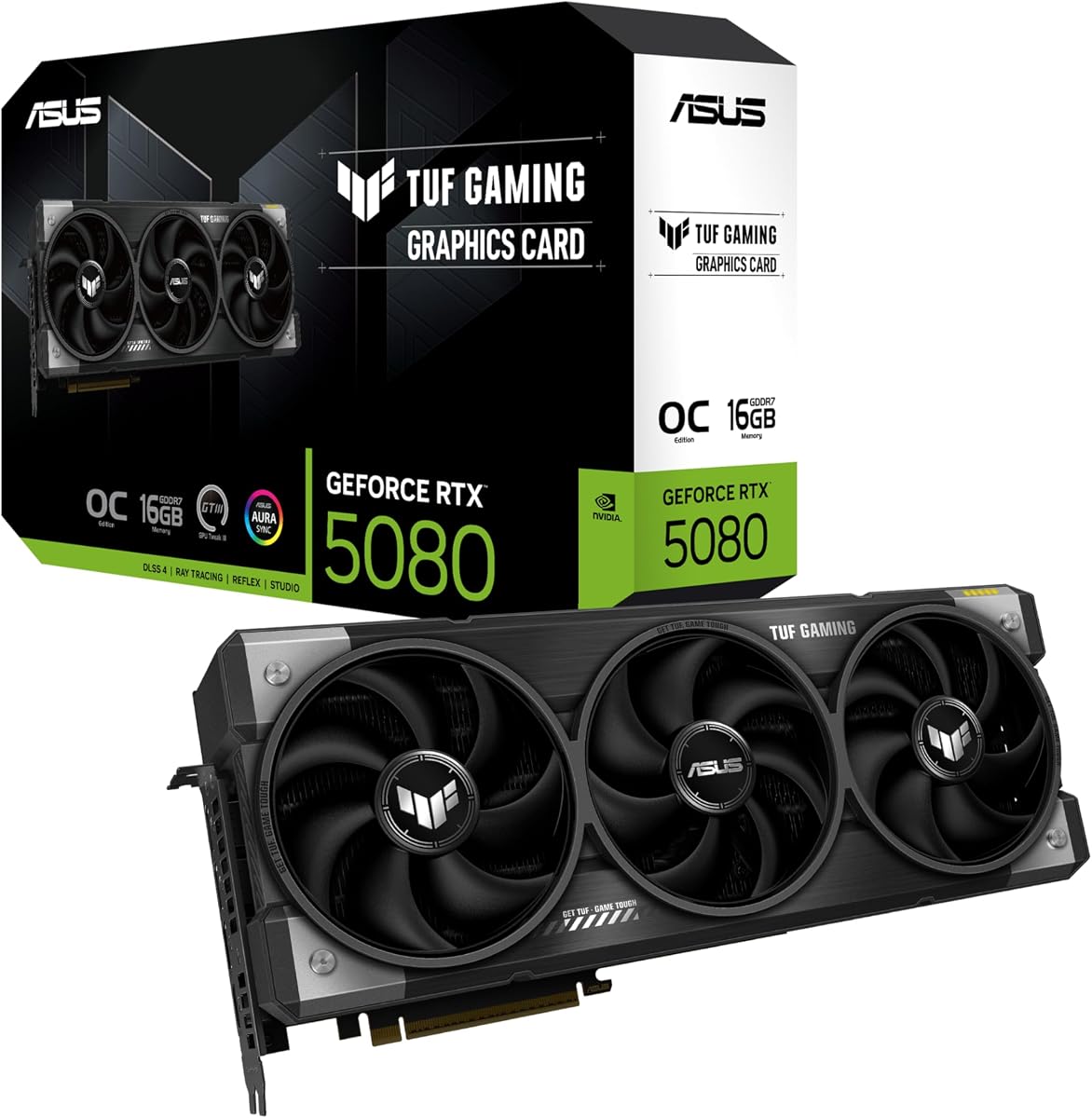
The ASUS TUF Gaming GeForce RTX 5080 16GB GDDR7 OC Edition is the most physically substantial premium card in the list. Its 4.6 rating is supported by flagship-class specifications, including Blackwell architecture, DLSS 4, 16GB of GDDR7 memory, and an OC boost clock of 2730MHz.
We may earn a commission when you buy through this link, at no additional cost to you.
Cooling is a major focus. Three Axial-tech fans feed a massive fin array within a 3.6-slot design, while a phase-change GPU thermal pad is intended to preserve thermal performance over long workloads. Military-grade components, a protective PCB coating, and the Auto-Extreme manufacturing process all emphasize durability and reliability.
Compatibility demands attention. ASUS specifies a length of 348mm, a 3.6-slot thickness, a weight of 4.3 pounds, a minimum 850W PSU, and a 16-pin 12V-2×6 connector. A GPU bracket is included, but the case must still have enough clearance for its length, slot spacing, and weight. Buying the power supply and graphics card together is a sensible approach.
This model is for a showcase-quality, high-end gaming system where CS2 is one part of a much broader workload. Its cooling and durability features are compelling, but the physical and electrical demands mean it is unsuitable for a compact or modestly equipped PC.
Three fans and a large fin array provide the physical cooling capacity expected from a flagship card. The phase-change thermal pad is designed to maintain heat transfer over time, making the package well suited to prolonged gaming and demanding multi-game sessions.
The 348mm length and 3.6-slot width make case selection a central part of the purchase. Check the maximum GPU length, available slot spacing, CPU-cooler clearance, and the position of the power connectors before committing to this model.
We may earn a commission when you buy through this link, at no additional cost to you.
The GIGABYTE GeForce RTX 3050 WINDFORCE OC V2 6G is a simple, budget-oriented graphics card centered on the basics needed for CS2. It has a supplied rating of 4.6 and uses 6GB of 96-bit GDDR6 memory, with two WINDFORCE fans handling cooling.
We may earn a commission when you buy through this link, at no additional cost to you.
NVIDIA Ampere Streaming Multiprocessors, second-generation RT cores, and third-generation Tensor cores provide the core feature set. This makes the card more than a basic display adapter, while the OC designation gives it a performance-oriented model identity. Its relative simplicity can appeal to buyers assembling a straightforward gaming PC.
The 6GB allocation and 96-bit bus are the major limitations. They leave less room for high-resolution textures and modern games than the 16GB alternatives, and they may become a more noticeable constraint over time. CS2 can still be the focus, but a card designed only around competitive play will not serve demanding creative workloads as well.
Choose this model when the aim is a competent, dedicated CS2 experience without overspending. It may be particularly useful for a first gaming build or an upgrade from integrated graphics. Buyers should compare the exact dimensions and connector needs with their case and PSU, but the overall proposition is simpler and more restrained than the larger 16GB cards.
Moving from integrated graphics to a dedicated RTX 3050 is the clearest use case for this model. It provides hardware-accelerated gaming with modern NVIDIA features without requiring the power and physical complexity of a flagship card.
Two WINDFORCE fans provide a straightforward cooling arrangement for a dual-fan model. As with any card, unobstructed case airflow and clean intake paths remain important for consistent performance during long sessions.
We may earn a commission when you buy through this link, at no additional cost to you.
The XFX Swift AMD Radeon RX 9060 XT OC Gaming Edition stands out with a supplied 4.8 rating and an advertised boost clock of up to 3320MHz, the highest figure in this comparison. It combines that clock with 16GB of GDDR6 memory and AMD's RDNA 4 architecture.
We may earn a commission when you buy through this link, at no additional cost to you.
Its XFX Swift dual-fan cooling solution provides the thermal foundation for the factory OC. A capable processor and good case airflow will help the card maintain strong performance, while the 16GB memory allocation gives CS2 players ample room for modern settings and other games. The model is listed as compatible with desktop PCs, which is an important point for anyone building a new system rather than replacing a laptop GPU.
The connectivity list includes HDMI and two DisplayPort outputs, which is useful for multi-monitor or high-refresh display setups. The exact physical dimensions and power requirements are not included in the supplied information, so they should be checked before purchase. High boost clocks also depend on cooling quality, and users should monitor the card rather than assuming it will sustain its maximum rating in every case.
This is a strong alternative for gamers comparing the XFX design against other 16GB RX 9060 XT cards. Its combination of memory, high stated clock, modern display outputs, and favorable rating makes it appealing for a competitive system that also needs to handle other modern games.
The 3320MHz maximum boost clock is the model's standout specification. It gives the card an enthusiast orientation, although sustained results depend on the GPU Tweak process, thermal conditions, and the power available from the system.
HDMI and two DisplayPort outputs provide flexibility for different monitors. This is especially helpful for high-refresh competitive displays and multi-screen arrangements, provided the chosen monitor and supported interface are compatible.
We may earn a commission when you buy through this link, at no additional cost to you.
Selecting the best GPU for CS2 starts with realistic expectations about resolution, refresh rate, memory, and system compatibility. The most expensive card is not automatically the best choice; a balanced build usually delivers more value than spending nearly all of the budget on the graphics card.
CS2 is playable on many of the cards in this guide, but frame rates change significantly with output resolution and settings. A high-refresh monitor benefits from a GPU that can consistently supply enough frames, while a 1080p competitive setup can place less demand on the graphics card. Consider the resolution, refresh rate, and competitive settings you actually intend to use rather than extrapolating from a higher-resolution result.
Choose a GPU that comfortably supports your target resolution and refresh rate. The 6GB RTX 3050 models are most relevant to budget and 1080p-focused systems, while the 16GB cards provide more headroom for higher resolutions and broader gaming use.
Video memory influences which textures and rendering workloads a card can manage comfortably. Six gigabytes is a constrained allocation, even if CS2 itself is not especially demanding, while 16GB gives the system more room for high-resolution output, detailed game assets, and future releases. Memory capacity does not determine frame rate by itself, but it helps define how comfortably the GPU can handle demanding scenes.
For a CS2-only budget build, 6GB may be adequate. For a system intended to run modern AAA games as well, 16GB is the more future-conscious choice and appears on most of the higher-tier cards in this guide.
CS2 uses both the processor and graphics card, so an exceptionally powerful GPU cannot create frames faster than the CPU and game engine allow. Older or entry-level processors may limit performance before the graphics card reaches its full potential. A balanced system is especially important for competitive play, where a consistent frame rate and low latency matter more than isolated peak numbers.
Check that the chosen processor is capable at the intended resolution and settings. If the graphics card is being upgraded in an older system, verify motherboard compatibility and avoid spending heavily on a card that the rest of the build cannot fully support.
Graphics card length, slot width, cooler height, and connector placement determine whether a card fits the enclosure. The ASRock RX 9070 is specified at 290mm long and 2.5 slots, while the ASUS TUF RTX 5080 reaches 348mm and occupies 3.6 slots. Both require a case with sufficient room, and the TUF also needs consideration for CPU-cooler overlap and bracket support.
Measure the available clearance before buying and compare it with the exact listing. Do not rely only on the number of expansion slots, because motherboard slot layout and installed components can reduce usable space.
A capable power supply protects gaming stability and leaves room for transient demand. The ASRock RX 9070 lists two 8-pin power connectors and a recommended 700W PSU, while the ASUS TUF RTX 5080 requires a minimum 850W PSU with a 16-pin 12V-2×6 connector. These figures show how dramatically requirements can vary across the list.
Choose a PSU with the correct connectors and adequate capacity rather than relying on adapters when possible. If replacing an older unit, select a reliable model with sufficient headroom and the appropriate power standard for the entire computer.
Cooling influences sustained clock behavior and component longevity. ASUS axial-tech designs use a smaller fan hub, longer blades, and a barrier ring intended to improve downward pressure. GIGABYTE's WINDFORCE and XFX Swift systems take different approaches, while the ASRock card's triple-fan layout provides substantial cooling hardware for its factory OC.
Match the cooler to the case's airflow and your tolerance for fan noise. Dual BIOS and 0dB features on several ASUS cards allow a quieter profile for light use and a performance profile for gaming, but a large case with good front-to-back airflow remains essential.
DLSS support on NVIDIA's Blackwell cards and dedicated AI or ray-tracing hardware on current AMD designs can add flexibility beyond the base game. These features may improve image quality or performance in supported titles, but they do not replace a balanced CPU and GPU combination. For CS2 specifically, the practical priorities remain frame rate, input responsiveness, memory, and a display matched to the desired competitive experience.
Prioritize features you will use. A player who only wants CS2 at 1080p may gain little from an expensive flagship feature set, while a broader gaming build can benefit from upscaling, ray tracing, and stronger AI hardware.
CS2 benefits from a responsive display, low-latency input device, adequate memory, and a processor that avoids stuttering. The graphics card is only one part of the competitive experience. Spending some of the budget on a suitable monitor, mouse, keyboard, or processor can produce a more noticeable improvement than moving to a marginally faster GPU.
Plan the whole system before shopping. This prevents an expensive graphics card from being limited by an older processor, undersized PSU, cramped case, or display that cannot show the intended frame rate.
Install the graphics card in a PCIe expansion slot, connect the required power cables, secure the card, and install the manufacturer's display drivers. Before installation, shut down the computer, disconnect the power cable, and confirm that the case and power supply meet the card's physical and electrical requirements. The supplied product details identify different connector arrangements, so follow the exact manual and listing rather than assuming every model uses the same connection.
After installation, launch CS2 and begin with the display's native resolution. Select settings appropriate to the desired frame rate and visual clarity, then adjust them gradually while monitoring performance and responsiveness. Use the vendor's tuning software, where included, to review clocks, fan behavior, and temperatures. Avoid applying aggressive adjustments until the card has a stable baseline and adequate case airflow.
Keep the intake paths clear, dust the card and filters periodically, and check cables for secure seating. Do not operate the system with an obstructed cooler or poorly connected power cable. When cleaning, power the system off completely and use gentle methods that do not dislodge cooler components or damage the circuit board.
A dedicated GPU is strongly recommended for a smooth and consistent CS2 experience, especially at higher resolutions or refresh rates. Integrated graphics may run the game, but its available performance can vary considerably with the processor and system memory. A dedicated card also provides a more predictable upgrade path for competitive play.
No, CS2 can run on the 6GB RTX 3050 models in this guide, making them practical budget choices. However, 16GB is preferable if the computer will also run modern games with detailed textures, work at higher resolutions, or handle other graphically demanding applications. More memory provides flexibility but does not guarantee higher frame rates by itself.
An RTX 3050 can be sufficient for CS2, particularly in a 1080p-focused build where competitive settings are the priority. Actual results depend on the processor, memory configuration, cooling, and monitor. A stronger CPU and faster memory may improve consistency more than moving to a much more expensive graphics card.
A capable CPU and GPU, fast memory, and a compatible high-refresh display work together to support smooth competitive play. Low input latency also depends on the mouse, settings, and system behavior. Before upgrading the graphics card, check whether the existing processor and display can make full use of the added performance.
The supplied models in both families provide 16GB of graphics memory, so the decision should include architecture, software preferences, pricing, case fit, and the rest of the system. The NVIDIA card supports DLSS 4 and lists Blackwell architecture, while the AMD option uses RDNA 4. Neither is automatically superior without considering compatibility and the games you plan to play.
Requirements vary across this guide. The ASRock Radeon RX 9070 specifies two 8-pin connectors and a recommended 700W PSU, while the ASUS TUF RTX 5080 requires a minimum 850W PSU and a 16-pin 12V-2×6 connector. Use the exact manufacturer's guidance and ensure the PSU includes the required native connectors.
Possibly, but you must check length, height, slot width, and power-cable clearance. The ASUS Dual RTX 3050 has a specified two-slot design and may suit smaller systems better than the 2.5-slot and 3.6-slot alternatives. The case manufacturer's GPU-length specification and the card's exact dimensions should be compared before purchase.
Usually not. A GeForce RTX 5080 offers substantial headroom, modern features, and excellent multi-game capability, but CS2 alone does not require flagship hardware. A 16GB RTX 5060 Ti or RX 9060 XT can offer a more balanced build, while a 3050 can serve a focused 1080p competitive setup.
The top picks cover three practical needs. The ASUS Dual GeForce RTX 3050 6GB is the budget and compact-build choice, the GIGABYTE Radeon RX 9070 XT Gaming OC provides the strongest all-around balance with 16GB of memory and modern cooling, and the ASUS Dual GeForce RTX 5060 Ti 16GB delivers premium NVIDIA features, GDDR7 memory, and flexible BIOS profiles.
For most competitive builders, prioritize a balanced CPU and GPU, sufficient system memory, and a monitor with the desired refresh rate. Choose 6GB when the budget is strict and CS2 at 1080p is the main goal; choose 16GB when the system will also handle modern games, higher resolutions, and broader creative workloads. Always verify case clearance and power requirements before ordering.
Graphics card prices and availability change over time, and retailer listings can change during a sale or promotion. Check the current product page for the latest specifications, connector details, dimensions, and customer feedback. The final purchase should fit both the gaming target and the rest of the system rather than simply selecting the highest-ranked model.