TASCAM DR-05XP
4.2Editor score
32-bit float recording
Two-input USB-C interface
Omnidirectional stereo microphones
Our Audio Recorder for Streaming Music guide compares ten portable recorders for live music, USB streaming, multitrack capture, reliable backup, and creator
An audio recorder for streaming music can improve the clarity, control, and reliability of a live broadcast while also creating useful local backups. The right model depends on your microphones, recording format, preferred workflow, and whether you need compact stereo capture or several inputs for a full band.
We compared the ten recorders using their supplied specifications, focusing on microphone configuration, XLR and TRS connectivity, USB-C streaming support, 32-bit float recording, multitrack capability, storage options, battery life, and suitability for musicians, podcasters, and filmmakers. The list includes entry-level recorders and advanced professional models.
Each review explains where the recorder stands out, where its feature set stops, and which creator is most likely to benefit from it. Our selections are not based on personal testing, and the featured ratings reflect the supplied customer feedback. Prices and availability can change, so confirm the current listing before purchasing.
4.2Editor score

4.5Editor score

4.6Editor score
The comparison below organizes all ten recorders by their most important capabilities, including input flexibility, recording format, USB connectivity, microphone configuration, and practical limits for streaming music sessions.
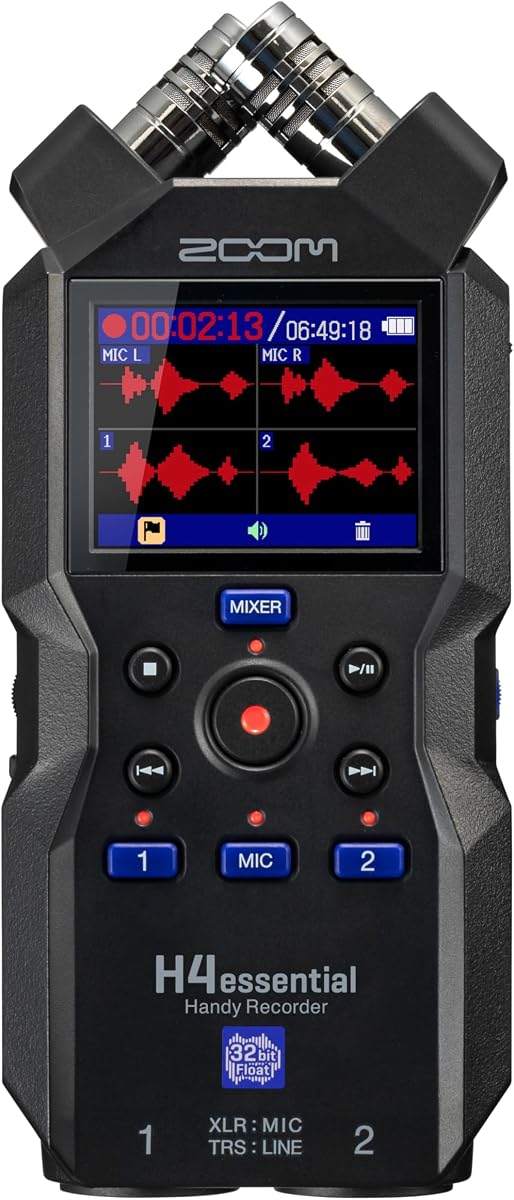


The Zoom H4 Essential is a versatile four-track recorder with a supplied rating of 4.4. It combines built-in stereo microphones with two XLR/TRS inputs, allowing a creator to capture a room, a performer, or multiple sources without changing to a different device. Its USB-C connection also makes it useful for streaming into a computer or mobile setup.
We may earn a commission when you buy through this link, at no additional cost to you.
The recorder's most important strength is flexibility. Musicians can connect a vocal microphone and an instrument, capture a rehearsal, and still use the internal microphones for room sound. It can also record to a phone, tablet, or computer over USB-C while saving a copy to an SD card, which is valuable when a livestream relies on a computer connection.
The trade-off is that the H4 Essential is more involved than a simple stereo voice recorder. Users need to understand track selection, input routing, storage requirements, and monitor levels. The spoken menu guidance improves accessibility and makes setup more approachable, but the device still offers more capability than a first-time streamer may initially need.
This is an excellent choice for a singer-songwriter, podcaster, or small ensemble that wants one recorder to handle both local capture and computer streaming. It is less compelling for someone who only needs a pocket backup of a podcast, but for creators who want expanded inputs without moving to a large multitrack console, the H4 Essential offers a particularly balanced toolset.
The two XLR/TRS inputs and four-track capability let creators pair vocals with instruments or record several performers. This makes the H4 Essential useful for rehearsal, live performance, and streaming preparation rather than simple narration alone.
USB-C recording can feed a phone, tablet, or computer while the recorder stores a separate copy on an SD card. That dual path is useful when a live broadcast needs redundancy or when a performance also needs to become a multitrack recording.
We may earn a commission when you buy through this link, at no additional cost to you.
The Zoom H1 XLR is a compact two-channel recorder that carries a supplied rating of 4.5. Rather than relying on built-in microphones, it focuses on two XLR/TRS combo inputs, making it a practical choice for creators who already own microphones, instruments, mixers, or compact signal sources.
We may earn a commission when you buy through this link, at no additional cost to you.
Recording in 32-bit float at up to 96kHz gives creators room to capture changing performance levels without relying on a perfect initial gain setting. The OLED waveform display provides a clear visual reference while monitoring, while the 3.5mm input and headphone output broaden the options for monitoring and connecting other devices.
Its primary limitation is channel count. Although two channels are sufficient for a solo singer and instrumentalist, a drummer, keyboardist, and vocalist would require another recording strategy. SDXC support up to 1TB also means users must plan for compatible high-capacity storage rather than assuming any memory card will work.
The H1 XLR is ideal for a mobile musician, filmmaker, or podcaster who values compactness and direct microphone control. It is a particularly compelling streamer’s capture device when the goal is to record a clean two-channel feed or stereo master while maintaining a small, easy-to-carry setup.
The OLED waveform display gives immediate information about signal levels, helping creators identify clipping and maintain cleaner recordings. This is especially helpful when moving between quiet speech, instruments, and louder performances.
The lack of built-in microphones is not a flaw for a model designed around professional external sources. It keeps the feature set focused and makes the recorder easy to pair with a compact microphone, stereo pair, or instrument setup.
We may earn a commission when you buy through this link, at no additional cost to you.
The Zoom H1 Essential is an approachable compact recorder for musicians, podcasters, and content creators, with a supplied rating of 4.0. Its built-in stereo microphones make it possible to begin recording a rehearsal, voiceover, interview, or ambient sound without assembling an external microphone setup.
We may earn a commission when you buy through this link, at no additional cost to you.
USB-C connectivity is its most relevant feature for streaming. It can serve as a microphone for livestreams, remote meetings, video calls, voiceovers, podcasts, and desktop or mobile recording, allowing creators to replace a basic built-in computer or phone microphone with a dedicated portable capture device.
The compromises are obvious when compared with recorder models that include XLR inputs and multitrack support. It is better suited to stereo capture than to isolating a vocalist and instrument on separate tracks. The supplied rating is also lower than several other options, so buyers should consider the model's simplicity rather than expecting every professional input feature.
This recorder suits a streamer who wants an inexpensive, portable, dedicated microphone and a separate tool for quick field recordings. It is a sensible starting point for podcasters and songwriters, while performers needing balanced XLR inputs or isolated tracks should consider a more specialized model.
Connecting the recorder by USB-C lets streaming software treat it as a dedicated microphone source. That can make it easier to position the recorder near a performance instead of relying on a computer's distant built-in microphone.
Beyond broadcasting, the built-in stereo microphones suit songwriting sessions, rehearsals, lessons, interviews, ambience, and sound-effect collection. The same device can therefore support both immediate content creation and later music-development work.
We may earn a commission when you buy through this link, at no additional cost to you.
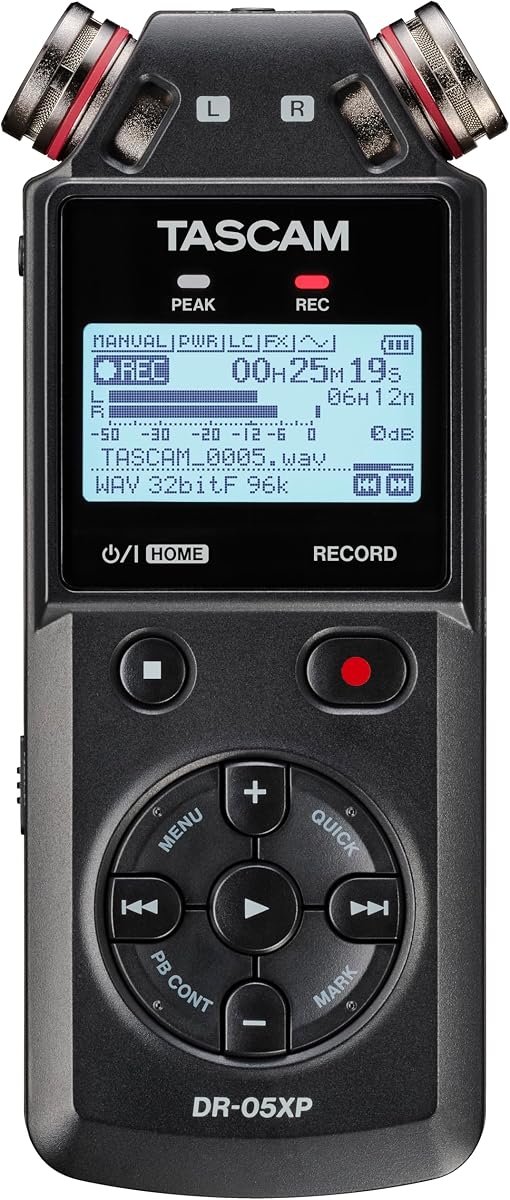
The TASCAM DR-05XP is a portable field recorder and USB-C audio interface with a supplied rating of 4.2. It supports music, voice, video sound, meetings, and dictation, making it a versatile companion for creators who want a standalone recorder and a computer-connected interface in one device.
We may earn a commission when you buy through this link, at no additional cost to you.
Its flexible modes include 32-bit float, 24-bit, and 16-bit recording, along with 96kHz, 48kHz, 44.1kHz, and MP3 options. The built-in omnidirectional condenser microphones can handle loud environments and sources up to 125dB SPL, while the two-in, two-out USB-C connection supports direct computer recording.
The package does not include an SD card or batteries, so the total ownership setup requires additional purchases. The microphones are omnidirectional, which is useful for capturing room character but may not provide the isolation or directivity some performers want without adding an external microphone.
The DR-05XP is a strong choice for a budget-conscious streamer who values a separate USB-C interface and needs reliable local recording. It also works well for field sound, rehearsals, voice recording, and video production, offering broad format support in a portable package.
The two-in, two-out USB-C interface lets a creator record digitally to a computer while keeping the DR-05XP ready for mobile capture. This is useful for remote performances, voice sessions, and streaming workflows that benefit from dedicated hardware.
The broad selection of bit depths, sample rates, and MP3 options supports both high-resolution production and convenient field capture. Creators can choose a format that matches the demands of editing, publishing, and storage.
We may earn a commission when you buy through this link, at no additional cost to you.
The Zoom R4 is a four-track recorder designed for rapid music creation, with a supplied rating of 4.5. Its strongest distinction is the ability to record, layer, bounce, and repeat, allowing a songwriter to build a complete idea in a single device rather than maintaining separate stems only in a computer workflow.
We may earn a commission when you buy through this link, at no additional cost to you.
The 32-bit float format reduces the need for repeated gain changes, while two XLR/TRS combo inputs accept microphones, instruments, keyboards, and other sources. A built-in microphone, effects, and more than 80 drum patterns across genres add practical tools for sketching arrangements and rehearsing with a rhythmic backing.
Although the R4 records up to four tracks, it has two physical combo inputs. Musicians who need to record a full band at once will need a more extensive input system. The built-in rhythm section and bounce-oriented design are also more useful for rehearsal and song development than for capturing a polished live audience mix on their own.
The R4 is a compelling match for singer-songwriters, producers, and streamers who want to capture ideas quickly and create layered music away from a studio. It also works as a battery-powered or USB-connected audio interface for computer and smartphone workflows, expanding its value beyond standalone recording.
The dedicated bounce track frees recording channels as parts are finished, while undo helps a creator step back when an arrangement needs revision. This workflow turns the R4 into more than a simple capture device.
More than 80 rhythm patterns across rock, hip-hop, funk, metal, and other styles provide an instant timing foundation. Together with effects and the built-in microphone, they make the recorder useful for spontaneous song development.
We may earn a commission when you buy through this link, at no additional cost to you.
The Zoom H6studio is a renewed eight-track, 32-bit float recorder built for creators who need more channel capacity than conventional compact recorders provide. Four XLR/TRS combo inputs give it the flexibility to record vocals, drums, instruments, and other sources in a mobile production environment.
We may earn a commission when you buy through this link, at no additional cost to you.
The included XY microphone capsule provides a built-in stereo option, and the 2-inch full-color display makes navigation easier when selecting inputs, tracks, and settings. The unit weighs 16.84 ounces and measures 3.27 by 8.70 by 2.15 inches, balancing expanded capability with manageable portability.
Because this listing is renewed, appearance or condition may differ from a new unit. The supplied data does not include a customer rating, so there is no numerical feedback score to use as a purchasing signal. Buyers should inspect the listing's condition details and confirm that the device, accessories, battery operation, inputs, and display all meet their needs.
The H6studio is most appropriate for a streamer or mobile musician who wants to layer several parts or record a small group without relying entirely on a computer. It is less suitable for a first-time buyer who needs only one microphone, but its eight-track architecture makes it a powerful bridge between a field recorder and a dedicated music workstation.
Eight-track recording supports layering and small-group capture without requiring every source to be mixed during the performance. Creators can preserve separate parts and perform the final balance later in editing software.
The full-color LCD, dedicated physical inputs, and four-AA battery operation support use away from a studio. A bundled XY capsule also gives the recorder a ready stereo option when a full external microphone rig would be excessive.
We may earn a commission when you buy through this link, at no additional cost to you.
The Zoom H2 Essential is a compact stereo recorder with three built-in microphones, nine selectable patterns, and a supplied rating of 4.4. It can move from intimate interviews to broad soundscapes without requiring a different microphone arrangement, giving solo performers and location recordists unusual flexibility.
We may earn a commission when you buy through this link, at no additional cost to you.
Its 32-bit float recording at up to 96kHz reduces the need to adjust gain for changing levels. More significantly for streaming, it can function as a USB microphone while simultaneously saving to an SD card. This creates both a computer-connected signal and a reliable local copy during a performance or recording session.
The listed feature set does not include XLR or TRS microphone inputs, so it is not the right choice for a creator who already owns a preferred external microphone and needs a full pro connection. It also requires a basic understanding of polar patterns to make the most of its three internal microphones. Wireless timecode synchronization is valuable for multi-unit work but adds a specialized use case.
The H2 Essential is excellent for a streamer who wants to capture a room, audience, rehearsal, or intimate stereo source and maintain an SD backup at the same time. Its pattern options make it particularly attractive to filmmakers, field recordists, and podcasters who need more directional control than a conventional built-in microphone provides.
Simultaneous USB microphone and SD-card recording is a valuable safety feature for live content. If a computer connection experiences an interruption, the local recording may still preserve the session.
Nine patterns allow a creator to narrow or widen the internal microphones' pickup. That makes it possible to favor a nearby instrument, isolate a speaker, or capture a broader musical environment from one compact device.
We may earn a commission when you buy through this link, at no additional cost to you.
The Zoom F3 is a professional field recorder for filmmakers and musicians, carrying a supplied rating of 4.6. It is built around two locking XLR inputs, clean preamps, and 32-bit float capture, focusing on dependable sound acquisition in locations where a take may not be repeatable.
We may earn a commission when you buy through this link, at no additional cost to you.
The locking XLR connections are particularly useful when the recorder is mounted on a larger rig or positioned where a conventional connector could become unsecured. Ultra-low-noise preamps help produce a clean signal, while 32-bit float recording provides substantial dynamic range for quiet dialogue and sudden louder peaks.
This is a specialized two-channel tool rather than a general-purpose home recorder. The supplied specifications do not describe multitrack recording, onboard effects, or extensive music-production features. It also carries a more specialized design than a simple creator recorder, making setup and signal flow more important for users who are comfortable with professional audio equipment.
The F3 is best for a serious musician, location sound recordist, or filmmaker who already uses quality microphones and values secure connections and clean preamps over effects or built-in rhythm tools. For streaming, it can function within a USB workflow, but its strongest advantage appears when used as a dependable standalone capture device for rehearsal, location, or performance audio.
Locking XLR sockets suit recorders mounted to stands, cameras, bags, or larger field rigs. They help preserve a dependable connection when movement or cable tension would challenge a less secure connector.
32-bit float capture and low-noise amplification allow a performer or filmmaker to work across a wide range of volumes. That reduces the risk of losing an important take to clipping or forcing repeated gain adjustments.
We may earn a commission when you buy through this link, at no additional cost to you.
The Zoom H5 Studio is a dedicated performer and filmmaker recorder with a supplied rating of 4.6. Its 19.4mm X/Y microphone capsule is described as the largest set of stereo microphones available on a handheld recorder, giving it a strong built-in capture option for rehearsals and location sessions.
We may earn a commission when you buy through this link, at no additional cost to you.
It records up to four tracks simultaneously at resolutions as high as 192kHz in WAV, while 32-bit float technology provides extended dynamic range. Dedicated gain knobs let performers adjust levels quickly and directly, which is valuable when a source changes and immediate control is more useful than navigating a menu.
The main limitation is the fixed nature of its built-in microphone pair and the greater complexity involved in a model built for high-resolution, multitrack work. Users who need a long cable run, unusual polar pattern, or highly directional external microphone may need an accessory or a recorder with more input options. The included feature set also places more emphasis on serious capture than streaming software integration.
The H5 Studio is an excellent choice for a musician who wants tactile controls, quality built-in stereo sound, and the ability to capture several tracks at once. It suits rehearsals, songwriting, location recording, and video production, especially for creators who value reliable standalone operation and flexible gain handling.
The large X/Y capsule captures a wide stereo image from a single matched pair. That makes the recorder a capable standalone tool for acoustic performances, interviews, and environmental sound without requiring an immediate external microphone purchase.
Dedicated gain knobs let a musician respond to changing source levels without leaving the main task. This direct control is a major advantage during live rehearsal and location recording.
We may earn a commission when you buy through this link, at no additional cost to you.
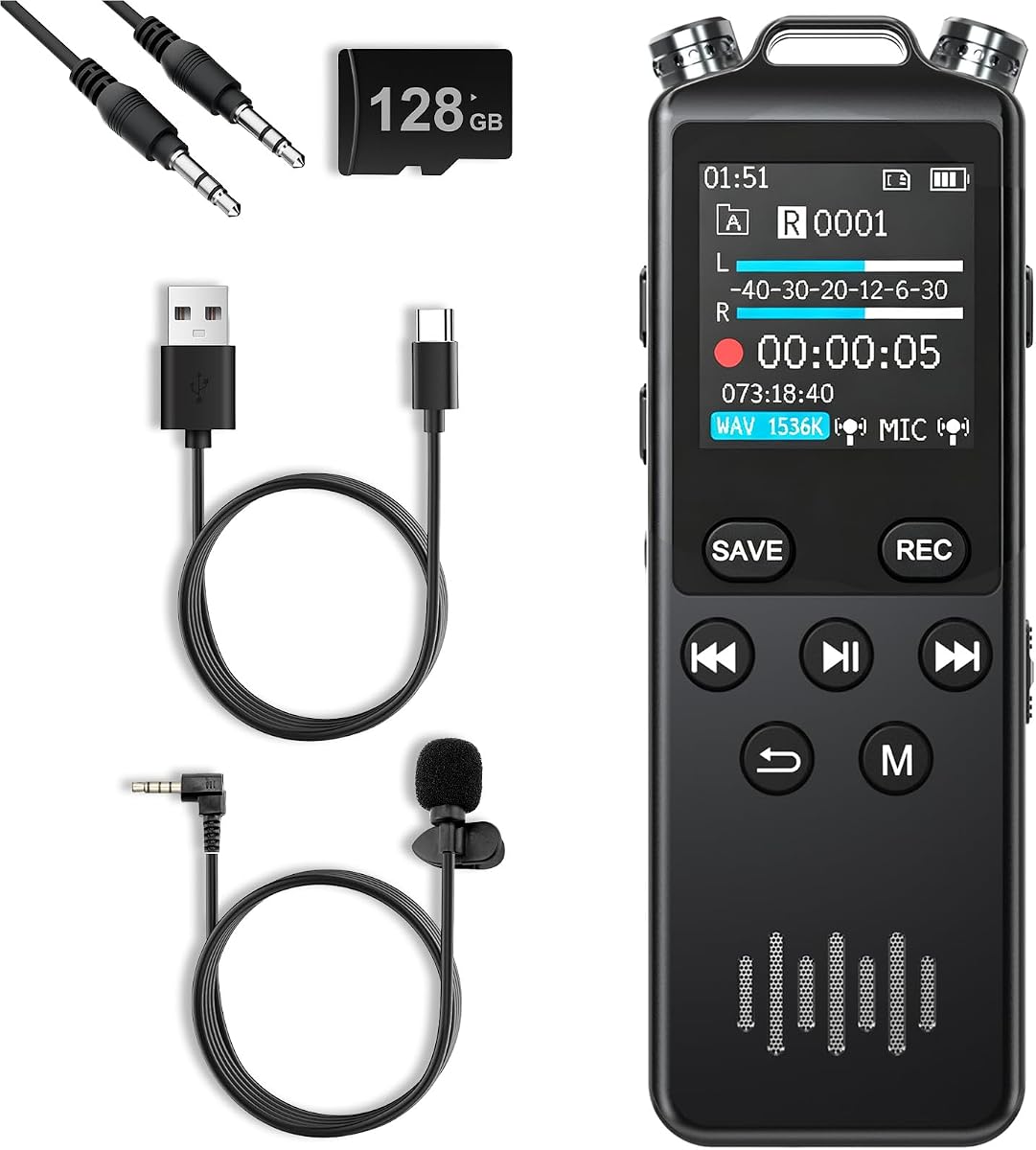
The 160GB Voice Recorder is a high-capacity handheld device for voice, meeting, lecture, interview, and journal recording, with a supplied rating of 5.0. Its storage combines 32GB of RAM with a 128GB memory card, while the product information claims support for as many as 11,500 hours of stereo recordings.
We may earn a commission when you buy through this link, at no additional cost to you.
Dual microphones and 1536kbps stereo recording are designed to provide balanced, detailed sound. A 1100mAh rechargeable battery is stated to support more than 68 hours of continuous operation, making the device useful for long conferences, classes, and extended note-taking. The zinc-alloy and acrylic body adds a secure pocket-sized form.
This model is not positioned as a music-streaming interface. The supplied specifications do not mention USB-C streaming, XLR inputs, multitrack recording, or dedicated USB audio interface operation. It also lacks the 32-bit float workflow found in many dedicated music recorders, so a musician wanting a broadcast feed or isolated instrument tracks should choose a purpose-built alternative.
The device is best for a streamer who needs inexpensive, long-duration local audio backup alongside a livestream, or for a creator who records meetings and voice notes in one device. Multiple modes, voice activation, scheduled recording, segment recording, WAV and MP3 support, bookmarking, and variable-speed playback make it especially useful for spoken-content documentation.
The unusually high storage capacity reduces the likelihood that a long lecture, conference, or journaling period will run out of room. It is a practical choice for creators who want to retain extensive voice archives on a portable device.
Normal, meeting, outdoor, and long-distance modes, together with voice control, scheduling, and segment recording, let the device operate with less attention. These functions suit a backup recorder during a livestream more than a controlled studio performance.
We may earn a commission when you buy through this link, at no additional cost to you.
The right recorder depends on how the audio reaches your stream, how many sources must be captured, and how much local backup you need. Input flexibility, monitoring, storage, and portability should be considered together rather than separately.
For a streaming-focused purchase, verify that the recorder can operate as a USB microphone or USB audio interface with the computer, phone, or tablet used for broadcasting. The Zoom H1 Essential, TASCAM DR-05XP, Zoom R4, Zoom H2 Essential, Zoom H4 Essential, and Zoom F3 all have stated USB workflows, but they do not necessarily provide identical channel counts or simultaneous-recording features.
Choose based on how the broadcaster plans to use the connection. A single stereo feed is simpler, while separate microphone and instrument channels provide more control in a live mixing application. Also check whether the recorder saves a local copy while connected, because that can provide valuable protection against an interrupted broadcast.
Built-in microphones are convenient for rehearsals, interviews, ambience, and quick content, but external XLR or TRS inputs provide access to the microphones, preamps, and instruments a serious performer already owns. Models with two inputs suit a vocalist and one instrument, while four inputs can handle a drummer, keyboard, guitar, and vocal source more effectively.
The supplied product data also distinguishes fixed microphone capsules from interchangeable or pattern-based systems. A single X/Y pair offers broad stereo capture, while multiple selectable patterns can help a creator change between a focused and wide pickup. Match the connection count and microphone design to the source rather than choosing on channel specifications alone.
Multitrack recording allows parts to be balanced after a performance instead of committing everything to a single stereo mix. The Zoom R4, Zoom H4 Essential, Zoom H5 Studio, and Zoom H6studio are the strongest options in this list for layered music. Their capabilities range from four-track capture to the H6studio's eight-track configuration.
Track count should be considered alongside physical input count. A recorder may support eight tracks while providing only two physical inputs, which is useful for overdubbing but not for capturing several performers simultaneously. Songwriters who build one layer at a time may appreciate that distinction, while a band recording live needs enough sockets for everyone.
The Zoom H1 XLR records at up to 32-bit and 96kHz, the TASCAM DR-05XP supports 32-bit float plus several sample rates and MP3, and the Zoom H5 Studio supports four tracks at up to 192kHz WAV. These specifications affect editing flexibility, storage consumption, and the amount of processing a creator expects from a production file.
Musicians often benefit from 32-bit float because it provides extra headroom when a source changes unexpectedly. Higher sample rates can be useful for detailed editing, although they also create larger files. Voice-oriented users may place less emphasis on maximum resolution and more on capacity, automatic modes, and playback convenience.
A waveform display, headphone output, and dedicated gain controls make it easier to judge a signal before or during capture. The Zoom H1 XLR uses an OLED waveform display for quick level awareness, while the Zoom H5 Studio provides physical gain knobs for immediate adjustment. The Zoom H2 Essential emphasizes a set-and-forget approach through 32-bit float capture.
The absence of a large display is not necessarily a problem for a creator who is already monitoring through an external interface, but beginners benefit from visible meters and clear indications of clipping. Headphone monitoring is also important for performers who need to hear themselves without creating a feedback loop through speakers.
A streaming setup benefits from a local recording because network interruptions, software crashes, or accidental stream stops cannot erase a separate capture. The Zoom H2 Essential records to USB and an SD card simultaneously, while the Zoom H4 Essential can also save to an SD card while connected by USB-C. The 160GB Voice Recorder offers particularly high capacity for spoken-content backups.
Storage format matters. The Zoom H1 XLR supports SDXC cards up to 1TB, while the TASCAM DR-05XP requires a compatible SD card that is not included. Check the recorder's supported media, maximum capacity, file format, and write speed requirements before recording a long event. Large storage does not compensate for an incompatible card.
A recorder used at rehearsals, street performances, or livestream locations should be easy to transport and power. The TASCAM DR-05XP states up to 17.5 hours of operation with two AA alkaline batteries, and the Zoom R4 can run on four AA batteries or USB-C. The Zoom H6studio is also designed around four-AA operation for extended mobile use.
Consider the size of the microphones, battery solution, controls, and any accessories that must travel with the recorder. A compact body with a fixed X/Y pair may be convenient, while a model requiring multiple wired microphones and stands may demand more setup than a solo streamer wants.
The best device is the one that fits the task without forcing unnecessary complexity. A singer-songwriter may prioritize stereo built-in sound, tactile gain controls, and layering. A streamer may prioritize USB operation, a local backup, and a compact form. A voice-focused user may value capacity, automatic recording modes, and playback controls over XLR inputs.
Look for a recorder whose primary strengths map directly to your normal workflow. Buying a sophisticated multitrack tool for occasional voice notes adds controls without improving the result, while buying a simple memo recorder for regular live performance can limit future flexibility. Treat the product category as a set of recording jobs rather than a single universal use case.
Before recording, format a compatible memory card, install the required batteries, and confirm that the USB-C connection and streaming application recognize the recorder as an audio input. Test the input route with a short recording before the live session. Check levels, headphone monitoring, storage remaining, and the final sample rate and file format.
Place microphones according to the room and source rather than relying on the recorder's default level. Keep the device stable, protect cables from strain, and leave sufficient space between a microphone and a loudspeaker to reduce feedback. When streaming, save a local copy when the recorder supports simultaneous recording, but monitor storage so the backup does not interrupt the broadcast.
After the session, power down the unit before changing cards or cables, then copy files to a computer before formatting the card. Keep the recorder dry, protect it from extreme heat, and store microphones separately from moisture. Replace aging batteries and cables if recording reliability declines, and use a protective case for mobile work.
Yes, if the model includes a compatible USB microphone or audio-interface mode. The Zoom H1 Essential, TASCAM DR-05XP, Zoom R4, Zoom H2 Essential, Zoom H4 Essential, and Zoom F3 have stated USB workflows. Confirm the recorder appears as an input in the streaming software and test the channel count and monitoring behavior before going live.
They are not essential for every solo stream, but they allow you to use a preferred microphone or connect an instrument directly. A recorder with built-in stereo microphones can work for rehearsals and room capture, while XLR or TRS inputs offer more control, a cleaner signal path, and greater flexibility as the setup develops.
32-bit float provides additional headroom, making it less likely that a sudden loud passage will clip the recording. This is especially useful in unpredictable performance environments where the performer cannot stop to reset the gain. It does not replace careful microphone placement, monitoring, or backup planning.
A backup is advisable because a software or network interruption can interrupt a live broadcast. Recorders such as the Zoom H2 Essential and Zoom H4 Essential support simultaneous local capture, while other models can record separately before or after a stream. Leave enough storage for the full session and confirm that backup recording has started.
It is useful when you want to record vocals and instruments separately, layer parts, or retain alternative performances. A multitrack model such as the Zoom R4 or Zoom H5 Studio can be especially helpful for home production. If you only need a finished stereo recording, a simpler stereo recorder may be sufficient.
Required capacity depends on recording duration, bit depth, sample rate, and file format. High-resolution WAV files consume much more space than compressed recordings, so long sessions benefit from a large card. Check the recorder's supported card type and maximum capacity, and use a card with suitable sustained write performance.
USB-C streaming sends the recorder's signal to a computer, phone, or tablet for live broadcast, while USB recording saves the audio as a file. Some models support both, potentially creating a local copy at the same time. The exact routing depends on the model, so consult its controls and verify the behavior with a short test.
A general voice recorder can capture ambient sound, but a music-focused model usually offers better input control, higher-quality microphones, multitrack options, or professional connectors. The 160GB Voice Recorder is better suited to a long-duration spoken backup than to a carefully controlled musical stream or isolated instrument recording.
The Zoom H4 Essential stands out for creators who want one recorder to cover two XLR/TRS inputs, four-track capture, USB-C streaming, and SD-card backup. The TASCAM DR-05XP is an appealing budget-oriented choice for straightforward stereo recording and computer use, while the Zoom H5 Studio is the stronger premium option for a musician who values tactile gain control, large built-in microphones, and simultaneous multitrack recording.
Prioritize the workflow you will actually use. A solo streamer may need little more than a reliable USB microphone and a local backup, while a songwriter may want separate tracks and layering. Performers should also consider external input flexibility, monitoring, storage compatibility, battery life, and whether the controls are comfortable during a live session.
Ratings, stock status, and prices can change over time, so review the current product listing and confirm the exact accessories, storage requirements, and warranty details before purchasing. The supplied information provides a strong basis for comparison, but current availability and included components should always be verified.