
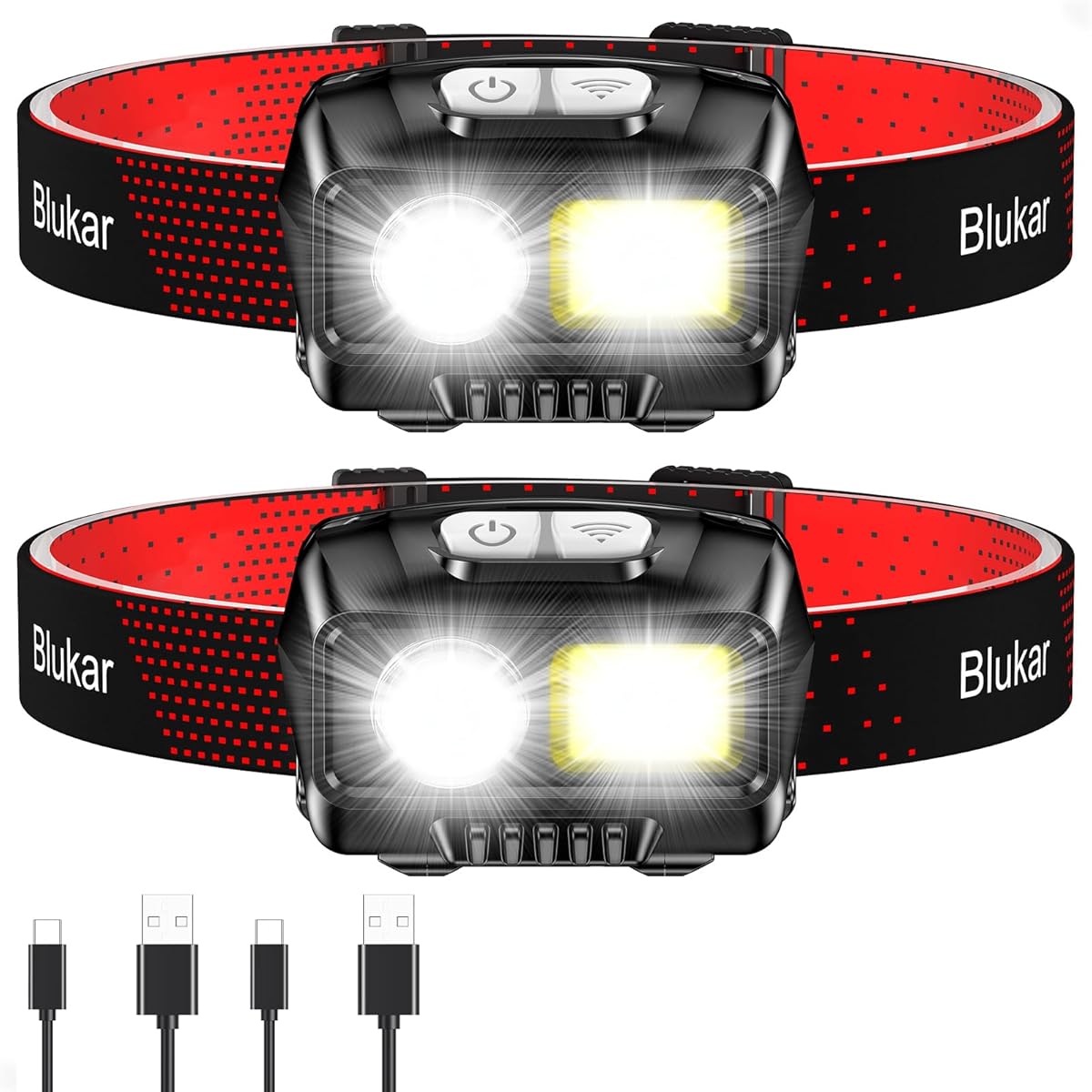
Blukar 2000L Rechargeable Headlamp
4.6Editor score
Stepless brightness adjustment
Eight lighting configurations
IPX5 water resistance
Our headlamp for kayaking guide compares 10 top models for brightness, runtime, waterproofing, fit, controls, and hands-free nighttime visibility on the water.
A headlamp for kayaking must do more than illuminate a campsite. It needs to provide a focused beam for navigating waterways, a wide beam for checking gear, and reliable red or low-output light without ruining the vision of a paddling partner. Water resistance, comfortable fit, simple controls, and dependable battery life matter just as much as raw brightness.
We compared ten headlamps using the specifications and features available for each model, focusing on light output, beam options, waterproof ratings, power systems, adjustability, and specialized modes. The list covers budget and premium choices, rechargeable and replaceable-battery designs, compact models, and feature-rich headlamps suited to different kayaking styles.
Each review explains the product's strongest qualities and the trade-offs worth considering before buying. The three highlighted picks represent a budget option, an all-around choice, and a premium model, while every product in the comparison table receives its own detailed assessment. Product availability, features, and prices can change, so check the current listing before purchasing.
4.6Editor score

4.7Editor score

4.4Editor score
The table below compares the key characteristics of all ten headlamps, including maximum output, water resistance, power source, lighting options, and weight. It provides a quick way to identify the model that best matches your budget, preferred controls, and expected conditions on the water.



The LHKNL Rechargeable Headlamp is a remarkably light option for kayakers who prefer to carry less gear. It has a 4.5 rating and stands out for its 1.87-ounce listed weight, rechargeable 1500mAh battery, and eight lighting modes. The combination of side LEDs, red light, and motion sensing makes it especially versatile for campsite tasks and low-light paddling.
We may earn a commission when you buy through this link, at no additional cost to you.
Its controls are designed for use when your hands are wet, cold, or occupied. Holding the mode button for three seconds turns the light off from any lighting mode, while waving a hand activates the motion sensor. The lamp can illuminate a tent or nearby road with its stronger settings, and the battery indicator gives users a clearer picture of remaining power. Its 4-to-10-hour stated runtime varies with the selected mode.
The main compromise is its IPX4 water-resistance rating. That level of protection is appropriate for rain, snow, and splashes, but it is not a guarantee of immersion resistance. The built-in battery also cannot be replaced independently, so kayakers who expect very long outings away from charging opportunities should carry a backup light. The red beam is nevertheless useful for preserving night vision around camp or checking equipment without creating a harsh white glare.
This headlamp is an excellent choice for day paddlers, casual overnight kayakers, and anyone who prioritizes low weight, multiple beams, and easy one-handed operation. It may not be the first choice for prolonged wet-weather expeditions, but its compact body and hands-free features make it a strong value for regular outings.
At only 1.87 ounces as listed, the LHKNL is one of the lightest selections in this guide. Its elastic band can be adjusted for different head sizes, while the 60-degree lamp rotation helps keep the beam directed where the paddler needs it without constantly readjusting the entire unit.
The motion sensor eliminates repeated button presses when both hands are on the paddle. A three-second long press provides a direct way to shut the lamp off, and the red light and SOS red strobe add options for campsite navigation and emergency signaling.
We may earn a commission when you buy through this link, at no additional cost to you.
The Blukar LED Headlamp Rechargeable combines multiple beam technologies with useful sensor controls, earning a 4.5 rating. It uses XPG and COB LEDs to provide spotlight and floodlight coverage, while a long press adjusts brightness continuously from full output down to 30 percent. That range is helpful on the water because it lets a paddler match illumination to the task rather than relying on a few fixed settings.
We may earn a commission when you buy through this link, at no additional cost to you.
Five standard modes cover XPG white, COB white, combined XPG and COB white, COB red, and a COB red strobe. Three additional motion-sensor modes let the user wave a hand to switch the light on or off. The 1200mAh battery charges through USB-C, and the included cable simplifies preparation for a trip. Its IPX5 rating provides stronger weather resistance than an entry-level splash-rated model.
Its 2.96-ounce listed weight is heavier than the LHKNL but still reasonable for a headlamp. The washable, removable band improves long-term comfort and hygiene, while the 45-degree tilt allows the beam to point slightly downward for looking at equipment in the cockpit. The trade-off is that a continuously adjustable sensor and multiple modes create more complexity than a simple three-mode light, and accidental activation is possible if the sensor is not positioned carefully.
Choose this model if you value a broad lighting toolkit, stepless dimming, and frequent use of red or strobe illumination. It is particularly suitable for campsite setup, checking lines and equipment, and keeping both hands on the paddle while the light is activated with a wave.
The XPG and COB combination gives this headlamp a practical balance of reach and coverage. Use the focused XPG output to inspect a shoreline or locate gear farther away, and switch to the broad COB illumination for immediate surroundings or tasks inside the cockpit.
USB-C charging reduces cable friction, and the removable, washable headband is practical for repeated outdoor use. A user can wash the band after sweat or water exposure rather than maintaining a fixed fabric strap around the head.
We may earn a commission when you buy through this link, at no additional cost to you.
The Coast XPH30R is the strongest all-around choice in this guide. It carries a 4.7 rating and combines 1200-lumen turbo output, a twist-focus beam, USB-C charging, and a detachable magnetic body. Those features give it enough flexibility for navigation, campsite work, equipment checks, and emergency lighting while remaining well suited to the realities of paddling.
We may earn a commission when you buy through this link, at no additional cost to you.
Its patented Pure Beam focusing system allows the user to transition between short-range flood illumination and long-range viewing without the halos or hot spots associated with some adjustable beams. Output tiers are clearly specified at 1200 lumens in turbo, 500 lumens at high, 160 lumens at medium, and 46 lumens at low. Stated runtimes are 6.75 hours at high, 10 hours at medium, and 28 hours at low, making mode selection important for longer outings.
The detachable design is especially valuable in a kayak because the lamp can be removed from the head strap and used as a handheld flashlight. Its built-in magnetic base can also attach it to a suitable metal surface, offering more placement options than a conventional headlamp. The trade-off is its 4.37-ounce weight, which is higher than the lightest products in the comparison, and turbo output will drain the battery faster than lower settings.
This is the recommendation for kayakers who want one adaptable tool rather than several specialized lights. It suits overnight paddlers, solo expedition paddlers, and anyone who may need to illuminate distant objects and immediate gear. The IP54 rating and one-meter drop protection support regular outdoor use, while the detachable, focusable design is the feature combination that most directly benefits life on the water.
The twist-focus optic is valuable on a river or lake where required illumination changes quickly. A wide beam makes navigating shallow water and checking the cockpit easier, while a tighter beam helps examine a distant shoreline, identify a trail marker, or search a larger area without depending on another flashlight.
Removing the lamp from the strap gives kayakers the option to direct light exactly where needed. The magnetic base adds further flexibility, allowing the light to be placed on an appropriate metal surface when the user needs both hands for paddling, rigging, or repairs.
We may earn a commission when you buy through this link, at no additional cost to you.
The Black Diamond Cosmo 350 is built for users who prioritize weather resistance and flexible power options. It has a 4.6 rating, produces up to 350 lumens, and carries an IP67 rating that allows operation after submersion in water up to one meter for 30 minutes. That makes it a compelling choice for wet-weather kayaking, subject to following the manufacturer's care guidance.
We may earn a commission when you buy through this link, at no additional cost to you.
The Cosmo accepts three included AAA batteries or a rechargeable BD 1500 Li-ion battery. This dual-fuel design is useful because a kayaker can choose disposable batteries for convenience or add the rechargeable battery system for repeated trips. Lighting options include dimming, strobe, and red night-vision settings. A simple button interface keeps the controls approachable, while the low-profile housing and adjustable band promote a stable, comfortable fit.
The important trade-off is that the rechargeable battery and charger are additional purchases, and AAA power generally will not deliver the same operating time as a higher-capacity integrated lithium-ion pack. The product should also be completely dried after wet use, as stated in its instructions. For someone who already owns compatible Black Diamond accessories, though, the flexibility can reduce long-term friction.
The Cosmo 350 best suits paddlers who expect rain, spray, or accidental immersion and want dependable illumination in compact form. It is also attractive for hikers who value replaceable batteries and night-vision modes. It may not be the first choice for maximizing total runtime, but its strong environmental rating and dual-fuel design set it apart.
The IP67 rating is the standout feature for kayaking. It provides a higher level of protection than models designed only for rain and splashes, making the Cosmo a sensible option for conditions where condensation, waves, and gear movement can expose a headlamp to water.
Using included AAA batteries keeps the initial setup simple, while the compatible rechargeable battery offers an alternative for regular users. This lets the owner choose power based on trip length, charging access, and the batteries already carried.
We may earn a commission when you buy through this link, at no additional cost to you.
The Blukar Three-Light Headlamp stands out for its combination of a zoomable main beam, a side light, and a rear red light. It has a 4.6 rating and uses T6 and XPE LED emitters to provide an even, broad field with an adjustable focal length. For a kayaker, the rear light adds a visibility benefit while the zoom function handles changing inspection distances.
We may earn a commission when you buy through this link, at no additional cost to you.
Five modes provide main white, side white, all-white, flashing white, and main red output. Rotating the main lens changes the beam between flood and spotlight patterns, making it easy to move from close-range cockpit work to more directed illumination. The lamp head rotates 90 degrees, and the breathable elastic band is adjustable and non-slip. A stated five-hour recharge time is supported by the included USB cable.
The primary limitation is its integrated, non-removable battery pack. That keeps the design simple and compact, but it means a depleted battery cannot be swapped for a fresh one in the field. The product is also intended for long-term lighting after charging, yet its stated charging interval means it should be prepared well before an overnight departure. Its IPX6 rating is nevertheless well suited to rain, snow, and active outdoor use.
This model is a strong choice for kayakers who value a combination of forward and rear visibility. It works particularly well for evening launches, campsite arrivals, and group outings where a red rear light can make the paddler easier to notice. The zoomable main light also makes it useful for both immediate gear checks and scanning farther ahead.
The red rear light offers a way to remain more visible without relying entirely on the main white beam. It is especially useful during low-light launches, around bends, and when several paddlers are moving through the same area.
The rotating lens allows a user to select a wide flood or tighter spotlight without changing devices. That flexibility is convenient on the water because a single headlamp can serve both immediate boat-side tasks and longer-distance searches.
We may earn a commission when you buy through this link, at no additional cost to you.
The Blukar 2000L Two-Pack is a budget-conscious recommendation because it supplies two headlamps with the same feature set. It has a 4.6 rating, continuous brightness adjustment, eight lighting configurations, motion sensing, and an IPX5 water-resistance rating. A pair is particularly useful for couples, families, or solo paddlers who want a backup.
We may earn a commission when you buy through this link, at no additional cost to you.
The regular modes combine XPG and COB white light, red light, and a red SOS function. A long press reduces brightness from 100 percent to 30 percent, which allows the user to preserve battery life without settling for a very dark fixed setting. In motion mode, the lamp can be switched with a wave of the hand. Its 1200mAh battery recharges by USB-C in a stated two to three hours, and the cable is included.
Runtime depends on the mode. The stated figures are 3.5 hours in XPG and COB mode and 5 hours in COB or XPG mode, so a paddler should not treat every setting as equal. The 45-degree adjustment helps direct the beam without moving the strap, and the detachable, washable band improves comfort over repeated trips. IPX5 protection handles rain and snow, though it is not equivalent to a fully waterproof design.
This is the best budget pick for most recreational kayakers because it combines a useful selection of beams, recharge convenience, sensor control, and a two-unit package. A solo paddler can keep one unit in the dry bag and the other in reserve, while partners can each have independent light. The model is less suitable for very long expeditions unless paired with another power source.
Having a second headlamp is especially sensible on the water, where a failed light can affect navigation, equipment checks, and emergency signaling. The two-unit format makes it easy to divide equipment between paddlers or keep one protected as a reserve.
Continuous adjustment from full to 30 percent brightness is a valuable battery-management feature. Lower illumination is suitable for reading gauges, sorting gear, and moving around camp without using the strongest output for every task.
We may earn a commission when you buy through this link, at no additional cost to you.
The Black Diamond Spot 400 is aimed at paddlers who need dependable trail visibility without moving to a larger integrated-light design. It has a 4.6 rating, produces up to 400 lumens, and provides multiple brightness settings plus proximity modes. Its low-profile housing and adjustable band are designed to remain stable during active use.
We may earn a commission when you buy through this link, at no additional cost to you.
A red night-vision mode is useful for checking equipment or moving around camp without fully adapting the eyes to bright white light. The button interface keeps mode changes straightforward. The Spot 400 runs on three included AAA batteries and can be upgraded with the BD 1500 Li-ion battery and charger, which are sold separately. That dual-power approach makes it adaptable to users with different battery preferences.
The trade-off is that compatibility with a rechargeable platform requires additional accessories. AAA batteries are convenient and widely available, but they generally provide less total runtime than a dedicated integrated lithium-ion battery. The product is also less specialized as a two-pack solution, since the listed configuration centers on one headlamp. Kayakers should therefore consider whether they prefer the flexibility of familiar batteries over longer operating time.
The Spot 400 is well suited to users who paddle on marked routes, explore shorelines, or carry the headlamp as a broader hiking and emergency light. Its focused output, red mode, and secure fit make it a strong all-day outdoor companion. It earns a place in this guide for those who prioritize replaceable power and straightforward nighttime visibility.
Red illumination is helpful when checking a map, organizing a dry bag, or moving quietly near other paddlers. It provides enough light for basic tasks while reducing the harsh glare of a full white beam.
Three AAA batteries make the light easy to power with common cells. Users who expect frequent use can add the separately sold rechargeable battery and charger, creating a more sustainable long-term setup without changing the headlamp.
We may earn a commission when you buy through this link, at no additional cost to you.
The Black Diamond Storm 500-R is a rugged, rechargeable option for kayakers who prefer a straightforward headlamp with substantial output. It has a 4.4 rating, reaches 500 lumens, and uses a 2400mAh integrated lithium-ion battery. Its weather-resistant housing and adjustable low-profile band suit active outdoor use.
We may earn a commission when you buy through this link, at no additional cost to you.
The lighting choices cover full strength, dimming, strobe, and red night-vision output. This is a more streamlined set than the eight-mode configurations offered by several budget models, but it includes the modes most relevant to camping and navigation. A charger is not specified as included, so users should verify what accessories accompany the lamp. Micro-USB is a less universal connection than USB-C, although it remains widely supported.
Its larger integrated battery is both a strength and a contributor to its overall bulk. Kayakers should expect a slightly less compact package than the lightest products, but the 500-lumen maximum provides a useful balance of reach and flood illumination. The rugged construction is intended to handle rain, snow, and demanding conditions, though buyers should still follow the correct charging and storage guidance.
The Storm 500-R is a good choice for campers and paddlers who want fewer controls, a bright maximum setting, and rechargeable power in a durable housing. It is less compelling for users who prioritize USB-C convenience or a removable lamp body. Within the guide, it serves as a rugged middle ground between compact budget models and premium focusing systems.
The 2400mAh integrated battery supports a straightforward approach: recharge before the trip and use the mode that matches the task. The reduced control complexity can be helpful in cold or wet conditions when interacting with small buttons is less convenient.
Kayaks and gear bags are not always sheltered from rain or spray. A rugged, weather-resistant housing gives this model an advantage for storage outside a tent or for use during unpredictable paddling conditions.
We may earn a commission when you buy through this link, at no additional cost to you.
The Petzl ACTIK CORE is the premium recommendation in this guide, combining 625 lumens, 88 grams, rechargeable power, and a mixed beam designed for both proximity and distance. Its 4.4 rating reflects a specialized lighting package that goes beyond simply offering a bright and dim setting.
We may earn a commission when you buy through this link, at no additional cost to you.
The mixed beam combines wide and focused illumination, allowing a paddler to see the immediate cockpit and a distant target without switching between radically different light sources. Three white levels include MAX BURN TIME, STANDARD, and MAX POWER. Continuous red light preserves night vision without blinding people nearby, while the strobe is intended to signal location in an emergency. A battery indicator displays the charge level whenever the lamp is switched on or off.
Its plate allows the lamp to tilt upward, including when the headlamp is worn around the neck. That positioning is unusual and useful for kayaking because it can direct light toward the bow or cockpit without requiring the user to point the head downward. The symmetrical adjustable band is made entirely from recycled materials and can be removed, washed, and replaced. The main trade-off is the use of Petzl's Core rechargeable battery system, so owners should check battery and charging compatibility before committing.
This model is ideal for regular paddlers, outdoor enthusiasts, and users who want a lightweight light without giving up advanced beam control, red illumination, and battery-status information. It is particularly appropriate for mixed-use trips involving hiking, camping, and paddling. Its premium construction and flexible positioning justify consideration for anyone who expects to use a headlamp regularly rather than only on occasional outings.
The combined flood and focused output is useful because paddling requires both environmental awareness and detail. The wide component illuminates nearby obstacles and gear, while the focused component helps examine distant water, shoreline features, or a navigation marker.
The tilting plate lets the lamp be aimed upward even when worn lower around the neck. This can illuminate the kayak's bow more naturally and gives the user a useful alternative to the conventional forehead-mounted position.
We may earn a commission when you buy through this link, at no additional cost to you.
The Energizer PRO-360 is a budget-friendly option with a 4.7 rating and a familiar AAA-battery format. It is designed for reliable hands-free use in camping kits, hiking, running, and emergency supplies. Its VisionGuard technology increases light intensity gradually, which may make activation feel less abrupt in close surroundings.
We may earn a commission when you buy through this link, at no additional cost to you.
The mode selection is unusually broad for a simple AAA-powered light. Available choices include high, low, wide, wide low, green, and red or flashing output. Green can be useful for map and instrument checks, while red and flashing modes support discreet camp use and signaling. The included three Energizer MAX AAA batteries mean the headlamp can be used without waiting for a recharge or purchasing separate cells.
The main limitation is its IPX4 water-resistance rating, which is intended to handle splashes and rain rather than immersion. Its impact resistance up to one meter and shatterproof lens improve durability, but kayakers should keep it protected from submersion and store it properly after wet use. A disposable-battery workflow also creates ongoing replenishment needs and is less convenient than an integrated rechargeable design.
The PRO-360 is best for occasional kayakers, emergency-kit builders, and people who want a simple headlamp using widely available batteries. It is also a useful backup because it does not require a proprietary charging system. For users searching for a high-output dedicated kayaking light, it falls short of the Coast, but for accessible nighttime visibility, it remains a capable choice.
Using standard AAA batteries means the light can be topped up with cells that are easy to find and carry. This simplicity is valuable for emergency kits, occasional outings, and paddlers who prefer not to manage a built-in rechargeable battery.
Red and green outputs provide alternatives for preserving night vision or checking details with less glare. The flashing option also adds a signaling function, while the wide and low white modes make the light useful beyond emergencies.
We may earn a commission when you buy through this link, at no additional cost to you.
The best headlamp for kayaking balances light control, water resistance, battery strategy, fit, and nighttime visibility. Because conditions change quickly on the water, it is better to compare complete feature sets than to choose solely by maximum lumen output.
A useful kayaking headlamp needs both proximity and distance illumination. A flood or wide beam reveals nearby obstacles, cockpit contents, paddle position, and shoreline detail, while a focused beam helps scan farther ahead, identify a marker, or inspect a distant object. The Coast XPH30R offers twist focusing, the Petzl ACTIK CORE uses a mixed beam, and several Blukar models combine focused XPG and broad COB emitters. A model with only one beam pattern can still work, but it may force you to choose between seeing the immediate surroundings and looking farther down the route.
Maximum lumens indicate potential brightness, but sustained output, beam shape, and battery behavior matter more than a single headline number. The Coast reaches 1200 lumens in turbo mode, the Petzl is rated at 625 lumens, and the Black Diamond models range from 350 to 500 lumens. Bright settings are valuable for searching or seeing distant terrain, but they can consume power quickly and may be unnecessary for routine campsite tasks. A headlamp with stepless dimming or several clearly separated levels gives you more control.
Water-resistance ratings describe different levels of protection. The Black Diamond Cosmo 350 has an IP67 rating and can withstand submersion in water up to one meter for 30 minutes when used according to its instructions. IPX6 models are designed to handle heavy rain and powerful water jets, while IPX5 and IPX4 designs are generally more appropriate for rain, snow, and ordinary splashes. None of the ratings should be interpreted as permission to leave a headlamp submerged intentionally. Dry the unit fully after use, particularly before charging.
Battery strategy should match the length and remoteness of your paddles. Integrated lithium-ion batteries are compact and rechargeable through USB-C or micro-USB, but their capacity and charging specifications differ. AAA systems make spare power easy to find, though disposable cells add weight and require ongoing replacement. The Petzl ACTIK CORE uses a rechargeable Core battery, the Coast charges through USB-C, and the Black Diamond Cosmo and Spot can run from AAA batteries or compatible rechargeable accessories. Always compare stated runtimes at the brightness level you expect to use.
Red light is valuable on the water because it provides enough illumination for checking equipment or organizing a gear bag without destroying dark adaptation. It is also less disruptive to nearby paddlers. Several products in this guide include red beams or strobes, while the Petzl offers continuous red lighting and the Energizer provides red, green, and flashing modes. Red is not a substitute for a navigational beam, but it is a valuable secondary function that can reduce the need to turn on a harsh white light at camp.
A headlamp that shifts during paddling can be both frustrating and unsafe. Look for an adjustable band, a stable housing, and enough tilt to aim the beam without moving the entire unit. The LHKNL rotates 60 degrees, the Blukar three-light model offers 90-degree adjustment, and the Coast XPH30R can be removed from its strap for handheld or magnetic placement. A low-profile design is also helpful under a hat. Whatever design you choose, test the fit before the trip because head shape and headwear can affect stability.
Small buttons become difficult to operate when fingers are cold, wet, or gloved. Motion sensors allow some models to be switched on or off with a wave of the hand, and a direct long-press shutdown can save time. The LHKNL and both featured Blukar designs offer sensor control, although a motion-responsive light can also activate unintentionally if positioned carelessly. Simple one-button interfaces remain dependable. Whichever control system you select, learn the sequence before heading onto the water.
A headlamp on a kayak should not be the only source of emergency light. Its usefulness increases if it offers a strobe, a robust body, and visible red output. The Blukar two-pack is especially practical because one lamp can remain a dedicated reserve, while the Coast's detachable magnetic body can serve as a handheld light when the strap is removed. Carry a small backup flashlight separately, keep spare batteries accessible, and protect the main headlamp inside a dry bag when it is not in use.
Before leaving, fully charge the lamp or install fresh batteries, check the strap, and learn how each lighting mode is activated. Test the brightest, dimmest, red, and emergency settings in a dark area. Confirm that the beam can be aimed where needed while the strap remains secure over a hat, and place the unit in an accessible pocket or dry bag rather than burying it in inaccessible cargo.
While underway, use the lowest practical brightness for immediate tasks and save stronger output for scanning the route, checking an obstruction, or handling an emergency. Waving to operate a motion sensor may be useful with wet hands, but the user should first learn how to disable or avoid accidental activation. Red light is better for camp tasks and close equipment checks, and a strobe should be reserved for situations in which signaling is appropriate.
After the trip, switch the headlamp off, wipe away salt and dirt, remove the batteries if the model uses them, and let the housing dry completely before charging or storing it. Clean a removable headband according to the manufacturer's guidance. Check contacts for corrosion, store the lamp in a dry place, and carry a backup light on future outings, especially when the headlamp has an integrated battery with no field-replaceable alternative.
The best type combines a wide proximity beam with focused distance illumination and a comfortable hands-free fit. Water resistance, red night-vision mode, simple controls, and a battery strategy suited to the trip length are also important. The Coast XPH30R is versatile because its beam focuses and its body detaches, while the Petzl ACTIK CORE is a lightweight premium option with mixed illumination.
Do not submerge a headlamp unless its documentation specifically permits it. Most products in this guide carry water-resistance ratings designed for rain, spray, or limited exposure, and only the Black Diamond Cosmo 350 states a one-meter, 30-minute submersion capability under specified conditions. Even with a high rating, the correct shutdown, drying, and charging procedures should always be followed.
Red light is useful for checking equipment, reading a map, and moving around camp without disrupting night vision as severely as white light. It can also be less disruptive to nearby paddlers. For navigation, obstacles, or route confirmation, however, a white flood or focused beam remains necessary because red light may not provide enough detail.
No. Brightness is only one part of a useful kayaking light. Beam control, runtime, water resistance, fit, and red-light availability may matter more over an entire trip. Strong output is useful for searching or seeing farther away, but lower settings are often better for routine tasks because they conserve power and reduce glare.
Runtime varies substantially by model and brightness setting. The Coast lists 6.75 hours at high, 10 hours at medium, and 28 hours at low, while the Blukar two-pack states approximately 3.5 to 5 hours depending on its XPG and COB modes. Check the specified runtime for the exact setting you plan to use and carry a backup for longer outings.
Rechargeable batteries are convenient for regular use and reduce the need to carry disposable cells. Replaceable AAA systems are often easier to top up in an emergency and may be preferable for occasional paddling. The best choice depends on charging access, trip length, weight tolerance, and whether you already own a compatible battery system.
A motion sensor can be useful when both hands are occupied, wet, or cold, because a wave can switch the light on or off without touching the controls. It is not automatically better, however, because accidental activation may drain the battery. Test the sensitivity and understand how to shut the unit down before relying on it during a trip.
Keep it in an easy-to-reach, dry location where it will not be crushed or submerged. A small waterproof pouch inside the kayak's dry storage is preferable to an open cargo compartment. If the headlamp is worn regularly, make sure the strap remains secure and that the housing is not resting against sharp gear.
The best headlamp for kayaking is not necessarily the model with the largest headline lumen number. The Blukar 2000L Two-Pack stands out as a budget choice with continuous dimming, multiple beams, motion sensing, USB-C charging, and the practical advantage of a second lamp. The Coast XPH30R is the most versatile overall option because it combines a focusable beam, high output, a detachable magnetic body, and clear runtime tiers.
For users who prioritize premium construction, efficient output, continuous red light, and a removable washable headband, the Petzl ACTIK CORE is the leading choice. The Black Diamond Cosmo 350 deserves particular attention for kayakers who need the strongest stated water protection and flexibility between AAA and compatible rechargeable power. Always prioritize a secure fit, dependable controls, and the correct beam and battery strategy for your route.
Product features, ratings, availability, and prices can change over time, so review the current listing before buying. Check the charging method, included accessories, battery compatibility, water-resistance rating, and stated runtime for your chosen mode. Most importantly, test the controls and fit before the trip and carry a separate backup light for any journey after dark.