
YINMIK pH Salt Meter
4.0Editor score
Five essential water parameters
Large salinity measurement range
Replacement probe availability
Calibration buffers included
Our salinity meter for pools guide compares ten digital testers for accuracy, features, ranges, calibration, portability, and pool maintenance.
A salinity meter for pools gives saltwater pool owners a faster, more precise way to check salt concentration, pH, temperature, TDS, and related water-quality readings. The right instrument should balance useful measurements with simple operation, dependable calibration, and a probe that is easy to maintain.
We compared ten digital meters using the information available for each model, focusing on salinity ranges, supporting measurements, temperature compensation, calibration methods, display features, portability, and suitability for pools, spas, aquariums, and other water applications. The guide favors instruments that can support routine pool care without unnecessary complexity.
Each review explains the standout capabilities, practical limitations, and best-fit owner. The top picks highlight the strongest combinations of features and value, while buyer badges identify three especially useful options. Product availability, features, and prices can change, so confirm the current listing before purchasing.
4.0Editor score

4.8Editor score

4.4Editor score
The table below compares all ten meters by measurement coverage, salinity range, calibration, portability, and connected features, making it easier to identify the model that fits a particular pool-care routine.


The first T TESTRUST option is a straightforward five-in-one digital meter designed to measure salinity, pH, TDS, EC, and temperature. Its 4.4 rating reflects a generally positive reception, while its strongest appeal comes from combining several useful water-quality readings in one compact instrument. It is particularly relevant to saltwater pool owners who want more than a simple salt reading.
We may earn a commission when you buy through this link, at no additional cost to you.
Salinity can be shown in PPM, PPT, or percentage, which is helpful because the normal operating range for a saltwater pool is easier to interpret in PPM while seawater and food testing may call for PPT or percent. The listed pool range extends from 0 to 9,999 PPM, and the meter automatically changes to PPT when the PPM figure exceeds that limit. Supporting pH, TDS, and EC measurements makes it more broadly useful for routine water balancing.
The trade-off is that this is an entry-oriented instrument rather than a fully specified laboratory device. The available information emphasizes ease of use, advanced sensing, and instant readings, but it does not provide the same level of detail about response time, probe material, automatic temperature compensation, or exact pH accuracy as some other products in this guide. Buyers who need detailed ORP, chlorine, or specific-gravity data may prefer a broader meter.
It remains a practical choice for a new pool owner, an aquarium hobbyist, or anyone who wants a simple way to monitor salt, pH, TDS, EC, and temperature. Dip the probe into the sample, select the relevant mode, and read the LCD. For a straightforward all-in-one pool meter without app complexity or a large feature list, it fits well.
PPM, PPT, and percentage modes make the meter adaptable to freshwater pools, saltwater pools, seawater, aquariums, and food-related testing. Automatic unit switching at the PPM ceiling also prevents a high reading from being displayed in a less useful format.
Combining salinity with pH, TDS, EC, and temperature reduces the need to reach for several separate tools during a pool-care check. The simple display and immediate readout also suit quick verification after topping up water or making chemical adjustments.
We may earn a commission when you buy through this link, at no additional cost to you.
This second T TESTRUST meter offers a closely related five-in-one configuration for salinity, pH, TDS, EC, and temperature. It carries a 4.4 rating and is aimed at swimmers, aquarium owners, and other users who want a digital instrument for monitoring several aspects of water quality. The appeal is convenience rather than advanced data management.
We may earn a commission when you buy through this link, at no additional cost to you.
The salinity display supports PPM, PPT, and percentage, with a 0–9,999 PPM pool range and automatic movement to PPT when the reading exceeds that figure. This makes the instrument suitable for checking a standard saltwater pool as well as seawater or food samples. The additional pH reading is particularly valuable for pool maintenance, while TDS and EC provide a broader view of dissolved content.
Its straightforward design is both a strength and a limitation. A user-friendly interface, clear LCD, and no complicated setup make it accessible, but there is no mention of an app, historical records, ORP, chlorine, or specific gravity. It therefore fits an owner who wants a dependable-looking digital reading without paying for a multifunction instrument with advanced connectivity.
This is a sensible alternative for pools, hot tubs, and aquariums, especially when the primary need is salinity and pH monitoring. It should appeal to buyers who value unit flexibility and simple operation. If detailed specifications, trend tracking, or a larger measurement set matter more, one of the more specialized models may be a stronger fit.
The meter is not limited to one water type. Its range of modes supports saltwater pools, aquariums, hot tubs, and seawater applications, giving owners several ways to use the same device throughout the season.
An instant numerical LCD reading can be easier to record and compare than a color-matched strip. That convenience is valuable when checking the pool repeatedly or confirming whether a recent adjustment has changed salinity.
We may earn a commission when you buy through this link, at no additional cost to you.
This green five-in-one pool salt tester is one of the most balanced options in the guide. It has a 4.8 rating, measures salinity, pH, TDS, EC, and temperature, and is explicitly designed for saltwater pool maintenance as well as hot tubs and aquariums. Its combination of quick readings, protective construction, and a broad set of measurements makes it especially compelling for routine daily checks.
We may earn a commission when you buy through this link, at no additional cost to you.
The product uses a high-precision chip and titanium alloy probe, with readings appearing on the LCD within three seconds and a stated measurement accuracy of plus or minus 2 percent when calibrated regularly. Salinity appears in PPM, PPT, or percentage modes. The meter supports the common 2,700–3,400 PPM pool target, automatically changes to PPT above 9,999 PPM, and includes a hold function for recording results.
Portability and durability are notable strengths. Automatic temperature compensation supports more consistent EC and TDS readings, the bright backlit screen is visible in low light, and the IP67 waterproof enclosure suits a wet poolside environment. The five-minute automatic shutdown conserves power, while the protective cap helps safeguard the probe during storage. The trade-off is that there is no app, long-term chart, or advanced chlorine and ORP measurement.
This is our top all-around choice for pool owners who want detailed specifications without premium complexity. It is particularly well suited to daily maintenance, weekly quality checks, and rapid verification after top-ups or adjustments. Buyers who value fast readings, portability, and a strong rating should give it priority over simpler five-function pens.
A three-second response time is useful when checking several water parameters or comparing readings at different points in the pool. The hold function adds convenience when the user needs time to record a value or inspect it before removing the probe.
The IP67 enclosure, high-brightness backlight, and automatic inactivity shutdown make the device more practical for regular outdoor use. A lightweight body and included protective cap add to its portability without adding unnecessary complexity.
We may earn a commission when you buy through this link, at no additional cost to you.
The eight-in-one salt tester is the most measurement-heavy product in this roundup. Its 5.0 rating is the highest listed, and the device measures pH, TDS, EC, salinity, ORP, specific gravity, free chlorine, and temperature. That breadth makes it a strong option for a saltwater pool owner who wants more than a salt-and-pH meter and also owns an aquarium, spa, or drinking-water application.
We may earn a commission when you buy through this link, at no additional cost to you.
The upgraded precision sensor is described as delivering a 0.05-second response and 0.01 pH accuracy. Automatic temperature compensation adjusts readings as water temperature changes, while automatic calibration and a backlit LCD are designed to make operation straightforward. A numerical display also avoids the uncertainty that can come from comparing test-strip colors.
The tradeoff is breadth itself. Eight parameters may require more careful calibration and maintenance than a five-function model, and the listing does not provide the same extensive detail about waterproofing, probe replacement, or long-term measurement stability. Buyers should also consider whether they will genuinely use ORP, free chlorine, and specific gravity rather than paying attention to features that have little relevance to their setup.
For a technically engaged owner, this is an attractive one-device solution. It is particularly useful for a busy saltwater pool where pH, salinity, chlorine, ORP, and temperature all influence water balance. The top rating and broad parameter coverage make it a compelling choice, provided the user is comfortable with a more capable instrument.
The inclusion of ORP, free chlorine, and specific gravity separates this model from ordinary five-in-one pens. Those measurements can help create a more complete picture of pool condition without requiring a separate device for every parameter.
The stated 0.05-second response, 0.01 pH accuracy, and automatic temperature compensation support quick, repeatability-focused use. Automatic calibration further reduces the number of manual steps during routine water checks.
We may earn a commission when you buy through this link, at no additional cost to you.
This five-in-one digital meter covers salinity, pH, TDS, EC, and temperature in a lightweight format intended for pools, hydroponics, aquariums, hot tubs, drinking water, wine, and food. Its 3.5 rating is lower than the ratings of most alternatives, so buyers should weigh that feedback carefully, but the stated accuracy and range features remain appealing for general water testing.
We may earn a commission when you buy through this link, at no additional cost to you.
The pH scale covers 0 to 14.00 with 0.01 resolution, and automatic temperature compensation is included across a 32°F to 140°F operating range. The meter is factory calibrated, while further calibration is possible using the calibration button and suitable solution. A bright green backlit screen improves readability in low-light settings, and the compact body is easy to carry.
The main concern is the comparatively modest 3.5 rating. The listing does not provide extensive information about saltwater-pool-specific calibration, response speed, waterproofing, or probe replacement, which can be useful details when choosing a long-term maintenance tool. It also gives less detail about salinity units than the most fully documented products in the guide.
The model is best for a general user who wants a pocket meter for several water types and values convenience over specialized pool features. It may suit an aquarium, hydroponic garden, or occasional pool check. For a saltwater system where salinity is the central measurement, an option with more explicit salinity specifications may offer greater peace of mind.
The same five measurements can support aquarium, hydroponic, drinking-water, and food-related checks. That flexibility makes the meter practical for households that monitor several different liquids rather than only a saltwater pool.
The 0.01 pH resolution provides a more detailed reading than a whole-number display, while automatic temperature compensation helps account for changing water temperature. Its pocket-sized format and green backlight prioritize convenience and legibility.
We may earn a commission when you buy through this link, at no additional cost to you.
This second five-in-one pool and pH meter provides salinity, pH, TDS, EC, and temperature readings in a portable green-backed design. Its 3.0 rating is the lowest among the ten products, which should prompt buyers to examine recent customer feedback carefully before choosing it over better-rated alternatives.
We may earn a commission when you buy through this link, at no additional cost to you.
Its technical foundation remains useful. The pH measurement covers 0 to 14.00 with 0.01 resolution, automatic temperature compensation operates from 32°F to 140°F, and the unit arrives factory calibrated. A calibration button and suitable solution are also supported, while the bright backlit display helps users read results in dim conditions.
The principal weakness is the evidence available to shoppers. The product data offers less detail on salinity ranges, response time, probe construction, and water-resistance than many competing listings. A low rating may reflect differences in expectations, use, or individual units, but it still provides less reassurance for a precision-oriented purchase than a stronger customer history.
It may be worthwhile for an occasional pool check or for measuring drinking water, food, wine, aquariums, and hydroponic solutions. For a saltwater pool treated as the primary application, a highly rated model with explicit pool-specific ranges, fast response information, and documented care guidance would generally be a safer recommendation.
The meter combines the measurements most often needed for a general water check. A newcomer can use it to become familiar with pH, salinity, TDS, EC, and temperature before investing in a more specialized instrument.
Automatic temperature compensation is a useful feature when samples are not always at the same temperature. The stated operating range also allows the device to be used in indoor and outdoor environments, subject to its specified limits.
We may earn a commission when you buy through this link, at no additional cost to you.
The FLOSGSAI digital meter is a five-in-one salinity and pH tester with a 4.7 rating, one of the strongest customer ratings in the guide. It combines salinity, pH, TDS, EC, and temperature in a portable body, but its defining strength is unusually specific range information that helps owners interpret results.
We may earn a commission when you buy through this link, at no additional cost to you.
Salt readings cover 0 to 10,000 PPM, 10.1 to 200.0 PPT, and 0.01 to 25.00 percent. The pH range is 0.1 to 14.0, EC extends to 9,990 microsiemens per centimeter and 19.99 millisiemens per centimeter, and TDS reaches 9,990 PPM. The listing also identifies 2,700–3,400 PPM as the ideal salinity range for pools and 7.2–7.8 as an optimal pH range.
A single mode button changes among pH, EC, PPM, salinity, and temperature, which keeps interaction uncomplicated. The limitations are the absence of app connectivity, long-term data tracking, and parameters such as ORP or free chlorine. A buyer interested in a compact general-purpose meter will find that trade-off reasonable, while a more technical pool owner may want a wider instrument.
This is an excellent choice for a new or moderate saltwater pool owner who appreciates clear target ranges and broad application support. It also works for spas, aquariums, hydroponics, drinking water, brewing, and food. The combination of a high rating, useful range detail, and simple controls makes it one of the most approachable options.
Published minimums, maximums, and display increments give users a clearer understanding of what the meter can measure. The recommended 2,700–3,400 PPM pool range is especially useful for deciding when salt needs to be replenished.
The meter can assist with hydroponic nutrient solutions, kombucha fermentation, reverse-osmosis water, tap water, ponds, coffee, juice, and brewing. A single mode button and broad ranges make switching between applications straightforward.
We may earn a commission when you buy through this link, at no additional cost to you.
The smart pool salt tester is the feature-rich premium option in this guide. It combines pH, salinity, ORP, EC, TDS, specific gravity, and temperature in a seven-in-one device, adds a rechargeable battery, and connects to iOS and Android through Bluetooth. Its 4.4 rating indicates positive reception, while the app and logging capabilities distinguish it from conventional handheld pens.
We may earn a commission when you buy through this link, at no additional cost to you.
The app provides real-time readings, visual trend charts, measurement organization by application, and one-tap report export. That makes the device more useful for owners who want to see how salt, pH, or other readings change over time rather than merely compare isolated numbers. Readings appear within three to five seconds, with a stated pH accuracy of plus or minus 0.02 and automatic temperature compensation from 32°F to 122°F.
Battery life is listed at more than 100 tests per charge, reducing the need for disposable batteries. The backlit display, hold function, mode controls, and included pH 4.00, 6.86, and 9.18 calibration powders support normal maintenance. The compromise is that the most valuable features depend on a compatible phone, stable Bluetooth connection, and an app workflow. Buyers who only need an occasional salinity reading may find that unnecessary.
This model is best for an engaged pool owner, aquarium hobbyist, or service professional who values history, reports, and connected organization. It is also well suited to salt chlorinator monitoring because it combines salinity, pH, and supporting measurements. Those who want fewer functions and a simpler standalone device should compare it with the more basic five-in-one options.
Visual charts and organized measurement history make it possible to identify gradual changes that isolated readings can hide. This is valuable when evaluating evaporation, salt additions, chemical adjustments, or changing equipment performance.
A built-in battery offering more than 100 tests per charge avoids routine disposable-battery replacement. The backlit screen and hold function preserve convenience even when the meter is used away from the phone.
We may earn a commission when you buy through this link, at no additional cost to you.
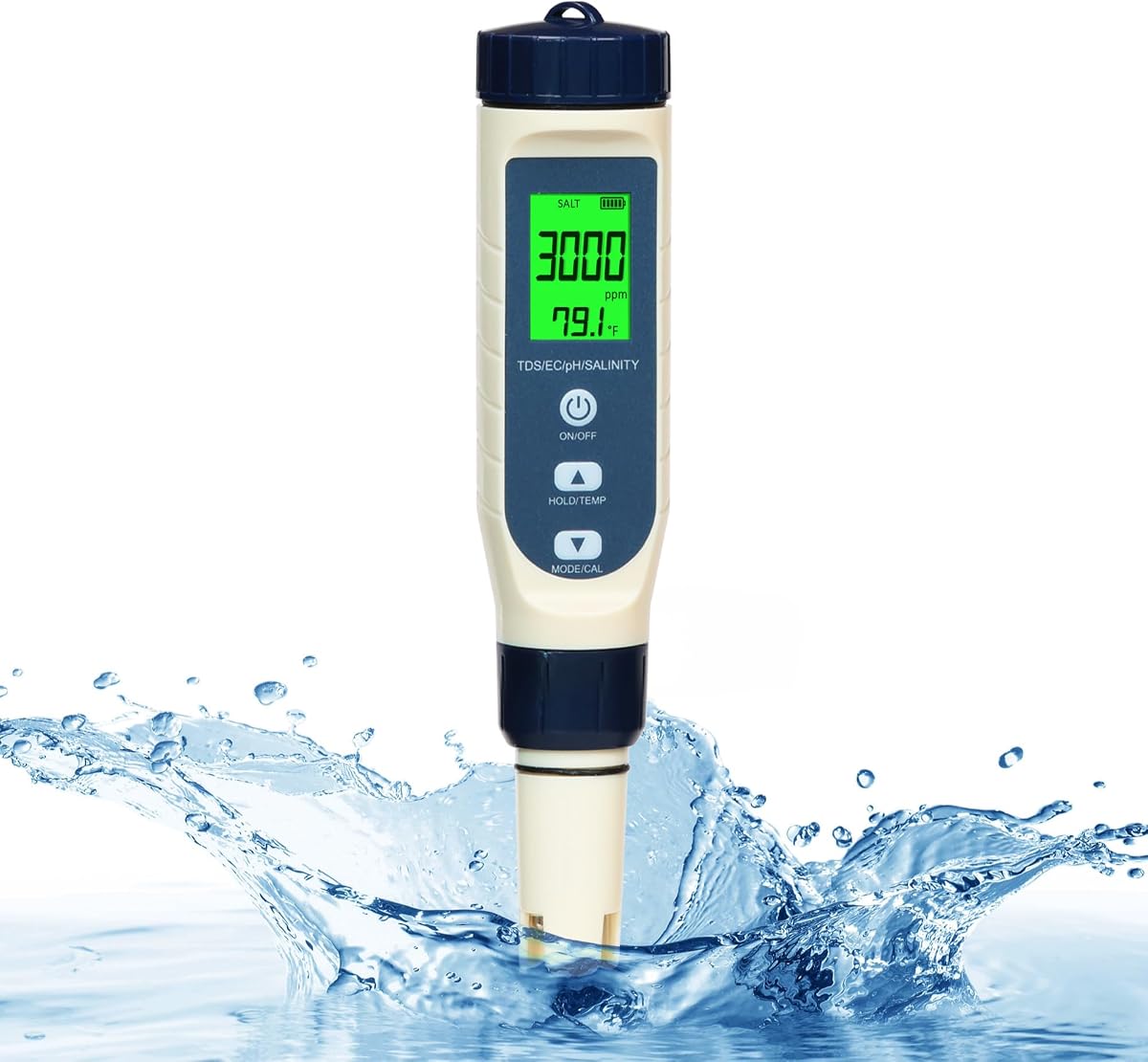
The YINMIK YK-5 is a practical five-in-one pH, TDS, EC, salinity, and temperature meter for pools, spas, aquariums, koi ponds, and hydroponic systems. Its 4.0 rating places it in the middle of the group, but the included calibration materials and replaceable probe offer meaningful long-term value.
We may earn a commission when you buy through this link, at no additional cost to you.
Salinity covers 0 to 9,990 PPM for swimming pools and 0.00 to 200.0 PPT for seawater, automatically switching units when the PPM result exceeds 9,990. The device includes six bags of calibration buffer, and the listing notes that replacement calibration solutions and a replaceable YK-5 probe are available separately. Being able to replace only the probe can extend the useful life of the meter.
The multiparameter design makes it appropriate for aquarists, who can monitor pH, temperature, salinity, TDS, and EC together, and for hydroponic growers working with nutrient reservoirs. It also suits DWC, NFT, aquaponics, ebb-and-flow, and aeroponic systems. The main limitation is that it does not offer the ORP, chlorine, specific gravity, app records, or elaborate charging system found in higher-feature models.
It is a strong budget-oriented selection for a saltwater pool owner who needs core measurements and maintainable parts. Users should follow the calibration instructions and protect the replaceable probe from damage. For anyone prioritizing a connected log, broader range, or stronger customer rating, a different product may be preferable.
A replaceable probe is valuable when the sensing component ages, becomes dirty, or suffers accidental damage. It can make continued ownership more practical than replacing the entire meter and supporting both pool and aquarium use.
Six included buffer bags help owners perform periodic pH and EC calibration without immediately searching for compatible solution. Regular calibration and careful probe storage are still important for reliable results.
We may earn a commission when you buy through this link, at no additional cost to you.
The PUREFIZ meter stands out for unusually thorough maintenance and calibration instructions. It is a five-in-one digital instrument for salinity, pH, temperature, EC, and TDS, with a 4.0 rating and applications spanning pools, hot tubs, aquariums, hydroponics, drinking water, and reverse-osmosis systems.
We may earn a commission when you buy through this link, at no additional cost to you.
Salinity can be displayed in PPM, PPT, or percentage, with a 0–9,999 PPM pool range and automatic conversion to PPT above that threshold. The meter is factory pre-calibrated for salinity, EC, and TDS, allowing immediate use. The listing explains two recalibration routes: a 35-PPT salinity standard or a 1,413 microsiemens-per-centimeter EC solution, with the latter also aligning the related readings.
The pH calibration guidance is equally clear. Included 4.00, 6.86, and 9.18 buffer powders can be dissolved in 250 milliliters of pure water, and the mode or calibration control is held for several seconds until the reading locks. Probe-care instructions also cover rinsing with distilled water, checking the zero point, and removing limescale with diluted citric acid. This detail may be more valuable to a careful owner than a long app feature list.
The product is best for a pool owner who wants a transparent maintenance process and does not need connected records. It is also suitable for aquariums and hydroponic systems. Buyers should obtain compatible calibration solutions if readings drift, and they should follow the care guidance consistently to preserve probe performance.
Owners can recalibrate with a dedicated salinity solution or an EC standard. The EC option also updates and aligns TDS and salinity readings, while the pH buffers support regular pH maintenance.
Rinsing the titanium probe after each use, checking the zero reading in pure water, and gently removing limescale with diluted citric acid can help preserve performance. Good storage and regular calibration are especially important in pools where coatings and chemical exposure are unavoidable.
We may earn a commission when you buy through this link, at no additional cost to you.
Choose a pool salinity meter by matching measurement coverage, accuracy information, calibration needs, and environmental features to your routine. A good meter should make routine checks faster without sacrificing the ability to maintain a probe correctly.
Start with the range and units the meter supports. Saltwater pool owners generally need readings around the manufacturer-recommended operating band, often described in the supplied product information as 2,700–3,400 PPM. A meter covering 0 to roughly 10,000 PPM will usually have ample room for a standard saltwater pool. PPT and percentage modes add flexibility for seawater, aquariums, and food-related samples, while automatic unit switching is convenient when a value crosses the PPM display limit.
Prioritize a clearly documented range over a vague claim of broad capability. A device that identifies its limits and minimum readings gives the user a better understanding of whether it suits a particular pool. Match the units to your maintenance routine and avoid paying for modes you will never use unless they come at no added complexity.
Accuracy claims should be evaluated together with calibration guidance. Some products specify plus or minus 2 percent, some state 0.01 or 0.02 pH accuracy, and others provide less detail. A small display resolution does not by itself guarantee accuracy, so buyers should consider the sensing system, stated tolerance, and recommended calibration process together. Repeatability matters because a pool owner is often comparing one result with the next after adding salt or adjusting chemicals.
Choose a model with clear technical information and a calibration schedule you can realistically follow. If detailed specifications are absent, favor a product with stronger customer feedback or readily available calibration guidance. Confirm that the meter is intended for the water type and temperature conditions in which it will be used.
Most useful pool meters also measure pH, TDS, EC, and temperature. These values help complete a broader water-quality picture, and temperature compensation can improve consistency when water conditions vary. Larger eight-in-one or seven-in-one devices add specific gravity, ORP, or free chlorine, which may be helpful for salt chlorinator management or detailed troubleshooting but can also increase calibration demands.
Match extra parameters to actual needs. An aquarium owner may value TDS and EC, while a saltwater pool owner may prioritize pH, salinity, and temperature. More functions are not automatically better if the additional readings will not influence maintenance decisions or if the owner lacks time to calibrate and maintain every sensor.
A digital meter is only as useful as its calibration process allows. Look for factory pre-calibration, included buffer powders, automatic calibration, or a replaceable probe. The PUREFIZ listing provides unusually explicit instructions and two salinity recalibration routes, while the YINMIK includes six buffer bags. Other models mention calibration more generally, so owners should confirm the expected frequency and required liquids before buying.
Choose a process you can maintain. If calibration buffers and standards are difficult to source or easy to forget, a pre-calibrated model with replaceable parts may be more practical. Keep solutions labeled, use clean containers, and never substitute an unspecified liquid for a documented standard.
Pool water can change temperature throughout the season, so automatic temperature compensation is a useful feature for EC, TDS, pH, and related readings. Models that specify their compensation range, such as the T TESTRUST green meter and the smart connected tester, make it easier to judge the operating limits. Response speed also affects usability when taking several readings or moving between different sample locations.
A fast readout of a few seconds is sufficient for routine pool maintenance, while professional or intensive users may value documented response times and tighter accuracy claims. Neither factor overrides calibration and probe care; an extremely fast but poorly maintained sensor will not produce useful long-term results.
Poolside instruments should be easy to carry and capable of handling splashes. The green five-in-one T TESTRUST model includes an IP67 waterproof specification, while other products emphasize portable construction without listing a water-resistance rating. A protective probe cap, backlit screen, and lightweight body can make storage and low-light use more convenient.
Treat water resistance as a helpful feature rather than permission to submerge a device beyond its instructions. After use, rinse and dry the probe, avoid leaving it in hot or chemically treated water unnecessarily, and store it with the cap secured. A compact meter is also more likely to remain accessible for frequent checks.
A clear numerical LCD is useful for immediate pool decisions, while mode and hold buttons help users navigate and record readings. The smart seven-in-one meter goes further with Bluetooth connectivity, real-time data, visual charts, organized applications, and exported reports. These features can reveal long-term trends and are particularly attractive to owners monitoring a salt chlorinator, repeated evaporation, or gradual changes in water balance.
Connectivity adds a dependency on a compatible phone and reliable pairing, so it is not automatically superior for every user. A simple standalone meter is often more convenient for occasional checks. Choose connected features only when you intend to use the history and reporting tools rather than merely seeing another icon in the product description.
Begin by washing and rinsing the probe according to its instructions, then select the appropriate measurement mode. For a routine saltwater pool check, remove a representative water sample in a clean container or carefully immerse the probe as directed. Avoid trapping air bubbles, keep the sensing area fully covered, and wait for the reading to stabilize before comparing it with the pool's target range.
Check the meter against the intended application and make sure the selected unit is correct. The common saltwater pool salinity range stated in several of the listed products is 2,700–3,400 PPM, but equipment recommendations and local conditions can vary. Record the result, clean the probe with fresh water, and dry it gently rather than wiping the sensing surface with a rough or abrasive material.
Calibrate on the schedule recommended by the manufacturer and whenever readings drift unexpectedly. Use only compatible buffer or standard solutions, follow the specified control sequence, and avoid touching the electrode unnecessarily. Store the meter in a protective case or with its cap on, away from excessive heat, and rinse the titanium probe after use. Periodic zero checks, limescale removal, and timely replacement of an aging probe help preserve measurement quality.
The target depends on the pool equipment, especially the salt chlorinator, but many of the meters in this guide identify approximately 2,700–3,400 PPM as the typical range for a saltwater pool. Always follow the equipment manufacturer's specification and adjust gradually when adding salt. Use the meter to check trends rather than changing the water after a single unusual reading.
PPM means parts per million, PPT means parts per thousand, and percent expresses salt as a portion of the whole sample. One PPT equals 1,000 PPM, while one percent equals 10,000 PPM. A digital meter that switches units automatically can be convenient, but the user should confirm that the displayed unit is correct before acting on a reading.
Calibration requirements vary by model and use. Some arrive factory calibrated, while others include buffer powders or recommend periodic checks with known solutions. Calibration is especially important when readings change unexpectedly, after prolonged storage, or when the probe has been exposed to buildup. Use only the specified solution and follow the manufacturer's control sequence.
Yes, pH and temperature are valuable companion measurements because salt concentration alone does not describe the full condition of pool water. Temperature can also influence instrument readings, making automatic temperature compensation helpful. The most practical choices combine salinity with pH, TDS, EC, and temperature in one device.
Many models in this guide are designed for more than pools, with applications including aquariums, fishponds, hydroponic reservoirs, drinking water, and food. Check the measurement range and probe suitability for the specific liquid. A meter used in a saltwater aquarium may need a different target range and more frequent care than one used only for a pool.
Differences may come from calibration, sample temperature, probe condition, timing, or the limited resolution of color strips. Digital meters can also respond differently depending on where the sample was taken and whether the probe was properly rinsed. Confirm the result with a clean sample, stable reading, and correctly selected unit before making a large adjustment.
Rinse the probe with fresh or distilled water after each use, especially when using pH calibration solutions. If the product instructions allow diluted citric acid, it may help remove light limescale buildup. Do not use abrasive materials or immerse the device beyond its water-resistance rating, and dry the sensing surface gently before storage.
No. An app can be valuable for tracking trends, organizing readings, and exporting reports, but it is unnecessary for a simple salt check. A well-calibrated standalone meter may be more convenient and less demanding. The premium connected model is best for owners who actively review historical data or monitor several water systems.
The green five-in-one salt tester stands out as the strongest all-around choice because it combines a 4.8 rating, quick readings, three salinity modes, automatic temperature compensation, and an IP67 housing. The eight-in-one model offers the broadest measurement coverage, while the FLOSGSAI meter is another approachable pick with detailed ranges and a 4.7 rating.
Prioritize the features your pool actually requires: clear salinity units, dependable pH readings, a usable calibration process, and protection for wet poolside storage. More measurements and connectivity are valuable when they support a real maintenance routine, but the probe still needs proper cleaning, periodic calibration, and secure storage to remain useful.
Before buying, verify the latest listing, package contents, supported salinity range, calibration instructions, and warranty details because specifications and availability can change. Product prices also fluctuate, so compare the current offer with the features and limitations described in this October 2026 guide before making a final selection.