
Amazfit Bip 6 Smart Watch
4.2Editor score
140+ workout modes
Built-in five-system GPS
Up to 14-day battery
Bright AMOLED display
A useful tennis smartwatch should capture more than a simple workout timer. It should record court activity, provide heart-rate and workout data, identify your location, and fit comfortably enough to wear before, during, and after a match. The right model also needs clear controls, dependable battery life, and software that makes performance information easy to review.
We compared ten smartwatches using the information supplied for each model, focusing on tennis-relevant factors such as dedicated sport modes, GPS, wrist-based heart rate, training metrics, recovery features, display size, water resistance, and battery life. The list includes general fitness trackers, running watches, health-focused models, and rugged multisport options, so the ideal choice depends on how seriously you train and which features matter most.
Each review explains the strongest reasons to consider a particular model, along with its limitations and the types of tennis player it may suit best. Ratings reflect the supplied customer feedback rather than hands-on testing. Product features, software behavior, availability, and prices can change, so readers should verify the current listing and app experience before making a final purchase.
4.2Editor score

4.6Editor score

4.1Editor score
As an Amazon Associate we earn from qualifying purchases.
The table highlights the core differences in tennis-watch suitability, from dedicated sport coverage and GPS capability to display size, recovery features, battery endurance, and construction.


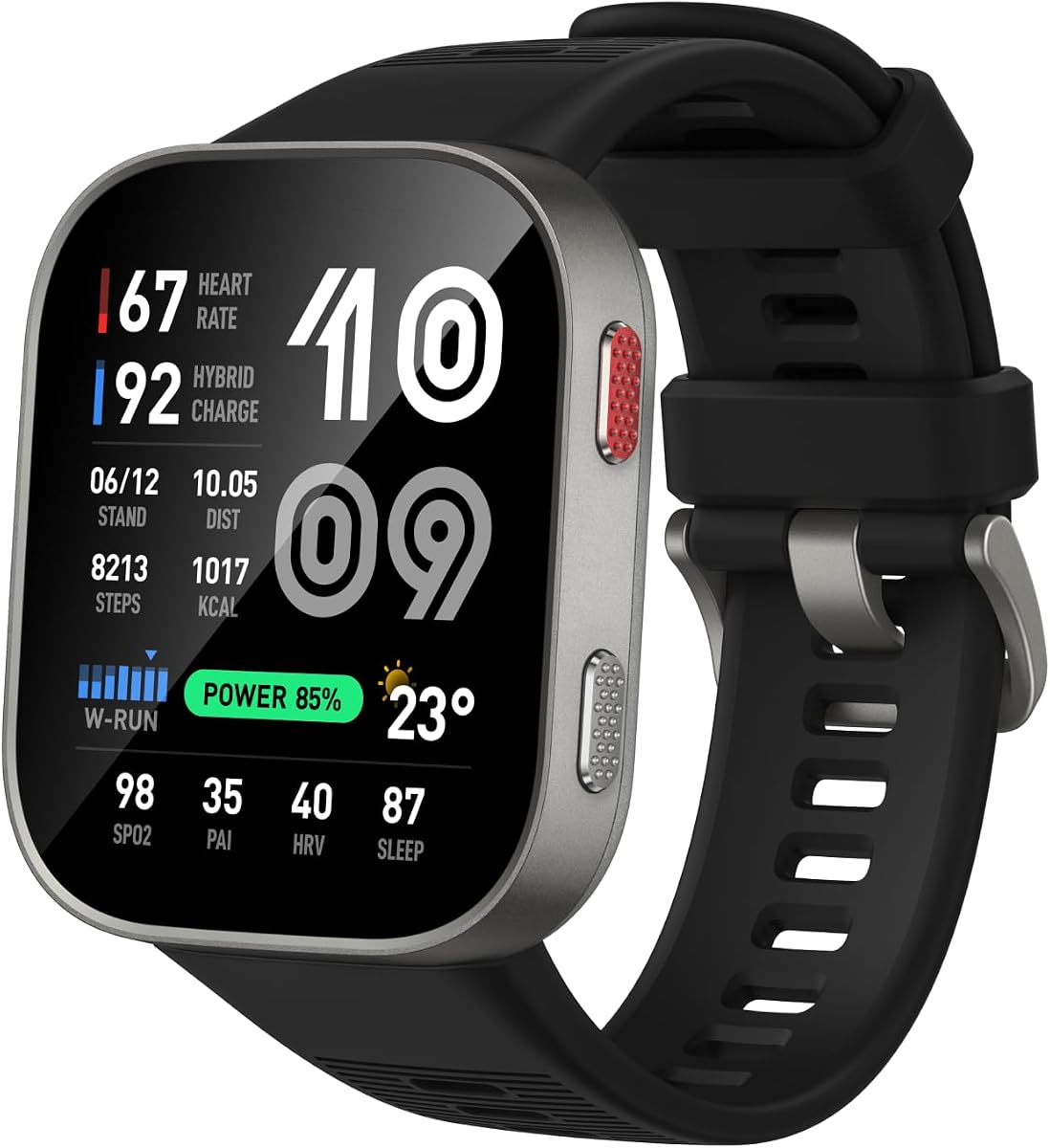


The Amazfit Bip 6 combines a bright 1.97-inch AMOLED display, built-in GPS, more than 140 workout modes, and an advertised battery life of up to 14 days. Its supplied customer rating is 4.2 out of 5. Although the product information does not identify a tennis-specific mode, the broad activity library makes this a practical choice for players who want one watch for court sessions, running, cycling, strength work, and everyday step tracking.
We may earn a commission when you buy through this link, at no additional cost to you.
Its most useful strength is the combination of features at a budget-oriented position. Five-satellite-system support is intended to improve connection speed and route accuracy, while downloadable maps and turn-by-turn directions make GPS useful beyond the tennis club. Health monitoring covers heart rate, sleep, blood oxygen, and stress, and the AMOLED screen should be easier to read in daylight than a dimmer display. The aluminum body also keeps the watch relatively light compared with many rugged sports watches.
The trade-off is that the Bip 6 is a general-purpose fitness tracker rather than a dedicated performance watch. Its 140-plus workout modes and AI coaching are impressive for the category, but the supplied data does not promise tennis-specific stroke statistics, serve tracking, or detailed on-court interval analysis. The 50-meter water-resistance rating and two-week maximum battery estimate are also best understood as advertised conditions, not guarantees for every workout schedule or GPS setting.
This is the strongest selection for recreational players who want tennis practice, recovery, and daily activity data in one affordable package without paying for a high-end multisport watch. Players who want advanced load, recovery, and training analytics may prefer a Garmin model, while those wanting calls and notifications should also weigh the more explicitly smart-focused alternatives in this guide.
With more than 140 workout modes and continuous heart-rate, step, distance, and calorie tracking, the Bip 6 can cover practice drills and other sports without requiring a separate activity tracker. Check the current app and watch menus to confirm how a tennis session is categorized before relying on specific metrics.
The claimed 14-day smartwatch battery reduces charging interruptions, while built-in GPS, offline downloadable maps, and turn-by-turn navigation are useful for travel to unfamiliar courts or outdoor sessions.
We may earn a commission when you buy through this link, at no additional cost to you.
The Garmin vívoactive 5 is a 42mm health-and-fitness GPS smartwatch with a bright AMOLED display, more than 30 indoor and outdoor sports apps, and up to 11 days of stated battery life in smartwatch mode. It carries a supplied rating of 4.3. Its appeal lies in a balanced feature set that combines activity tracking, recovery insight, smart features, and a relatively understated design.
We may earn a commission when you buy through this link, at no additional cost to you.
For a tennis player, the most relevant features are the built-in GPS sports apps, wrist-based heart rate, workout benefit, and recovery time. Those tools can place a match within a broader training context rather than treating it as an isolated session. Body Battery, stress tracking, sleep coaching, HRV status, and automatic nap detection add context that may be especially useful for players balancing court time with work, school, travel, and other exercise.
Garmin's activity library includes walking, running, cycling, HIIT, swimming, and golf, but the supplied information does not confirm a dedicated tennis profile. That means buyers should check the latest Garmin Connect sports-app list to verify tennis support and understand exactly which fields it records. The watch also lacks the more intensive training ecosystem of the Forerunner 165 and fēnix 9 Pro, and it is less rugged than the premium titanium option.
The vívoactive 5 is a strong fit for active adults who want a health-oriented smartwatch for tennis plus daily movement, sleep, and recovery monitoring. Players who value an approachable ecosystem, clear AMOLED visibility, and offline music may appreciate it. Serious competitors focused on detailed workout analysis may instead prefer the more performance-oriented Garmin models later in the guide.
Body Battery draws on sleep, naps, stress, and workouts to estimate energy availability, while recovery time suggests when the body may be ready for another demanding effort. These estimates are intended as close approximations rather than medical measurements.
Downloaded playlists and wireless headphone connectivity let players leave the phone behind during travel or warm-ups. Smart notifications also keep the watch useful between practice sessions without turning it into a full fitness computer.
We may earn a commission when you buy through this link, at no additional cost to you.
The Garmin Forerunner 165 earns a supplied customer rating of 4.6, the highest among the Garmin models in this roundup, and combines a lightweight 43mm case, built-in GPS, an AMOLED touchscreen, wrist-based heart rate, and 25-plus activity profiles. Although it is marketed primarily as a running smartwatch, its training-effect labels, recovery time, adaptive plans, and suggested workouts make it a strong general choice for tennis performance tracking.
We may earn a commission when you buy through this link, at no additional cost to you.
The decisive advantage is Garmin's training context. Training effect and its labels explain the main benefit obtained from a workout, while recovery time estimates how long recovery may last before another high-effort session. Daily suggested workouts adapt to performance and recovery, and Garmin Coach provides adaptive plans. These features can help a tennis player compare demanding practices with easier days, although the watch is not described as providing shot-by-shot tennis analytics.
Battery endurance is another practical strength. The Forerunner 165 is rated for up to 11 days in smartwatch mode and up to 19 hours in GPS mode, making it suitable for players who want continuous tracking without charging every night. The trade-off is that this is a larger and more sophisticated watch than a simple fitness tracker, and its running orientation does not guarantee that every tennis-specific field will be available. Notifications, contactless payments, incident detection, and Assistance features add utility, although some require setup and a compatible phone.
This is the most balanced recommendation for competitive and serious recreational players who want useful training analysis, strong customer feedback, built-in GPS, and long battery life without moving to a rugged premium multisport watch. It is particularly attractive for athletes who also run or cycle, since its performance features extend well beyond a single court sport.
Training effect and recovery time make the watch more than a record of elapsed minutes. A player can review whether a session was primarily aerobic, contributed to a different adaptation, or warrants an easier next day.
Built-in GPS supports distance and pace tracking without requiring a phone. Personalized daily workouts, race-adaptive plans, and the morning report help athletes connect court performance with sleep, HRV status, weather, and recovery.
We may earn a commission when you buy through this link, at no additional cost to you.
The Samsung Galaxy Watch9 is a 40mm Bluetooth smartwatch with a 4.5 supplied rating and a strong focus on daily health, personalized coaching, and smart assistance. Its breathable sports band is designed for comfortable daily wear, while the Fitness Index provides tailored guidance according to a player's goals. That combination can be useful for tennis players who want recovery and consistency insights rather than only a workout log.
We may earn a commission when you buy through this link, at no additional cost to you.
The watch's standout features include Vitals for detecting shifts from usual sleep patterns, Advanced Sleep Coaching, Bedtime Guidance, a unified Heart Health Score, and daily Fitness Index coaching. Heart-rate and activity information can inform the broader coaching model, giving a more integrated view of readiness than a basic step-counting tracker. Voice interaction and Tap to Pay also add everyday convenience, particularly for players who want to manage a phone more selectively.
Its limitation is that the supplied information emphasizes health and smart features more than outdoor multisport analytics. There is no stated tennis-specific field set, detailed training-load model, or long GPS battery claim. Blood-pressure measurement also requires a separately sold cuff, and the health scores and insights are wellness estimates rather than clinical diagnoses. The watch works with Samsung phones and other Android phones, which adds flexibility, though the deepest integration is naturally expected with Samsung devices.
The Galaxy Watch9 is best for a player who wants a compact health companion, strong sleep and recovery guidance, and polished everyday smart features. Someone whose main priority is detailed court-session analysis may prefer a Garmin running or multisport watch. For general tennis tracking, however, its activity logging and coaching ecosystem make it a credible health-centered alternative.
The Fitness Index and Heart Health Score combine multiple inputs rather than presenting one isolated metric. This can help players consider sleep, activity, BMI, and vascular load when deciding how demanding the next practice should be.
A soft sports band with a breathable air-pocket design is intended to remain comfortable throughout the day. That matters because the most useful health watch is often the one a player is willing to wear consistently.
We may earn a commission when you buy through this link, at no additional cost to you.
The Samsung Galaxy Watch 7 has a supplied rating of 4.6 and centers its experience on an Energy Score, improved heart-rate tracking, sleep monitoring, and personalized Wellness Tips. Its 40mm green case is a practical size for a tennis player who wants a comfortable daily watch with useful health context before and after training.
We may earn a commission when you buy through this link, at no additional cost to you.
The Energy Score estimates physical readiness based on the previous day's activity, offering a simple way to judge whether a hard practice makes sense. Improved heart-rate tracking uses Galaxy AI to filter movement-related interference, which is relevant during dynamic court activities where the wrist can rotate and swing frequently. Sleep tracking and moderate-to-severe sleep-apnea detection support broader wellness monitoring, while performance comparisons can help compare a current run or ride with an earlier session.
The supplied features do not identify dedicated tennis metrics, a full multisport training-load system, or an extended GPS battery estimate. Wellness analysis is collected by the watch and analyzed on a phone, making phone compatibility part of the overall experience. As with other wearables, sleep-apnea and heart-rate features should be viewed as wellness tools rather than substitutes for medical evaluation.
The Galaxy Watch 7 is a compelling choice for a player who values a simple readiness score, accurate-feeling heart tracking, and sleep guidance in a 40mm package. It may be less compelling than a dedicated performance watch for detailed training-load analysis, but its high supplied rating and accessible coaching tools make it an attractive general fitness option.
The Energy Score gives a player an at-a-glance indication of physical readiness based on recent activity. It can support better decisions about training intensity without requiring the interpretation of many separate charts.
The stated heart-rate improvements are particularly relevant during court movement. Filtering movement-related body signals can make readings feel more representative during swings, changes of direction, and other rapid actions.
We may earn a commission when you buy through this link, at no additional cost to you.
The Garmin Venu 4 is a 45mm advanced fitness smartwatch with a stainless-steel design, a bright AMOLED display, a built-in flashlight, and up to 12 days of advertised battery life. Its supplied rating is 4.5. The watch combines Garmin's established health-monitoring tools with a more refined construction style, making it attractive to tennis players who want a watch that transitions easily from court to professional settings.
We may earn a commission when you buy through this link, at no additional cost to you.
Its sports value comes from a broader Garmin platform that includes wrist-based heart rate, Body Battery, fitness age, stress tracking, sleep coaching, recovery awareness, and a health-status feature. The health-status tool looks for changes across metrics such as heart rate, HRV, and skin temperature that could reflect stress from activity, illness, or other changes. Custom behaviors for caffeine and alcohol can then be reviewed in Garmin Connect to explore lifestyle effects on sleep and stress.
The main compromises are size, weight, and cost relative to lighter running-focused devices. Its 45 by 45 by 12.5mm case is substantial, and it fits wrists with a circumference of 135 to 200mm. The supplied information does not identify a dedicated tennis mode or advanced on-court statistics, so buyers who want granular sport analysis should verify app availability. The built-in flashlight is distinctive but should not be confused with a tennis-performance feature.
Choose the Venu 4 when design, health context, and multi-sport use matter more than minimal weight. It works well for a recreational or club player who wants polished styling alongside extensive daily health features. Athletes focused specifically on training metrics may find the Forerunner 165 more purpose-built, while outdoor enthusiasts may prefer the fēnix 9 Pro.
The health-status feature watches for changes across several metrics rather than reacting to a single reading. Those patterns can be reviewed alongside lifestyle logs to make more informed choices about recovery habits.
The stainless-steel case and black silicone band give the Venu 4 a more refined appearance than most dedicated sport watches. The built-in flashlight adds practical value during early starts and outdoor travel.
We may earn a commission when you buy through this link, at no additional cost to you.
The Amazfit Bip Max is a large-screen fitness watch with a 2.07-inch AMOLED display, built-in GPS, 4GB of onboard storage, and more than 150 sports modes. Its supplied rating is 4.4. The watch stands out for its big visual canvas, claimed 20-day typical battery life, offline maps, and a Zepp coaching environment that emphasizes endurance, strength, and recovery.
We may earn a commission when you buy through this link, at no additional cost to you.
The large screen is useful during a match because it can present more workout information without repeated scrolling. Five-satellite-system GPS, downloadable maps, turn-by-turn directions, and off-track alerts make the device useful for outdoor travel as well as court tracking. Dedicated modes include HYROX, strength training, and yoga, while smart metrics such as VO2 Max, Training Load, and Training Effect add depth for players who train across several sports.
The trade-off is physical size. A 2.07-inch display is easier to read but less discreet and may be less comfortable for small wrists. The supplied description calls the Zepp App subscription-free, but feature access can change, so users should verify current terms. Although the sports count exceeds that of the Bip 6, no specific tennis mode or serve-level analytics are identified in the available data.
The Bip Max is a strong choice for budget-conscious players who want a large screen, generous workout selection, and minimal charging. It is especially attractive for athletes combining tennis with running, cycling, strength work, and travel. Those wanting deeper sport specialization should compare the more advanced Garmin analysis tools before deciding.
The oversized AMOLED panel is well suited to reading a larger workout layout during breaks in play. It may also be easier to operate than compact screens when the player is moving between activities or wearing the watch with gloves.
Four gigabytes of internal storage, offline downloadable maps, and navigation reduce dependence on a phone. With up to 20 days of typical-use battery, the watch is designed for long training cycles away from a charger.
We may earn a commission when you buy through this link, at no additional cost to you.
The black 42mm version of the Garmin vívoactive 5 shares the core strengths of the ivory model while offering a more conventional dark appearance. It has a supplied rating of 4.3, a bright AMOLED display, more than 30 indoor and GPS sports apps, and up to 11 days of battery life in smartwatch mode. The black finish is a practical choice for players who prefer their watch to coordinate with athletic clothing.
We may earn a commission when you buy through this link, at no additional cost to you.
Sports tracking, wrist-based heart rate, workout benefit, and recovery time provide a useful performance foundation. The extensive health features add more value: Body Battery, sleep scoring, HRV status, stress monitoring, and automatic nap detection can help explain variations in performance. Preloaded cardio, yoga, strength, HIIT, and Pilates workouts expand its use beyond tennis, while Garmin Coach adds adaptive planning for runners and other athletes.
Compared with the Forerunner 165, this watch provides a more lifestyle-oriented experience and smaller 42mm format but does not advertise the same extensive suggested-workout and race-planning focus. The supplied information still does not confirm dedicated tennis statistics, so users should check the current sports-app catalog. The always-on display setting is stated to reduce maximum battery life to five days, a consideration for players who want glanceable information without lifting the wrist.
This black model is ideal for players who want Garmin's health and recovery experience in a discreet everyday design. It may be the more natural choice for office-to-court transitions, while the Forerunner is more compelling for running-centric training. Either way, thevívoactive 5 should be evaluated for the accuracy and usefulness of its current tennis activity profile.
The 42mm black case is less conspicuous than the Venu 4 and many rugged multisport watches. That makes it suitable for players who want court data without the appearance of a dedicated expedition device.
Workout benefit shows how an activity may affect the body, while recovery time provides guidance before another demanding session. These features make the watch more useful for training balance than simple elapsed-time recording alone.
We may earn a commission when you buy through this link, at no additional cost to you.
The MFVLP D16 is a general-purpose smartwatch with Bluetooth calling, a 1.83-inch HD touchscreen, 110-plus sport modes, health monitoring, and a supplied rating of 4.8. It is the only product in this guide whose supplied description explicitly names tennis among its supported activities, making it particularly relevant to readers who want a dedicated tennis mode at a more accessible level of sports specialization.
We may earn a commission when you buy through this link, at no additional cost to you.
Real-time sports-data recording, step and distance tracking, calorie monitoring, continuous heart-rate and blood-oxygen monitoring, and sleep analysis cover the core requirements of a tennis fitness watch. Bluetooth 5.3 calling through built-in speakers and social notifications add usefulness when the player does not want to carry a phone on court. More than 100 downloadable watch faces and photo-wallpaper support add personalization for daily wear.
Its limitations are important. Although tennis appears in the stated 110-plus modes, the product information does not describe stroke counts, serve speed, rally duration, court-side movement, or other advanced tennis metrics. The IP68 rating is suitable for rain and sweat, but the seller specifically advises against hot water and seawater. The 300mAh battery is stated to last five to seven days in normal use or up to 30 days in standby, so continuous GPS and heavy sports use may produce different results.
The D16 is a compelling choice for budget-minded players who prioritize calls, notifications, and having tennis listed as a sport mode. It may be especially convenient for someone who wants one device for court sessions and daily communication. Players who need advanced training analysis or verified professional metrics should examine the Garmin options more closely before purchase.
Tennis is explicitly included among the supported sports modes, and the watch claims real-time recording of sports data. Players should still test the current mode's summaries and field names to understand what it captures during a match.
Built-in speakers and Bluetooth 5.3 allow calls and notifications to be handled from the wrist. This is useful during travel and breaks, although some players may still prefer a phone-free device dedicated strictly to training.
We may earn a commission when you buy through this link, at no additional cost to you.
The Garmin fēnix 9 Pro is a 51mm premium multisport GPS smartwatch with a titanium case, sapphire lens, 1.5-inch AMOLED display, built-in flashlight, and more than 100 activity profiles. Its supplied rating is 4.1. For a player who wants the most extensive performance and outdoor ecosystem in this guide, it offers advanced fitness tools, durable materials, LTE, and inReach satellite connectivity.
We may earn a commission when you buy through this link, at no additional cost to you.
The stamina curve and stamina zones visualize how far, how fast, and how long the user can go based on fitness gains and training history. These features can inform a player managing the demands of doubles, drills, running between venues, and conditioning. Enhanced indoor and outdoor rowing profiles, VO2 Max support for compatible rowing machines, and expanded rucking functions broaden the training value well beyond tennis.
The 51mm titanium body is large, and its premium construction and connectivity capabilities make it much bulkier than conventional fitness watches. LTE messaging and calls require compatible service, while inReach functions depend on an active plan, coverage, and regional rules. A supplied 30-day trial and limited free SOS messaging terms should be checked directly before relying on the feature. The available data also does not identify tennis-specific shot or serve analytics.
Despite those compromises, the fēnix 9 Pro is the premium selection for a serious multisport athlete who values ruggedness, advanced training intelligence, and the ability to remain connected away from a phone. It is less rational for a casual court player, but for a player who also runs, rows, hikes, or travels, the extensive platform can justify its size and position.
Stamina zones and the stamina curve translate training history into a picture of sustainable effort. This can help a player understand how hard to push during a match or a demanding conditioning session.
LTE permits messages and calls when the phone is left behind, while inReach supports satellite messaging and interactive SOS subject to plan and coverage requirements. These are major advantages for travel and remote-court scenarios.
We may earn a commission when you buy through this link, at no additional cost to you.
The right tennis watch depends on how you play, which metrics you want to understand, and how much complexity you are willing to manage. These are the most important features to evaluate before purchasing.
Begin by confirming that the watch and companion app support tennis or a sport profile that fits the way you train. A tennis mode may capture elapsed time, heart rate, calories, distance, and basic workout summaries, but it may not provide serve speed, stroke type, rally length, or court positioning. The MFVLP D16 is the only product in the supplied data that explicitly names tennis among its sport modes, while Garmin and Amazfit models offer broader activity libraries. Buyers should check the current app catalog because sport support and recorded fields can change with software updates.
Choose a model with an explicit tennis profile when recording every practice and match automatically is the priority. If you want broader coaching, stamina, and recovery tools, a multisport watch may be more useful even if tennis is selected from a general list.
Built-in GPS is valuable when courts are outdoors, when you want distance data, or when the phone is not carried during a session. The Amazfit Bip 6 and Bip Max use five-satellite-system support, and several Garmin models include GPS as a core feature. GPS can also help verify travel to a club or compare routes, although indoor-court positioning may remain limited because the surrounding structure can weaken the satellite signal.
Prioritize a watch with built-in GPS and a clear connection indicator if outdoor practice is common. Treat the number of supported satellite systems as one consideration, then consider battery drain and whether offline maps or turn-by-turn navigation add practical value.
Wrist-based heart-rate tracking gives the watch context for intensity and recovery. It can reveal whether a match was a brief high-intensity session or part of a demanding weekly load. Models such as the Galaxy Watch 7 emphasize filtering movement-related interference, while Garmin watches use heart rate alongside HRV, stress, sleep, and recovery tools. None of the supplied data establishes clinical accuracy, and readings can vary with fit, motion, and individual physiology.
For court sports, choose a secure, comfortable fit and test whether heart-rate readings remain stable during swings and rapid direction changes. A watch that is too loose can add movement artifacts, while a tight band may be uncomfortable through long sessions.
A match log becomes more useful when it shows how the session affected the body and how long recovery may take. Garmin's Training Effect, recovery time, Body Battery, and the Amazfit Bip Max's Training Load are designed to place individual workouts in a broader training context. Samsung's Energy Score and Fitness Index offer a more simplified daily-readiness approach, while the Galaxy Watch9 emphasizes sleep patterns and coaching. These tools are not medical assessments and should guide general planning rather than clinical decisions.
Look for a balance of workload and recovery information rather than choosing only by metric count. Players training several times per week may benefit most from recovery estimates, while casual players may prefer a simple score and concise recommendations.
Battery life determines how consistently the watch can collect data. Advertised figures range from five to seven days of typical use for the MFVLP D16, up to 11 or 12 days in smartwatch mode for Garmin vívoactive and Venu models, up to 14 days for the Amazfit Bip 6, and up to 20 days of typical use for the Bip Max. The fēnix 9 Pro is built for premium multisport use, and the Forerunner 165 claims up to 19 hours in GPS mode. Always-on displays, GPS, music, LTE, and satellite functions can reduce practical endurance.
Match the claimed battery figure to your intended use. Frequent outdoor GPS sessions and communication features justify selecting for endurance, while players who charge nightly may prioritize display quality and smart features instead.
Tennis data should be readable without prolonged attention, especially during changeovers. AMOLED models provide bright, colorful screens, while the D16 uses a 1.83-inch HD TFT-LCD touchscreen. Screen size ranges from 1.83 inches on the D16 to 2.07 inches on the Bip Max, with the fēnix 9 Pro using a large 1.5-inch AMOLED panel in a 51mm case. Button layouts, touchscreen behavior, and wrist size can be as important as raw resolution.
For smaller wrists, avoid choosing solely by screen size. Compare case dimensions, band fit, button placement, and weight. A large display may be easy to read but less comfortable during extended wear, while a compact watch may disappear more easily under a sleeve.
Court use creates sweat, dust, accidental splashes, and the possibility of outdoor play in heat. The Amazfit Bip 6 lists 50-meter water resistance, and the D16 has an IP68 rating with a warning against hot water and seawater. The fēnix 9 Pro uses a titanium case and scratch-resistant sapphire lens for a more rugged construction. Water-resistance standards describe specific test conditions and do not mean every watch is suitable for swimming, diving, hot baths, or salt water.
Check the manufacturer's care instructions and avoid exposing the watch to hot showers, seawater, or high-pressure water unless explicitly permitted. A protective case can reduce scratches, but it should not make the watch too bulky during play.
Smartwatch features can make a sports watch more convenient without improving the underlying workout measurement. The D16 includes Bluetooth calls, the Galaxy Watch models support notifications and payments with compatible services, and several Garmin watches offer music, phone-free connections, safety features, and—in the fēnix 9 Pro—LTE and satellite communications. Some features require a paired phone, network coverage, a supported region, or an active subscription.
List the smart functions you will actually use before paying for them. A tennis player who values training data may prefer simplicity, while someone who wants calls and notifications may find smartwatch integration more useful. Verify compatibility with your phone and account requirements before purchase.
Set up the watch with its companion app before the first match, complete any fitness profile, and verify that heart-rate readings, units, and sport settings appear correctly. Pair notifications and music only if needed, then perform a short test session in a controlled setting. Familiarize yourself with starting, pausing, and ending a workout so a new interface does not distract you during warm-ups.
Wear the watch snugly enough to maintain sensor contact without restricting movement. Remove sweat and dirt after each session and rinse the watch only when the manufacturer permits it. Dry the strap and charging contacts fully before reconnecting the charger, and inspect the band for irritation or damage. Use only the supplied or manufacturer-approved charging equipment and keep the watch within its specified temperature limits.
Review the session after recovery rather than checking every metric immediately. Look for consistent trends in duration, heart rate, sleep, stress, recovery, and workout effect instead of treating one reading as a definitive measure of performance. Update the watch and companion app regularly, and recalibrate or adjust settings when training volume, wrist size, or fitness goals change.
A tennis mode is convenient because it can automatically start a relevant workout and present the correct summary. Some general multisport watches can still record heart rate, duration, and other basic data, but they may not offer tennis-specific fields. Check the current watch and app menus because supported sports and data fields can be updated.
Some sports watches or third-party sensors can measure certain tennis metrics, but that capability should be verified before purchase. None of the supplied product descriptions explicitly states that these ten watches measure serve speed, stroke type, rally length, or shot accuracy. A phone or dedicated court-analysis sensor may be needed for that level of detail.
GPS is most useful for outdoor court distance, travel, and general route tracking, particularly when the phone is not on the wrist. It may be less useful for an indoor match because buildings can weaken the satellite connection. A watch with a good connection indicator and clear outdoor battery estimate is preferable for frequent outdoor play.
The watch should sit close enough to minimize movement and maintain reliable sensor contact, but it should not feel restrictive. A slightly snug position is usually better than a loose fit during swings and rapid direction changes. If the watch rotates or causes discomfort, adjust the band or select a smaller case before relying on its heart-rate data.
No consumer smartwatch should be treated as a diagnostic medical device. Wrist-based readings are estimates and can be affected by movement, fit, skin contact, and individual physiology. The supplied descriptions repeatedly characterize health data as close estimations. Anyone with a medical concern or unusual reading should use appropriate clinical equipment and seek professional advice.
A running watch can be a strong choice when its training metrics, GPS, suggested workouts, and recovery tools are the priorities. A general fitness watch may be better for casual players who want health monitoring, calls, and convenient daily wear at a lower or more moderate outlay. The most important factor is whether the app's tennis profile and recorded fields match your goals.
No. Advertised battery figures are usually based on particular settings and usage. Continuous GPS, always-on display, music, LTE, satellite functions, and frequent workouts can shorten real-world endurance. Check the relevant mode estimate, especially the GPS figure, rather than relying only on a maximum smartwatch-mode claim.
A premium watch is not automatically better for every player. The Amazfit Bip 6 and Bip Max provide broad sports support, GPS, and long battery life, while the MFVLP D16 explicitly lists tennis. The Garmin Forerunner 165 may suit performance-focused players because of training-effect and recovery tools, whereas the fēnix 9 Pro is most relevant to athletes who also need rugged construction and advanced multisport features.
The Amazfit Bip 6 is the best budget selection, offering a bright AMOLED display, built-in GPS, more than 140 workout modes, and up to 14 days of stated battery life. The Garmin Forerunner 165 takes the overall recommendation for players who want richer training context, with training effect, recovery time, adaptive suggestions, and built-in GPS. The Garmin fēnix 9 Pro is the premium choice for athletes who value rugged titanium construction, advanced stamina tools, extensive activity profiles, and phone-free connectivity.
Prioritize the features that will influence your training rather than choosing on screen size or smartwatch extras alone. A player who wants a confirmed tennis mode may look closely at the MFVLP D16, while a health-focused player may prefer the Galaxy Watch 7 or Watch9. Serious athletes should compare sport profiles, heart-rate behavior, recovery tools, comfort, and battery life under the conditions in which they actually train.
Finally, verify the current listing, app compatibility, sport-profile availability, and included accessories before purchasing. Ratings and features can change as firmware and companion apps evolve, and connectivity features may have service or subscription requirements. Checking current pricing and terms at the time of purchase will help ensure that the selected watch still offers the best balance for your tennis routine.