
ARCTIC MX-4
4.8Editor score
Carbon microparticle thermal formula
Nonconductive and metal-free
Easy application for beginners
Our Heatsink Compound guide compares 10 top thermal pastes for CPUs, GPUs, LEDs, and electronics, highlighting conductivity, stability, and ease of use and
Heatsink compound fills microscopic gaps between a hot component and its cooler, improving the transfer of heat where ordinary metal-to-metal contact would otherwise leave air gaps. A good formula combines useful thermal conductivity with low electrical conductivity, stable consistency, and enough durability to remain effective through repeated heating and cooling cycles.
This guide compares ten compounds based on the specifications and features listed for each product, including thermal conductivity, operating temperature, dielectric strength, stability, package size, and intended applications. It covers general-purpose computer pastes as well as silicone greases and heavier-duty compounds for LEDs, power devices, PCBs, and other electronics.
Each selection highlights the circumstances in which that compound appears most suitable, from small CPU installations to large maintenance jobs and specialized industrial equipment. Ratings and product information can change over time, and current prices fluctuate, so readers should confirm the latest listing details before making a purchase.
4.8Editor score

4.8Editor score

4.9Editor score
The following comparison organizes all ten compounds by their listed thermal properties, electrical behavior, application range, and practical strengths, making it easier to match a paste or grease to a specific computer, lighting, PCB, or industrial cooling job.



ARCTIC MX-4 combines a highly regarded 4.8 rating with a formula built around carbon microparticles. Its stated purpose is straightforward: move heat rapidly from CPUs and GPUs to their coolers while avoiding the electrical risks associated with conductive compounds. It is one of the most balanced selections here because it emphasizes performance, safety, consistency, and straightforward application rather than specializing in one unusual use case.
We may earn a commission when you buy through this link, at no additional cost to you.
The listing highlights extremely high thermal conductivity and explains that the carbon microparticle construction is designed to dissipate CPU and GPU heat efficiently. MX-4 is metal-free and nonconductive, which reduces the likelihood of accidental short circuits if the material is placed near exposed circuitry. It also remains workable for beginners and has a consistency that should spread across mating surfaces without requiring advanced installation techniques.
Durability is another major part of the product's appeal. ARCTIC states that, unlike metal and silicone alternatives, MX-4 does not compromise over time and should remain useful for at least eight years after application. That statement does not mean every installation will remain undisturbed for that entire period, because maintenance, contamination, and component changes can force a fresh application. Even so, it makes MX-4 attractive for users who do not want to schedule frequent re-pasting.
This is a strong recommendation for a standard desktop processor or graphics-card installation, especially for someone building or servicing a PC for the first time. The small package is best suited to occasional precision work rather than filling many heatsink bases. Buyers who need a large quantity of industrial compound should look elsewhere, but for a compact, well-rounded computer thermal paste, MX-4 remains an excellent place to start.
The carbon microparticle formula is the foundation of MX-4's performance claim, providing a route for heat to travel from the processor or graphics chip into the heatsink. Its general-purpose compatibility makes it a practical choice for a new build or routine component refresh.
Metal-free, nonconductive construction lowers the consequence of a slightly uneven application around sensitive electronics. The listing also emphasizes ideal consistency and easy spreading, helping first-time users achieve a more uniform interface.
We may earn a commission when you buy through this link, at no additional cost to you.
Super Lube 98003 is a white silicone heat sink compound designed for heat transfer across CPUs, LEDs, and power diodes. Its 4.8 rating reflects a strong customer reception, while its defining feature is the combination of thermal coupling with high dielectric strength. That makes it especially interesting for builders working around energized components or applications where electrical isolation matters as much as moving heat.
We may earn a commission when you buy through this link, at no additional cost to you.
Unlike compounds that harden, separate, or migrate, the listed silicone formula is described as noncuring and designed to remain flexible. Its low-bleed behavior also supports long-term contact between the thermal interface and the surrounding surface. The product adheres smoothly to metal, fills small imperfections, and can be removed when a component or heatsink needs to be disassembled, reducing the likelihood of a difficult cleanup job.
There is an important distinction between this grease and the higher-conductivity carbon or silver compounds in the list. The supplied information does not quote a numerical thermal conductivity value for Super Lube, so it should be judged principally on its stated heat-dissipation role, electrical insulation, and flexibility. That combination may be more valuable in an industrial or electronics repair context than in a tightly packaged enthusiast processor installation where space is limited.
Choose 98003 when reliable heat transfer, electrical protection, and clean removability matter more than maximizing every available degree of thermal performance. It is particularly relevant for LED assemblies, power diodes, and electrical components near sensitive circuitry. For a basic PC processor refresh, ARCTIC MX-4 may be a more specialized choice, but for broad electronics work, this silicone compound offers a more versatile profile.
High dielectric strength makes 98003 a practical thermal interface for components where conductive residue would be especially unwelcome. It can provide heat-transfer support while preserving a strong electrical barrier.
The noncuring formula remains flexible rather than becoming rigid during service work. Its smooth application and listed ease of removal also make it useful when components must be accessed repeatedly.
We may earn a commission when you buy through this link, at no additional cost to you.
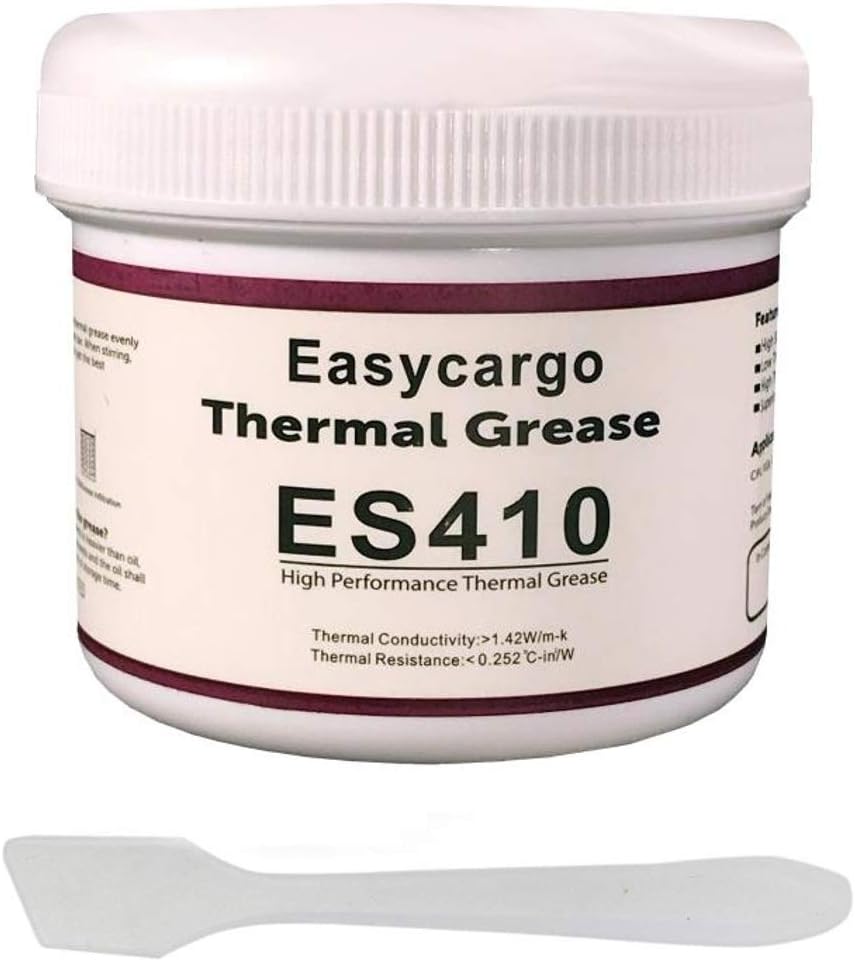
Easycargo's 200 g thermal paste kit is built around versatility and quantity. It carries a 4.8 rating and is described for use across GPUs, VGA cards, LEDs, MOSFETs, transistors, CPUs, and other chips. The large container makes it a practical choice for technicians, builders with several systems, or anyone who expects to service multiple heat-producing components over time.
We may earn a commission when you buy through this link, at no additional cost to you.
Its listed thermal conductivity is above 1.42 W/mK, while thermal resistance is specified below 0.252 k-in/W. Those figures provide a useful technical baseline, although compound performance also depends on application quality, contact pressure, and the design of the cooler. The working temperature range of minus 30 to 280°C further suggests suitability for demanding electronics rather than only a single desktop CPU task.
The product is described as a white silicone carbon compound and thermally conductive paste or grease. Although the title uses the word conductive in reference to heat conduction, the supplied information does not provide a dielectric-strength figure or explicitly state whether the compound is electrically conductive. Buyers working around exposed circuitry should therefore verify this detail with the manufacturer before application rather than assuming that every carbon compound is safe in the same way.
This kit is a compelling option for volume-oriented maintenance, repeated installations, and mixed workloads involving LEDs, transistors, MOSFETs, graphics hardware, and processors. It may offer more than a first-time builder needs, but for a workshop or enthusiast with numerous components, the large package reduces the likelihood of running out during repeated servicing.
A 200 g package is considerably more substantial than the small tubes and sachets often sold for individual processor installations. It suits users who expect to work on several devices or replace thermal compound after extended service intervals.
The listed uses cover LEDs, GPUs, CPUs, MOSFETs, transistors, and chips. This broad scope makes the compound useful for general electronics work rather than a single form-factor-specific cooling task.
We may earn a commission when you buy through this link, at no additional cost to you.
Arctic Silver 5 is the strongest performance-oriented choice in this group, earning a 4.8 rating and offering a listed thermal conductance above 350,000 W/m² degrees Celsius when measured with a 0.001-inch layer. Its formula combines thermally enhanced ceramic particles with three distinct shapes and sizes of pure silver particles to improve physical contact between a heatsink and the processor core.
We may earn a commission when you buy through this link, at no additional cost to you.
The formulation is specifically designed to resist separation, running, migration, and bleeding. Those stability characteristics are valuable in a long-running system because they help the interface remain consistent under repeated heating. The product also has a highly refined reputation for spreading well and removing cleanly, which matters when a cooler must be taken off for maintenance or a processor upgrade.
The principal trade-off is electrical conductivity. With 99.9% pure micronized silver, this is not a nonconductive paste. It should be kept away from exposed electrical contacts, and a nonconductive compound is usually the more logical choice for cautious builders. The small 3.5 g container is also better suited to a few precision applications than to servicing a large collection of devices.
Arctic Silver 5 is the top recommendation for a builder seeking a specialized, high-conductivity interface and confident application technique. It suits experienced enthusiasts who want a metal-based option for processor or graphics-card contact surfaces. For beginners concerned about accidental short circuits, ARCTIC MX-4 offers a safer metal-free alternative.
Three shapes and sizes of silver particles are combined with ceramic particles to fill different microscopic gaps. This particle distribution is central to the product's high listed thermal conductance and contact-focused design.
The listing specifically states that the compound will not separate, run, migrate, or bleed. This stability helps distinguish it from greases that can change position or develop gaps during extended operation.
We may earn a commission when you buy through this link, at no additional cost to you.
G107 offers a useful middle ground between a tiny enthusiast package and a large industrial container. It has a 4.7 rating, contains 20 g of silver thermal paste, and includes a dedicated spatula. The compound is intended to disperse heat from CPUs to heatsinks and is also listed for GPUs, LEDs, ovens, chipsets, and other components.
We may earn a commission when you buy through this link, at no additional cost to you.
Thermal conductivity is specified above 3.17 W/mK, placing its stated performance well above the lower-conductivity silicone greases in this comparison. It is also described as non-electrical conductive, non-toxic, non-corrosive, and tasteless, while adding high-temperature resistance. Those characteristics make the listing attractive for users who want both measurable performance and a broad set of safety properties.
There is one detail worth checking before purchase. The product title identifies the material as silver thermal paste, but the supplied bullet points call it nonconductive. Silver-filled formulations can vary widely, and the product information here does not explain how the material is electrically nonconductive. Buyers should look for manufacturer clarification if the compound will be applied near exposed pads, pins, connectors, or other sensitive surfaces.
G107 is most appealing to users who want a 20 g supply and an included applicator without moving to a bulk industrial container. It can handle multiple computer and electronics projects, and its included spatula makes spreading easier. For an enthusiast who values the highest listed conductance, Arctic Silver 5 may be preferable; for straightforward, well-rounded service work, G107 is a strong alternative.
The 20 g container offers enough compound for several applications, while the included spatula helps users control placement. This combination is practical for technicians and builders who repeatedly service heat sinks.
CPUs, GPUs, LEDs, ovens, chipsets, and other components appear in the listed applications. That makes the product useful for mixed computing, lighting, and electronics maintenance workloads.
We may earn a commission when you buy through this link, at no additional cost to you.
MYQ058 is the highest stated thermal conductivity figure in this roundup at more than 5.8 W/mK. It has a 4.6 rating and is built as a 100 g carbon-based thermal grease for CPUs, GPUs, PCBs, and integrated circuits. The formulation combines graphite and metal powders, according to the listing, positioning it as a high-output option for demanding thermal work.
We may earn a commission when you buy through this link, at no additional cost to you.
Electrical protection is a major strength. The compound is said to withstand voltages above 10,000 volts, reducing short-circuit risk around sensitive electronic components. It also maintains a consistent paste consistency, low thermal resistance, and stable performance without drying out or separating. These qualities are particularly relevant to industrial environments, repair benches, and users servicing several heat-producing assemblies.
Temperature compatibility is broad. The listed continuous operating range is minus 20 to 230°C, with transient operation from minus 30 to 280°C. That makes the compound suitable for both everyday computer use and demanding industrial applications, although the exact operating limits for any installation should follow the requirements of the component and cooler manufacturer.
MYQ058 is a good fit for technicians, system integrators, and experienced builders who repeatedly install or maintain thermal interfaces. Its 100 g container and industrial specifications are excessive for a single CPU upgrade, but they add value where uptime and thermal transfer are critical. Buyers should still follow careful application practices and confirm that the compound is compatible with their specific hardware.
A stated conductivity above 5.8 W/mK makes MYQ058 suitable for users who prioritize strong thermal transfer. The graphite and metal-powder formula is aimed at moving heat efficiently through demanding component interfaces.
The listed 10,000-volt withstand capability and broad temperature range suit specialized equipment and industrial service work. Stable consistency also supports performance over extended operating periods.
We may earn a commission when you buy through this link, at no additional cost to you.
HY-510 is sold as four 25 g packages totaling 100 g, giving users both quantity and the convenience of keeping portions in separate containers. It carries a 4.6 rating, uses a silicone grease compound, and states a thermal conductivity above 1.93 W/mK. The product is designed for CPUs, GPUs, chipsets, radiators, PS4 components, and other computer hardware.
We may earn a commission when you buy through this link, at no additional cost to you.
One of its clearest advantages is electrical safety. The supplied information explicitly describes the paste as metal-free and nonconductive, which reduces the risk of short circuits when installing it on CPUs or graphics cards. Its ideal consistency is also presented as easy to apply, making it a manageable option for beginners who want a forgiving thermal grease.
Durability is supported by a listed operating range of minus 30 to 280°C and an emphasis on maintaining its mushy consistency. Low thermal resistance is also claimed. As with any paste, however, actual results depend on applying a thin, even layer and maintaining proper mounting pressure, so none of the listed figures can substitute for correct installation.
HY-510 is a sensible choice for a workshop, a multi-computer enthusiast, or a builder who prefers clearly packaged, nonconductive material. It does not claim the numerical performance of the carbon and silver leaders, but safety, spreadability, and four separate containers create a practical balance. It is particularly attractive where several devices may be serviced but smaller, sealed portions are easier to store.
The 25 g multipack format makes it easier to divide the compound among several systems or keep unused material sealed. This is more practical for repeated work than carrying one large container into every service situation.
Metal-free, nonconductive construction makes HY-510 less concerning around exposed processor contacts and graphics-card components. Easy-to-spread consistency supports neat, repeatable installation.
We may earn a commission when you buy through this link, at no additional cost to you.
G104 is a 100 g tube of white silicone thermal grease with a 4.8 rating. It is designed to help transfer heat from CPUs and GPUs to heatsinks and is also listed for ovens, chipsets, Xbox systems, high-power LEDs, and other components. An applicator spatula is included, making the package practical for both computer maintenance and general electronics work.
We may earn a commission when you buy through this link, at no additional cost to you.
The compound's thermal conductivity is listed above 1.63 W/mK, and its thermal resistance below 0.249°C-in²/W. These numbers are lower than those of the highest-conductivity options, but G104's broader appeal comes from its 100 g quantity, nonconductive characteristics, and versatility. It is also described as high-temperature resistant, non-toxic, non-corrosive, and tasteless.
For installation, the included spatula provides better control than trying to spread a thick grease from the container itself. A thin, even layer is important because excess material can reduce contact quality or make cleanup difficult. Users should remove the old compound from both mating surfaces before applying the new material.
G104 is a strong option for owners of several older or mixed computer systems, LED assemblies, and general electronics. The large container and included spatula are especially useful for repeated servicing. Users seeking the highest possible conductivity for a tightly packaged enthusiast processor may prefer a carbon or silver paste, while G104 favors a more general-purpose maintenance profile.
The listed applications extend well beyond desktop CPUs to chipsets, Xbox hardware, ovens, and high-power LEDs. This makes G104 relevant to a broad collection of heat-producing equipment.
The included spatula helps place and spread a more uniform layer. That control is useful with silicone grease, whose consistency can otherwise make it difficult to apply evenly.
We may earn a commission when you buy through this link, at no additional cost to you.
Dow Corning 340 holds the highest customer rating in the guide at 4.9 and is the premium choice for specialized electronics. This 142 g, five-ounce container of silicone heat sink compound is formulated for electrical devices, PCB assemblies, computer CPUs, IGBTs, industrial equipment, automotive applications, and other compact, high-performance electronics.
We may earn a commission when you buy through this link, at no additional cost to you.
Its defining characteristics are stability and insulation rather than maximum numerical conductivity. The compound is listed as nonflowing and noncuring, with low bleed and high temperature stability. Its stated dielectric strength is 210 V/mil, volume resistivity is 2 × 10¹⁵ Ω·cm, and it is described as providing excellent electrical insulation without requiring curing or oven processing.
The 0.67 W/mK conductivity figure is lower than those of the carbon, silver, and other higher-conductivity pastes in the comparison. That makes the product less compelling for a conventional enthusiast CPU where every fraction of conductivity may matter. In industrial, automotive, and PCB applications, however, nonflowing behavior, dielectric properties, and long-term stability can be more important than achieving the highest possible transfer figure.
Dow Corning 340 is best for specialized thermal coupling, IGBT heat dissipation, PCB assemblies, and professional maintenance. The five-ounce container also supports users who handle many devices. Buyers should store it sealed in a cool, dry place, observe its stated shelf life, and avoid prolonged or direct solvent exposure.
A nonflowing, noncuring formula stays in place without requiring an oven or chemical curing step. Low-bleed behavior also supports stable thermal coupling in compact and demanding assemblies.
High dielectric strength and very high listed volume resistivity make 340 suitable for IGBTs, PCBs, and other electrical assemblies. The product is aimed at improving heat transfer while maintaining dependable insulation.
We may earn a commission when you buy through this link, at no additional cost to you.
BSFF provides a compact thermal paste package designed for CPUs, GPUs, integrated circuits, and heatsinks. It carries a 4.7 rating and includes a 1.8 g quantity of paste with a toolkit. That makes it a convenient option for a first repair or a processor installation where the buyer does not want to purchase several separate application accessories.
We may earn a commission when you buy through this link, at no additional cost to you.
The formula uses carbon microparticles and is described as having extremely high thermal conductivity, although the supplied information does not provide a numerical value. The paste is metal-free and nonconductive, reducing the risk of a short circuit if it is placed near exposed processor contacts or graphics-card circuitry. Its consistency is also promoted as easy to use for beginners.
The stated durability is at least five years after application, with an emphasis on maintaining heat-dissipation performance over time. As with every paste, real longevity depends on operating temperature, mounting pressure, contamination, and whether the cooler is removed. Nevertheless, the claim makes BSFF appropriate for users seeking a reasonably durable maintenance solution rather than a temporary single application.
BSFF is best for a precise CPU or GPU refresh where the included toolkit adds value and the 1.8 g quantity is sufficient. It is not the right package for repeated industrial servicing or many heatsinks. Buyers wanting a larger supply can consider Easycargo, HY-510, or G104, while ARCTIC MX-4 offers a similarly compact and beginner-friendly concept with a longer stated service life.
The included toolkit and small tube reduce the need to source cleaning and application accessories separately. BSFF's metal-free, nonconductive formula also makes it approachable for careful first-time builders.
Carbon microparticles form the basis of the stated heat-transfer mechanism, while the formula is designed not to degrade quickly. The five-year durability claim makes it relevant for standard component refreshes.
We may earn a commission when you buy through this link, at no additional cost to you.
Selecting a heatsink compound involves balancing thermal transfer, electrical safety, stability, quantity, and the type of equipment being serviced. The most important step is to identify whether the application is a precision computer install, a large maintenance program, or a specialized electrical assembly.
Thermal conductivity indicates how readily the compound transfers heat, while thermal resistance describes the opposition the interface creates to heat flow. Published figures are useful for comparing formulas, but they are not direct temperature predictions for every computer. A paste that performs excellently on one cooler may behave differently on another due to mounting pressure, surface finish, and contact area. Users should also examine whether the manufacturer provides a consistent methodology for its figures.
Prioritize compounds with clear, comparable specifications when performance is the priority. The highest figure in this guide belongs to MYQ058 at more than 5.8 W/mK, while Arctic Silver 5 lists thermal conductance rather than the same unit of conductivity. Choose a compound with credible published data and a formulation suited to the device rather than assuming the largest number always creates the coolest system.
Thermal compounds are not automatically safe around exposed circuitry. Metal-free, nonconductive formulas such as ARCTIC MX-4 and HY-510 offer a lower-risk approach for processors, graphics cards, and other sensitive components. Silicone greases can also provide valuable insulation when the product specifically states a high dielectric strength, as Super Lube and Dow Corning 340 do.
Metal-filled pastes such as Arctic Silver 5 may perform well but require careful application away from conductive surfaces. For exposed or densely populated electronics, favor a clearly nonconductive product with verified dielectric specifications. If a listing uses ambiguous terms such as conductive without explaining electrical behavior, seek manufacturer guidance before use.
The compound's operating range should comfortably cover the temperatures reached by the component and cooler. Some options are listed from minus 30 to 280°C, while others specify a lower continuous ceiling and allow brief excursions. Industrial electronics, automotive assemblies, and high-power LEDs may have different thermal demands from a desktop processor.
Check the equipment maker's recommended temperature range, the cooler's design, and the compound's continuous and transient limits. Wider numerical ranges are useful, but they are not permission to exceed component or manufacturer limits. A high-range compound still needs proper mounting pressure and an even layer to realize its potential.
A good thermal interface should remain stable as temperatures rise and fall. Pump-out, drying, separation, hardening, migration, and bleeding can all create gaps that reduce performance over time. Noncuring silicone compounds are valued for remaining flexible, while metal and ceramic pastes may be selected for resistance to separation and flow.
Look for explicit claims about consistency, low bleed, noncuring behavior, and durability. Listed service periods can be useful points of comparison, but users should not interpret them as guarantees. Cleaning, cooler removal, contamination, and operating temperature all influence how long an interface remains effective.
Package size should reflect the number of surfaces you expect to service. A 1.8 g tube or 4 g container is sensible for one or two precision installations, while 20 g, 100 g, 142 g, and 200 g packages suit repeated maintenance. Large industrial quantities also reduce the inconvenience of replenishing a workshop supply.
For a single PC build, a compact package is usually easier to store and less likely to be exposed unnecessarily. Technicians, repair shops, and owners of multiple systems should consider bulk formats or multipacks. Account for the need to reseal or store opened compound in a clean, suitable container, especially when the product is noncuring and can remain usable for future service.
Ease of application matters because an uneven, overly thick, or contaminated layer can undermine the thermal interface. Some products include a spatula, while others emphasize a consistency suitable for beginners. If a heatsink will be removed regularly, a compound that is easy to remove can prevent damage to surrounding components and simplify cleaning.
Choose a product whose consistency matches the user's comfort level and the available cleaning tools. Isopropyl alcohol, lint-free material, and a clean surface help produce a reliable bond, but the compound must also be compatible with the service process. Silicone greases may be useful for removable assemblies, while specialty pastes may demand more careful handling.
IGBTs, PCBs, automotive electronics, industrial equipment, LEDs, and power diodes may value insulation and stability more than maximum conductivity. Dow Corning 340 emphasizes nonflowing behavior, high dielectric strength, and specialized heat-dissipation use. Super Lube targets CPUs, LEDs, and power diodes with a flexible, noncuring silicone formula and high dielectric strength.
For professional applications, check the compound's official working limits, curing requirements, storage guidance, and compatibility with nearby materials. Avoid replacing a specialized manufacturer-recommended compound with a general paste unless its specifications clearly satisfy the equipment requirements. A slightly lower conductivity figure can be acceptable when insulation or dimensional stability is the decisive property.
Begin by powering down the system, disconnecting its power source, and allowing the processor, graphics processor, or other component to cool. Remove the existing heatsink carefully, especially if the compound has hardened or become difficult to separate. Follow the hardware manufacturer's removal procedure and avoid bending components or applying force directly to a chip package.
Clean both mating surfaces with appropriate electronics-grade isopropyl alcohol and a lint-free wipe or applicator. Allow the surfaces to become completely dry, then apply a small, even layer of the new compound. The appropriate amount varies with the component and cooler, so use the instructions supplied with the thermal interface or cooler. Spread the material when directed, avoid air pockets, and keep it away from connectors and exposed electrical contacts.
Seat the heatsink according to the mounting instructions and tighten fasteners gradually in a cross pattern so that pressure is distributed evenly. Confirm that the cooler makes consistent contact and remove any compound that squeezes out from the edges. After assembly, allow the system to run under a controlled monitoring setup and check temperatures under a representative workload, reinstalling the cooler and replacing the compound if contact was disturbed.
No. A larger quantity does not improve the thermal interface once the surface gaps are adequately filled. Excess paste can spill onto surrounding components, make disassembly difficult, or interfere with parts of the cooler. Use a thin, even layer appropriate to the chip and heatsink, following the compound and cooler instructions.
Usually, no. Many quality compounds are designed to remain stable for years, although the listed service duration depends on the formula, operating temperature, mounting pressure, and environmental conditions. A paste may need replacement sooner if the cooler is repeatedly removed, the compound becomes contaminated, or the processor has changed significantly.
It can be used correctly on suitable processor and heatsink surfaces, but silver is electrically conductive. Users should keep it away from exposed contacts, connectors, and any powered electrical path. A clearly nonconductive compound is generally easier to apply confidently around complex graphics cards and densely populated circuit boards.
Yes, when the product is listed for those applications. Easycargo, G107, G104, Super Lube, and Dow Corning 340 all identify LEDs or power devices among their uses. The compound must still be appropriate for the component's temperature, electrical requirements, and mounting method.
Thermal paste is generally optimized to fill microscopic gaps and maximize contact between a hot chip and its cooler. Silicone thermal grease also fills gaps but may offer flexibility, insulation, and easier removal. The correct choice depends on the equipment, electrical environment, temperature range, and whether the heatsink must be serviced frequently.
Apply enough to create a thin, complete layer after the cooler is mounted, not enough to flood the surrounding area. Many modern processors have heat spreaders, and an excessive dot or line can still squeeze out around the edges. Follow the cooler manufacturer's diagram and the paste instructions, and verify even contact during installation.
It is usually better to clean the old material and apply a fresh layer. Reusing a disturbed or contaminated interface can leave gaps and produce inconsistent cooling. A noncuring compound may remain in its container for later work, but the mating surfaces should be cleaned before reassembly.
No. A compound's thermal performance also depends on mounting pressure, surface flatness, cooler design, airflow, workload, paste thickness, and application quality. Use the conductivity figure to compare products, but evaluate the complete cooling system rather than assuming a single specification determines the final temperature.
ARCTIC MX-4 stands out as the best balanced option for general computer use, combining a carbon microparticle formula, nonconductive construction, easy application, and a strong stated service life. Arctic Silver 5 offers the strongest performance case for an experienced user seeking a highly conductive silver compound, while Dow Corning 340 leads the specialized industrial category with nonflowing silicone grease and high insulation.
Before choosing, prioritize the properties required by the actual application. Conventional PC builders may value a nonconductive formula, easy spreading, and a compact package. Technicians should consider quantity, low bleed, and resistance to drying, while industrial users should examine dielectric strength, temperature limits, and nonflowing behavior as closely as thermal conductivity.
Current prices and product details can change, so confirm the latest listing, package contents, and manufacturer guidance before buying. The most effective compound is still the one that is compatible with the component, remains stable in the intended environment, and can be applied cleanly under the cooler's mounting system.