
Portable UHF/VHF Frequency Counter
4.1Editor score
VHF and UHF coverage
CTCSS and DCS decoding
Battery-powered handheld operation
Our Frequency Counter for Ham Radio guide compares 10 portable and RF counters for range, accuracy, decoding, spectrum analysis, calibration, and field use.
A frequency counter helps ham radio operators identify transmit frequencies, examine radio signals, and verify equipment more accurately than visual tuning alone. A useful counter should cover the bands you operate, provide a readable display, offer dependable time-base performance, and include the accessories needed for immediate field or bench use.
We compared the ten products in this guide by examining stated frequency ranges, signal-measurement capabilities, decoding functions, portability, display design, operating controls, and included accessories. The list covers dedicated two-way-radio counters, compact counter boards, a portable spectrum analyzer, and a GPS-disciplined precision instrument for advanced calibration work.
Each review explains where the product fits best, what its specifications imply for amateur-radio work, and which compromises deserve attention before purchase. Ratings and product details can change, while current prices and availability fluctuate, so readers should confirm the latest listing information before ordering.
4.1Editor score

4.4Editor score

5.0Editor score
This side-by-side comparison highlights the range, measurement functions, portability, and intended use of each frequency counter, from simple radio-testing modules to a GPS-disciplined precision analyzer.


The Mcbazel Surecom SF401 Plus is a portable frequency counter intended primarily for checking continuous-carrier transmissions from two-way radios. It covers 27MHz through 3000MHz, includes CTCSS and DCS decoding, and displays signal strength. Its 4.1 rating reflects a practical device for operators who need to identify common VHF and UHF radio frequencies rather than perform general-purpose spectrum analysis.
We may earn a commission when you buy through this link, at no additional cost to you.
A major strength is the combination of coverage, decoding, and a relatively compact enclosure. The included 144/430MHz antenna and 400-470MHz antenna support immediate use around common amateur and commercial two-way-radio frequencies. Selection through several ranges helps narrow the measurement process, while four-button operation keeps the controls straightforward. A TCXO-based time base is specified to maintain accuracy across a temperature range of approximately -45°C to 65°C, with stated accuracy varying from plus or minus 2ppm to plus or minus 4ppm.
The product has an important limitation that should shape expectations: it is designed to count continuous-wave signals from two-way radios and is not suitable for wide-bandwidth signals. That means it is a focused field service and monitoring tool, not a replacement for a broad spectrum analyzer. Users checking ordinary handheld or mobile-radio carriers will find the relevant capability, but those investigating complex emissions need a different instrument.
This is a sensible choice for ham radio operators, technicians, and club members who mainly work with FM voice radios and want portable frequency plus tone decoding. The supplied antenna, power adapter, USB cable, and manual improve first-use convenience. Choose it when straightforward carrier-frequency identification matters more than spectral visualization or wide-band signal characterization.
The 27MHz-3000MHz range accommodates many VHF and UHF two-way-radio transmissions. It is particularly relevant to amateur-radio operators who want to confirm a handheld or mobile radio's operating frequency without tuning by ear.
Four-button controls, selectable ranges, and the included antennas keep setup manageable. The portable format also makes the meter easier to carry between a vehicle, radio room, and field location.
We may earn a commission when you buy through this link, at no additional cost to you.
The Surecom SF401 Plus is a compact counter designed to measure continuous-wave signals from two-way radios across 27MHz to 3000MHz. It combines frequency measurement, a signal strength indicator, and CTCSS and DCS decoding in an easy-to-operate four-button device. The stated 4.3 rating makes it one of the more favorably reviewed conventional counters in this roundup.
We may earn a commission when you buy through this link, at no additional cost to you.
Its TCXO time base is specified to provide accuracy of plus or minus 2ppm to plus or minus 4ppm between approximately -45°C and 65°C. Temperature compensation is relevant for field work because an unstabilized oscillator can drift as ambient conditions change. Selectable ranges cover most of the two-way-radio frequencies users are likely to test, while the small enclosure makes the unit convenient to carry and operate away from a fixed bench.
As with other simple carrier counters, the scope is more limited than the frequency range alone might suggest. Its intended signal is a continuous carrier from a two-way radio; it is not a full-featured analyzer for examining occupied bandwidth, modulation quality, or a complicated RF environment. It also does not provide the visual spectral context offered by a dedicated spectrum analyzer.
The Surecom is best for a ham radio operator who wants a lightweight frequency identifier with tone decoding for FM radios. It fits club maintenance days, programming checks, and general troubleshooting. Buyers who need to inspect multiple signal types or understand interference across a band should select a broader analysis instrument instead.
The stated TCXO performance gives the counter a useful foundation for field measurements. Its specified accuracy varies with temperature but remains aligned within a few parts per million across the listed operating environment.
CTCSS and DCS decoding can reveal the tone identifier associated with a transmission, not just its carrier frequency. That added information is valuable when comparing radios or investigating a channel assignment.
We may earn a commission when you buy through this link, at no additional cost to you.
The FC-2800M is a compact frequency counter marketed for ham radio, CB, and DMR use. It measures continuous-carrier signals, includes a signal strength indicator, and provides CTCSS and DCS decoding. With a 4.4 rating, it offers a balanced combination of frequency coverage, digital-radio relevance, and straightforward operation.
We may earn a commission when you buy through this link, at no additional cost to you.
Two range configurations broaden its practical use: 2MHz-200MHz and 27MHz-2800MHz. The stated description also identifies CB, ham radio, and DMR frequency ranges, making it a natural fit for operators who move among VHF, UHF, and citizen-band equipment. A low-PPM crystal time base is used for measurement accuracy, and the four-button interface keeps navigation manageable in the field.
The counter remains intentionally focused. It identifies frequencies and decodes common radio tones, but it does not display a wide spectral view or deeply characterize complex signals. Its value therefore rests on fast identification of ordinary radio carriers, including DMR-related testing, rather than advanced diagnostic work. The compact body is helpful, although users should still account for the antennas, power, and connection method required by their test setup.
The FC-2800M is well suited to amateur-radio clubs, CB operators, and technicians who need a portable meter spanning conventional VHF and UHF use. It is a particularly relevant option for users interested in digital-radio frequency checks. For laboratory-grade timing, GPS synchronization, or broad spectrum inspection, the product's feature set indicates a more specialized instrument would be preferable.
Separate low-band and high-band selections make it easier to work across several radio systems. The result is a versatile counter for common amateur, CB, and two-way-radio frequencies.
The stated DMR support is useful for users who work with digital systems and need to confirm carrier frequency. CTCSS and DCS decoding adds another layer of identification for conventional FM equipment.
We may earn a commission when you buy through this link, at no additional cost to you.
The Portable TinySA Spectrum Analyzer is the broadest visual-analysis tool in this guide, covering 100kHz to 960MHz. It provides MF, HF, VHF, and UHF measurements, a 2.8-inch color touchscreen, and a displayed spectrum with as many as 290 scan points. Its 4.4 rating reflects a feature set that appeals to hams who want more than a carrier-frequency reading.
We may earn a commission when you buy through this link, at no additional cost to you.
Dual-range analysis separates 0.1-350MHz from 240-960MHz operation, while selectable resolution bandwidth from 2.6kHz to 640kHz lets users adjust the trade-off between scan speed and detail. A built-in signal generator provides a sine-wave output from 0.1-350MHz and a square-wave output from 240-960MHz. An internal calibration source supports self-testing and low-input calibration, reducing reliance on elaborate external calibration equipment for basic setup.
The device also supports USB CDC control under Windows and Linux, allowing remote measurements, setting changes, and serial commands. This makes it useful for iterative troubleshooting or a more computer-centered workflow. The included RF cables, SMA adapters, telescopic antenna, USB cable, and touchscreen pen create a broad accessory package. One limitation is its 960MHz ceiling, which falls below 2.8GHz-capable counters in this roundup.
Choose the TinySA when you need to see surrounding spectrum activity, evaluate an antenna setup, or combine measurement with a signal source. Its portable rechargeable design works at a bench or away from mains power. It is the editor's choice for readers seeking the most broadly useful RF inspection tool, while advanced frequency standardization remains the specialty of a GPS-disciplined counter.
A spectrum display helps reveal activity near the target frequency rather than presenting only one numeric reading. This context can be valuable when diagnosing interference, checking antenna behavior, or locating unexpected signals.
The internal generator and calibration source make the package more versatile than a basic counter. Signal output supports testing receivers and systems, while the calibration feature assists with setup.
USB operation extends the analyzer into a Windows or Linux workflow. Remote control and serial commands can streamline repeated measurements that would otherwise require more hands-on interaction.
We may earn a commission when you buy through this link, at no additional cost to you.
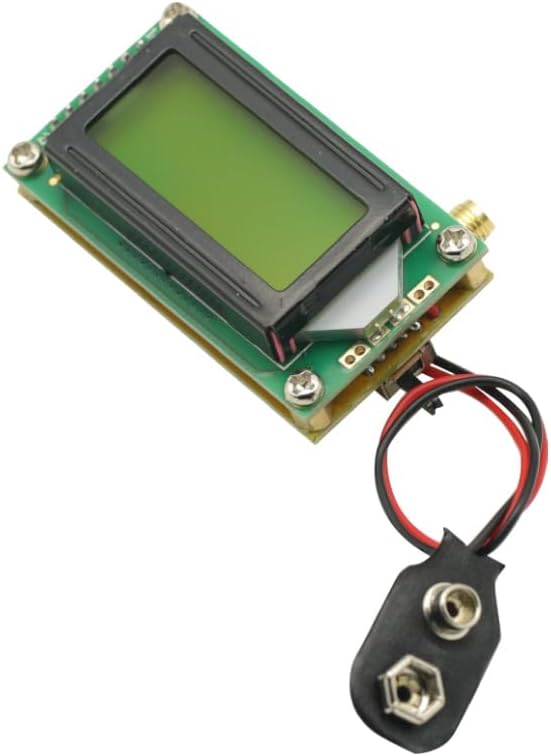
The Portable UHF/VHF Frequency Counter is a small, battery-powered meter for testing radios in the 136-174MHz and 400-470MHz ranges. It includes CTCSS and DCS decoding, uses a one-button control scheme, and comes with a 9V battery and antenna. Its 4.1 rating and focused feature set make it a practical budget-oriented option for common VHF and UHF work.
We may earn a commission when you buy through this link, at no additional cost to you.
Operation is deliberately simple. A long press turns the device on or off, and a normal press advances to the next test after the frequency appears on the display. That design reduces the number of controls users must learn and suits quick checks of nearby transmissions. The stated measurement distance is within one meter, making proximity with the radio under test an important part of the operating procedure.
The product's main limitation is its deliberately narrow frequency coverage. It does not address HF, 220MHz, 902MHz, or the wide upper spectrum covered by several other models. It is therefore a specialized tool for VHF and UHF two-way-radio testing rather than an all-purpose amateur-radio counter. The tiny 9 by 5.5 by 2cm size also means it is best suited to portable work with minimal physical space.
This counter is an attractive choice for beginners, club members, and technicians who need an inexpensive way to identify nearby FM radio carriers and tones. It is less appropriate for an operator with broad band interests. Within its defined VHF and UHF remit, however, the battery, antenna, decoder, and uncomplicated controls create a useful self-contained testing package.
Long-press power control and press-to-advance testing reduce setup time. This makes the meter approachable for new users and efficient during repeated radio checks.
The included 9V battery supports use away from a bench or vehicle power outlet. Its compact body is easy to place in a small toolkit or carry directly to a radio.
We may earn a commission when you buy through this link, at no additional cost to you.
The Anysecu SF-103 A-SF103 is a portable counter covering 2MHz to 2.8GHz, including the 2m amateur band, VHF, and UHF. It measures continuous-carrier two-way-radio signals, displays signal strength, and supports DMR radio signals. The stated 4.2 rating indicates a solid general-purpose radio meter, particularly for maintenance and wireless testing.
We may earn a commission when you buy through this link, at no additional cost to you.
Compared with basic counters limited to one VHF or UHF segment, the SF-103 offers a much broader operating range. Selectable ranges help narrow the search, while the four-button layout balances multiple functions with portable dimensions. Its stated positioning as a tool for maintenance personnel and wireless enthusiasts is relevant to users who test equipment regularly rather than simply check a single channel.
Its scope is still concentrated on carrier-frequency measurement rather than full analysis. There is no stated spectrum display, signal generator, or advanced time measurement. The device is designed for continuous-wave signals, so it should not be treated as a general analyzer of wide-bandwidth or complex emissions. Users who want to understand what else occupies the band would benefit from the TinySA or another spectrum-oriented instrument.
The Anysecu is a strong fit for amateur-radio operators, radio technicians, and users who need to cover 2m through UHF in one portable device. DMR support adds relevance for digital-radio work, while the signal-strength display helps evaluate a received carrier. It offers a useful balance of range and simplicity without reaching the complexity or expense of a laboratory-grade counter.
The 2MHz-to-2.8GHz span includes important 2m, VHF, and UHF activity. That range makes one device useful across several radio systems and maintenance tasks.
A signal-strength indication gives useful context beyond the carrier number. It can help a user judge signal presence while positioning a radio or antenna near the meter.
We may earn a commission when you buy through this link, at no additional cost to you.
The Mcbazel Surecom SF-103 is a handheld frequency counter for 2MHz through 2.8GHz, covering 2m, VHF, and UHF radio signals. It includes a signal-strength indicator and a graphical battery-level display. Its 4.3 rating and broad range make it a well-rounded choice for amateur-radio operators, maintenance personnel, and wireless enthusiasts.
We may earn a commission when you buy through this link, at no additional cost to you.
The key technical feature is its TCXO-based time base, specified to deliver accuracy of plus or minus 2ppm through plus or minus 4ppm from approximately -45°C to 65°C. Temperature compensation is especially meaningful for a portable instrument that may be used in changing outdoor conditions. Selectable frequency ranges and four-button operation make the counter convenient for routine transmitter and walkie-talkie testing.
Important safety guidance limits maximum direct input to 5V peak-to-peak and prohibits connecting the counter directly to a radio antenna output. Users must respect that boundary because an unsuitable signal level could damage the instrument. The device is designed to count continuous carriers from two-way equipment, so it remains narrower in scope than a spectrum analyzer or precision timing instrument.
The SF-103 is a good general selection for users who test a mix of 2m, VHF, and UHF radios and value stable readings outside a controlled laboratory. It is more specialized than a visual analyzer and less capable in timing and phase analysis than the TinyGTC. Within portable two-way-radio measurement, however, it combines broad coverage, temperature compensation, and helpful battery and signal displays.
The stated TCXO accuracy range is especially relevant outdoors. Stable timing helps maintain measurement confidence when ambient temperature changes during a field session.
The lower 2MHz limit includes 2m and other lower-frequency radio activity, while the 2.8GHz upper limit covers UHF equipment. One meter can therefore serve several station and maintenance needs.
The maximum direct input is specified as 5V peak-to-peak, and direct access to a radio antenna output is prohibited. Proper attenuation and connection methods are essential to protect the counter.
We may earn a commission when you buy through this link, at no additional cost to you.
The Acxico 1-500MHz Counter Module is a basic RF frequency counter built around a PCB and FR4 construction with a digital 0802 LCD. It covers 1MHz through 500MHz and is intended as an accessible kit for ham radio experimentation. Its 3.1 rating is the second-lowest in this group, so buyers should view it as an entry-level instrument rather than a precision solution.
We may earn a commission when you buy through this link, at no additional cost to you.
The module's appeal lies in its simplicity. It presents a direct numeric frequency on a small display without the broader controls and analysis functions found in handheld or touchscreen products. Its range reaches into 6m, 2m, and much of the VHF region, making it relevant for common amateur-radio transmitters and receivers. Because it is sold as one module, it is better suited to builders comfortable integrating electronics into a larger project.
The stated high-accuracy positioning should be interpreted carefully. Accuracy can be adjusted only through the second digit after the decimal point, which the description says represents less than one-tenth of the available precision. The module also stops at 500MHz, lacks stated tone decoding, and does not provide signal-strength or spectrum functions. It is consequently less versatile than the dedicated counters, even when used on the same frequencies.
This Acxico board is most appropriate for a hobbyist who wants a straightforward counter display for a home-built setup and primarily operates below 500MHz. It is less attractive for field technicians, DMR users, or operators needing calibrated readings across UHF. A complete dedicated counter may cost more but offers accessories, controls, and measurement features that the module does not claim to provide.
The small display and dedicated module format let builders incorporate direct frequency readings into experimental equipment. It can be a useful educational or project component rather than a complete field solution.
The specified adjustment limit affects how precisely the displayed reading can be tuned. Buyers should not assume the marketing language of high accuracy equates to laboratory-grade measurement.
We may earn a commission when you buy through this link, at no additional cost to you.
The 1-500MHz Counter Board is a minimal frequency-counter kit with an LCD display, a 1MHz-to-500MHz measurement range, and low power consumption. It is presented as a single board for ham radio projects. Its 3.6 rating places it above the bare Acxico module but below the dedicated portable counters and professional-grade analysis tools.
We may earn a commission when you buy through this link, at no additional cost to you.
The integrated display makes the board more convenient than a solution requiring a separate readout. Low power consumption can be helpful in a fixed installation, experimental setup, or battery-oriented project where operating demands are modest. Coverage from 1MHz to 500MHz reaches several important amateur-radio bands and makes the board potentially useful for checking ordinary VHF transmitters.
The product description contains fewer technical details than those of the other counters. It does not state a time-base specification, temperature performance, tone-decoding support, signal-strength function, input limits, or included connection accessories. It also lacks a spectrum display and ends at 500MHz. These unspecified areas mean the board is best evaluated as a basic project component, not a fully documented professional field instrument.
The board is suitable for a ham radio builder who wants a simple LCD counter for a limited-frequency project and can handle the necessary integration. It may serve as an educational platform or a dedicated indicator within a homebrew setup. Operators who need a ready-to-use counter, confirmed accessories, and broad radio support should favor one of the dedicated handheld models instead.
The integrated LCD and single-board format are convenient for a purpose-built indicator. It can provide a direct reading without carrying a larger standalone enclosure.
The stated low power consumption makes the board potentially suitable for installations where energy use matters. Actual run time would depend on the complete setup and power arrangement.
We may earn a commission when you buy through this link, at no additional cost to you.
The AURSINC TinyGTC 7GHz is a portable, high-precision dual-channel frequency counter and timer with an integrated GPS-disciplined oscillator. It measures frequency, phase, counts, and time intervals with 40ps resolution and receives a 5.0 rating. The specification set clearly separates it from simpler radio counters by emphasizing stability, timing, calibration, and professional analysis.
We may earn a commission when you buy through this link, at no additional cost to you.
Channel A covers 0.1Hz through 7GHz, while Channel B covers 0.1Hz through 350MHz. Both use independent high-resolution counter and timer channels, and gapless interpolated reciprocal counting is supported for stable results. The integrated GPSDO uses a premium TCXO, with stated ADEV near 1e-10 from 1 to 100 seconds. An external 10MHz reference input can also be used when calibrating SDR boards, signal generators, and radio equipment.
Portability is unusually strong for an instrument of this class. A rechargeable 4000mAh battery supports handheld operation, while a 4-inch responsive touchscreen and backup jog wheel provide multiple ways to control it. The device offers real-time charting, histograms, ADEV, FFT, and FM-deviation analysis. USB logging, SD card storage, and SCPI remote control broaden its role in long-running or computer-assisted measurements.
The accessory package includes an active GPS antenna, USB cable, two 30cm coaxial cables, and an SMA tee. That makes it suitable for ham radio calibration, SDR reference verification, oscillator work, homebrew projects, and general RF testing. The trade-off is complexity: users seeking only a quick carrier-frequency reading will find the simpler counters easier. Advanced operators who need GPS traceability and high-resolution timing will find this model's capabilities substantially more relevant.
The integrated GPSDO disciplines the internal oscillator against a stable reference. This is especially valuable for long measurements where an ordinary free-running counter may drift or lose confidence in its displayed result.
Two independent high-resolution channels allow different signals to be measured together. That can support phase comparisons, reference verification, and other tasks that benefit from simultaneous observations.
FFT, ADEV, histograms, FM deviation, SCPI control, USB logging, and SD storage cover both on-device analysis and longer workflows. The instrument can function as a standalone field analyzer or a data-oriented bench tool.
An active GPS antenna, coaxial leads, USB cable, and SMA tee support the primary use cases immediately. The external 10MHz reference option adds flexibility for calibrating other radio and test equipment.
We may earn a commission when you buy through this link, at no additional cost to you.
The right frequency counter depends on the bands, radio types, and measurement depth you need. Start with frequency coverage, then consider time-base stability, decoding, spectrum capability, field power, and whether you need calibration-grade reference accuracy.
Begin with the exact bands and equipment you intend to test. A meter covering 136-174MHz and 400-470MHz is well suited to common VHF and UHF radios but cannot handle HF, 220MHz, or 900MHz equipment. Products extending from 2MHz to 2.8GHz cover 2m, much of VHF, and UHF, while the TinySA spans 100kHz to 960MHz for broader spectrum work. The TinyGTC reaches 7GHz on Channel A and 350MHz on Channel B, making its range appropriate for advanced calibration and wideband test signals. Choose coverage with room for future bands rather than relying on a model that only meets today's most common channel.
Many affordable two-way-radio counters are designed to count continuous carrier signals. They are excellent for reading a radio's nominal frequency, but they do not show a detailed spectrum, analyze complex emissions, or characterize wide-bandwidth signals. A spectrum analyzer provides a visual view of activity across a range and can reveal interference or nearby transmissions. A precision counter adds frequency, phase, count, and time-interval functions. The correct choice therefore depends on whether the goal is simple channel identification, broader RF diagnosis, or high-resolution measurement of oscillators and time bases.
Accuracy depends heavily on the reference oscillator, especially when temperature, supply voltage, or warm-up conditions change. Several SF-series counters use a TCXO and state accuracy of approximately plus or minus 2ppm to plus or minus 4ppm over a broad temperature range. The FC-2800M uses a low-PPM crystal time base, while the TinyGTC adds GPS discipline for long-term stability and an external 10MHz reference option. For casual checks, a ppm-level specification may be more than sufficient, but calibration work benefits from traceability to a stable reference.
CTCSS and DCS decoding provide useful context beyond the carrier frequency by identifying common tone information associated with FM radio transmissions. This can help distinguish a radio's channel setup or confirm its operating mode. DMR support is valuable for operators working with digital systems, and it appears in the FC-2800M and SF-103 product descriptions. These functions do not turn a basic counter into a full digital-radio analyzer, so users should distinguish tone identification and frequency measurement from deeper protocol analysis. If digital-radio troubleshooting is central, verify that the specific feature named in the listing matches your intended use.
A numeric frequency display answers one question at a time, while a spectrum analyzer shows how energy is distributed around that point. The TinySA adds 290 scan points on a color touchscreen, selectable resolution bandwidth, an internal calibration source, and a built-in generator. Its generator provides a sine-wave output over 0.1-350MHz and a square-wave output over 240-960MHz, enabling receiver and system tests. These capabilities increase versatility but also introduce a steeper learning curve than a single-purpose counter with four buttons.
A counter used at a home station may be placed on the bench, but portable models are often more useful when carried directly to a radio, vehicle, antenna, or field location. The smallest option measures 9 by 5.5 by 2cm and runs from an included 9V battery. Other handheld products use four-button interfaces, while the TinySA relies on a touchscreen and rechargeable battery. The TinyGTC provides a 4-inch touchscreen plus a backup jog wheel, which is helpful when gloves, outdoor conditions, or precise control make touch operation less convenient. Consider display readability, physical size, battery availability, and included power accessories together.
The way a counter connects to a transmitter affects both convenience and safety. The SF-103 warns that direct antenna-output access is prohibited and specifies a maximum direct input of 5V peak-to-peak. Other products include antennas for VHF, UHF, or telescopic use, while advanced instruments provide coax cables and an SMA tee. Forcing a strong signal into a sensitive input can damage the counter. Users should use suitable attenuation, follow the stated input limits, and confirm the connector type of the radio or test setup before making a purchase.
A useful package should include the parts needed to begin measuring. The SF401 Plus includes VHF and UHF antennas, an AC adapter, a USB cable, and a manual. The TinySA includes RF cables, USB cable, SMA adapters, telescopic antenna, and touchscreen pen. The TinyGTC adds an active GPS antenna, coax leads, and an SMA tee, plus USB logging, SD card storage, and SCPI remote control. Software integration is particularly valuable for long-running measurements, repeatable tests, and users who need to preserve or analyze results rather than simply read a number.
Before testing, read the product instructions and verify the selected input range, connector, antenna, and allowable signal level. Identify the radio's nominal frequency, connect the appropriate accessory, and begin with the counter at a suitable range. For a handheld model, install the required battery or power adapter; for the TinySA, allow the USB and RF accessories to be connected without applying an excessive input. For the TinyGTC, position the active GPS antenna with a clear view of the sky and allow the GPS-disciplined oscillator to establish its reference before relying on long-term stability.
Place the radio and counter in a stable configuration, allow the radio to key or transmit as intended, and observe the displayed frequency, signal strength, or spectrum trace. If the result appears incorrect, move through the counter's selectable ranges rather than repeatedly changing the connection. Use a spectrum display to distinguish the target signal from nearby activity, and use tone decoding when identifying CTCSS or DCS information. For precision work, compare the measurement against a known reference and use the instrument's calibration, histogram, ADEV, or data-export features as appropriate to the task.
Treat every counter as sensitive RF equipment. Do not connect an unattenuated transmitter directly to an input unless the manufacturer explicitly permits it, and observe stated maximum input levels. Disconnect power before changing cables or antennas, keep moisture and dust away from openings, and avoid leaving a radio keyed while swapping connections. Protect the display from impact, store cables without sharp bends, and keep the device within its intended temperature environment. For a TCXO or GPS-based unit, allow time for the oscillator to stabilize when making high-resolution comparisons.
The best general-purpose choice depends on the bands and radios you use. A counter covering 2MHz through 2.8GHz handles 2m, VHF, and UHF, while a spectrum analyzer is more useful when you need to see interference and surrounding activity. Review the supported range, time-base specification, and required accessories before choosing.
The counter should be connected and configured according to its instructions, and the radio may need to key for a measurement. Never connect directly to an antenna output when the manufacturer prohibits it or specifies a low maximum input. Use suitable attenuation and stay within the published signal limits to avoid damage.
It is helpful if you work with conventional FM two-way radios and want to identify tone information along with the carrier frequency. It is less essential for a basic home station interested only in confirming a transmitter's main frequency. DMR support may be more relevant to users working with digital systems.
Neither device replaces every function of the other. A counter provides a focused numeric frequency reading, while a spectrum analyzer displays signal activity across a range and can help reveal interference. The TinySA also includes a signal generator, whereas a dedicated precision counter may offer far better timing and phase measurement.
A TCXO is a temperature-compensated crystal oscillator intended to maintain a more stable reference as ambient temperature changes. Products stating approximately plus or minus 2ppm to plus or minus 4ppm indicate how closely readings are expected to track the reference under the stated conditions. Actual results still depend on signal quality and correct use.
GPS discipline is most useful when long-term stability, precise oscillator comparison, or calibration-quality traceability matters. The TinyGTC can also verify SDR boards, signal generators, and radio gear with an external 10MHz reference. For occasional carrier identification, a less complex counter is usually sufficient.
Most dedicated handheld models cover at least 2MHz, so they can reach the 2m amateur band and many VHF frequencies. The Acxico board and the separate 1-500MHz board also extend to 1MHz, covering 6m. The TinySA reaches 100kHz, while the SF401 Plus starts at 27MHz and therefore does not cover 2m or 6m.
A suitable band antenna, power source, and safe connection method are the essentials. Some products include antennas, adapters, cables, and a power supply, while board-style counters may require additional integration. The TinyGTC includes an active GPS antenna, coax leads, USB cable, and SMA tee for its calibration-oriented workflow.
The best choice for a reader seeking a compact radio-testing tool is the Portable UHF/VHF Frequency Counter, which provides focused VHF and UHF coverage, CTCSS and DCS decoding, simple one-button operation, and battery-powered portability. For broader visual RF work, the TinySA stands out with spectrum display, dual ranges, a touchscreen, calibration source, signal generator, and USB control. The TinyGTC represents the premium choice for operators who need high-resolution timing, GPS discipline, dual channels, and professional analysis features.
Traditional radio counters remain compelling when the task is straightforward. The SF401 Plus models emphasize portability and carrier measurement, the FC-2800M adds DMR support and selectable ranges, and the SF-103 models provide broad 2MHz-to-2.8GHz coverage with temperature compensation. Prioritize the frequency bands you use, the signal types you must identify, the required input method, and the amount of analysis your work genuinely needs before settling on a model.
Product ratings, listings, and current prices can change, so confirm the specifications and accessories at the time of purchase. Comparing the latest listing with the radio, antenna, and connection method in your possession is the safest way to avoid an inconvenient mismatch and ensure the selected counter fits your operating plan.