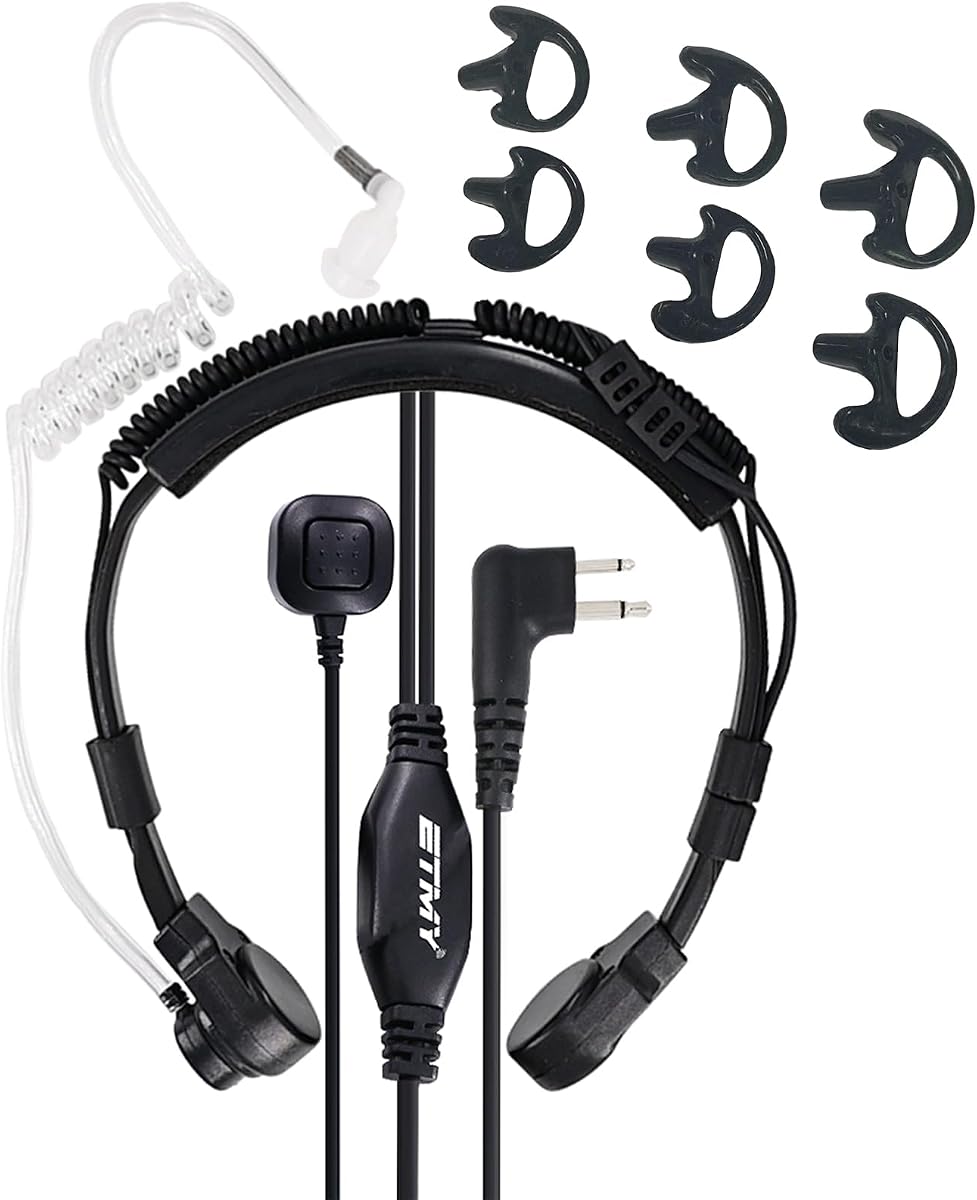
ETMY Throat Mic Tactical Headset
3.7Editor score
Motorola two-pin M connector
Lightweight air-conduction earpiece
Extended flexible cable
Our Throat Mic for Gaming guide compares ten options for noise control, radio compatibility, comfort, privacy, PTT access, and clearer voice communication.
A throat microphone can be useful in gaming setups where keyboard noise, fan noise, ventilation, or nearby conversation makes an ordinary headset difficult to use. The strongest models transmit vocal vibration directly, while connectivity, comfort, push-to-talk access, and compatibility determine whether that advantage becomes practical in real play.
This guide compares ten products based on the supplied specifications, including throat-vibration technology, connector type, included earbuds, neck adjustment, cable design, and intended environment. It covers purpose-built radio headsets, a 3.5 mm gaming option, and two conventional microphones for players whose needs differ from tactical communications.
The entries reveal that the most suitable throat microphone depends heavily on whether you connect through a two-way radio, a 3.5 mm device, or a USB-based streaming setup. Rankings reflect the supplied rating and feature fit, while prices and availability can change at any time, so check the current listing before purchasing.
3.7Editor score

4.0Editor score

4.7Editor score
The comparison below separates true throat microphones from conventional USB and wireless alternatives, focusing on the connection method, noise-control approach, physical design, and practical gaming environment for each product.


The Interface Z Tactical Throat Mic is a specialized communications headset rated 3.5 in the supplied product data. Its defining feature is the interface for Element and Z Tactical push-to-talk equipment, which makes it more relevant to players who already use supported tactical radios than to ordinary console users. The dual sensitive throat microphone transponder is its main technical attraction.
We may earn a commission when you buy through this link, at no additional cost to you.
Rather than relying entirely on ambient sound, the headset sends vocal vibration from the wearer’s throat to the connected radio. That approach can help in loud airsoft fields, crowded events, or mobile tactical scenarios where wind, footsteps, and nearby voices compete with team calls. The transparent voice tube keeps the earpiece visually discreet, and the included mushroom earplugs provide a basic private listening option.
The neckband combines ABS and nylon, giving the product a flexible construction intended to sit comfortably around the neck. This is valuable when communication is continuous because a rigid collar can become tiring during extended sessions. On the other hand, the stated compatibility is narrower than that of the general K-connector and U94 options in this guide, so buyers should confirm the exact Element or Z Tactical interface before ordering.
This is a practical choice for a narrow but clearly defined audience. If your gaming group uses compatible Element or Z Tactical PTT equipment and operates in a noisy environment, the dual pickup system offers a sensible reason to select it. It is less suitable for PC, console, or mobile players unless an appropriate radio interface is already part of the setup.
The Element and Z Tactical PTT interface is the decisive feature here. It is intended for players who value a dedicated radio link over the broader device compatibility offered by a 3.5 mm or USB microphone.
A dual sensitive transponder emphasizes voice transmission through throat vibration. This can make team calls easier to understand where environmental noise would overwhelm a conventional headset microphone.
We may earn a commission when you buy through this link, at no additional cost to you.
The Retevis Adjustable Throat Mic Walkie Talkie Earpiece with Mic, Covert Tube holds a 4.1 rating, making it one of the strongest-rated dedicated throat microphones in the group. It combines vibration-based voice pickup with an adjustable neck, a concealed acoustic tube, and a finger PTT, giving it a balanced feature set for radio-based gaming teams.
We may earn a commission when you buy through this link, at no additional cost to you.
Compatibility is a major strength. The supplied specification lists numerous Retevis models, along with radios from Pxton, Baofeng, and Kenwood. The K-head two-pin connection narrows it compared with a standard 3.5 mm headset, but within the two-way radio category it offers considerable flexibility. Players using one of the listed radios can gain private communication without broadcasting team chatter through a room-filling speaker.
The neck section can be adjusted for size, while the flexible throat sensor sits close enough to the voice source to transmit vocal vibration. The finger PTT may be worn or fixed to a handlebar, making it useful during riding and outdoor activities as well as stationary tactical gaming. The transparent tube is less conspicuous than a large headset boom, although some users may prefer a visible over-ear design.
This is a strong general-purpose choice among dedicated throat microphones, especially for players who want a flexible radio connection, discreet audio, and easy transmission control. Confirm that your radio uses the specified K-head two-pin setup, and consider whether concealed tubing suits your comfort and visibility preferences before purchasing.
The connector works with a long list of Retevis, Baofeng, Pxton, and Kenwood radios. That breadth gives team organizers more flexibility when different members use different compatible hardware.
Adjusting the flexible neck section lets the sensor sit closer to the throat without a fixed-size collar. The result is a more tailored fit for different users and longer sessions.
We may earn a commission when you buy through this link, at no additional cost to you.
The Retevis Adjustable Throat Mic Walkie Talkies Earpiece, Acoustic Tube, 2 Pin carries a 3.9 rating and offers a well-rounded set of communications features. It uses throat vibration to reduce environmental interference, includes an adjustable neck section, and provides a sensitive finger PTT for fast squad communication.
We may earn a commission when you buy through this link, at no additional cost to you.
Its compatibility list covers numerous Retevis radios, the Baofeng UV-5R series and selected other Baofeng models, and devices from Pxton, eSynic, Arcshell AR-5, and Kenwood. The included two-pin K-head plug must physically match the radio and its accessory configuration, so a model name alone is not enough; checking the connector and supported accessory list is essential.
The acoustic-tube earpiece has a soft mushroom tip that can be worn on either side. This is useful for players who want low-profile monitoring, although the fit of a mushroom earplug can vary significantly from person to person. The adjustable tightness helps keep the throat sensor in a consistent position, which is important because movement can affect the consistency of vibration pickup.
This headset is a good middle-ground option for airsoft, hunting, security, and tactical gaming groups that already use supported two-pin radios. It is less attractive for standard PC gaming, but for a compatible radio network it delivers the essential combination of discreet monitoring, adjustable fit, and accessible push-to-talk control.
The K-head two-pin plug supports a substantial selection of popular two-way radio families. This makes it easier to standardize a group when members use different but listed brands.
A soft acoustic tube and mushroom earbud allow private listening without the bulk of a conventional gaming headset. The low-profile design also suits players who want less visual distraction.
We may earn a commission when you buy through this link, at no additional cost to you.
The ETMY Throat Mic Tactical Headset, M Connector is the best-budget pick among the dedicated gaming-oriented throat options, earning a 3.7 rating. It offers vibration sensing, a lightweight air-conduction earpiece, a finger PTT, and a long cable, but its most important buying consideration is the clearly stated M-connector restriction.
We may earn a commission when you buy through this link, at no additional cost to you.
This model is designed for Motorola two-pin systems and is explicitly not compatible with Baofeng radios. The supplied specification identifies CP200, CLS1410, and similar Motorola series as examples, while advising buyers to consult the full compatibility list. The standard M head uses a 0.25 cm TS plug, and the listing emphasizes a secure connection for compatible devices.
At 64.5 grams, the earpiece is designed to remain comfortable through extended wear. The total cable reaches 152 centimeters, including separate earphone and microphone runs, providing mobility while avoiding an extremely short lead. PU cable construction is described as flexible yet durable, which suits movement-heavy airsoft, riding, and outdoor use. Air conduction and throat vibration both help the headset keep ambient interference away from the transmitted voice.
Choose this headset if you use a supported Motorola two-pin radio and want a light, flexible setup without paying for a full conventional gaming microphone. It is not the right choice for a Baofeng user or someone whose computer exposes only a 3.5 mm or USB connection, so verify hardware compatibility before buying.
The product makes a particularly important distinction by identifying itself as a Motorola two-pin model and warning that it will not fit Baofeng radios. That clarity prevents a technically incompatible purchase.
A 64.5-gram earpiece and 152-centimeter cable combine low weight with useful movement. The extended lead is especially helpful when the radio is carried beneath clothing or away from the player’s mouth.
We may earn a commission when you buy through this link, at no additional cost to you.
The Caroo Tactical Throat Mic Headset Earpiece with U94 Tactical PTT is the editor’s choice because it combines a 4.0 rating with broad radio support and a design aimed at noisy, fast-moving environments. It transmits speech through throat vibration, giving it a more specialized communication advantage than an ordinary boom microphone.
We may earn a commission when you buy through this link, at no additional cost to you.
Compatibility is extensive for a two-way radio headset. The supplied information names the Baofeng UV-5R, UV-5RA, UV-82 series, BF-888S and BF-F8HP, Kenwood TK-2107 and TK-3107, and Retevis H777, RT7, RT21, and RT2, among other supported models. The U94 PTT arrangement offers hands-on control for teams that coordinate through physical radios rather than a single PC chat program.
The neckband is lightweight and incorporates a transparent acoustic tube with silicone ear tips. This low-profile arrangement can be preferable during movement because it avoids a large over-ear cup or a boom arm projecting in front of the face. Throat pickup is especially relevant for skiing, cycling, climbing, running, and airsoft, where wind and environmental sound can dominate a conventional microphone.
The Caroo is a compelling pick for tactical gaming groups using compatible radios and for players who regularly operate in high-noise situations. Its feature set and strong supplied rating give it a broader appeal than products tied to a single radio platform. Confirm the U94 connection and exact radio model before placing the order.
Support for major Baofeng, Kenwood, and Retevis families reduces the chance of a group being locked into one brand. It is a strong foundation for shared airsoft or tactical gaming communications.
Throat vibration, a lightweight neckband, and discreet acoustic monitoring target fast-moving activities. The result is most useful when wind, breathing, and background activity would impair a boom microphone.
We may earn a commission when you buy through this link, at no additional cost to you.
The Retevis ETK007 Adjustable Throat Mic Two Way Radio Headset, Finger PTT has a 3.9 rating and emphasizes comfort and personal fit. It includes two pairs of earplugs plus two additional pairs in different sizes, giving users several options for a secure, private acoustic seal.
We may earn a commission when you buy through this link, at no additional cost to you.
The adjustable throat section can be tightened to keep the sensor near the voice source. This is important because stable positioning helps the headset transmit vocal vibration consistently while the wearer moves. The product also uses a finger PTT, allowing transmission to be activated without reaching for a separate control on the radio.
Its noise-reduction claims focus on both background and wind noise, making it appropriate for outdoor gaming, airsoft, and other communication-heavy scenarios. The K-head two-pin connector supports many Retevis radios, including the RT22, RT21, RT68, RT22S, H777, H777S, RB26, RT19, and RT-5R. It is specifically not compatible with DEWALT walkie-talkies.
This is a compelling choice for players who spend long sessions wearing an earpiece, especially if finding a comfortable earplug fit is important. It also offers more than the minimum for a radio headset by including multiple tip sizes. As with the other K-head products, check the radio accessory configuration before purchasing.
Two additional pairs of earplugs in different sizes allow the user to find a better seal and reduce accidental sound leakage. That can make a long session more comfortable than a single fixed-size tip.
Adjusting the sensor close to the throat helps maintain a consistent signal. The design reduces the chance that vigorous movement will pull the pickup away from its ideal position.
We may earn a commission when you buy through this link, at no additional cost to you.
The ETMY K-2 PIN Throat Mic has a 3.9 rating and is framed explicitly around airsoft, motorcycle riding, hunting, security, and other noisy settings. It uses throat vibration sensing with a single-ear air tube, offering an alternative to the two-ear configurations found elsewhere in the guide.
We may earn a commission when you buy through this link, at no additional cost to you.
The product lists compatibility across more than 30 models from Retevis, Pxton, Baofeng, and Kenwood. Named examples include the Retevis RT68, RT22, H777, and H777H; Pxton PX-888S, PX-999S, and PX-666S; Baofeng UV-5R, UV-82, and BF-F8HP; and Kenwood TH-D7, TH-F6, and TK-208. Actual use still depends on having the correct K-connector radio configuration.
Three pairs of small, medium, and large silicone earbuds help prevent the air tube from falling out. A 150-centimeter cable can be hidden beneath clothing to reduce tangling, while the PTT lead can pass through a sleeve. At 62 grams, the headset is marketed for extended wear, including multi-hour sessions.
The listing makes strong noise-reduction and support claims, including an asserted percentage of ambient-noise reduction and a specific sound-level scenario. Those figures are manufacturer statements rather than independently established test results, so buyers should judge them by the underlying throat-sensing design and their own environment. It remains a focused option for compatible K-connector airsoft players.
The single-ear layout, long concealable cable, and anti-fall earbuds address common airsoft concerns. It prioritizes team calls and stable wear during running, crouching, and prone movement.
A broad list of supported Retevis, Pxton, Baofeng, and Kenwood models makes team standardization easier. The connector and radio configuration should still be verified for every device.
We may earn a commission when you buy through this link, at no additional cost to you.
The Throat Mic Acoustic Tube with Finger PTT, 3.5mm Jack is the most directly accessible dedicated throat microphone for general gaming. Its 3.2 rating is the lowest among the ten products, but its universal 3.5 mm connection gives it a wider device audience than the radio-specific headsets.
We may earn a commission when you buy through this link, at no additional cost to you.
The supplied specification lists compatibility with 3.5 mm-enabled phones, tablets, laptops, computers, and gaming devices. It also mentions compatibility with game machines such as the PS5. Users should still check whether their current device has a compatible output or whether a separate adapter is needed, because a physical 3.5 mm plug cannot connect directly to every modern interface.
The core benefit is throat vibration rather than conventional microphone pickup, which helps reduce background and wind noise. A transparent acoustic tube provides private, low-profile monitoring, while the finger PTT provides a physical way to initiate transmission in supported applications. That feature is especially relevant for games with push-to-talk communication.
This product makes the most sense for a gamer who wants to try throat-based communication through a simple analog connection and does not need a wireless or USB microphone. The low rating suggests a more measured experience than the higher-rated radio models, so buyers should consider return options and verify that their game supports the intended connection method.
A 3.5 mm plug is more approachable for ordinary gamers than a specialized radio connector. It can serve phones, computers, and compatible game systems, depending on the available ports.
The finger button provides direct transmission control without reaching for a keyboard shortcut. It can reduce interruptions when team communication must begin only at the right moment.
We may earn a commission when you buy through this link, at no additional cost to you.
The HyperX Quadcast 2 Frost is not a throat microphone, but its 4.6 rating makes it an important comparison for gamers who prioritize a conventional USB setup. It is designed for gaming, streaming, and podcasting, offering a direct connection to a computer rather than a radio or analog gaming port.
We may earn a commission when you buy through this link, at no additional cost to you.
Its distinguishing features include on-board controls, LED lighting, and a removable shock mount. The controls simplify tasks that might otherwise require software adjustments, while the removable mount offers flexibility when positioning the microphone. The Frost finish also fits visually with many gaming setups that use cool-toned lighting and light-colored components.
Unlike a throat headset, this microphone captures sound from the surrounding space. That can be advantageous for natural room sound, reaction commentary, and streaming, but it also means mechanical keyboard noise, mouse clicks, and nearby voices may be captured. A pop filter, quiet room, and appropriate gain settings can help, although none is confirmed in the limited supplied data.
Choose the HyperX Quadcast 2 Frost when you want a polished desktop microphone for PC gaming and content creation. It is not a substitute for a throat headset in a noisy radio environment or when push-to-talk privacy is essential, but it is a strong alternative for a player who values straightforward USB operation and visible control features.
A USB microphone removes the need for a separate analog interface. That makes setup easier for players who want one device for game chat, streaming, and recorded commentary.
On-board controls, LED lighting, and a removable shock mount suit a desk-based setup. They favor streamers and content creators who need simple, visible control over their recording environment.
We may earn a commission when you buy through this link, at no additional cost to you.
The DJI Mic Mini is not a throat microphone, but it is the premium wireless alternative in this comparison and carries the highest supplied rating at 4.7. The package includes two transmitters, one receiver, and a charging case, making it a complete two-person audio system rather than a single-person gaming microphone.
We may earn a commission when you buy through this link, at no additional cost to you.
Each lavalier transmitter weighs only 10 grams, allowing two speakers to wear them discreetly for conversations, livestreams, interviews, and content creation. The system supports 48 kHz sampling, up to 120 dB SPL, and a maximum transmission range of 400 meters under the stated conditions. It also provides automatic limiting to reduce the chance of clipping when input levels become excessive.
Two noise cancellation levels provide another way to manage challenging sound environments. Basic mode is intended for quieter indoor settings, while Strong mode is offered for noisier situations. A receiver and charging case make the system more practical for extended work, with the supplied data stating up to 48 hours of battery life when used with the case.
This is the best choice in the guide for a two-person gaming commentary team or a creator who values wireless freedom and detailed audio over throat-based operation. It does not provide the private radio monitoring, physical radio PTT, or environmental-noise isolation of the dedicated throat products. For conventional PC streaming with a single voice, a dedicated USB microphone may also be more direct.
Two transmitters and one receiver support a shared conversation without requiring separate wireless systems. The included case also organizes and protects the components between sessions.
48 kHz sampling, strong noise cancellation, automatic limiting, and a 400-meter stated range provide a sophisticated audio feature set. These qualities suit mobile creators and two-person gaming commentary.
We may earn a commission when you buy through this link, at no additional cost to you.
The right gaming throat microphone depends first on the device you intend to connect, followed by the noise level of your environment, comfort requirements, and the type of communication you want. A connector that fits your radio is essential, while a throat-based design is only worthwhile if the application supports its push-to-talk behavior.
Begin with the physical connector rather than the brand name. K-head two-pin, Motorola two-pin, U94, Element or Z Tactical PTT, and 3.5 mm connections are not interchangeable. A product may list many radio models, yet still require a particular accessory configuration or programming standard. For PC gaming, confirm whether the radio is linked through a 3.5 mm interface or a compatible USB adapter. For console or mobile use, a 3.5 mm throat microphone may be relevant, while a USB microphone may be easier if the application accepts standard computer audio.
In short, identify your exact output, inspect the connector, and read the full compatibility list. Never assume that a two-pin radio will accept a different two-pin plug.
A throat microphone transmits vibration from the vocal cords rather than relying entirely on a microphone in open air. This can improve intelligibility in noisy or windy environments, but performance still depends on a secure fit and proper placement. Models with adjustable neck sections help keep the sensor close to the throat, while dual pickup units may provide additional sensitivity. For a quiet streaming room, this benefit may be less important than microphone position, gain control, and room treatment.
Choose vibration transmission when noise, wind, and nearby movement are persistent problems. Choose a conventional USB microphone when natural room ambience and simple streaming controls matter more.
Physical PTT control can be valuable in team games because it prevents unnecessary open-microphone conversation. A finger button allows rapid access, while some tactical units place the PTT near the radio or on a cable. Confirm that the connected game, radio, or application recognizes the PTT line and behaves as expected. A connector that carries audio but lacks a compatible control function may provide voice pickup without giving the user the intended transmission workflow.
Prioritize a confirmed PTT system when privacy and controlled communication are central. Test the button in your chosen application before committing to long sessions.
A headset worn around the neck or in the ear for several hours must remain comfortable. Adjustable neck sections are especially valuable because neck sizes and preferred sensor positions differ. Lightweight earpieces reduce strain, and flexible cables reduce pulling when the radio sits at the waist or under a jacket. Earbud size also matters: a stable acoustic seal improves privacy and comfort, while an ill-fitting tip may become distracting during active play.
Look for an adjustable neck, a manageable weight, and at least two ear-tip options. A fit that remains comfortable in a seated match is more valuable than a marginally smaller design on paper.
Single-ear designs keep one ear open for game cues, teammates, or environmental awareness. Dual-ear or two-earplug designs can provide more private listening and stronger isolation from the room. Acoustic tubes are discreet and often light, but they can be less comfortable for some users than a compact over-ear earpiece. A transparent tube also minimizes visual distraction, which may be useful for role-play, streaming, or tactical events where a full gaming headset would look out of place.
Choose single-ear monitoring when situational awareness matters. Choose private monitoring when sound leakage and focused radio calls are the priority.
Cable design affects freedom of movement, tangling, and accidental pulls. Long leads can run under clothing or through a sleeve, which is useful when the radio is carried on a belt. Short leads reduce clutter around a desk. A finger PTT should be reachable without crossing the body, and the connector should remain stress-free during movement. Long cables need flexible outer jackets and secure joints to withstand repeated handling.
Match the cable to the activity. Use a long concealed route for mobile or airsoft play, and consider a shorter or wireless arrangement for stationary streaming.
A single throat headset handles one person’s voice, but a gaming broadcast may need several speakers. In that case, a multi-transmitter wireless system can be more useful than repeated wired headsets. The DJI Mic Mini includes two transmitters and a receiver, whereas the HyperX Quadcast 2 Frost is a single USB desktop microphone. Conventional microphones are also easier to position for room-based commentary, although they capture more environmental sound. The correct choice depends on whether privacy, mobility, two-person conversation, or polished desktop recording is the main objective.
For solo private chat, choose a dedicated throat headset. For a two-person broadcast, consider a multi-transmitter system; for solo commentary in a controlled room, consider a USB microphone.
Ratings can reveal broad satisfaction, but they do not describe every use environment. Look for comments that mention the same connector, game, radio, and operating conditions you expect. Warranty coverage and replacement support are particularly useful for cable-heavy products used in rough settings. The ETMY K-Connector listing, for example, states a 24-month warranty and replacement support, while the limited information supplied for other products does not establish equivalent coverage.
Use ratings as an initial signal, then evaluate fit, connector accuracy, and support terms. The most highly rated option is not automatically the most compatible one for your setup.
Before the first session, identify the correct connector, inspect it for bent pins, and connect the headset while the radio or device is powered off when the manufacturer recommends it. For a throat model, place the neck sensor close to the throat without making it so tight that it becomes uncomfortable. Select the best earbud or silicone tip, route the cable away from sharp edges, and connect the PTT control only to a port or accessory that supports its function.
Test transmission in the intended game, radio group, or streaming application before joining a match. Speak at your normal vocal level and listen for clipping, muffling, excessive room noise, or unintended open transmission. If the microphone sounds quiet, check the radio or application gain, connector seating, and throat placement rather than immediately increasing every setting. Keep the cable clear of chair wheels, mouse cables, and clothing fasteners that could pull against the connector.
After use, disconnect the headset gently rather than pulling on the wire. Wipe the throat sensor and ear tips with a dry or lightly dampened soft cloth, and avoid pushing moisture into the acoustic tube. Let all parts dry before storage. Inspect the cable and connector for damage, coil the cable loosely, and keep the headset in a protective pouch or drawer away from heat, direct sunlight, and pets.
They can be better when your environment is noisy or when you need private, low-profile communication through a two-way radio. Throat vibration pickup reduces the effect of background sound on the transmitted voice. In a quiet room, however, a conventional USB microphone may be easier to position and may provide a more natural result for streaming.
It depends on the connector and software. A 3.5 mm throat microphone can work with a compatible PC audio output, while a radio headset usually requires a compatible radio interface or adapter. Verify the input type and whether the game supports its PTT control before purchasing.
These terms describe different radio accessory plug configurations. A K-head two-pin setup and a Motorola M two-pin setup may appear superficially similar but are not necessarily compatible. Identify the exact radio model, inspect its accessory socket, and consult the complete manufacturer compatibility list before ordering.
Comfort depends on weight, neck adjustability, earbud fit, and cable routing. Products such as the ETMY models emphasize low weight, while the Retevis options include adjustable sections and multiple ear-tip sizes. A properly positioned headset should not need to be pulled tight to remain functional.
No. Most models use a single acoustic earpiece or earbud, so one ear may remain open depending on the design. The intended benefit is clearer incoming radio communication and reduced background pickup, not complete isolation from the game or surroundings.
A wired throat mic is straightforward, consistent, and often less complicated once the correct connector is available. A wireless multi-transmitter system offers mobility and supports two-person conversations or recording, but it serves a different use case. Choose according to your device, movement level, and number of people who need to transmit.
Begin by checking connector seating, throat sensor position, radio volume, application gain, and microphone input selection. The sensor should rest close to the throat without discomfort. If the sound is harsh, reduce the gain or source volume and use automatic limiting where the connected system provides it.
Yes, because many of the products are designed for radio communication in noisy environments. Airsoft options commonly include throat vibration, a finger PTT, an air tube, and reinforced cables. Match the connector to your radio and confirm that the PTT arrangement works with your group’s equipment.
The Caroo U94 Tactical Headset stands out for broad radio compatibility, throat-based noise control, and a 4.0 rating, making it the strongest overall choice for compatible radio teams. The ETMY M-Connector Headset is the practical budget option for Motorola two-pin users, while the DJI Mic Mini is the premium pick for two-person wireless commentary rather than throat operation.
Prioritize the connector before every other feature. A headset cannot outperform an incompatible radio or device, so verify the exact model, pin configuration, PTT behavior, and game support. For noisy play, favor a securely adjustable throat sensor and light earpiece; for streaming, consider whether a conventional USB or wireless lavalier system better fits the recording situation.
Ratings and feature descriptions provide a useful starting point, but the final decision should reflect your equipment and environment. Check current product availability, warranty terms, and prices on the listing, and confirm the connector visually before ordering. Those checks can prevent an otherwise attractive gaming microphone from becoming an unusable purchase.
