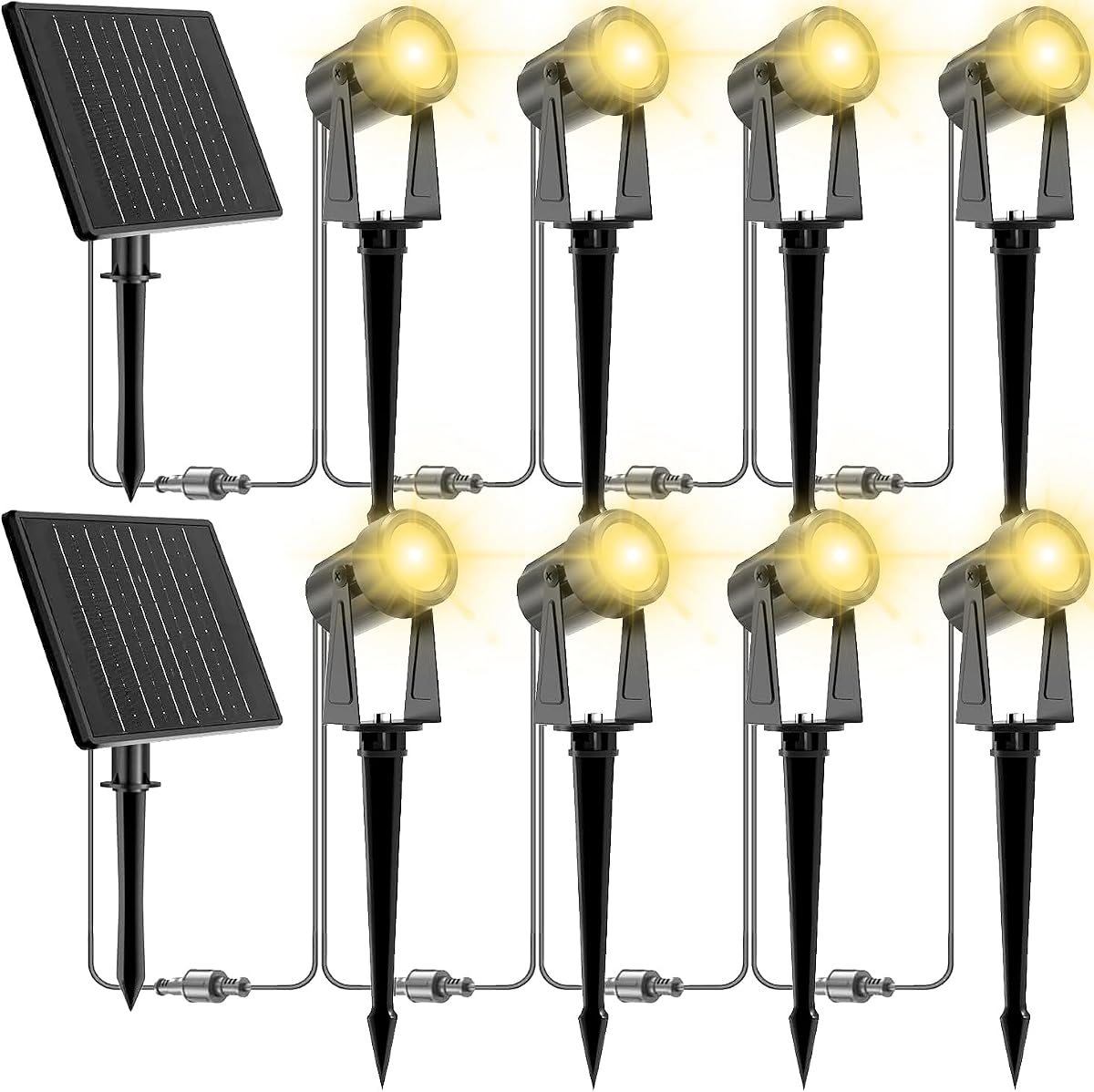
ZYAN 8-Pack Solar Spotlights
4.3Editor score
Eight independently positioned spotlights
Separate monocrystalline solar panels
USB-C backup charging connection
Four selectable lighting modes
Discover the best solar panel for low voltage lighting, comparing power, weather resistance, battery support, brightness, and installation options outdoors.
Solar panel for low voltage lighting solutions range from compact photovoltaic cells for experiments to complete spotlights designed to illuminate paths, gardens, walls, and outdoor structures. A capable system must match the light’s voltage and power needs while collecting enough sunlight to charge its battery reliably throughout the season.
The products in this guide were compared by examining their stated power or output, voltage, lighting features, battery arrangements, weather resistance, installation methods, and suitability for low-voltage projects. The list includes bare solar cells, integrated solar spotlight sets, a charge-maintenance kit, and a protection controller for broader lighting systems.
Each review highlights the product most suitable application, along with the compromises a buyer should consider. The top picks represent the strongest all-around options, while individual rankings reflect fit for this lighting-focused category rather than a universal claim. Product availability, configurations, and prices can change, so verify current listing details before purchasing.
4.3Editor score

4.5Editor score

4.4Editor score
This comparison shows what each product actually offers, from compact photovoltaic cells and circuit-protection hardware to complete low-voltage lighting systems, so buyers can distinguish between raw power components and ready-to-install outdoor fixtures.


This five-pack of 1W, 5V photovoltaic panels is designed for compact DIY projects, small lights, toys, STEM models, and other low-current electronics. Its 4.3 rating reflects a practical balance of size, output, and accessibility. The panels measure only 89.5 by 89.5mm, making them useful when conventional solar modules would be too large.
We may earn a commission when you buy through this link, at no additional cost to you.
The main advantage is flexibility. Each panel is rated for 200mA, and the included wire clips make temporary connections to simple circuits more approachable. Buyers can use the cells individually for tiny LEDs or combine them in series or parallel when learning how voltage and current affect a project. Their small format also makes them easier to incorporate into craft projects, model vehicles, and compact garden-light repairs.
These panels are not a substitute for powering a full-size landscape spotlight. One 1W cell may struggle with a high-draw lamp, cloudy-day charging, or a load that requires regulated 5V power. Output changes with sunlight, and proper polarity, circuit design, and current limits remain the buyer’s responsibility. Buyers expecting a ready-made outdoor light should consider a complete spotlight system instead.
This is a strong choice for small 5V lighting experiments, educational models, decorative LEDs, and prototype repairs where panel area is severely limited. It ranks first because it directly addresses the practical needs of low-power builders, but its output is intentionally modest. It is best for experimentation rather than high-output landscape illumination.
At 89.5mm square, each panel can fit project boxes, model cars, small garden ornaments, and other spaces where a standard module would interfere with the design. The five-panel quantity also allows buyers to test alternative series and parallel arrangements without sacrificing their original components.
The supplied wire clips reduce the need for permanent soldering during initial testing. They are particularly helpful for classroom circuits, temporary light experiments, and builds that may need several connection changes before the final configuration is settled.
We may earn a commission when you buy through this link, at no additional cost to you.
This pair of 3.6W, 12V polycrystalline solar cells provides more usable output than the 1W five-pack while retaining a compact form. With a 4.3 rating, it is well suited to garden-light repairs, model projects, outdoor monitoring, fountains, camping lights, and other compact systems that operate around a nominal 12V level.
We may earn a commission when you buy through this link, at no additional cost to you.
The two matching panels can be connected in series to increase nominal voltage or in parallel to increase nominal current. That flexibility makes the set useful for classroom demonstrations, small solar chargers, and low-power lighting experiments. Wire clip leads permit temporary hookups to exposed wires or metal contacts, helping makers evaluate a circuit before making permanent connections.
The listing also notes that output varies with sunlight and load, while battery charging needs a suitable controller. A 12V nominal panel is not automatically a regulated 12V supply, and voltage can rise or fall under changing conditions. The absence of an integrated controller, battery, and fixture means this product demands more assembly knowledge than a complete lighting set.
This set is a good middle ground for makers who understand basic DC circuits and want 12V-compatible source panels without using a large module. It is particularly useful for experiments, replacement cells, and modest outdoor lighting projects. Buyers seeking a finished light with automatic operation should look to one of the integrated spotlight systems.
A matched pair gives buyers the freedom to use one panel for a small project or combine both for greater output. It also provides a spare for experiments, letting one cell remain available while another configuration is tested.
The 12V rating fits many common low-voltage lighting concepts, including repaired garden fixtures and small model equipment. Appropriate regulation and a charge controller remain necessary whenever a battery or sensitive electronics are connected.
We may earn a commission when you buy through this link, at no additional cost to you.
The APONUO 2-in-1 set delivers 150 lumens of warm-white light from solar-powered metal spot fixtures designed for pathways, gardens, trees, sculptures, and other outdoor accents. Its 4.4 rating and stated eight- to twelve-hour operating options make it an appealing budget-oriented choice for decorative low-voltage landscape lighting.
We may earn a commission when you buy through this link, at no additional cost to you.
The daisy-chain cable layout is the standout practical feature. The system provides about 19.6 feet of total cable, with 9.8 feet from the plug to the first light and 9.8 feet between lights. This allows the solar portion to receive a favorable sun position while fixtures illuminate a wider area. The lights can be inserted into the ground or mounted on a wall using the included installation accessories.
Automatic operation removes the need to switch the lights manually, and the IP65 rating is intended for exposure to rain and snow. Nevertheless, the product is primarily a decorative solar system, not a grid-connected professional installation. Continuous high-brightness runtime is stated at eight hours and low-brightness runtime at twelve hours, with actual results depending on sunlight, placement, and seasonal conditions.
This is a strong pick for homeowners who want warm accent lighting without complicated low-voltage wiring. The daisy-chain design gives it more placement freedom than a basic single spotlight, while the two brightness levels help balance coverage and operating duration. It is the top budget recommendation for complete decorative lighting rather than a raw power component.
The linked cable arrangement allows the solar panel to sit in a brighter location while the spotlights point toward the areas that need illumination. That separation is valuable around shrubs, walls, and garden features that cast shade.
Warm-white output is generally less harsh for garden accents than cool-white illumination. The 150-lumen maximum is best interpreted as accent lighting for paths, foliage, and focal objects rather than broad-area flood coverage.
We may earn a commission when you buy through this link, at no additional cost to you.
The Mini 5V 6W panel is a portable monocrystalline solar source designed for phones, power banks, small fans, night lights, water pumps, and other low-power electrical appliances. Its 4.0 rating reflects a useful combination of rated capacity and portability, though buyers should understand that real output varies with sunlight.
We may earn a commission when you buy through this link, at no additional cost to you.
Six watts is substantial for a panel this small, making it more practical than a tiny experimental cell for powering a small lantern or replenishing a compatible power bank. Its 5V focus also simplifies connections to common USB-based equipment. The compact, lightweight form is convenient for camping, hiking, climbing, and other situations where carrying a larger panel would be inconvenient.
The product description claims durable, waterproof, scratch-resistant construction, but it does not provide a specific ingress-protection rating like the complete spotlight sets. It also warns that performance slows or stops when sunlight is weak. Consequently, this panel is better viewed as a supplementary source for compatible low-voltage devices than as a dependable primary installation for unattended nighttime lighting.
For portable 5V lighting, camping lanterns, and small electronics, this is the most capable compact raw panel in the group. It is less appropriate for a permanently installed garden system, where weather rating, controller protection, and predictable overnight reserves are more important. Its strongest advantage is portability combined with useful power.
The 6W rating offers a practical balance for compatible USB and 5V equipment without requiring the dimensions of a conventional rooftop panel. That makes it convenient for mobile projects and temporary lighting demonstrations.
A compatible device or power-management circuit should regulate the variable panel output. A storage battery and suitable controller can improve stability, particularly when a device requires continuous power after sunlight decreases.
We may earn a commission when you buy through this link, at no additional cost to you.
The ICSTATION module is a digital low-voltage disconnect designed to protect lead-acid or lithium batteries used in solar lighting systems. Although it does not generate electricity, it is an important companion for any low-voltage lighting project where an over-discharged battery could damage the load or lose useful capacity.
We may earn a commission when you buy through this link, at no additional cost to you.
Its 4.3 rating and broad 12–36V input range make it suitable for many common DC lighting systems. Users can configure a preset cutoff voltage, after which the relay disconnects the load. The module also allows a delay of 0 to 999 seconds before power returns, reducing repeated cycling when a battery hovers near its threshold. Settings are retained after unexpected power loss.
The key limitation is clearly stated in the product information: this device acts as a switch, not a voltage regulator, and no battery is included. It also does not replace a solar charge controller. A complete system still requires appropriate source wiring, regulation, charging management, and a correctly rated fuse or breaker. The stated maximum amperage before the breaker trips is 20A.
This protector is most valuable for builders of custom lighting arrays, backup systems, or other installations where battery protection matters. It does not directly satisfy someone looking for a plug-and-play solar panel, but it adds control and safety to a professionally planned low-voltage setup. For that supporting role, it is one of the most technically useful products in the guide.
A configurable cutoff lets the user disconnect lighting before the battery reaches an excessively low voltage. This can reduce stress on the battery and prevent a lighting load from repeatedly operating below its intended range.
The adjustable reconnect delay keeps the load disconnected for a selected interval after cutoff. This is useful when a battery needs time to recover or when automatic restarting could create an undesirable on-off cycle.
We may earn a commission when you buy through this link, at no additional cost to you.
This five-pack of 5V, 200mA polycrystalline cells is aimed at small DC lighting, science projects, model applications, and miniature solar systems. The 4.2 rating indicates a straightforward educational kit, and the rectangular 110 by 60mm format gives builders more layout flexibility than a square module.
We may earn a commission when you buy through this link, at no additional cost to you.
Each panel is only 2.5mm thick and comes with wire leads, making it convenient to incorporate into a model or compact project box. The five-cell quantity supports multiple experiments, replacement use, and series or parallel demonstrations. The epoxy-resin construction is described as strong, wind resistant, and snow resistant, which is useful for small outdoor models when the cells are protected from impact and moisture.
Like the other miniature cells, the 200mA rating is modest and does not represent a guaranteed output in every environment. A 5V nominal panel still requires correct polarity, and an appropriate circuit may be needed to regulate output for a battery or LED. The product is a component kit rather than a finished garden light, so it requires more technical setup.
This set is a good choice for students, teachers, and hobbyists who want multiple inexpensive-looking cells for science demonstrations or tiny decorative circuits. It is less suitable for anyone expecting to illuminate a pathway or power a substantial outdoor fixture. Within that educational role, its wired panels and varied shapes make it easy to experiment.
The set provides enough panels to compare individual output, connect cells in different arrangements, or preserve a spare for a damaged experiment. It is particularly useful when learning how solar output changes under different loads and conditions.
The 2.5mm thickness allows the panels to fit onto model roofs, small signs, and project housings. Pre-attached wires reduce preparation time, although a permanent installation still needs strain relief and secure attachment.
We may earn a commission when you buy through this link, at no additional cost to you.
The SOLPERK kit is the most complete raw power solution in the guide, combining a 20W monocrystalline panel, a 10A MPPT controller, and a fully adjustable mounting bracket. Its 4.5 rating is the highest among the listed products. Although the kit is designed primarily as a battery maintainer, it is well suited to powering low-voltage lighting projects that need a dependable 12V source.
We may earn a commission when you buy through this link, at no additional cost to you.
The panel’s stated cell efficiency is 21% to 30%, and the MPPT controller uses a three-stage charging design intended to limit overcharging, overvoltage, and short-circuit damage. It supports common rechargeable battery types, including LiFePO4, lithium-ion, AGM, SLA, gel, EFB, and MF batteries. The glass-and-aluminum construction and stated environmental tolerances suit a permanent outdoor installation.
The included bracket can rotate through 360 degrees, allowing the panel to face available sunlight more effectively. Plug-and-play connections and pre-drilled holes simplify installation. Nevertheless, no lights, wiring harness for a specific fixture, or battery are included, and the user must ensure that the controller, cable lengths, current demands, and battery capacity are appropriate for the lighting load.
This is the top editor’s choice because it offers the strongest balance of output, weather-conscious construction, adjustable installation, and included charge management. It is the best starting point for a custom garden-lighting array, remote lighting cabinet, or 12V auxiliary lighting system. For an instantly usable decorative light, however, a bundled spotlight may be simpler.
A 20W panel provides substantially more collection capacity than the miniature cells in the guide. That makes it more suitable for multiple low-voltage lamps, larger installed fixtures, or a system that also maintains a rechargeable battery.
The included controller handles charging stages and communicates status through indicator lights. This reduces the need for a separate basic controller while supporting several common 12V rechargeable battery types.
The bracket’s 360-degree adjustment makes it easier to tune the panel’s angle as light conditions change through the day or season. Pre-drilled holes and supplied hardware support straightforward installation on a suitable structure.
We may earn a commission when you buy through this link, at no additional cost to you.
The ZYAN set is a premium-ready eight-light solution for yards, paths, patios, trees, walls, and driveways. It combines separate monocrystalline solar panels, 10800mAh of stated battery capacity, USB-C backup charging, and automatic dusk-to-dawn operation. Its 4.3 rating reflects a feature-rich package designed to overcome placement constraints common in multi-zone landscape lighting.
We may earn a commission when you buy through this link, at no additional cost to you.
Each spotlight uses three high-brightness LED beads producing 100 lumens of warm 2700K light. The total system includes two 5400mAh batteries, and the product information states a 16- to 18-hour lighting duration. The independent panels can be placed where sunlight is strongest, while the lights themselves remain near the areas they illuminate. The 48.2-foot total cord adds considerable reach across a landscaped property.
Installation flexibility extends to adjustable ground-stake height, 360-degree rotating heads, wall mounting, and use near flagpoles or pathways. Four modes—Steady On, Quick Flash, Slow Flash, and Pulsating—serve both practical and decorative preferences. The IP65 rating and stated operating range of -4 to 140 degrees Fahrenheit indicate outdoor-oriented construction, although exposure and placement still matter.
This is the best premium selection for buyers who want a coordinated eight-point installation without assembling a custom low-voltage system. The USB-C backup connection adds flexibility during poor weather, while separate panels improve solar exposure. The main drawback is complexity: longer cables require careful routing, and optional extension cables are not included.
Separate panels mean the charging hardware does not have to occupy the same shaded location as each light. This is especially helpful beneath trees, beside walls, or in gardens where the desired lighting locations receive limited direct sun.
The USB-C connection offers a way to supplement solar charging when conditions are poor. For a dependable installation, buyers should still confirm cable routing, weather exposure, and the charging time required for the system.
The eight fixtures can accent multiple landscape features with one coordinated visual style. Adjustable heads, variable stake height, and selectable modes make the set practical for both subtle pathway guidance and decorative outdoor ambiance.
We may earn a commission when you buy through this link, at no additional cost to you.
The Fabrito eight-pack is built for buyers who want stronger accent or security-style illumination than a small decorative spotlight can provide. It has a 4.3 rating and an impressive listed maximum output of 800 lumens, using 108 high-brightness LED beads in each adjustable head.
We may earn a commission when you buy through this link, at no additional cost to you.
Four operating modes balance brightness and duration. The listing specifies approximately 20 hours in Low mode, 12 hours in Medium mode, 8 hours in High mode, and 8 hours with continuous dimming. These are useful choices for balancing nighttime coverage against stored energy. Automatic dusk-to-dawn switching eliminates manual operation, and the fixture can be installed with a ground stake or wall mount.
Its IP67 rating is the strongest stated weather-protection level among the complete spotlight sets in this guide. The product is also described as capable of operating from 14 to 140 degrees Fahrenheit. The lamp head adjusts through 120 degrees, allowing the light to be directed toward trees, walkways, entrances, decks, and other targets. Actual runtime depends on sunlight, temperature, mode, and the panel’s charging position.
This set is a good fit for larger yards and buyers seeking a visibly brighter output. It is less suitable where a soft decorative glow is the priority or where every fixture must run at maximum brightness through long cloudy periods. The generous LED count and mode selection make it a versatile choice when both brightness and adjustable runtime matter.
The listed 800-lumen peak output gives the Fabrito lights more visual impact than lower-output accent fixtures. This is useful near entrances, larger trees, and driveway edges where stronger directional light can improve visibility.
The wide range of brightness settings allows the owner to prioritize extended low-level illumination or maximum visibility. Mode selection should match available sunlight and the importance of consistent brightness through the night.
The higher stated ingress rating provides useful confidence in exposed garden and yard locations. Weather resistance still depends on correct assembly, undamaged seals, and sensible placement rather than a rating alone.
We may earn a commission when you buy through this link, at no additional cost to you.
This APONUO 1-in-1 spotlight is a straightforward solar accent light for gardens, yards, paths, garages, walls, and outdoor features. It earns a 4.4 rating and shares the same stated 150-lumen maximum output as the warm-white 2-in-1 option, but its cooler color temperature creates a crisper, more contemporary appearance.
We may earn a commission when you buy through this link, at no additional cost to you.
Automatic dusk-to-dawn activation makes the fixture easy to operate, while the cast aluminum body and IP65 rating are intended for outdoor use. The head adjusts through 270 degrees, providing a broad range of vertical aiming options. Installation can be handled with either a ground stake or wall mounting using the included screws.
The three-meter, or 118-inch, cable gives the solar panel and light some separation, but it is less flexible than a longer daisy-chain arrangement. Runtime is stated at eight hours on the high setting and 12 hours on low. As with all photovoltaic products, direct sunlight, panel orientation, and seasonal weather will influence charging and performance.
This spotlight is a good choice for a single tree, a garage entrance, a wall, or a small section of path where crisp directional light is preferred. It ranks lower because the single-light format offers less whole-yard coverage, but that simplicity can be an advantage when only one feature needs illumination. It is a practical, focused solution rather than a comprehensive landscape system.
Cool-white output and a 270-degree adjustable head make it easy to direct light at a wall, tree, façade, or path. The 150-lumen output is suited to focused accent coverage rather than broad floodlighting.
Ground stakes and wall mounting give the buyer two straightforward placement options. The included hardware and automatic operation reduce the need for external lighting controls or low-voltage wiring.
We may earn a commission when you buy through this link, at no additional cost to you.
The right choice depends on whether you need a source panel, a complete solar spotlight, or a battery-protection accessory. Voltage, usable solar capacity, lighting load, installation conditions, and overnight power requirements should guide the decision.
A bare photovoltaic cell is only one part of a lighting system. It may also require wiring, a battery, a charge controller, voltage regulation, switches, and the light itself. A complete solar spotlight is more convenient because the panel, battery, sensor, and LED fixture are integrated. Choose a raw panel when you are constructing a custom circuit, testing low-voltage behavior, repairing a compatible lighting product, or need several smaller cells arranged around a model. Choose a complete set when the priority is convenient outdoor accent lighting without complex electrical assembly.
In short, match the product format to the project. Raw panels offer customization, while integrated spotlights offer simpler installation and more predictable operation.
Voltage compatibility is the first technical check. The guide includes 5V panels for tiny LEDs, USB-based devices, and model projects; 12V panels for garden fixtures and common low-voltage equipment; and a 12–36V protector for larger DC systems. A nominal rating does not guarantee perfectly regulated output. Panel voltage changes with sunlight, while battery voltage rises and falls during charging and discharge.
Verify polarity and use the correct converter, charge controller, or regulated connection for the intended load. In short, match the nominal system voltage first, then account for variable operating conditions and any need for regulation.
Rated wattage describes collection capacity under specified test conditions, while current and voltage determine what a load can draw. A 1W cell rated at 5V and 200mA is appropriate for tiny indicator LEDs and experiments, not a substantial lamp. The 3.6W and 6W panels support more capable 5V or 12V projects, while the 20W SOLPERK panel is better suited to custom arrays and battery-maintained lighting systems.
Add up the fixture’s current requirement, account for conversion losses, and allow for cloudy periods. In short, a larger lighting load requires more collection area and storage than a tiny decorative circuit.
A panel can collect energy during the day but still fail to light the target area if the battery capacity is too small or charging conditions are poor. Complete systems often state expected high- and low-mode runtimes, such as eight and twelve hours for the APONUO lights or 16 to 18 hours for the ZYAN set. These figures are useful comparisons, but actual results depend on sunlight, temperature, panel placement, battery condition, and the selected mode.
Choose a fixture with a low-output mode when long coverage is more important than maximum brightness. In short, prioritize battery capacity and the lowest adequate mode for reliable all-night illumination.
The panel must receive direct sunlight, which may not be available exactly where the light is needed. Separate-panel systems and longer cables provide valuable placement flexibility, while a compact one-piece spotlight is easier to deploy where both sun and target are close together. The APONUO 2-in-1 set offers a daisy-chain layout, the ZYAN system includes separate panels with extensive cabling, and the SOLPERK bracket allows a custom panel to be angled toward the strongest available light.
Avoid excessive cable runs and route wires where they cannot be damaged. In short, place the collector for sunlight first, then use adequate cable length and secure connections to serve the lighting area.
Outdoor solar lighting must tolerate rain, dust, seasonal temperature changes, and occasional impacts. The complete spotlight products in this guide carry stated IP65 or IP67 ratings, which indicate different levels of protection against water ingress. A specific rating is more informative than a general claim that a panel is weather resistant. Raw mini cells may suit protected models or under-cover installations, whereas complete fixtures are more clearly positioned for exposed outdoor use.
Weather ratings do not prevent damage from poor assembly, immersion, impact, or cable strain. In short, verify the stated rating and install every enclosure, seal, and connection according to the manufacturer’s instructions.
Light output alone does not determine whether a fixture will be useful. Direction, color temperature, mode selection, and mounting height often matter more. Warm-white light such as the APONUO 2-in-1 and ZYAN fixtures creates a softer landscape effect, while the APONUO 1-in-1 offers cool-white output. The Fabrito set emphasizes brightness, and adjustable heads, ground stakes, and wall mounts expand placement options across the different systems.
Consider whether you need gentle decorative illumination or visible security-style coverage. In short, choose brightness and color only after mapping the space, intended target, and desired nighttime mood.
A low-voltage lighting system may need a charge controller, battery protection, proper fusing, and regulated connections. The ICSTATION protector can disconnect a load at a configured cutoff voltage, helping prevent excessive battery discharge, but it does not regulate voltage or replace a charge controller. The SOLPERK kit includes an MPPT controller for its battery-charging function, while the bare panels do not include equivalent power management.
Match every protection component to the battery chemistry, voltage, and current. In short, use a controller for charging and a correctly configured low-voltage protector for battery safety rather than expecting one component to perform both jobs.
Begin by positioning the solar collector where it receives the strongest available direct sunlight for the longest part of the day. Avoid placing it under trees, behind walls, or beneath eaves where shadows can interrupt charging. For a complete spotlight, aim the panel toward the sun and then rotate the lamp head independently toward the feature you want illuminated. For a custom system, check polarity, voltage, and current requirements before connecting the panel to a controller, battery, regulator, or light.
Install the fixture or circuit according to its design. Stake ground units firmly into stable soil, mount wall units with the supplied hardware, and protect all connections from moisture and mechanical strain. Do not assume that a nominal 5V or 12V panel will remain perfectly regulated under changing conditions. If a battery is involved, use a compatible charge controller and configure low-voltage protection to suit the battery chemistry and lighting load.
For ongoing care, clean the solar surface periodically with a soft, damp cloth and remove leaves, dust, snow, or bird droppings that block illumination. Check that the panel remains firmly attached and unobstructed as plants grow. Inspect cables, seals, stakes, and wall fasteners, particularly after strong wind or winter weather. Replace a damaged light or panel rather than attempting to bypass its protection, and follow the seller’s warranty and support procedures for covered defects.
The appropriate size depends on the lamp’s current draw, the battery, and how many hours the light must operate after sunset. Tiny indicator lights may work with 1W cells, while a 20W module is more appropriate for a custom array or several fixtures. The panel must also have a compatible nominal voltage, and the system needs enough battery capacity and charge management to provide dependable overnight power.
No, not safely as a direct substitute. The voltage and current requirements are different, and connecting a 5V panel to a nominal 12V fixture can leave the light without sufficient power or produce unpredictable behavior. Use a 12V-compatible panel, a suitable voltage converter where appropriate, and a correctly rated charge controller for the battery involved.
They can operate after charging in earlier sunlight, but performance is commonly reduced because cloud cover lowers solar collection. Complete systems may include larger batteries or backup connections to improve resilience, while a backup connection does not guarantee all-night operation. Position panels in unobstructed sunlight and select a lower brightness mode when dependable extended coverage is more important than maximum output.
It is strongly advisable whenever a rechargeable battery is being charged, especially with lead-acid or lithium batteries that require controlled charging. A controller helps manage charge stages and prevents excessive voltage. The ICSTATION module protects against over-discharge, but it is not a charge controller, and the SOLPERK kit already includes an MPPT controller for the stated charging function.
The solar panel should face the available sunlight, while the light should face the area you want illuminated. They do not need the same orientation. Separate panels and longer cables, as found in the ZYAN set, make it easier to place the collector in a sunny area while directing light toward a shaded tree, wall, or path.
These are ingress-protection ratings describing resistance to solids and water under specified test conditions. An IP65 product is protected against dust and water jets, while IP67 is designed to withstand temporary immersion under the applicable test conditions. Neither rating replaces proper assembly, and cables, connectors, seals, and physical damage can still compromise a fixture.
Warm-white light usually creates a softer, more residential atmosphere that blends well with natural landscaping and warm interior colors. Cool-white light appears crisper and can emphasize modern architecture, paths, and security-style visibility. The APONUO 2-in-1 offers warm white, the 1-in-1 offers cool white, and the ZYAN and Fabrito sets also emphasize warm-white outdoor illumination.
Allow the panel to charge in direct sunlight for a full day before relying on automatic operation. Testing in a dark location can create the impression that the light is defective when its battery simply lacks stored energy. If the first full charge does not produce the expected output, check panel orientation, protective film, switches, and battery seating, then consult the seller’s support instructions.
The three leading choices serve different needs. The SOLPERK 20W kit is the strongest foundation for a custom low-voltage installation because it combines a higher-output panel, MPPT charging, and an adjustable bracket. The ZYAN eight-light set is the premium option for coordinated landscape lighting with separate panels, flexible placement, and backup charging. The APONUO 2-in-1 set provides the most approachable warm-white lighting with daisy-chain placement and two brightness levels.
Prioritize the part of the system that matters most to your project. Choose a complete spotlight for straightforward outdoor accents, a larger raw panel for custom arrays, and a protection module for a battery-backed circuit you understand well. Check nominal voltage, usable solar output, battery storage, weather rating, cable reach, and the required lighting duration before making a final choice.
Solar performance can change with seasons, weather, panel direction, and battery age, so no product should be judged solely by its headline output. Review the current listing, included accessories, installation instructions, warranty terms, and latest customer feedback before buying. Prices and configurations can also change, making a fresh comparison especially worthwhile at the time of purchase.