
SOLPERK 20-Watt Solar Panel Kit
4.5Editor score
Twenty-watt monocrystalline panel
Ten-amp MPPT controller
360-degree adjustable bracket
Supports twelve-volt batteries
Discover the best small solar panels for shed, comparing power, battery support, durability, portability, lighting, and installation options.
Small solar panels for sheds range from dedicated lighting systems to portable power panels and complete kits designed to charge 12V or 24V batteries. The right choice depends on whether you need illumination, battery maintenance, or a renewable source for tools, cameras, and other shed equipment.
We compared all ten products by examining their stated power, efficiency, weather resistance, included controllers, mounting hardware, connectivity, and intended applications. The list covers both fixed and portable panels, integrated solar lights, security-camera chargers, and complete battery-charging kits.
Each pick highlights a different practical advantage, from comprehensive installation to low-cost trickle charging or portable power. Ratings and product details reflect the supplied listings, while availability, configuration, and pricing can change, so confirm current specifications before purchasing.
4.5Editor score

4.6Editor score

4.5Editor score
The comparison below organizes the ten options by product type, rated power, core function, and installation features, making it easier to identify the right system for lighting, battery upkeep, portable charging, cameras, or general shed electricity.




The ECO-WORTHY 200-Watt Solar Panel Kit is the most complete conventional power option in this guide, combining two 100-watt monocrystalline panels with a 30A PWM charge controller and mounting and wiring accessories. Its 4.6 rating reflects a well-rounded package for users who want more than a single-purpose trickle charger.
We may earn a commission when you buy through this link, at no additional cost to you.
The stated daily output is 800Wh under four hours of full sunshine, giving this kit a useful balance between capacity and installation complexity. Each panel uses an aluminum-alloy frame, while the junction box carries an IP65 rating. The listed wind and snow-load figures of 2400Pa and 5400Pa also make it better suited to exposed shed roofs and outdoor installations than small decorative panels.
The main trade-off is footprint and controller type. Two rigid panels require more mounting space than a portable folding model, and a PWM controller is less efficient than an MPPT controller when conditions are not ideal. Even so, the included brackets, 10 AWG cables, connectors, and 24V or 12V configuration options make the package approachable for a broad range of off-grid projects.
This is the strongest all-around choice for a shed owner planning to power lights, small electronics, tools, or maintain a battery bank. Choose it when you want a stationary, scalable system and are comfortable installing a fixed array rather than carrying a portable panel between locations.
The kit includes two panels, mounting brackets, a charge controller, solar cables, connectors, and a tray cable, reducing the need to source each component separately. That completeness makes it useful for both first-time solar users and owners expanding an existing shed power arrangement.
The panels can be connected in series for a 24V arrangement or in parallel for 12V use, giving owners some flexibility when matching the kit to a battery system. The 30A controller is the central component in determining which battery and wiring plan is appropriate.
We may earn a commission when you buy through this link, at no additional cost to you.
This dual-lamp solar shed light is designed specifically for illumination rather than general battery charging. One centralized power box operates two pendant lights, producing a stated 2000 lumens at a 6500K color temperature. Its 4.6 rating and flexible placement make it a practical choice for workshops, garages, chicken coops, and storage rooms.
We may earn a commission when you buy through this link, at no additional cost to you.
Three lighting modes balance brightness against operating time. One pull selects a medium setting for approximately 6–8 hours, two quick pulls select high brightness for 3–4 hours, and three pulls activate an automatic medium mode lasting 12–14 hours. The pull strings are built into the power box, while visible indicators show battery and operating-mode status.
Solar charging uses a 30% conversion panel measuring 11.4 by 13.7 inches, with a listed full-charge time of 6–8 hours in direct sunlight. Its 16.4-foot panel-to-box cable allows the panel to sit in a sunny location while the box remains accessible, and 9.8-foot lamp cables plus an extension cable provide additional installation reach.
This is best for users whose primary goal is dependable, adjustable shed lighting without running electrical cable. It is not a general solar generator, and the lamps still need to be connected to the power box. If your priority is powering devices rather than illuminating rooms, choose a battery-charging panel or portable solar product instead.
The dual pendant arrangement is especially useful when a bench and storage area need light but are too far apart for a single lamp. Centralized controls make it easier to change modes without walking to each fixture.
The operating choices cover high-output task lighting, medium illumination, and a longer dusk-to-dawn pattern. This lets owners adapt energy use to working hours, overnight security, or intermittent access without replacing the system.
We may earn a commission when you buy through this link, at no additional cost to you.
The SOLPERK 20-Watt Solar Panel Kit is a compact maintenance solution for 12V rechargeable batteries, with a 4.5 rating and a focused set of components. It includes a 20-watt panel, a 10A MPPT controller, an adjustable bracket, an alligator clip, an O-ring, and mounting hardware.
We may earn a commission when you buy through this link, at no additional cost to you.
Its monocrystalline A-grade cells are listed at 21–30% efficiency, making the small panel more productive than its physical size might suggest. It can maintain compatible LiFePO4, lithium-ion, AGM, SLA, gel, EFB, and MF batteries, opening applications beyond a typical shed.
The smart controller uses a three-stage charging design intended to reduce overcharging, over-voltage, and short-circuit risk. A fully adjustable bracket and pre-drilled holes simplify placement, while plug-and-play connections make removal and reinstallation convenient. The stated construction includes low-iron tempered glass and a corrosion-resistant aluminum frame.
This kit is best for maintaining a small battery that powers a gate opener, electric fence, water pump, lawn mower, or similar intermittent shed equipment. It is not the answer for running a workshop continuously, but its compactness and MPPT controller make it an efficient dedicated maintainer.
The MPPT controller is a meaningful feature in a compact maintenance kit because it is designed to improve charging control. Indicator lights provide a simple way to check charging status without relying on the battery alone.
A 360-degree bracket allows the panel to face available sunlight more closely, while the alligator connection and supplied hardware reduce setup complexity. It is particularly convenient for maintaining batteries attached to equipment parked near a shed.
We may earn a commission when you buy through this link, at no additional cost to you.
The Renogy 100-Watt Starter Kit combines a rigid 12V panel with a Wanderer 30A PWM controller and earns a 4.7 rating in the supplied data. It is a conventional shed installation for users who value a compact footprint, established service coverage, and room to grow the system.
We may earn a commission when you buy through this link, at no additional cost to you.
The panel is stated to generate an average of 500Wh per day, depending on sunlight, and uses cells with 22.5% efficiency. Every panel is described as receiving electroluminescence testing before shipment. Its service plan includes 10 years for panel materials and workmanship, two years for the controller, and 25 years for panel power output.
Safety and certifications are another strength. The panel is listed under UL 61730, CSA C22.2 No. 61730, IEC 61730 and IEC 61215, with an IP65 junction box, IP67 solar connectors, 2400Pa wind resistance, and 5400Pa snow-load resistance. The PWM controller can support expansion up to 400W and works with AGM, gel, flooded, and lithium batteries.
Remote monitoring is possible but not included: adding the Renogy BT-1 Bluetooth module enables app-based voltage, current, and warning visibility through Renogy DC Home. This kit is a strong choice for a fixed 12V shed system, especially if you may add panels later and value long-term service coverage.
Expansion up to 400W means a single-panel installation does not have to remain a one-panel project. Owners can grow their array as storage, tools, lighting, and other shed loads increase.
The combination of recognized certifications, stated load ratings, and long service coverage adds reassurance for a permanent installation. These are particularly useful details when the panel will remain exposed to weather throughout the year.
We may earn a commission when you buy through this link, at no additional cost to you.
This 100W portable solar panel is built for owners who want to move renewable charging between a shed, vehicle, campsite, or emergency location. It has the highest listed rating in the roundup at 4.8 and uses a bifold monocrystalline design with a stated 23.7% cell efficiency.
We may earn a commission when you buy through this link, at no additional cost to you.
The panel outputs 19.8V and 100W through an XT60 connection, with support for 12V batteries up to 12A. A built-in smart IC is described as providing reverse-charge, overcharge, and overload protection. For a shed, that means the panel can act as a compact solar charger rather than a permanently wired generation array.
Its foldable briefcase-style form is a major convenience, reinforced by hanging loops and adjustable kickstands. Series or parallel configurations can be used with another matching panel to increase output. The stated ETFE lamination offers dust and heat resistance from -10°C to 70°C, while the IP65 rating covers outdoor use.
This is a strong choice for emergency backup, portable power stations, RV trips, and remote work. Buyers should confirm that their battery or power station accepts the XT60 connection and voltage. It is best treated as a flexible charging tool rather than an all-in-one lighting or stationary battery-maintenance system.
The folding design stores more compactly than a rigid panel and deploys quickly through built-in kickstands. This makes it practical for owners who need solar capability at a temporary worksite or during power disruptions rather than in one fixed location.
A claimed 23.7% cell efficiency makes the panel productive relative to its size, while series and parallel support creates a path to a larger array. Connector compatibility remains the important check before purchase.
We may earn a commission when you buy through this link, at no additional cost to you.
The Renogy 200-Watt Portable Solar Panel is the most feature-rich premium portable option, with 16BB N-Type cells, a stated 25% efficiency, and a 4.5 rating. It targets owners who want substantial charging capacity without sacrificing portability or direct device output.
We may earn a commission when you buy through this link, at no additional cost to you.
The panel weighs 13.89 pounds and folds to 23.72 by 22.99 by 1.97 inches. A magnetic closure makes it convenient to store in an SUV or RV, while four kickstands, reinforced grommets, and 40-, 50-, and 60-degree positions allow it to be placed on a roof, tent, or campsite surface.
Direct charging is one of its distinguishing features. USB-C PD at 45W and two USB-A ports can charge phones, tablets, laptops, GPS units, and cameras. For power stations, the listing names compatibility with Jackery Explorer 1000 v2, EcoFlow DELTA 3 and DELTA 3 Max, RIVER 3 Max, and Anker SOLIX S2000, provided the device meets its requirements.
The MC4 output is the principal trade-off, because the listed four-in-one adapter is sold separately. The panel is UL 61730 certified and also carries CE, RoHS, FCC, CA65, PSE, and ISO 9001 claims. It is best for premium portable power use, emergency backup, and RV charging where direct charging and higher output justify the added size.
The 16BB N-Type construction is intended to produce more energy from limited sunlight, and the stated 25% efficiency supports that goal. Folding construction preserves portability without turning the product into a basic maintenance panel.
USB-C and USB-A outputs provide a useful way to charge small electronics directly from the panel. Owners should still treat these outputs as supplemental, because actual charging speed depends on sunlight, device requirements, and the panel's operating conditions.
We may earn a commission when you buy through this link, at no additional cost to you.
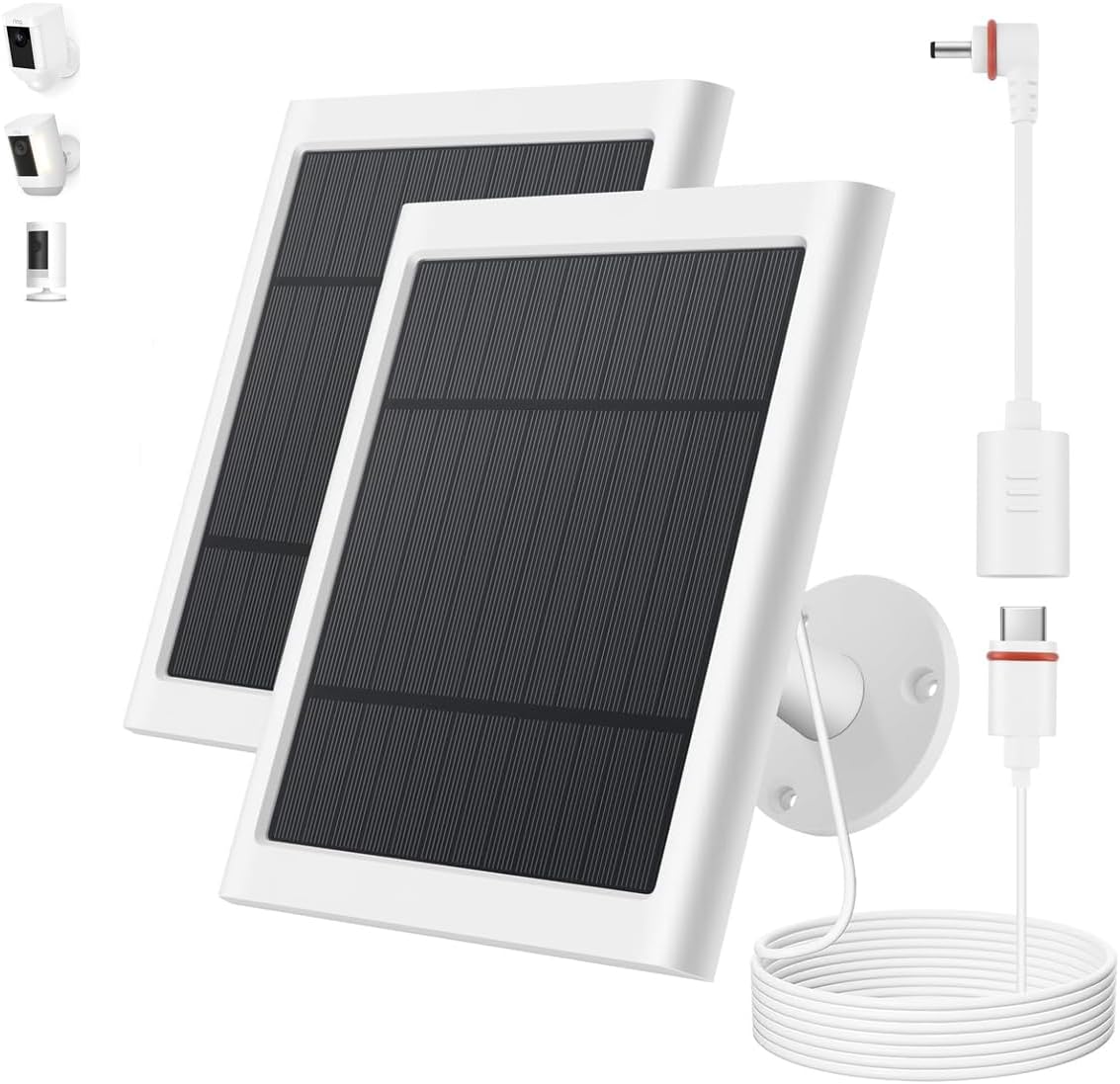
This two-pack of 4-watt solar panels is a specialized solution for keeping compatible security cameras supplied in a shed, garage, or outbuilding. Its 4.2 rating reflects a product with a clear purpose rather than the broader capabilities of a general battery-charging panel.
We may earn a commission when you buy through this link, at no additional cost to you.
The package includes two solar panels, two ten-foot Type-C cables, two Type-C-to-DC barrel adapters, two 360-degree mounting brackets, cable clips, and screws. Compatibility is listed for Ring Stick Up Cam 3rd and 2nd Generation Battery models, Ring Spotlight Cam Plus and Pro Battery models, and the Reolink Argus Pro.
The 360-degree mounting design allows the small panel to face direct sunlight, while the long cable provides flexibility between the camera and the best available solar position. The listed construction is designed to withstand rain, hail, strong wind, and sun exposure, making it better suited to outdoor placement than an uns weatherproof panel.
This is best for owners who want continuous trickle charging for a compatible camera and want to reduce how often its battery needs manual charging. Solar performance remains dependent on direct sunlight, weather, angle, and the camera's battery level, so it should not be treated as a guarantee that every camera will operate indefinitely without a charge.
The included adapters and stated camera compatibility make this easier to deploy than a general solar charger. It can support one camera per panel, providing a simple approach for monitoring structures where wiring a conventional power supply is inconvenient.
Because output is only 4 watts, exposure to direct sun is crucial. The adjustable mount and ten-foot cable help owners place each panel away from shadows while keeping the camera connected.
We may earn a commission when you buy through this link, at no additional cost to you.
The 396-LED solar shed light is a high-output lighting option with five operating modes, programmable timers, and remote control. Its 4.1 rating is the lowest in the supplied group, but the stated coverage and feature set make it interesting for larger work areas.
We may earn a commission when you buy through this link, at no additional cost to you.
The light is said to illuminate up to 400 square feet and runs for 8–12 hours after a 6–8-hour charge. The listing advises a full eight-hour initial charge in direct sunlight. A 16.4-foot extension cable separates the panel from the fixture, allowing the panel to sit in full sun while the lamp is positioned where the light is needed.
Modes include motion activation, bright and dim motion output, constant nighttime illumination, daytime charging with the light paused, and automatic activation at dusk. The remote also handles brightness and two-, four-, or six-hour auto-off schedules. Its IP65 rating supports year-round use in rain, snow, and dust.
This light is best for patios, porches, gazebos, barns, chicken coops, and covered areas where no electrical wiring is desired. Its trade-off is dependence on charging conditions: shaded placement or poor weather can reduce available runtime, and the remote is an additional item that must be stored.
Five modes let the fixture respond differently to movement, darkness, and charging needs. This is more flexible than a basic all-night light and helps conserve stored energy when full illumination is unnecessary.
The extended panel cable solves a common installation problem: the ideal light position may not be the sunniest position. Keeping the panel outside direct shade can improve charging without forcing the fixture into the same location.
We may earn a commission when you buy through this link, at no additional cost to you.
The HISHEN FLOWE 100-Watt Solar Panel emphasizes compact construction and reduced maintenance through its frameless clean-edge design. With a 4.6 rating, it is a strong fixed-panel option for sheds, cabins, marine installations, and small rooftops where a full frame would be unnecessary.
We may earn a commission when you buy through this link, at no additional cost to you.
Its 16BB A-grade monocrystalline cells are designed to deliver 100 watts in a compact footprint. The frameless edges provide fewer places for dust, water, snow, and debris to accumulate, and the smooth surface allows rain to wash away residue more easily. That characteristic is especially relevant for unattended outdoor installations.
Pre-drilled mounting holes and standard MC4 connectors simplify installation and future expansion. The panel is described as suitable for 12V and 24V battery-charging systems, but it does not include a controller, so compatibility with an MPPT controller or inverter must be confirmed before ordering.
This is best for owners who value a clean, low-profile appearance and want to reduce edge maintenance on a permanent installation. It is less convenient for a plug-and-play project because the missing controller means additional system planning, but standard connections can simplify adding compatible modules later.
The frameless construction gives the panel a streamlined appearance suited to modern sheds and small roofs. It also reduces the number of raised edges where debris commonly collects on framed modules.
MC4 connectors and pre-drilled holes support a more conventional permanent system. Buyers should plan the controller and battery voltage configuration before installation to avoid mismatched components.
We may earn a commission when you buy through this link, at no additional cost to you.
The ZOUPW 100-Watt Portable Solar Panel is a connectivity-focused charger designed for a wide range of power stations. Its 4.6 rating and unusual five-in-one cable make it a practical option for users who want one portable panel to work with several battery ecosystems.
We may earn a commission when you buy through this link, at no additional cost to you.
The included ten-foot cable provides DC8020, XT60, Anderson, DC7909 or 8mm, and DC5521 connections. The listing associates these with a range of Jackery, EcoFlow, Anker, Bluetti, and generic lithium-battery applications. This broad selection can reduce the need to track several proprietary adapters.
The panel uses Grade A+ monocrystalline cells with a stated 23.5% efficiency. Adjustable kickstands can angle it at 45 degrees, which the listing says can capture up to 25% more sunlight than laying flat. ETFE lamination and an IP67 rating support outdoor use, and a zippered pocket helps protect the built-in controller and cables from moisture.
A built-in controller also provides USB-C PD at 15V and 3A plus two USB-A outputs, including QC3.0, for phones, tablets, GPS units, and cameras. Actual power-station charging speed depends on the unit's input limit, so a lower-limit power station may draw less than the panel's full output. It is best for owners prioritizing broad connection support.
The five-in-one connector is the product's defining feature, allowing a single panel to serve many common portable power stations. It is particularly helpful for users who already own equipment from different brands or frequently switch between battery systems.
Power-station input and direct USB outputs provide two different ways to use the panel. Direct outputs are suitable for common small electronics, while power-station connections are the better route when a rechargeable battery is needed.
We may earn a commission when you buy through this link, at no additional cost to you.
Start by identifying the load, battery system, installation space, and operating conditions. A small shed project may call for nothing more than a solar light, while tools, cameras, pumps, and batteries require carefully matched charging capacity and electrical components.
Prioritize the function that matters most, then confirm that the panel can support it under realistic sunlight conditions.
For a shed battery, choose a controller sized for the panel and battery, and avoid assuming that nominal panel wattage alone determines usable power.
Use a controller and wiring plan designed for the battery's voltage and chemistry; nominal compatibility alone is not enough.
Favor the sunniest unobstructed location, and remember that a fixed panel generally benefits more from correct placement than from extra mounting complexity.
Select a fixed panel for a permanent shed system and a folding panel when portability or compact storage is the priority.
Confirm connector shape, voltage, current, and controller compatibility before installation to avoid mismatched or unsafe components.
Balance ruggedness with upkeep: sealed fittings and simple surfaces help, but every exposed connection should still be checked periodically.
Design for the next stage early by choosing a controller, wiring scheme, and mounting layout that can accommodate additional capacity.
Before installation, identify the equipment being powered or maintained, verify battery voltage and connector type, and read the included instructions. Choose a location with the best direct sun exposure, then confirm that brackets, cables, and controllers will not create trip hazards, exposed sharp edges, or water-entry points. For lighting products, place the solar panel outside deep shade even if the lamp itself belongs under a roof.
Install the panel securely using the supplied hardware, keep electrical connections dry and protected, and follow the stated series or parallel arrangement for a fixed system. Stand portable panels on stable ground and use their kickstands or hanging loops. Do not exceed the controller's current rating or connect a battery whose chemistry is unsupported by the charging system.
For routine care, clean the glass with a soft cloth and nonabrasive cleaner when dirt or dust reduce performance, especially on frameless models. Check brackets, cable connections, and seals periodically, and keep the panel free of snow, leaves, and bird debris. Test lighting modes and battery indicators as seasons change, and follow the manual guidance for storage, battery condition, and long periods without sunlight.
The right size depends on what the panel is meant to do. A compact 4-watt panel may suit a compatible security camera, while a 20-watt panel is often practical for maintaining a small 12V battery. A 100-watt or 200-watt panel offers more capacity for portable power, lighting, and expansion. Calculate expected loads, available sunlight, and battery requirements before choosing.
A small panel can power or support limited loads, but it usually cannot run an entire workshop indefinitely. Lighting, a camera, a small pump, or battery maintenance is more realistic than continuous high-power tool use. Multiple panels, a suitable charge controller, and adequate storage increase the possibilities, especially when the load is switched rather than left running constantly.
A charge controller is generally important whenever a panel charges a battery because it regulates charging and helps protect the battery from improper voltage or current. Kits such as the ECO-WORTHY, SOLPERK, and Renogy starter packages include controllers. A standalone panel, such as the HISHEN FLOWE model, requires a compatible controller unless it is connected to equipment designed to manage charging internally.
MPPT controllers can extract more power under many conditions and are often advantageous when panel voltage and battery voltage differ. PWM controllers are simpler and widely used, though they may produce less energy in some installations. The better choice depends on the panel, battery, controller sizing, and local conditions rather than on a single universal rule.
The strongest results come from unobstructed direct sunlight, with orientation and season affecting the total. A panel placed beside a shed may perform poorly if a wall, roof overhang, or tree blocks it. Portable panels can be moved as the sun changes, while fixed installations need a carefully selected location. Weather and temperature also influence output, so nominal wattage should not be read as a constant hourly result.
Yes, if the power station's solar input matches the panel's connector and voltage. The portable options in this guide include XT60, MC4, and multi-connector designs for common models. Also check the power station's maximum solar input, since it may accept less than the panel's stated wattage. The panel can be used inside a shed, but it must still receive direct sunlight through an open doorway or window.
That depends on the product's stated rating and installation guidance. The 396-LED model and the dual-lamp system list outdoor-oriented features, including IP65 protection and extended solar-panel cables. Weather resistance does not mean every connector can remain exposed indefinitely, so follow the manual and protect connection points from standing water.
They still produce energy, but output generally falls when sunlight is weaker or snow covers the panel. A 100-watt panel may produce only a fraction of its rated output under poor conditions, which is why controller selection, battery capacity, and realistic load calculations matter. Keep panels clear of snow and use energy-efficient devices when dependable winter operation is essential.
The ECO-WORTHY 200-Watt Solar Panel Kit is the strongest general-purpose choice because it combines two panels, a charge controller, mounting hardware, and flexible 12V or 24V arrangement. The SOLPERK 20-Watt Kit stands out for focused battery maintenance at a more modest scale, while the Renogy 200-Watt Portable Panel delivers premium output and broad device-charging features.
Prioritize the job your shed actually needs. Choose an integrated solar light for illumination, a dedicated camera panel for surveillance, a maintenance kit for a small battery, and a portable folding panel for power-station charging or backup. Before buying, verify connectors, battery chemistry, controller compatibility, mounting space, and the amount of direct sunlight at the installation site.
Ratings provide a useful starting point, but they do not replace system planning. Product configurations, included accessories, availability, and pricing may change, so review the current listing and specifications carefully before making a final decision.