
Outdoor RV TV Antenna for Camper
3.9Editor score
Roof-mount installation hardware
360-degree omnidirectional reception
Weather-resistant UV housing
Mobile RV reception design
Our RV Antenna for Local Channels guide compares ten indoor and outdoor antennas, focusing on reception, range, cable length, weather resistance, and RV setup.
An RV antenna for local channels can transform road-trip downtime into a dependable source of news, sports, entertainment, and emergency information. The best unit for an RV must balance broad signal reception, compact construction, flexible placement, and resistance to the vibration, moisture, and changing locations encountered while traveling.
We compared ten indoor and outdoor antennas using the specifications and customer feedback provided for each model. The evaluation considers advertised range, antenna design, amplifier features, coaxial cable length, mounting options, TV compatibility, weather resistance, and suitability for campers, motorhomes, trailers, and temporary outdoor locations.
Each pick below highlights a distinct approach, from compact magnetic models to roof-mounted 360-degree designs and flexible indoor units with long cables. Ratings reflect the available customer feedback, while channel availability and reception still depend on broadcast coverage, terrain, obstacles, and correct installation. Product availability can also change.
3.9Editor score

5.0Editor score

3.8Editor score
The table below compares all ten antennas by design, installation style, signal features, and included cable. It is a quick reference for travelers seeking a roof-mounted solution, a flexible indoor unit, or a compact model that can move easily between campsites.


The 2026 Digital TV Antenna is a versatile indoor/outdoor option for RV owners who need more placement freedom than a compact desktop model can offer. It carries a 4.7 customer rating and advertises 6000+ miles of reception, a smart signal booster, and a professional waterproof housing. Those features make it relevant to travelers who may use the antenna at a campground, beside an RV, or in a temporary outdoor location.
We may earn a commission when you buy through this link, at no additional cost to you.
Its greatest practical advantage is the included 40-foot coaxial cable. A longer run allows the antenna to be separated from the television and positioned near a window, on an exterior surface, or at a higher point. The upgraded smart amplifier automatically adjusts between long-range and short-range modes, while the VHF and UHF reception structure is designed to capture local broadcasts and reduce interference from nearby electronics. Connection is straightforward through the standard antenna input, followed by a television channel scan.
The waterproof housing and suitability for RV, camping, yacht, garage, and outdoor use set this model apart from basic paper-thin indoor antennas. However, an advertised maximum range does not guarantee that every listed station will be available in every location. Mountains, dense forests, hills, buildings, and distance from broadcast towers can all limit reception. The manufacturer also recommends rescanning after repositioning, which is sensible but adds a step whenever the signal location changes.
This is a strong choice for travelers who want one antenna to cover several installation styles without being tied to a roof-mounted base. The long cable and weather-resistant construction are especially helpful at RV parks where roof space or cable access may be restricted. Choose it when flexible placement and indoor/outdoor versatility matter more than a compact footprint, and verify local broadcast coverage before installation.
The 40-foot cable is the model’s most traveler-friendly feature. It provides enough separation between the antenna and television to experiment with windowsills, exterior walls, and elevated positions without immediately buying another cable.
Its waterproof housing and suitability for both indoor and outdoor placement are valuable for campgrounds, coastal routes, and trips that encounter rain or changing temperatures. The housing is also described as durable enough for RV and camping use.
We may earn a commission when you buy through this link, at no additional cost to you.
The TV Antenna for Smart 6000+Miles is our Editor’s Choice because it combines flexible installation, useful amplifier controls, and a generous cable in a design expressly suited to RVs, cars, caravans, and motorhomes. Its 5.0 customer rating is the highest among the listed products. The supplied description highlights a switch-control amplifier booster, a smart IC chip, and compatibility with both modern smart televisions and older sets.
We may earn a commission when you buy through this link, at no additional cost to you.
Travelers can use the switchable amplifier to select short-range operation within 38 miles or long-range operation beyond that distance. This is more adaptable than a fixed amplification design, although the correct setting still depends on the actual signal environment. The 38-foot coaxial cable uses a solid copper center conductor, dielectric insulation, three aluminum shielding layers, and a durable outer layer. That construction is intended to preserve signal conductivity and limit interference or signal loss during the run to the television.
Installation requires no specialist: connect the antenna, place it high on a wall or window for a stronger signal, select the appropriate amplifier range, and scan the television. The lightweight housing can be placed on a table, wall, cabinet, or exterior surface. It can also be attached to a truck, car, caravan, or motor home. A comprehensive waterproof design and ventilation structure are intended to reduce condensation during temperature changes.
The main limitation is that even a 5.0 rating cannot guarantee identical reception in every location. Tower distance, terrain, weather, and obstructions remain more important than a headline range. Within those realities, this antenna is a well-rounded choice for RV users who want a portable indoor/outdoor design, a long cable, and explicit short- and long-range amplifier settings.
The manual range switch is useful when moving between cities, rural highways, and campgrounds. It lets the user match the amplifier behavior to the estimated distance from local broadcast towers instead of relying on one fixed setting.
The layered shielding and copper conductor are intended to maintain a dependable connection over the longer run. A 38-foot cable also gives an installer more freedom to find a stronger signal without moving the television or adding another cable.
We may earn a commission when you buy through this link, at no additional cost to you.
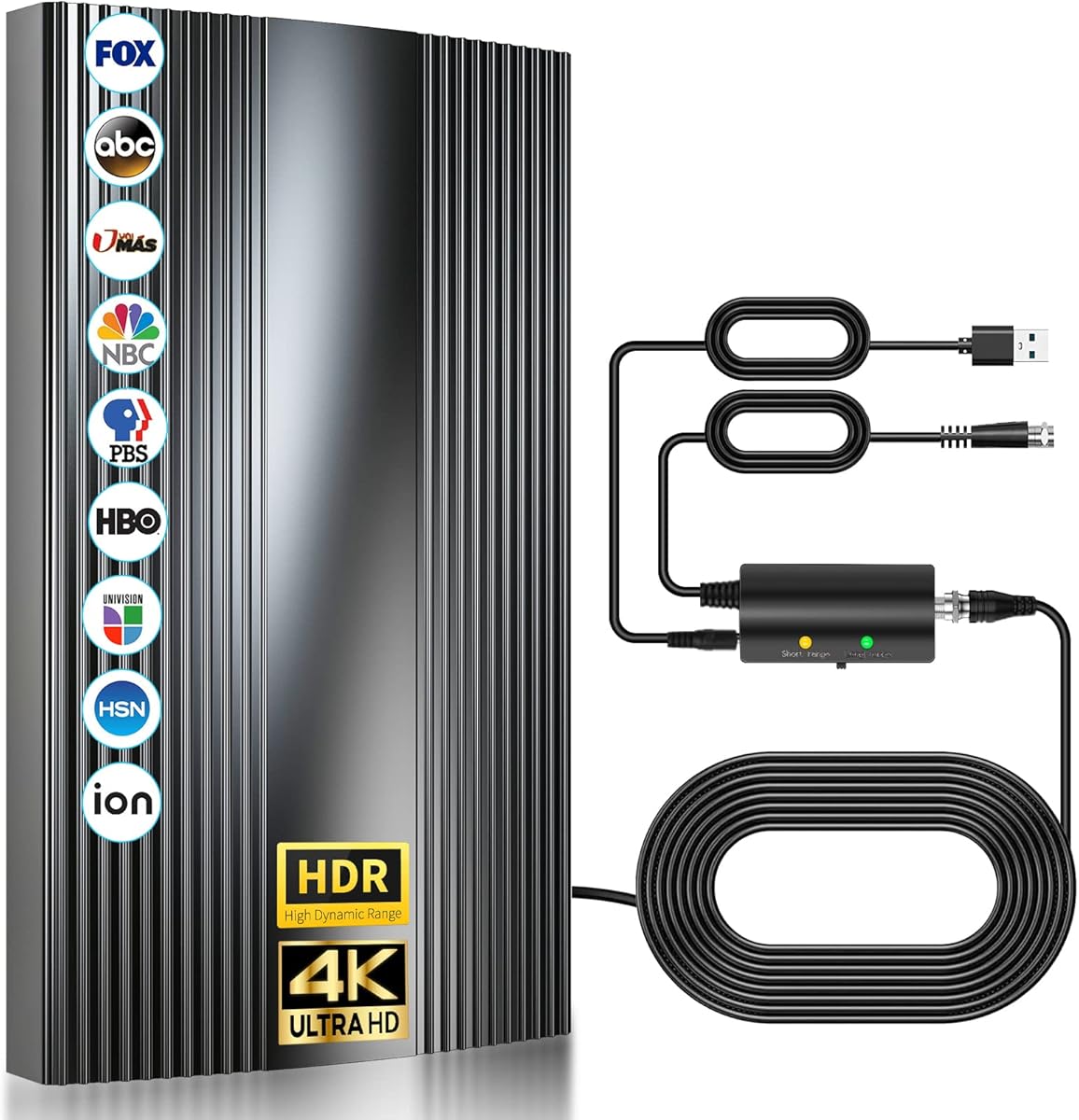
The Indoor TV Antenna is a compact option for RV interiors, with a 4.7 rating and a magnetic base that makes placement unusually simple. It captures VHF and UHF signals from all directions, removing the need to rotate a directional antenna when channels originate from different parts of the sky. That omnidirectional approach is useful in an RV because the vehicle’s orientation changes as it travels.
We may earn a commission when you buy through this link, at no additional cost to you.
The magnetic base attaches to metal surfaces such as a television stand, window frame, or RV wall. A 16.5-foot coaxial cable then provides enough reach to place the unit on an upper shelf, near a window, or on the opposite side of the interior. Switchable yellow and green amplifier modes provide some adjustment, while the smart IC chip is intended to support clear HD, 4K, and HDR reception where the available broadcast signal permits.
The antenna connects to a television with a built-in ATSC or ATSC 3.0 tuner. Older televisions require a digital converter box, and the amplifier can draw power from a television USB port, converter box, or suitable USB adapter. Unlike weatherproof outdoor models, this one should be brought inside before rain. Reception also depends on ZIP code, terrain, buildings, and proximity to transmission towers, so checking coverage before buying is important.
This model suits campers who travel frequently, need a portable unit, and do not want to drill into the RV roof. Its magnetic base and moderate cable length make setup and relocation simple. It is less suitable for travelers who need a permanently mounted exterior antenna, but it is a practical indoor complement for vehicles with several usable mounting surfaces.
The magnetic base is especially useful for temporary installations. It can be moved from a window frame to a metal stand or RV wall as the vehicle or campsite changes, without leaving permanent marks or requiring tools.
Receiving signals from every direction reduces the need to reposition the antenna whenever the RV turns or parks. The 16.5-foot cable still allows the unit to be moved away from electronics that could interfere with reception.
We may earn a commission when you buy through this link, at no additional cost to you.
The Outdoor RV TV Antenna for Camper is the premium pick for travelers who want a dedicated exterior installation rather than a temporary indoor arrangement. Its 3.9 rating is respectable but trails several flexible models. The reason for including it is its purpose-built RV design: a sturdy mounting base with four screws, a weather-resistant and UV-stabilized housing, and a 360-degree omnidirectional design intended for moving vehicles.
We may earn a commission when you buy through this link, at no additional cost to you.
Roof placement can give the antenna a clearer path to broadcast signals than a unit positioned inside a metal-sided RV. The omnidirectional structure is particularly appropriate for mobile use because it avoids constant adjustment as the vehicle changes direction. It is marketed for local full-HD channels such as ABC, CBS, NBC, PBS, and Fox, along with news, sports, sitcoms, and children’s programming.
The antenna works with major televisions through a standard 75-ohm coaxial Antenna In or RF In connection, assuming the television has a built-in tuner. Before installation, users should check available stations with an official coverage map. A higher mounting point can help bypass obstacles, but actual reception varies with location, terrain, and weather. The manufacturer recommends rescanning after moving the antenna and warns that enclosed or heavily blocked areas may limit the signal.
This is the option for RV owners who prefer a permanent roof installation and want the antenna to remain outside during rain, snow, and sun exposure. Installation requires drilling or otherwise securing the base, so it is less convenient than a magnetic or suction-based setup. The tradeoff is a more permanent mobile setup and the ability to keep the active element away from interior obstructions.
The four-screw base provides a more involved installation than a magnetic model, but it is better suited to a roof-mounted antenna that will remain in one position. Once secured, the unit can operate outside the RV while the television remains inside.
Its 360-degree omnidirectional pattern is designed to maintain reception as the camper changes direction. The weather-resistant, UV-stabilized housing supports year-round outdoor use, although channel availability still depends on the local broadcast environment.
We may earn a commission when you buy through this link, at no additional cost to you.
The Indoor TV Antenna is a straightforward choice for RV users who want understandable controls and clear setup guidance. It has a 4.1 customer rating and focuses on two selectable modes: short-range operation for locations within 35 miles and long-range operation for areas from 35 to 250 miles. The manufacturer stresses that choosing the correct mode can materially affect reception.
We may earn a commission when you buy through this link, at no additional cost to you.
An upgraded smart IC chip is designed to filter cellular and FM interference, while the antenna supports UHF and high-VHF signals and can pass through 4K, UHD, and 1080p broadcasts when strong enough signals are available. The included 16.5-foot cable permits placement near a window, on a wall, or in another elevated position away from metal objects, thick walls, routers, and other electronics.
A notable limitation is that some low-VHF channels numbered 2 through 6 may require a separate low-VHF-compatible antenna. The stated long-range figure also does not mean that weak stations will necessarily appear in mountainous or heavily obstructed areas. The product guidance recommends checking distance from towers, switching modes, moving the antenna higher, and rescanning whenever it is repositioned.
This is a useful indoor option for RVs that regularly receive a strong local signal and do not require permanent exterior mounting. Its most valuable feature is the clearly defined mode system, which helps users diagnose whether poor results come from using the wrong range setting. Travelers who regularly visit areas with weak or distant stations should consider a more capable outdoor model.
The short-range setting is intended for locations close to broadcast towers, while the long-range setting is designed for more distant areas. Following that guidance can prevent a weak result caused by operating in the wrong mode.
The antenna works best near a window, high in the room, and away from metal and other electronics. Even a 16.5-foot cable is most valuable when it helps the user find a location with a cleaner signal path.
We may earn a commission when you buy through this link, at no additional cost to you.
The 2026 Long Range TV Antenna is a rounded indoor model with a 4.2 rating, a 33-foot coaxial cable, and a 360-degree reception pattern. It is especially relevant to RV interiors where the television may sit on one side of the cabin while the best signal position lies near a distant window or wall. The long cable offers more placement freedom than most compact indoor antennas.
We may earn a commission when you buy through this link, at no additional cost to you.
The listed features include a smart IC chip, support for HD, 1080p, 4K, and 8K HDR formats, and compatibility with smart televisions, older sets, digital tuners, and set-top boxes. It can be used in bedrooms, living rooms, RVs, or outdoor locations. Installation takes only a connection to the CABLE-ANT IN port, placement in a suitable location, and a channel scan.
The product’s range and resolution figures are best understood as capabilities rather than guarantees. Broadcast stations available in a particular ZIP code, terrain, buildings, and the antenna’s position will determine the final result. The manufacturer recommends checking official coverage resources before purchase and notes that a television without a tuner requires a digital converter box.
This antenna is a good middle ground for travelers who need more cable length than a desktop model but do not want a roof-mounted assembly. Its simple, compact appearance also suits temporary camping setups and home use. It is best for viewers who want flexible indoor placement and broad television compatibility without permanent modifications to the RV.
The 33-foot cable is a meaningful advantage in an RV, where interior walls, appliances, and metal framing can affect reception. It allows the antenna to move toward a window without requiring a longer accessory cable.
Support for modern smart TVs and older televisions makes the unit useful across a varied RV electronics setup. A converter box remains necessary for televisions without an internal digital tuner.
We may earn a commission when you buy through this link, at no additional cost to you.
The Outdoor 360-Degree HDTV Antenna combines one of the strongest customer ratings in the group with a design intended for roofs, attics, RVs, campers, trailers, and motorhomes. Its 4.9 rating reflects broadly favorable customer feedback. The antenna uses an omnidirectional VHF/UHF structure, a built-in amplifier, and a 32.8-foot coaxial cable to provide placement flexibility in a variety of outdoor environments.
We may earn a commission when you buy through this link, at no additional cost to you.
Because it is designed for exterior installation, weather resistance is a major feature. The housing is described as capable of withstanding rain, snow, wind, and heat. It can be mounted on a wall, pole, rooftop, or near a window area, which lets RV owners find a location that improves the signal path. The built-in amplifier and upgraded reception technology are intended to provide stable over-the-air reception in suburban and rural areas.
The antenna supports common local broadcast stations and is ready for 4K, UHD, and 1080p signals when the broadcast and received signal support those formats. As with every antenna in the roundup, the channels available depend on the viewer’s location, nearby towers, and obstructions. A television needs a built-in ATSC tuner, or the antenna must feed a digital converter box.
This is an excellent choice for an RV owner seeking outdoor versatility without being limited to a permanent roof assembly. The long cable and multiple mounting options make it suitable for campers that lack a clean roof location. Because it is intended for outdoor exposure, installation should avoid locations where the housing or connections could be unnecessarily exposed to moisture or physical damage.
The unit can be placed on a rooftop, wall, pole, attic structure, or exterior RV surface. That flexibility is useful when roof access is limited or when a temporary exterior position produces better reception.
The housing is designed for rain, snow, wind, and heat, making it better aligned with continuous RV use than an indoor-only model. Secure placement and protected cable connections remain important during severe conditions.
We may earn a commission when you buy through this link, at no additional cost to you.
The HIDB TV Antenna is the most discreet option in the roundup, designed for indoor use and built around a compact, slim housing. It has a 3.8 rating, which is lower than several alternatives, but its small footprint and lightweight construction may appeal to travelers who do not want an exterior antenna or a visible indoor device. It receives local television signals without a cable subscription and is intended for smart TVs and HDTVs.
We may earn a commission when you buy through this link, at no additional cost to you.
The antenna uses a dual-PC soft housing rather than ordinary PVC, providing flame-retardant characteristics along with moisture resistance and a measure of lightning protection for indoor placement. Its omnidirectional reception removes the need to point the unit toward one tower. It can sit on a TV stand or table, and the lightweight construction makes it simple to move between locations inside an RV.
The main limitation is that it is clearly designed for indoor use. The listing does not describe an extended coaxial cable or provide the same exterior mounting flexibility as the dedicated outdoor models. Actual reception also depends on location, terrain, weather, and obstacles. The best approach is to mount the antenna high and near a window facing the direction of local broadcast towers, then rescan after moving it.
This model makes sense for an RV owner who wants a small indoor antenna for occasional local viewing rather than a permanent mobile broadcast system. It is less appropriate for travelers who expect many stations in weak-signal areas or need a unit that can remain outside. Its strongest features are discretion, low weight, and simple omnidirectional setup.
The slim housing can sit on a television stand, cabinet, or table without taking up much visible space. Its light weight also makes it convenient to move when trying different window positions.
The dual-PC housing is described as flame retardant, moisture resistant, and less ordinary than conventional PVC construction. Those attributes suit an indoor environment where the antenna is handled frequently.
We may earn a commission when you buy through this link, at no additional cost to you.
The 2026 6000+ Mile TV Antenna is a strong all-around option with a 4.7 customer rating, 360-degree reception, a 38-foot coaxial cable, and a smart IC chip. It supports 4K, 1080p, and HDR content where the local signal permits, and the product information identifies common stations such as ABC, CBS, NBC, PBS, Fox, CW, and Univision.
We may earn a commission when you buy through this link, at no additional cost to you.
Its clear filter technology is intended to minimize interference while improving signal pickup, and the built-in booster is designed to strengthen weak signals. The long cable allows the compact antenna to be placed on a wall, window, tabletop, cabinet, or outside near an RV. Waterproof materials make it suitable for harsh weather and multiple environments, including homes, garages, offices, RVs, and camping trips.
Setup follows a simple three-step process: connect the antenna to the television’s CABLE-ANT IN port, position it with a window generally recommended, and run a channel scan. If few channels appear, the manufacturer recommends moving the antenna and scanning again. Local coverage should be checked before purchase, because the advertised range cannot account for every terrain or tower condition.
This model is well suited to travelers who want a single unit that can be deployed inside or outside without roof drilling. It combines a long cable, a compact design, filtering, and 360-degree reception. Those features make it versatile for a mix of permanent and temporary RV setups, although dedicated roof-mounted hardware is not included.
The intelligent IC and clear filter technology are designed to reduce unwanted interference while receiving a broad range of broadcasts. This can be valuable near electronics, appliances, and other sources of noise inside an RV.
Waterproof materials and the 38-foot cable let the antenna move from a television stand to a window or exterior campsite position. This makes it a practical single-antenna option for travelers who want flexible placement.
We may earn a commission when you buy through this link, at no additional cost to you.
The Digital Antenna with Magnetic Base is the Best Budget pick because it is compact, straightforward, and designed to move with an RV. It has a 3.8 customer rating and advertises reception of local HD channels through a 360-degree omnidirectional design. The magnetic base attaches to metal surfaces such as a television stand, window frame, or RV wall, while a scratch-resistant metal shell helps it blend into a living space.
We may earn a commission when you buy through this link, at no additional cost to you.
Installation is described as a connect-place-scan process with no tools and no USB power requirement. The included 10-foot coaxial cable provides some freedom to position the antenna, and the compact size allows it to fit in bedrooms, living rooms, on windowsills, or in a travel setup. The product is also positioned for cord-cutting households, campers, and road travelers who want a minimal television system.
The included cable is shorter than those supplied with most of the other options, so users may have less room to move the antenna away from the television or toward a better window. Reception is advertised for up to 120 miles, but distance alone does not determine performance. Terrain, weather, nearby towers, and obstacles can all change the result, making a channel scan after repositioning essential.
This antenna is best for a simple indoor RV installation, especially when a user wants to avoid power adapters, complicated hardware, or a permanent roof mount. It is less suitable for weak-signal regions where a longer cable and elevated outdoor placement are essential. Even so, the magnetic base and compact construction make it one of the easiest models to deploy quickly.
The magnetic base eliminates screws and fixed mounting. Travelers can connect the cable, attach the antenna to a suitable metal surface, and scan the television without bringing tools or modifying the vehicle.
The antenna does not need a USB connection, and its small metal shell is easy to conceal. That makes it convenient for temporary setups, although the shorter cable limits how far it can move from the television.
We may earn a commission when you buy through this link, at no additional cost to you.
Choosing an RV antenna requires balancing signal reach, physical construction, installation method, and the television setup inside the vehicle. The following factors explain which specifications are most useful and where customer expectations should be tempered by real-world broadcast conditions.
Check official broadcast maps and local station availability before choosing a model. Consider the locations you expect to visit rather than relying on one maximum-distance figure. For frequent travel through remote areas, an outdoor antenna with a higher mounting position and a longer cable generally offers more flexibility than a compact indoor unit.
Most of the products in this roundup use a 360-degree omnidirectional approach. That is generally the more convenient choice for mobile use. Whatever the design, the antenna should be installed as high and as clear of obstructions as practical.
Choose a compact indoor model for occasional viewing or strong local coverage. Choose an outdoor model when reception is unreliable, the RV parks in remote areas, or the television is far from the best window. Confirm that any outdoor antenna is securely mounted and that cable connections remain protected.
The roundup includes cables from 10 to 40 feet. A 10-foot lead suits a close indoor setup, while 30-plus-foot cables provide much more placement freedom. Longer runs are helpful on larger RVs, but cable quality and a secure connection still matter.
Use the recommended mode for the local conditions and rescan after changing it. Place the antenna where a clean signal is available before expecting an amplifier to compensate for a poor signal path. If channels disappear in a strong-signal location, test the alternate mode rather than assuming the antenna is defective.
The best method is the one that holds the antenna securely and keeps it high above nearby obstructions without creating a hazard. Travelers who move frequently should favor a removable design. Permanent installers should consider drilling points, roof sealant, cable strain relief, and the effect of vibration while driving.
Verify the available antenna input before installation. If the television lacks a tuner, confirm that the converter box has a coaxial antenna input and a compatible output for the television. Account for amplifier power needs without confusing them with the television connection.
For complete channel information, check coverage maps and station lists for the intended viewing area. Some low-VHF channels, particularly channels 2 through 6 in certain areas, may require a compatible low-VHF antenna or a different tuner. Plan to rescan whenever the vehicle moves to a new broadcast area.
Start by confirming that the television has a working ATSC tuner or by connecting the antenna to a compatible digital converter box. Check official coverage resources for the campsite or intended viewing area, then connect the coaxial cable to the television’s Antenna In, CABLE-ANT IN, or RF In port. If the antenna includes a powered amplifier, connect its power to the appropriate television USB port, converter box, or compatible USB adapter.
Place the antenna as high as practical and as close to a window as possible when using it indoors. For an exterior model, secure it on the roof, wall, or pole with suitable mounting hardware, protect the connection from moisture, and route the cable without creating a sharp bend or loose section that could be caught while traveling. Avoid placing the antenna near microwaves, routers, heavy wiring, or other electronics that may interfere with reception.
Run a channel scan after installation. If results are incomplete, move the antenna, change the amplifier range setting if the model provides one, and scan again. Allow several scans while trying different positions rather than judging the antenna after a single attempt. For outdoor units, inspect the mount and cable connections periodically, clear debris where appropriate, and bring indoor-only antennas inside before rain or extreme moisture exposure.
An omnidirectional antenna is generally the most convenient choice for a moving RV because it does not need constant directional adjustment. Reception can still fluctuate around hills, tall buildings, tunnels, and dense forests. A roof-mounted or higher-positioned antenna generally has a clearer path to broadcast towers than one placed low inside the vehicle.
An indoor antenna can work well when local broadcast signals are strong and the RV has a suitable window or wall position. An outdoor antenna is usually more dependable in rural areas, during bad weather, or when metal RV construction interferes with indoor reception. The decision depends more on coverage and placement than on the antenna’s marketing range.
There is no required distance, but a longer coaxial cable allows the antenna to be moved away from electronics and placed near a better signal location. The included cables in this roundup range from 10 to 40 feet. Use enough length for useful positioning without creating unnecessary slack, sharp bends, or vulnerable sections around doors and exterior fittings.
Only if the television includes a compatible over-the-air tuner. Many older sets require a digital converter box between the antenna and television. Check for a coaxial antenna input, confirm that the converter supports ATSC broadcasts, and use the correct output connection for the television model.
The television must discover every broadcast that is currently reaching the antenna, and channel reception changes with position. A new campsite, a different window, a nearby building, or a changed amplifier setting can alter the available signal. Rescanning after each meaningful movement is therefore a normal and necessary part of using an over-the-air antenna.
No. An amplifier can strengthen a usable signal and help preserve it along the cable, but it cannot overcome a blocked signal path or create coverage where no station reaches the location. Tower distance, terrain, foliage, buildings, and weather remain decisive. A suitable outdoor position often matters more than amplifier strength alone.
Several listed antennas can pass 4K or UHD broadcast signals, provided the local station transmits in that format and the received signal is strong enough. The antenna must also connect to a 4K-capable television or converter. A compatible antenna and television do not guarantee reception in locations outside the station’s coverage area.
Check the mounting hardware and cable connections at regular intervals, particularly after long trips or severe weather. Clean away debris with appropriate non-damaging methods, inspect the housing for cracks, and confirm that the sealant and strain relief remain secure. Avoid walking on the roof, and ensure the antenna and cable cannot create a hazard during travel.
The TV Antenna for Smart 6000+Miles is the most versatile overall selection because it combines a long cable, switchable amplifier modes, portable construction, and indoor/outdoor suitability. The Outdoor RV TV Antenna for Camper is the premium choice for a dedicated roof installation, while the Digital Antenna with Magnetic Base offers the simplest portable setup for travelers who want a compact indoor option.
Prioritize the signal path over the largest advertised range. Check coverage for the places you will actually watch, consider whether the RV’s walls obstruct reception, and choose a cable length that allows the antenna to reach a window or elevated exterior position. Also verify television tuner compatibility, mounting needs, amplifier controls, and weather resistance before installation.
Product specifications, ratings, and availability can change, so confirm the current listing and its installation requirements before purchasing. Once installed, allow time to test several positions, rescan after every move, and adjust the amplifier according to the manufacturer’s guidance. The right antenna is the one that works with your television, fits your RV, and can find a reliable signal where you travel.