
XMZXMZ 486-LED Panel
4.4Editor score
324 red and 162 infrared LEDs
Five brightness levels
Five programmable timer options
Our guide compares the best Red Infrared Light Therapy Panel options across wavelengths, power, coverage, controls, cooling, stand design, and ease of use.
Red infrared light therapy panels combine visible red light and near-infrared wavelengths to create a convenient home option for skin, body, recovery, and general wellness routines. A useful panel should balance meaningful output, broad illumination, safe controls, effective cooling, and positioning hardware that fits your space.
This guide compares ten panels using the specifications and customer feedback supplied for each product. We examine wavelength combinations, irradiance, panel size, LED arrangement, timer functions, mounting options, portability, and practical controls, without claiming to have personally tested any model.
The selections range from compact units for targeted routines to larger panels designed for broader coverage, including modular and adjustable designs. Each review explains the most important strengths and compromises, while current prices and availability can change, so readers should confirm the latest listing details before purchasing.
4.4Editor score

4.6Editor score

4.7Editor score
The table below compares the ten panels by core wavelengths, output, coverage, and practical features, making it easier to identify the model that best matches your preferred routine and available space.



The BestQool BQ60 combines 660nm red light and 850nm near-infrared light in a 105W panel that has earned a 4.6 customer rating. Its standout feature is the stated 95.6 mW/cm² irradiance at three inches, paired with a housing designed to deliver a broad, consistent field of light.
We may earn a commission when you buy through this link, at no additional cost to you.
Three operating modes let users select red light, infrared light, or both, making it easy to adapt the panel to different routines. The touchscreen provides accessible control, while the lightweight construction and adjustable U-shaped stand support tabletop positioning. A hanging kit adds flexibility for fixed wall installation, and the advanced cooling system is designed to help maintain steady operation.
The principal trade-off is size and complexity compared with smaller panels. Its support hardware takes more room, and the 105W rating should not be confused with the actual light delivered to every part of the body. Distance from the panel affects irradiance, so users still need to position it consistently for the most even results.
This is our top overall recommendation for readers who want a capable home panel without moving to the largest or most feature-heavy model. It combines clear output data, two common wavelengths, several placement options, and straightforward controls, making it a strong all-around choice for face, body, workout, and wind-down routines.
The touchscreen and adjustable U-shaped stand make routine changes simple, while the included wall-mount hardware supports a more permanent installation. That flexibility is useful when the same panel is used at a desk, beside a bed, or on a nightstand.
Independent red and infrared choices allow users to simplify a session rather than always operating both channels. Red light offers visible illumination, while 850nm near-infrared light provides the invisible component of the panel's dual-wavelength output.
We may earn a commission when you buy through this link, at no additional cost to you.
This Viconor panel provides 120 LEDs using 660nm red and 850nm near-infrared wavelengths. It has a 4.3 customer rating and focuses on a curved, compact format intended to concentrate light toward the face or selected body areas.
We may earn a commission when you buy through this link, at no additional cost to you.
Each LED arrangement includes one 660nm emitter and two 850nm emitters, providing both visible red and invisible infrared light. The curved panel shape is the defining design element, while the supplied stand, hook, and three-meter power cord allow the unit to be placed independently or suspended for convenient use while relaxing.
Unlike several higher-output competitors, the supplied information does not provide a numerical irradiance measurement or a detailed timer specification. Those omissions make it harder to compare delivered intensity and session precision directly. The product also has a lower rating than several alternatives in this list, so prospective buyers should review recent customer feedback carefully.
It is a sensible value-oriented option for readers who prioritize a small footprint, flexible placement, and dual-wavelength illumination over advanced controls or published performance measurements. The curved face-oriented design and included stand make it particularly approachable for personal routines at home.
The lightweight housing and compact curved construction are well suited to rooms where a large floor-standing panel would be inconvenient. The included hook also supports a wall-mounted setup when users want to keep the device out of the way.
Combining 660nm and 850nm light gives users access to both visible red and near-infrared channels. This is a common pairing in the category because it supports different preferences and positioning needs without changing devices.
We may earn a commission when you buy through this link, at no additional cost to you.
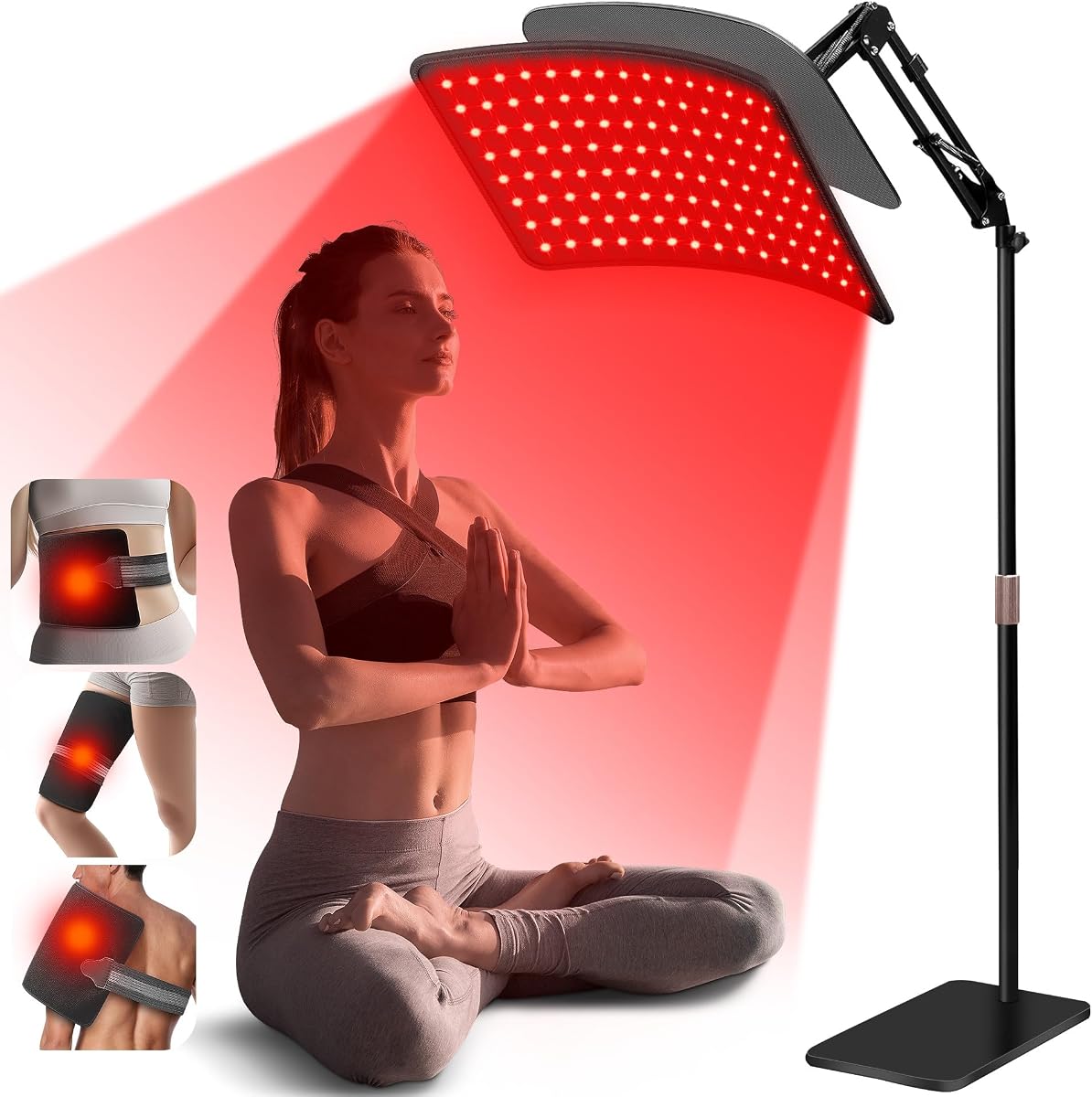
The XMZXMZ panel combines 324 red LEDs at 660nm with 162 near-infrared LEDs at 850nm. Its 4.4 customer rating reflects a feature-rich home design, and the 8-by-14.5-inch face is intended to cover areas such as the face, neck, back, arms, and legs.
We may earn a commission when you buy through this link, at no additional cost to you.
Five brightness levels make it easy to change the visual intensity, while five timer presets provide 20, 30, 40, 50, and 60-minute sessions. Users can operate the touch panel or use the included remote from up to 65.6 feet away. A gooseneck, sturdy stand, adjustable hook, and seven-foot cord provide several positioning options.
A key limitation is the lack of a stated irradiance measurement, making output difficult to compare with panels that publish figures at specific distances. The large LED count and broad panel may also require more room than a compact personal model, although the flexible neck helps compensate for the footprint.
This model is a strong budget choice for users who value programmable brightness, a wide timer range, and remote operation more than laboratory-style output comparisons. It is especially useful for household routines in which a user may move between a sofa, desk, or table and adjust the angle for different body areas.
The included remote is useful when the panel is positioned across a room or while the user is reclining. Touch controls remain available for closer adjustments, and five brightness levels offer more nuance than a simple on-off design.
Its elongated surface can illuminate a wider section of the body than a small facial lamp. Users should still account for the reduced intensity that naturally occurs farther from the light source.
We may earn a commission when you buy through this link, at no additional cost to you.
The BestQool 160W Pro panel is a four-wavelength model with a 4.7 customer rating, placing it among the most favorably reviewed products here. It measures 19.7 by 8.4 by 2.6 inches and delivers a stated 109 mW/cm² at three inches with a 60-degree beam angle.
We may earn a commission when you buy through this link, at no additional cost to you.
Its major advantage is modularity. Connection holes allow compatible BestQool Pro100 panels to be linked, creating a wider field for users who want a more expansive setup. Red, near-infrared, and combined lighting modes add further control, while the smart control system and dual-chip LEDs support flexible routine settings.
This is also the largest and most advanced specification set in the group, which means more space, setup, and a greater investment than entry-level panels. The product information does not identify every additional wavelength or enumerate the full control interface, so buyers should review the current listing and manual for exact operation details.
For a home setup intended to grow over time, it is the strongest premium recommendation. The combination of high stated output, multiple wavelengths, a broad beam, and expandability particularly appeals to users who want a panel that can serve targeted routines and later support a multi-panel arrangement.
The connection system is the standout feature for buyers planning a dedicated wellness area. Linking compatible panels can produce a broader treatment field, although it requires additional panels and enough space to operate them safely.
A published 109 mW/cm² figure at three inches gives shoppers a more concrete basis for comparison. Irradiance naturally changes with distance, so consistent placement remains important when comparing sessions across different models.
We may earn a commission when you buy through this link, at no additional cost to you.
The Hooga HG300 uses 60 five-watt LEDs to provide 660nm red and 850nm near-infrared light. It carries a 4.6 customer rating, and its stated output exceeds 73 mW/cm² at six inches while remaining small enough for targeted home sessions.
We may earn a commission when you buy through this link, at no additional cost to you.
A smart distinction is the inclusion of independent controls for red, near-infrared, and combined operation. The adjustable tabletop stand makes it easy to place the panel on a desk, counter, nightstand, or table. Active cooling supports steady output, and the complete kit includes protective eyewear, a power cord, and a user manual.
The HG300 is less appropriate than a modular panel for users wanting to illuminate a large area with several linked devices. Its value proposition is instead centered on compact construction, clear performance data, a 50,000-plus-hour LED lifespan, and a three-year warranty rather than maximum breadth.
It is an excellent choice for readers seeking a focused and well-supported panel without the footprint of a full modular system. The published output, independent wavelength controls, complete accessory kit, and warranty make it especially attractive for a straightforward and consistent personal routine.
The three-year warranty and U.S.-based customer support add reassurance that is not described for many alternatives. Users also receive protective eyewear and a manual, making setup more complete out of the box.
The HG300 concentrates its 60 LEDs into a smaller housing for targeted areas. That makes it a practical middle ground between a small lamp and a broad modular installation.
We may earn a commission when you buy through this link, at no additional cost to you.
This 45W LED panel is a straightforward dual-wavelength device combining deep red 660nm light with 850nm near-infrared light. It has a 4.4 customer rating and is marketed for home routines involving skin, muscles, and joints.
We may earn a commission when you buy through this link, at no additional cost to you.
The panel can be placed independently or hung, allowing users to keep it active while reading, watching television, or using a computer. Its relatively simple design avoids the learning curve associated with remote controls, pulse modes, and elaborate timers, which can be advantageous for straightforward daily use.
The supplied specifications do not include a quantified irradiance value, timer range, detailed dimensions, or cooling arrangement. As a result, it is difficult to compare its delivered intensity with higher-end panels that publish distance-based output. Its 45W rating alone should not be treated as a direct measure of therapeutic performance.
This unit suits shoppers who want a basic red-and-infrared panel with flexible placement and little operational complexity. It is less suitable for buyers whose priority is precise output data, extensive controls, or the ability to expand a multi-panel installation.
The panel's basic format makes it approachable for new users. With no elaborate setup described, it can be positioned and incorporated into a relaxing activity without interrupting the routine.
The 660nm channel provides visible red illumination, while 850nm adds invisible near-infrared light. Together they offer a familiar dual-wavelength configuration without adding extra hardware.
We may earn a commission when you buy through this link, at no additional cost to you.
The Viconor 300W panel has a 5.0 customer rating and pairs 60 dual-chip LED beads with a stated irradiance of 140 mW/cm² at six inches. Each bead includes both 660nm and 850nm emitters, allowing the panel to support superficial, localized, and deeper-tissue routines.
We may earn a commission when you buy through this link, at no additional cost to you.
A timer can be set from five to 30 minutes, and a built-in cooling fan helps manage heat during longer use. The supplied package includes a manual, hanging kit, and eye protection. Hooks allow the unit to stand on a table or hang on a wall, making it practical to use while working, relaxing, or lying down.
Its 300W rating and high output specification may produce more heat than lower-powered models, making ventilation and a stable mounting point important. As with every panel, actual irradiance varies with distance and angle. The perfect 5.0 rating should also be interpreted alongside the number of reviews behind that average.
This is a strong recommendation for users who prioritize high stated output and can provide an appropriate installation area. It is particularly useful for broader body routines, and the included timer, cooling system, handle, and hanging hardware make it versatile around the home.
The stated 140 mW/cm² at six inches offers a useful benchmark against competing panels. Consistent distance and positioning help users reproduce their routine more accurately from one session to the next.
A five-to-30-minute timer and integrated cooling fan simplify longer routines. Users should still maintain airflow around the panel and avoid blocking the cooling path during operation.
We may earn a commission when you buy through this link, at no additional cost to you.
This second Viconor design uses the same 120-LED mix of 660nm red and 850nm near-infrared emitters. It has a 4.5 customer rating and emphasizes a curved housing intended to concentrate illumination across the face or a selected body region.
We may earn a commission when you buy through this link, at no additional cost to you.
The included stand supports 180-degree adjustment, and the panel can also be hung using the supplied hook. Its compact size and light weight allow it to move between a bedside table, sofa area, and other indoor spaces. A recommended 15-to-30-minute session is noted in the supplied information.
The one-point-eight-meter cord is shorter than the three-meter cord listed for the similar Viconor panel, and no numerical irradiance is provided. That makes the panel less attractive for users who need to place the device farther from an outlet. It also offers fewer advanced controls than models with remotes, timers, or multiple brightness levels.
Choose this version if a curved face-oriented panel, adjustable stand, and portable format matter most. It is a credible everyday choice for targeted routines, particularly when a compact unit is easier to place consistently than a larger high-output panel.
The concave shape helps direct light toward a centered facial area. Combined with the stand's angle adjustment, it allows users to move between face, shoulder, and other targeted applications.
A hook provides a second mounting method beyond the freestanding stand. This makes it easy to keep the panel active in a fixed position while the user relaxes nearby.
We may earn a commission when you buy through this link, at no additional cost to you.
The INTEO panel earns a 4.7 customer rating through a flexible two-in-one design. Its lamp head can be detached and carried with an adjustable elastic strap or mounted on a matching bracket, allowing the same light source to serve portable and stationary routines.
We may earn a commission when you buy through this link, at no additional cost to you.
Five brightness levels, nine timer options from 10 to 90 minutes, and three working modes provide unusually granular control. The curved frame supports even coverage, while the aviation-grade aluminum stand offers 180-degree flipping, flexible height adjustment, and a 360-degree rotating head. The panel measures 13 by 7.5 inches and can reach a maximum height of 46.5 inches.
The product information does not state a numerical irradiance measurement, making direct output comparison difficult. Its range of settings may also feel excessive for users who want a one-touch routine, and the detachable strap needs secure positioning to maintain consistent distance. Quick assembly is described as requiring no extra tools.
INTEO is a compelling option for users who change locations or need precise directional control. The combination of portability, broad timer selection, and extensive mechanical adjustment makes it one of the most versatile panels in the roundup for home and travel-oriented routines.
The detachable lamp head can move from a bracket to an elastic strap without changing the light source. That makes it easier to bring the same panel into a different room or adopt a closer, more targeted setup.
Five brightness levels and nine timer options offer more choices than a basic on-off panel. These settings help users build a repeatable routine, provided the chosen distance and angle are also kept consistent.
We may earn a commission when you buy through this link, at no additional cost to you.
The black four-point irradiance panel has a 4.7 customer rating and provides unusually detailed output information. Its specifications list 140 mW/cm² at three inches, 110 at six inches, 90 at 12 inches, and 70 at 18 inches, along with corresponding coverage dimensions.
We may earn a commission when you buy through this link, at no additional cost to you.
A 1.77-inch LCD touchscreen and six-key touch control make wavelength, timer, and lighting-mode adjustments visible. Nine pulse modes extend from 0Hz to 300Hz, while independent 660nm and 850nm channels allow the two wavelengths to be used separately. A 433MHz remote provides control from a distance, and flicker-free illumination is part of the stated design.
The SPCC housing is described as durable and efficient for heat dissipation, while quiet cooling fans help prevent overheating. The compact 13.98-by-7.87-inch panel should fit many home spaces, but the supplied details provide little information about the included support hardware, so buyers should verify how it is intended to stand or mount.
This model ranks highly for buyers who want transparent distance-based measurements and detailed control over pulse settings. It is best suited to users who enjoy fine-tuning a routine rather than simply switching the panel on for a fixed period.
The four measured distances help users select a position based on the desired coverage and intensity. Moving farther away broadens the illuminated area but lowers the stated irradiance, so distance should be treated as a core part of the routine.
Nine frequencies from 0Hz through 300Hz provide more control than conventional panels. Independent channels add another layer, allowing users to determine whether red, infrared, or both are active during a session.
We may earn a commission when you buy through this link, at no additional cost to you.
A useful red infrared panel is defined by more than wattage. Compare wavelength channels, measured output, coverage, thermal management, controls, mounting options, and accessories so the device fits your space and routine.
Irradiance describes the light energy delivered per unit area, but it changes with distance, angle, and panel size. Specifications at three, six, 12, or 18 inches are more useful than a wattage figure alone. The BestQool BQ60, Hooga HG300, Viconor 300W, and four-point panel provide numerical output data, making direct comparison easier.
Choose a published measurement that matches the distance you expect to use, and keep that distance consistent. More intense light at close range is not automatically preferable to a broader field at a greater distance.
Most panels in this roundup combine 660nm visible red light with 850nm near-infrared light. The BestQool 160W Pro model goes further with four wavelengths, while the Hooga and Viconor 300W provide independent channel controls. A dual-wavelength setup is versatile, but independent operation offers more routine flexibility.
Look for controls that make your preferred configuration easy to repeat. Visible displays, remotes, and separate channel buttons are helpful, although complicated interfaces are unnecessary if your routine only requires one setting.
Larger panels cast a broader field and may cover more of the face or body in one session, but they require more room and can be harder to position precisely. Compact curved panels are more convenient for targeted routines, while elongated panels suit areas such as the back, arms, and legs.
Select the smallest panel that covers your intended area comfortably. A broad panel still needs correct distance and angle to deliver consistent light across its entire surface.
A stable stand is essential for repeatable use. Adjustable height and angle help align the panel with the face, back, shoulders, or legs, while hooks and hanging kits can free floor space. The INTEO model offers the most articulated positioning, and the BestQool BQ60 combines a tabletop stand with wall-mounting hardware.
Check whether the table is deep enough and whether the cord reaches the intended outlet. For wall mounting, confirm that the supplied hardware suits the wall type and that the panel remains stable.
High-output panels produce heat, making active cooling important for comfort and consistent operation. The Viconor 300W includes a cooling fan and timer, the BestQool BQ60 uses an advanced cooling system, and the four-point panel uses quiet fans with a heat-dissipating SPCC housing. Good airflow around the device remains essential.
For frequent or extended routines, prioritize a documented cooling system over raw power. Keep vents unobstructed and allow the panel to operate in a ventilated space, particularly in warmer rooms.
Timers help establish consistent sessions and reduce the need to manually switch the unit off. The XMZXMZ offers five timer presets, INTEO provides nine options, and the four-point model combines nine pulse frequencies with dual-channel adjustment. The Hooga HG300 includes a built-in timer, while simpler panels offer fewer documented controls.
Select settings that match your experience and available time. More options are not inherently better, but brightness and timer controls can make it easier to adjust a routine without moving the panel.
Compact panels are easier to move between a desk, nightstand, sofa, and other treatment areas. Portable options may include a detachable head, elastic strap, carrying handle, or extended cord. Eye protection, hooks, hanging kits, remotes, and manuals can add convenience and help with setup.
List the accessories you will actually use before deciding. A complete kit is useful, but a simple bundle with a stable stand and clear instructions may be more valuable than numerous accessories you do not need.
Before the first session, read the product manual, identify the red and infrared controls, and confirm that the stand or wall mount is stable. Clear nearby objects, choose a comfortable position, and use the distance and timer guidance supplied by the manufacturer. If protective eyewear is included or recommended, use it as directed.
Use the panel consistently, as many home wellness routines depend on regular sessions rather than occasional use. Keep the panel at a consistent distance and angle, avoid looking directly into bright emitters, and do not block cooling vents. Do not exceed the manufacturer's session limits, especially with a high-output panel that may produce noticeable heat.
After use, switch the panel off, unplug it, and let the housing cool before moving or cleaning it. Wipe the surface gently with a dry or lightly damp cloth after the power is disconnected, and keep liquids away from the electronics. Store the panel in a dry place with the cord loosely secured, and inspect the stand and mounting hardware periodically.
The 660nm channel produces visible red light, while the 850nm channel is near-infrared and therefore not visible to the human eye. Panels commonly offer both so users can select a single wavelength or combine them. The exact effects and appropriate routines can vary, so users should follow the guidance provided for their specific device.
No. Wattage describes electrical power, while irradiance describes light energy delivered to an area. Distance, angle, LED optics, and panel design also affect the result. A panel with published irradiance at the distance you intend to use is often more useful for comparison than a large wattage number alone.
There is no single distance that suits every panel. Follow the manufacturer's instructions, especially when the listing includes measurements at three, six, 12, or 18 inches. Keep the chosen distance consistent because moving farther away generally expands the illuminated field while reducing intensity.
Eye safety depends on the light intensity, wavelengths, and the instructions for the particular model. Some panels in this roundup include protective eyewear, while others recommend looking away rather than staring into the source. Review the manual and use any supplied protective equipment exactly as directed.
The Viconor curved models and INTEO panel are particularly convenient for facial positioning because their shapes and adjustable supports are intended to direct light toward the face. The XMZXMZ and BestQool models also cover facial areas, but their broader surfaces may be more useful when treating several body zones in one setup.
It depends on the model and included hardware. The BestQool BQ60, Viconor 300W, and Viconor 120-LED designs list hanging kits or hooks, while other models primarily emphasize freestanding use. Confirm that the supplied hardware is appropriate for your wall and that the panel can operate safely with airflow around its cooling system.
Most dual-wavelength panels can operate both channels simultaneously, but control options vary. The Hooga HG300, Viconor 300W, and four-point model explicitly provide independent controls, allowing red-only, infrared-only, or combined sessions. Follow the manual for safe timing and brightness settings.
The BestQool BQ60 stands out as the most balanced overall recommendation because it combines published output, three operating modes, a flexible stand, wall-mounting hardware, and active cooling. The Hooga HG300 is a particularly polished compact choice, while the BestQool 160W Pro panel offers the premium combination of four wavelengths and modular expansion.
For shoppers seeking a feature-rich lower-cost option, the XMZXMZ panel provides 486 LEDs, five brightness levels, useful timer presets, and a remote. The most important priorities are consistent placement, realistic coverage, documented output, safe controls, and cooling that suits the available space. More elaborate features are worthwhile only when they improve your routine rather than adding complexity.
Before purchasing, confirm the panel dimensions, stand requirements, wavelength controls, timer settings, accessories, and current product details on the retailer listing. Prices, promotions, availability, and specifications can change, so checking the latest listing and seller information is an important final step.