
APC Smart-UPS 1500VA
4.6Editor score
1500VA, 900W power capacity
Pure sine wave output
Six NEMA 5-15R outlets
Two-unit rackmount design
Discover the best Rackmount UPS Battery options for racks, comparing capacity, output, outlets, runtime features, monitoring, warranty, and installation needs.
A rackmount UPS battery backup protects servers, network devices, security systems, and other essential equipment from outages, voltage fluctuations, and power-related damage. The right unit should fit your enclosure, deliver compatible output, provide enough backup time, and make operating conditions easy to monitor from the front panel or remotely.
We compared all 10 products by examining rack height, listed power capacity, output waveform, outlet configuration, battery support, voltage regulation, monitoring features, warranty coverage, and equipment protection. The guide includes short-depth and 1U models, conventional 2U systems, sine-wave options, lithium-ion alternatives, and units designed for extended runtime.
Each review explains where the product is strongest, identifies practical limitations, and identifies the kind of installation it suits best. Ratings and specifications reflect the supplied product information, while product availability and pricing can change. Always confirm dimensions, connector types, load requirements, and current seller details before purchasing.
4.6Editor score

4.7Editor score

4.5Editor score
The table below compares the ten rackmount UPS battery options across capacity, output type, physical format, and key management features, helping narrow the field before assessing runtime and installation details.
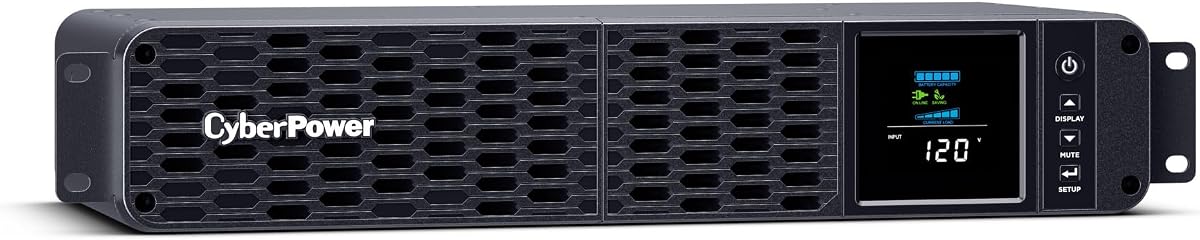





The CyberPower CP2000PFCRM2U earns the Editor's Choice position because it combines the highest listed rating in the group, generous 2000VA and 1200W capacity, pure sine wave output, and a short-depth rackmount enclosure. It is a strong all-around choice for installations that need to support active PFC and conventional power supplies without dedicating substantial rack depth to the UPS.
We may earn a commission when you buy through this link, at no additional cost to you.
Its eight NEMA 5-20R outlets provide both battery backup and surge protection, giving administrators more placement options than the smaller CyberPower models. The multifunction color LCD immediately presents battery and power conditions, while automatic voltage regulation corrects minor fluctuations without needlessly switching to battery power. PowerPanel Management Software is included for download, and the listed three-year warranty includes the battery.
The main installation consideration is the NEMA 5-20P input and its six-foot cord, which requires a compatible 20-amp circuit. Although the chassis is only 10.8 inches deep, short depth does not mean high runtime, so users with substantial load demands must still estimate run time from their actual equipment. The 2000VA rating is also a maximum capacity figure rather than a promise of sustained output for every combination of devices.
This model is recommended for small business racks, network cabinets, media installations, and security systems that benefit from clean output and numerous outlets. It is less suitable where only standard household receptacles are available or where an outage requires an unusually long runtime. Subject to those constraints, it offers the strongest balance of capacity, rack efficiency, monitoring, and compatibility in this collection.
Pure sine wave output is particularly relevant for active PFC and conventional power supplies. It helps avoid compatibility concerns that can arise with lower-cost backup units, making the CP2000PFCRM2U a sensible match for servers, networking equipment, security systems, and audiovisual installations.
Eight NEMA 5-20R outlets give users considerable connection flexibility while the 10.8-inch depth preserves valuable rack space. The color LCD adds useful operating information without requiring a separate display, although remote administration still benefits from the included PowerPanel software.
We may earn a commission when you buy through this link, at no additional cost to you.
The CyberPower OR500LCDRM1U is a compact 500VA, 300W rackmount UPS designed for department and workgroup servers, network devices, and telecom installations that do not use active PFC power supplies. Its 4.5 rating reflects a positive balance of useful capacity, straightforward monitoring, and a space-conscious 1U format.
We may earn a commission when you buy through this link, at no additional cost to you.
Six NEMA 5-15R outlets divide into four battery-backed and surge-protected receptacles plus two surge-only outlets. A multifunction LCD reports runtime in minutes, battery status, and current power conditions, while AVR handles minor voltage variations without switching to battery operation. The ten-foot NEMA 5-15P input cord provides flexibility when placing the unit in a rack.
Its main limitation is the simulated sine wave output, which makes it less appropriate for active PFC power supplies. Remote management also requires the optional RMCARD205 card, so buyers who need network oversight should account for that additional requirement. Capacity is appropriate for essential smaller devices, but it is not intended for power-hungry servers or large equipment clusters.
This is a sensible choice for a small rack containing routers, switches, telephone equipment, or a modest network appliance. It suits administrators who want front-panel battery information and a compact unit without requiring a more elaborate management card. The final recommendation is to use it where the connected equipment explicitly supports simulated sine wave output and the estimated load remains comfortably within 300 watts.
With 500VA and 300W of capacity, the OR500LCDRM1U works best with essential low-power equipment such as network devices and telecom hardware. Its four battery-backed outlets prioritize continuity, while the two additional surge-only receptacles can serve accessories that do not need outage support.
The built-in LCD gives local users immediate information about runtime, battery condition, and power status. For installations requiring remote control, the RMCARD205 management card is an optional addition rather than a standard feature.
We may earn a commission when you buy through this link, at no additional cost to you.
The CyberPower CP2000PFCRM2U is one of the most capable units in the roundup, with 2000VA, 1200W, pure sine wave output, and a 4.7 rating. Its short-depth 1U-style chassis is designed for space-conscious rack installations, yet it still provides eight protected outlets and a detailed color display.
We may earn a commission when you buy through this link, at no additional cost to you.
The system is intended for active PFC and conventional power supplies, opening it to servers, security systems, audio-visual equipment, and networking devices. AVR corrects minor input fluctuations without draining the battery, while the multifunction LCD reports immediate power and battery conditions. The three-year warranty includes the battery and is paired with a $500,000 connected equipment guarantee.
The NEMA 5-20P plug is the central trade-off. It requires a compatible 20-amp source and may not suit racks wired only for 15-amp equipment. Users should also avoid assuming that 1200 watts will yield a long outage window; actual runtime depends on load and operating conditions, and higher draw reduces available time.
We recommend this model for administrators seeking a high-capacity, pure sine wave rack UPS without sacrificing rack depth. It is particularly attractive when the connected equipment includes active PFC power supplies and multiple devices need surge protection. It is less attractive for simple household-style loads or installations where a standard 15-amp input is mandatory.
The 2000VA and 1200W rating provides meaningful room for a broader collection of essential equipment, while the 10.8-inch depth limits the space consumed inside the enclosure. This makes the model attractive for retrofits where a full-depth UPS would be difficult to accommodate.
A color LCD provides an immediate view of battery and power conditions, potentially allowing administrators to address developing issues before they affect critical equipment. Free PowerPanel Management Software adds a software-based path for broader monitoring and configuration.
We may earn a commission when you buy through this link, at no additional cost to you.
The CyberPower OR700LCDRM1U provides 700VA and 400W in a 1U rackmount design, making it a practical middle ground for workgroup servers, network devices, and telecom equipment. Its 4.4 rating is complemented by a clear LCD, AVR, and a three-year warranty that includes the batteries.
We may earn a commission when you buy through this link, at no additional cost to you.
Four of its six NEMA 5-15R outlets provide both battery backup and surge protection, while the remaining two focus on surge protection. The multifunction display reports runtime, battery status, and power conditions, helping users see whether the system is prepared for an outage. Automatic voltage regulation corrects minor fluctuations without needlessly drawing on the battery.
The simulated sine wave output is the key constraint. It should not be selected for equipment with active PFC power supplies unless the manufacturer permits that waveform. Remote management similarly requires an optional RMCARD205 card. Although PowerPanel Business Edition is included for download, a network management card is still needed for remote control access.
This UPS is best for a rack where the power budget is larger than the OR500LCDRM1U but does not justify a high-capacity model. It works particularly well for network appliances and telecom equipment that can operate on simulated sine wave output. Buyers should calculate connected load, confirm outlet requirements, and verify waveform compatibility before finalizing the installation.
The 700VA, 400W specification gives users additional headroom over a 500VA unit without requiring the bulk and higher capacity of a 1500VA or 2000VA model. It is a balanced choice for essential workgroup equipment spread across a small rack.
The included PowerPanel Business Edition software supports management tasks, while the optional RMCARD205 adds the hardware needed for remote management. Buyers who need unattended network access should plan for that card as part of the complete system.
We may earn a commission when you buy through this link, at no additional cost to you.
The CyberPower CP500PFCRM1U combines a compact 500VA, 300W rackmount design with pure sine wave output. That waveform support makes it a notable choice among smaller units, particularly for active PFC and conventional power supplies used in security, audio-visual, or networking systems.
We may earn a commission when you buy through this link, at no additional cost to you.
Its six NEMA 5-15R outlets include four that offer battery backup and surge protection, plus two surge-only outlets. The multifunction LCD shows runtime in minutes, battery status, and power conditions, while AVR corrects minor voltage changes without switching to battery mode. A three-year warranty includes the batteries, with a $300,000 connected equipment guarantee.
Capacity is the main limitation. At 300 watts, this unit is intended for smaller essential loads rather than a full server rack, and runtime will decrease as the load approaches its maximum. Remote management also depends on the optional RMCARD205 card, even though PowerPanel Business Edition software is included for download.
The model is recommended for space-constrained installations with a few essential devices that benefit from pure sine wave power. It provides a more versatile waveform than the simulated-sine OR500LCDRM1U without moving up to a larger chassis. Confirm the total connected wattage and ensure that each device supports pure sine wave operation before purchasing.
Pure sine wave output is the defining benefit of this compact model. It supports active PFC and conventional supplies without requiring a larger rack unit, making the CP500PFCRM1U useful in cabinets where space and depth are tightly constrained.
Runtime, battery condition, and current power status appear on the multifunction LCD. This local visibility is valuable in installations where quick visual checks are more practical than continuous remote supervision, though network management requires the optional card.
We may earn a commission when you buy through this link, at no additional cost to you.
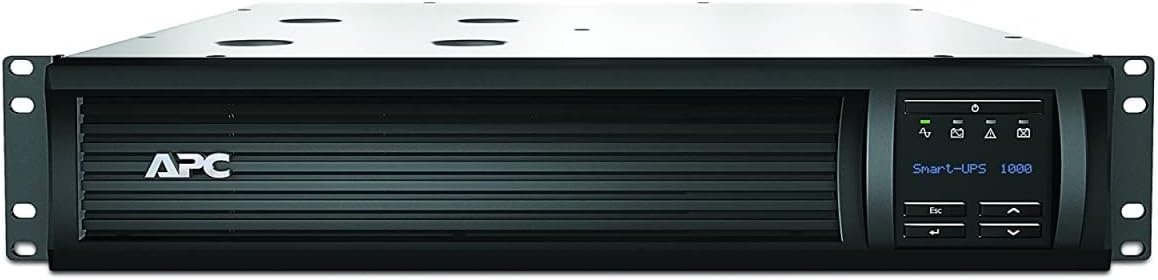
The APC Smart-UPS SMC1500-2UC combines 1500VA and 900W of capacity with pure sine wave output, a two-unit rackmount format, and remote monitoring through APC SmartConnect. Its 4.6 rating is among the strongest in the group, making it a compelling choice for administrators who value an established management platform.
We may earn a commission when you buy through this link, at no additional cost to you.
Six NEMA 5-15R outlets provide backed-up connections, while the NEMA 5-15P input uses a familiar connection format. Automatic voltage regulation adjusts high and low voltages to a safer level, helping preserve battery life. Rack support rails are included, simplifying the physical installation, and SmartConnect provides automatic notifications, firmware updates, and advanced support services.
The principal trade-off is size. This is a 2U unit, so it consumes twice the rack space of a one-unit model. It also has fewer outlets than several CyberPower alternatives. SmartConnect is offered as a six-month free trial for eligible units purchased or registered after August 1, 2023, which means users should understand the current access arrangement when registering their unit.
Warranty coverage includes two years of repair or replacement excluding the battery and a separate two-year battery term, along with a $150,000 connected equipment policy. Registration with SmartConnect can qualify for an additional year of battery warranty. This model is recommended for 1500VA-class rack installations that value pure sine wave output, guided installation, and cloud-oriented monitoring.
SmartConnect provides notifications, firmware updates, and advanced support through a secure portal. This is particularly useful for distributed installations where an administrator needs visibility without walking to each rack, although the stated trial arrangement should be confirmed during registration.
The listed coverage separates the repair-or-replacement warranty for the unit from the battery warranty and includes connected equipment protection. Connecting and registering the UPS with SmartConnect may also unlock an additional year of battery warranty, making setup paperwork an important part of the ownership experience.
We may earn a commission when you buy through this link, at no additional cost to you.
The CyberPower CP700PFCRM1U provides 700VA and 400W of capacity with pure sine wave output, setting it apart from many similarly sized lower-cost UPS models. Its 4.5 rating reflects a versatile unit for active PFC and conventional power supplies used with security, audio-visual, and networking equipment.
We may earn a commission when you buy through this link, at no additional cost to you.
The 1U format preserves rack space, while six NEMA 5-15R outlets include four battery-backed and surge-protected receptacles and two additional surge-only outlets. A multifunction LCD displays runtime, battery status, and power conditions. AVR corrects minor fluctuations without switching to battery mode, and the included ten-foot NEMA 5-15P cord simplifies connection to a standard rack circuit.
As with the smaller CP500PFCRM1U, remote management requires the optional RMCARD205 card. Although PowerPanel Business Edition software is supplied for download, the unit itself does not include that network accessory. The 400W maximum also means the model should not be treated as a high-capacity server UPS, and runtime will be shorter when multiple devices draw significant power.
The three-year warranty includes the batteries and is supported by a $300,000 connected equipment guarantee. This model is best recommended for small network cabinets containing a handful of active PFC or conventional devices that need clean backup power. It is a strong fit when one rack unit and pure sine wave operation are priorities over high outlet count or extended runtime.
Pure sine wave output allows the unit to support both active PFC and conventional power supplies. That broader compatibility makes it more versatile for modern network and security equipment than a unit offering only simulated sine wave output.
The LCD presents runtime and battery information at the rack, while downloadable PowerPanel Business Edition software supports wider management tasks. Remote network management still requires the separately sold RMCARD205 card.
We may earn a commission when you buy through this link, at no additional cost to you.
The APC SMT1500RM2UC offers 1500VA and 1000W of pure sine wave backup in a 2U rackmount design. It targets users who need more supported wattage than many compact CyberPower units but still want SmartConnect monitoring, automatic voltage regulation, and familiar NEMA connections.
We may earn a commission when you buy through this link, at no additional cost to you.
The unit uses a NEMA 5-15P input and provides six NEMA 5-15R outputs. Its pure sine wave waveform is suitable for sensitive network, server, and related equipment, while AVR adjusts high and low input voltages to a safer level. Rack support rails are included, and SmartConnect offers remote notifications, firmware updates, and support services through its secure portal.
Its 2U chassis consumes more space than a one-unit design, and six outlets may be limiting for a densely equipped rack. The stated SmartConnect offer for eligible units purchased or registered after August 1, 2023 is a six-month free trial, so administrators should verify how the service applies at the time of setup. A 4.3 rating is solid, though not the highest among the listed products.
The SMT1500RM2UC is recommended for installations needing a comparatively high 1000W maximum in a standard 2U format, especially where the equipment benefits from pure sine wave output. It may be less attractive for a compact cabinet or a large number of connected devices, and runtime should be evaluated against the actual load before installation.
The 1000W rating provides useful headroom for a group of essential network or computing devices. Although its physical depth is greater than compact models, the 2U format is still common in equipment racks and provides more capacity than the smallest units in this guide.
Secure remote monitoring can help administrators receive automatic notifications and keep firmware current. The stated six-month trial arrangement makes it important to review current enrollment terms before relying on the service for long-term remote oversight.
We may earn a commission when you buy through this link, at no additional cost to you.
The Eaton Tripp Lite BC500RT1ULNC stands apart through its 1U rackmount format, lithium-ion battery system, cloud connectivity, and 500VA, 400W capacity. Its 4.5 rating makes it a strong compact option for administrators who want remote visibility and a lighter installation than a conventional lead-acid rack UPS.
We may earn a commission when you buy through this link, at no additional cost to you.
The unit provides six outlets with surge protection and battery backup. During a prolonged outage, two outlets remain active while four are divided into switchable banks for load shedding. It is rated for 14 minutes at half load, 3 minutes at full load, and 158 joules of surge protection, making the difference between moderate and maximum demand especially important.
Cloud connectivity is a major distinction. Through the free Brightlayer app and a web browser, users can receive email or text alerts, silence alarms, restart the UPS, and view outlet banks. The LCD and LEDs show status at a glance, a QR code simplifies app setup, and NFC supports mass configuration of network settings from a phone.
The model is protected by a five-year limited manufacturer's warranty and a $250,000 Ultimate Connected Equipment insurance policy. It is best suited to essential, modest loads where compactness, lithium battery technology, and remote management matter more than long full-load runtime. Users should model the connected equipment carefully because maximum draw can reduce protection time to only a few minutes.
Lithium-ion batteries are listed as having a service life of five years or more and offer a lighter weight for easier installation. These characteristics can be valuable in crowded racks or cabinets that are difficult to access during routine service.
The Brightlayer app and browser interface allow administrators to review alerts, silence alarms, restart the unit, and manage switchable outlet banks. During longer outages, load shedding helps prioritize the two continuously active outlets, although users need to decide which equipment receives priority.
We may earn a commission when you buy through this link, at no additional cost to you.
The Eaton Tripp Lite SMART1500LCDXL is a 1500VA, 900W 2U rack UPS distinguished by its support for an external battery pack, eight NEMA outlets, and flexible rack-or-tower installation. Its 4.2 rating is the lowest in this group, but its expandable runtime makes it a specialized option for users who need more outage endurance.
We may earn a commission when you buy through this link, at no additional cost to you.
The optional BP24V15RT2U battery pack can provide an additional 30 minutes at half load and 11 minutes at full load. The external pack occupies its own 2U rack space, so users must account for both the UPS and expansion battery when planning the enclosure. A large rotatable LCD reports voltage, runtime, load, battery condition, and operating mode.
Output is modified sine wave in battery mode and sine wave in AC mode, which makes equipment compatibility an important consideration. The unit also has an RJ45 Ethernet port for dataline surge protection up to 100 Mbps. Internal batteries are user-replaceable, potentially simplifying long-term maintenance when handled according to the manufacturer's guidance.
The three-year limited manufacturer's warranty and $250,000 Ultimate Connected Equipment insurance provide stated support. This model is recommended for installations that need extended runtime and do not have sensitive equipment requiring pure sine wave output during every outage. It is less attractive where rack space is scarce, waveform compatibility is sensitive, or the external battery expansion is unnecessary.
The optional BP24V15RT2U external battery pack is the defining feature for installations that need more backup time. It can add 30 minutes at half load or 11 minutes at full load, but it requires another 2U of rack space and should be included in the enclosure's physical plan.
Included hardware allows the system to be rack mounted or placed vertically as a tower, giving administrators flexibility when installation conditions change. The rotatable LCD consolidates voltage, runtime, load, battery, and operating-mode information into an easy-to-read front-panel display.
We may earn a commission when you buy through this link, at no additional cost to you.
Choosing a rackmount UPS requires balancing electrical capacity, waveform compatibility, physical fit, outlet needs, runtime, and management. The most important first step is to inventory the connected equipment before comparing models.
Start by adding the power requirements of every device that should continue operating during an outage. Compare the total measured in watts with the UPS's listed maximum wattage, while also considering startup surges from servers, networking hardware, displays, and other equipment. A conservative operating target leaves room above the measured load, but the UPS's VA and watt ratings should not be treated as interchangeable. A device may draw a high apparent power in VA while consuming fewer real watts, and the product's rated output is the limit that matters.
Do not fill a UPS completely. Heat, power factor, and transient behavior can make a maximum rating unsuitable for sustained operation. A load target around half of the available capacity often provides more practical headroom, especially when the goal is meaningful runtime rather than merely keeping a light load alive.
Pure sine wave output is broadly compatible with modern active PFC and conventional power supplies, while simulated or modified sine wave output may not suit every network, server, or security device. The CyberPower CP1500PFCRM2U, CP2000PFCRM2U, CP500PFCRM1U, and CP700PFCRM1U specify pure sine wave support. The OR500LCDRM1U and OR700LCDRM1U use simulated sine wave, while the SMART1500LCDXL uses modified sine wave in battery mode.
Check the power requirements of every connected device before choosing a lower-cost waveform. If documentation does not establish compatibility, prioritize pure sine wave. This is particularly important for modern computer equipment with active PFC supplies and for systems that may experience repeated or lengthy outages.
A rack UPS must physically fit the available mounting position. The short-depth CyberPower models are particularly useful in shallow enclosures, while the APC Smart-UPS and SMART1500LCDXL occupy 2U. The BC500RT1ULNC also uses a 1U profile, and the SMART1500LCDXL can be converted into a vertical tower with the included adapter. Measure the enclosure before ordering and consider the clearance required for cables behind the unit.
Rack height is only one part of the fit. Users should also check the input plug orientation, cord length, rear connector access, and the space required by an optional external battery pack. A product that fits the nominal rack units but blocks airflow or makes servicing difficult may still be a poor installation choice.
Count both the number of devices and the connector type required by each. Most smaller CyberPower models use NEMA 5-15R receptacles, while the CP1500PFCRM2U and CP2000PFCRM2U provide NEMA 5-20R outlets and use corresponding higher-current input plugs. The APC models provide six NEMA 5-15R outlets, and the SMART1500LCDXL provides eight.
The input connection must match the branch circuit. A NEMA 5-20P input cannot simply be assumed to fit a 15-amp receptacle, and a higher-capacity UPS still needs a correctly rated circuit. Also distinguish between outlets that provide battery backup and those offering only surge protection, especially on the six-outlet CyberPower units.
Runtime is not a fixed property of the battery alone; it changes with the connected load and the unit's efficiency. The BC500RT1ULNC provides a useful published example: 14 minutes at half load, but only 3 minutes at full load. The SMART1500LCDXL can add substantial time with its optional external battery pack. For all other products, users should consult current runtime information and model their actual connected load rather than relying on a generic duration.
Identify the minimum equipment that must remain online before adding optional accessories. Longer runtime may be more valuable than a larger outlet count for a network switch or security recorder, while a media system may need a different balance. Runtime planning is essential whenever an orderly shutdown procedure depends on a known available window.
Local LCDs provide quick visibility into runtime, battery status, load, and power conditions, but remote monitoring can be essential for unattended installations. CyberPower's smart-app models require an optional RMCARD205 card for remote management, while the CP1500PFCRM2U and CP2000PFCRM2U include downloadable PowerPanel software. APC models use the SmartConnect portal, and the Eaton BC500RT1ULNC offers cloud connectivity through the free Brightlayer app and a web browser.
Remote capabilities vary considerably, from status visibility to controls such as alarm silencing, outlet-bank management, and UPS restart. Choose the platform that fits the administrator's existing workflow and confirm whether any optional hardware, account enrollment, trial period, or network connectivity is required.
Every model in the list provides surge protection, but the stated coverage differs. The BC500RT1ULNC lists 158 joules of surge protection, and the SMART1500LCDXL includes an RJ45 Ethernet port for dataline surge protection up to 100 Mbps. Several CyberPower products also include connected equipment guarantees, with stated amounts varying by model. APC offers a $150,000 connected equipment protection policy, while Eaton lists $250,000 Ultimate Connected Equipment insurance.
These figures and policies are part of the overall protection picture, but they should not obscure the primary purpose of the UPS: maintaining safe, stable power to critical equipment. Review the terms, registration requirements, exclusions, and local applicability of every coverage statement before making a purchasing decision.
Battery service life affects the practical ownership experience. Most CyberPower units in the list carry a three-year warranty that includes the battery, while the BC500RT1ULNC has a five-year limited manufacturer's warranty and uses lithium-ion batteries listed for a service life of five years or more. The SMART1500LCDXL has a three-year limited warranty and user-replaceable internal batteries.
APC's SMC1500-2UC includes two years of unit coverage excluding the battery, two years for the battery, and an additional battery year when connected and registered with SmartConnect. Compare not only the duration but also what is covered, how replacement batteries are handled, and whether registration activates additional protection.
Before installation, identify a grounded outlet or circuit that matches the UPS input plug and connector rating. Mount the unit securely in the rack, leave the required clearance around vents and connectors, and use appropriate rack support hardware. Connect loads after the UPS is operating normally, and avoid daisy-chaining equipment or exceeding the listed wattage capacity.
After startup, review the front LCD and confirm that the display shows a normal operating mode, acceptable input voltage, and an appropriate load level. Configure the power condition alerts, remote-management access, and any outlet-bank or load-shedding controls supported by the chosen model. Test the installation according to the manufacturer's procedure so administrators know how the unit behaves during an outage and how long the connected load can remain active.
For ongoing care, schedule regular visual inspections, confirm that the battery status remains healthy, and keep vents unobstructed. Use the unit's management software or cloud service to review alerts and operating conditions, and follow the stated battery replacement guidance when the battery reaches the end of its service life. Firmware, registered account details, and any required management card should also be kept current.
A rackmount UPS battery backup is an uninterruptible power supply designed to fit a standard equipment rack. It provides regulated power and battery runtime when utility electricity is interrupted, while also protecting connected devices from surge damage and voltage fluctuations. Most models include a front display for battery, runtime, and load information, while some also support remote monitoring or management.
Pure sine wave is generally the safer choice for modern servers, active PFC power supplies, and sensitive network equipment. Simulated or modified sine wave models may be suitable for compatible low-power devices, but every connected product should be checked. If compatibility information is unclear, a pure sine wave model reduces the risk of startup problems or unwanted behavior during an outage.
Add the power consumption of every device that should remain online and compare the total with the UPS's maximum supported wattage. Leave some headroom for startup surges and future equipment, then check the expected runtime at that load. A larger capacity can improve runtime, but it also requires more battery space, ventilation, and potentially a different input connection.
A 1U UPS occupies one rack unit, but its actual depth, cable routing, and weight still matter. The short-depth CyberPower models and the BC500RT1ULNC are designed for space-conscious cabinets. Measure the enclosure and confirm connector clearance before installation, especially if power cords curve tightly behind the unit.
Yes, but the method varies by model. APC SmartConnect provides portal-based notifications, firmware updates, and support services, while the Eaton BC500RT1ULNC uses the free Brightlayer app and browser interface. The smaller CyberPower smart-app models require an optional RMCARD205 card for remote management, and the two higher-capacity CyberPower PFC models include downloadable PowerPanel software.
The SMART1500LCDXL specifically supports the optional BP24V15RT2U external battery pack. The listed additional runtime is 30 minutes at half load and 11 minutes at full load, and the external battery occupies its own 2U rack space. Other models in this guide do not list external battery expansion, so compatibility should be confirmed before assuming that an add-on pack will work.
No. On the six-outlet CyberPower models, four outlets provide both battery backup and surge protection, while two provide surge protection only. Always check the specific outlet arrangement before connecting essential equipment. The SMART1500LCDXL has eight outlets described as providing battery backup and surge protection, and the Eaton BC500RT1ULNC has six outlets with both functions but divides four into switchable banks during prolonged outages.
Check the displayed battery condition, operating alerts, runtime estimate, and load level regularly, and follow the manufacturer's recommended inspection and testing schedule. Remote software or cloud alerts can help with ongoing monitoring. If the unit reports a battery fault, unusual runtime decline, or a failed self-test, follow the documented battery replacement or service procedure.
The CyberPower CP2000PFCRM2U stands out as the most complete general-purpose choice because it combines a 4.7 rating, 2000VA and 1200W capacity, pure sine wave output, eight outlets, and a short-depth chassis. The APC Smart-UPS SMC1500-2UC is a strong alternative for administrators who prioritize SmartConnect monitoring and a mature rack UPS platform, while the Eaton BC500RT1ULNC offers a compact, lightweight, cloud-connected lithium solution.
The right choice ultimately depends on the installation rather than one universal specification. Match the UPS to the equipment's power draw, verify waveform requirements, confirm the input and output connectors, and ensure the chassis fits the available rack depth. For longer outages, investigate expandable runtime and load-shedding options; for distributed systems, compare local displays with remote alerts and controls.
Product specifications and seller details can change, so verify the current listing, dimensions, warranty terms, connected equipment coverage, and compatibility information before ordering. Availability also varies, and the supplied prices are only a snapshot rather than a guarantee. Taking those final checks seriously helps ensure the chosen rackmount UPS battery performs as expected in the installation where it will actually operate.