
TP-Link TL-SG105
4.7Editor score
Five gigabit Ethernet ports
Plug-and-play unmanaged operation
Fanless metal construction
Our Network Switch for Xfinity guide compares 10 top models for port count, network speed, PoE, management, features, and everyday home networking needs.
A network switch can give an Xfinity-connected home more usable Ethernet ports, reduce reliance on Wi-Fi, and create a cleaner path for computers, televisions, consoles, and other wired devices. The right model depends on port count, speed, Power over Ethernet needs, and whether you want simple plug-and-play operation or advanced network controls.
We compared ten switches based on their supplied specifications, including Ethernet port quantities, supported link speeds, switching capacity, QoS, IGMP Snooping, PoE availability, mounting options, cooling, and management features. The list covers compact gigabit models, multi-gig options, PoE systems, and a more advanced 10GbE switch for demanding networks.
Each review identifies the strongest use case and any important compromises, helping you choose according to your devices, cabling, and networking goals. Product ratings reflect the supplied marketplace feedback, while technical claims are limited to the available specifications. Product prices and availability can change, so confirm current details before purchasing.
4.7Editor score

4.7Editor score

4.0Editor score
This side-by-side comparison highlights the major differences among ten switches for Xfinity networks, including port count, link speed, PoE capability, management, switching capacity, and physical design.



The TP-Link TL-SG105 is a compact five-port gigabit switch with a 4.7 rating, offering a practical way to expand a home Xfinity network without introducing a complicated configuration process. Its five RJ45 ports support 10/100/1000Mbps connections, making it suitable for laptops, desktop computers, smart televisions, game consoles, printers, and other Ethernet-equipped devices that need a wired path.
We may earn a commission when you buy through this link, at no additional cost to you.
This model distinguishes itself from a bare entry-level hub through useful traffic-handling features. Port-based 802.1p/DSCP QoS can prioritize selected traffic for consistent video or voice transmission, while IGMP Snooping helps manage multicast data more efficiently. IEEE 802.3x flow control supports reliable transfers, and auto-negotiation automatically matches each connected device to an appropriate link speed.
The main compromise is its limited scale. Five ports leave little room for expansion, and an unmanaged design offers no web interface for VLANs, port monitoring, or detailed traffic controls. Those omissions are reasonable for a straightforward home network, but they make the switch less attractive for users who expect to segment traffic or control individual ports later. The compact footprint also means a larger model may be needed for a busy media rack or shared office.
It remains an excellent choice for someone with an Xfinity gateway and several wired devices but no need for multi-gig speed or PoE. Installation requires no software or manual configuration: connect the switch to the appropriate network device, attach Ethernet cables, and allow auto-negotiation to establish the links. For uncomplicated gigabit expansion in a small home, the TL-SG105 offers the clearest package of useful features.
The five gigabit ports make the TL-SG105 especially appropriate for connecting a few essential devices while leaving the Xfinity connection responsible for internet access. Auto-negotiation and Auto MDI/MDIX reduce configuration work and simplify cable placement.
A fanless metal enclosure keeps operation quiet, while QoS and IGMP Snooping add useful handling for streaming, voice, and multicast workloads without turning the device into a managed system.
We may earn a commission when you buy through this link, at no additional cost to you.
The TP-Link TL-SG108 is an eight-port gigabit switch that pairs a 4.7 rating with a simple, roomy design for homes and small offices. It gives an Xfinity network room to connect several wired devices without needing a larger, more complicated network architecture. All eight RJ45 ports support 10/100/1000Mbps speeds for computers, printers, gaming consoles, and other Ethernet-enabled equipment.
We may earn a commission when you buy through this link, at no additional cost to you.
Its strongest advantages are the extra port, straightforward installation, and physical design. The switch operates without software installation or configuration, so it can be placed near an Xfinity gateway, router, or access point and put into service with basic Ethernet cabling. A fanless enclosure supports quiet operation in bedrooms, home offices, bedrooms, and conference rooms, while the metal housing and shielded ports contribute to durability, heat dissipation, and protection from electromagnetic interference.
The trade-off is that this remains a gigabit, unmanaged solution. It does not offer the 2.5G links found in newer multi-gig models, nor does it provide interface-based VLAN, traffic visualization, or per-port administration. IEEE 802.3x flow control and traffic optimization improve the basic experience, but users who need detailed network segmentation will need to look toward an easy-managed or lite-managed product.
Choose the TL-SG108 when eight wired connections and simple operation matter more than future-facing multi-gig performance. It is especially practical for a household with an Xfinity gateway, several Ethernet-ready entertainment devices, and an intent to avoid a complicated setup process. The additional port compared with a five-port model also provides useful breathing room as more devices join the network.
Eight gigabit ports make this model more adaptable than a five-port switch, allowing several entertainment and computing devices to remain wired while preserving an open connection for future expansion.
The shielded fanless metal housing is designed for continuous, quiet operation, making the TL-SG108 suitable for a home office, bedroom, media area, or compact shared workspace.
We may earn a commission when you buy through this link, at no additional cost to you.
The TP-Link TL-SG105S-M2 is a five-port multi-gig switch with a 4.7 rating and one of the strongest speed-to-size combinations in this guide. Each of its five ports can operate at 100Mbps, 1Gbps, or 2.5Gbps, and the switch provides up to 25Gbps of switching capacity. It is designed for users who want faster wired links without moving to a large, fully managed system.
We may earn a commission when you buy through this link, at no additional cost to you.
Auto-negotiation makes the switch practical for mixed environments. It can connect a 2.5G Wi-Fi 6 access point, network-attached storage device, server, gaming computer, or PCIe adapter while also accommodating ordinary gigabit and 100Mbps hardware. The result is a useful bridge for homes where some equipment supports multi-gig but not every endpoint does. Its fanless metal design keeps it quiet and allows desktop or wall-mounted installation.
There are two important compromises. First, five ports may be restrictive for a home with many wired devices. Second, the unmanaged design means there is no web-based interface for VLAN segmentation, link monitoring, or scheduled configuration. This is not a problem for a single-purpose home LAN, but it may be limiting for a shared office, creative studio, or anyone expecting advanced switch administration.
The TL-SG105S-M2 is an especially good recommendation for an Xfinity household that already uses a capable router or access point and wants to remove Wi-Fi bottlenecks from high-traffic devices. Large local transfers, high-resolution media, and a 2.5G access point are its strongest use cases. It combines future-friendly port speeds, quiet construction, and simple deployment without introducing a difficult configuration process.
Five 2.5GbE ports create an accessible upgrade path for compatible devices, while auto-negotiation allows slower equipment to connect without manual speed settings.
With 25Gbps of switching capacity, the model is well suited to LAN parties, home entertainment, small offices, and rapid workstation transfers where gigabit links can become limiting.
We may earn a commission when you buy through this link, at no additional cost to you.
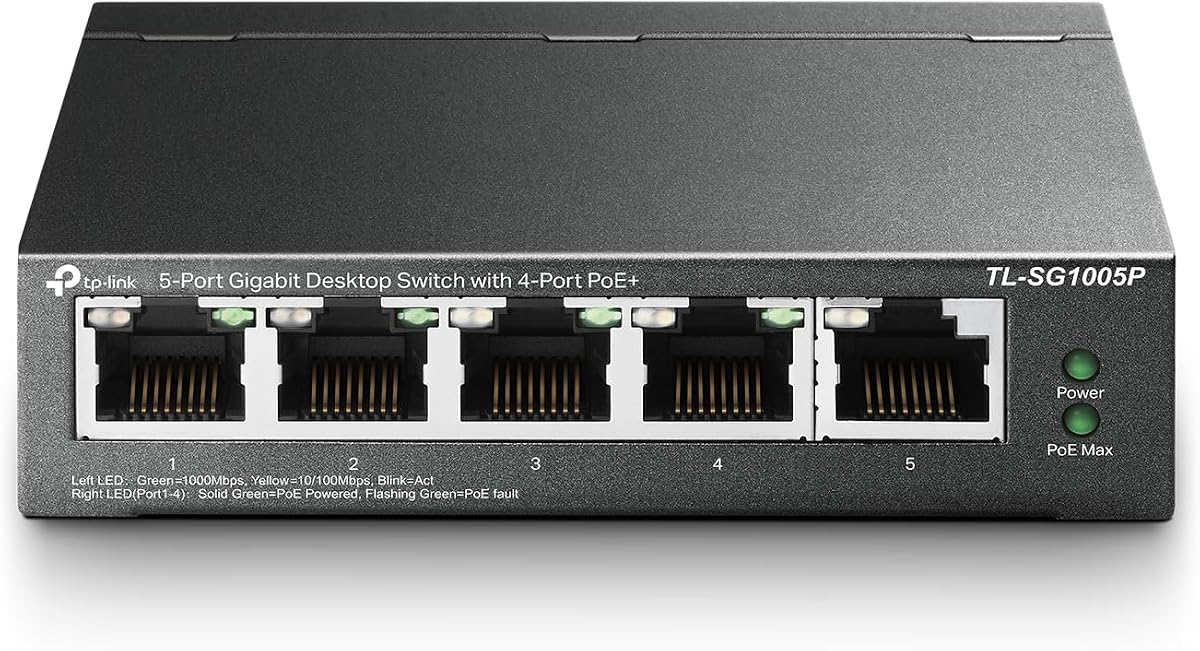
The TP-Link TL-SG1005P is a compact gigabit switch designed for deployments that need Power over Ethernet without pulling in a larger PoE chassis. It carries a 4.7 rating and includes four PoE+ ports capable of supplying up to 30 watts per port, with a total PoE budget of 65 watts. A fifth gigabit port provides a non-PoE connection for a router, access point, or other upstream device.
We may earn a commission when you buy through this link, at no additional cost to you.
PoE can simplify an Xfinity home network by supplying power and data over one Ethernet cable to compatible access points, surveillance cameras, VoIP phones, and other networked devices. Port-based 802.1p/DSCP QoS helps protect the quality of video and voice traffic, and IGMP Snooping is included for multicast management. Installation remains plug-and-play, with no software installation or configuration required.
The limitations are important. You cannot power every kind of device through the PoE ports; the attached equipment must support the relevant PoE standard, and the combined power draw must remain within the 65-watt budget. There is also only one non-PoE port, which can be a limitation if an upstream connection plus several ordinary Ethernet devices need dedicated uplink capacity.
Despite those constraints, the TL-SG1005P is a strong option for a focused home or office installation where a few PoE peripherals must be connected to an existing wired network. Its fanless metal housing supports quiet use, and the desktop or wall-mount design makes placement straightforward. The combination of PoE, traffic prioritization, and simple operation makes it more specialized and more useful than a basic five-port gigabit switch when powered endpoints are involved.
Four PoE+ ports simplify deployment for compatible access points, cameras, and phones, while a 65-watt total budget provides a defined limit for connected powered equipment.
Port-based QoS and IGMP Snooping make the switch more useful for streaming, voice, and multicast traffic while retaining a simple plug-and-play configuration.
We may earn a commission when you buy through this link, at no additional cost to you.
The TP-Link TL-SG108S-M2 combines eight multi-gig ports with the highest rating in this guide at 4.8. Every port supports 100Mbps, 1Gbps, or 2.5Gbps, and the device provides up to 40Gbps of switching capacity. That combination makes it a particularly strong option for a larger Xfinity home or small office that wants several fast Ethernet connections without a large managed interface.
We may earn a commission when you buy through this link, at no additional cost to you.
Auto-negotiation allows the switch to work with both current and future equipment. A 2.5G Wi-Fi 6 access point, network-attached storage, server, gaming computer, or PCIe adapter can use the full 2.5G link, while conventional gigabit and 100Mbps devices connect at their supported speeds. The eight-port format also offers enough capacity for entertainment, work, and smart-home devices without forcing an immediate move to a larger chassis.
As an unmanaged switch, it does not provide VLAN configuration, port-level traffic dashboards, or scheduled policies through a graphical interface. It also cannot create 2.5G performance where the connected endpoint, router, access point, and Ethernet cables do not support it. Those are not problems for a single trusted LAN, but they are worth considering in shared offices or complex household networks.
The TL-SG108S-M2 is a strong recommendation for users who want broad 2.5G coverage in a quiet, straightforward package. Its fanless construction suits living spaces and work areas, while 40Gbps of switching capacity is appropriate for demanding local transfers, large media libraries, and high-performance access points. Among unmanaged multi-gig switches in this selection, its combination of port count, rating, and speed stands out.
Eight flexible ports let an entire home or compact office use 2.5G where supported while retaining compatibility with slower wired equipment.
The 40Gbps switching capacity supports demanding combinations of workstations, storage, entertainment, and access points while the fanless chassis keeps noise low.
We may earn a commission when you buy through this link, at no additional cost to you.
The TP-Link TL-SG116 is built for dense wired networks, offering 16 gigabit RJ45 ports in a desktop or wall-mountable fanless design. Its 4.7 rating reflects a well-regarded model, and the large port count makes it relevant to Xfinity users who need many devices connected through one compact switch rather than a chain of smaller units.
We may earn a commission when you buy through this link, at no additional cost to you.
Every port supports 10/100/1000Mbps and uses auto-negotiation and Auto MDI/MDIX, allowing modern and older equipment to connect without manual crossover-cable concerns. IEEE 802.3x flow control supports dependable data transfer, while port-based 802.1p/DSCP QoS and IGMP Snooping add traffic prioritization and multicast handling. Energy-efficient technology is intended to expand capacity while limiting unnecessary power use.
The main limitation is speed. Although 16 gigabit ports sound impressive, the TL-SG116 does not offer 2.5G, 5G, or 10G links. A household with several multi-gig workstations or a high-speed NAS may eventually exceed the practical benefit of this model. Its larger chassis also requires more space than a five- or eight-port switch, and the unmanaged format still does not provide VLAN or per-port monitoring controls.
Choose the TL-SG116 when the priority is abundant, reliable gigabit connectivity rather than multi-gig performance. It suits large homes, shared workrooms, game areas, media rooms, and small offices with many wired endpoints. The operating-temperature range of 32 to 104 degrees Fahrenheit also broadens the environments in which it can be deployed. For a high-density, straightforward switch, it delivers substantial port capacity and useful traffic features.
Sixteen ports let one device serve many computers, displays, consoles, and access points, reducing the need to stack several small unmanaged switches.
A fanless desktop or wall-mount design and a broad stated operating range make the model suitable for home, office, and utility-space deployment.
We may earn a commission when you buy through this link, at no additional cost to you.
The Ubiquiti 8-Port PoE Network Switch is an eight-port Layer 2 PoE model with a 4.6 rating. Its core appeal is the combination of silent fanless cooling and integrated power delivery in a network where compatible endpoints need both data and electrical power. It is a specialized choice, but one that can be useful for access points, cameras, and other PoE devices connected to an Xfinity-based home or office network.
We may earn a commission when you buy through this link, at no additional cost to you.
The included external 60-watt power adapter supplies 52 watts of total PoE capacity. That figure is the key specification to evaluate because it determines how many supported powered devices can be connected at once and what kind of PoE loads the installation can handle. Port-level and individual power requirements are not provided in the supplied product data, so compatibility should be confirmed before purchasing multiple devices.
Compared with a fully described unmanaged or easy-managed model, this listing offers less information about link speeds, VLAN capabilities, QoS, and physical mounting options. That makes it harder to compare with the other switches in this guide. Its Layer 2 designation indicates network switching functionality, but the available information does not support claims about specific managed features. Buyers should therefore review the complete product documentation and confirm the required network functions.
This switch makes most sense for an installation already centered on Ubiquiti equipment or a clearly identified need for eight PoE connections within a 52-watt budget. Its fanless operation is valuable in quiet areas, and consolidating powered devices onto one switch can simplify cabling. For users seeking more transparent port speeds or management features, one of the better-documented alternatives may be easier to evaluate, but for a compatible Layer 2 PoE environment, Ubiquiti remains a credible choice.
Eight PoE ports can reduce separate power requirements for compatible devices, helping simplify cable routing in access-point, camera, or voice-oriented installations.
Fanless cooling supports silent operation, while the external 60-watt adapter provides a clearly defined source for the switch's 52-watt PoE capacity.
We may earn a commission when you buy through this link, at no additional cost to you.
The NETGEAR GS308EP is an eight-port gigabit Easy Smart Managed switch with a 4.8 rating. It occupies a practical middle ground between basic unmanaged hardware and a more complex enterprise system: all eight Ethernet ports are gigabit, all eight support PoE+, and an intuitive software interface adds VLANs, QoS, port monitoring, and network-security controls.
We may earn a commission when you buy through this link, at no additional cost to you.
Its PoE budget totals 62 watts, while uninterrupted PoE and per-port PoE controls provide better delivery management than a simple always-on PoE switch. The auto-negotiating ports work with existing Cat5e or Cat6 cabling, which helps when an Xfinity home already has suitable Ethernet runs. A compact fanless metal chassis can sit on a desk or be mounted on a wall, and IEEE 802.3az Energy Efficient Ethernet reduces power use during lighter operation.
This is not an enterprise feature set, and the 62-watt total is less than the TL-SG1005P's stated 65-watt budget even though the NETGEAR offers more PoE ports. That means the total power available must be spread across eight ports rather than four, and the network must be evaluated carefully if it includes many high-power devices. A managed interface also involves more deliberate configuration than an unmanaged switch.
The GS308EP is a strong recommendation for a small business, home office, or sophisticated household that wants network segmentation and visibility without a large managed chassis. It is particularly helpful when devices need to be grouped into VLANs or when voice, video, and general data should receive different priorities. For users who only need basic wired expansion, the management capability may be unnecessary; for those who want control, it is the key benefit.
VLAN support, QoS, port monitoring, and security configuration make it easier to organize devices and prioritize important traffic as a home or office network grows.
Eight PoE+ ports simplify the addition of powered equipment, while per-port controls and uninterrupted PoE delivery provide more administrative flexibility.
We may earn a commission when you buy through this link, at no additional cost to you.
The D-Link 5-Port 2.5G Unmanaged Ethernet Switch has a 4.7 rating and a strong focus on high-performance home and small-office traffic. Its five ports each support 2.5Gbps, with auto-negotiation accommodating 100Mbps, 1Gbps, and 2.5Gbps devices. The switch provides 25Gbps of switching capacity, making it a natural match for a 2.5G Wi-Fi 6 access point, NAS, server, gaming computer, IPTV setup, or 8K media workflow.
We may earn a commission when you buy through this link, at no additional cost to you.
Unlike some basic unmanaged models, the D-Link includes a QoS feature that classifies traffic into eight priority levels. Flow Control helps minimize dropped packets, while IGMP Snooping optimizes multicast streams for bandwidth-intensive uses. These functions are particularly relevant when the Xfinity gateway is connected to a separate high-speed access point and several local devices exchange media or other large files.
The five-port limit means this is not the best choice for a household expecting numerous wired endpoints, and the unmanaged format does not provide VLAN creation or graphical port monitoring. Although the supplied data notes backward compatibility with Cat5 and Cat6 cables, actual multi-gig performance still depends on cable quality, length, and the capabilities of every connected endpoint. A device with only a gigabit port will not gain a faster link simply because the switch supports 2.5G.
Overall, the D-Link is an appealing option for users who want faster Ethernet plus meaningful traffic handling without managing a full switch interface. It is particularly useful in media, gaming, and compact work environments where traffic priority matters. Its quiet metal housing, Energy Efficient Ethernet support, plug-and-play setup, and per-port link indicators add practical value, making it one of the more complete compact multi-gig choices in the guide.
Eight QoS priority levels, flow control, and IGMP Snooping help the five-port switch handle streaming, multicast, and other local traffic with greater awareness than a bare hub.
Auto-negotiation supports three link speeds and works with Cat5 or Cat6 cabling, although connected devices must support 2.5G to realize the highest throughput.
We may earn a commission when you buy through this link, at no additional cost to you.
The QNAP QSW-L3208-2C6T-US is the most advanced network switch in this guide, carrying a 4.0 rating while providing a distinctly high-end connection platform. It includes six 10GbE RJ45 ports and two combo SFP+/RJ-45 ports for fiber or copper connections. Those links support 10G, 5G, 2.5G, 1G, and 100M, giving the switch unusual flexibility for a home lab, creative office, or small enterprise edge.
We may earn a commission when you buy through this link, at no additional cost to you.
Lite-managed controls include VLAN, QoS, LACP, IGMP Snooping, and loop detection, providing a more structured network than an unmanaged device. Switching capacity is rated at 160Gbps, with non-blocking throughput of 80Gbps. Support for 12K jumbo frames can improve efficiency when moving large files, and a durable metal enclosure with smart cooling suits more demanding installation environments.
The complexity and feature set are not appropriate for every Xfinity household. A basic consumer may have no need for fiber uplinks, link aggregation, loop detection, or 10G copper, while the management interface demands a basic understanding of VLANs and traffic policy. A 4.0 rating also trails the field, though rating alone does not capture the model's broader capability. Installation should account for suitable switches, cables, and endpoints that can benefit from the available bandwidth.
This QNAP model is a compelling choice for a power user who wants an Xfinity connection feeding a sophisticated local network rather than simply adding basic Ethernet ports. It is well suited to high-speed NAS systems, workstations, media infrastructure, and small offices that need 10G connectivity or fiber flexibility. For ordinary home expansion, a five- or eight-port gigabit or 2.5G model is simpler; for advanced multi-speed networking, this is the guide's strongest premium option.
Six 10GbE RJ45 ports serve compatible wired devices, while two combo SFP+/RJ-45 ports allow fiber or copper choices for flexible network design.
VLAN, QoS, LACP, IGMP Snooping, and loop detection provide the tools needed to organize traffic, improve resilience, and manage a more advanced local network.
We may earn a commission when you buy through this link, at no additional cost to you.
Choose an Xfinity-compatible network switch by matching port count and link speed to your wired devices, then considering PoE, management, cooling, and installation needs.
Start by identifying how the switch will connect to your Xfinity equipment. The switch itself does not replace a compatible router or gateway; it adds Ethernet ports and may provide a central wired backbone. A basic five-port gigabit model is appropriate when the gateway or a separate router already offers the required wired connection and your goal is simply to connect more devices. Multi-gig switches are more useful when the upstream router, access point, or gateway also supports the faster link you want to use.
Match the switch to the speed available upstream. A 2.5G switch cannot make a 1G connection faster, and 10G connectivity requires compatible devices and cabling throughout the relevant path.
List every device you expect to connect by Ethernet, including computers, televisions, game consoles, printers, access points, cameras, and game systems. Leave at least one port open for reasonable expansion unless your layout includes a second switch. Five-port models work well for a small network, while eight ports offer more flexibility in a busy home. A 16-port model is most appropriate for dense deployments where replacing it with several smaller switches would be inconvenient.
Choose a port count based on realistic present and near-term needs. A switch with several unused ports is usually preferable to stacking additional units later, although it does not provide the same management visibility as a larger controlled system.
Gigabit Ethernet remains the practical baseline for ordinary web browsing, streaming, downloads, and most gaming activity. A 2.5GbE switch is worthwhile for fast local storage transfers, high-resolution media, a compatible Wi-Fi 6 access point, and busy home offices. Models with 5G, 10G, and fiber options serve more specialized networks where workstation-to-NAS performance, large file transfers, or infrastructure upgrades justify the added complexity.
Use the fastest common denominator among your key devices. A mixed-speed network can still benefit from 2.5G, but every endpoint on a fast segment must support that speed to realize the improvement.
Power over Ethernet supplies electricity and network data through one cable to compatible devices such as access points, cameras, and VoIP phones. It is particularly helpful when installing powered equipment in locations where a nearby outlet is inconvenient. The four-port TP-Link model provides a 65-watt total budget, while the eight-port NETGEAR and Ubiquiti options offer different capacity and management characteristics.
Do not choose a PoE switch unless you have compatible powered devices. Check each endpoint's power requirement and the switch's total budget before purchase. Ordinary computers, televisions, and many routers still need conventional power connections.
An unmanaged switch is generally simpler: connect the cables and let the hardware handle traffic. It is appropriate for one trusted home LAN where every device can communicate freely. Easy Smart and lite-managed models add VLANs, QoS, port monitoring, link aggregation, or loop detection. Those controls help separate devices, prioritize applications, and troubleshoot network behavior, but they also call for more deliberate configuration.
Begin with an unmanaged model if you want minimal maintenance and do not need traffic segmentation. Choose a managed model when privacy, voice quality, IPTV behavior, or a growing number of connected systems makes precise control important.
QoS can prioritize latency-sensitive voice or video traffic over less urgent transfers, while IGMP Snooping helps control multicast data associated with streaming and discovery protocols. These features do not turn a gigabit port into a multi-gig port, but they can make shared links behave more predictably. They are especially relevant when several devices use the same local network for calls, gaming, media, and large downloads at once.
Prioritize models with clear QoS and multicast support when media traffic is central to your setup. For basic file sharing and internet access, the simpler processing in an unmanaged switch is usually adequate.
Most compact switches in this guide use fanless metal housings, which reduce noise and suit bedrooms, living rooms, and offices. A larger 16-port model needs more physical space, while managed and multi-speed models may use more sophisticated cooling. Desktop placement is the simplest option, but several models support wall mounting, making it easier to position the switch near cable routes or an access point.
Choose a design that fits the intended location and allows cables to be connected without strain. Avoid placing a network switch in an enclosed, poorly ventilated space unless the manufacturer permits it.
The switch does not change the capabilities of the devices attached to it. A gigabit endpoint remains limited to gigabit, and a 2.5G device needs a 2.5G switch, compatible network equipment, and a suitable cable. Most switches support auto-negotiation, so mixed-speed devices can connect, but advanced speed combinations may depend on cable category, length, and the behavior of the upstream equipment.
Review the specifications of every important device before buying. Confirm port speed, PoE compatibility, and cable requirements, especially when building a new installation around Wi-Fi 6 access points, NAS systems, servers, or 10G equipment.
Begin by identifying the correct network role for the switch. Connect the appropriate upstream Ethernet port to your Xfinity gateway, router, or network access point, and connect each intended endpoint to an available LAN port. If the upstream device has only one suitable Ethernet port, use the switch to create a larger wired LAN. If the equipment includes a dedicated uplink or PoE port, use that according to the device documentation rather than treating every port as identical.
Power on the switch and allow its auto-negotiation process to establish link speeds. Check the port indicators to confirm that each cable is recognized, then test the important devices with a local file transfer, streaming service, internet connection, and voice or video call. Keep one or more ports open for expansion, and avoid repeatedly changing cables on a working network unless troubleshooting requires it. For a managed model, configure VLAN membership, QoS priorities, and any link aggregation before moving critical equipment into service.
For maintenance, keep the switch in a dry, ventilated location and protect the power adapter and cables from strain, moisture, and excessive heat. Clean the exterior with a dry or lightly damp cloth after disconnecting power, but do not spray liquid directly into vents or ports. Periodically inspect link indicators, check switch health through the management interface when available, and update management software or firmware according to the manufacturer's instructions. Replace only cables or accessories with compatible equipment to avoid damaging the ports.
A network switch is useful if your Xfinity gateway or router does not have enough Ethernet ports for the devices you want to connect. It can also make a wired network easier to expand by providing more LAN connections in one place. If only one or two devices need Ethernet and your equipment already provides those ports, a separate switch may not be necessary.
A switch does not increase the internet speed delivered by your Xfinity service. It can improve performance on the local network by reducing Wi-Fi dependence, providing full-speed wired connections, and supporting faster local transfers. The actual internet result still depends on your plan, gateway, router, cables, and the speeds of connected devices.
Gigabit Ethernet is generally sufficient for common household activities such as streaming, browsing, downloads, and online gaming. It can become limiting for very fast NAS transfers, high-resolution media workflows, and networks with a 2.5G or 10G access point. In those situations, a multi-gig switch can prevent the local network from becoming the bottleneck.
An unmanaged switch is configured by connecting cables and generally offers little or no software control. A managed switch provides features such as VLANs, QoS, port monitoring, link aggregation, or loop detection. An unmanaged model is easier for a simple home network, while a managed model is more useful for isolating devices, prioritizing traffic, and controlling a growing network.
You need PoE only when you want to power compatible network devices through Ethernet cables. Wi-Fi access points, network cameras, and some VoIP phones may support PoE, while computers, televisions, and many routers do not. If none of your devices use PoE, spending attention on port count and link speed is more appropriate.
It is possible to connect the gateway to a switch, but the result depends on the gateway's networking modes and the number of Ethernet ports it provides. Many users place a compatible router or access point between the gateway and the switch so the switch handles LAN connections. Follow the gateway documentation and confirm the intended network topology before making changes.
Yes. The multi-gig switches in this guide use auto-negotiation to support 100Mbps, 1Gbps, and 2.5Gbps links as appropriate. A gigabit device will connect at its supported speed, while a 2.5G device can use the faster link when the rest of its connection path—including the router, access point, and cable—also supports it.
Place it near the devices or cable concentration point so Ethernet runs remain short and manageable, while ensuring access to power and ventilation. A central media cabinet may work well for a home office or entertainment area. Wall mounting can help when a shelf is crowded, but the switch should not be enclosed in a space that traps heat.
The TP-Link TL-SG105 stands out as the best budget option for straightforward expansion with five gigabit ports, a fanless metal enclosure, and useful traffic features. The TP-Link TL-SG105S-M2 is the editor's choice for buyers who want a more future-facing five-port design with 2.5G links. For advanced networks, the QNAP QSW-L3208-2C6T-US provides 10GbE copper, fiber flexibility, and lite-managed controls.
Prioritize compatibility before features. Count the wired devices, determine whether they need more than one gigabit, and check whether any endpoints require PoE. If the network is a single trusted home LAN, an unmanaged switch will usually be easiest to live with. If VLANs, traffic prioritization, monitoring, or resilience are important, choose a managed or Easy Smart model with a documented interface.
Finally, confirm current product details, ratings, and availability before ordering, because marketplace feedback and product offerings can change. A switch can make an Xfinity-connected home much more flexible, but the best choice is the one whose port count, speed, power options, and management features fit the equipment you actually own.