
Bingfu 27MHz Magnetic Base Antenna
4.4Editor score
27 MHz CB operation
Thirty-watt maximum input
Thirteen-inch antenna height
Includes 10-foot RG58 cable
Provides BNC-to-SO239 adapter
Our Mobile CB Antenna for Dx guide compares ten magnetic, whip, and truck antennas for range, power handling, tuning, and easy installation.
A mobile CB antenna for Dx communication must balance antenna height, bandwidth, mounting security, connector compatibility, and the ground plane beneath the vehicle. A longer whip can improve the available signal, but height alone does not guarantee better performance. Installation position, cable routing, nearby structures, and radio matching all influence the result.
We compared the ten antennas in this guide using their published specifications, including supported frequency ranges, power ratings, impedance, SWR claims, antenna height, connector type, mounting method, and supplied accessories. The list covers magnetic-base antennas, high-power mobile whips, telescopic models, and a vibration-resistant fiberglass truck antenna.
Each review explains the product's most useful characteristics, practical trade-offs, and ideal installation environment. The three highlighted picks emphasize strong specifications for different priorities, while the complete comparison shows how shorter, taller, fixed, telescopic, and specialized designs fit different mobile CB setups. Prices and availability can change.
4.4Editor score

4.6Editor score

4.7Editor score
The comparison highlights frequency coverage, mounting style, antenna dimensions, power capability, and connector arrangements so Dx operators can identify the most suitable design before installing it on a vehicle.


The Nagoya CB-72 is a complete mobile installation kit designed for 26–28 MHz CB operation, and it holds a 4.2 rating among buyers. Its main appeal is the combination of a 28-inch whip, an 18-foot RG-58A/U coax run, and a heavy-duty magnetic base. That package gives operators more placement flexibility than a short antenna and permanently mounted cable assembly.
We may earn a commission when you buy through this link, at no additional cost to you.
The stated 50-ohm impedance and VSWR of no more than 1.5 under appropriate installation conditions make the CB-72 a sensible conventional CB antenna rather than a general-purpose wideband whip. The PL-259 termination fits mobile radios with a matching SO-239 antenna jack. An Allen wrench is included for assembly, and the generous cable length allows the magnetic base to be placed away from the radio.
The important limitation is the mounting surface. The base requires clean, flat ferrous steel and will not attach to aluminum, fiberglass, glass, plastic, or composite panels. The antenna also lacks a direct SMA connection for handheld radios, and no SMA adapter is included. Installation position can materially change the ground-plane relationship, so the published VSWR figure should not be treated as guaranteed in every location.
This antenna is best for a driver who wants a complete, conventional CB installation without separately sourcing a mount and long coax lead. It suits pickup trucks, metal-bodied cars, SUVs, and other vehicles with a suitable mounting area. For users with composite bodywork or handhelds requiring SMA, a more specialized mounting solution or connector arrangement will be easier.
The 18-foot RG-58A/U lead gives operators room to find a stronger metal mounting surface and keep the radio away from the antenna base. Routing should still avoid sharp bends, pinched sections, and parallel paths with noisy vehicle wiring.
With a PL-259 plug, 50-ohm impedance, and stated 26–28 MHz coverage, the CB-72 is intended for mobile radios using SO-239 antenna ports. It is better suited to dedicated CB equipment than to a handheld radio needing an SMA lead.
We may earn a commission when you buy through this link, at no additional cost to you.
The Bingfu 27MHz Magnetic Base Antenna earns a 4.4 rating and offers one of the most approachable installations in this group. Its 13-inch whip, portable magnetic base, and 10-foot RG58/U cable make it practical for operators who want a straightforward mobile setup without a tall, permanently mounted antenna. It is particularly relevant to lower-power CB installations.
We may earn a commission when you buy through this link, at no additional cost to you.
Published specifications list a 27 MHz working frequency, a maximum input power of 30 watts, 50-ohm operation, and 10 feet of RG58/U coaxial cable. The antenna weighs approximately 480 grams. It uses a PL-259 male connection and includes a BNC male-to-SO-239 female adapter, expanding the radio options when the appropriate matching connector is used.
Compatibility is one of its strongest selling points. The listed antenna is intended for many Cobra, Midland, Uniden, Maxon, and President mobile or handheld CB radios, although the radio's actual connector still has to match. The included adapter is valuable for installations with a BNC-equipped radio, while a radio with a PL-259 or SO-239 connection can follow the appropriate included path.
The tradeoff is antenna height and the 30-watt limit. A 13-inch whip is easier to clear under bridges, in garages, and on crowded truck routes than a tall fixed whip, but it may not provide the same potential radio horizon as a larger mobile antenna. It is best for travelers, backup vehicles, and standard-power mobile users who value simple magnetic mounting and broad radio compatibility.
The supplied adapter allows the antenna to be used with a BNC-equipped radio while retaining a PL-259 antenna-side connection. Verify the radio's connector before installation so the correct cable and adapter path is used.
At 13 inches, the whip is compact enough for frequent removal and storage. The magnetic base can move among a roof, hood, or trunk when the vehicle has a suitable metal surface.
We may earn a commission when you buy through this link, at no additional cost to you.
The Radioddity CB-101 stands out with a 4.6 rating by combining CB and 10-meter frequency coverage in an adjustable mobile whip. Its stated range of 26–30 MHz covers the standard 27 MHz CB band as well as 10-meter amateur frequencies, making it useful for operators whose radio equipment serves more than one communications role.
We may earn a commission when you buy through this link, at no additional cost to you.
The two-piece whip extends from 23 to 30 inches, allowing the user to select a height that fits the vehicle and surrounding environment. Its listed specifications include 50-ohm impedance, a rated VSWR of 1.5:1 or better, and power handling up to 500 watts. The standard PL-259 connector makes it compatible with M916 and RAM5 bases as well as suitable Radioddity, Cobra, Midland, and Uniden mobile radios.
This is a whip rather than a complete magnetic-base kit. The base, coax, and radio must be supplied separately, and the final system depends heavily on those components. A low-loss coax run, secure ground connection, and correct base selection are still essential. The 500-watt figure is a peak-power capability, so the radio's output and installation should remain within reasonable limits.
The CB-101 is an excellent recommendation for someone who wants a single telescopic antenna to serve both CB and 10-meter mobile operation. It is also attractive for highway travel, field kits, off-road use, and low-clearance storage. Choose it when flexibility matters more than having every mounting part in one box.
The 26–30 MHz coverage lets the same whip support 27 MHz CB and 10-meter operation. That makes the antenna more versatile when a compatible radio can change frequency or band.
The 23–30-inch extension lets operators balance signal potential against clearance. Retracting the whip is useful for garages and tight parking areas, while extension may help when a taller mounting location is available.
We may earn a commission when you buy through this link, at no additional cost to you.
The Wilson 880-300100B Little Wil combines a relatively compact magnetic base with a 36-inch stainless-steel whip and earns a 4.6 rating. It is designed for operators who want a full 300-watt mobile antenna without moving to an especially tall 62-inch whip. The kit is packed in a box and is centered on efficient base-loaded performance.
We may earn a commission when you buy through this link, at no additional cost to you.
Its large 10-ounce magnet provides meaningful holding force for a mobile installation, which is especially useful when a robust mechanical mount is not desirable. The heavy-duty coil uses 14-gauge copper wire and a low-loss coil design. The 36-inch 17-7 PH stainless-steel whip offers a practical compromise between useful height and manageable clearance.
The stated 300-watt ICAS power handling capability is a major strength for higher-powered mobile radios. Unlike very small whip assemblies, this kit does not present itself as a limited-power accessory. It is also made with high-impact thermoplastic, which suits the repeated handling and temperature exposure associated with vehicle-mounted equipment.
The best fit is a user who values a strong magnetic base, moderate whip length, and established mobile-kit format. It may be less attractive than a telescopic model for frequent garage storage, and it is not positioned as a broad-band CB-and-10-meter antenna. For a conventional CB installation with a metal mounting surface, however, the Little Wil is a balanced and sturdy choice.
A large magnet helps keep the base secure while reducing the need for a permanent bracket. Drivers should still inspect attachment points regularly because road vibration, dirt, and movement can reduce magnetic contact over time.
The low-loss coil and 14-gauge copper winding provide the loading function in a compact assembly. This approach supports mobile use while avoiding the footprint of a much taller full-length whip.
We may earn a commission when you buy through this link, at no additional cost to you.
The Eifagur 27MHz Soft Whip is the most compact antenna in this comparison, with a listed height of 9.9 inches and a 3.9 rating. Its low profile suits operators who want a magnetic CB antenna without adding much height to a vehicle, particularly around parking structures, wooded routes, or high-clearance restrictions.
We may earn a commission when you buy through this link, at no additional cost to you.
The antenna covers 26–28 MHz, is centered at 27 MHz, and is specified at 50 ohms with a VSWR of 1.2:1. Maximum RF power is 30 watts. It comes with 10 feet of RG-58U coax, a BNC male antenna connector, and a BNC female-to-UHF PL-259 adapter. The published specification also states that no tuning is required.
A listed 1.2:1 VSWR is attractive on paper, although actual performance still depends on the location and the surrounding vehicle structure. Low-profile antennas can be especially sensitive to placement because they have less vertical separation from the vehicle body. The mount should be placed on a broad, clean metal panel with the supplied cable routed without sharp bends.
Compatibility is broad, with the listing naming numerous Cobra, Midland, and Uniden mobile and handheld models as well as other radios using a suitable BNC connection. This makes the Eifagur attractive for a mixed radio setup, but its 30-watt ceiling limits it to lower-power equipment. It is best for convenience, low clearance, and standard-power communications rather than maximum reach.
The 9.9-inch whip is the shortest listed in the guide and is intended to reduce clearance concerns. Its compact form is useful for routes with low bridges, dense traffic, or frequent garage entry.
The included adapter and long list of supported radio models make this a practical option for mixed equipment. Always confirm the radio connector and transmit power before final installation.
We may earn a commission when you buy through this link, at no additional cost to you.
The Wilson 880-200152B 5000 Series is built around a 62-inch whip, making it the tallest antenna in this guide. Its 3.8 rating reflects the trade-off inherent in a high-profile mobile antenna: substantial vertical reach is available, but installation requires more clearance and planning than a short magnetic whip.
We may earn a commission when you buy through this link, at no additional cost to you.
The supplied information identifies a 5000W power capability, a 17-7 stainless-steel whip, and a high-impact thermoplastic magnet-mount body. The product is also described as weather channel ready. These characteristics make it a candidate for high-power mobile installations where the operator prioritizes antenna height and power capacity over a compact profile.
A whip of this length can improve the radio's relationship to the surrounding ground plane and create a more favorable vertical profile than a low-profile antenna. However, no detailed VSWR or impedance figures are included in the supplied data, so it is not possible to compare its tuning specification directly with the models that publish 1.2 or 1.5 ratios. A proper SWR check remains essential.
The best use case is a truck, large SUV, or dedicated communication vehicle where clearance is rarely an issue and the antenna can be mounted securely. Operators traveling frequently beneath low structures may find it inconvenient. Its high power capability and long whip make it a specialist alternative rather than the most universally convenient choice in the group.
A 62-inch whip places the antenna well above many magnetic installations. That additional height can benefit operators who have a large vehicle, an unobstructed mounting position, and few low-clearance routes.
The stated 5000W capability is aimed at demanding mobile installations. Actual results depend on the radio output, feed line, mounting point, and antenna tuning, all of which should be verified together.
We may earn a commission when you buy through this link, at no additional cost to you.
The Sirio Turbo 5000 PL combines CB and 10-meter use with an unusually broad published bandwidth. It carries a 4.5 rating and lists a frequency range from 27 to 28.5 MHz, 50-ohm impedance, and vertical linear polarization. For Dx operators who work across the upper CB and adjacent amateur bands, that range provides more flexibility than a narrowly tuned 27 MHz antenna.
We may earn a commission when you buy through this link, at no additional cost to you.
SWR at the resonant frequency is listed at no more than 1.2, while the usable bandwidth at SWR of 2 or less is given as at least 2,000 kHz, or approximately 200 channels. Those are useful figures for comparing frequency flexibility with the other products. A 10-foot RG58/U cable and PL-259 connector are included, providing a conventional connection for compatible mobile radios.
Power handling is specified at 1,500 watts continuous for CW and 5,000 watts for short-term CW use. That distinction matters: sustained high-power operation should remain within the continuous rating. A high rating does not eliminate the need for a sound ground, efficient coax, correct impedance matching, and an SWR check after mounting.
This antenna is well suited to operators who need broad coverage and recognize that the mounting platform and surroundings influence real-world results. The US-shipping restriction is a significant limitation for international buyers. For eligible users, it is one of the strongest specifications in the guide for multi-channel and multi-band mobile reception.
The stated 2,000 kHz bandwidth at SWR of 2 or less gives the antenna room across many channels and portions of the 27–28.5 MHz range. This is advantageous for Dx monitoring across a wide selection of frequencies.
The 1,500-watt continuous figure is the more relevant specification for sustained transmitting. The 5,000-watt figure applies only to short-term CW use and should not be treated as a constant operating limit.
We may earn a commission when you buy through this link, at no additional cost to you.
The Bingfu Fiberglass Truck Antenna focuses on mechanical durability, with a fiberglass pole and stainless-steel spring designed to absorb vibration and shock. Its 2.9 rating is the lowest in the comparison, but the available information presents it as a specialized truck installation rather than a conventional short magnetic-base antenna. That distinction is important when judging the product.
We may earn a commission when you buy through this link, at no additional cost to you.
The package includes a 13.1-foot RG58 extension cable with a PL-259 connector and a BNC adapter. The 180-degree adjustable antenna pole allows the operator to change the antenna's orientation after mounting, potentially helping fine-tune its relationship to the vehicle. The long cable also provides flexibility in selecting a mounting location without routing the radio's own cable over a long distance.
The listing names a broad collection of Galaxy, Uniden, Bearcat, Cobra, Radioddity, Texas Ranger, and RoadKing mobile radios as compatible. Physical connector fit and appropriate radio power should still be confirmed. Unlike several better-documented products in the group, the supplied information does not provide a clear impedance, VSWR, operating-frequency range, or maximum-power figure, so comparisons on RF performance should remain cautious.
The strongest case for this antenna is a truck, off-road vehicle, or RV exposed to constant vibration where a spring-mounted fiberglass assembly is preferred. Users who need a clearly stated SWR, impedance, and power rating may prefer a more fully specified model. It remains a relevant option for durability-focused installations, but careful radio and connector compatibility checks are essential.
The fiberglass pole and stainless-steel spring are intended to reduce the effect of road shock and vibration. This design is especially relevant to trucks and off-road vehicles that spend long periods at highway speed.
The 180-degree pole adjustment gives the installer another tuning variable after the base is fixed. Combined with the 13.1-foot extension, it helps place the antenna on a strong metal surface while adjusting its final orientation.
We may earn a commission when you buy through this link, at no additional cost to you.
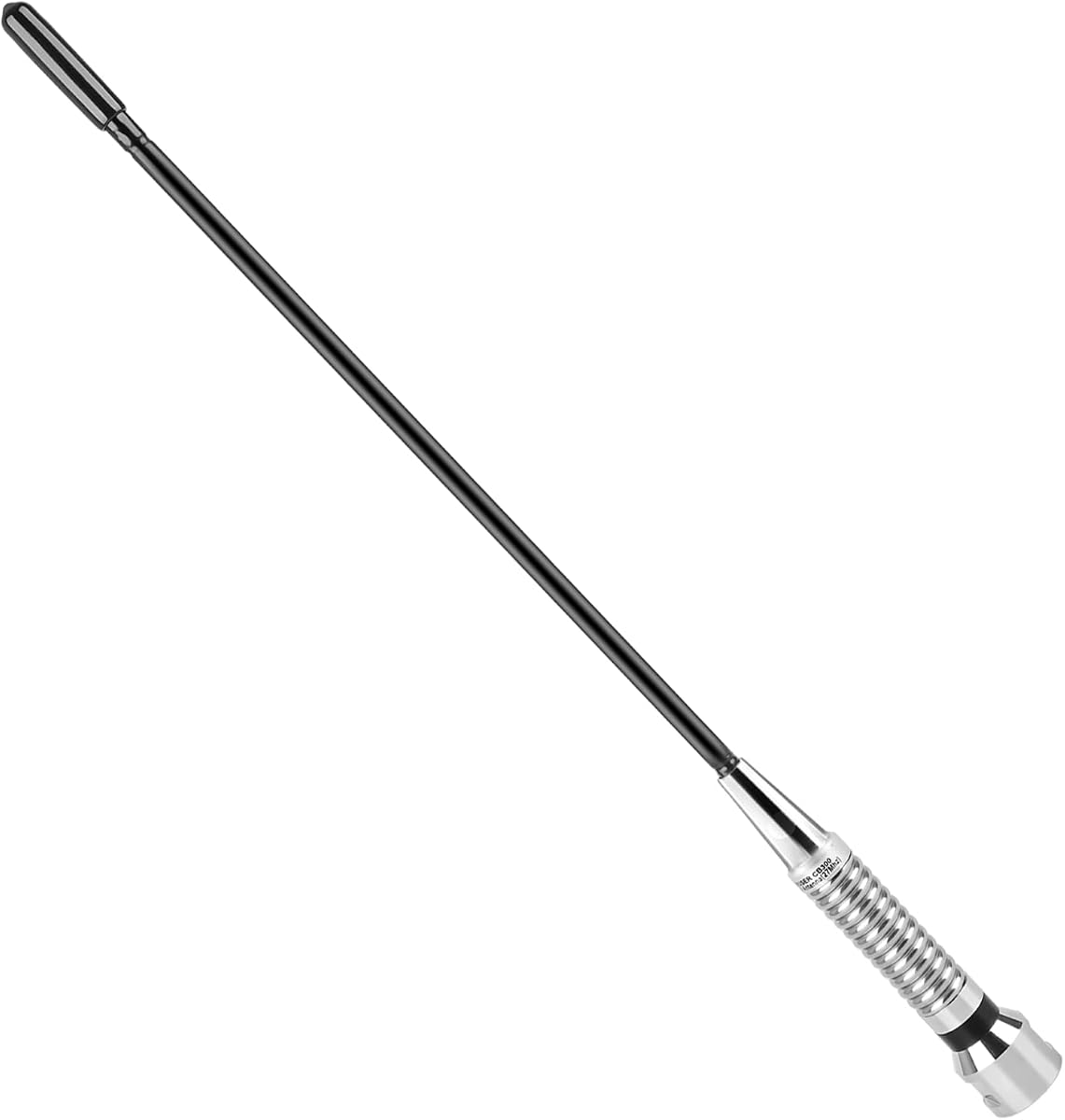
The FMUSER CB300 is a 16.5-inch whip designed primarily for truck installations, with a 4.3 rating. Its defining feature is adjustable tuning, allowing the operator to optimize VSWR for a particular channel. That is useful because antenna resonance can shift slightly across the CB band and vary with the vehicle's mounting environment.
We may earn a commission when you buy through this link, at no additional cost to you.
The whip is listed with 2.1 dBi gain and a maximum power-handling capability of 100 watts. A stainless-steel spring forms the mounting base, intended to withstand the vibration and impacts associated with rough travel. The spring design also accommodates movement between the antenna and a fixed mount more gracefully than a rigid short whip.
The supplied information does not identify a complete mounting kit, connector type, coax length, or exact frequency range. As a result, it should be treated as a whip-and-spring product rather than an all-in-one mobile antenna system. The vehicle's existing mount, feed line, radio connector, and any required adapter must be accounted for before purchase.
The CB300 is a good fit for truck and off-road operators using moderate-power CB equipment who want the ability to tune the antenna rather than accept a fixed preset. Its 16.5-inch height is practical for many routes, and the 100-watt rating suits standard mobile radio outputs. For a clearer turnkey package, one of the kits with an included base and coax may be more convenient.
Adjustable tuning lets the operator bring the antenna closer to resonance on the channel in use. This can reduce reflected power and is especially useful when a truck's body structure affects the final antenna system.
The stated 100-watt limit is appropriate for many standard mobile CB installations. It offers room above common low-power portable use without requiring the extreme power specifications listed for some other antennas.
We may earn a commission when you buy through this link, at no additional cost to you.
The Stryker SRA10 is a specialized 10-meter mirror-mount antenna with a 4.7 rating, the highest among the ten products compared. Its defining specifications are an exceptionally high stated power-handling capability of 10,000 watts, a floating waterproof enclosure rated to IPX8 and JIS8 standards, and a package weight of 1.08 pounds.
We may earn a commission when you buy through this link, at no additional cost to you.
Rather than using a conventional roof or fender whip, the SRA10 is designed for a mirror-style mounting position. That format can place the antenna lower and closer to the vehicle body than a tall roof whip. The backlit feature uses a paper-white light for daytime visibility, adding a practical detail to a permanent mobile installation.
The 10,000-watt figure represents antenna capability rather than a recommendation to transmit at that level. Real results depend on the radio output, feed line, mounting integrity, impedance match, and nearby structures. The supplied data does not state SWR, impedance, frequency limits, connector type, or included accessories, so users should confirm those details for their particular radio and mounting system.
This antenna is best for a dedicated 10-meter operator who values a polished, low-profile mirror installation, strong weather sealing, and a very high stated power ceiling. It is less directly aligned with operators who need a conventional 27 MHz CB antenna with an included magnetic base and long coax. The right choice depends on whether 10-meter capability and permanent mirror mounting outweigh a ready-to-install mobile kit.
The SRA10 is explicitly intended for 10-meter operation rather than standard 27 MHz CB use. It therefore fits a different role from the roof- and trunk-mounted CB antennas that dominate this comparison.
A floating waterproof enclosure rated to IPX8 and JIS8 supports use in wet conditions. The paper-white backlight adds daytime visibility to the mirror-mounted assembly without changing the antenna's core function.
We may earn a commission when you buy through this link, at no additional cost to you.
Choosing an effective mobile CB antenna for Dx work requires matching frequency coverage, mounting method, connector type, vehicle construction, and power handling to the installation. Height and advertised range should be considered only after those technical requirements are met.
Begin with the frequencies your radio actually uses. A conventional CB antenna may cover 26–28 MHz, while the Sirio Turbo 5000 extends from 27 to 28.5 MHz and the Radioddity CB-101 spans 26–30 MHz for both CB and 10-meter operation. Wider coverage can be valuable for Dx monitoring, but only when the radio, connector, antenna, and legal frequency plan all support it. A narrow, well-matched antenna can still outperform a poorly installed broadband model on the channels it covers.
Height affects the antenna's relationship to the vehicle and surrounding ground plane, but longer is not automatically better in every route. The guide ranges from the Eifagur Soft Whip at 9.9 inches to the Wilson 5000 Series with a 62-inch whip. Between those extremes are compact, standard, telescopic, and truck-specific designs. Operators should consider garage clearance, bridges, parking structures, tree cover, exposed roof areas, and the consequences of contacting an overhead obstacle. A retractable or telescopic antenna offers a practical way to preserve installation convenience.
Magnetic mounts are convenient because they can be removed or relocated, but they require a clean, flat ferrous-steel surface. Aluminum, fiberglass, glass, plastic, and composite panels cannot hold a conventional magnet. Fiberglass trucks often require a drilled bracket or another permanent mounting solution, while mirror-mount products are intended for a specific vehicle interface. Permanent mounts generally provide greater security but require careful sealing, cable strain relief, and corrosion prevention.
The antenna's power rating should comfortably exceed the transmitting power of the radio, while installation quality and coax losses must also be considered. The Bingfu and Eifagur antennas are listed for 30 watts, the FMUSER CB300 for 100 watts, the Wilson Little Wil for 300 watts, and the Radioddity CB-101 for 500 watts peak power. The Sirio and Stryker models list much higher figures for specialized applications. Exceeding a connector, mount, or feed-line rating can create reliability problems regardless of what the antenna itself can accept.
A 50-ohm system is the standard for the mobile CB antennas described here, and several products publish SWR figures at or below 1.5. The Sirio Turbo 5000 lists SWR of no more than 1.2 at resonance, while the Eifagur Soft Whip is specified at 1.2:1. Published figures generally depend on correct installation. Always check SWR with the antenna mounted on the intended vehicle, and adjust or relocate the installation when the reading is unsatisfactory.
The radio connector must physically match the antenna connector or adapter included with the product. PL-259 and SO-239 are common on mobile CB radios, while BNC connections appear on some portable radios and scanners. The Bingfu 27MHz antenna and Eifagur Soft Whip include adapters, as does the Bingfu fiberglass truck model. Cable length, connector type, and impedance must all be considered before installation, and the supplied lead should not be replaced with an arbitrary cable of unknown quality.
Truck and off-road antennas face continuous vibration, shock, weather, and changing mounting loads. The Bingfu fiberglass antenna uses a fiberglass pole and stainless-steel spring, while the FMUSER CB300 also incorporates a stainless-steel spring. Stainless-steel whips appear in both Wilson kits. Inspect magnetic contacts and mounting hardware regularly, keep the coax protected from abrasion, and avoid allowing road salt or moisture to remain around connectors.
A complete kit is usually the simplest route to installation. The Nagoya CB-72 includes a magnetic base, 28-inch whip, 18-foot RG-58A/U cable, PL-259 plug, and Allen wrench. Some alternatives provide only a whip or specialized assembly, requiring the installer to supply a base, coax, and connectors separately. Portable users may value a removable magnetic setup, while permanent-install operators may prefer a more permanent mirror or bracket arrangement. Compare the full package rather than focusing only on the visible whip.
Start by identifying a broad, clean ferrous-steel mounting surface for a magnetic base. Clean the area, inspect the paint, and confirm that the base sits flat and securely. Mount the base vertically where possible, attach the whip to the specified connector, and route the coax away from sharp edges, moving suspension parts, exhaust components, and electrical wiring that could create interference.
Connect the antenna to the radio using the correct PL-259, SO-239, BNC, or supplied adapter arrangement. Power the radio and check SWR before transmitting. Move the magnetic base to a different part of the metal body or adjust a telescopic whip, spring, or pole if the reading is high. Remember that opening a new location changes the ground plane and can require a fresh check.
During routine care, inspect the magnetic base, connector, whip, spring, and cable for looseness, corrosion, cracks, or abrasion. Clean the magnetic contact and use suitable hardware on permanent mounts. Replace a damaged cable rather than repairing its shield poorly, and avoid transmitting when the connector is loose or the SWR is outside the radio's recommended range.
No. A taller whip can provide a more favorable vertical profile, but the vehicle's ground plane, mounting position, coax, nearby structures, and radio also shape the result. Some highly tuned compact antennas perform well when installed correctly. Compare height together with SWR, bandwidth, impedance, and a real installation check rather than choosing by length alone.
Not directly. A conventional magnetic mount needs a clean, flat ferrous-steel surface, while fiberglass cannot hold the magnet. A fiberglass or composite truck generally needs a properly designed permanent bracket that seals the penetration, provides electrical bonding, and avoids the coax and wiring. Products such as the Bingfu fiberglass truck antenna or the Stryker SRA10 may suit specialized permanent installations better.
Many mobile CB radios use an SO-239 antenna jack, while some portable radios and scanners use BNC or SMA. The antenna in this guide commonly uses PL-259 or BNC, with adapters included on selected products. Check the connector printed on the radio or its specification before installation, and do not force an adapter or modify a cable unnecessarily.
Connect an SWR meter or the radio's built-in SWR function through the appropriate cable and adapter, then transmit briefly on several CB channels. Compare the readings with the radio manufacturer's recommended range. If the reading is high, move the base, change the whip extension, adjust the spring or pole, or inspect the coax before transmitting at higher output.
That depends on its stated frequency range. The Radioddity CB-101 explicitly covers 26–30 MHz, so it supports both 27 MHz CB and 10-meter frequencies. The Stryker SRA10 is described specifically as a 10-meter antenna, and the Wilson 5000 Series is a conventional 62-inch mobile CB model. Verify the published tuning range rather than assuming that similar physical appearance guarantees compatibility.
Use a quality 50-ohm coaxial cable appropriate for the radio's connector and the required run length. RG-58A/U is used by several products in this guide, and the included cable lengths range from 10 feet to 18 feet. Avoid sharp bends, tight wraps around metal, pinching, and routing parallel to noisy electrical cables, because all of these can degrade the feed line.
A properly seated magnetic base can be secure, but road vibration, dirt, ice, and changing body panels can affect the contact. Inspect the mounting area before and during trips, keep the magnetic faces clean, and consider a permanent bracket for severe off-road use. A spring-mounted whip also needs enough clearance and should never be bent or forced against a fixed object.
Some products include the adapters needed for broader radio compatibility. The Bingfu 27MHz magnetic antenna includes a BNC male-to-SO-239 female adapter, while the Eifagur Soft Whip includes a BNC-to-PL259 adapter. The handheld must have a compatible connector, and its transmitted power must remain within the antenna's rating. Lower-power handheld use should not be confused with the supported output of a full mobile radio.
The Radioddity CB-101 is the most versatile highlighted choice, covering 26–30 MHz with an adjustable 23–30-inch whip and a stated 500-watt peak-power capability. The Bingfu 27MHz Magnetic Base Antenna is a practical budget-oriented option for standard-power users, while the Stryker SRA10 stands apart as a premium, permanently mounted 10-meter platform.
For conventional mobile CB use, prioritize the required frequency range, connector, vehicle mounting surface, and realistic power requirement before considering height. A complete kit such as the Nagoya CB-72 may be easiest for a new installation, while the Wilson 5000 Series or Sirio Turbo 5000 better address operators seeking greater height, bandwidth, or high-power capability. Every installation should finish with an SWR check.
Finally, review the radio's output, connector, and operating frequencies along with the antenna specifications before purchasing. Availability, included accessories, and prices can change, so confirm the current product listing and package contents at the time of order.