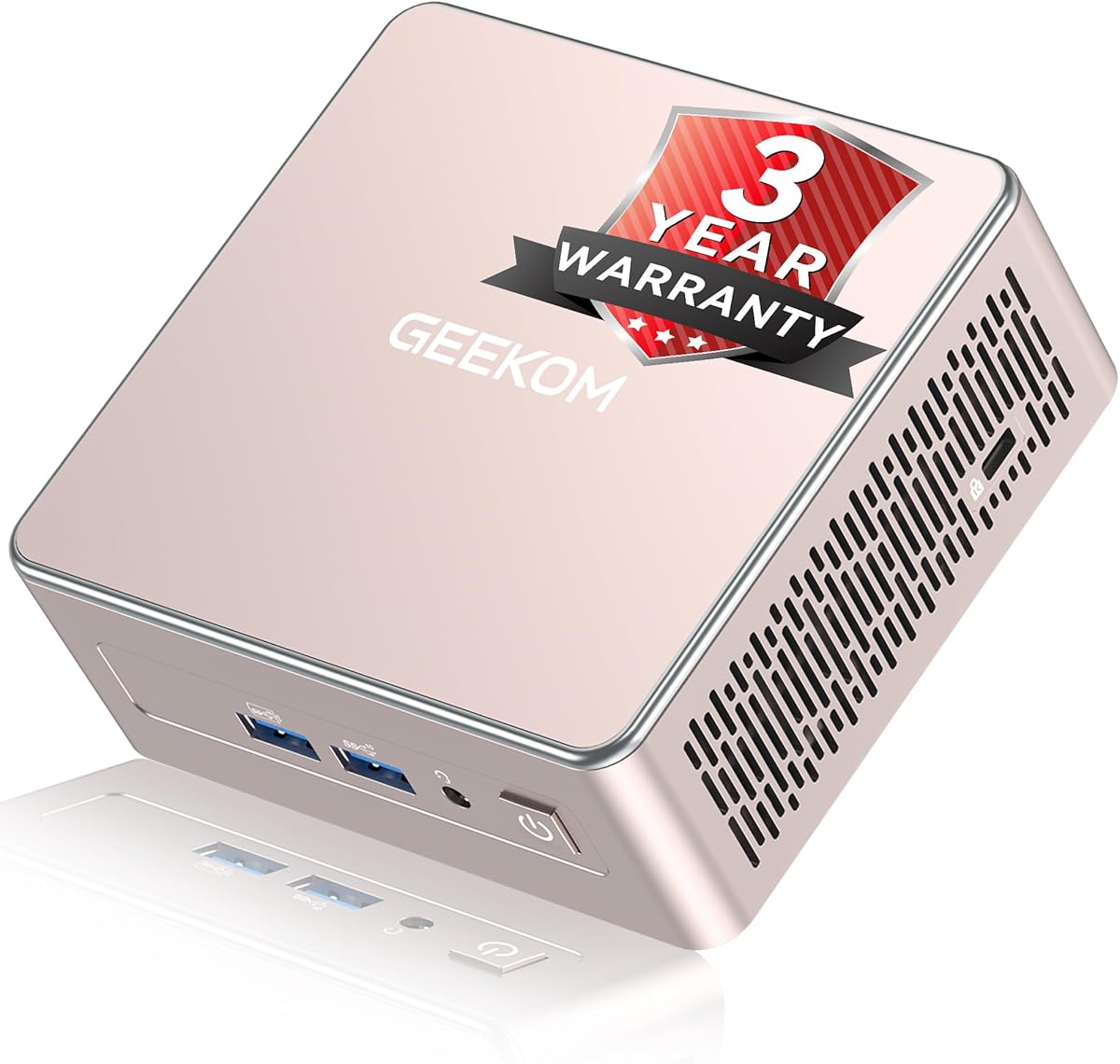
GEEKOM A5 2027 Edition Mini PC
4.5Editor score
Ryzen 7 7730U processor
Dual HDMI display outputs
Up to four-screen support
Expandable DDR4 memory
Explore the best mini PCs with 2 HDMI ports and compare 10 models across processors, memory, storage, networking, cooling, expandability, and display support.
A mini PC with 2 HDMI ports can create a useful dual-screen workspace without requiring a full-size tower, but the best model depends on how it will be used. Processor power, memory capacity, storage flexibility, networking, cooling, and display resolution all influence whether a compact computer feels capable or merely inexpensive.
This guide compares ten small-form-factor computers with emphasis on models that explicitly support two HDMI connections or provide a clear dual-display configuration. We examined the available processor, memory, storage, connectivity, cooling, upgrade, and multi-monitor information to distinguish dedicated dual-HDMI systems from models that use a different combination of display outputs.
Each review explains the practical strengths and limitations of its featured model and identifies the type of user most likely to benefit. Featured ratings come from the supplied product data, while products without a published rating remain unrated here. Prices and configurations can change, so confirm the current listing and port layout before buying.
4.5Editor score


4.4Editor score
The comparison below highlights each system's processor, memory, storage, display configuration, and distinguishing connectivity features. Only products whose supplied descriptions explicitly confirm two HDMI ports should be treated as direct matches for the search phrase.




The BOSGAME E5 is a compact Ryzen 3 5300U system with a supplied rating of 4.6. Its standout feature is flexibility: two SODIMM slots, dual M.2 storage positions, two 2.5GbE ports, and support for three independent 4K displays. It is best viewed as a multi-output productivity machine, although it is not a direct dual-HDMI match.
We may earn a commission when you buy through this link, at no additional cost to you.
The four-core, eight-thread processor is aimed at office software, spreadsheets, online classes, general administration, and network-server applications rather than intensive 3D rendering or demanding 3A games. Starting with 8GB of DDR4 and a 256GB SATA M.2 drive, it is better suited to buyers who plan to add memory or storage than to people who want a fully equipped system for demanding work.
Networking is unusually strong for a compact office PC. Realtek-based 2.5GbE connections, Wi-Fi 5, and the possibility of using the additional storage and memory make the E5 appealing for a home server, firewall appliance, NAS project, or virtual-machine lab. Its principal trade-off is that the supplied display list includes only one HDMI 2.0 output, with DisplayPort and USB-C supplying the other two screens.
Choose the E5 when flexible networking and three-screen operation matter more than having the displays connected through two HDMI sockets. It is a strong general-purpose compact PC for technical users, but buyers whose primary requirement is two HDMI ports should confirm their adapter preferences or choose one of the explicitly dual-HDMI alternatives in this guide.
The two SODIMM slots can support memory upgrades of up to 64GB, while a second M.2 2280 NVMe PCIe 3.0 position allows another drive to be added without removing the original system drive. That makes the compact enclosure more adaptable than many similarly sized office computers.
The E5 can drive up to three independent 4K displays at 60Hz through HDMI, DisplayPort, and a full-function USB-C connection. This is valuable for editing, monitoring, and financial workflows, but it is a mixed-port arrangement rather than a two-HDMI configuration.
We may earn a commission when you buy through this link, at no additional cost to you.
The GMKtec Nucbox M8 is a higher-performance compact system built around the Ryzen 5 PRO 6650H, six cores, twelve threads, and Radeon 660M graphics. No published rating was supplied, but its specifications position it for demanding office workloads, content creation, virtualization, mainstream gaming, and users who want a path to external graphics expansion.
We may earn a commission when you buy through this link, at no additional cost to you.
Its 16GB LPDDR5 memory runs at 6400 MT/s, and the 512GB NVMe SSD provides a fast foundation. Two M.2 2280 slots can accommodate up to 4TB per drive, according to the supplied information. The major attraction is OCuLink, which offers a direct route to an external GPU, while USB4 adds 40Gbps data transfer, power delivery, and video output.
Dual 2.5GbE Ethernet, Wi-Fi 6E, and the option of link aggregation make this more than a simple office machine. It can serve as a compact network host, development system, or performance-oriented workstation. The main limitation is that memory is soldered, and the specified display arrangement uses one HDMI, one DisplayPort, and one USB4/DP output instead of two HDMI ports.
The M8 is a compelling choice for a buyer who values CPU and graphics performance, fast networking, and future external-GPU flexibility more than uniform HDMI connectivity. It can still present two screens through DisplayPort and HDMI, but users who require two cables to be HDMI should look to the G3 Ultra, AK1PLUS, Getorli, or G11.
The Ryzen 5 PRO 6650H and Radeon 660M provide considerably more processing and graphical headroom than typical entry-level mini PCs. OCuLink is the standout expansion route, allowing a compatible external graphics solution to be connected when integrated graphics are not sufficient.
Two 2.5GbE ports, Wi-Fi 6E, and USB4 create a flexible platform for high-speed transfers, network appliances, and compact workstation use. Quiet, Balanced, and Performance power modes also let the owner tune energy use and responsiveness.
We may earn a commission when you buy through this link, at no additional cost to you.
The GMKtec G3 Ultra is one of the clearest answers to the search for a mini PC with 2 HDMI ports. Its supplied description confirms two HDMI 2.0 outputs capable of driving two 4K displays at 60Hz, while 16GB of LPDDR4 memory and 512GB of M.2 storage give it a balanced foundation for office work and media use.
We may earn a commission when you buy through this link, at no additional cost to you.
The Intel Pentium Gold 7505 offers four cores and four threads, with integrated Intel UHD Graphics rated at 48 execution units in the supplied data. The product information emphasizes faster single-core responsiveness and improved graphics compared with common N100 and N150 systems, making the G3 Ultra suitable for web browsing, office applications, streaming, and light photo editing.
Connectivity is well suited to a clean desk setup. The specification lists three 10Gbps USB 3.2 Gen2 ports, one USB 2.0 port, Gigabit Ethernet, 2.5GbE connectivity, Wi-Fi 6, Bluetooth 5.2, and a 3.5mm audio jack. A primary M.2 PCIe slot and secondary M.2 SATA slot allow more storage to be added, although the LPDDR4 memory itself cannot be upgraded.
The G3 Ultra is an excellent choice for a two-monitor office, study, or media setup when native HDMI on both displays is important. Its limits are modest graphics potential and fixed memory, so buyers who need heavy editing or demanding games should consider a more powerful Ryzen-based system.
Both HDMI 2.0 ports support 4K at 60Hz, making the G3 Ultra convenient for side-by-side documents, browser research, video calls, and media playback. Users can connect two compatible displays without relying on DisplayPort or USB-C adapters.
Sixteen gigabytes of LPDDR4 memory is comfortable for browser-heavy productivity, and the 512GB drive provides more room than the entry configurations of several competitors. The second storage slot preserves an easy path to additional capacity later.
We may earn a commission when you buy through this link, at no additional cost to you.
The KAMRUI AK1PLUS combines a 4.4 supplied rating with a straightforward dual-HDMI design. It has two HDMI 2.0 outputs that support 4K at 60Hz, making it a practical option for users who want to run two high-resolution screens in an office, classroom, reception area, or home workspace.
We may earn a commission when you buy through this link, at no additional cost to you.
Its Intel Celeron N5095 has four cores and four threads with a maximum boost of 2.9GHz. While that is not a processor for intensive creative work or modern gaming, the supplied information identifies browsing, online classes, video conferencing, email, office work, and light multitasking as its intended strengths. The 16GB of LPDDR4X memory helps make those everyday tasks smoother.
Storage starts with a 256GB M.2 2280 SSD. The system can also accept an M.2 SATA or NVMe drive of up to 2TB and a 2.5-inch SATA drive of up to 2TB, enabling as much as 4TB total according to the listing. Four USB 3.2 ports, Gigabit Ethernet, Wi-Fi, Bluetooth, and management functions such as Wake-on-LAN round out a practical feature set.
The AK1PLUS is best for straightforward productivity where dual 4K HDMI support matters more than demanding CPU or graphics performance. Its affordable positioning and expandable storage make it particularly appealing as a small office computer, classroom unit, media hub, or digital-signage controller.
Two native HDMI 2.0 outputs allow two 4K monitors to run at 60Hz simultaneously. This makes the AK1PLUS effective for spreadsheets, research, communication, and media tasks that benefit from additional screen space without requiring advanced graphics performance.
The combination of an M.2 expansion and a 2.5-inch drive bay makes it easier to balance operating-system storage with larger media or backup files. Auto Power On, RTC Wake, and Wake-on-LAN add convenience for kiosks and managed deployments.
We may earn a commission when you buy through this link, at no additional cost to you.
The Getorli Mini PC combines a Ryzen 5 3501U processor with a configuration that directly addresses the dual-HDMI requirement. It includes two HDMI ports for one or two 4K screens, 16GB of expandable DDR4 memory, and a 512GB NVMe SSD. No published rating was supplied, but its specification is well suited to general office and home use.
We may earn a commission when you buy through this link, at no additional cost to you.
The processor provides four cores and eight threads with speeds from 2.1GHz to 3.7GHz. The supplied listing positions it for daily computing, browsing, office applications, and media streaming. Because the DDR4 memory is expandable to 32GB, the system can be configured for heavier multitasking than the base processor alone might suggest.
Its 512GB NVMe drive supports quick startup and file access, while Wi-Fi 6 and Bluetooth 5.3 provide modern wireless connectivity. The port selection includes two USB 3.0 ports, two USB 2.0 ports, a basic USB-C port, a full-featured USB-C 3.2 port, and two HDMI connections, giving a good mix of peripherals and display flexibility.
The Getorli is a strong match for users who want two conventional HDMI connections alongside a capable everyday configuration. It is less suitable for intensive gaming, professional 3D work, and demanding video editing, but it should serve general productivity, browsing, media, and light creative tasks well.
The two HDMI outputs support 4K Ultra HD video, allowing a user to connect two displays with familiar cables. This avoids the adapter and mixed-display-port arrangement found on several other compact PCs in the guide.
The 512GB NVMe SSD offers a useful combination of capacity and speed, while 16GB of DDR4 can be expanded to 32GB. That makes the system more adaptable to browser-heavy office work and other multitasking scenarios.
We may earn a commission when you buy through this link, at no additional cost to you.
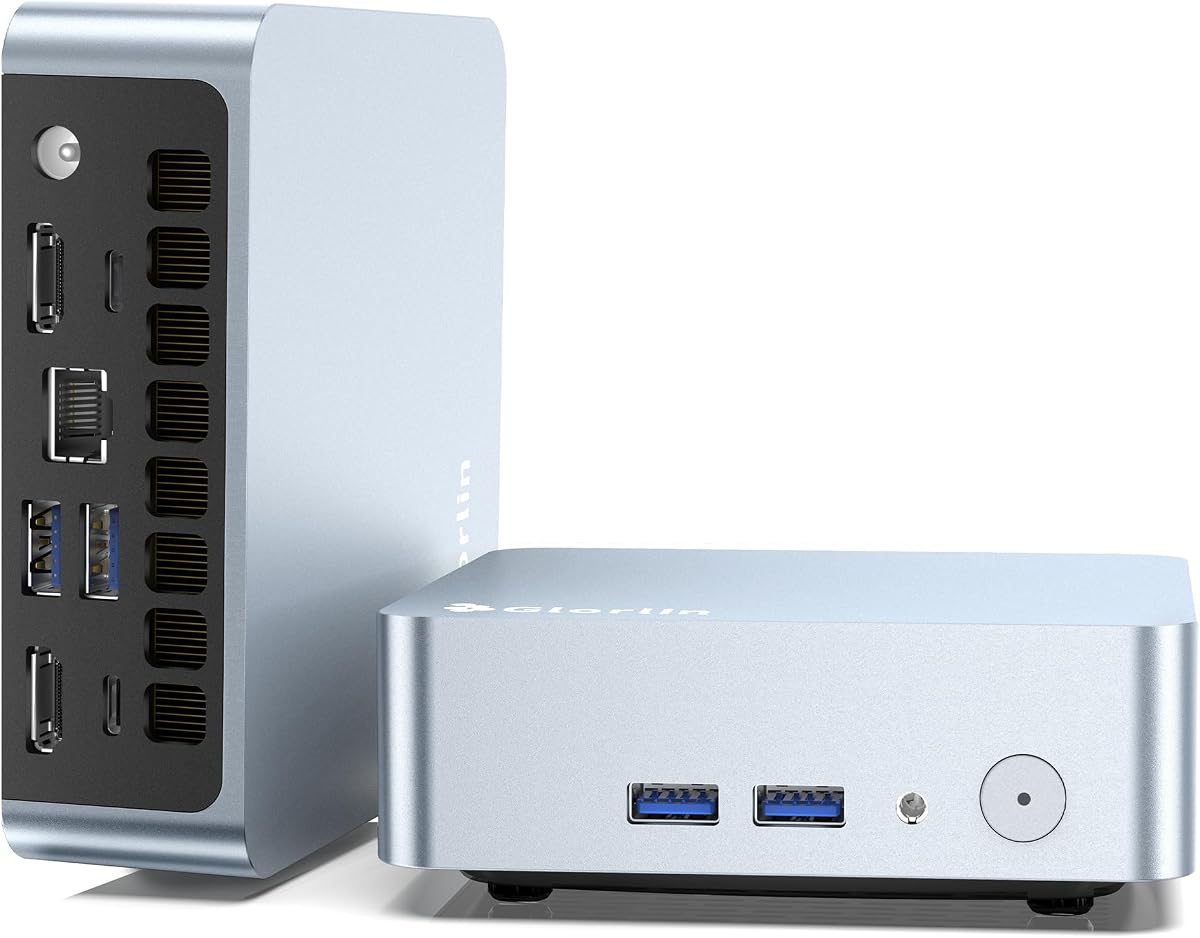
The Glorlin Mini PC is built around the Ryzen 5 3500U and explicitly includes two HDMI ports plus a full-function USB-C 3.2 connection with display support. Together, those outputs can drive three 4K screens, making it a strong candidate for users who need more than two displays or want flexibility in how they connect them.
We may earn a commission when you buy through this link, at no additional cost to you.
Its four-core, eight-thread processor operates from 2.1GHz up to 3.7GHz and is intended for daily work, browsing, office applications, media streaming, and light use. The supplied information compares it favorably with common N-series chips, but it remains a midrange processor rather than a solution for demanding professional rendering or intensive 3A games.
The base memory is 8GB DDR4, expandable to 32GB, while the included 256GB NVMe SSD provides quick boot and application loading. Wi-Fi 6, Bluetooth 5.3, two USB 3.2 ports, two USB 2.0 ports, and both USB-C connections make the peripheral selection versatile. A preinstalled operating system simplifies initial setup.
The Glorlin is a good choice for a three-screen office, trading setup, or media workstation where the second HDMI port is required but a third display may be useful. Its modest base memory and storage are the principal compromises, and buyers should consider an upgrade if they will run many applications or keep substantial media locally.
Two HDMI ports and one display-capable USB-C port support three 4K screens. The flexible arrangement is useful for users who prefer HDMI for two displays and want USB-C for a laptop-style monitor, tablet, or other compatible screen.
The Ryzen 5 3500U provides a reasonable balance of processing power and efficiency for general productivity. Upgrading the 8GB memory to 16GB or 32GB would make the system better prepared for sustained multitasking.
We may earn a commission when you buy through this link, at no additional cost to you.
The GMKtec Nucbox G10 has a 4.2 supplied rating and pairs the Ryzen 5 3500U with 16GB of DDR4 memory and a notably generous 1TB SSD. It supports three screens through HDMI 2.1, DisplayPort 1.4, and a full-function USB-C connection, but only one HDMI port is confirmed in the supplied description.
We may earn a commission when you buy through this link, at no additional cost to you.
Memory can be expanded as high as 64GB, and two M.2 2280 PCIe 3.0 slots provide a path to substantial storage expansion, listed at up to 16TB when configured with compatible 8TB drives. That storage flexibility makes the G10 attractive for media libraries, project files, virtual machines, and local development environments.
The Ryzen 5 3500U provides four cores and eight threads, while Radeon Vega 8 graphics at up to 1.2GHz handle casual gaming, video playback, and lighter editing. A 2.5GbE Ethernet connection supports fast wired networking, and Wi-Fi 5 plus Bluetooth 5.0 cover wireless peripherals and standard connectivity needs.
The G10 is a good general-purpose compact PC for someone who values storage and memory headroom over having two physical HDMI connectors. For dual-HDMI setups, the G3 Ultra, AK1PLUS, Getorli, and G11 are more direct choices. The G10 makes more sense when one HDMI plus flexible USB-C and DisplayPort connections are acceptable.
The included 1TB SSD is unusually roomy for a compact PC, and the second M.2 slot allows even more capacity. A buyer can start with one large drive and add another when media libraries, project archives, or virtual machines expand.
HDMI 2.1, DisplayPort 1.4, and full-function USB-C provide three simultaneous 4K outputs. The mixed interface gives display flexibility, although it does not satisfy a requirement for two HDMI sockets.
We may earn a commission when you buy through this link, at no additional cost to you.
The GEEKOM A5 2027 Edition is the strongest premium selection here, with a supplied rating of 4.5 and an eight-core, sixteen-thread Ryzen 7 7730U processor. It explicitly supports dual HDMI and dual USB-C display outputs, with a total capability of up to four displays and resolutions as high as 8K through USB-C.
We may earn a commission when you buy through this link, at no additional cost to you.
The system includes 16GB of RAM in dual-slot DDR4 configuration, allowing expansion to 64GB, and a 256GB PCIe NVMe SSD. Storage can be expanded through an M.2 slot supporting up to 4TB, an additional M.2 2242 position, and a 2.5-inch bay, with total capacity listed as high as 10TB. This is a more flexible platform than a mini PC with entirely soldered memory.
Its 0.6-liter enclosure uses a reinforced metal internal frame and IceBlast 3.0 cooling, with the supplied data citing improved cooling efficiency and airflow. Wake-on-LAN, Scheduled Power On, and Group Policy support make it suitable for business deployment, while Wi-Fi 6, Bluetooth 5.4, 2.5GbE Ethernet, an SD card reader, and multiple USB ports cover everyday connectivity.
The A5 is ideal for a premium four-screen office, creative workstation, trading station, or compact deployment where display flexibility and processing headroom are priorities. Its 256GB starting drive is the most obvious limitation, but the extensive expansion options make it straightforward to add capacity before installing large project libraries.
Dual HDMI and dual USB-C outputs allow up to four displays, including 8K output through USB-C. This makes the A5 especially appropriate for analysts, editors, engineers, and other users who want broad desktop space from a compact enclosure.
Replaceable DDR4 memory, multiple storage positions, remote-management features, and a reinforced internal frame distinguish the A5 from simpler budget systems. Its physical design is also intended to provide stable thermals and reduce vibration in unattended or professional setups.
We may earn a commission when you buy through this link, at no additional cost to you.
This GMKtec M8 configuration shares the Ryzen 5 PRO 6650H platform and general feature set of the earlier M8 listing, but appears under a separate ASIN. It combines six cores, twelve threads, Radeon 660M graphics, 16GB of LPDDR5 memory, and a 512GB NVMe SSD. No published rating was supplied for this entry.
We may earn a commission when you buy through this link, at no additional cost to you.
The main performance benefit is the combination of high clock speeds and stronger integrated graphics than many entry mini PCs. It is positioned for demanding office work, content creation, multitasking, mainstream gaming, and 4K media tasks. Dual M.2 2280 slots can support up to 8TB of storage, providing room for projects, games, and media.
Networking and expansion are particularly strong. Two 2.5GbE ports support advanced networking, virtualization, and home-server arrangements, while OCuLink enables a direct external GPU connection. USB4 handles high-speed data, power delivery, and display output. Three screens can be driven through HDMI 2.0, DisplayPort 1.4, and USB4/DP.
The M8 is a strong choice for performance-oriented users who do not require two HDMI ports. It is particularly interesting for network-heavy workstations and buyers considering an eGPU. Those who need two native HDMI outputs for simple dual-monitor cabling should instead favor one of the models explicitly equipped with dual HDMI.
The Ryzen 5 PRO 6650H and Radeon 660M give this system more headroom for productivity and mainstream gaming than entry-level alternatives. Its three power modes let users balance quiet operation, balanced performance, or maximum available performance.
Dual 2.5GbE networking is unusual at this size, and OCuLink provides a high-speed path to compatible external graphics. Together, these features make the M8 suitable for advanced network appliances and expandable workstation configurations.
We may earn a commission when you buy through this link, at no additional cost to you.
The GMKtec G11 has a supplied rating of 4.4 and directly satisfies the dual-HDMI requirement. Two HDMI 2.0 ports can each drive a 4K display at 60Hz, while a USB-C connection with DisplayPort Alt Mode adds a third screen. It is aimed at office, NAS, industrial, digital-signage, and home-entertainment applications.
We may earn a commission when you buy through this link, at no additional cost to you.
Its Ryzen Embedded R2514 uses quad-core Zen+ architecture with eight threads and is designed and validated for continuous 24/7 workloads. Integrated Radeon graphics run at 1.2GHz and support H.265/HEVC encoding, modern graphics APIs, and three independent 4K displays. The listed specifications also emphasize improved graphics performance over common Intel N-series systems.
The system includes dual-channel 16GB DDR4 memory, a 256GB PCIe M.2 SSD, and two 2.5GbE Ethernet ports. That network configuration makes it appropriate for firewall, VPN, NAS, home-lab, camera, or isolated IoT applications. Wi-Fi 6E, Bluetooth 5.2, several USB 3.2 ports, and a USB-C connection support everyday peripherals and data transfers.
The G11 is a compelling choice for a compact, always-on mini PC that also needs two conventional HDMI connections. Its smaller starting drive and embedded-focused processor make it less attractive for a gaming build or a workstation that needs abundant local storage, but for monitoring, signage, infrastructure, and dual-screen administration, the feature set is well aligned.
The Ryzen Embedded R2514 platform is intended for sustained operation in business, industrial, and professional environments. A 35W raw-performance BIOS mode provides additional processing power when a workload requires it.
Two HDMI outputs support dedicated 4K screens, while dual 2.5GbE ports make the G11 useful as a compact network appliance. The combination is especially relevant for monitoring stations, digital signage, VPN servers, and multi-panel information systems.
We may earn a commission when you buy through this link, at no additional cost to you.
The most important decision is confirming that the system truly includes two physical HDMI ports. Beyond that, match processor performance, memory, storage, networking, and cooling to the demands of your displays and everyday workloads.
A system advertised for multiple displays does not necessarily provide two HDMI connectors. Some use HDMI, DisplayPort, and USB-C, while others include only one HDMI port. Buyers who need two HDMI sockets for a fixed installation should examine the port list and product images rather than relying on a general multi-screen claim. The G3 Ultra, AK1PLUS, Getorli, and G11 explicitly confirm two HDMI outputs, while the A5 confirms dual HDMI as part of a four-screen arrangement.
Entry-level Celeron and Pentium chips can handle browsing, office applications, video calls, and media, but they are less appropriate for intensive editing, virtualization, demanding games, or large compile projects. Ryzen 5 systems offer a useful middle ground, while the Ryzen 5 PRO 6650H and Ryzen 7 7730U provide additional cores and stronger performance. Think about the applications that consume CPU time, not only how many applications are open.
Two 4K outputs at 60Hz are suitable for detailed documents, financial charts, and general creative work, but users who edit high-frame-rate video or play fast games may need stronger graphics and carefully matched displays. Confirm whether the stated resolution applies simultaneously to both screens. USB-C-only outputs may also depend on compatible monitors, while native HDMI gives a more straightforward installation.
Sixteen gigabytes is a practical starting point for a modern productivity mini PC, especially with several browser tabs and office applications open. LPDDR memory is compact and efficient but usually cannot be replaced, whereas dual-slot DDR4 systems may support much higher capacities. Consider whether the machine will run virtual machines, local AI tools, large media libraries, or development environments before choosing a fixed-memory model.
A 256GB SSD can feel limited once applications, updates, media, and project files are installed. Systems with 512GB or 1TB drives have more breathing room, but storage expandability matters as much as the included capacity. Look for M.2 slots, 2.5-inch drive bays, and the supported interface for each position. A second M.2 slot is convenient for a fast working drive, while a larger SATA bay can hold bulk media or backups.
Gigabit Ethernet is sufficient for most homes and offices, while 2.5GbE is valuable for fast NAS transfers, large backups, and network-heavy server use. Dual Ethernet ports can support link aggregation, virtualization, router duties, firewall software, and separate management or storage networks. Wireless standards matter less for a permanently connected workstation but remain useful for peripherals and flexible placement.
Compact systems dissipate heat in a small enclosure, and a quiet cooling design can matter in an office, bedroom, or media center. Models with larger fans, copper heat pipes, multiple airflow paths, and selectable power modes offer a useful balance of temperature control and noise. Continuous-operation systems may also include reinforced frames, vibration-damping feet, and business-oriented power controls.
Begin by identifying the two displays, their resolution and refresh-rate requirements, and the compatible cables you will need. Connect each monitor to an HDMI port, then attach power, networking, and peripherals. Install the necessary display and networking drivers, choose the correct resolution for each screen, and confirm that the operating system recognizes both displays before arranging windows and applications.
Place the mini PC on a hard, level surface with ventilation openings unobstructed. Avoid enclosing it in a tight cabinet, keeping it directly on deep fabric, or placing it beside a heat source. Periodically clean dust from exterior vents, retain adequate free space around the chassis, and use the available BIOS power modes or operating-system sleep settings to reduce unnecessary energy use.
For a two-screen productivity workflow, assign one display to primary work and the other to supporting material such as email, documentation, chat, or monitoring. For kiosk, signage, or server use, enable the appropriate auto-power, scheduled-start, or remote-management features only after confirming that they fit the deployment. Keep the operating system, firmware, storage firmware, and security software current, and maintain an independent backup of important files.
Several models in this guide explicitly support two 4K displays at 60Hz through their HDMI 2.0 connections, including the G3 Ultra, AK1PLUS, Getorli, and G11. Confirm that both screens are connected directly to the mini PC and that the monitors and cables meet the required resolution and refresh-rate specifications. Higher resolutions, specialized gaming features, or very high refresh rates may require a stronger graphics system or different outputs.
Two-display support means the computer can drive two screens, but those screens may be connected through HDMI, DisplayPort, and USB-C. Two HDMI ports means the chassis contains two dedicated HDMI sockets. A buyer with existing dual-HDMI monitors should prioritize the physical port count, while a buyer shopping for a new setup may find mixed outputs equally convenient.
For web browsing, office work, communication, media playback, and typical light multitasking, 16GB is generally a comfortable starting point. Heavy virtual-machine use, large editing projects, data analysis, and other demanding software can benefit from 32GB or more. Models with replaceable DDR4 provide an easier upgrade path than systems with fixed LPDDR memory.
It depends on the mini PC, the number of displays, and the desired resolution and refresh rate. The systems described here support multi-screen output through integrated graphics, but an OCuLink-equipped model such as the M8 can connect a compatible external GPU for more demanding graphics workloads. Basic productivity displays do not generally require an external GPU.
Several options are well suited to that role because they include multiple Ethernet ports, fast memory, and expandable storage. The BOSGAME E5, GMKtec M8, and GMKtec G11 list features relevant to firewall software, NAS use, virtualization, and home labs. Operating-system compatibility, driver support, storage configuration, and network services must still be confirmed for the intended application.
The requirement depends on whether the machine is used mainly for cloud applications or stores files locally. A 256GB drive can be adequate for a light office setup, while 512GB or 1TB provides more room for applications and active project files. Users with large media libraries should also consider a second M.2 drive or a 2.5-inch storage bay instead of relying on a single drive.
The relevant product descriptions list support for three 4K outputs on the BOSGAME E5, Glorlin, G10, and G11. However, simultaneous resolution can depend on the processor, graphics capability, operating-system configuration, and selected output combination. Users should verify the manufacturer's current manual and monitor requirements for their exact display arrangement.
Fixed LPDDR memory can make a mini PC smaller, more efficient, and potentially more consistent at the hardware level. Upgradeable DDR4 is generally preferable when the machine may later need more memory for virtual machines, heavy multitasking, or specialized software. In either case, 16GB is a sensible starting configuration for modern productivity use.
The GEEKOM A5 stands out as the premium choice because it combines dual HDMI, a Ryzen 7 processor, four-display capability, upgradeable memory, and extensive storage options. The GMKtec G3 Ultra is the most straightforward high-priority choice when two native 4K HDMI ports, 16GB of memory, and dual storage slots are the essential features, while the KAMRUI AK1PLUS offers a more modest dual-HDMI setup for basic productivity.
Before purchasing, verify the physical connector count rather than relying on a general multi-monitor claim. Then prioritize the processor and memory for your applications, choose sufficient storage or an accessible expansion path, and consider 2.5GbE networking if the computer will serve a NAS or other network role. Cooling and remote-management features are especially relevant for permanent installations.
Ratings, configurations, port layouts, and prices can change, so review the current product listing and manufacturer documentation before ordering. If two HDMI sockets are non-negotiable, the explicitly confirmed dual-HDMI models deserve the closest comparison, while the mixed-output alternatives may still offer better performance or greater expandability.