Logitech Z313
4.4Editor score
Compact dedicated subwoofer
25W RMS rated output
Convenient wired control pod
Explore the best 2.1 Channel Desktop Speakers for 2026, comparing sound, bass, connectivity, controls, design, and performance for gaming, music, and movies.
A 2.1 channel desktop speaker system combines two satellite speakers with a dedicated subwoofer, giving computers and entertainment setups more depth than conventional compact speakers. The best models balance clear vocals, controlled bass, useful controls, and practical connections while fitting comfortably into a modern workspace.
We compared all ten systems using the supplied specifications, customer ratings, driver configurations, power figures, connection options, and control features. The list covers traditional multimedia systems, USB-powered desktop models, wireless additions, RGB designs, gaming-oriented setups, and premium options for music and movies.
Each review identifies the strongest reasons to consider a particular model, along with meaningful limitations and the type of listener it suits best. Ratings and product details reflect the supplied information, while prices and availability can change, so shoppers should verify current listings before purchasing.
4.4Editor score

4.6Editor score
4.2Editor score
The comparison below highlights each system's rated output, driver approach, connection methods, and most useful control features. These details help distinguish compact desktop models from higher-output multimedia and premium wireless systems.


The Klipsch ProMedia 2.1 THX Certified Computer Speaker System (Black) combines two two-way satellite speakers with a substantial 6.5-inch side-firing subwoofer. Its 4.5 rating reflects a well-regarded balance of clarity, output, and bass extension, making it one of the most substantial conventional desktop systems in this roundup.
We may earn a commission when you buy through this link, at no additional cost to you.
Klipsch's Microtractrix horn technology is central to the satellites' character. The horns help control dispersion while efficiently delivering the midrange and high frequencies, giving voices and instrumental detail greater presence. The satellites also use three-inch midrange drivers, while the ported subwoofer handles low frequencies and adds impact that the small enclosures could not produce alone.
The system's 200-watt peak rating and 110 dB in-room maximum output indicate a meaningful upgrade over lightweight computer speakers. A convenient control pod provides main volume and subwoofer gain, allowing listeners to adjust bass independently rather than relying entirely on the source device. The trade-off is a permanently wired design with no Bluetooth or USB-C playback, so modern source flexibility is limited.
This is a strong choice for listeners who care more about full-range tone and confident output than compact dimensions or wireless convenience. It is especially appropriate for computer gaming, film viewing, and music playback when the subwoofer has enough desk or floor space. For a serious desktop audio upgrade with detailed mids and genuinely separate bass, it remains one of the most compelling systems here.
The Microtractrix horns help focus the satellites' output toward the listening area, improving the perceived clarity of dialogue, lead vocals, and game effects. This controlled presentation is particularly useful on a busy desk where unfocused treble can quickly become tiresome.
A dedicated subwoofer-gain control lets users match the low end to different desks, rooms, and source material. It also prevents the bass from overwhelming the satellites, creating a more balanced presentation for both films and music.
We may earn a commission when you buy through this link, at no additional cost to you.
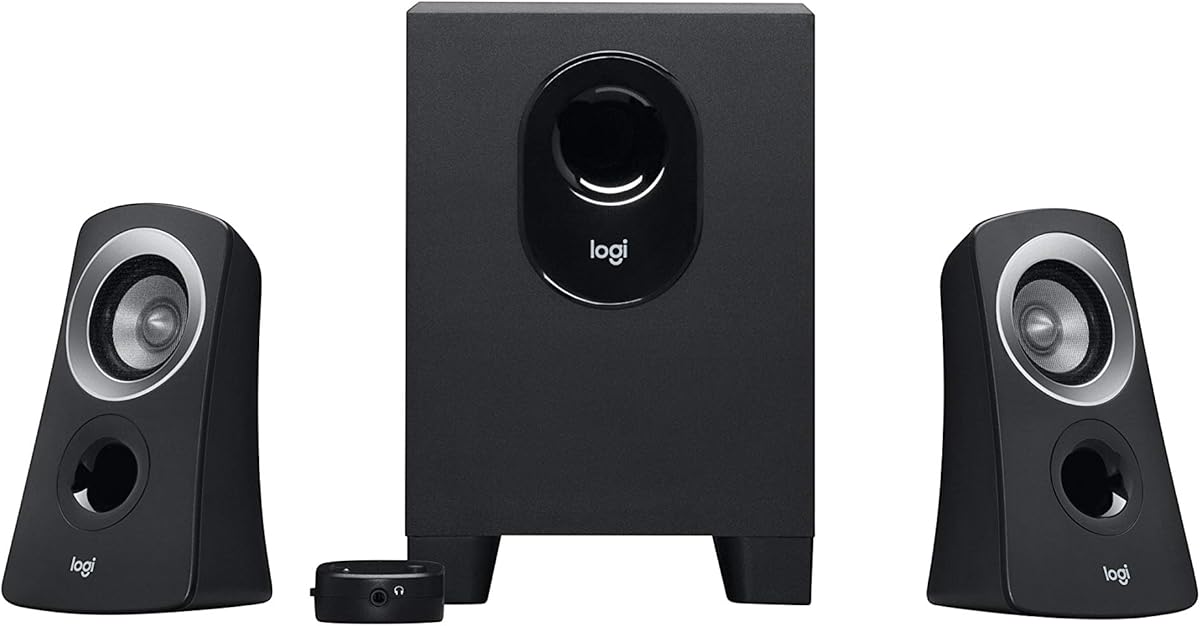
The Logitech Z313 2.1 Multimedia Speaker System with Subwoofer – Black is a straightforward 2.1 setup for users who want more bass than ordinary desktop speakers without committing to a large entertainment system. Its 4.4 rating indicates solid customer reception, and the 25-watt RMS specification gives it more authority than its modest footprint suggests.
We may earn a commission when you buy through this link, at no additional cost to you.
The two satellites handle stereo separation while the compact subwoofer supplies lower-frequency effects for music, movies, and games. A separate control pod puts the main volume control within easy reach, which is useful when the speakers are placed on a shelf or the subwoofer is tucked under a desk. The design prioritizes straightforward operation rather than elaborate controls.
Its main limitation is the use of a conventional 3.5 mm connection without Bluetooth, USB-C audio, or a multi-device switch. It also offers less headroom than higher-powered systems, so it is better suited to a smaller room and moderate listening levels than to a large space filled with demanding bass. Buyers seeking advanced equalization or app-based control will not find those features.
The Z313 works well for students, office workers, and casual listeners who want a dedicated subwoofer in a manageable package. It is a practical alternative when a premium system would be excessive or a basic pair of computer speakers would feel underpowered. For uncomplicated wired listening and convenient volume control, it remains an easy recommendation.
The system preserves the familiar advantage of a dedicated bass unit without requiring a large entertainment cabinet. Placing the satellites apart can create a wider stereo image, while the subwoofer can sit close to the floor for efficient low-frequency response.
The separate control pod makes daily volume changes straightforward. Because the relevant control does not depend on software, the speakers can also be used with different source devices that support the same wired connection.
We may earn a commission when you buy through this link, at no additional cost to you.
The Logitech Z623 400 Watt Home 2.1 Speaker System – Black has the highest customer rating in this group at 4.6. Its combination of THX certification, 400 watts of peak power, a 130-watt subwoofer, and flexible inputs makes it an especially complete choice for home computers, televisions, and game consoles.
We may earn a commission when you buy through this link, at no additional cost to you.
Each satellite is powered by a 35-watt amplifier, providing more drive than typical compact multimedia speakers. The subwoofer supplies the low end, while the system's 400-watt peak and 200-watt RMS ratings indicate room-filling potential without requiring a separate surround-sound receiver. Its stated compatibility includes computers, smartphones, tablets, music players, disc players, Blu-ray devices, and major gaming systems.
The main convenience comes from support for up to three devices through RCA and 3.5 mm connections. That makes it easy to move between a PC, television, and game console, although the connections are wired rather than wireless. Its size also needs consideration: the subwoofer and satellites occupy more room than minimalist models, and the system does not provide the app lighting or Bluetooth convenience found in newer alternatives.
The Z623 is best for buyers who want one capable speaker system to serve several entertainment sources. It handles gaming, film dialogue, and music with enough output and scale to feel less like an upgrade confined to the desktop. For broad compatibility and strong conventional 2.1 performance, it is among the easiest systems on this list to recommend.
RCA and 3.5 mm inputs support a broad mix of source equipment, including computers, televisions, consoles, and portable players. That flexibility allows the speakers to become the central audio system for an entire entertainment area rather than only a PC accessory.
The 200-watt RMS specification indicates considerably more continuous power than the compact options in this guide. It is particularly appropriate for users who regularly watch movies or play games and want bass and dynamics that can carry beyond a very small workspace.
We may earn a commission when you buy through this link, at no additional cost to you.
The Creative Pebble X Plus 2.1 USB-C Computer Speakers with Subwoofer blends a modern desktop aesthetic with features rarely seen in basic multimedia sets. Its 4.2 rating reflects a versatile package that includes Bluetooth 5.3, USB digital audio, 3.5 mm AUX, RGB lighting, and dedicated headset and microphone connections.
We may earn a commission when you buy through this link, at no additional cost to you.
The 2.75-inch drivers and compact subwoofer are rated for 15 watts RMS and 30 watts peak as a standard configuration. When connected to a 30-watt or higher USB Power Delivery adapter, the system can reach 30 watts RMS and 60 watts peak. The adapter is not included, which is an important detail for anyone expecting the higher output immediately.
Customizable lighting offers up to 16.8 million color combinations and six presets, making the system visually engaging for gaming and creative desks. It is also one of the few choices here to provide communication ports, allowing headset and microphone connections without requiring separate desktop accessories. Conversely, users who prefer a minimalist office may regard the lighting as unnecessary visual activity.
The Pebble X Plus is a good match for a modern workstation that mixes productivity, gaming, and music. Its connection flexibility reduces dependence on a single cable, while the external subwoofer supplies meaningful low-end extension. Buyers should simply plan for a compatible USB PD adapter if they intend to use its highest rated output.
USB, Bluetooth 5.3, and universal AUX input let the system serve computers, phones, and other audio sources. This mix of digital and wireless options is particularly useful for users who switch between focused work sessions and casual streaming.
Six lighting presets and extensive color customization let the system blend into a gaming setup or match a more coordinated workspace. Because the controls are accessible on the system, the visual effect does not require complicated software configuration.
We may earn a commission when you buy through this link, at no additional cost to you.
The Bluedee Computer Speakers with Subwoofer, 2.1 PC Speakers, 80W Peak Power is a contemporary desktop system aimed at office, entertainment, and gaming use. Its 4.4 rating places it among the stronger-rated options, while the combination of DSP tuning and an independent bass unit distinguishes it from basic decorative speakers.
We may earn a commission when you buy through this link, at no additional cost to you.
Connectivity is a major strength. Bluetooth 5.4, USB, USB-C, and 3.5 mm AUX give users several ways to connect a computer or other source, and the adapter-powered design supports straightforward plug-and-play operation. The supplied information emphasizes balanced vocals, smoother high frequencies, and reduced distortion through DSP tuning, which should make extended listening more comfortable than an untuned system of similar size.
A multifunction control knob consolidates volume, playback, lighting, and mode changes into one accessible component. The RGB lighting can use dynamic colors or a restrained static glow, allowing the speakers to serve both an animated gaming desk and a more conventional home office. The stated 80-watt peak rating is useful for establishing general output potential, although buyers should not treat it as equivalent to 80 watts of continuous RMS power.
This system is most appealing to users who want modern connectivity without moving to a premium price category. It suits general music, movies, gaming, and work-from-home listening where a dedicated subwoofer is welcome. For buyers who prioritize a simple, current feature set and convenient one-knob operation, it is a flexible and persuasive desktop option.
The system uses digital signal processing to reduce harsh highs and distortion while supporting clearer vocals. That processing is particularly relevant for long workdays and repeated listening, where fatigue can make an overly bright or untuned system tiring.
Playback, volume, lighting, and mode controls are consolidated into the same knob. This reduces desk clutter and makes the speakers approachable even when the user does not want to depend on companion software.
We may earn a commission when you buy through this link, at no additional cost to you.
The Cyber Acoustics CA-3090 2.1 Speaker System, 18W, Subwoofer is a basic powered desktop system for listeners who want dedicated bass without a large or feature-heavy installation. Its 3.9 rating is the lowest among the ten products, but the system's straightforward design and 2.1 layout remain useful in appropriate spaces.
We may earn a commission when you buy through this link, at no additional cost to you.
Two two-inch satellite drivers are paired with a ported four-inch side-firing polycarbonate subwoofer. The full system has 18 watts of peak power and 9 watts RMS, so it is better viewed as a compact near-field option than a system intended to fill a large room. The flat-panel satellites have a modern visual profile, while the subwoofer can be placed separately for better separation.
A control pod handles main volume and power, and a separate knob on the subwoofer adjusts bass. The supplied guidance recommends setting the source device to roughly 65 to 80 percent and making primary level changes with the speaker controls. This arrangement is uncomplicated, although it does not offer Bluetooth, USB audio, advanced equalization, or multiple source inputs.
The CA-3090 is suitable for basic office use, casual gaming, and music at moderate levels in a compact area. It is also a logical choice for buyers who value simple controls and a dedicated subwoofer without paying for modern connectivity. Its limitations become apparent in a large room, at demanding listening levels, or when switching among several devices.
Separate controls for master volume and bass make it possible to adapt the balance quickly. Following the recommended source-level range can provide a predictable starting point while leaving the primary adjustment on the physical control pod.
The side-firing four-inch subwoofer provides the low-frequency foundation missing from small satellite speakers. Its compact construction and flat-panel satellites make the entire arrangement easier to integrate into a modest workspace.
We may earn a commission when you buy through this link, at no additional cost to you.
The Creative Pebble Plus 2.1 USB-Powered Desktop Speakers with Powerful Down-Firing Subwoofer and Far-Field Drivers, Up to 8W RMS Total Power for Computer PCs and Laptops (Black) is built for convenient desktop use. Its 4.3 rating reflects a popular compact design, while USB power and a dedicated subwoofer distinguish it from ordinary two-piece speakers.
We may earn a commission when you buy through this link, at no additional cost to you.
The 2-inch midrange drivers sit at a 45-degree angle, directing sound toward the seated listener instead of the far wall. A newly designed four-inch down-firing ported subwoofer adds the low-end impact that its relatively small cabinet can produce. Together, the components are rated for up to 8 watts RMS in High Gain mode.
High Gain is activated with a simple button and requires a 5-volt, 2-amp USB adapter, which is not included. The standard USB-powered arrangement otherwise removes the need for a nearby wall outlet, and a universal 3.5 mm AUX cable handles audio input. As with the CA-3090, output is modest, so the system is better aligned with close-range computer listening than large-room entertainment.
The Pebble Plus is an appealing option for laptop owners, students, and anyone building a compact workstation. Its angled drivers, front-mounted volume controls, and external subwoofer improve usability without increasing desk clutter dramatically. Choose it for portable setup simplicity and focused near-field sound rather than maximum output or wireless flexibility.
Raising the two-inch drivers to 45 degrees helps direct sound toward the listener's ears. This angled arrangement can improve the perceived focus of near-field desktop audio while keeping the satellite cabinets visually compact.
USB power removes the need for a dedicated power connection, which is useful with laptops and compact workspaces. High Gain can provide additional drive when a suitable USB adapter is available.
We may earn a commission when you buy through this link, at no additional cost to you.
The Cyber Acoustics CA-3610 2.1 Multimedia Speaker System with Subwoofer, 62 Watts Peak Power, Strong Bass, Perfect for Music, Movies, and Games is a capable wired 2.1 system. Its 4.2 rating and 62-watt peak specification make it more substantial than the smallest desktop options, especially when movies and games benefit from a strong low end.
We may earn a commission when you buy through this link, at no additional cost to you.
Each satellite contains dual two-inch titanium drivers, combining two small drivers to produce crisp high frequencies and warm mid-tones. A tuned-port 5.25-inch down-firing subwoofer handles bass, with 62 watts peak and 30 watts RMS across the system. The arrangement is designed for a richer, room-filling result than the small subwoofers found in highly portable speakers.
The control pod supports separate volume and bass adjustments, while the satellites have an accessible 3.5 mm auxiliary input and a headphone jack for private listening. Compatibility extends to PCs, Macs, laptops, PS4, PS5, Xbox, Nintendo Switch, tablets, and smartphones with suitable outputs. Its disadvantages are the absence of Bluetooth and the need for an included 120-volt AC power adapter.
The CA-3610 is a good fit for home-office users who also want to watch films and play console games on the same setup. It offers stronger output and more driver detail than entry-level desktop models while remaining conventional and easy to operate. Buyers seeking a dedicated multimedia system with flexible bass control and a headphone option will find plenty to like.
The two-driver satellite arrangement gives each side more radiating surface than a basic single-driver speaker. The result is designed to improve high-frequency crispness and midrange warmth across music, dialogue, and game effects.
A built-in headphone jack provides a convenient way to switch to personal listening without replacing the entire speaker system. Independent bass and volume controls make it easier to tune the same setup for daytime background audio and evening entertainment.
We may earn a commission when you buy through this link, at no additional cost to you.
The Logitech Z407 Bluetooth Computer Speakers with Subwoofer and Wireless Control, Immersive Sound, Premium Audio with Multiple Inputs, USB Speakers is a modern wireless 2.1 system. Its 4.3 rating reflects a well-rounded feature set, including Bluetooth, a 40-watt RMS rating, a down-firing subwoofer, and a separate wireless control dial.
We may earn a commission when you buy through this link, at no additional cost to you.
The satellites and subwoofer are rated for 80 watts peak and 40 watts RMS. Digital signal processing supports a 20-watt bass section, while the ported down-firing subwoofer adds low-frequency impact to music, movies, and games. The oval satellites may be placed vertically or horizontally, which makes it easier to align them with different desk layouts and monitor positions.
The control dial is the system's most distinctive feature. It can manage playback, volume, and bass from up to 30 meters with line of sight, allowing listeners to change tracks or adjust the system from across a room. Bluetooth, micro USB, and 3.5 mm input support up to three devices, although micro USB is less contemporary than USB-C and its role is largely as a wired audio connection.
The Z407 suits users who want wireless freedom without giving up dedicated bass and physical controls. It is particularly good for casual listening, gaming, and television viewing in a medium-sized room. Those who insist on USB-C or desire a more refined control app may prefer the Klipsch ProMedia Lumina, but the Z407 remains a flexible and approachable wireless system.
The wireless dial separates essential playback and level adjustments from the speaker bodies. Its stated 30-meter line-of-sight range is useful when the computer or television is not close to the listening position.
Dual-position satellites can be arranged to suit the available space, while three source connections reduce cable juggling. This makes the system adaptable to a desktop, entertainment console, and mobile device.
We may earn a commission when you buy through this link, at no additional cost to you.
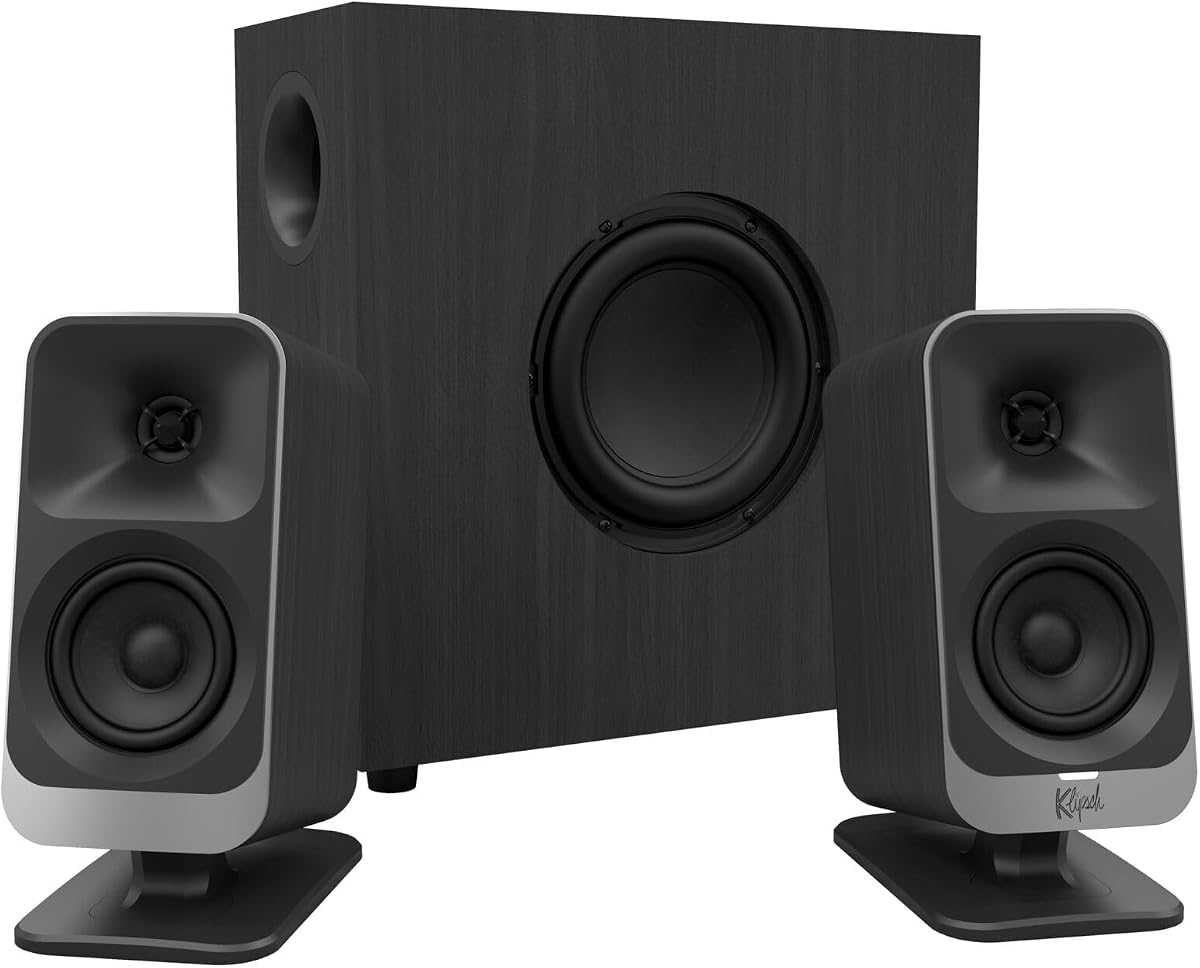
The Klipsch ProMedia Lumina 2.1 Computer Gaming System with Subwoofer and RGB Lighting Effects Built-in is a redesigned take on Klipsch's long-running ProMedia desktop concept. Its 4.2 rating reflects a modern feature set that includes USB-C, AUX, Bluetooth 5.3, app-based equalization, night mode, music-reactive lighting, and a compact low-profile subwoofer.
We may earn a commission when you buy through this link, at no additional cost to you.
The cabinet design has been reworked for a workstation, and the satellites sit on tiltable stands so users can direct them toward the listening position. A low-profile subwoofer includes an adjustable gain knob and cable-management design, helping it use floor space efficiently. These practical details are as important as the RGB effects because they improve integration into a real desk setup.
The Klipsch Control desktop app provides detailed control over equalization, lighting, night mode, and music react mode. Three color-changing options allow the visual presentation to match a room or react to audio. The limitation is dependence on software for more advanced functionality, and the feature set is clearly oriented toward listeners willing to invest in a premium desktop ecosystem.
The Lumina is best for gamers, content creators, and music or movie enthusiasts who want a refined 2.1 system with contemporary connectivity. It combines the brand's recognizable desktop-speaker heritage with flexible app control and a more considered physical design. For a premium workstation where appearance, adjustment, and connectivity all matter, it is the most advanced option here.
USB-C, AUX, and Bluetooth 5.3 provide practical choices for modern computers, consoles, phones, and media players. Wireless operation improves flexibility when the primary source is not directly beside the speaker system.
App access to equalization and night mode allows the output to be adjusted for different listening conditions. Music react mode and selectable color effects add further personalization for gaming and entertainment setups.
We may earn a commission when you buy through this link, at no additional cost to you.
The most useful 2.1 system is not necessarily the one with the largest specification. Room size, source connections, control preferences, and the type of content you listen to should guide the decision alongside output and sound characteristics.
Choose based on realistic use. Near-field computer listening needs less output than a television, gaming, or music setup used across a living area. Always leave room for the product's separate subwoofer, and consider whether its bass will be heard cleanly without creating unwanted vibration.
Look beyond driver size alone and consider the complete architecture. A modest subwoofer may be enough for close-range use, while a larger ported unit is better for music and film. Confirm the stated dimensions so the arrangement fits beneath a desk or beside your computer.
Choose the connection style you will actually use. A 3.5 mm input is widely compatible, USB-C is convenient for modern laptops, and Bluetooth is valuable when switching between devices. More options add flexibility, but they can also make setup and control more complicated.
Decide whether simplicity or fine adjustment matters more. Independent bass control is useful for balancing movies, dialogue, and music, while wireless remote control is helpful when the speakers sit across the room. App features are valuable for enthusiasts but unnecessary for basic listening.
Wireless support is most valuable when convenience outweighs absolute connection consistency. Confirm the Bluetooth version, available inputs, and whether your preferred device supports the same wireless codec. Do not assume every Bluetooth system includes wireless volume or source controls.
Prefer a subwoofer position that avoids cramped corners and furniture that could obstruct the port. Under-desk placement may save space, but leave enough distance for bass to develop. The best footprint is one that leaves you comfortable access to controls and unobstructed listening.
Gaming, content creation, office work, and private listening each reward different extras. Write down the features you will use regularly and compare them with the product descriptions. This prevents a visually exciting model from being chosen over a simpler system that better matches your routine.
Begin by placing the two satellite speakers at equal height and separate them enough to create a clear stereo image. Angle them toward your listening position if possible, and place the subwoofer near a wall or corner for stronger low-frequency extension. Keep the subwoofer unobstructed and leave sufficient clearance around its port. Connect the included power supply, attach the speaker cables, and select the appropriate input for your computer, television, or console.
Start with the source volume low and the system volume moderate. Increase the subwoofer gain gradually until the bass feels balanced with the satellites rather than louder than the rest of the mix. For systems such as the CA-3090, follow the recommended source-volume guidance. When connecting over USB-C, AUX, RCA, or Bluetooth, verify that the computer has selected the correct output device and test all available inputs before moving the speakers into their final positions.
For daily care, dust the cabinets and gently wipe surfaces with a dry, soft cloth. Do not use liquid cleaners directly on the speakers, and avoid placing the subwoofer or satellite drivers near moisture, excessive heat, or direct sunlight. Check cables occasionally for strain or damage, keep the power connections secure, and avoid pushing the volume controls to maximum for long periods. When a model includes app controls, update the relevant software periodically and explore equalizer or lighting presets only after establishing a comfortable baseline.
A 2.0 system has two full-range speakers, while a 2.1 system adds a dedicated subwoofer for low frequencies. The extra bass can make music, movies, and games sound fuller, although the subwoofer requires additional space and another cable or wireless link. A 2.1 setup is especially useful when the two satellites alone cannot produce enough impact.
RMS is generally more useful for estimating sustained output, while peak power reflects a maximum short-term level. Comparing two systems is easiest when the same measurement is used for both. Do not interpret a high peak figure as proof that a small system will outperform a larger one in every room.
Most of the systems in this guide can work with gaming consoles through 3.5 mm, RCA, USB, or Bluetooth, depending on the model and console. Check the exact connection support listed for both devices. The Logitech Z623 and Klipsch ProMedia Lumina are particularly flexible for mixed entertainment setups.
Usually not. Powered 2.1 systems include their own amplification, and most connect directly to a computer headphone or line output. A USB audio interface is only necessary when the computer lacks a compatible output, suffers from poor built-in audio quality, or needs features such as balanced connections, high-resolution recording, or multiple professional inputs.
Place it near a wall or in a corner if you want stronger bass extension, or farther into the room for a smoother response. Keep the port and rear connections clear, and avoid enclosing the subwoofer in a tight cabinet. Listen from your normal seat and adjust the bass control after deciding on its final position.
Bluetooth is more convenient because it supports wireless playback and easier device switching. Wired connections can be preferable for consistent high-quality audio, lower latency in some gaming situations, and simpler setup. The best choice depends on whether you value flexibility, spatial freedom, or dependable wired performance.
No separate external amplifier is required because these are powered speaker systems. The satellites and subwoofer contain their own amplification and connect to a line-level source such as a computer, television, console, phone, or music player. The control pod or system knob then manages overall output and, in many models, bass level.
A compact system with moderate output is usually sufficient for close-range computer listening. Larger rooms, cinematic games, and louder music benefit from a more capable system, but higher power does not guarantee better fidelity. Match the system's output to the room, begin with moderate levels, and prioritize balanced sound and convenient controls over maximum wattage.
The Logitech Z623 stands out for its strong output, THX-certified design, and ability to connect several entertainment devices. The Logitech Z313 is a more compact and economical route into a dedicated subwoofer setup, while the Klipsch ProMedia Lumina represents the premium end with USB-C, Bluetooth, tiltable satellites, app controls, and RGB lighting.
For listeners seeking a contemporary balance of features, the Creative Pebble X Plus and Logitech Z407 deserve close attention. The former combines USB-C, Bluetooth, RGB lighting, and communication ports, while the latter emphasizes wireless control and flexible source switching. Smaller workspaces may prefer the Creative Pebble Plus, while the Cyber Acoustics CA-3090 and CA-3610 serve opposite ends of the practical wired range.
Before purchasing, verify the current listing, connection requirements, dimensions, and included accessories. Product details, ratings, availability, and prices can change, so the final decision should reflect both the supplied specifications and your actual room, devices, and listening priorities.