
Insta360 X6 Essentials Bundle
4.5Editor score
Native 8K50fps 360 recording
Dual 1/1.1-inch sensors
10-bit color recording
140-minute Xtreme Battery
AI Director automated editing
Insta360 action cameras appeal to adventure shooters, motorcyclists, skaters, travelers, and vloggers who want flexible framing without constantly aiming a conventional camera. The right model depends on whether you prioritize immersive 360 capture, compact wearable footage, low-light performance, simple editing, rugged construction, or extended recording time.
This guide compares ten Insta360 cameras across image quality, resolution, stabilization, waterproofing, battery life, audio, lens protection, creative modes, and ecosystem features. It includes conventional 360 models, the remarkably small GO series, flat-screen action cameras, standard and expanded bundles, and a renewed X5 option.
Each review explains the strongest reasons to choose that camera while noting important limitations and ideal users. Ratings reflect the supplied customer feedback, and bundle contents can differ, so check the current listing carefully. Prices and promotional terms change frequently, making real-time comparison essential before buying.
4.5Editor score

4.7Editor score

4.6Editor score
As an Amazon Associate we earn from qualifying purchases.
The table below compares all ten cameras by format, maximum resolution, stabilization, waterproofing, and standout features. It is designed to make the differences between full-size 360 models and tiny wearable cameras easier to understand.


The Insta360 X3 combines 5.7K 360 recording with a conventional 4K wide-angle action camera, making it one of the most versatile choices in this guide. Its 4.6 rating reflects broad customer approval, while the 2.29-inch touchscreen offers direct control without requiring the phone for every adjustment. For creators who want both immersive footage and conventional action clips, the format remains unusually useful.
We may earn a commission when you buy through this link, at no additional cost to you.
The camera's strongest feature is the ability to capture a complete spherical scene and choose the visible angle afterward. AI-powered reframing in the Insta360 app reduces the need to predict where the best composition will be. When a narrower perspective is preferable, 4K30fps wide video is available, as is a super-wide 170-degree MaxView mode at 2.7K60fps. FlowState Stabilization and Horizon Lock work together to keep moving footage smooth and level.
The main compromise is generational age. The X3 lacks the 8K capture, newer sensors, replaceable lens system, longer runtime, and advanced AI editing found in recent X-series models. It is also less ambitious in low-light conditions. Nevertheless, those limitations are reasonable for a value-oriented purchase, especially when the buyer wants proven 360 features without moving to the latest generation.
Choose the X3 if you want a capable motorcycle, winter-sports, travel, or vlogging camera at a more accessible tier. It is a particularly sensible first 360 camera because the same body handles both 360 and single-lens shooting. Newer buyers prioritizing low light, serviceable lenses, and extended recording should compare it with the X5, while those wanting the highest resolution should investigate the X6.
Recording the full 360 scene means the camera can remain still while you move freely through the shot. The app then makes it possible to isolate a compelling angle afterward, turning one take into several possible compositions.
The 4K wide mode is useful for direct action footage, while 170-degree MaxView expands the field of view for tight spaces. This dual-purpose design makes the X3 adaptable to rides, hikes, group activities, and everyday vlogging.
We may earn a commission when you buy through this link, at no additional cost to you.
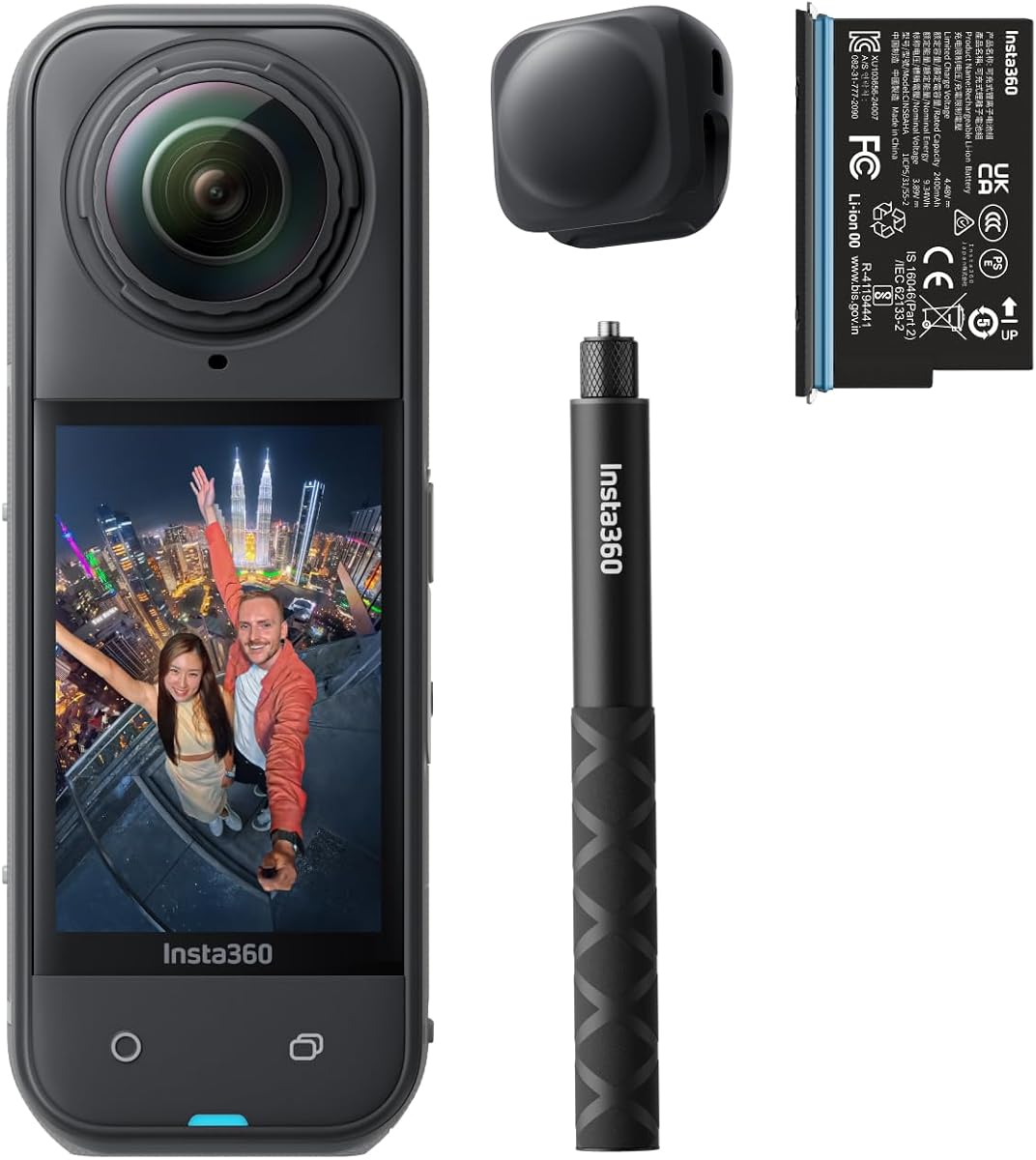
The Insta360 X6 Essentials Bundle is the premium selection here because it combines dual 1/1.1-inch square sensors with native 8K50fps 360 recording. Its 4.5 rating is strong despite being one of the more advanced products in the lineup. The camera is aimed at creators who want maximum image quality, flexible 360 perspectives, and more color latitude than a conventional action camera typically provides.
We may earn a commission when you buy through this link, at no additional cost to you.
A triple AI chip system includes a 4nm flagship processor and two professional imaging chips. This hardware supports 8K50fps 360 footage, 10-bit color with multiple profiles and filters, and InstaFrame 2.0 tracking. AI Director can organize footage while the camera charges, while Auto Edit 2.0 assists with vlog assembly. Flat ultra-wide output reaches 5K60fps, with 4K120fps also available for high-speed sequences.
Audio and serviceability receive notable attention. Wind-protected microphones capture sound from all directions while reducing wind interference, and the new replaceable lenses are designed to resist scratches. The Xtreme Battery is rated for up to 140 minutes at 8K30fps. The package also includes a fast-charge case, extra battery, invisible selfie stick, cable, protective pouch, and lens cloth, although storage media is not listed among the contents.
This is the camera to choose when 360 footage is central to your work and you want the highest resolution, richer color, advanced tracking, and premium hardware. The tradeoff is a substantial financial commitment and a more complex feature set than smaller models offer. Creators who mainly need 4K flat video may find the Ace Pro 2 more direct, while the X5 provides a strong middle ground.
Native 8K50fps recording provides a substantial resolution and frame-rate combination for 360 work. The large sensors also give the camera a strong foundation for detail, dynamic range, and more demanding production requirements.
Recording more than one billion colors gives editors additional latitude when shaping a final video. Insta360's color profiles and filters can also provide a more consistent starting point for quick social edits.
We may earn a commission when you buy through this link, at no additional cost to you.
The Insta360 X5 Starter Bundle offers an effective balance of resolution, endurance, low-light processing, and ruggedness. Its 4.6 customer rating is among the strongest in the group. Dual 1/1.28-inch sensors record 8K30fps 360 footage, while a triple AI chip design supports noise reduction and image processing in dim conditions. It is a strong all-around choice for mixed adventure and everyday shooting.
We may earn a commission when you buy through this link, at no additional cost to you.
Creative tools reduce the complexity of 360 production. AI-assisted reframing creates third-person views, InstaFrame Mode can track a subject and produce flat video, and one-tap export provides quick highlights without a full manual edit. FlowState Stabilization and 360-degree Horizon Lock keep the frame smooth and level. For conventional output, the camera can also record flat ultra-wide footage, although the X5's headline emphasis remains immersive capture.
The X5 improves the practical ownership experience with tougher, fully replaceable lenses, a four-microphone array, and a new Wind Guard designed to reduce wind interference. It is waterproof to 49 feet without a case. Its battery can run for up to 208 minutes and charge from zero to 80 percent in about 20 minutes. The trade-off versus the X6 is the lack of 8K50fps and smaller sensors.
Choose the X5 when you want a modern 360 camera that handles low light, long outings, and underwater use without forcing a premium-tier purchase. It also suits creators who value replaceable lenses because a scratched component can be changed without replacing the entire camera. For frame-rate-sensitive professional work, inspect the X6; for a smaller wearable format, consider the GO series.
Dedicated processing helps reduce noise and improve the clarity of dim footage. The X5 is therefore more convincing for evening rides, indoor events, and night activities than earlier 360 models with less capable imaging systems.
A 208-minute rated runtime supports extended recording sessions, while replaceable lenses reduce the concern of a minor scratch ending an entire adventure. Both features matter for cameras used outdoors in demanding environments.
We may earn a commission when you buy through this link, at no additional cost to you.
The Insta360 X5 Essentials Bundle is the most complete standard X5 package in this comparison and carries a 4.7 rating, the highest listed score among the ten products. It retains the X5's 8K30fps 360 recording, dual 1/1.28-inch sensors, and low-light-focused triple AI chip design while adding more useful travel accessories than the starter package.
We may earn a commission when you buy through this link, at no additional cost to you.
The included invisible selfie stick supports the camera's signature third-person visual effect, while the utility fast-charge case, carry case, lens guards, extra battery, and lens cap create a more complete field kit. The camera itself remains waterproof to 49 feet and offers up to 208 minutes of runtime. Its 360-degree Horizon Lock and FlowState Stabilization help it remain usable during active movement.
One important purchasing detail is that a microSD card is sold separately. That makes the listed bundle convenient for people who already own compatible storage, but it also means the complete ownership cost is not represented by the bundle contents alone. Another limitation is the lack of the X6's native 8K50fps mode and larger sensors. For conventional 360 work rather than high-frame-rate 360 capture, those differences may matter little.
This is an excellent recommendation for a buyer who wants the X5's strongest practical features without assembling a collection of accessories one at a time. It is particularly suitable for motorcycle travel, hiking, action sports, and family activities where the invisible selfie stick, fast charging, and protective carrying solution add convenience. The standard X5 is the better fit if you already own the major accessories.
The fast-charge case, carry case, extra battery, lens cap, standard lens guards, and 114-centimeter invisible selfie stick cover several common ownership needs. This reduces setup friction for new owners and travelers.
InstaFrame Mode can automatically frame a moving person, pet, or object, or users can select a fixed view. The full spherical recording remains available for discovering unexpected moments during the edit.
We may earn a commission when you buy through this link, at no additional cost to you.
The Insta360 Ace Pro 2 is the conventional action camera answer in this guide. It uses a 1/1.3-inch sensor and a Leica Summarit lens to produce 8K30fps footage, while Active HDR extends to 4K60fps. Its 4.5 rating indicates solid customer satisfaction, and the dual-battery bundle is a convenient option for long shooting days.
We may earn a commission when you buy through this link, at no additional cost to you.
The camera's dual-chip design combines a dedicated imaging processor with a 5nm AI chip for noise reduction and image processing. PureVideo Mode supports low-light capture up to 4K60fps, while the flip touchscreen provides 70 percent more pixel density, 6 percent more brightness, and improved durability according to the supplied details. A 157-degree lens and MegaView field of view create a wide perspective without abandoning the familiar action-camera design.
The practical advantages include magnetic accessory mounting, 4K Clarity Zoom, Gesture Control, Timecode, Pre-Recording, and compatibility with data overlays from phones, Apple Watch, and Garmin devices. It is waterproof to 39 feet and rated for temperatures as low as minus 4 degrees Fahrenheit. The drawback is obvious but important: it cannot capture native spherical 360 footage, so it lacks the shoot-first, reframe-later workflow of the X-series.
Choose the Ace Pro 2 for vlogging, motorcycle filming, diving, winter sports, and conventional action footage where a direct viewfinder-like experience matters. The large flip screen also makes solo creators comfortable framing themselves. If the defining benefit you want is invisible selfie-stick perspective and 360 reframing, the X5 or X6 is the more appropriate choice.
The large 1/1.3-inch sensor and Leica Summarit lens support detailed 8K recording and 13.5 stops of stated dynamic range. Leica color profiles give flat footage a more deliberate visual identity for travel and lifestyle edits.
PureVideo Mode applies AI noise reduction and brightness enhancement for dark environments. Its support up to 4K60fps makes it more flexible than a basic night mode restricted to lower frame rates.
We may earn a commission when you buy through this link, at no additional cost to you.
The Insta360 X4 Standard Bundle established much of the modern 360 formula still visible across the range: 8K recording, strong stabilization, a bright touchscreen, app-based reframing, and both immersive and conventional video modes. Its 4.6 rating reflects strong customer reception, and it remains relevant for buyers who want 5.7K60fps 360 footage and a 170-degree MaxView option.
We may earn a commission when you buy through this link, at no additional cost to you.
The camera can record 8K or 5.7K60fps 360 video with Active HDR. It also functions as a wide-angle action camera at 4K60fps or with a 170-degree field of view at 4K30fps. FlowState Stabilization and 360-degree Horizon Lock help maintain smooth, level footage, while the app lets creators reframe scenes after recording. That flexibility is especially useful during sports, rides, and family activities.
Its 2.5-inch Gorilla Glass touchscreen is large enough for direct control, and the standard bundle includes lens guards, a cable, cloth, protective pouch, and guide. The camera is waterproof to 33 feet without a dive case, cold resistant to minus 4 degrees Fahrenheit, and rated for 135 minutes of recording. Compared with the X5, the X4 has a shorter runtime, lacks the newer Xtreme-style battery system, and uses removable lens guards rather than the newer fully replaceable lens design.
Choose the X4 if you want proven 360 performance with strong resolution and wide-angle flexibility at a lower generation. It is a sound choice for creators who do not need the X5's longer battery, improved low-light processing, or serviceable lenses. The X6 is the option for maximum resolution and color depth, while the GO 3S serves users seeking a much smaller wearable camera.
At 5.7K60fps, the X4 can capture smoother 360 motion than standard 30fps modes. That is valuable during fast cycling, skiing, skateboarding, and other activities where rapid movement benefits from additional temporal detail.
The upgraded lens guards are easier to install and remove. Keeping them in place helps protect the exposed 360 lenses during transport and active use, although users should still handle the camera carefully.
We may earn a commission when you buy through this link, at no additional cost to you.
The Insta360 GO 3S is built around portability rather than conventional action-camera handling. At 1.4 ounces, the camera is small enough to wear, clip, or place in unusual positions, and its 4.2 rating reflects a more mixed customer response than the larger models. It is especially compelling for creators who want a body-mounted point of view without the presence of a full-size camera.
We may earn a commission when you buy through this link, at no additional cost to you.
The camera records 4K footage through a wide-angle lens with MegaView field of view, while FlowState Stabilization and Horizon Lock smooth and level the image. Its Action Pod has a 2.2-inch flip screen, remote control, live preview, and a battery rated for 140 minutes. The pod can also charge the camera while recording, which is useful for extended wearable sessions. QuickCapture, Gesture Control, and Voice Control reduce the need to touch the tiny body.
Mounting flexibility is the GO 3S's defining strength. Magnetic accessories allow it to become a pendant, clip, or compact action camera, and the supplied package includes a Magnet Pendant, Easy Clip, Pivot Stand, and Lens Guard. The camera is IPX8 waterproof to 10 meters, while the Action Pod is only IPX4 splash-resistant. A separate Dive Case extends underwater use to 60 meters, but the pod must stay out of water.
Choose the GO 3S for pet POVs, cycling, running, travel, family documentation, and hands-free vlogs. Its size makes it far less obtrusive than a 360 camera, and the pod still provides a screen for setup. If immersion, 8K resolution, or maximum low-light control matters more than compact dimensions, look to the X5, X6, or Ace Pro 2.
At only 39 grams, the camera can be worn with less distraction than a conventional action camera. It is particularly useful for activities where both hands are occupied and a stable point-of-view perspective adds more than polished flat framing.
Its flip touchscreen and remote controls make the separate camera easier to manage. Charging while shooting further improves the practical value of the pod for long walks, rides, and full-day family recordings.
We may earn a commission when you buy through this link, at no additional cost to you.
The Insta360 X4 Air emphasizes the advantages of 360 capture while reducing the weight of the camera body to 165 grams. Its 4.6 rating indicates broad customer approval, and the starter bundle includes an extra battery, a 114-centimeter invisible selfie stick, and a lens cap. It appeals to creators who want the X4 Air's reframe-later workflow without moving to a larger camera.
We may earn a commission when you buy through this link, at no additional cost to you.
Dual lenses record 8K30fps 360 footage, and 8K30fps Active HDR is available for stabilized daytime scenes with improved detail in highlights and shadows. The shoot-first, frame-later approach lets users record without continuously tracking a subject, then select perspective in the app. FlowState Stabilization and 360-degree Horizon Lock are applied automatically, making smooth level footage less dependent on careful camera movement.
Unlike the original X4, the X4 Air uses replaceable lenses, which can be swapped if damaged rather than requiring replacement of the full camera. It also features a built-in wind guard and 360 wind-protected microphones. The Insta360+ cloud service provides automatic file backup, cloud editing, one-tap sharing, and storage options. The main tradeoff is that it remains larger and more visually present than the GO series.
Choose the X4 Air for travel, motorcycling, group activities, and creators who prioritize flexible 360 perspectives but value a lighter body. It is a good middle ground between a tiny wearable camera and a conventional full-size 360 model. Buyers seeking stronger low-light processing, longer battery life, and fully waterproof operation should compare the X5.
The 165-gram design retains two lenses and complete spherical capture while remaining lighter than many full-size 360 models. That makes the X4 Air easier to carry throughout a day of activities.
Replaceable lenses are easier to manage than an exposed fixed assembly. If a lens is scratched or damaged, replacing that component can help restore performance without replacing the entire camera.
We may earn a commission when you buy through this link, at no additional cost to you.
The Insta360 GO Ultra combines a compact 53-gram camera with a larger 1/1.28-inch sensor and 4K60fps recording. Its 4.3 rating is positive but trails several larger models. The camera targets users who want hands-free footage and advanced software assistance in a body that can be worn or magnetically mounted almost anywhere.
We may earn a commission when you buy through this link, at no additional cost to you.
Video can be captured at 4K60fps, with 4K Active HDR available for demanding lighting. PureVideo Mode uses the sensor, 5nm AI chip, and processing tools to support low-light performance. FlowState Stabilization offers three levels, while 360 Horizon Lock keeps the image level. The standalone camera is rated for 70 minutes, and the Action Pod extends operation to up to three hours while also charging the camera rapidly.
The most distinctive feature is its AI voice assistant. The camera can provide real-time translation, answer questions by voice, work with image-based queries, and identify speakers through Voiceprint Recognition. Auto Editing finds highlights and assembles them with transitions and music, while FreeFrame Mode supports sharing in different aspect ratios. A microSD card is sold separately, which is an important storage consideration.
Choose the GO Ultra for travel, cycling, running, diving, and first-person vlogging where wearability and intelligent assistance outweigh the need for native 360 footage. Its 10-meter waterproof rating works without a case, and the optional Dive Case extends that depth to 60 meters. If 8K resolution, invisible selfie-stick effects, or maximum 360 framing flexibility is the goal, the X5 or X6 is the stronger fit.
Real-time translation, voice questions, image-based requests, and speaker identification can be helpful when a phone is inconvenient or impractical. The feature set adds value for travel-focused creators.
The Action Pod's 200-minute runtime and fast charging reduce interruptions during long activities. Charging the camera while shooting through the pod adds flexibility for multi-hour outings.
We may earn a commission when you buy through this link, at no additional cost to you.
The renewed Insta360 X5 combines current-generation 360 features with a 4.7 rating, tied for the highest score in the guide. It records 8K30fps video through dual 1/1.28-inch sensors and uses the same triple AI chip concept to support noise reduction and improved low-light performance. For buyers comfortable with renewed equipment, it offers a different ownership proposition from the standard bundles.
We may earn a commission when you buy through this link, at no additional cost to you.
InstaFrame Mode supports automatic subject tracking or a fixed flat view, while AI-assisted reframing turns the spherical recording into shareable perspectives. FlowState Stabilization and 360-degree Horizon Lock keep footage smooth and level. Fully replaceable, scratch-resistant lenses help protect the camera's core imaging system, and a four-microphone array with Wind Guard improves audio in outdoor conditions.
The renewed listing states a battery runtime of up to 185 minutes, which is shorter than the 208-minute figure listed for the standard X5 bundles. It is waterproof to 49 feet, charges to 80 percent in 20 minutes, and supports quick AI-assisted exports. The box includes the camera, USB-C cable, lens cloth, protective pouch, and guide. The invisible selfie stick and microSD card are sold separately.
The defining consideration is the renewed condition. Buyers should examine the seller's warranty, return terms, cosmetic details, battery expectations, and included accessories before choosing this option. When those terms are favorable, the renewed X5 is appealing for its high rating, modern sensor, low-light tools, and replaceable lenses. New-camera shoppers who prioritize battery capacity and a broader bundle may prefer the X5 Essentials Bundle.
Dual 1/1.28-inch sensors deliver 8K30fps 360 footage with improved clarity, color, and dynamic range. The X5 generation also emphasizes cleaner processing in dim scenes through its dedicated AI chip architecture.
Renewed status can make a capable model more attainable, but the exact condition and included components may vary. Checking warranty coverage, return eligibility, battery condition, lens surfaces, and accessory contents is essential before ordering.
We may earn a commission when you buy through this link, at no additional cost to you.
The right Insta360 camera depends on shooting style, image-priority, portability, and editing habits. These factors help narrow the field before comparing resolution, battery, protection, and bundle contents.
Insta360's lineup includes full 360 cameras, traditional wide-angle action cameras, and ultra-small wearable cameras. Full-size X-series models capture every direction and let you reframe afterward, which is valuable for group activities, travel, and action sports. The Ace Pro 2 provides a conventional wide view with a large flip screen and is easier for creators accustomed to standard action cameras. The GO 3S and GO Ultra place a tiny camera on a cap, pendant, or magnetic mount for a less intrusive first-person perspective.
Resolution is only one part of image quality, but it determines how much detail remains available for cropping and large displays. The X6 reaches native 8K50fps for 360 video, while the X5, X4, and X4 Air record 8K30fps. The X4 also offers 5.7K60fps for smoother motion, and the Ace Pro 2 records conventional 8K30fps plus 4K60fps Active HDR. Tiny GO cameras top out at 4K, but their compact size and stabilization are the reasons to select them rather than raw resolution.
Larger sensors generally provide a stronger foundation for detail, dynamic range, and low-light performance. The premium X6 uses dual 1/1.1-inch square sensors, the X5 uses dual 1/1.28-inch sensors, and the Ace Pro 2 uses a 1/1.3-inch sensor. The GO Ultra pairs a 1/1.28-inch sensor with a 5nm AI chip and PureVideo Mode, while the GO 3S is designed primarily around portability. Noise reduction and image processing matter most for evening rides, indoor events, and night sports.
All ten products provide stabilization, but the implementation and operating modes differ. Full-size 360 models combine FlowState Stabilization with 360-degree Horizon Lock, which is especially useful during complete camera rotations. The Ace Pro 2 also uses FlowState Stabilization for conventional action footage. The GO models add compact stabilization and three selectable levels on GO Ultra. Stabilization improves smoothness, but it cannot prevent motion blur from extreme movement or restore detail lost in poor light.
Runtime varies significantly by model, mode, and operating conditions. The X5 is listed at up to 208 minutes, GO Ultra's Action Pod at 200 minutes, and the X4 at 135 minutes. Fast charging can soften the impact of a depleted battery, with the X5 listed as reaching 80 percent in 20 minutes and GO Ultra's pod reaching 80 percent in 12 minutes. For long expeditions, carrying a spare battery or using a pod that charges the camera can be more valuable than a slightly smaller body.
The X5 is waterproof to 49 feet, Ace Pro 2 to 39 feet, X4 to 33 feet, and the standalone GO cameras to 33 feet. The GO 3S and GO Ultra can reach 60 meters with a Dive Case. Important distinctions apply: the GO Action Pod is splash-resistant rather than fully waterproof, and the X4 can reach 50 meters with its Invisible Dive Case. Cold resistance is also relevant for winter sports, with several models rated down to minus 4 degrees Fahrenheit.
Action footage often takes place in windy environments, so microphone design can materially affect the final result. The X5 and X4 Air use wind-protection systems, and the X6 features 360 wind-protected microphones intended to capture sound from all directions. The Ace Pro 2 includes a removable Wind Guard, while the GO 3S and GO Ultra use separate Action Pods. Owners should still use reasonable wind protection and monitor audio, because no compact camera can eliminate disruptive weather noise entirely.
The Insta360 app is central to the experience of 360 cameras. Reframing, subject tracking, 360-degree Horizon Lock, and export tools let users turn spherical footage into conventional flat clips. AI Director and Auto Edit 2.0 on the X6 assist with automated organization, while X5 one-tap export and automatic highlight creation speed up quick edits. GO models support FreeFrame, beat-based Auto Editing, and different social aspect ratios. The more assistance you want, the more dependent you become on the app and a capable phone or computer.
The same camera can arrive in meaningfully different bundles. The X5 Starter Bundle includes the camera, lens cap, battery, and invisible selfie stick, while the Essentials Bundle adds a fast-charge case, standard lens guards, and a carry case. The X6 package includes multiple batteries and charging accessories. The GO bundles supply mounting options such as a pendant, clip, and pivot stand. Some listings exclude microSD cards, and the renewed X5 excludes the selfie stick, so always compare what is actually included.
Before the first outing, format a compatible microSD card, update the camera and Insta360 app, confirm the battery and lens protection are secure, and understand the selected recording mode. Traditional cameras should be mounted and checked before the action begins, while 360 cameras can be pointed in any direction. Take a short test clip, review its stabilization and reframing, and verify that the microphones are unobstructed before relying on the setup for an important event.
For recording, use FlowState Stabilization and Horizon Lock when movement or rotation is likely. Keep the lenses clean, and use the available lens guards or replaceable lens system without blocking the field of view. On GO models, distinguish the waterproof camera from the splash-resistant Action Pod, and place the camera in its Dive Case before taking it beyond its standalone depth. When attaching the Invisible Selfie Stick, confirm the mounting joint and stick are secure.
After recording, transfer files promptly and back up important footage before formatting storage. Open the app to inspect stabilization, subject tracking, color, and audio, then export the exact views needed for the final edit. Keep lenses dry when possible, clean them with the supplied cloth, and avoid placing a dirty lens directly in a case. Check battery contacts, charging cables, seals, and mounts periodically, especially before outdoor, cold, or underwater use.
The Ace Pro 2 is the most conventional choice because it records flat wide-angle video and has a large 2.5-inch flip touchscreen for solo creators. The GO 3S and GO Ultra are better for hands-free point-of-view footage, while the X5 and X6 suit vloggers who want to reframe 360 scenes after recording. Your editing style and need for a visible screen are the most important distinctions.
Yes, the X3, X4, X4 Air, X5, and X6 use dual lenses to capture a complete spherical scene. That allows you to choose the visible direction after recording and can create third-person perspectives with an invisible selfie stick. The Ace Pro 2 and GO-series cameras are conventional wide-angle or wearable cameras and do not provide the same native 360 workflow.
The X6 is the premium model, featuring dual 1/1.1-inch sensors, native 8K50fps 360 recording, 10-bit color, AI Director, and an Xtreme Battery rated for 140 minutes at 8K30fps. The X5 uses dual 1/1.28-inch sensors, records 8K30fps, and offers a longer stated runtime of 208 minutes. The X5 generally represents the stronger balance of features and endurance, while the X6 prioritizes maximum image quality and high-frame-rate capture.
The standalone GO 3S and GO Ultra cameras have IPX8 waterproof ratings, but their Action Pods are only splash-resistant. A compatible Dive Case extends underwater capability to 60 meters. The pod and camera should be correctly separated for underwater use according to the instructions, and neither should be assumed to tolerate submersion merely because the camera body itself is waterproof.
A 360 camera is better when missing a decisive moment would be frustrating or when you want dramatic third-person views. It records every direction and offers broad reframing options after the fact. A conventional action camera is often simpler, produces a smaller file more directly, and makes framing on set easier. Riders and vloggers may also prefer the familiar preview and handling of a flip-screen model.
No, but some listings include storage while others explicitly sell it separately. The X5 Essentials Bundle and renewed X5 listing state that a microSD card is sold separately, and the GO Ultra also notes that storage is not included. The X5 Starter Bundle's supplied contents do not list a card. Confirm the package contents and use a compatible, reliable card with sufficient capacity for high-resolution 360 files.
The GO 3S and GO Ultra offer accessible editing through automatic highlights, FreeFrame output, and social aspect-ratio options. Full-size 360 models provide more comprehensive reframing and subject tracking, while the X6 adds AI Director and Auto Edit 2.0 for additional automation. Manual editors still get greater control from the X-series, whereas quick mobile edits are especially convenient on the GO models.
They can be valuable because the exposed lenses of a 360 camera are vulnerable to scratches, dust, and impacts. The X5, X6, and X4 Air support replaceable lens designs, allowing a damaged component to be changed rather than replacing the entire camera. The older X4 uses removable lens guards for protection, while the X3 relies on a different lens and guard arrangement.
The X5 Essentials Bundle is the strongest all-around recommendation, combining 8K 360 capture, improved low-light processing, replaceable lenses, long battery life, and a broad accessory set. The X6 stands above it for creators who need the highest image quality, 8K50fps recording, larger sensors, and ten-bit color. The X3 remains a compelling budget-oriented choice for buyers who want proven 360 and flat action-camera versatility without paying for the newest generation.
Prioritize the camera format that matches your work. Choose an X-series model when reframe-later creativity is important, the Ace Pro 2 for direct flat action footage, and a GO camera for discreet first-person recording. Within those formats, consider low-light performance, water resistance, battery life, replaceable components, and the amount of editing assistance you actually want to use.
Finally, verify the current listing, customer rating, bundle contents, warranty, and price before ordering. Deals and configurations can change, and a listing may swap accessories or include a microSD card without warning. Checking the present-day product page helps ensure the exact X-series, GO-series, or Ace Pro package matches your intended use.