
Denon DL-110
4.6Editor score
Standard MM phono input
Litz wire winding
Plug-and-play installation
High-output MC design
High Output Mc Cartridge guide comparing ten moving-coil models, including compatibility, stylus design, construction, output, and ideal turntable use.
A high-output moving-coil cartridge is designed to deliver a stronger signal than many low-output MC models, making it easier to pair with a broad range of turntables, amplifiers, and phono stages. The right cartridge should balance signal strength with refined tracking, accurate reproduction, robust construction, and compatibility with your existing system rather than simply producing the highest output available.
This guide compares ten moving-coil cartridges using the specifications and product information supplied for each model. We examine output characteristics, stylus and cantilever construction, magnetic and coil design, channel performance, tracking considerations, and practical system fit. The list includes several high-output designs, along with selected low-output models included to clarify important compatibility differences.
Each review explains what distinguishes its cartridge, where it fits best, and which system requirements deserve attention before buying. The comparison also makes clear that high output does not automatically guarantee compatibility, because phono-stage gain, input impedance, turntable wiring, and cartridge loading still matter. Product prices and availability can change, so check current listings and verify the exact version before ordering.
4.6Editor score

4.6Editor score

5.0Editor score
This side-by-side comparison organizes the ten cartridges by their most important visible and practical characteristics, while separating true high-output models from lower-output options that demand a more capable phono stage.




The Sumiko Blue Point No. 3 High Output MC Moving Coil Phono Cartridge earns a 4.6 rating and stands out as a carefully constructed reference-oriented design. Its selling point is not novelty but refinement: an open-body moving-coil structure, high-purity copper coils, and Japanese handcrafting come together in a cartridge explicitly made to maximize the refinement of an existing MC system.
We may earn a commission when you buy through this link, at no additional cost to you.
The open-body architecture can reduce unnecessary enclosure constraints around the generator, while the copper coil winding is intended to support clean signal generation. Sumiko describes the cartridge as part of its latest reference open-body MC range, which makes it appealing for listeners who value established cartridge engineering without necessarily pursuing the most specialized low-output design in the market.
The important caution is that this is specifically the high-output version, not the low-output Blue Point No. 3. It should therefore be easier to drive than many reference MC cartridges, but it still benefits from a phono stage with genuine MC capability and a sensible load setting. Its exact electrical requirements should be verified before installation, particularly when pairing it with an older receiver or a fixed-loading stage.
This is the strongest all-around choice for an enthusiast who wants a refined high-output MC cartridge and can provide a proper phono stage. It is particularly appropriate for listeners moving from a basic moving-magnet setup toward a more serious moving-coil system without taking on the burden of the lowest-output designs in this guide.
Sumiko's open-body approach is central to the Blue Point No. 3's identity, creating an open, visually direct generator architecture. That construction fits the cartridge's stated goal of refining the performance of a moving-coil system rather than concealing the generator in a conventional enclosed body.
The use of high-purity copper coils is one of the clearest technical distinctions in the supplied specifications. Copper wiring is a familiar cartridge material, and Sumiko applies it here as part of a handcrafted generator intended to provide a refined moving-coil signal.
We may earn a commission when you buy through this link, at no additional cost to you.
The Sumiko Songbird High Output MC Phono Cartridge has a 5.0 rating and belongs to Sumiko's prestigious Reference Series. Its open-architecture moving-coil design and long 7-micron stylus face make it a distinctive option for listeners seeking both technical refinement and an engaging presentation, particularly in classical-oriented systems.
We may earn a commission when you buy through this link, at no additional cost to you.
Sumiko specifically describes the Songbird as capable of bringing excitement to otherwise anemic classical system setups. That positioning is more revealing than simple marketing language: the cartridge is intended for a strong, articulate musical presentation rather than a soft or undemanding role. The open architecture gives the generator a visually distinctive form and serves as the foundation for the cartridge's design identity.
As a high-output model, the Songbird should be more approachable than a low-output reference cartridge, but it should not be mistaken for a moving-magnet cartridge. A system with a dedicated MC phono input gives you more control over gain and impedance. Owners should also respect the tracking requirements of the long stylus and make sure the turntable can accommodate the cartridge's physical and mechanical demands.
The Songbird is a compelling choice for classical listeners, vinyl enthusiasts, and anyone who wants a premium high-output MC with a measured 5.0 user rating. It is best in a system with a flexible, properly configured MC stage and a turntable capable of handling a more exacting cartridge.
The stated purpose of the Songbird is to add excitement to classical systems that may sound restrained. That makes it worth considering for listeners who want a cartridge with a clear musical character rather than a completely neutral option.
A 7-micron stylus face gives the Songbird a clearly defined geometry within the Sumiko range. It is one of the most useful visible distinctions when comparing this model with cartridges that use different stylus shapes and intended tracking behaviors.
We may earn a commission when you buy through this link, at no additional cost to you.
The Hana EL Series Moving Coil Cartridges hold a 4.8 rating and represent Hana's commitment to premium moving-coil design. Unlike a single-model listing, this product covers a family of cartridges, which gives knowledgeable listeners access to several levels of refinement while making careful version identification especially important.
We may earn a commission when you buy through this link, at no additional cost to you.
Hana is widely associated with hand-built phono cartridges, and the EL Series reflects the sort of specialist engineering for which the brand is known. The emphasis is on the relationship between stylus, cantilever, generator, and coil design rather than a single headline specification. That makes the series appealing to listeners who understand that cartridge performance emerges from the complete system.
The main complication is that the supplied product data identifies the item as a series rather than documenting the output, stylus shape, and loading requirements of every variant. Buyers should confirm the exact model, output level, stylus, and replacement availability before checkout. Matching a low-output EL model to an MM-only stage would undermine the very benefits the cartridge is designed to provide.
This listing is best recommended for an informed buyer who wants access to a respected premium moving-coil family and is prepared to verify the exact model. It suits listeners with a capable phono stage and the patience to match the cartridge, load, and tonearm carefully.
The EL Series provides access to a broader Hana platform instead of a single isolated model. For listeners comparing specifications, that range can offer a clearer path toward finding a cartridge suited to a particular system and musical preference.
Because the listing covers a series, the final choice should be confirmed before ordering. Check the output, stylus geometry, tracking force, load impedance, and included hardware rather than assuming every EL model behaves identically.
We may earn a commission when you buy through this link, at no additional cost to you.
The Hana MC Moving-Coil Stereo Cartridge with Nude Microline Tip – MH has a 5.0 rating and stands out as the premium high-output choice in this roundup. The MH designation matters because Hana also makes a closely related low-output ML version, allowing buyers to choose according to their phono-stage gain rather than treating both versions as interchangeable.
We may earn a commission when you buy through this link, at no additional cost to you.
Its Nude Microline stylus is the defining visible feature. A nude stylus offers an open, minimally interrupted path between the record groove and the generator, while the Microline profile is designed for refined reproduction. The result is a cartridge with a clear specialist identity, appropriate for a high-quality phono stage and a turntable capable of precise installation.
Compared with the ML, the MH's higher output makes it the more practical version for a wider range of MC-capable equipment. That does not eliminate the need to check loading, but it can reduce gain-related complications. Listeners should still confirm the manufacturer's requirements, tonearm compatibility, and tracking setup before installation.
The Hana MH is our premium pick for buyers who want a high-output moving coil with a distinctive stylus and specialist construction. Its 5.0 rating, explicit high-output configuration, and premium Hana identity make it particularly attractive for a serious but not excessively specialized system.
Choosing the MH over Hana's ML model gives the buyer a more accessible output level while retaining the range's specialist moving-coil approach. It is a practical distinction for systems whose phono stage has limited gain.
The nude Microline tip provides the cartridge with an immediately identifiable design and a refined stylus profile. It rewards careful alignment, an appropriate tracking force, and a tonearm with stable, adjustable geometry.
We may earn a commission when you buy through this link, at no additional cost to you.
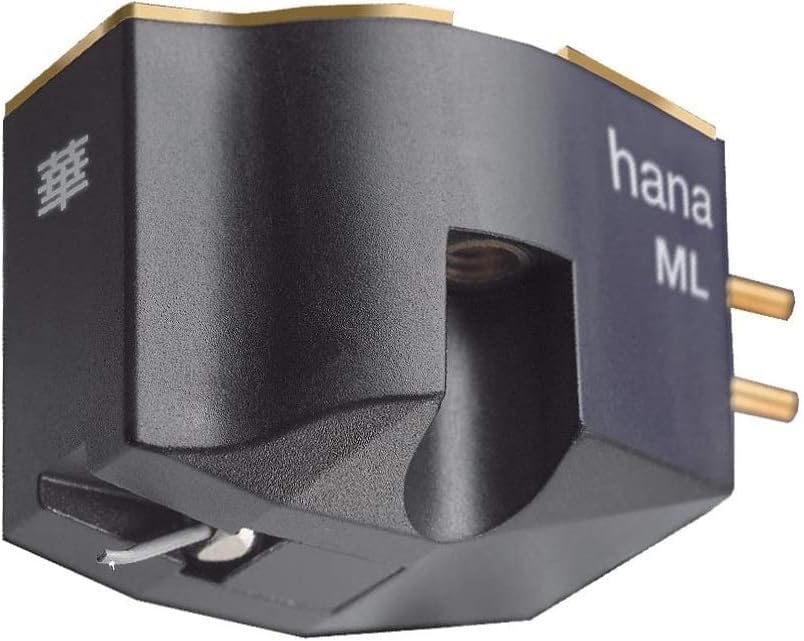
The Hana MC Moving-Coil Stereo Cartridge with Nude Microline Tip – ML has a 5.0 rating and shares the visual and mechanical sophistication of the MH, but it is explicitly the low-output version. It belongs in this guide because comparing the two Hana models makes the importance of phono-stage gain unusually clear.
We may earn a commission when you buy through this link, at no additional cost to you.
The Nude Microline stylus is the headlining feature, presented on a premium moving-coil stereo cartridge. Its fine stylus construction is intended for accurate reproduction and careful tracking, while the generator requires an appropriately sensitive phono stage to translate the low output into a usable line-level signal.
The ML should not be connected to a standard MM phono input simply because it uses a moving-coil generator. A suitable step-up transformer, head amplifier, or high-gain MC preamplifier is needed. Attempting to use it without sufficient gain can produce a weak, distorted, or otherwise compromised result that falsely suggests a problem with the cartridge.
The Hana ML is best for listeners with a dedicated high-gain MC stage who want a premium low-output cartridge and understand the extra system requirements. It is not the most direct choice for the keyword, but its inclusion highlights why you should verify output specifications before choosing any moving-coil cartridge.
The low-output designation defines how the ML must be used. A compatible, high-gain MC phono stage is essential, and an MM-only input is not a viable substitute for the required amplification.
The shared Microline stylus design gives the ML a refined profile, but achieving its intended performance still depends on accurate alignment, suitable tracking force, and a turntable that can support the cartridge's mechanical requirements.
We may earn a commission when you buy through this link, at no additional cost to you.
The Denon DL-110 High Output Moving Coil Cartridge [Electronics] has a 4.6 rating and offers one of the most approachable ways to enter the moving-coil category. Its plug-and-play positioning and high-output design reduce the usual barrier associated with MC cartridges, especially for listeners whose amplifier or receiver has only a standard MM phono input.
We may earn a commission when you buy through this link, at no additional cost to you.
Litz wire is the notable construction detail in the supplied information. The cartridge's high-output moving-coil design is the key practical advantage, allowing it to produce a stronger signal than many specialized MC models. That additional output can make a familiar phono stage work more comfortably while preserving the lower noise and detail associated with a moving-coil generator.
The trade-off is that the Denon is positioned around convenience rather than exotic construction. Dedicated high-end cartridges may offer more elaborate styluses, bodies, or generator systems, but those benefits can require greater gain and more deliberate system matching. The DL-110 focuses on making the MC experience accessible and immediate.
This is the best budget choice for a new moving-coil owner, an owner of an MM-capable receiver, or anyone seeking a simple cartridge upgrade without a separate step-up device. It is especially useful when system compatibility and ease of use are more important than chasing exotic specialist design.
The high-output approach makes the DL-110 straightforward to compare with moving-magnet alternatives. It offers moving-coil technology while reducing the likelihood that available gain will become the first obstacle.
Litz wire is the defining technical feature listed for this model. It supports the cartridge's practical construction story and makes the DL-110 appealing to listeners who value a recognized design feature without navigating a complex specialist installation.
We may earn a commission when you buy through this link, at no additional cost to you.
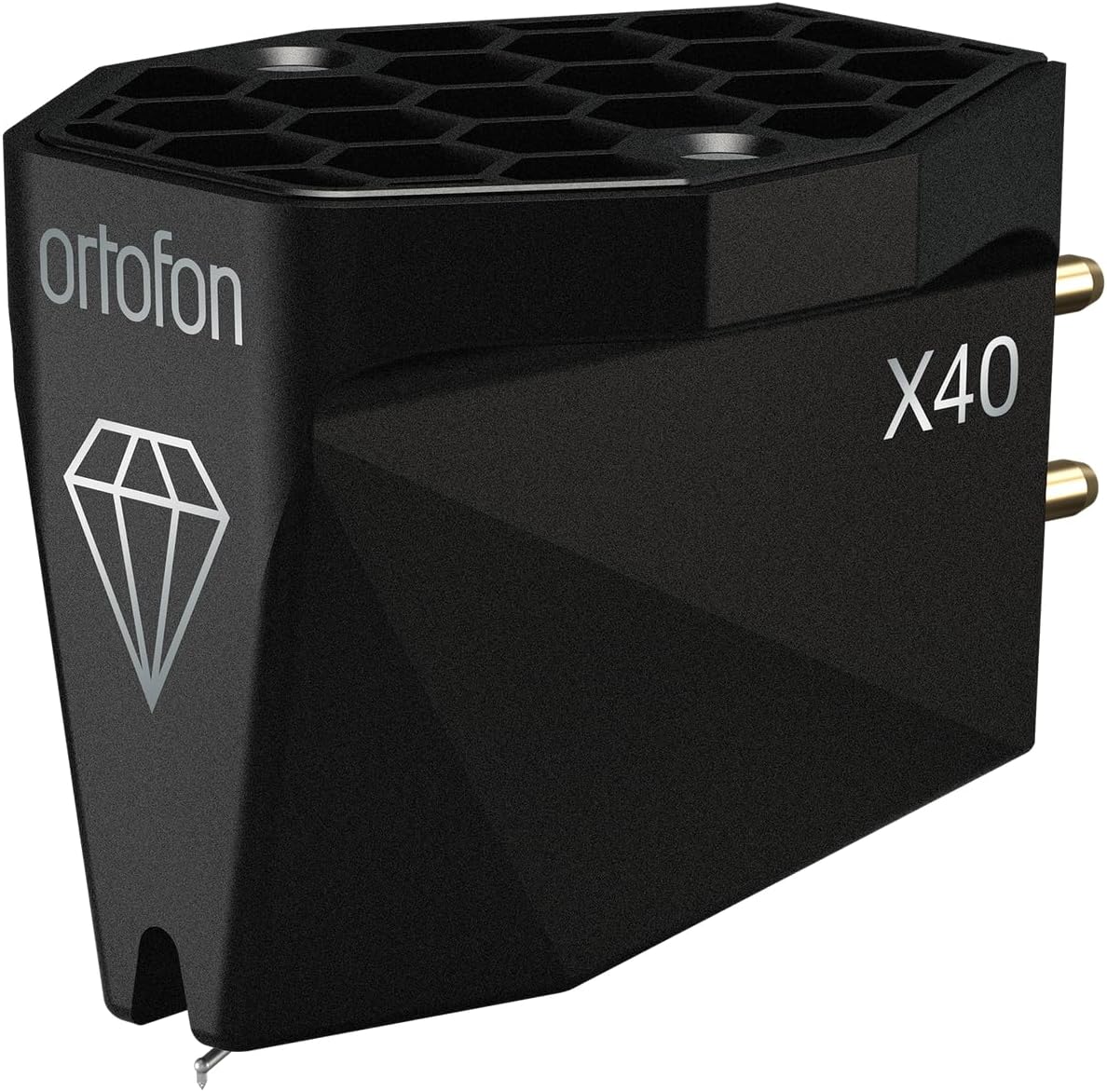
The Ortofon MC X40 Moving Coil Phono Cartridge with Nude Shibata Stylus and Boron Cantilever carries a 4.4 rating and brings unusually complete engineering information to this roundup. It combines a 0.4 mV output, a nude Shibata diamond stylus, a boron cantilever, and a pure silver winding system in a model presented as the pinnacle of Ortofon's MC X Series.
We may earn a commission when you buy through this link, at no additional cost to you.
The generator is built around a newly developed magnet arrangement with a one-piece pole cylinder integrated into a rear magnet yoke. The stated aim is greater magnetic efficiency and a clean signal path. Quad coils use high-purity silver wire, while custom rubber dampers are designed to stabilize the moving coils, minimize unwanted vibration, and improve tracking behavior.
The specifications are precise: 0.4 mV output at 1 kHz and 5 cm per second, 26 dB channel separation, a frequency response of 20 Hz to 20 kHz within plus or minus 1 dB, dynamic lateral compliance of 15 micrometers per millinewton, a 2.0-gram recommended tracking force, and a recommended load resistance above 50 ohms. The cartridge weighs 8.6 grams.
The MC X40 is for owners of a proper MC phono stage and a turntable capable of handling a 2.0-gram tracking force. Its output is lower than the classic high-output MC models in this list, so it is better viewed as a premium, low-to-moderate-output option. Buyers who want a high-output cartridge should be careful not to confuse strong construction with a high output rating.
The MC X40 uses quad coils wound with high-purity silver wire. Ortofon presents this material choice as a means of improving signal clarity and preserving detail, making it a central reason to consider the cartridge beyond its styling.
Custom-developed rubber compounds form the damping system. Ortofon explains that they control coil movement, improve stability, reduce unwanted vibrations, and support precise tracking, which is especially relevant when pairing a 2.0-gram recommended setting with a high-quality tonearm.
We may earn a commission when you buy through this link, at no additional cost to you.
The Denon DL-110 High Output Moving Coil Cartridge has a 4.1 rating and makes a strong case for versatility. Its 1.6 mV output allows it to work with standard MM phono inputs in amplifiers and receivers without requiring a step-up transformer, head amp, or pre-preamplifier.
We may earn a commission when you buy through this link, at no additional cost to you.
The supplied description highlights quick transient response, articulation, clear highs, a detailed and accurate midrange, and rich, powerful bass. Construction details include a traditional cross-shaped armature, weight-balance plate, dual-construction cantilever, and a vibration center with two-way damping. The stylus is described as a special elliptical solid diamond with a rectangular cross section of 0.1 by 0.2 millimeters.
Its 160-ohm output impedance and 1.6 mV output make it a practical MC choice, although those figures still benefit from confirmation in the current product documentation and system manual. The lower rating compared with many other entries may reflect varied customer experiences, so prospective buyers should consider recent reviews and ensure their amplifier provides the required grounding and connection configuration.
This listing is recommended for owners who want a higher-output MC without replacing their phono stage. It is particularly useful for broad turntable compatibility and simple integration, while buyers seeking a more elaborate specialist cartridge may prefer the Hana or Ortofon alternatives in this guide.
A 1.6 mV output is high enough for the Denon to be used with many standard MM phono inputs. That removes the need for a dedicated step-up device and makes it one of the most approachable moving-coil upgrades in the roundup.
The cross-shaped armature, balance plate, dual-construction cantilever, and vibration center illustrate the attention paid to the cartridge's mechanical behavior. These features are central to Denon's articulation and tracking claims.
We may earn a commission when you buy through this link, at no additional cost to you.
The Audio-Technica AT-ART9XA Dual Moving Coil Cartridge has a 5.0 rating and uses a dual moving-coil system to emphasize channel separation, sound localization, and low distortion. The generator coils are arranged in an inverted V shape, creating a distinctive configuration intended to support wide, evenly reproduced soundstage information.
We may earn a commission when you buy through this link, at no additional cost to you.
A Shibata stylus handles high and mid-low frequency reproduction, while the boron cantilever is chosen for response characteristics. The magnetic circuit is specially designed to optimize energy in the gap where the generator coils sit. Audio-Technica also redesigned the armature, increasing the coil's cross-sectional area by 20 percent and producing a 0.2 mV output voltage.
The coils use PCOCC, or Pure Copper Ohno Continuous Cast, wire to support signal transfer. Even with that carefully engineered construction, the 0.2 mV output places the AT-ART9XA firmly in the specialist low-output category. It needs a high-gain phono stage, and standard MM inputs are not an appropriate substitute.
This cartridge is best for a dedicated vinyl system with a capable MC preamplifier or step-up transformer. It appeals to listeners who prioritize spatial precision, detailed stylus engineering, and premium moving-coil construction, but it is less convenient for the high-output keyword than the Denon, Sumiko, or Hana MH options.
The dual moving-coil arrangement places the generator coils in an inverted V. Audio-Technica links this architecture to high separation, wide response, clear localization, and minimal distortion.
The larger generator coil cross section is designed to improve output and signal efficiency. Combined with the special magnetic circuit, it is one of the most significant engineering changes distinguishing the AT-ART9XA.
We may earn a commission when you buy through this link, at no additional cost to you.
The Denon DL-110 Moving Coil Cartridge carries a 4.8 rating and presents a compact specification profile that makes it easy to understand. It outputs 1.6 mV, remains compatible with MM inputs, covers a stated 20 Hz to 45 kHz frequency range, offers 25 dB channel separation at 1 kHz, and has 1 dB channel balance at 1 kHz.
We may earn a commission when you buy through this link, at no additional cost to you.
Those figures make the cartridge appealing for a broad home-audio audience. A 1.6 mV output provides a useful margin over a typical moving-magnet cartridge while remaining manageable for many integrated amplifiers and receivers. The wide frequency-response claim suggests that the cartridge is designed to cover the audible range and extend beyond it, while the channel-separation figure reflects attention to stereo performance.
The measurement data should not be confused with an assurance that every installation will sound identical. Cartridge alignment, tonearm geometry, tracking force, record condition, phono-stage topology, and loading all influence the result. Nevertheless, a clear 1 dB channel balance and specified separation indicate a properly balanced stereo product rather than an unspecified generic MC cartridge.
The Denon DL-110 is a good value-oriented choice for a first moving-coil upgrade, especially when the rest of the system includes a standard MM phono input. It is also a dependable benchmark against which more specialized high-output cartridges can be compared.
The 1.6 mV output, 25 dB separation, and 1 dB balance give buyers a clear set of performance figures. Those specifications make system matching more objective than relying on a cartridge's output designation alone.
A stated 20 Hz to 45 kHz response range covers the core musical spectrum with meaningful extension above the audible range. It is one of the clearest reasons to consider this listing as a specification-driven option.
We may earn a commission when you buy through this link, at no additional cost to you.
The best high-output moving-coil cartridge is the one that matches your phono stage, tonearm, turntable, and musical priorities. Output voltage is only the starting point because impedance, stylus geometry, tracking force, and system cleanliness influence the result as well.
Output voltage tells you how much electrical signal the cartridge generates, and it determines how much amplification the phono stage must provide. A high-output MC generally produces more signal than a low-output MC, which can make it easier to use with an existing MM-capable amplifier. Models such as the Denon DL-110 are described as producing 1.6 mV, while the Ortofon MC X40 produces 0.4 mV and the Audio-Technica AT-ART9XA produces 0.2 mV. Those differences materially change system requirements.
In short, select enough output for your phono stage's gain, but do not treat the largest available output as automatically the most refined choice.
A moving-coil cartridge needs a phono input with adequate gain and a suitable load impedance. Some high-output models are specifically designed to operate with standard MM inputs, but even those products can benefit from a dedicated MC stage. Dedicated stages often provide more control over loading and gain, allowing the cartridge's characteristics to be used more effectively.
In short, confirm that your amplifier or preamplifier supports moving-coil cartridges, or plan to add a suitable step-up transformer or head amplifier before installation.
Load impedance describes the effective resistance presented to the cartridge by the phono stage. The relationship between cartridge impedance and phono-stage loading affects output level, frequency response, and noise performance. The Ortofon MC X40 recommends a load resistance above 50 ohms, while the Denon DL-110 is listed at 160 ohms. Variable-load stages offer useful flexibility when a cartridge is new to your system.
In short, match the cartridge manufacturer's recommended load to the phono stage and avoid assuming that every MC input is electrically identical.
The stylus shape affects how the cartridge contacts the record groove and the type of record surface for which it is best suited. The Sumiko Songbird uses a 7-micron stylus face, the Hana MH and ML use Nude Microline tips, the Ortofon MC X40 uses a nude Shibata diamond, and the Denon DL-110 uses an elliptical solid diamond. Fine and specialized geometries often demand more careful alignment and can be less forgiving of setup errors.
In short, consider both stylus construction and your listening habits, and favor a design whose tracking requirements fit your turntable and record collection.
The cartridge must be mounted at a tracking force compatible with the tonearm's geometry and adjustment range. The Ortofon MC X40 recommends 2.0 grams, a useful figure for comparing with premium arms. A cartridge's effective weight, cantilever design, and compliance also influence how it interacts with the arm. Installing outside the intended range can impair tracking or produce poor results even when the cartridge itself is excellent.
In short, check the cartridge weight, recommended force, arm compatibility, and alignment requirements before removing your current cartridge.
Coil material, magnet geometry, damping, and armature design influence efficiency, signal clarity, and mechanical control. The Sumiko Blue Point No. 3 uses high-purity copper coils, the Ortofon MC X40 uses pure silver quad coils and custom rubber dampers, and the Audio-Technica AT-ART9XA uses an inverted V dual-coil arrangement with PCOCC wire. These differences are meaningful, but they work as parts of complete generators rather than isolated guarantees of sound quality.
In short, look for a coherent generator design, then consider how its output, impedance, and mechanical behavior fit your phono stage and tonearm.
Premium cartridges often use refined bodies, carefully machined components, and hand assembly to improve structural stability and reduce unwanted vibration. The Sumiko Blue Point No. 3 is hand-crafted in Japan, the Denon DL-110 combines a cross-shaped armature with a vibration center and two-way damping, and the Hana cartridges emphasize specialist moving-coil construction. Build quality is especially relevant when a tonearm operates at low tracking forces.
In short, consider rigidity, vibration control, and manufacturing consistency, but prioritize electrical and mechanical compatibility over cosmetic prestige.
A cartridge cannot reveal its full potential when the turntable, tonearm, phono stage, amplifier, speakers, and records are poorly matched. A simpler cartridge may sound more cohesive in a modest system, while a demanding specialist can be ideal when every other component supports its requirements. Consider the existing system's noise floor, gain, bass response, and tonal character before making a change.
In short, buy the least demanding cartridge that meets your performance goals, then improve the surrounding system gradually when ready.
Before installation, confirm that the cartridge is the exact output version you intended, especially for ranges such as Hana that include closely related high- and low-output models. Read the manufacturer's loading, tracking-force, and compatibility requirements, and check that your phono stage offers sufficient gain and the recommended impedance. Keep the original packaging until installation is complete because the stylus is delicate and the mounting hardware is easy to misplace.
When changing a moving-coil cartridge, switch off and unplug the turntable, remove the old cartridge carefully, and avoid twisting the delicate pin connectors. Install the new body squarely according to the arm manufacturer's alignment procedure, tighten the mounting screws evenly, and set the tracking force only after the tonearm is properly positioned. Take care not to touch the stylus, cantilever, or signal pins with bare fingers.
After installation, set the cartridge's vertical alignment and tracking force, then check the manufacturer-recommended load and capacitor settings on the phono stage. Play several familiar records, varying music and recording quality, and listen for stable centering, clean transients, balanced channels, and quiet operation. If the sound is weak, distorted, or unbalanced, revisit gain, grounding, loading, and alignment before concluding that the cartridge is faulty.
A high-output moving-coil cartridge uses a moving generator and produces a stronger signal than a low-output MC model. That extra output can make it easier to drive with existing phono equipment, although a dedicated MC input remains preferable. The important requirements are sufficient gain, a compatible load impedance, and correct wiring.
Some high-output models are specifically designed to work with standard MM phono inputs, including the Denon DL-110 versions described here. Other cartridges may produce enough output for an MM input while still benefiting from an MC stage. Check the manufacturer's output and loading requirements before making the connection.
No. Moving-coil is a generator technology, not an output classification. Some MC cartridges provide a comparatively generous signal, while specialist models such as the Audio-Technica AT-ART9XA at 0.2 mV need substantial gain. Always compare the stated output voltage with the capabilities of your phono stage.
It depends on the cartridge and phono stage. A high-output model may work with an MM-compatible input, but a step-up transformer can still provide better control of gain and impedance. Low-output cartridges generally require a dedicated high-gain MC stage or a suitable step-up device.
Use the impedance range recommended by the cartridge manufacturer and supported by your phono stage. The Ortofon MC X40, for example, calls for a recommended load resistance above 50 ohms. If your preamplifier offers adjustable loading, compare several settings only after establishing a secure baseline.
It depends on the design and the manufacturer's requirements. The Ortofon MC X40 lists a recommended tracking force of 2.0 grams, while other cartridges may require different values. Use the specified range rather than copying a force from another cartridge, and confirm that your tonearm can support it.
Correct installation normally produces stable tracking, clean silence, balanced volume between channels, and clear transients without obvious distortion. If problems occur, check alignment, tracking force, grounding, phono-stage gain, load impedance, and connections. Replacing the cartridge before checking these fundamentals can hide a simple setup issue.
The stylus should be handled carefully and kept away from dust, but unnecessary cleaning can cause more harm than good. Use a purpose-made stylus cleaning method when contamination is evident, avoid aggressive liquids, and never touch the stylus with fingers. A good protective cover and a clean record-cleaning routine are safer preventive measures.
The Denon DL-110 is the practical budget selection because its high output and MM-input compatibility reduce setup complexity. The Sumiko Blue Point No. 3 is the most balanced overall choice for a dedicated moving-coil system, while the Hana MH stands out as the premium high-output pick for listeners who value specialist construction and a Nude Microline stylus.
Prioritize phono-stage gain and load compatibility before stylus preference or construction details. The Songbird, MH, and Denon options align more directly with the high-output concept, while the MC X40 and AT-ART9XA require a more capable stage despite their refined engineering. Confirm the exact model, mounting requirements, and recommended settings before making a purchase.
Current prices, listings, and availability can change, so review the live product page and technical documentation before ordering. Taking time to match the cartridge with your turntable, tonearm, phono stage, and records will produce a more satisfying result than choosing on cartridge name alone.