
LFSYS 25 Pcs DIY Cup Cover Fruit Fly Traps for Indoor
4.6Editor score
Covers cups with sticky cards
Double-sided adhesive catches both sides
No added chemicals or fragrances
Discover the best fruit fly traps by comparing lure, light, suction, coverage, refill design, placement needs, and ease of cleanup.
Fruit fly traps work best when they are attractive, discreet, and placed near the places where flies gather. The most effective options use liquid bait, light attraction, or a combination of both, while convenient refill systems help maintain control without creating additional clutter or mess.
We compared ten indoor traps across attraction method, pack configuration, coverage, monitoring features, noise, and cleanup. The list includes ready-to-use lure traps, DIY cup covers, plug-in adhesive devices, and light-and-suction models for shoppers seeking different levels of automation.
Each review explains the strongest feature, practical limitations, and ideal placement for every product. Ratings and product details reflect the supplied information, while prices and availability can change, so check the current listing before choosing.
4.6Editor score
4.9Editor score

4.3Editor score
The comparison below highlights each trap's attraction method, package contents, monitoring features, and practical advantages. These differences help distinguish simple lure traps from automated light-and-suction systems and DIY adhesive solutions.


The TERRO Fruit Fly Trap 4-Pack combines food-based liquid bait with a small apple-shaped housing that is designed to sit near common fruit fly problem areas. It holds a 3.9 rating, and its strongest qualities are simplicity, broad package coverage, and the ability to monitor catches without opening the trap.
We may earn a commission when you buy through this link, at no additional cost to you.
Each trap is ready to use and is described as offering up to 45 days of continuous protection. Together, the four traps provide 180 days of lure supply. That makes the set practical for distributing traps around fruit bowls, trash cans, and kitchen counters instead of concentrating every trap in one location. The non-staining formula and lack of required mixing also simplify routine use.
The main limitation is that this is a passive lure trap rather than an electrically powered system. It cannot actively pull insects from an entire room, and its effectiveness depends on correct placement near breeding areas. The lure supply also eventually runs out, so the product is best understood as a targeted and repeatable control method rather than a permanent appliance.
Choose this set if you prefer a simple, quiet, and discreet option that can be positioned throughout a kitchen. It is especially suitable for households that know where fruit flies tend to gather and want to address several hotspots without adding electrical devices to the countertop.
The apple-shaped housing is intended to blend into a fruit display, while monitoring windows make it easier to see accumulated insects and remaining lure. That combination suits kitchens where conspicuous pest-control equipment could be inconvenient.
Four separate traps can be placed near different sources, such as produce bowls, refuse containers, and counters. Distributed placement often makes more sense than relying on one trap to cover an entire home.
We may earn a commission when you buy through this link, at no additional cost to you.
The TERRO Fruit Fly Trap 6-Pack is the expanded counterpart to the four-pack, carrying a 3.9 rating and 270 days of total lure supply. It is built for households that want to place multiple passive traps around several fruit fly hotspots or across separate rooms.
We may earn a commission when you buy through this link, at no additional cost to you.
The six-trap configuration offers greater placement flexibility than a smaller set. Each trap can remain near a fruit bowl, trash can, countertop, or other breeding area without requiring electrical outlets or a central device. Food-based liquid bait attracts flies, and the non-staining formula needs no preparation before use.
Its trade-offs reflect those of lure-based control generally. Performance is strongest where flies are already active, and the traps do not use light, suction, or electronic monitoring. Buyers who only have one persistent source may not need all six units and could create unnecessary visual clutter.
This pack makes the most sense for larger homes, shared kitchens, or anyone who wants to establish several monitoring points at once. It is a straightforward choice for shoppers who value longevity, low-tech operation, and the ability to move traps as problem areas change.
Six units provide enough flexibility to establish a wider monitoring network. Moving a trap toward a newly active source can be more useful than maintaining a single fixed location throughout an infestation.
The stated 270-day lure supply provides a long operating window, with each trap described as lasting up to 45 days. This reduces the need for frequent replacement compared with shorter-lived cup-and-card methods.
We may earn a commission when you buy through this link, at no additional cost to you.
The Zevo Flying Insect Trap with one base and three refills uses blue and UV light to attract flying insects and hold them on a wall-facing adhesive cartridge. Its 4.2 rating reflects a well-rounded package for shoppers who want continuous indoor operation without aerosol sprays.
We may earn a commission when you buy through this link, at no additional cost to you.
The plug-in design works around the clock, while the disposable adhesive cartridge keeps captured insects hidden from direct view. Removal is simplified by a no-mess tab, and a blinking light provides a reminder to inspect the cartridge every six weeks. The package includes one base and three cartridges, giving buyers several replacement cycles.
Compared with a simple cup trap, this model offers a more automated approach and broader suitability for living rooms, bathrooms, kitchens, and enclosed patios. Its drawbacks are dependence on an outlet and a larger physical footprint. The blue light is also a deliberate operating feature rather than something that disappears completely when the unit is plugged in.
This is a good fit for one problem area where continuous light attraction is desirable. It suits households that want a discreet, odor-free, spray-free system and are comfortable mounting a plug-in device near the source of activity.
Blue and UV light provide ongoing attraction, while the cartridge captures insects on a hidden adhesive surface. The approach avoids spraying, zapping, and added odors, making it convenient for occupied indoor spaces.
The blinking indicator prompts a cartridge check every six weeks. That built-in cue is useful for households that might otherwise forget to inspect a plug-in trap until it becomes visibly full.
We may earn a commission when you buy through this link, at no additional cost to you.
The Zevo two-base package is the most versatile of the Zevo configurations in this roundup, combining two plug-in devices with two adhesive cartridges. It carries a 4.3 rating and is designed for fruit flies, gnats, house flies, and other small flying insects.
We may earn a commission when you buy through this link, at no additional cost to you.
Each base uses blue and UV light for continuous attraction and a wall-facing adhesive pad to conceal caught insects. A no-mess tab simplifies replacement, while the blinking light reminds users to check every six weeks. The two-base format is especially useful when separate rooms or two distinct problem areas need simultaneous attention.
The package requires access to two suitable outlets, and it includes only two initial cartridges. Buyers who intend to use the devices extensively may want to plan for additional refills. Otherwise, the system avoids sprays, strong odors, and high-voltage zapping, which can make it easier to integrate into an occupied home.
Choose this option for a multi-room setup or a household that values a high-capacity, low-visibility capture system. It is the strongest choice here for users who want more placement flexibility than a single plug-in trap without moving to a larger light-and-suction appliance.
The two bases can serve separate kitchens, living areas, or other gathering zones. This avoids concentrating one device in a location where flies are rarely found.
The disposable cartridge holds insects on its adhesive surface and can be removed using the included tab. The wall-facing orientation helps keep captured insects out of prominent view.
We may earn a commission when you buy through this link, at no additional cost to you.
The LFSYS 25-piece DIY cup-cover system offers a highly flexible approach to fruit fly control. It has a 4.6 rating and uses double-sided sticky cards placed over cups containing apple cider vinegar, wine, or another preferred attractant.
We may earn a commission when you buy through this link, at no additional cost to you.
The package contains 25 clear cards, allowing repeated traps to be made across multiple rooms. Because both sides are adhesive, flies can be caught after landing from above or entering from inside the cup. The card acts as a barrier that also helps limit splashes, making the setup more controlled than an uncovered container.
The trade-off is that it is not a ready-made trap. Buyers must provide a cup and liquid attractant, and the card may need a new cup or refreshed bait during continued use. It is also less self-contained than a pre-filled apple-shaped trap, although the clear design remains low-profile.
This is the best budget choice for flexible, hands-on control. It works well for renters, students, and households that want to experiment with different baits or relocate traps frequently without investing in powered equipment.
Because the cards work with apple cider vinegar, wine, or another preferred attractant, shoppers can adapt the setup to available ingredients. This flexibility makes the system useful for testing what fruit flies respond to in a particular home.
The adhesive card covers the cup opening, reducing direct contact with liquid bait. It captures insects on its sticky surfaces while preserving a clean, low-profile appearance on the counter.
We may earn a commission when you buy through this link, at no additional cost to you.
This adjustable-light fruit fly trap combines an attracting light with strong suction and a sticky pad to retain captured insects. Its 4.4 rating makes it a compelling option for shoppers who want an electric countertop device that remains relatively discreet.
We may earn a commission when you buy through this link, at no additional cost to you.
Two light modes and simple controls allow the illumination to be adjusted for different conditions. The product is advertised for mosquitoes, fruit flies, gnats, moths, and other flying insects, making it more broadly useful than a lure designed only for fruit flies.
The supplied guidance recommends placing the unit in a dimly lit area and running it for more than 12 hours for the first use. This creates a learning curve compared with an immediately placed bait trap, and the light and suction may still create a more noticeable countertop presence. The bottom tray makes pad replacement straightforward once insects accumulate.
Choose this model for bedrooms, living rooms, offices, or kitchens where a low-noise electric trap fits the decor and a longer operating period is realistic. It is particularly attractive to users who prefer mechanical capture over exposed liquid bait.
The light draws nearby flying insects while suction helps pull them into the trap. Sticky pads then retain the catch, combining active capture with a simple cleaning method.
One button controls power and another adjusts lighting. When a pad becomes covered, the bottom tray opens for removal and replacement without dismantling the entire unit.
We may earn a commission when you buy through this link, at no additional cost to you.
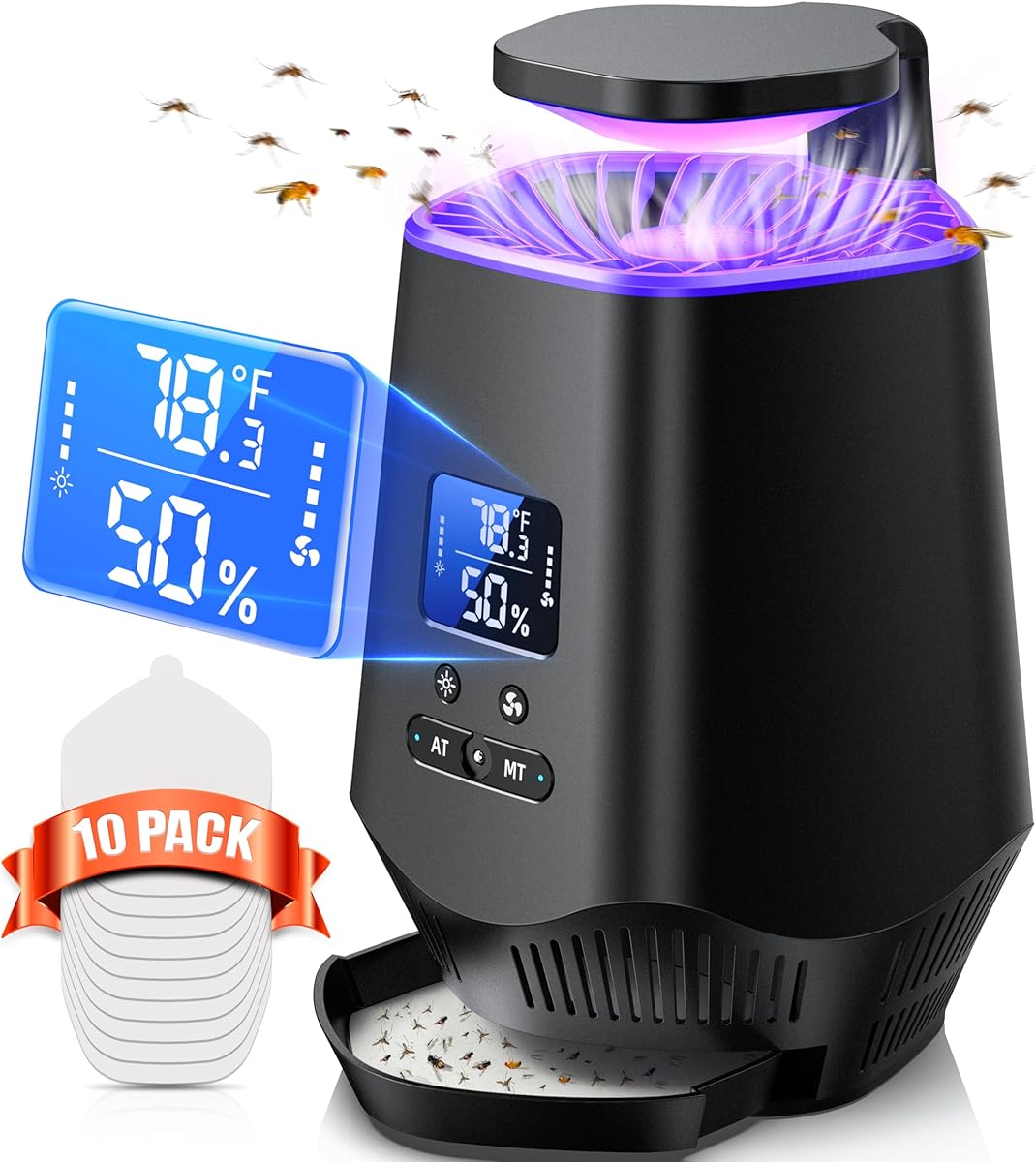
The Smart Fly Trap Indoor Bug Zapper is the most feature-rich product in this guide, combining 365–395nm light, a fan, sticky boards, a smart chip, and a light sensor. It holds the highest supplied rating at 4.9, making it a strong choice for buyers who value automation and environmental monitoring.
We may earn a commission when you buy through this link, at no additional cost to you.
Automatic night mode and manual 24/7 operation provide flexible scheduling. Five brightness levels and five fan speeds let users adjust the device, while the pull-out tray makes glue-board replacement faster and cleaner. The device also tracks real-time temperature and humidity, adding information that basic traps do not provide.
Coverage is stated at up to 500 square feet, but placement still matters. The product works best near fruit, plants, or trash cans, and its advanced capabilities are unnecessary for a very small, isolated problem. It also requires a five-foot charging cable and suitable power location, making it less convenient than passive traps.
This is the editor's choice for a modern, automated indoor system. It is best suited to larger rooms, frequent nuisance insects, and users who appreciate adjustable light, fan control, and built-in environmental data.
The light sensor supports automatic night mode, while manual 24/7 control remains available. This balance makes the trap adaptable to rooms where light levels and insect activity change throughout the day.
Real-time temperature and humidity readings add a monitoring function beyond insect capture. The stated coverage of up to 500 square feet makes the unit useful in larger kitchens, living rooms, and offices.
We may earn a commission when you buy through this link, at no additional cost to you.
The Timed Blue Light Trap uses blue light and an adhesive sheet to capture fruit flies, mosquitoes, gnats, and other flying insects. Its 4.2 rating and timer options make it appealing for people who want controlled daily operation rather than an always-on appliance.
We may earn a commission when you buy through this link, at no additional cost to you.
Users can choose continuous operation or six- and twelve-hour timer settings. The compact enclosure is designed to blend with home decor, while the low-noise design suits kitchens, living rooms, and dining rooms. Ten adhesive glue boards are included, and the bottom tray opens for straightforward replacement.
The blue illumination may be noticeable in a bedroom or dark living area, even though the trap is described as stylish and compact. The physical design avoids zapping and sprays, but caught insects remain on a visible glue surface until the board is changed. Timer settings also mean the trap will not operate during selected hours.
Choose this model when scheduled operation, a modern appearance, and broad indoor insect coverage matter most. It is a practical middle ground between passive cup traps and larger smart appliances with several adjustable settings.
Six-hour, twelve-hour, and continuous modes let users align operation with meals, work schedules, or periods of heavier insect activity. The control reduces unnecessary daytime running when activity is lower.
The understated enclosure takes up relatively little space. Its bottom tray provides direct access to the adhesive boards, making routine replacement straightforward.
We may earn a commission when you buy through this link, at no additional cost to you.
The Zevo single-base package is a simple entry point into plug-in flying-insect control. It includes one base and one disposable cartridge and carries a 4.2 rating. Blue and UV light attract fruit flies, gnats, house flies, and other small flying pests.
We may earn a commission when you buy through this link, at no additional cost to you.
The wall-facing adhesive cartridge keeps the catch concealed, and a no-mess tab assists removal. The unit operates continuously without spraying, zapping, or adding odor. A blinking light provides a six-week reminder to check the cartridge, making the maintenance interval easy to remember.
Compared with the three-refill package, this set provides less immediate replacement capacity. That is the main practical drawback, particularly for shoppers who do not want to order refills soon. A wall outlet is also required, and placement near food bowls, refuse bins, or plants remains more effective than leaving it in an unrelated area.
This version is best for a single-room problem or a first-time buyer who wants a compact, quiet option without buying a multi-device setup. It offers the core benefits of the Zevo system in its most straightforward configuration.
One base is enough to address a focused hotspot, such as a fruit bowl or indoor plant. The system avoids complex assembly and can start operating as soon as it is plugged in.
The trap works continuously without a loud zapping sound or added fragrance. Its wall-facing adhesive cartridge helps keep captured insects out of direct view.
We may earn a commission when you buy through this link, at no additional cost to you.
The Super Ninja Fruit Fly Traps 4-Pack uses a natural liquid bait intended to resemble decaying fruit. It has a 3.7 rating, the lowest among the listed products, but it offers a straightforward passive approach for counters, refuse bins, and other fly hotspots.
We may earn a commission when you buy through this link, at no additional cost to you.
The bait attracts fruit flies without harsh smells or chemicals, and the package includes four traps. Each bottle is described as providing up to three weeks of continuous coverage. The design is also marketed as family-friendly when used as directed and as more sustainable because the bottles and packaging use recycled materials.
The main drawback is the shorter stated coverage period than the 45-day TERRO traps. Its rating is also lower than those of the other entries, so buyers should pay particular attention to recent customer feedback and proper placement. The product does not provide electronic monitoring or active suction.
Choose this set for shoppers who specifically prefer natural liquid bait, a simple bottle format, and multiple units for placement around the home. It is best for targeted problems where the shorter operating period is acceptable and easy-to-use passive control is the priority.
The liquid attractant imitates decaying fruit, offering a familiar target for flies without the strong chemical odor associated with some pest-control products. The bottle format keeps bait handling straightforward.
The four bottles can be distributed near different sources of activity. This is useful in kitchens where fruit, vegetables, indoor plants, and trash cans may support separate breeding areas.
We may earn a commission when you buy through this link, at no additional cost to you.
The right fruit fly trap depends on where flies are active, how much automation you want, and whether you prefer liquid bait, light attraction, or a hands-on cup system. Compare capture methods, maintenance, placement needs, and room coverage before choosing.
Liquid bait traps, light traps, and DIY cup covers use different mechanisms to attract fruit flies. Food-based liquid bait works particularly well close to produce, refuse, and other breeding sources. Blue or UV light devices can provide broader room coverage, while DIY cup systems let the user select the attractant and monitor local activity.
Choose the method that matches the problem area. Use lure close to known hotspots and consider light or suction when flies are dispersed or originate near plants, bins, and multiple indoor locations.
A trap placed beside an active breeding source is generally more useful than one located across the room. Passive lure traps and cup covers need close proximity, while powered models benefit from open space, suitable light levels, and an unobstructed path to nearby insects.
Map out hotspots before buying. Multiple traps distributed near fruit bowls, trash cans, counters, and indoor plants usually offer more consistent control than a single unit placed in a convenient but inactive location.
Powered traps offer continuous or scheduled operation without manually refreshing liquid bait. Some models include light sensors, automatic night modes, timers, multiple brightness levels, and fan-speed controls. These features can make a device more convenient, although they also require a suitable outlet, cable reach, and ongoing energy use.
Prioritize automation when the trap will run for long periods in a frequently occupied room. A passive system may be enough for small, localized problems where simple placement and disposal are more important than programmable controls.
Maintenance requirements vary from changing a sticky card to replacing a complete cartridge or glue board. The number of included refills also matters. A device may be inexpensive to start but inconvenient if replacements are not readily available, while a multi-refill bundle can support longer use.
Check whether the trap has a removable tray, a no-mess tab, and a clear replacement method. Favor designs that let you replace the adhesive component without cleaning trapped insects from the main unit.
Fruit fly traps are often placed in kitchens where appearance matters. Apple-shaped lure traps and clear cup covers can blend into food displays, while plug-in light models may create a visible glow. The lowest-noise and least conspicuous options are usually preferable in bedrooms, dining areas, and open kitchens.
Consider visibility, color, and light output before choosing a permanent countertop position. A trap that fits the decor is more likely to remain in place near the source instead of being moved somewhere less effective.
Most options in this guide avoid loud high-voltage zapping, but noise levels still differ. Passive traps are silent, adhesive plug-ins are quiet, and fan-assisted models may produce a soft operating sound. Odor-free operation is especially helpful around food preparation areas and for households with children or pets.
Read the stated directions carefully and keep traps out of reach when children or pets are present. Placement near food does not mean the trap should touch or directly contaminate food, and electrical devices should be used only with appropriate power connections.
A larger pack can be useful when several rooms or hotspots need attention, but it can also create unnecessary clutter. Single traps suit isolated problems, while multi-packs improve placement flexibility. Refill supply and stated duration matter as much as the initial trap count when estimating long-term convenience.
Avoid buying a large pack simply for the largest number available. Choose according to the number of active locations, how frequently each trap must be replaced, and whether you want a spare unit for seasonal use.
Monitoring features can help users know when a trap is working or needs attention. Lure traps may include viewing windows, while plug-in models use blinking reminders, timers, or smart sensors. Some newer designs add temperature and humidity readings, giving users more information about the environment around the trap.
Choose visible reminders if you are likely to forget about maintenance. More advanced monitoring is useful in larger spaces, but a simple window and clear replacement schedule can be sufficient for a small kitchen or a single hotspot.
Begin by identifying likely breeding sources such as ripe or damaged fruit, vegetables, trash cans, recycling bins, drains, and indoor plants. Remove or clean accessible food residue, empty refuse regularly, and let produce dry before storing it. Traps work best when they are placed near these sources rather than hidden in an area where flies rarely travel.
Follow the product-specific placement directions. For liquid lure traps, position the container close to the activity without touching food. For DIY cup covers, use a suitable cup with a small amount of attractant and secure the double-sided card over the opening. Plug-in and light-and-suction devices need an unobstructed area, suitable lighting, and a reliable outlet or USB power connection.
Inspect traps on a regular schedule and replace exhausted bait, full adhesive cards, or spent cartridges promptly. For sticky systems, remove the used component directly into a sealed waste container, clean the surrounding surface, and insert a fresh refill. Store unused traps and attractants according to their labels, keep them away from children and pets, and wash your hands after handling bait or trapped insects.
Place traps close to the places fruit flies gather, such as fruit bowls, trash cans, recycling containers, kitchen counters, and indoor plants. A trap several feet away from an active source may perform poorly, so move it when the problem shifts. Multiple traps distributed around separate hotspots can be more effective than one device placed in a central but inactive location.
Liquid-bait traps are often more practical for targeted problems because flies are drawn directly to a food-like attractant. Electric models can be better for dispersed activity because light and suction help catch insects that roam around a room. The better choice depends on the source, the size of the area, and how much maintenance and automation you want.
The stated duration varies significantly by product. Some traps in this roundup are described as lasting up to 45 days, while others provide approximately three weeks of coverage. Actual results depend on fly pressure, placement, temperature, whether the bait is exposed, and whether the device is switched on. Check the trap regularly rather than assuming it is still effective.
Several products are described as suitable for use around children and pets when used according to their directions. Nevertheless, place traps where they cannot be reached, touched, or consumed, and keep liquid bait away from food preparation surfaces. Always read the current label and safety instructions because formulations and handling requirements can vary.
A trap is only one part of effective fruit fly control. Fruit flies breed near moist, fermenting, or decaying organic material, so removing overripe produce, cleaning counters, rinsing containers, and emptying bins can remove the underlying attraction. Traps then help capture remaining adults and monitor whether new flies continue to appear.
The most common issue is poor placement. Move the trap closer to fruit, trash, plants, or other likely breeding sources and leave nearby surfaces clear. For light-based traps, try a dimmer setting or area where the light is noticeable to insects, while also checking that power, suction, bait, and adhesive components are functioning.
Replace it sooner if the adhesive surface is full, the bait has dried out, insects are no longer being caught, or the surrounding area has been cleaned recently. High summer temperatures, heavy infestations, and frequent opening of the trap can shorten performance. Checking the device at least as often as its maintenance reminder is the best approach.
A single trap may be enough for one localized source, but it rarely replaces careful source control. Larger rooms or several active breeding locations may require multiple passive traps or a powered model with broader coverage. Pairing traps with sanitation and produce-storage improvements gives the best chance of reducing the population over time.
The LFSYS 25-Cup Covers stand out as the most flexible budget option, offering double-sided adhesive cards and a large pack without requiring powered equipment. The Smart Fly Trap Indoor Bug Zapper is the editor's choice for advanced automation, environmental readings, adjustable settings, and broad stated coverage, while the Zevo two-base package is the premium pick for a polished multi-location plug-in system.
Prioritize placement, the type of fly activity, and maintenance before choosing. A passive bait trap is effective near a known source, a DIY cup cover gives you control over the attractant, and a light-and-suction unit is more appropriate for dispersed activity or scheduled operation. Sanitation remains essential because traps work best after fruit flies have fewer breeding and feeding opportunities.
Ratings, product configurations, and availability can change over time, and prices should always be checked on the current listing. Review recent customer feedback, confirm the included accessories, and follow the manufacturer's setup and safety directions before making a final selection.
