
POWERUP 2.0 Paper Airplane Kit
3.8Editor score
Thirty-second flight time
Twenty-second setup
Crash-resistant carbon shaft
Works with varied paper designs
Our Electric Motor Paper Airplane Kit guide compares 10 options for stability, control, flight time, DIY design, and beginner-friendly operation outdoors.
Electric motor paper airplane kits combine the creativity of folding with the excitement of powered flight. A strong option should offer stable control, easy setup, durable components, and a power unit that works well with lightweight paper designs. The right kit depends on whether you value hands-on customization, straightforward launching, remote handling, or STEM learning.
We compared all ten products by examining their control systems, stabilization features, propulsion, compatibility with folded designs, accessibility, durability, and educational value. The list includes conventional remote-control kits, gyro-stabilized models, and a paper-airplane launcher that adds electric thrust without requiring a traditional radio controller.
Each pick highlights a distinct balance of features, from beginner-friendly operation to customizable folding experiments. Ratings reflect the supplied customer feedback, while technical details come from the listed product information. Availability and pricing can change, so check the current listing and included components before making a final purchase.
3.8Editor score

5.0Editor score

2.0Editor score
The comparison below places each motorized paper airplane system side by side, focusing on the control method, stabilization, charging convenience, paper compatibility, and intended experience.


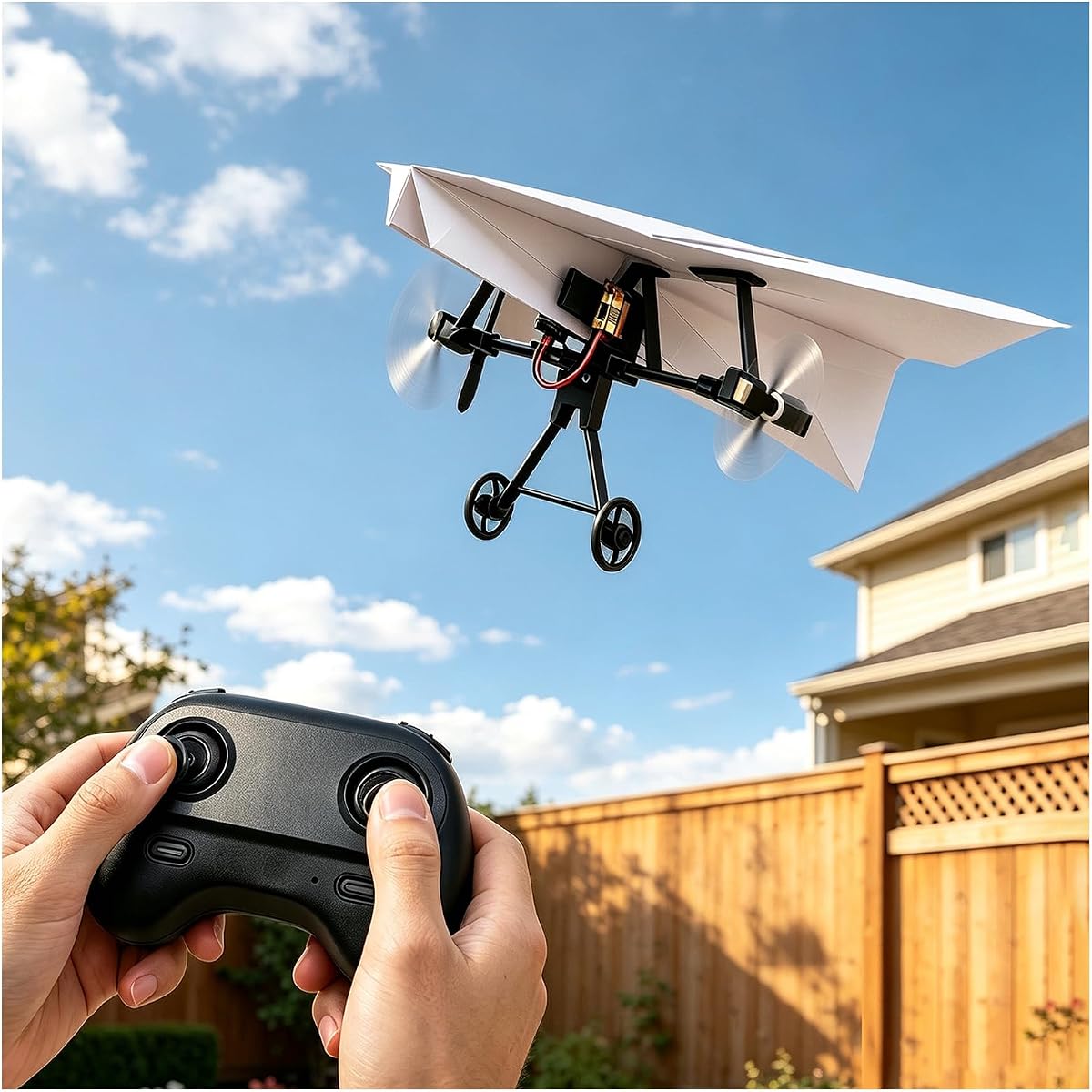

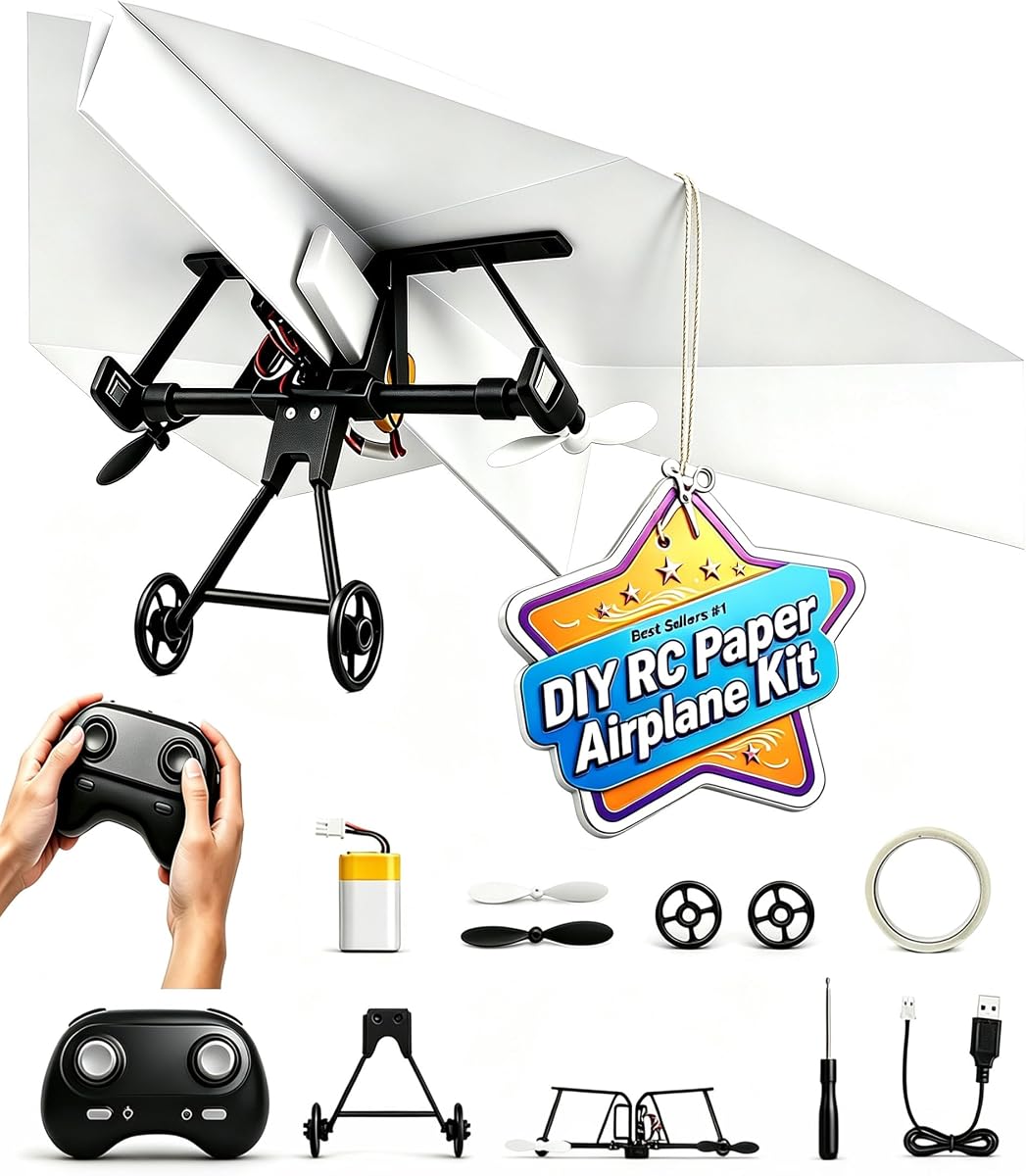
This remote-controlled paper airplane motor kit combines an approachable control system with a gyro stabilizer and dual propellers. Its supplied 5.0 rating is the strongest in the group, making it a particularly attractive option for buyers who want a polished, beginner-oriented package. The motor module turns a self-folded paper aircraft into an interactive model rather than a conventional hand-launched glider.
We may earn a commission when you buy through this link, at no additional cost to you.
The main strength is the combination of automatic stabilization and understandable remote commands. The gyro is designed to reduce shaking and drift, while the paired propellers support balanced thrust. Two rechargeable batteries reduce the inconvenience of frequent charging, and the lightweight, foldable construction is suitable for transport, indoor practice, or outdoor use in calm conditions.
The main limitation is that the paper airplane body is not included. Buyers must supply and fold their own aircraft, then attach the power module according to the instructions. This is ideal for a creative DIY project, but it adds a setup step for someone seeking a ready-to-fly model. The listing also does not provide a specific flight-duration figure.
This is a strong recommendation for beginners, families, STEM learners, and hobbyists who want a stable remote-control experience. It balances ease, customization, and flight support better than most alternatives, while the two-battery arrangement is especially useful for repeated play.
Gyro assistance and dual propellers help the model resist turbulence and maintain a more balanced path. That gives new pilots room to focus on takeoff, steering, and landing rather than constantly correcting sudden yaw or shake.
Two upgraded rechargeable batteries make it easier to enjoy multiple sessions without constant charging interruptions. The compact power unit also folds for convenient storage and transport between indoor and outdoor flying locations.
We may earn a commission when you buy through this link, at no additional cost to you.
The POWERUP 2.0 is a simple electric launcher that adds motor-assisted flight to a paper airplane without requiring a full remote-control transmitter. Its 3.8 rating is lower than most of the RC-focused products, yet the kit stands apart with a clear setup time, advertised flight time, and a design that welcomes people who want the paper-airplane experience without learning radio operation.
We may earn a commission when you buy through this link, at no additional cost to you.
Its electric motor is described as capable of providing more than 30 seconds of flying time. Users can fit it to a range of paper aircraft, and the pack includes simple starting designs according to the supplied information. The carbon fiber propeller shaft and tough rear propeller are intended to withstand the crashes that naturally occur while learning a new flying hobby.
Because this is a launch-and-fly system rather than a manually piloted RC aircraft, buyers should not expect directional commands, turning, or landing control comparable to the other picks. Its 3.8 rating suggests that the launch experience may not satisfy every customer, and the listing does not describe a gyro stabilizer. Those limitations matter if precise maneuvering is the main objective.
It is a compelling choice for families, casual hobbyists, and STEM learners who want a relatively approachable motor attachment. Choose it when endurance, quick preparation, and forgiving construction matter more than full remote navigation.
The motor handles the initial launch, allowing users to focus on folding and observing flight performance. That makes the kit accessible to younger or less experienced participants while still providing a clear connection between design changes and airborne behavior.
A carbon fiber shaft and reinforced rear propeller address a major reality of paper flying: frequent landings. These components make the kit more practical for repeated experiments with wing shapes, launch angles, and paper weights.
We may earn a commission when you buy through this link, at no additional cost to you.
This construction set combines a compact electric power unit, smart stabilization, and a 2.4GHz transmitter for a controlled paper-airplane experience. Its 4.6 rating is among the strongest in the list, suggesting broad appeal among people who value both flying performance and the process of designing their own aircraft.
We may earn a commission when you buy through this link, at no additional cost to you.
A major advantage is the balance between guided flight and creative freedom. Smart stabilization supports smoother gliding, while the remote gives the user more direct control than the POWERUP launcher. The kit can be adapted to different wing styles and body shapes, turning each folded design into a separate experiment involving lift, balance, and thrust.
The product is described as a construction set rather than a ready-made plane, so some assembly and folding are expected. That is a deliberate strength for STEM use but may disappoint a buyer seeking immediate entertainment. As with many paper-powered kits, the supplied information does not provide a precise flight duration, and actual results will depend on the chosen design and conditions.
This is an excellent match for families, classroom projects, and paper-airplane enthusiasts who want meaningful customization along with remote navigation. It is also a strong option for adults seeking a more involved engineering project rather than a simple add-on motor.
The 2.4GHz transmitter gives users direct navigation while stabilization handles routine corrections. That allows the underlying paper airframe to remain the main experimental element rather than hiding all performance behind a preassembled fuselage.
Assembly, folding, and outdoor testing create a practical introduction to aerodynamics and spatial reasoning. Participants can observe how changes to wing shape or balance influence the aircraft's path, making the set suitable for structured lessons.
We may earn a commission when you buy through this link, at no additional cost to you.
This micro RC paper airplane kit uses a lightweight powered module and propeller to convert folded paper into a remote-controlled aircraft. It is particularly suited to adults who want a reusable platform for testing folding structures, airflow, thrust, and direction. The supplied information does not include a customer rating, so the evaluation must rely on its stated design and intended use.
We may earn a commission when you buy through this link, at no additional cost to you.
The reusable motor unit is a meaningful advantage for iterative testing. Instead of constructing a new electronic aircraft for every experiment, builders can fit the module to different paper shapes and compare their flight characteristics. The listed flight-height range extends from 0 to 394 feet, or 0 to 120 meters, under suitable flying conditions.
Buyers need to prepare their own paper airplane body because it is not included. The listing also identifies the product as a single-cell design, which may impose different expectations than larger dual-battery kits. The stated height range should not be read as a guaranteed performance result, because actual flight depends on paper weight, fold quality, weather, and launch conditions.
This is a practical recommendation for adult builders and experimenters who prioritize a reusable test platform over a highly finished appearance. It is less compelling for someone who wants batteries, detailed electronics, or a complete aircraft supplied out of the box.
Reusing the power module keeps the creative focus on the paper design. Builders can make a series of aircraft and compare center-of-gravity placement, wing proportions, and surface texture without buying a separate powered system for every experiment.
The motor adds steady thrust while retaining a low overall load, making the aircraft useful for balance adjustment and repeated trials. Best results require careful alignment, properly balanced paper, and a clear area for launch and recovery.
We may earn a commission when you buy through this link, at no additional cost to you.
This kit is built around speed of preparation. Standard A4 paper can be folded along marked lines and turned into an RC aircraft in seconds, while the electric module adds gyro stabilization and dual propellers. Its supplied 5.0 rating matches the highest rating in the group, while the no-glue, quick-fold process lowers the barrier for beginners.
We may earn a commission when you buy through this link, at no additional cost to you.
The operating sequence is refreshingly direct: charge the unit, bind it, and fly. The remote responds to simple takeoff, turn, and land commands, so new users do not need an extensive background in radio-controlled aircraft. Lightweight plastic and modular wings also support repeated use and allow the paper covering to be replaced for different experiments.
The requirement for standard A4 paper may be restrictive for buyers who only keep legal-size sheets or prefer foam, although the design does make paper swapping convenient. Paper is not included, and the product information does not specify a quantified flight duration. Light wind and open space remain important for achieving the smooth flight described.
This is a highly appealing recommendation for beginners, young aviators, and anyone who wants to move from folding to flying without a lengthy build. It also works well for casual backyard sessions and indoor practice when conditions are calm.
Marked fold lines remove much of the guesswork from preparing the aircraft. The quick preparation is especially useful for short sessions, classroom demonstrations, or anyone who wants to change a paper design and launch again without a complicated assembly process.
Takeoff, turn, and land commands create an understandable starting point. The gyro and dual propellers provide automatic support, allowing pilots to learn handling while still experimenting with lift, drag, and thrust through the paper airframe.
We may earn a commission when you buy through this link, at no additional cost to you.
The Vodolo kit is a compact RC paper airplane platform centered on automatic pairing, multi-aircraft control, and compatibility with several lightweight materials. The product information identifies it as suitable for users aged six and above, making it a potential choice for parent-child activities, classroom demonstrations, and amateur flight practice.
We may earn a commission when you buy through this link, at no additional cost to you.
Its 2.4GHz system can support multiple aircraft operating in the same field without interfering with one another, according to the supplied description. Automatic pairing removes the need for complicated debugging, so takeoff, turning, gliding, and landing can begin quickly. A4 paper, letter paper, and foam paper are supported, giving builders more freedom than a fixed-format template.
There is no supplied customer rating, which makes it especially important to consider the product's specifications and age guidance carefully. The package does not include paper, and even compatible materials require appropriate weight and balance. Its stated weight of 162.43 grams is specific and useful for planning, though it does not guarantee the same handling in every custom design.
This is a good pick for groups that want to fly multiple models or for a child and adult to operate separate aircraft together. It also appeals to builders interested in systematically tuning center-of-gravity placement and testing multiple paper materials in a shared setting.
The multi-aircraft capability makes the system attractive for family flights, clubs, or classroom groups. Automatic startup pairing reduces setup delays and allows participants to concentrate on design and handling rather than radio synchronization.
Support for A4 paper, letter paper, and foam paper gives builders several ways to tune the aircraft. Weight and balance remain crucial, but the wider material range makes it easier to find a light, rigid airframe suited to a particular experiment.
We may earn a commission when you buy through this link, at no additional cost to you.
This one-piece DIY RC kit supports A4 sheets, letter paper, copy paper, foam sheets, and even balsa wood according to the supplied information. That broad compatibility, paired with a 4.2 rating and ASTM certification for ages eight and above, makes it a versatile option for families, students, and hobbyists who want more than one airframe material.
We may earn a commission when you buy through this link, at no additional cost to you.
A built-in gyro and dual propellers automatically correct turbulence and wind drift, reducing shake while supporting more accurate control. The remote handles straightforward commands, and the modular wing arrangement lets builders replace the covering to explore differences in lift, drag, thrust, and gravity. The foldable airframe is also designed to survive ordinary bumps and tumbles.
The package contains one power system rather than two, so buyers planning shared flights should account for that. It also does not include paper, and its paper planes must be folded separately. Compatibility with balsa wood is convenient, but the airframe still needs appropriate balance and structural alignment to fly predictably.
This is a strong recommendation for a single pilot who wants to test multiple materials and wing arrangements. It is also a practical classroom or hobby choice because the modular design encourages repeat flights and the age certification provides clear guidance for gift purchases.
The ability to use copy paper, foam, and balsa wood turns the power module into a versatile experimental platform. Changing the airframe can reveal how weight, rigidity, and surface area affect flight in ways a single fixed plane cannot.
Replaceable wings let users modify the aircraft without replacing the entire system. This supports iterative lessons in balance and aerodynamics while keeping the setup approachable for beginners.
We may earn a commission when you buy through this link, at no additional cost to you.
This electric DIY kit combines a foldable micro fixed-wing format, gyro stabilization, dual propellers, and a 2.4GHz remote transmitter. Its 4.0 rating places it in the middle of the group, but the design is well suited to buyers who want remote navigation and an educational activity centered on assembling and flying a custom paper model.
We may earn a commission when you buy through this link, at no additional cost to you.
Smart stabilization is intended to smooth outdoor gliding, while the dual-propeller arrangement supports balanced propulsion. The remote is described as intuitive and capable of stable flights, making it suitable for beginners despite the more technical appearance of the product. Custom folding styles and body shapes can give each model a distinct flight character and learning experience.
The listing does not identify a battery count, charging arrangement, or a specific flight-duration figure, so buyers should verify the package contents. The moderate rating also suggests that some customers may have found the overall experience less satisfying than the strongest-rated options. As a paper-powered model, it still depends heavily on accurate folding, balance, and suitable wind conditions.
This is a good recommendation for older children, families, and adults who want a compact STEM-oriented flying project. It suits buyers who value a combination of customization and direct remote control more than detailed charging specifications or a preassembled body.
Gyro assistance helps the aircraft glide smoothly, while the power unit can be fitted to different folded forms. This balance makes it possible to change the paper design without losing the stabilizing benefits of the electronic core.
A 2.4GHz transmitter gives users direct control over movement and turning. Pilots can connect their inputs with visible changes in direction, turning a simple paper model into an engaging lesson in spatial reasoning.
We may earn a commission when you buy through this link, at no additional cost to you.
The CRILEAL package is distinctive because it includes two DIY RC paper airplane power kits. Each system has an electric motor, remote-control capability, gyro stabilization, and a lightweight foldable design. That two-kit configuration makes it convenient for shared flights, siblings, parent-child activity, or carrying a backup system into the field.
We may earn a commission when you buy through this link, at no additional cost to you.
The built-in gyro is intended to maintain balance and make operation easier, while the foldable construction supports compact storage and travel. The package can transform ordinary folded planes into powered models and encourages creativity, problem-solving, and an understanding of basic aerodynamics. Its target audience spans children, teenagers, and adults.
The supplied 2.0 rating is notably lower than every other rated option and should be considered carefully. The listing provides no quantified flight time, battery details, or precise control-specification information, making it harder to judge performance beyond the stated stabilization and design. Two complete systems are useful, but the value depends on both units meeting expectations.
This is a premium-style choice for buyers who specifically need two power units and value shared or portable use more than a heavily documented specification list. For a single pilot or a gift requiring strong customer feedback, one of the higher-rated one-kit alternatives may be the more conservative choice.
The two-system package supports turn-taking, cooperative flying, or side-by-side comparisons. It also gives a group a spare unit, which can be useful when one system is being charged or adjusted.
The lightweight foldable design is easy to store between lessons or pack for an outdoor session. Combined with the STEM focus, it offers a convenient way to connect paper folding, assembly, and flight experiments.
We may earn a commission when you buy through this link, at no additional cost to you.
This kit offers a straightforward introduction to remote-controlled paper flying. Its 4.1 rating reflects generally positive customer feedback, and the core feature set is easy to understand: a remote controller, a gyro stabilizer, dual propellers, and a lightweight plastic structure designed for indoor or outdoor use.
We may earn a commission when you buy through this link, at no additional cost to you.
The simple operating system is intended to help model enthusiasts, pilots, and DIY users master flying skills. Gyro assistance and the dual-propeller design should produce smoother, more balanced movement with less shaking, while the foldable construction makes the unit easier to store and carry. It is a sensible choice for a first powered-paper-airplane experience.
The supplied information is limited compared with many competitors. It does not state a specific control frequency, flight duration, charging method, age recommendation, or material-compatibility details. Paper is also not included, so buyers must design and prepare the airframe themselves. The repeated focus on easy operation suggests a conventional remote experience rather than a fully automatic launcher.
This is a worthwhile recommendation for hobbyists and beginners who prioritize uncomplicated controls and stable assisted flight without a large collection of advanced features. Verify the current package contents and operating instructions before purchase, particularly if precise specifications matter.
A straightforward controller keeps the learning curve manageable for first-time pilots. Users can focus on the relationship between stick or button inputs and the aircraft's movement before progressing to more advanced design experiments.
The lightweight plastic body and foldable structure suit both storage and transport. Gyro support is especially useful indoors, where walls and furniture leave little room for correcting a sudden drift.
We may earn a commission when you buy through this link, at no additional cost to you.
The right motorized paper airplane kit depends on the control experience, stabilization, charging arrangement, paper compatibility, and degree of customization you want. Use the following factors to narrow the options before checking current listings.
A full remote-control kit gives you directional control, including turns and landing, while an automatic launcher simplifies the experience and concentrates on the paper design's flight path. The POWERUP 2.0 fits the automatic-launch side of the category, while the other selections primarily use remotes. Choose remote control if active piloting and aerobatic maneuvering matter to you. Choose a launcher if you want a quick, screen-free activity with fewer controls to learn.
In short, select remote control for handling and automatic launching for simplicity.
A built-in gyro can correct turbulence, reduce shaking, and help the model maintain a balanced path. This is especially useful for beginners, indoor flying, and paper designs that are not perfectly symmetrical. Several kits combine gyro assistance with dual propellers, which can improve thrust balance. However, stabilization does not compensate for poor folding, an unbalanced center of gravity, or a paper body that is too heavy.
In short, favor gyro assistance for easier handling but still build carefully.
Battery information determines how often the kit can be used and how much setup is required between flights. The leading pick includes two rechargeable batteries, giving it a clear advantage for repeated sessions, while the POWERUP 2.0 advertises over 30 seconds of flying time. Some products omit battery-count and duration details, so check the package carefully. Also look for a straightforward charging process and a battery system appropriate to the model's weight.
In short, confirm battery count, charging method, and realistic flight duration before buying.
Paper is the creative heart of this category, but not every kit supports every material. Some are optimized for A4 paper, while others also accept letter paper, copy paper, foam, or balsa wood. Wider compatibility allows you to test how weight, rigidity, and balance affect flight. It also means you can create a more durable aircraft without replacing the powered module. Check whether a paper body and templates are included before planning the purchase.
In short, choose broad material support for experiments and verify whether paper is included.
Some kits advertise a very fast preparation process, while others are framed as construction projects. A marked fold template and a simple charge-bind-fly sequence are convenient for children, beginners, and short sessions. A more involved build can be valuable for older students and adults who want to understand the assembly. Consider both the attention span of the intended user and how much instruction they will need before takeoff.
In short, match assembly complexity to the pilot's age and interest in building.
Paper-powered aircraft are sensitive to their surroundings. A large open field is preferable for beginners, while a clear room can work for small designs and assisted stabilization. Strong or turbulent wind can overwhelm a lightweight paper airframe even when the motor and gyro are working correctly. Check whether the product is described for indoor and outdoor use, and plan to recover the aircraft in a clear area with no people, pets, fragile objects, or overhead obstacles nearby.
In short, use a calm open area and avoid obstacles, crowds, and strong wind.
Repeated crashes are normal, so the motor mount, propeller, and control hardware need enough strength to continue functioning. Lightweight plastic works well for a paper aircraft because it avoids excessive load. The POWERUP 2.0 specifically highlights a carbon fiber shaft and reinforced rear propeller. Foldability also matters if you plan to carry the kit to a park or use it in a classroom, since a compact unit is easier to store and transport.
In short, prioritize reinforced propulsion parts and a design that is easy to carry.
Most choices include one powered system, while the CRILEAL option includes two. One kit is generally sufficient for a solo builder and keeps the setup simple. Two kits are useful for shared flights, comparisons between designs, or keeping a spare available. Consider whether the intended use is individual experimentation or a social activity. For group play, confirm that the radio system supports the number of aircraft you plan to operate together.
In short, buy two systems for shared flying and one for focused solo development.
Begin by reviewing the included instructions and identifying the power module, controller, propeller assembly, charging cable, and any marked fold templates. Charge the batteries as directed, then bind or pair the controller according to the kit's sequence. Do not install the propeller while testing the power connection. Once the control link is established, cut the power before attaching or adjusting the motor unit to a folded paper airplane.
Fold a lightweight paper design using the recommended size, keep the wings symmetrical, and make sure the aircraft is balanced around its center of gravity. Attach the powered module securely but without pulling or creasing the paper. Carry the model to a clear area, point it into the wind, and increase power gradually. Begin with gentle corrections and allow the stabilization system time to settle after each turn or landing.
After flying, switch off the motor before recovering the aircraft. Inspect the propeller and shaft for bends, remove loose paper fragments, and gently wipe the components with a dry cloth. Store the kit in a protective case or its original packaging with the batteries in the recommended charge state. Replace damaged paper, avoid moisture and extreme heat, and charge only with the compatible power source.
Most of the kits in this guide require the user to supply and fold the paper airplane body. The power module, controller, and related electronic components are generally the central contents. Some listings include starter designs or marked templates, so buyers should review the package description carefully. Having a standard A4 or letter sheet ready is useful, although certain kits support additional materials such as foam or balsa wood.
A gyro is not essential for every paper airplane, but it can make powered flight easier to control. It helps correct turbulence, shaking, and wind drift, which is valuable for beginners and indoor flying. It cannot fix a badly folded or unbalanced airframe. The paper design, motor alignment, weather, and pilot technique still have a major effect on overall performance.
Several products are described as suitable for indoor and outdoor use, but indoor flying requires a large, clear room. Ceiling fans, pets, furniture, lights, and narrow walls can interrupt a flight. Beginners may get more consistent results in a calm outdoor field. Gyro-stabilized models are especially helpful indoors because they can correct some minor disturbances.
Lightweight, relatively stiff paper is generally easier for the motor to support. Standard A4 or letter paper is common, while some kits also accept foam or balsa wood. Avoid paper that is overly thick, wrinkled, or damp. Whatever material you use, the wings should be symmetric, the body should be aligned, and the center of gravity should be properly balanced.
Flight duration depends heavily on battery condition, design, wind, launch technique, and the specific kit. The POWERUP 2.0 is the only product here with a clearly advertised figure of more than 30 seconds, while most others do not provide a measured duration. A stable, lightweight design in calm conditions generally performs better than a heavy or poorly balanced model.
That depends on the product's age guidance and the child's experience. The Vodolo model is described as suitable for ages six and above, while the DIY RC Paper Airplane Kit is ASTM-certified for ages eight and older. Other products do not list a specific age in the supplied information. Adults should always supervise flying near people, pets, roads, power lines, or fragile property, regardless of age.
Choose a remote-control kit if you want to steer, turn, and land the aircraft during flight. Choose an automatic launcher if you prefer a simpler setup and want to focus on paper folding, launch angles, and passive flight behavior. The remote kits offer more interaction, while the launcher approach is often easier for beginners and quick demonstrations.
Start with a symmetric fold and check that the center of gravity sits near the correct point under the wings. Make sure the motor module is mounted straight and that the propellers rotate freely. Use light paper, fly in calm conditions, and make small control inputs. If the aircraft consistently rolls or dives, adjust the airframe balance before blaming the electronics.
The RC Paper Airplane Kit with Gyro is the strongest all-around recommendation, combining a 5.0 rating, stabilization, dual propellers, beginner-friendly controls, and two rechargeable batteries. The POWERUP 2.0 is the value-focused choice for anyone wanting quick setup and long advertised electric launches, while the CRILEAL two-kit package serves buyers who want a spare system or shared flying.
Your priorities should guide the decision. Choose full remote control for active steering, an automatic launcher for simplicity, broad paper compatibility for experiments, and gyro assistance for easier handling. Before folding the first plane, check the current package contents, battery arrangement, age guidance, and charging instructions because included accessories and specifications can vary between listings.
Finally, remember that prices, availability, ratings, and product configurations can change over time. Compare the current listing with the features covered in this guide and confirm that the required paper and accessories are included. With a clear flying area and a carefully balanced design, any of these kits can turn a simple sheet of paper into a rewarding flying project.