
Soundcore V20i
4.4Editor score
Four adjustable wearing positions
Non-intrusive open-ear design
Situational awareness outdoors
Earbuds for Difficult Sensitive Ears guide comparing open-ear, clip-on, in-ear, sleep, and noise-cancelling models for comfort, fit, and daily sound.
Earbuds can be difficult for sensitive ears when deep tips create pressure, rigid housings cause rubbing, or heavy drivers add weight. The most comfortable models typically use open-ear designs, ultra-light components, soft materials, and adjustable fittings that avoid sealing the ear canal unnecessarily.
This guide compares ten options ranging from budget in-ear earbuds to premium noise-cancelling models. The comparison considers fit style, weight, adjustability, environmental awareness, microphone systems, playback features, water resistance, app support, and suitability for sleeping, exercise, travel, and extended wear.
Each review highlights the reasons a product may suit sensitive ears as well as its practical limitations. Open-ear and clip-on options lead for users who dislike insertion, while compact in-ear models offer stronger isolation. Ratings, features, and availability can change, so confirm current product details before purchasing.
4.4Editor score

4.4Editor score

3.9Editor score
The table below compares all ten earbuds by wearing style, fit options, major audio features, and everyday versatility, making it easier to identify the model that best matches your sensitivity concerns and listening habits.



The Soundcore V20i ranks first because it directly addresses one of the most common causes of earbud discomfort: insertion. Its open-ear design rests around the ear rather than inside the ear canal, which can feel much better for listeners who become irritated by pressure, trapped moisture, or prolonged contact with silicone tips. It holds a 4.4 rating, offering a strong balance of features without moving beyond the basics.
We may earn a commission when you buy through this link, at no additional cost to you.
Four adjustable positions make the V20i more accommodating than many fixed-fit open-ear earbuds. Users can rotate each earpiece until it feels secure and balanced, which is especially helpful when the outer ear shape differs significantly from side to side. The 16mm drivers include titanium-coated domes and BassUp technology, while the open construction preserves awareness of traffic, companions, and environmental sounds.
Call quality is supported by four microphones and an AI enhancement system, making the model practical for commuting and remote conversations. Tune-synced lights add visual flair, and the soundcore app provides HearID, EQ modes, Spatial Audio, firmware updates, and other controls. The tradeoff is that an open design cannot isolate noise as effectively as a well-sealed in-ear model, and some listeners may hear more audio leakage in quiet environments.
This is the strongest general recommendation for sensitive ears because it avoids the ear canal while remaining feature-rich and easy to adjust. It is particularly well suited to walks, office use, errands, and all-day listening where environmental awareness matters. People seeking maximum quiet or deep bass isolation should compare it with an in-ear noise-cancelling model instead.
Because the V20i does not need a sealed tip inside the canal, it reduces the sensation of pressure that can bother sensitive listeners. The open design also lets some surrounding sound enter naturally, which may make long sessions feel less enclosed.
Four wearing positions give users more control than a single fixed angle. This adjustment can improve stability without requiring a tighter or more invasive fit, although each ear may still need a different position.
We may earn a commission when you buy through this link, at no additional cost to you.
The Soundcore Sport X20 is built for people whose sensitive ears also need dependable security during exercise. It has a 4.1 rating and uses flexible ear hooks that extend by 4mm and rotate up to 30 degrees. That combination lets the wearer position each bud precisely, reducing the need to push an in-ear tip deeply for stability.
We may earn a commission when you buy through this link, at no additional cost to you.
Its strongest feature is active noise cancelling, with manual and adaptive settings designed to reduce distracting gym noise. Eleven-millimeter dynamic drivers and BassUp technology add the energetic sound profile expected from a workout earbud. A submarine-inspired cavity and SweatGuard technology add protection against sweat, water, and dust, making the model more rugged than many compact alternatives.
The app adds HearID, EQ modes, Spatial Audio, and over-the-air firmware updates. These controls are useful for tailoring the presentation to a sensitive listener. However, the ear hooks and larger housing create more physical contact than a tiny in-ear model, and people with very small or unusually shaped ears may find the attachment demanding despite its adjustability.
Choose the X20 when exercise stability, noise reduction, and durability take priority over minimal size. It is a strong choice for gym sessions, running, and active days when earbuds must remain secure. For users who are highly sensitive to anything resting on the ear, the V20i or OpenDots ONE would present a less bulky wearing profile.
The hooks carry much of the stabilizing role, allowing the earpiece to remain seated without relying on maximum tip insertion. Users sensitive to canal pressure may still need to select a gentler tip size to preserve comfort.
Adaptive and manual noise-cancelling controls are valuable when equipment noise and conversations compete with music. The model still retains app controls for EQ and spatial audio, so users can adjust emphasis without changing physical positions.
We may earn a commission when you buy through this link, at no additional cost to you.
The SHOKZ OpenDots ONE combines an open-ear approach with a clip-on attachment, giving sensitive listeners another way to avoid inserting earbuds. It carries a 4.4 rating, and each earpiece weighs only 6.5 grams. Its small size and restrained contact area are especially appealing for listeners who dislike the sensation of a conventional earbud filling the canal.
We may earn a commission when you buy through this link, at no additional cost to you.
A flexible nickel-titanium plate and soft silicone grip conform to the outer ear, providing security without the need for deep tips. The earbuds can switch between left and right ears, which simplifies placement and may make it easier to find a comfortable angle. Dolby Audio, Bassphere technology, and DirectPitch work together to create an open listening experience while limiting leakage.
Battery life reaches 10 hours per charge and up to 40 hours with the case. A 10-minute quick charge adds two hours, while wireless charging is supported, though quick charging is unavailable wirelessly. The Shokz app provides EQ modes, touch-control settings, multipoint pairing, device switching, battery tracking, and a locate function.
The principal limitation is that open-ear audio cannot match the isolation of a sealed noise-cancelling earbud. Clip-on hardware may also require more adjustment than a familiar stem or bud. Even so, the OpenDots ONE is an excellent choice for users who prioritize low weight, minimal intrusion, and long all-day wear over complete acoustic isolation.
At 6.5 grams per earbud, the OpenDots ONE places less mass against the outer ear than many hook-based alternatives. This low profile can reduce the feeling of fatigue during workdays, study sessions, or long walks.
The flexible plate and silicone grip give the clip several possible angles without changing tip sizes. Interchangeable left-right placement adds another layer of flexibility for users whose ears are not symmetrical.
We may earn a commission when you buy through this link, at no additional cost to you.
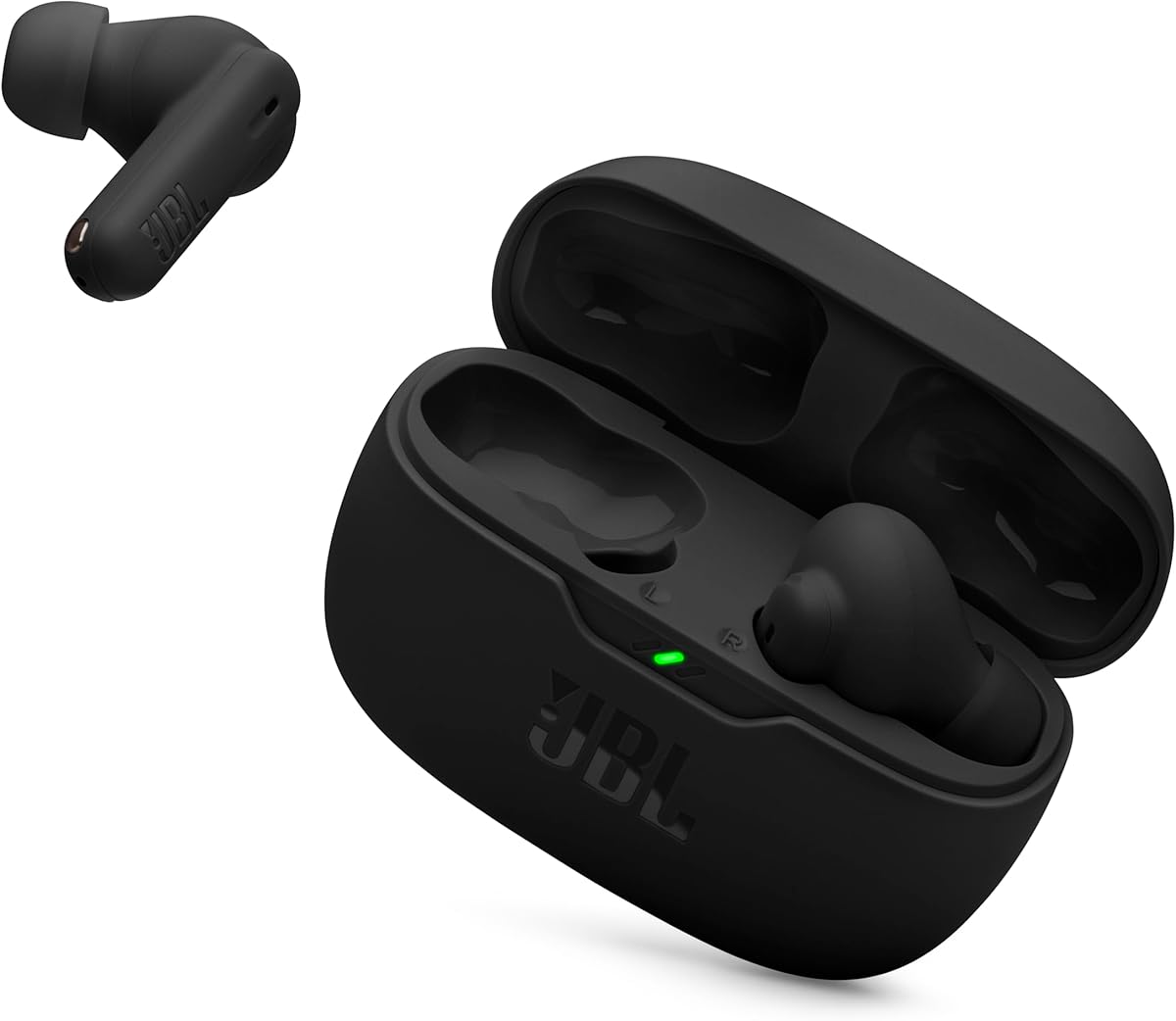
The JBL Vibe Beam 2 is a conventional in-ear option for sensitive listeners who still want meaningful noise reduction. It has a 4.1 rating and combines active noise cancelling with Smart Ambient, allowing users to admit outside sound when needed. Unlike the open designs in this list, it is intended to create a more private listening space.
We may earn a commission when you buy through this link, at no additional cost to you.
Eight-millimeter dynamic drivers produce JBL Pure Bass sound, while two microphones in each earbud help isolate your voice during calls. The battery provides 10 hours on one charge and up to 40 hours with the case when ANC is off. A 10-minute USB-C charge adds three hours. The JBL Headphones app adds EQ presets, custom sound, battery information, and a Relax Mode with five peaceful sounds.
The fit is the central concern for sensitive ears because inserted silicone tips may create pressure. Users with a strong preference for channel isolation may accept that tradeoff, but anyone who experiences soreness from inserted earbuds should investigate models with shallow or open fittings. The Vibe Beam 2 does not state an open-fit or non-insertive design in the supplied specifications.
This model works best for commuters and office workers who value noise cancelling, call clarity, and familiar in-ear convenience. It offers a balanced feature set without the extreme emphasis of workout models. Sensitive-ear users should make sure the included tips do not create a tight seal and use the app to reduce harshness in the EQ.
Smart Ambient gives listeners a middle ground between full cancellation and leaving the earbuds out. This makes the model useful when office announcements, traffic, or nearby voices need to remain audible.
The app can shape EQ output without changing the physical fit. For listeners sensitive to treble, reducing brightness or selecting a gentler preset may improve long-session comfort even before considering different tip sizes.
We may earn a commission when you buy through this link, at no additional cost to you.
The JLab Go Air Pop is a compact, affordable in-ear model for listeners who can tolerate a light inserted fit but dislike large housings. It has a 4.4 rating, and the design is 15% smaller than the previous generation. Small dimensions can reduce contact with the outer ear, making it a more approachable starting point than bulky workout earbuds.
We may earn a commission when you buy through this link, at no additional cost to you.
Three gel tip sizes help establish a secure fit for commuting or exercise. The earbuds carry an IPX4 rating for sweat and light rain, and Bluetooth 5.3 supports stable connections with iOS, Android, and PC. Dual Connect allows either earbud to operate independently, useful when one ear is kept free for conversation or awareness.
Sound can be selected among Signature, Bass Boost, and Balanced profiles using the built-in EQ3 control, with further adjustments available through the JLab app. Each earbud includes a MEMS microphone and voice-assistant access. Battery life is listed at more than nine hours per earbud and more than 26 hours from the USB-C case, for more than 35 hours overall.
The main limitation is the absence of active noise cancelling, so the Go Air Pop is best for quieter commutes or users who value situational awareness. It also cannot eliminate the potential discomfort of an inserted tip. Nevertheless, its small scale, multiple tip sizes, solid rating, and two-year warranty make it a practical option for sensitive ears that dislike oversized earbuds.
Reducing the housing by 15% helps limit the outward bulk that can bother wearers with small ears. The compact case is also easier to carry, although comfort still depends primarily on the selected silicone tips.
Three built-in sound signatures allow quick changes without opening the app. Bass Boost may be energizing, while Balanced or Signature can be gentler choices for listeners who find strong low frequencies uncomfortable.
We may earn a commission when you buy through this link, at no additional cost to you.
The Soundcore P30i combines noise cancelling with useful travel features, earning a 4.3 rating. Its in-ear form is less suitable for listeners who strongly prefer non-insertive products, but it offers effective quiet for commuters who want to soften aircraft, train, or office noise. Adaptive technology selects a cancellation level based on outside sound.
We may earn a commission when you buy through this link, at no additional cost to you.
Noise reduction is stated at up to 42dB, and transparency mode lets outside sound back in without removing the earbuds. Ten-millimeter drivers and BassUp technology provide the sound foundation, while four microphones and an AI algorithm support voice pickup during calls. The soundcore app provides EQ modes, adjustable ANC settings, and firmware updates.
The standout practical feature is the two-in-one charging case. Opening the rear panel creates a stand for a phone, making the P30i useful for hands-free viewing during travel. Battery life reaches 10 hours with ANC off and six hours with it on. The case extends total playback to 45 hours without ANC and 25 hours with ANC. A 10-minute charge adds two hours.
For sensitive ears, the deciding factor will be the tip fit and whether deep insertion is acceptable. The app's ANC adjustment can help avoid making the environment seem unnaturally quiet, which some listeners find uncomfortable. Buyers who need complete avoidance of ear-canal contact should instead prioritize the V20i or OpenDots ONE, while travelers who value isolation will find the P30i more versatile.
Adaptive cancellation changes with the surrounding environment, reducing the need to control the earbuds manually. Users sensitive to excessive pressure can also adjust the ANC level in the app or switch briefly to transparency mode.
The built-in phone stand reduces the need to carry a separate stand for airport waits or video viewing. Its extra structure is convenient, although it occupies more bag space than a very compact case.
We may earn a commission when you buy through this link, at no additional cost to you.
The 2026 Sleep Earbuds L8 Pro specialize in a narrow but important use case: discreet audio while resting. Its 4.8 rating is the highest among the selected products, and each earbud weighs only 3 grams. The contoured housing is intended to sit securely without creating pressure when a listener lies on one side.
We may earn a commission when you buy through this link, at no additional cost to you.
The full-color touch-screen charging case controls playback, tracks, calls, volume, voice assistant access, sleep mode, language settings, brightness, wallpaper, a timer, and an earbud-search function. Sleep mode suppresses low-battery and power-off announcements, which helps prevent abrupt disturbances during the night. Battery displays show the condition of both the earbuds and the case.
Thirteen-millimeter drivers and an in-ear acoustic structure provide bass, clear mids, and brighter treble, with five EQ modes covering standard, classic, jazz, rock, and pop. The battery lasts over six to eight hours from a single charge and up to 48 hours with the case. USB-C charging reportedly restores a full charge in about 1.5 hours. IPX7 protection adds resistance to sweat, rain, and dust.
There is no active noise cancelling, so this model is better for masking steady background sound than blocking sharp environmental noise. Its generic naming and extensive feature claims make independent evaluation especially important. For side sleepers who want exceptionally light hardware, a lockable sleep mode, and minimal charging-case distractions, it is a purpose-built and highly rated choice.
The 3-gram housing and contoured shape minimize both weight and outward bulk. Users should still confirm that the earbud remains comfortable in their preferred side-sleeping position rather than assuming every ear shape is compatible.
Locking touch controls helps prevent a pillow movement from changing tracks or activating a function. Muting low-battery and shutdown announcements also makes the earbuds more suitable for uninterrupted overnight playback.
We may earn a commission when you buy through this link, at no additional cost to you.
The Mini ANC Sleep Earbuds D20 are another purpose-built option for side sleepers, with a 4.6 rating and a 3-gram weight per earbud. Their main advantage over many compact sleep earbuds is active noise cancellation, aimed at reducing low-frequency background sound such as air-conditioning hums, distant traffic, and consistent snoring.
We may earn a commission when you buy through this link, at no additional cost to you.
ANC is not equally effective against every sound. Sharp, high-frequency noises may remain audible, so the earbuds should not be treated as a complete guarantee of silence. Dedicated Sleep Mode locks the touch controls and mutes low-battery voice alerts, reducing interruptions caused by accidental touches during restless sleep.
Fourteen-point-two-millimeter dynamic drivers deliver bass, crisp highs, and broad-sounding audio for white noise, meditation tracks, or calming music. Four microphones use environmental noise cancellation to improve voice pickup during late-night calls. The soft, skin-friendly silicone tips and curved shape are intended to reduce pressure inside the ear canal.
The D20 is best for sensitive sleepers who want a small in-ear design with some noise reduction. It is less suitable for people who cannot tolerate any inserted tips, and actual runtime depends on volume and ANC use. Charging both earbuds and the case fully before bedtime is the most reliable way to support uninterrupted sleep.
The cancellation system targets steady low-frequency disturbances that commonly interfere with sleep. Its limitations against sharp sounds make it more appropriate for relaxation tracks and familiar background hum than for sudden noise.
Locking the touch controls protects against accidental activation when the wearer rolls over. The sleep mode also suppresses the kind of low-battery announcement that could abruptly wake someone.
We may earn a commission when you buy through this link, at no additional cost to you.
The TOZO NC9 stands out for the number of fit choices provided, with six replaceable eartip sizes designed to help users find a comfortable seal. It has a 4.3 rating and an ergonomic shape intended for daily wear. For sensitive ears, that variety is valuable because comfort often depends more on the correct tip than on the electronic features.
We may earn a commission when you buy through this link, at no additional cost to you.
Hybrid active noise cancelling is stated to reach a maximum reduction of 45dB, while transparency mode restores outside awareness for outdoor activities. Six microphones and environmental noise reduction support call clarity. Ten-millimeter drivers and OrigX Acoustic 2.0 technology provide the audible foundation, and the app offers 32 EQ choices along with a sharing zone for custom profiles.
The case displays remaining battery, and playback reaches 14 hours without ANC or 10 hours with ANC per charge. Total playback extends to 60 hours without ANC and 40 hours with it. IPX8 water resistance offers substantial protection for workouts and weather, while Bluetooth 5.3 supports a stated connection range of up to 15 meters with low latency for movies and games.
The drawback is that six tip sizes can be confusing, and users should not feel obligated to create a tight seal if that causes discomfort. The case is also larger than those on ultra-compact sleep models. Overall, the NC9 is a strong all-day option for listeners who need multiple fitting options, dependable call performance, and substantial battery life.
Six sizes create more room to find a comfortable relationship between the canal and the earpiece. A secure but gentle seal is the objective, and the app's EQ settings can further reduce harshness without forcing deeper insertion.
The charging case extends listening time substantially, which is useful for travelers or office workers who do not want to recharge frequently. The LED display provides a quick way to check remaining power before leaving.
We may earn a commission when you buy through this link, at no additional cost to you.
The Bose QuietComfort Earbuds are the premium conventional-earbud option in this guide, carrying a 3.9 rating and focusing on active noise cancellation, rich sound, and wireless charging. The model is aimed at sensitive listeners who are comfortable with an in-ear fit but want a polished noise-cancelling experience for commuting and travel.
We may earn a commission when you buy through this link, at no additional cost to you.
A trio of eartip sizes and multiple stability band sizes allow the fit to be adjusted in two dimensions. That is useful for achieving a stable seal without relying on a single fixed tip or band. The earbuds also support Bluetooth multipoint, Bluetooth 5.3 connectivity, and a stated range of up to 30 feet, while customizable tap controls handle common playback functions.
Battery life reaches up to 8.5 hours, and a 20-minute charge in the case adds up to two hours. Wireless charging and a USB-C cable are supported, while an IPX4 rating helps with everyday sweat and moisture. The Bose QCE app allows adjustment of bass, midrange, and treble, along with battery and connected-device management.
The main caveat for sensitive ears is the fully inserted design, which can create pressure if the selected tip is too large or inserted too deeply. The 3.9 rating is also the lowest in this comparison, so buyers should evaluate the complete experience rather than assume premium positioning guarantees a better fit. It remains a strong premium option for excellent isolation and refined customization.
Separate eartip and stability-band choices allow users to refine both the seal and the external hold. This can reduce the need to push the earbuds deeper, which is especially helpful for listeners sensitive to canal pressure.
Active cancellation is the defining feature for noisy travel and work environments. Fine-grained bass, midrange, and treble adjustments in the app help listeners refine the sound after establishing a comfortable physical fit.
We may earn a commission when you buy through this link, at no additional cost to you.
Comfort is individual, so the most important choice is the wearing method that your ears tolerate without pressure, rubbing, heat, or an irritating seal. The following factors help narrow the field before comparing battery life, sound quality, and specialized features.
Open-ear and clip-on earbuds rest around or attach to the outer ear rather than extending into the ear canal. They are often the most logical starting point for people who feel pressure, itching, moisture, or soreness from inserted silicone tips. The Soundcore V20i and SHOKZ OpenDots ONE represent these two approaches: the former surrounds the ear, while the latter uses a flexible clip.
The trade-off is weaker isolation. Surrounding noise will enter the listening experience, and some audio can leak outward. Choose a non-insertive design when physical comfort and environmental awareness matter more than achieving a quiet, private soundstage.
Long sessions are easier when the earbud is light and does not press sharply against sensitive areas. The L8 Pro and D20 sleep earbuds weigh 3 grams each, the OpenDots ONE weighs 6.5 grams, and the Sport X20 uses larger hooks for exercise stability. Weight alone does not determine comfort, but it often influences how quickly the wearer notices the device.
For extended wear, favor rounded surfaces, soft contact points, and a shape that does not dig into the outer ear. Compare the model against your normal daily activities rather than selecting solely from the lightest specification.
An adjustable model can adapt to different ear shapes without requiring an overly tight fit. Rotating positions, extending hooks, flexible clips, multiple eartip sizes, and interchangeable stability bands provide different ways to customize the fit. The V20i offers four positions, the Sport X20 has rotating and extendable hooks, the OpenDots ONE uses a flexible plate and grip, and the TOZO NC9 includes six eartip sizes.
More options are helpful only if they are used correctly. Start with the gentlest position or size, listen for pressure, and gradually adjust. A comfortable fit should not require pain, numbness, or prolonged redness.
In-ear active noise cancelling is appropriate for flights, trains, busy offices, and other places where reduced background sound is important. The Bose QuietComfort Earbuds, Soundcore P30i, JBL Vibe Beam 2, TOZO NC9, and D20 provide cancellation or related isolation features. Open-ear models preserve more environmental awareness, which can feel safer during outdoor activity.
Some listeners find complete isolation uncomfortable because it changes the perceived acoustic environment. Transparency or ambient modes offer a middle path. If sound leakage bothers you in quiet spaces, an open-ear model may be less suitable even when it feels physically comfortable.
The best earbuds for a sensitive listener are not necessarily the ones with the longest feature list. Evaluate the environment where they will spend most of their time. Exercise calls for secure hooks and water resistance, travel favors noise cancellation and battery life, work benefits from multipoint pairing and clear microphones, and sleep requires a low-profile shape with locked controls.
Specialized functions can improve convenience without altering the basic fit. The P30i case doubles as a phone stand, the TOZO NC9 case shows battery status, and the OpenDots ONE supports wireless charging. Treat these as secondary benefits once comfort has been established.
Sensitive ears may react not only to physical contact but also to sharp treble, heavy bass, or unexpectedly loud output. Many models provide EQ presets or custom controls through an app. The V20i and Sport X20 include HearID, the OpenDots ONE offers adjustable EQ, the Go Air Pop includes three built-in profiles, and the Bose QCE app exposes detailed tonal controls.
Call systems are also important for practical use. Four-, six-, and seven-microphone arrangements appear across the selection, but microphone quantity alone does not describe every environment. Read the listed call features and use transparency or ambient mode when natural conversation matters more than complete isolation.
Playback estimates often differ depending on active noise cancelling, volume, spatial audio, lights, and other functions. For example, the P30i offers 10 hours without ANC and six with it, while the TOZO NC9 lists 14 hours without ANC and 10 with it. The OpenDots ONE provides 10 hours per charge and up to 40 hours with its case.
For sensitive listeners, runtime matters because replacing earbuds frequently can be inconvenient. Consider how often you realistically recharge the case and whether the earbuds can complete a work shift or sleep cycle on one charge. Full runtime varies with real use.
Water resistance, sweat protection, and dust resistance matter when earbuds are exposed to moisture. The Sport X20 uses SweatGuard in a protected cavity design, the Go Air Pop is IPX4 rated, the TOZO NC9 carries IPX8, the OpenDots ONE is IPX4, and the L8 Pro is IPX7. These ratings help describe resistance to specific forms of moisture but do not make any product suitable for deliberate submersion unless stated.
Remove earbuds before showering or swimming unless the manufacturer expressly permits it. Clean replaceable tips according to the included guidance, keep charging contacts dry, and store the case in a cool, dry place. A gentle cleaning routine helps reduce hygiene issues that can otherwise be mistaken for fit discomfort.
Begin with a clean fit rather than maximum insertion or tightness. For in-ear models, start with a gentle tip size and insert only far enough to create a stable seal. For open-ear or clip-on products, rotate or position the hardware gradually, checking after several minutes that you feel pressure, warmth, or rubbing anywhere around the ear. Adjustments made during a trial session can reveal differences that an initial five-minute check misses.
Set realistic volume and use the available EQ or hearing-related personalization features. Many included apps provide equalizer controls, while HearID is available for several Soundcore models. Begin with moderate output and avoid compensating for a poor seal by turning the volume higher. For travel, compare noise cancelling with transparency or ambient mode to determine which sounds feel natural rather than pressing or intrusive.
Maintain the earbuds and tips regularly. Wipe the surfaces gently, remove debris from sound openings, and clean removable silicone tips according to the manufacturer's instructions. Keep the earbuds dry when charging, allow moisture to evaporate before placing them in the case, and replace damaged tips or bands. A comfortable fit depends on both the hardware and the condition of the parts that touch the ear.
Open-ear earbuds are often more comfortable for sensitive ears because they do not insert silicone tips into the ear canal. They can reduce pressure, moisture, and the plugged sensation associated with sealed earbuds. Their main drawback is weaker noise isolation and possible sound leakage. They are especially suitable for walks, office use, and extended wear where environmental awareness is welcome.
The L8 Pro and Mini ANC Sleep Earbuds D20 are the most purpose-built choices in this guide for side sleepers. Both weigh 3 grams per earbud and use compact, contoured shapes intended to reduce pressure when lying down. The D20 adds active noise cancellation for low-frequency disturbances, while the L8 Pro emphasizes a large touch-screen case, sleep mode, and several EQ options.
Noise cancelling itself does not necessarily create canal pressure, but the inserted earbud and seal can feel pressuring to some listeners. Low-frequency cancellation may also make the listening environment feel unnatural. Adjustable ANC, transparency modes, gentler tips, and a less sealed fit can improve comfort. People who cannot tolerate insertion should consider an open-ear or clip-on design.
Clip-on earbuds can be secure when the attachment is correctly adjusted, although their stability depends on the clip and the shape of the outer ear. The SHOKZ OpenDots ONE uses a flexible nickel-titanium plate and silicone grip for adjustability. For vigorous running or gym work, a hook-based model such as the Soundcore Sport X20 may offer a more secure alternative.
Start by choosing the smallest comfortable tip, reducing insertion depth, and checking for pressure points during longer wear. Open-ear or clip-on models may be necessary if tips consistently cause soreness. Rotating or repositioning the earbuds, lowering the volume, and adjusting EQ can also help. Persistent pain, drainage, or ongoing discomfort warrants attention from a qualified healthcare professional.
Not necessarily. Active noise cancelling is useful in noisy travel and work settings, but it is not inherently more comfortable than an open design. Some people prefer open-ear models because they retain awareness and avoid a sealed feeling. Others choose in-ear noise cancelling to reduce unwanted noise. The best choice depends on whether your priority is minimal physical contact or maximum acoustic isolation.
Cleaning instructions vary by product, so the included manual and manufacturer guidance should take priority. In many cases, removable silicone tips can be gently washed with mild soap and water, then allowed to dry completely before use. Do not immerse electronic earbud bodies, and avoid pushing moisture into the charging case. Replace tips that become cracked, deformed, or difficult to clean.
Look for a battery display, quick charging, wireless charging, and enough runtime for your normal routine. The OpenDots ONE supports wireless charging, the TOZO NC9 displays remaining power, and the L8 Pro shows the condition of both earbuds and case. Because noise cancelling and high volume can reduce runtime, compare figures for the modes you plan to use most often.
The Soundcore V20i is the most broadly appealing recommendation because it combines a completely non-insertive open-ear design, four adjustment positions, useful situational awareness, and solid app support. The SHOKZ OpenDots ONE is an excellent alternative for users who favor an even lighter clip-on format, while the Bose QuietComfort Earbuds stand out as the premium in-ear choice for effective cancellation and detailed fit customization.
Your priorities should guide the final decision. Choose an open or clip-on model if insertion causes irritation, a hook design for vigorous exercise, a compact sleep model for side sleeping, and sealed noise-cancelling earbuds for maximum isolation. Use the correct tip size, avoid excessive volume, and make gradual adjustments before expecting a new pair to feel comfortable immediately.
Finally, check the current listing, warranty terms, included accessories, and availability before buying. Product ratings, firmware features, app compatibility, and design details can change over time, and prices vary between sellers. The information in this guide is intended to simplify the initial comparison, but the current manufacturer and retailer details remain the final source for purchase decisions.