As an Amazon Associate we earn from qualifying purchases. We may earn a commission when you buy through links on this page, at no additional cost to you.As an Amazon Associate we earn from qualifying purchases.Purchases through our links may earn us a commission, at no extra cost to you.
A DSC VHF marine radio is a core piece of safety equipment for boaters, anglers, kayakers, and anyone traveling on coastal waters. A capable unit combines clear voice communication, distress signaling, position information, emergency alerts, and dependable construction in a package suited to the vessel and its users.
The products in this guide range from compact handheld radios to fixed-mount installations with larger displays and expanded connectivity. We compared the supplied specifications for transmission power, DSC support, GPS capability, waterproofing, battery life, monitoring functions, navigation features, and practical accessories to identify the most compelling options for different needs.
Each selection highlights a different balance of portability, capability, and installation requirements. The top three picks represent our strongest overall, budget-minded, and premium choices, while the remaining reviews identify alternatives for offshore users, dedicated anglers, and boaters who prioritize compact controls. Prices and availability can change, so check the current listing before purchasing.
Top 3 Picks for Best Dsc VHF Marine Radio
Best Budget
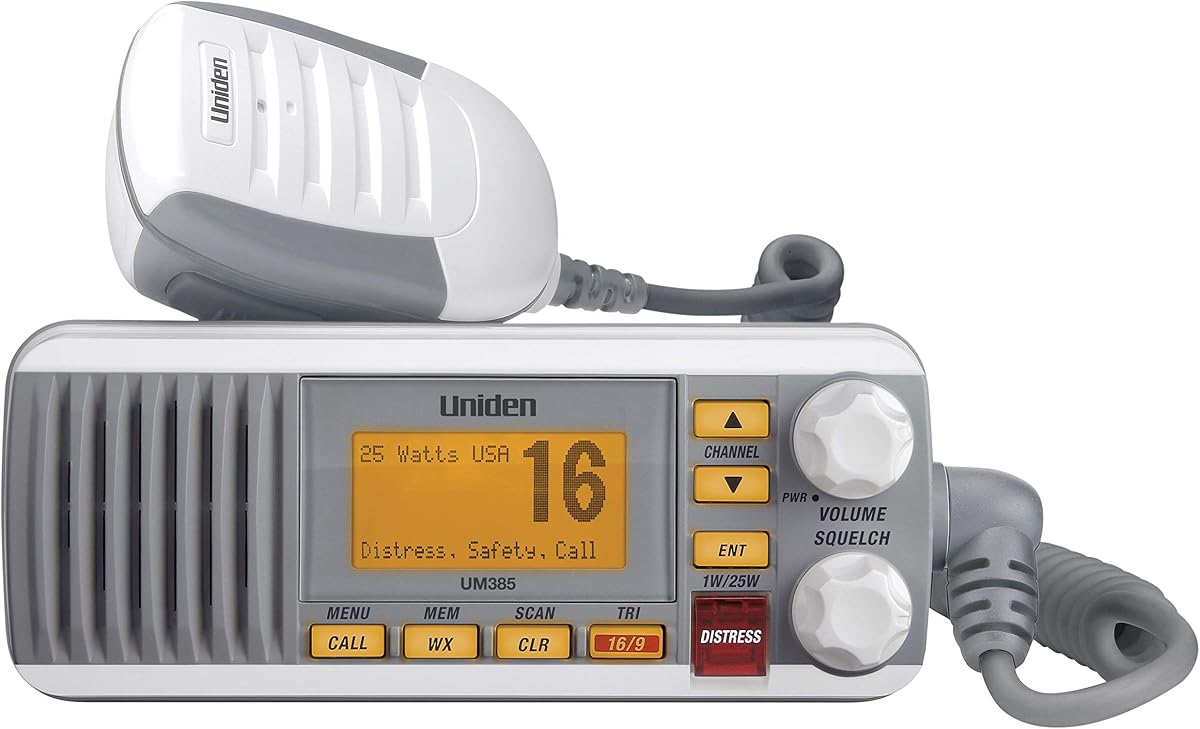
Uniden UM385 25 Watt Fixed Mount Marine Vhf Radio, Waterproof IPX4 with Triple Watch, Dsc, Emergency/Noaa Weather Alert, All Usa/International/Canadian Marine Channels, Memory Channel Scan, White
This side-by-side comparison covers fixed-mount and handheld DSC VHF marine radios, emphasizing the features that affect safety, communication, portability, and ease of use on the water.
The Uniden UM385 is a fixed-mount marine VHF radio with a 4.6 rating that combines substantial transmit power with essential DSC safety features. Its 25-watt output is well suited to a powerboat, center console, sailboat, or workboat where extended VHF range and installation convenience matter more than pocket-sized portability.
Pros
Strong 25-watt output
Distress and position functions
International marine channels
Weather alert capability
Cons
Not fully submersible
Requires fixed installation
We may earn a commission when you buy through this link, at no additional cost to you.
The radio supports full Class D DSC, including a distress button, position sending, and position requests. Triple Watch allows the operator to monitor several marine channels, while access to USA, international, and Canadian channels broadens its usefulness across different waters. NOAA weather alerts add another layer of situational awareness, and the included rugged microphone is designed for easy transmission from the helm.
Its IPX4 rating means it resists rain and splashing water, which makes it appropriate for a protected helm installation, though it is not submersible like some competing models. The memory-channel scan and one-button DSC controls add convenience, but there is no built-in GPS or AIS receiver mentioned in the supplied information. Owners should therefore plan how the radio will receive position information for automated or precise DSC calls.
This is a strong value-oriented option for a boat with an existing mounting location and a need for reliable Class D DSC communications. It is less suitable for a small tender, kayak, or highly exposed console where a fully submersible fixed-mount unit would be preferable. For those needs, the Uniden UM435BK offers a more rugged alternative.
Fixed-Mount Power and Reach
The 25-watt transmitter is the UM385's defining advantage for vessels traveling farther from shore. Its controlled microphone also lets the operator keep a hand on the wheel while using the primary communication controls.
Practical DSC Protections
Distress sending, position requests, and position reporting provide the core functions expected from a Class D DSC marine radio. Triple Watch adds valuable monitoring flexibility on busy waterways.
The Retevis RM40 is a portable 5-watt DSC marine radio designed with anglers and small-boat users in mind. It carries a 4.0 rating and combines a built-in GPS receiver, distress messaging, a man-overboard alarm, and a floating IPX67 body in a package suited to coastal fishing and other activities close to shore.
Pros
Integrated GPS position data
Floats after accidental drop
Flashing red retrieval light
Dual and tri-watch monitoring
Cons
Lower 5-watt output
Less established feature detail
We may earn a commission when you buy through this link, at no additional cost to you.
Its integrated GPS updates the radio's position in real time, while the DSC function can preset distress messages and automatically transmit GPS coordinates. The MOB function records and shares an overboard location with other vessels, adding a dedicated emergency layer. If the radio is dropped into the water, it floats and uses a flashing red LCD to make retrieval easier.
Dual and Tri-Watch functions help users monitor distress traffic and important communications on shipping lanes. The trade-off is 5-watt transmit output, which is lower than the 6-watt power offered by several competing handhelds. The supplied specifications also list fewer broad navigation and accessory features than those of the Icom M94D or Standard Horizon HX890.
For shore-based anglers, kayakers, and small-boat operators who value position sharing and flotation, the RM40 offers a compelling safety-focused feature set. It is less compelling for extended offshore work where maximum handheld transmit power and a broad accessory ecosystem may take priority.
GPS-Assisted Emergency Signaling
The RM40 can send stored distress messages with GPS position information, reducing the amount of manual information required during a serious emergency. Its MOB sharing function makes the overboard scenario more directly addressable.
Designed to Stay Recoverable
The floating IPX67 enclosure and flashing red display are particularly useful around docks, in surf, and on fishing kayaks. These retrieval-focused details complement the radio's DSC and position-sharing functions.
The Icom M94D is a feature-rich handheld marine radio with a 4.4 rating, 6-watt transmission, and an integrated AIS receiver. It is especially compelling for boaters who want to see nearby vessel traffic and quickly turn AIS target information into DSC calls from a portable unit.
Pros
AIS target visibility
Long 10-hour runtime
High-output 1500 mW audio
Precise MOB distress signal
Cons
Higher-tier feature requirement
Handheld may lack hardwired power
We may earn a commission when you buy through this link, at no additional cost to you.
Its AIS display provides information about surrounding vessels, while AIS target call streamlines individual DSC communication and distress-alert setup. The radio also delivers 1500 mW of speaker output, a useful advantage in noisy marinas, engine rooms, and offshore conditions. Its 2400 mAh lithium-ion battery is listed as providing up to 10 hours of typical operation.
Simplified navigation supports up to 50 favorite fishing spots or destinations, making the unit useful beyond emergency communications. Float'n Flash helps the user locate the radio if it is dropped overboard, and pressing the distress button while that feature is active sends a precise MOB signal. The main trade-off is that this advanced feature set may be more than a casual day-boater needs.
Choose the M94D for a portable unit that combines AIS, GPS-linked DSC, strong audio, and substantial battery life. It is a strong match for offshore anglers and recreational cruisers who want serious handheld capability without carrying a fixed-mount console.
AIS Awareness in a Handheld
The integrated AIS receiver gives users a way to view nearby vessel traffic rather than relying only on voice calls. Direct integration with DSC target calling makes that awareness more useful for routine and emergency communication.
Audio That Cuts Through Noise
The 1500 mW speaker output is a meaningful distinction for users in rough conditions or crowded engine spaces. Clearer reception reduces the need to turn up an already loud radio and helps calls remain intelligible.
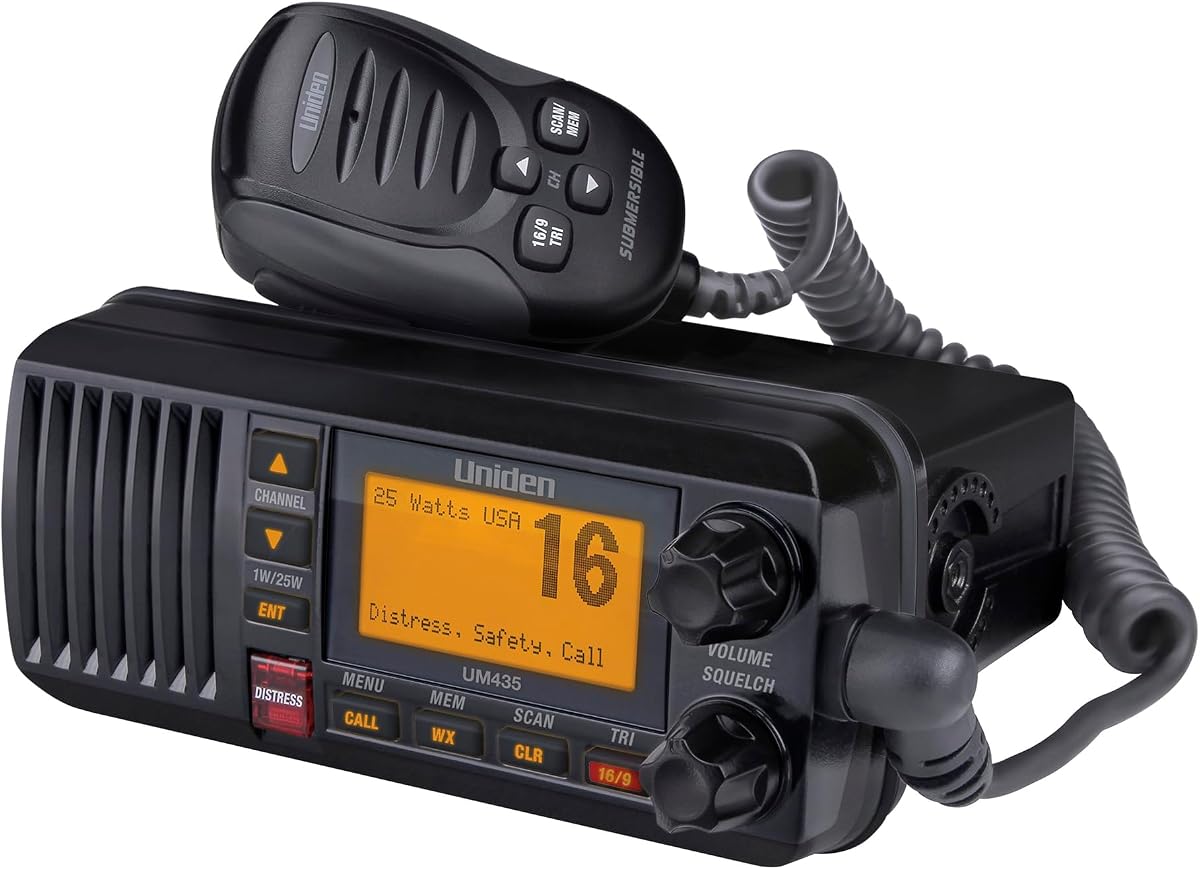
The Uniden UM435BK is a rugged fixed-mount radio with a 4.6 rating and an IPX8 submersible design. It provides 1-watt and 25-watt transmit settings, digital selective calling, position sending and requesting, and broad channel coverage for a more demanding marine installation.
Pros
Fully submersible enclosure
Selectable 1- or 25-watt power
Dual and triple watch
Wide international channel support
Cons
Fixed installation required
No listed AIS receiver
We may earn a commission when you buy through this link, at no additional cost to you.
Its completely submersible construction distinguishes it from splash-resistant fixed-mount competitors. That makes it a logical choice for an exposed helm, center console, fishing boat, or other installation where weather and spray are routine concerns. Memory-channel scanning, dual watch, and triple watch support flexible monitoring.
The radio includes USA, international, and Canadian marine channels, including new four-digit and Canadian B channels. A three-year water-protection warranty adds reassurance for a device intended to face demanding marine conditions. Compared with the Uniden UM385, it sacrifices no listed transmission-power capability while moving up to a stronger waterproofing standard.
The UM435BK is best for a permanent vessel installation where ruggedness and range matter. It lacks a stated built-in AIS receiver and does not offer the integrated multi-system GPS described for the Icom IC-M330G, so buyers should verify navigation and positioning requirements before finalizing their installation.
Weather-Ready Fixed Installation
The IPX8 enclosure is built for direct exposure to water in demanding marine environments. It reduces the need to treat the console like a dry location and makes the radio a stronger option for open helm layouts.
Flexible Power and Monitoring
Switching between 1-watt and 25-watt output lets users balance communication range and power consumption. Dual- and triple-watch functions support simultaneous monitoring of important marine channels.
The Icom IC-M330G is our Editor's Choice and the highest-rated product in the group, carrying a 4.9 rating. Its palm-sized fixed-mount chassis, integrated GPS, Class D DSC, and receiver performance make it a particularly balanced choice for modern boat consoles where space and clear information both matter.
Pros
Highest listed customer rating
Exceptionally compact installation
Integrated position and navigation data
One-touch soft-key functions
Cons
Fixed-mount format only
No AIS receiver specified
We may earn a commission when you buy through this link, at no additional cost to you.
The built-in GPS/GLONASS/SBAS receiver provides position, course, and speed data for more accurate DSC calls. Continuous Channel 70 monitoring covers distress, individual, group, all-ships, safety, position request and report, polling, and test calls. The radio's directional keypad, soft keys, and one-touch assignments for frequently used features simplify operation.
Receiver selectivity above 70 dB and improved IMD performance help the radio remain reliable in RF-busy marinas and harbors. The new speaker design is listed as delivering loud, clear sound with rich bass and crisp treble. Its ultra-compact chassis fits more readily into small consoles and tight helm spaces than a full-size traditional radio.
This is our top overall selection for a boat with a fixed mounting point and an emphasis on compact design, DSC, and integrated positioning. It does not list an AIS receiver, so it is not the natural choice for a user who primarily wants to view surrounding vessel traffic. Even so, its strong rating, safety features, and installation-friendly proportions make it exceptionally compelling.
Built-In Positioning Improves DSC
The multi-system GPS receiver supplies position, course, and speed directly to the radio. That reduces reliance on a separate GPS feed and supports more informative DSC calls.
Compact Without Oversimplifying Controls
The small chassis is paired with a directional keypad and configurable soft keys. Frequently used functions can be placed close at hand, which makes the radio practical for both experienced operators and new users.
The Standard Horizon HX210 is a compact 6-watt floating handheld with a 4.6 rating. It is designed for smaller boats and users who want a straightforward marine radio with international channel access, emergency signaling, and a charger that can work from common household or vessel power sources.
Pros
Compact floating construction
Selectable 6, 2.5, or 1 watts
Emergency water-activated strobe
Dual charging options included
Cons
No stated built-in GPS
Fewer navigation functions listed
We may earn a commission when you buy through this link, at no additional cost to you.
Its IPX7 waterproof rating covers immersion to 3.3 feet, or one meter, for 30 minutes. The radio also floats, which reduces the risk of losing it after an overboard drop. A water-activated emergency strobe provides another visible recovery aid, while the large full dot-matrix display keeps channel and status information readable.
Selectable output of 6 watts, 2.5 watts, and 1 watt allows the operator to match power to communication distance and battery needs. The 1850 mAh lithium-ion battery is paired with a three-hour desktop rapid charger. Charging cables for 12-volt DC and 110-volt AC are included with the cradle, making it versatile for dock and onboard charging.
The HX210 also receives NOAA weather and FM broadcast bands and includes programmable function keys. Its lack of listed built-in GPS and navigation functions makes it less advanced than the M94D or HX890, but that simplicity can be advantageous for a small-boat owner who values compactness, charging convenience, and essential durability.
Compact Power for Local Waters
The HX210 provides the same maximum 6-watt output as several larger handhelds while maintaining a compact case. Multiple selectable power levels help manage energy use during extended outings.
Charging That Fits Different Locations
The included cradle accepts both 12-volt DC and 110-volt AC charging cables. That flexibility lets users charge from a boat's electrical system, a vehicle outlet, or a household connection.
The Uniden UM725GBT is a connected fixed-mount marine radio with a 4.3 rating. It combines 25-watt transmit power, a built-in GPS receiver, Bluetooth, a large 68-by-38-millimeter display, and DSC support, making it a strong candidate for modern boats with networked navigation equipment.
Pros
Exceptionally large display
Bluetooth smartphone connection
GPS and DSC integrated
NMEA data input and output
Cons
More complex fixed installation
Connection features may require setup
We may earn a commission when you buy through this link, at no additional cost to you.
Its integrated GPS allows the radio to know its position for emergency signaling without relying entirely on an external position source. NMEA0183 and NMEA2000 input and output support the sharing of GPS and DSC information with other compatible devices and stations. This connectivity makes the radio useful as part of a broader helm electronics setup.
Bluetooth allows connection to a smartphone, while NOAA weather channels and alerts support weather awareness. The large display is especially useful for users who want to see more channel, position, and status information at once. The included speaker microphone keeps voice communication practical at the helm.
This model is best for a modern fixed installation where the owner values connectivity and information density over the smallest possible footprint. The more expansive feature set introduces more setup considerations, and the IPX8 waterproof rating should be interpreted in the context of proper installation rather than treating the radio as a portable device.
Modern Helm Connectivity
Bluetooth and NMEA0183/NMEA2000 connections create links between the radio, a smartphone, and other marine electronics. These options can simplify information sharing when compatible onboard devices are present.
A Display Built for Visibility
The 68-millimeter-wide by 38-millimeter-high screen provides a generous view of radio information. Its larger dimensions are helpful on a fixed console where glanceable status details are more important than minimalism.
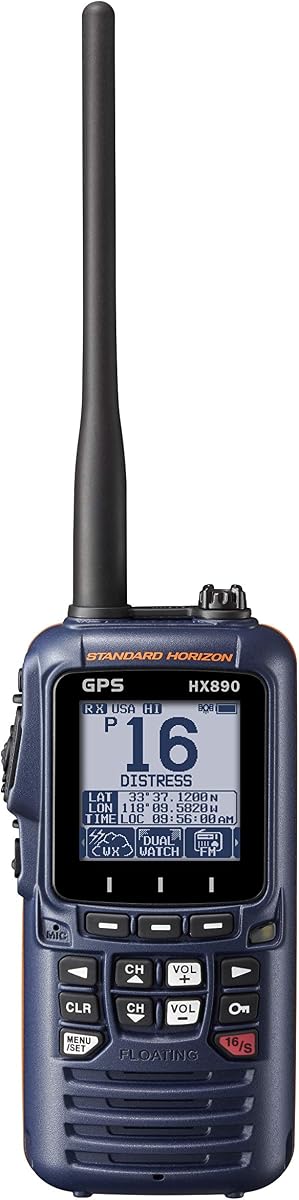
The Standard Horizon HX890 Navy is our premium handheld selection, earning a 4.6 rating for its extensive safety, navigation, and communication capabilities. It combines 6-watt output, floating IPX8 construction, Class H DSC, an integrated 66-channel WAAS GPS receiver, and an 11-hour stated operating time.
Pros
Comprehensive accessory package
Advanced DSC group monitoring
Waypoint and route navigation
Noise-canceling transmission and reception
Cons
More complex than basic handhelds
Larger feature set than needed offshore
We may earn a commission when you buy through this link, at no additional cost to you.
The 1.7-inch square full dot-matrix display, waypoint and route navigation, and group monitoring through DSC group position calls give the radio more capability than a basic waterproof handheld. Selectable day and night modes improve readability in changing conditions. The 700 mW audio system includes noise canceling for both transmitted and received speech, which can be useful in busy or noisy settings.
The accessory package is notably complete, including a rechargeable lithium-ion battery, alkaline battery tray, wall charger, international adapter, cradle, 12-volt charger, programming cable, and belt lip with lanyard. A water-activated white strobe, man-overboard feature, FM receiver, NOAA weather alerts, dual and triple watch, and two scrambler systems further broaden its functionality.
Choose the HX890 when you want a portable radio with the capabilities of a small command center rather than a basic channel selector. It is particularly attractive for cruisers, anglers, and expedition-minded users who need navigation and DSC group features. Those who only require simple local communication can find more streamlined alternatives.
Navigation and DSC in One Unit
The integrated WAAS GPS supports waypoint and route navigation while supplying position information for DSC calls. Group monitoring adds another way to track and communicate with a defined set of vessels.
Premium Accessories Included
The supplied charging, power, programming, and carrying accessories cover several common charging and operating scenarios. This makes the package more complete for a buyer who does not want to source separate accessories immediately.
The Standard Horizon HX891BT is a handheld marine radio with a 4.6 rating and a compact physical profile. The supplied listing identifies it as the HX891BT model, describes it as a two-way radio, and gives approximate dimensions of 5.43 by 2.6 by 1.5 inches.
Pros
Recognizable marine radio format
Compact handheld dimensions
Portable communication option
Standard Horizon product family
Cons
Sparse supplied specifications
Key safety details unconfirmed
We may earn a commission when you buy through this link, at no additional cost to you.
Because the available product information is limited, its appeal lies in its recognizable handheld form and place within the Standard Horizon marine-radio range. It provides an alternative for a boater seeking a portable two-way unit rather than a permanently mounted console radio. The one-item quantity also makes it straightforward for an individual purchaser to select.
The main caution is the absence of listed details about DSC class, GPS, waterproof rating, transmission power, and included accessories. Those specifications should be verified directly on the current listing and packaging before purchase. In particular, a buyer should not assume that the HX891BT offers the same features as the HX890 solely because both products share the Standard Horizon name.
This is a reasonable shortlist candidate for compact portable communications, but the detailed HX890 may be a safer choice when detailed feature documentation is important. Treat the HX891BT as a model to investigate rather than assuming it matches the more extensively documented premium handhelds in this guide.
Verify Before Installing or Relying
Key emergency functions, channel access, power levels, and water-resistance claims should be confirmed from the current product documentation. Those details are central to choosing a marine safety device responsibly.
Portable Form Factor
The listed dimensions place the radio in a conventional handheld range. That makes it easier to compare physically with other compact marine units when storage and on-board space are priorities.
The Standard Horizon HX890 Black is a rugged floating marine handheld with a 4.6 rating. It delivers 6-watt transmission, full Class H DSC, an integrated 66-channel WAAS GPS receiver, waypoint and route navigation, and an IPX8 enclosure for demanding use.
Pros
Floats after overboard loss
Six-watt maximum transmission
Built-in GPS navigation
Extensive accessory bundle
Cons
Advanced controls need learning
May exceed basic radio needs
We may earn a commission when you buy through this link, at no additional cost to you.
The round case is designed for strong ergonomics and features a 1.7-inch square full dot-matrix display with selectable day and night modes. Its 1800 mAh lithium-ion battery is listed for up to 11 hours of operation. A man-overboard function, water-activated emergency strobe, dual and triple watch, NOAA weather alerts, and group monitoring provide a broad safety framework.
Audio output is listed at 700 mW, with noise-canceling functions for both transmission and reception. Two built-in scrambler systems, an FM broadcast receiver, and a micro-USB data jack add functions beyond basic VHF communication. The complete accessory set includes several chargers, a charging cradle, a programming cable, battery tray, and belt lip with lanyard.
This black HX890 is an excellent alternative for buyers who prefer the HX890 platform without the navy color choice. Its rugged case is described as conforming to military standard testing, and the radio floats for recovery after an accidental drop. It is best suited to users who will take advantage of its navigation, group DSC, and accessory features.
Serious Handheld Navigation
Waypoint and route navigation gives the HX890 more day-to-day utility than a basic marine handheld. The integrated GPS receiver also provides position data for DSC communication.
Built for the Boat and Beyond
The floating IPX8 body, water-activated strobe, and multiple charging options support use in wet environments. A complete accessory bundle improves readiness for regular operation.
We may earn a commission when you buy through this link, at no additional cost to you.
Buying Guide – How to Choose the Best Dsc VHF Marine Radio
The right DSC VHF marine radio depends on vessel size, operating range, installation space, power supply, and the navigation features you actually need. Comparing these factors prevents a purchase based solely on output wattage or a long feature list.
Fixed Mount or Handheld
A fixed-mount radio is installed in a helm or console and generally draws from the boat's electrical system. It is convenient for regular communication, provides a prominent control surface, and may include more extensive navigation or connectivity features. Installation involves cable routing, mounting, antenna connection, and adequate space behind the console.
A handheld radio is easier to carry between the helm and elsewhere, can be taken on a dinghy, and often provides flotation and water-activated emergency lights. It is particularly useful for anglers, kayakers, and small-boat users. Its limitations include finite battery life and the need to keep the device accessible during an emergency.
Choose by use case: fixed mount for a primary onboard communications system, handheld for mobility, or both for complementary coverage.
Transmission Power
Higher transmit power can improve practical communication distance, particularly between vessels or from a boat farther offshore. The listed fixed-mount choices reach 25 watts, while the handhelds range from 5 to 6 watts. Power is not the only influence on range; antenna height, placement, obstruction, weather, and the receiving station all matter.
A lower-power setting may help conserve battery life on a handheld or reduce unnecessary power use. Fixed-mount radios commonly offer both low and high settings. Consider where you will travel: nearshore trips may demand less than coastal or offshore passage.
Prioritize adequate range for normal routes, not a maximum number printed on the box.
DSC and Position Functions
Digital Selective Calling sends structured distress, position, and calling information in addition to ordinary voice communication. Look for the distress button, position send, position request, and the relevant DSC class. Class D is common for fixed-mount marine use, while the HX890 and HX891BT family information identifies Class H functionality.
GPS integration can make an DSC call more useful because the radio can send a location without requiring the user to estimate or enter coordinates. Check whether GPS is built in or if the radio accepts position data from another device. Also verify how the radio is configured to use that data.
Treat DSC and GPS as a connected safety system rather than separate headline features.
Water Resistance and Flotation
Marine radios face rain, spray, washdowns, and occasional immersion. IPX4 is designed to resist splashing water, while IPX7 and IPX8 indicate stronger submersible capabilities. A radio that floats and uses an activated strobe or flashing display is easier to locate after an overboard drop.
Fixed-mount ratings depend on correct installation, including use of the supplied or specified microphone and sealing arrangements. Handheld ratings are easier to assess because the entire unit is exposed during use.
For an open console, small boat, or kayak, prioritize a higher waterproof rating and flotation over added convenience features.
Battery and Charging
Battery capacity influences how long a handheld can remain available. Listed figures range from 1,850 mAh for the HX210 to 2,400 mAh for the M94D, while the HX890 supports up to 11 hours of stated operation. Actual runtime varies with transmit power, screen use, GPS reception, weather conditions, and battery age.
Consider the charging system. The HX210 includes a rapid cradle and both 12-volt DC and 110-volt AC cables, which is convenient for dock and onboard use. Other premium handhelds include multiple chargers and battery options. A fixed-mount unit avoids daily handheld battery management but needs a reliable vessel power source.
Match charging arrangements to where the radio will spend most of its life.
Display and Controls
A dot-matrix display can show more detailed channel and status information than a simple segment display. Larger fixed-mount screens may reduce menu navigation and improve visibility at a distance, while a compact handheld benefits from large buttons and an easy-to-read interface. Day and night display modes can also help in changing light.
Look for programmable function keys, soft keys, and a directional keypad. These features can put emergency or frequently used actions closer to the operator's thumb. A complicated interface with functions you never use is not automatically better than a simpler radio with controls you understand.
For new users, prioritize readable information and straightforward access to DSC rather than the longest menu.
Navigation and Traffic Awareness
GPS adds position, waypoint, route, course, and speed information depending on the model. The Icom M94D stores up to 50 favorite waypoints, while the Standard Horizon HX890 supports waypoint and route navigation plus group position monitoring. These functions can help users navigate to saved destinations and communicate with a selected vessel group.
AIS is a separate capability. The M94D includes an AIS receiver that displays nearby vessel traffic, but an AIS receiver does not automatically mean the radio transmits your own position as an AIS target. Do not assume every DSC radio has AIS.
Decide whether active traffic awareness is important enough to favor a model with a built-in AIS receiver.
Connectivity and Accessories
The Uniden UM725GBT supports Bluetooth and NMEA0183/NMEA2000 input and output, enabling connections with a smartphone and compatible marine electronics. Standard Horizon handhelds may include programming cables, charging cradles, alternative power adapters, battery trays, and carrying attachments. Complete packages can simplify initial setup.
Confirm whether the included microphone, antenna, charging cradle, power cables, and data cable meet your installation needs. Some fixed-mount packages require separate antennas or existing onboard GPS data. Accessories are also important for secure storage and rapid access.
Choose connectivity only when it serves a real workflow in your helm or on your vessel.
How to Use and Care for Your Dsc VHF Marine Radio
Before the first outing, read the supplied manual, install the antenna correctly, confirm the radio's channel plan, and program the channels used in your area. Charge a handheld fully, test its controls in a safe location, and configure DSC information only with accurate data. For a fixed-mount unit, verify the power connection, microphone routing, emergency channel, and compatibility with any external navigation equipment.
Keep the microphone, controls, and display dry and unobstructed, but do not use abrasive cleaners or strong chemicals. A marine radio is designed for a demanding environment, not for submersion beyond its stated rating. Rinse removable handheld parts with fresh water after use in salt or mud, allow the microphone connector and charging contacts to dry, and store the unit in a dry, accessible location.
Test the radio according to the manufacturer's guidance and local requirements, particularly if DSC is part of your emergency plan. Keep a charged backup battery, know how to reach emergency services by VHF, and make sure the vessel's registration and contact information remain current. After every outing, monitor the battery, inspect the antenna and connections, and address corrosion or physical damage promptly.
Frequently Asked Questions
What is a DSC VHF marine radio?
A DSC VHF marine radio combines conventional VHF voice communication with Digital Selective Calling. It can transmit and receive distress alerts, position information, and individual or group calls. Many models also include GPS, emergency alerts, and marine channel monitoring, making them central to a vessel's safety equipment.
Do I need a GPS receiver with DSC?
GPS is highly useful because it allows a radio to transmit an accurate position with a distress or position call. Some radios have a built-in receiver, while others accept position data from another device. Check the connection method and DSC configuration carefully, because a DSC radio without accurate position information cannot provide the full benefit of location-based emergency messaging.
Is a 25-watt fixed-mount radio better than a 6-watt handheld?
Neither is universally better. A 25-watt fixed-mount unit is usually more appropriate for a primary boat communications system and can offer more range from a good antenna installation. A 6-watt handheld is more portable and easier to carry to a dinghy or emergency location. The best choice depends on vessel layout, travel distance, and whether mobility matters more than fixed convenience.
What does IPX4, IPX7, or IPX8 mean for a marine radio?
IPX4 indicates resistance to splashing water and is generally more appropriate for a protected fixed installation. IPX7 indicates a radio can withstand a specified period of submersion, while IPX8 represents a higher submersible standard. Ratings should still be considered alongside proper installation, connector care, and the manufacturer's instructions.
Is AIS the same as DSC?
No. DSC is a digital calling and distress system, while an AIS receiver provides information about certain nearby vessels. The Icom M94D combines both in one handheld. A DSC radio without AIS can still make distress, position, individual, and group calls, but it may not display the same surrounding traffic information.
Should I choose a handheld that floats?
A floating handheld is especially valuable for anglers, kayakers, and small-boat users because the radio can rise to the surface after an overboard drop. A water-activated strobe or flashing display makes recovery easier. For a permanently mounted helm radio, flotation is less important than water-resistance rating and correct microphone sealing.
How long should a marine radio battery last?
The listed products provide differing capacity and runtime, including up to 10 hours for the Icom M94D and up to 11 hours for the Standard Horizon HX890 under typical conditions. Real usage varies with transmit power, GPS, screen brightness, and battery age. Rechargeable batteries also lose capacity over time, so inspect and replace them when reliable operation declines.
Can I install a fixed-mount marine radio myself?
Many owners can perform a basic installation, but antenna placement, power routing, grounding, microphone connection, and NMEA data wiring require care. Follow the manual for the specific model and vessel configuration. If the installation involves unfamiliar electrical or navigation connections, professional marine electronics support can help prevent faults and improper operation.
Final Thoughts on Choosing the Best Dsc VHF Marine Radio
The Icom IC-M330G is the strongest all-around choice for a modern fixed installation because it combines a compact chassis, integrated multi-system GPS, full Class D DSC, and excellent receiver selectivity. The Uniden UM385 offers a more budget-conscious 25-watt fixed-mount option, while the Standard Horizon HX890 Navy is the most fully equipped premium handheld in the group.
Start with the operating environment: choose a rugged handheld for portability and flotation, or a fixed mount for a primary helm system. Then prioritize DSC operation, accurate position data, appropriate transmission power, usable controls, and a waterproofing rating that matches the installation. Features such as AIS, NMEA connectivity, waypoint storage, and Bluetooth are valuable when they support your actual boating routine.
Before buying, verify the current product details, included accessories, compatibility, channel configuration, and operating instructions. Product listings, promotions, and prices can change, so check the latest information rather than relying solely on this guide. With the right match between vessel, range, and safety features, a DSC VHF marine radio becomes a dependable link to other vessels, emergency services, and the information needed to respond safely on the water.
Explore the best Light Up Glowing Moon Lamps, comparing 10 highly rated models across colors, controls, timers, light quality, portability, and home decor.