
Elitech HVAC Digital Manifold Gauge Set DMG-2SE
4.4Editor score
Supports 88 common refrigerants
Includes three charging hoses
Comes with R410A adapters
This digital manifold gauge set guide compares 10 leading models for accuracy, refrigerant support, temperature probes, displays, portability, and field
A digital manifold gauge set combines pressure, vacuum, and temperature measurements in one diagnostic instrument, helping HVAC technicians diagnose refrigeration systems with less manual calculation. The best model balances accurate readings, broad refrigerant compatibility, readable displays, useful accessories, and dependable construction for demanding service environments.
This guide compares ten digital manifold gauge sets based on their stated pressure and temperature ranges, supported refrigerants, probe and hose accessories, measurement functions, display design, power options, and portability. It covers everything from straightforward two-channel kits to advanced wireless systems with vacuum gauges, data logging, and smartphone connectivity.
Each review highlights the most important strengths and trade-offs, helping readers identify a model suited to routine residential service, refrigeration work, A2L refrigerant systems, or mobile diagnostics. Product features and availability can change, and current prices fluctuate, so shoppers should verify specifications and accessories before purchasing.
4.4Editor score

4.6Editor score

4.5Editor score
The table below places all ten digital manifold gauge sets side by side, focusing on refrigerant breadth, measurement capabilities, display and connectivity features, and the accessories that affect real-world HVAC and refrigeration work.




The Elitech DMG-2SE is a practical digital manifold gauge set with a 4.4 rating and an unusually complete collection of included accessories for its class. Its most attractive feature is the combination of 88 refrigerant profiles, high- and low-side saturation temperature readings, three five-foot hoses, and two dedicated R410A adapters. That makes it a strong choice for technicians who want a ready-to-use kit without needing to source common pieces separately.
We may earn a commission when you buy through this link, at no additional cost to you.
The gauge is designed to replace slow PT chart lookups by presenting saturation temperatures directly during diagnostics. It supports pressure monitoring, leak testing, real-time condensation readings, and refrigerant charging across residential, commercial, and automotive applications. The standard 1/4-inch SAE connections also make it familiar to technicians who already work with conventional manifold hose sets.
Its construction is another meaningful strength. Elitech describes a shock-resistant structure with lab-tested drop stability, while the auto shutoff and data hold features support efficient use during long service calls. The main limitation is that the listed feature set does not mention wireless probes, app-based documentation, or an integrated mechanical vacuum gauge, so it is less oriented toward advanced remote workflows than some premium choices.
This is the best budget-oriented recommendation in the roundup because it arrives with the hoses and adapters needed for common charging work and covers a broad refrigerant library. It is especially appropriate for residential HVAC technicians, maintenance beginners, and anyone who values a compact, straightforward instrument over extensive digital connectivity.
Showing saturation temperature alongside high- and low-side readings can shorten diagnosis time. Instead of consulting a separate chart for every pressure-temperature relationship, the instrument provides the reference values needed to evaluate the system more directly.
The three color-coded 1/4-inch SAE hoses and R410A adapters remove several common setup obstacles. The included components make the DMG-2SE a practical all-in-one option for technicians who want to keep essential charging hardware together.
We may earn a commission when you buy through this link, at no additional cost to you.
The VIVOHOME Digital HVAC Manifold Gauges offer a broad measurement package with a 4.2 rating. The instrument covers temperature and pressure monitoring, pressure leak testing, vacuum measurement, and the calculation of superheat and subcooling. Two wired temperature clamp probes allow pipe-temperature readings to be collected at the same time as dual pressure readings, making it useful for conventional diagnostic workflows.
We may earn a commission when you buy through this link, at no additional cost to you.
Its stated temperature range extends from -58°F to 302°F, while pressure readings cover vacuum through 500 or 800 psi depending on the side. The listed temperature precision is plus or minus 0.9°F, and pressure accuracy is plus or minus 0.5% of full scale. A large backlit LCD, automatic pressure and temperature unit conversion, and an auto power-off function improve readability and energy management.
The accessory set is extensive, with three hoses, locking valves, two temperature clamps, a hook, a carry case, and two anti-freeze safety valves. The main inconvenience is that three AA batteries are required but not included. Its wired probes also may be less convenient in tight mechanical areas than wireless options, although that arrangement can simplify consistent probe placement.
VIVOHOME is a sensible choice for technicians who need simultaneous pressure and temperature measurements without paying for app connectivity. The broad functions, carrying case, and included safety valves make it particularly useful for installation, maintenance, and field diagnostics involving systems that use any of its 88 supported refrigerants.
The two clamp probes provide live pipe-temperature data while the gauge monitors both pressure sides. That combination supports direct superheat and subcooling calculations, helping reduce the number of separate tools required during a diagnostic visit.
A dedicated carry case protects the instrument and accessories between calls, while the rear hook provides a convenient way to suspend the gauge during setup or testing. These practical touches matter when tools must survive repeated transport and use.
We may earn a commission when you buy through this link, at no additional cost to you.
The Fieldpiece SM382V SMAN is the premium choice in this guide, combining a 4.5 rating with a wireless three-port design and an integrated vacuum gauge. It is built for technicians who want one diagnostic platform to cover low-side pressure, high-side pressure, temperature, superheat, subcooling, and system tightness evaluation.
We may earn a commission when you buy through this link, at no additional cost to you.
One of its defining advantages is the built-in micron vacuum gauge. It can connect with Job Link Psychrometer probes, while protected thermocouple jacks support pipe and outdoor-temperature measurements. Data logging and temperature-compensated system tightness testing extend the instrument beyond basic charging into more structured service reporting.
The wireless format is particularly relevant for advanced service work because it reduces the need to manage several tethered sensors around a system. That convenience is paired with a four-valve manifold, giving technicians more control during evacuation, recovery, charging, and diagnostic procedures. The tradeoff is greater complexity and a substantially higher cost than the entry-level options.
The SM382V is best for professional HVAC and refrigeration operations that routinely perform leak testing, evacuation, and detailed system analysis. Technicians who only need occasional residential charging may find simpler sets more economical, but service businesses seeking a scalable, connected diagnostic platform will find this model's feature set particularly compelling.
The integrated vacuum gauge adds an important dimension to system evacuation and leak diagnosis. It allows the manifold to serve as the center of a broader diagnostic workflow instead of requiring technicians to rely on a separate vacuum instrument for every operation.
Wireless probes can be positioned around equipment without tether constraints. The reduced cable management can improve access in crowded mechanical rooms and makes temperature measurements easier to maintain while working around both the indoor and outdoor portions of a system.
We may earn a commission when you buy through this link, at no additional cost to you.
The WISSCOOL Digital Manifold Gauges distinguish themselves with a stated refrigerant database of 113 profiles and a 4.0 rating. They support common refrigerants including R454B, R410A, R32, R134a, R1234yf, and R22, covering a broad mixture of residential, light-commercial, and automotive air-conditioning applications.
We may earn a commission when you buy through this link, at no additional cost to you.
The color LED display presents pressure, vacuum, and temperature information, while two temperature clamp probes enable automatic superheat and subcooling calculations. The stated temperature range is -40°F to 302°F, and the pressure range extends to 6000 kPa. A pressure and temperature accuracy of plus or minus 0.5% full scale provides a reassuringly tight stated specification for professional measurements.
The included kit is notably complete, with three five-foot hoses, a storage case, two probes, four AA batteries, and a manual. The hoses have a 600 psi working rating and 3000 psi burst rating. A limitation is that the listing does not mention wireless probes, app documentation, or a separate integrated vacuum gauge.
WISSCOOL is a good fit for technicians who work across many refrigerant types and value a bright, information-rich display. The large profile library and ready-to-use accessories reduce the chance of encountering an unsupported common refrigerant, while the lack of connected features keeps the focus on direct measurements.
With 113 selectable refrigerant profiles, the gauge is well suited to technicians who encounter more than one refrigerant family in the field. Coverage of both older R134a and newer R454B and R1234yf systems supports a broad service mix.
The color LED screen can help distinguish changing values more quickly than a monochrome display. Bright presentation is particularly useful in mechanical rooms, service trucks, and other locations where lighting may be inconsistent during critical parts of a diagnostic.
We may earn a commission when you buy through this link, at no additional cost to you.
The testo 550s holds the highest customer rating in this roundup at 4.6, and its combination of precision, wireless probes, and app-based documentation makes it the strongest all-around recommendation. It handles air-conditioning, refrigeration, and heat-pump systems, providing a versatile platform for technicians who want measurement and digital records in the same workflow.
We may earn a commission when you buy through this link, at no additional cost to you.
Its temperature range is -58°F to 302°F, and its pressure range extends from -15 to 870 psi. The stated accuracy is plus or minus 0.9°F and plus or minus 0.5% of full scale. The kit includes two temperature probes and one vacuum probe, with the product information also describing these as wireless. Automatic superheat and subcooling calculations reduce the manual work required after readings are captured.
The smart app is the centerpiece. It can remotely operate the gauges, visualize service information, support maintenance tasks, and help send results from the job site. That makes the set useful for technicians who need to communicate findings to customers or office staff, document work, or maintain consistent procedures. A possible downside is that app-based operation is less attractive to users who prefer a fully self-contained instrument.
The testo 550s is recommended for mobile service professionals, service managers, and technicians who routinely work across residential and light-commercial refrigeration. Its measurement breadth and digital reporting capabilities justify the premium nature of the package, while the wireless probes improve flexibility around the equipment.
The app allows readings and service information to be presented and shared from a phone or tablet. For service businesses, this can make customer communication and recordkeeping more consistent without requiring the technician to manually reconstruct a report later.
The broad temperature and pressure ranges support air conditioning, refrigeration, and heat-pump work. A2L refrigerant support and automatic superheat and subcooling calculations also make the set useful for newer environmentally conscious refrigerant systems.
We may earn a commission when you buy through this link, at no additional cost to you.
The Elitech LMG-10 is a 4.5-rated two-way valve manifold designed around pressure holding, vacuum leakage testing, and temperature-compensated measurements. It supports 88 refrigerants and automatically calculates overheating and supercooling, giving it a solid feature set for routine field diagnostics.
We may earn a commission when you buy through this link, at no additional cost to you.
Users can switch between five pressure units and two temperature units, which helps when comparing readings with system documentation, service records, or regional conventions. The instrument also offers temperature compensation and automatic shutoff. These controls make it a practical upgrade from a purely analog gauge without introducing a complicated connected interface.
Its three 59-inch charging hoses use heavy-duty brass connections and are color coded yellow, blue, and red. The listed working pressure is 500 psi, with a 4000 psi burst rating. Those specifications are reassuring, though users should continue to verify hose condition and compatibility for every job rather than treating the rating as permission to exceed the connected system's requirements.
The LMG-10 is a strong choice for technicians who primarily need charging and pressure-testing performance in a conventional two-valve format. It is less compelling for advanced evacuation workflows than the Fieldpiece, and less connected than the testo, but it focuses on core diagnostics with a manageable learning curve.
The two-way valve arrangement follows a familiar service pattern, making the gauge approachable for technicians accustomed to standard manifold sets. It offers a clear route to simultaneous pressure and temperature information without the overhead of a four-valve system.
Three 59-inch hoses provide useful flexibility when the gauge cannot be positioned immediately beside both service ports. The brass connections and color coding help keep the three lines organized during connection and teardown.
We may earn a commission when you buy through this link, at no additional cost to you.
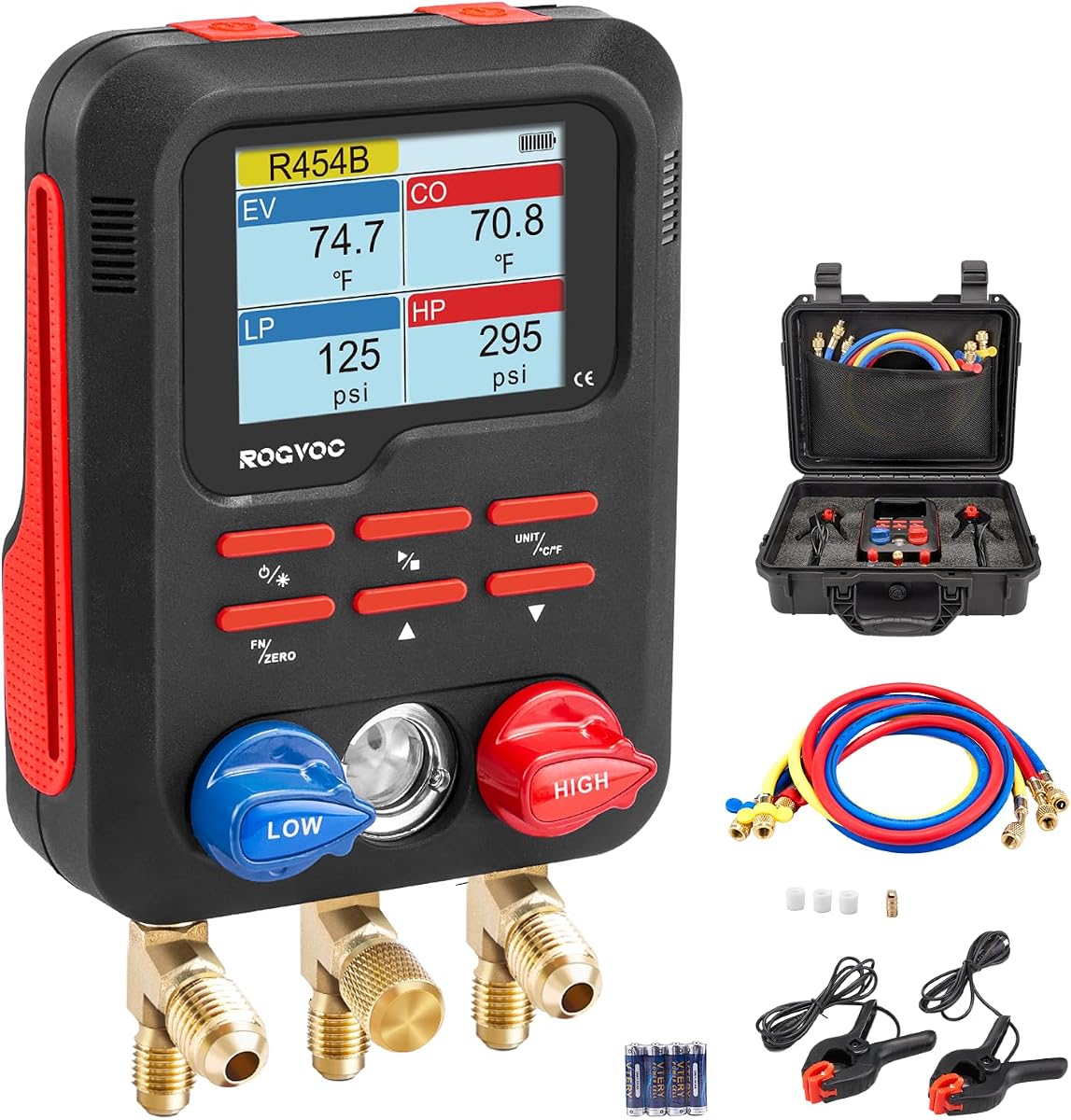
The Rogvoc Digital Manifold Gauge is a 4.0-rated kit that combines refrigerant charging, pressure testing, vacuum testing, temperature testing, and saturation measurements. Its 93-refrigerant database and 32-bit data acquisition system are designed to provide stable pressure readings across a wide range of common applications.
We may earn a commission when you buy through this link, at no additional cost to you.
The pressure test range extends to 6000 kPa, with a resolution of 1 kPa and stated accuracy of plus or minus 0.5% full scale. The vacuum range runs from -101 to 0 kPa, and the instrument can display vacuum values and percentages. That makes it useful for evaluating system tightness and observing pressure changes during a leak test.
A TFT LCD provides a clear display in dim conditions, and a visual window allows the charging status to be observed. The accessory package includes three five-foot hoses, two thermometer clamps, a replacement valve core, a toolbox, and batteries. The product listing promises around-the-clock customer support, although it also states that responses may take up to 24 hours.
Rogvoc is a good budget option for technicians who want a modern display, extensive refrigerant support, and vacuum testing without moving into premium wireless ecosystems. Its lower rating suggests some variability in user satisfaction, so buyers should pay close attention to warranty terms, included components, and after-sales support before committing.
The ability to show both absolute vacuum and a percentage of vacuum gives technicians more context during evacuation. A pressure difference over time can also help reveal whether a system is holding pressure as expected.
The TFT LCD remains readable in dark service environments, which is important when checking a gauge positioned behind equipment. A visible charging window adds another way to monitor the service process at a glance.
We may earn a commission when you buy through this link, at no additional cost to you.
The Elitech LMG-10Plus is a 4.3-rated compact digital manifold kit centered on portability and battery endurance. Its claimed battery life of up to 200 hours is the headline feature, offering a potentially useful advantage for technicians who work long shifts, travel frequently, or do not want to depend on disposable batteries for every call.
We may earn a commission when you buy through this link, at no additional cost to you.
The gauge supports 88 refrigerants, automatically calculates overheating and supercooling, and includes temperature compensation, auto shutoff, five pressure units, and two temperature units. A large display and hanging hook help with readability and hands-free positioning, while two temperature clamps are included for pipe measurements.
The replaceable battery is more useful than it may initially appear because it can extend the working life of the instrument without requiring the whole gauge to be replaced when a battery ages. Compact construction and low power consumption further support mobile use. However, the product information does not identify an integrated vacuum gauge, wireless probes, or app connectivity.
This LMG-10Plus is best for technicians who prioritize endurance, compactness, and a straightforward dual-channel diagnostic tool. It is especially suitable for field service providers who want dependable power availability and traditional temperature-clamp measurements without paying for a connected premium platform.
A stated 200-hour runtime can reduce interruptions caused by battery changes. The replaceable design also gives technicians a practical path for maintaining performance over years of regular use instead of discarding the entire instrument when its original battery ages.
The large screen presents core data clearly, and the back hook keeps the gauge accessible during setup. Automatic shutoff conserves power, while selectable units accommodate different service standards and documentation habits.
We may earn a commission when you buy through this link, at no additional cost to you.
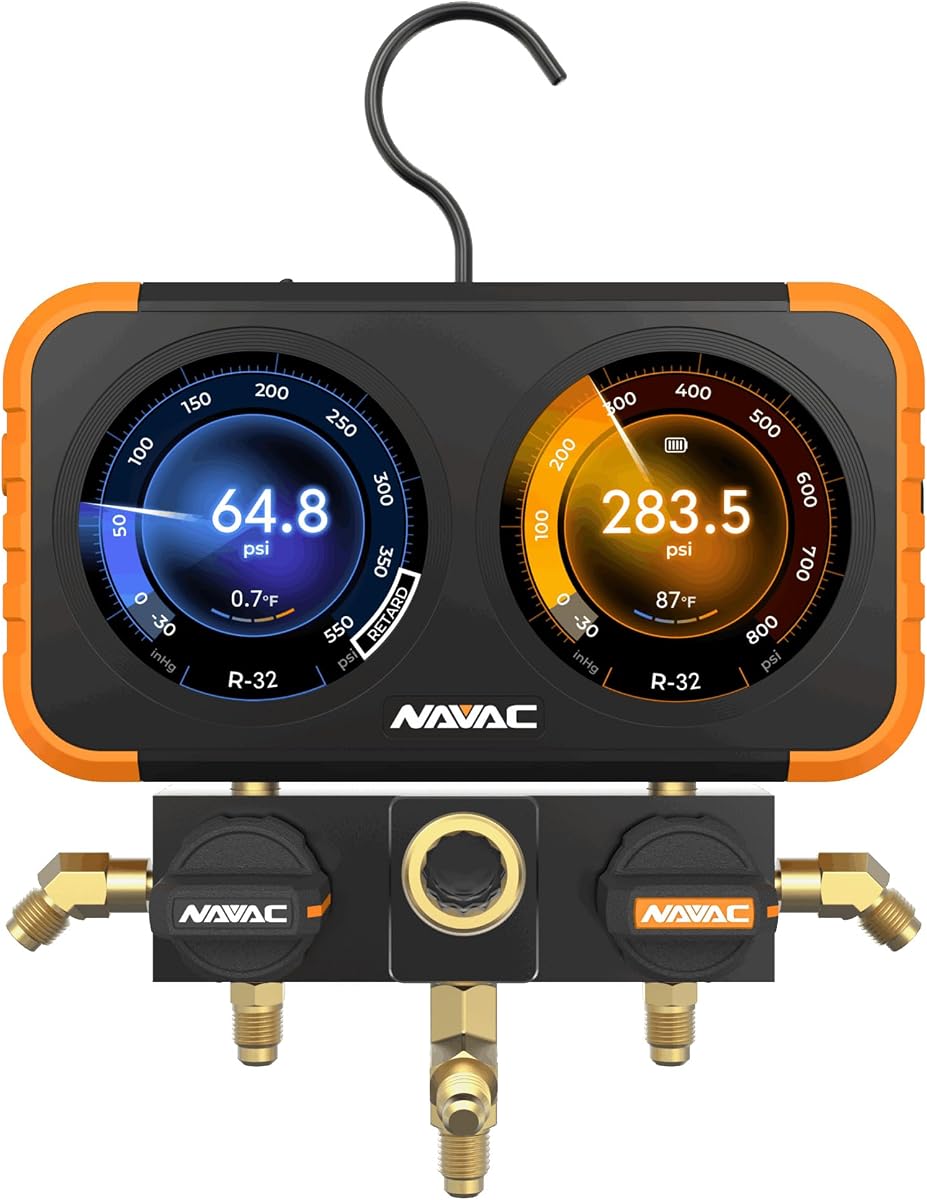
The NAVAC N2DX Flex-X combines a rugged aluminum body, IP54 protection, and a full-color HD display in a 4.3-rated package. Its Class 0.4 accuracy and visual interface make it appealing for technicians who want clear information and straightforward operation in demanding field environments.
We may earn a commission when you buy through this link, at no additional cost to you.
One-knob control is a defining design choice. The interface uses graphics, animations, and real-time visuals to help guide both experienced contractors and newer technicians. The gauge supports 72 refrigerants, including A2L types, giving it broad relevance across contemporary HVAC systems without attempting to offer every possible profile.
Its rechargeable lithium battery can run for up to 100 hours and uses USB-C charging, which simplifies routine power management. A foldable hook, compact size, and protective carry case make it easy to transport. The lack of an explicitly documented integrated vacuum gauge or wireless app functions means it is less comprehensive than the Fieldpiece or testo for those specific tasks.
The N2DX Flex-X is an excellent choice for field-oriented technicians who value screen clarity, durable construction, and simple controls. It should appeal particularly to users who want a modern, premium-feeling display and rechargeable power without a complicated application ecosystem.
The full-color screen presents readings and process graphics in a way that can be interpreted quickly. This is valuable when a technician needs an immediate overview of changing pressure or temperature values during a busy service call.
USB-C charging removes the need to keep a stock of disposable batteries, while the stated 100-hour runtime covers many working patterns. A compact protective case helps the instrument travel safely between sites.
We may earn a commission when you buy through this link, at no additional cost to you.
The AUTOOL Manifold Gauge Set has a perfect 5.0 customer rating and focuses on direct dual-pressure, dual-temperature measurement. It can also perform vacuum readings, detect pressure leaks, record leak duration and pressure differences, and calculate superheat and subcooling using profiles for 93 refrigerants.
We may earn a commission when you buy through this link, at no additional cost to you.
Its pressure accuracy is stated at plus or minus 0.5% full scale, and a large backlit LCD supports use in low-light areas. One-touch unit switching covers kPa, bar, psi, inHg, and MPa, while temperature readings can be switched between Celsius and Fahrenheit. Manual zeroing at startup is straightforward, which helps establish a consistent reference before a test.
The automatic leak-test mode records the initial pressure, real-time pressure, and pressure differential while displaying a timer. This is particularly useful for confirming whether a system is losing pressure gradually. Durable valve switches and standard 1/4-inch connectors support broad compatibility, while the three included hoses provide the basic service connections.
AUTOOL is a compelling choice for technicians seeking a simple, direct instrument with a high customer satisfaction score and a three-year warranty. It does not offer documented wireless connectivity, and users should verify that the stated hose rating is appropriate for each system. Even with those limitations, the straightforward workflow makes it a strong general-purpose choice.
Recording the initial and real-time pressure alongside a timer and pressure differential gives technicians a clear method for judging a pressure hold. The result is more structured than relying only on a visual estimate from a conventional analog gauge.
One-touch zeroing creates a simple starting point for each session, and one-touch unit switching reduces setup delays. The backlit display helps technicians read changing values in cramped or poorly illuminated service areas.
We may earn a commission when you buy through this link, at no additional cost to you.
Choosing a digital manifold gauge set requires balancing measurement capability, refrigerant coverage, service workflow, accessories, and portability. The most useful set is not necessarily the model with the longest feature list; it is the instrument that can perform the work you actually perform while remaining easy to carry, read, and maintain.
Begin by confirming that the gauge covers the pressures and temperatures found in the equipment you service. The products in this guide range from compact digital sets to professional systems with broad measurement spans, including vacuum, high-side pressure, low-side pressure, and pipe-temperature readings. Consider refrigerant-specific operating limits as well as the instrument's published range. A wide display range is useful, but it should not be confused with a guarantee of equally accurate results across the entire span.
Prioritize a set that provides both pressure and temperature measurements, and confirm that the stated accuracy suits the precision required by your work. Look for low-side, high-side, and vacuum readings rather than a gauge designed only for charging.
A useful refrigerant library prevents repeated manual pressure-temperature lookups and helps the gauge calculate saturation values, superheat, and subcooling. The reviewed sets support between 72 and 113 refrigerants, including widely used options such as R410A, R32, R454B, R134a, and R1234yf. For automotive or mixed-service work, broader coverage can be especially valuable. For a specialist operation, however, a smaller but accurate library may be sufficient if it includes every refrigerant regularly encountered.
Choose a database that covers current fleet needs and includes any newer A2L refrigerants relevant to your region. Verify the exact refrigerant names in the product listing rather than assuming compatibility from the broad category.
Temperature clamps must contact the pipe tightly to produce dependable readings for superheat and subcooling calculations. Wired probes provide a consistent connection and do not require charging, while wireless probes reduce cable clutter and can be easier to position around awkward equipment. Some premium models go further by including a wireless vacuum probe or accepting additional system probes.
Decide based on service environment and charging habits. For frequent mobile work, wireless probes may save setup time. For technicians who prefer fewer charging-related tasks or want simple placement, reliable wired clamps can be entirely adequate.
Bluetooth and app support can improve communication and recordkeeping, but connectivity is not essential for every technician. The testo 550s uses a smart app for remote operation, visual documentation, and sharing results, while the Fieldpiece SM382V supports data logging and Job Link probe integration. Connected features are most valuable for service managers and businesses that repeatedly document system conditions.
If you work independently and need only live readings, prioritize accuracy, probe quality, and display readability over app compatibility. If reporting and customer follow-up are central to the job, a connected platform may justify the added complexity.
A large, backlit screen is important because readings may be viewed in dim closets, under equipment, or in bright outdoor conditions. Color displays can make changing values easier to distinguish, while one-knob controls reduce the learning curve for new technicians. Also consider menu structure, unit switching, whether readings are shown simultaneously, and how easy it is to interpret leak-test results.
Choose a display that presents the measurements you need at a glance. A larger screen is helpful, but clean layouts and intuitive controls may matter more than maximum size or graphics.
The manifold is only as useful as its connections. All ten sets use standard 1/4-inch-style charging connections, and most include three color-coded hoses with working and burst pressure ratings. Two-way manifolds are streamlined for charging and pressure work, while four-valve designs can provide more control during evacuation and recovery. Premium systems may include an integrated vacuum gauge or additional ports.
Check hose length, fittings, valve operation, and included adapters before purchasing. R410A adapters are valuable for many residential systems, but they should never substitute for verifying that the entire hose and gauge set is approved and compatible with the refrigerant being used.
Power strategy affects field productivity. Some sets use replaceable AA batteries, while the NAVAC Flex-X uses a rechargeable lithium battery with USB-C charging, and the Elitech LMG-10Plus emphasizes a replaceable battery and up to 200 hours of runtime. Automatic shutoff can conserve energy during pauses, and data hold can keep readings visible during brief interruptions.
Consider battery availability, charging time, and whether you prefer consumable cells or a built-in rechargeable system. Always confirm which batteries are included, because some kits list them while others require separate purchase.
A manifold travels in a service truck, climbs onto rooftops, and works in crowded mechanical rooms. Compact dimensions, a rear hook, and a carry case improve handling, while shock-resistant structures, aluminum bodies, and IP54 protection offer additional resilience. These features do not eliminate the need for careful transport, but they can make daily use more convenient.
Pick a set with a storage solution that matches your travel pattern. A case is valuable if probes and hoses are easy to lose, while a hook and balanced grip help when the gauge must hang during setup.
Before a job, inspect the gauge, hoses, valves, adapters, and temperature probes for physical damage. Confirm that the refrigerant profile is correct, zero the pressure sensors as directed, and install fresh batteries or fully charge the built-in battery. Connect the manifold with the service valves closed, then verify that the appropriate high-side, low-side, and center hoses are attached to the correct ports before opening any valve.
Open the manifold valves cautiously and observe the display as pressures stabilize. Attach the temperature clamps to clean, bare pipe locations and wait for the readings to settle before using the instrument's superheat, subcooling, or saturation calculations. During charging or evacuation, watch the live pressure, temperature, vacuum percentage, timer, and pressure differential rather than relying on a single value.
After completing the work, close the manifold valves before disconnecting any service hose, release residual pressure in a controlled manner, and remove the hoses carefully. Wipe the gauge and probes with a clean, dry cloth, coil hoses without sharp bends, and store the set in its case. Periodically inspect seals and hose ratings, replace damaged components, and remove batteries during long storage if the manufacturer recommends it.
A digital manifold gauge set is used to measure HVAC or refrigeration-system pressure and temperature during installation, service, charging, evacuation, and leak diagnosis. Many models also calculate superheat, subcooling, and saturation values using built-in refrigerant profiles. The exact functions vary, so buyers should check the model's listed modes and included accessories before choosing.
An integrated vacuum gauge is convenient for technicians who routinely evacuate systems and monitor vacuum readings during a pressure-hold test. It can reduce the need to carry a separate vacuum instrument. If your work mainly involves charging and pressure diagnosis, a digital gauge with a strong vacuum range may be sufficient, but verify whether the display actually provides a dedicated vacuum function.
Wireless probes reduce cable clutter and are often easier to position around crowded equipment, but they require charging and careful handling. Wired clamps provide a stable connection and avoid probe battery management, although their cables can make pipe placement less convenient. The better choice depends on service frequency, work environment, and how much you value flexible positioning.
Yes, because each refrigerant has different pressure-temperature relationships. A useful digital manifold has a refrigerant database that includes the types found in your service area or equipment fleet. The sets reviewed support varying numbers of refrigerants, including common R410A, R32, R454B, R134a, and R1234yf profiles, but you should confirm exact model coverage before purchasing.
Look for stated pressure and temperature accuracy, and understand whether pressure accuracy is expressed as a percentage of full scale. A tighter specification can improve confidence during fine diagnostics, but correct setup and sensor zeroing remain essential. Also consider measurement range, resolution, probe quality, and whether the values you need are displayed simultaneously.
A complete kit commonly includes the gauge, three color-coded charging hoses, temperature clamp probes, and a carrying case. Some sets add R410A adapters, replacement valve cores, batteries, safety valves, or a vacuum probe. Compare the package with the work you perform, because a larger number of accessories does not necessarily mean every included item will be useful.
Many models support R134a and R1234yf, so they can cover common automotive air-conditioning refrigerants alongside residential refrigerants such as R410A and R32. You still need correctly rated hoses, adapters, and procedures appropriate to the vehicle. The gauge's software support does not by itself make every kit suitable for automotive charging.
Store the instrument and probes in their case, coil hoses without kinks, and keep seals free of contamination and damage. Clean the display and body with a dry cloth, verify probe operation regularly, and replace batteries as needed. Before each job, inspect hose ratings and connections, zero the sensors according to the manual, and confirm the correct refrigerant profile is selected.
The best overall choice is the testo 550s because it combines a 4.6 customer rating, wide measurement ranges, wireless probes, and app-based documentation. The Fieldpiece SM382V is the premium selection for technicians who need an integrated vacuum gauge, data logging, and a comprehensive wireless platform, while the Elitech DMG-2SE is the strongest budget-oriented kit because it arrives with hoses and R410A adapters.
For most buyers, prioritize the refrigerant profiles you actually use, dependable pressure and temperature specifications, compatible hoses and probes, and a display that remains readable in your normal work environment. Add connectivity if documentation and remote operation justify it, and consider an integrated vacuum gauge when evacuation and tightness testing form a large part of your service routine.
Specifications, package contents, ratings, and prices can change, and promotions are not permanent. Before buying, confirm the current product listing, battery inclusions, hose pressure ratings, refrigerant coverage, and manufacturer instructions so the selected digital manifold gauge set is suitable for the systems and procedures you use.