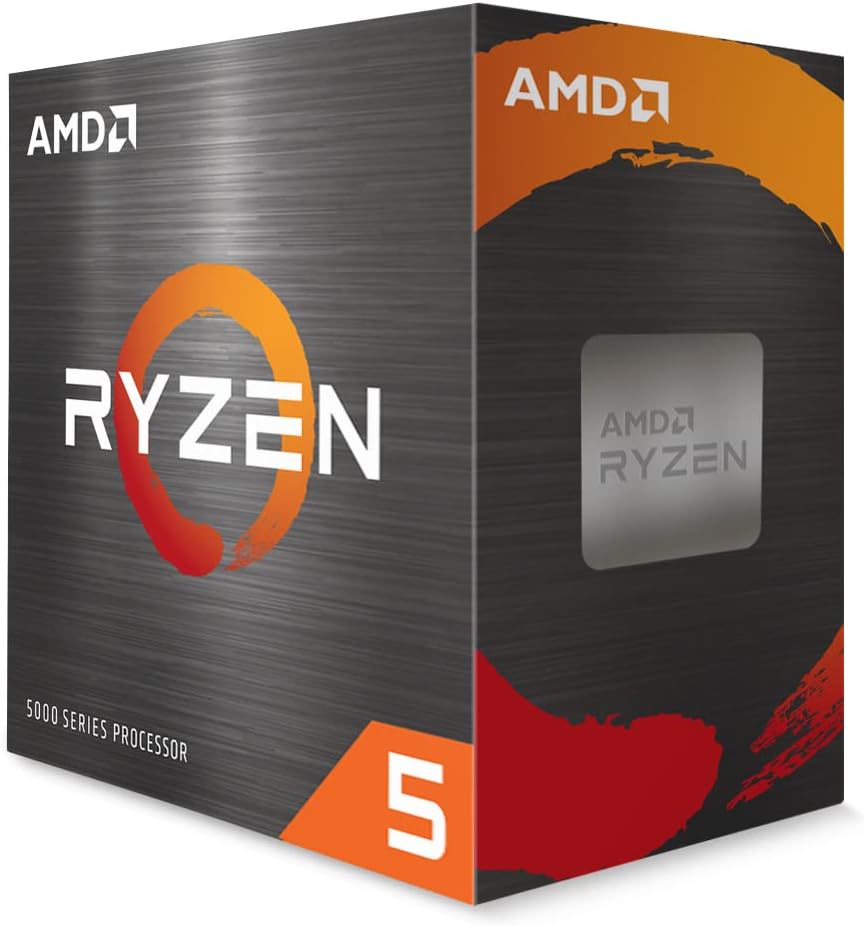
AMD Ryzen 5 5500
4.7Editor score
Six cores, twelve threads
Unlocked AM4 processor
Wraith Stealth cooler included
Looking for the best cheap AMD processor? Compare 10 affordable options for gaming, everyday use, and PC upgrades, with features, compatibility, and ratings.
Affordable AMD processors can deliver a practical balance of gaming performance, responsiveness, and upgrade flexibility without requiring the latest flagship platform. The right model depends on your existing motherboard, memory type, graphics setup, and tolerance for upgrading specific components, so processor cost is only one part of the purchasing decision.
This guide compares ten AMD processors spanning the Athlon, Ryzen 3, Ryzen 5, and Ryzen 7 families, including AM4 and AM5 models. We considered core and thread counts, maximum boost clocks, cache, integrated graphics, socket compatibility, memory support, included coolers, overclocking features, and the user ratings supplied for each listing.
Each review explains who the processor suits, which strengths matter most, and where compromises appear. The list includes models with bundled coolers, affordable gaming options, and more capable eight-core chips, while every product remains available with a discrete graphics card. Prices and availability change, so confirm the current listing and total platform cost before buying.
4.7Editor score
4.8Editor score

4.8Editor score
This side-by-side comparison highlights each processor's core count, clock speed, platform, graphics support, and cooling situation. It is designed to make it easier to identify a model for a new AM4 or AM5 build, an existing desktop upgrade, or a system with or without a discrete graphics card.




The AMD Ryzen 5 5500 is a compelling budget processor for a new gaming-oriented desktop, particularly when a system builder wants six cores, twelve threads, and a bundled cooler without moving to the newest platform. Its supplied rating is 4.7, which indicates strong buyer satisfaction, and its core count gives it more room for demanding applications than a basic dual-core option.
We may earn a commission when you buy through this link, at no additional cost to you.
Its headline specifications are well matched to affordable AM4 builds. It offers six cores and 12 processing threads, a 4.2 GHz maximum boost clock, 19 MB of cache, and support for DDR4-3200 memory. The processor is unlocked, allowing compatible systems to explore higher clock settings, while the included AMD Wraith Stealth cooler simplifies the initial assembly. AMD states that it can deliver fast 100-plus-FPS performance in popular games when a discrete graphics card is used.
The main limitation is that this is not a complete gaming system by itself. A separate graphics card is required for the promised gaming performance, and buyers must use a compatible Socket AM4 motherboard with supported DDR4 memory. Although the processor and cooler are bundled, the graphics card, motherboard, memory, storage, and case still contribute substantially to the total build cost. Its platform is also older than AM5, limiting the long-term expansion path compared with a new DDR5-based system.
This is a strong recommendation for a value-focused gaming build, a productive home desktop, or an AM4 upgrade that benefits from more than four CPU cores. Choose it when the processor, motherboard, memory, and discrete graphics card are planned as a balanced package. If you need the newest platform features or a more powerful eight-core option, the Ryzen 5 5600 and Ryzen 7 5700X are stronger alternatives.
Six cores and 12 threads make the Ryzen 5 5500 more versatile than a basic four-thread chip. That capacity is useful for gaming, multitasking, and heavier desktop workloads while remaining within an affordable AM4 platform.
The included Wraith Stealth cooler means buyers do not have to select a separate basic cooler before the first use. It also makes this processor a practical option for a straightforward upgrade in an existing compatible desktop.
We may earn a commission when you buy through this link, at no additional cost to you.
The AMD Ryzen 5 9600X represents the most modern platform in this guide, using AMD Zen 5 architecture on Socket AM5. It carries a supplied rating of 4.8 and pairs six cores with 12 processing threads, a configuration that remains particularly relevant to gaming. Its 5.4 GHz maximum boost clock is the highest listed in this roundup, making it an attractive processor for a new high-refresh gaming desktop.
We may earn a commission when you buy through this link, at no additional cost to you.
The platform features are just as important as the clock speed. This processor supports DDR5-5600 memory and can support PCIe 5.0 on selected motherboards, giving builders access to the newest socket and expansion options represented in the list. It is also unlocked for overclocking. AMD describes the chip as being designed for pure gaming performance and smooth 100-plus-FPS results in popular games, subject to the rest of the system and the requirement for suitable graphics hardware.
The trade-off is platform cost. A DDR5 AM5 motherboard and compatible memory are required, and the processor does not include a cooler. Compared with an AM4 build using DDR4, the complete system can require a larger initial outlay. Buyers must also account for an aftermarket CPU cooler, although that allows better thermal hardware choices than a bundled solution. AM5 may be a better long-term foundation, but it is not the least expensive way to assemble a capable gaming PC today.
The Ryzen 5 9600X is best for buyers starting a fresh system who prioritize gaming, a modern socket, fast memory support, and room for future platform features. It is the editor's choice because it combines the highest boost clock in the group with the latest architecture shown. If a cheaper total build matters more than platform modernity, choose an AM4 Ryzen 5 model; if the system must use a discrete graphics card, budget for that separately.
Socket AM5, DDR5-5600 support, and possible PCIe 5.0 connectivity make this a forward-looking choice for a new motherboard purchase. It is most attractive when the system is being built from the case outward rather than installed in an older AM4 chassis.
The listed 5.4 GHz maximum boost provides the Ryzen 5 9600X with a strong headline specification for games that depend heavily on processor speed. A suitable discrete graphics card and capable system memory remain necessary to realize its full gaming potential.
We may earn a commission when you buy through this link, at no additional cost to you.
The AMD Athlon 200GE is the simplest and most approachable choice in this guide for everyday computing on an AM4 desktop. Its 4.4 supplied rating is the lowest among these ten products, but that figure still reflects a generally positive buyer response. The processor's integrated Radeon Vega 3 graphics and included near-silent cooler make it useful when a separate graphics card is unnecessary.
We may earn a commission when you buy through this link, at no additional cost to you.
Its specifications center on affordability and basic responsiveness. The Athlon 200GE provides two cores and four processing threads, runs at a 3.2 GHz clock frequency, includes 5 MB of cache, and supports DDR4-2667 memory. AMD positions it for everyday users, smooth video, and light gaming. The Socket AM4 platform can also be upgraded to Ryzen, allowing a future processor upgrade without changing the socket, provided the board, BIOS, and other components support the selected chip.
Its limitations are substantial when compared with the Ryzen alternatives. Two cores and four threads provide less capacity for modern multitasking, content creation, and demanding games. The integrated graphics may be adequate for general use but do not replace a capable discrete graphics card in a gaming-focused system. DDR4-2667 is also a more conservative memory specification than the DDR4-3200 support offered by several Ryzen models, and buyers need compatible AM4 components.
The Athlon 200GE is a sensible pick for a family computer, office desktop, media-focused system, or inexpensive AM4 starter build where integrated graphics and a bundled cooler are priorities. It is not the right recommendation for a gaming PC or a workstation that regularly runs demanding parallel workloads. For broader multitasking headroom, the Ryzen 5 5500 or Ryzen 3 2200G offer a more substantial foundation.
Radeon Vega 3 integrated graphics give the Athlon 200GE a useful advantage for general computing, video playback, and lighter games. This can reduce the number of parts required for a basic home or office desktop.
Because it uses Socket AM4 and can be paired with an AM4 platform that supports Ryzen processors, it can serve as an entry point. A later CPU upgrade is still subject to motherboard, BIOS, memory, and cooler compatibility.
We may earn a commission when you buy through this link, at no additional cost to you.
The AMD Ryzen 3 2200G combines four cores and eight processing threads with Radeon Vega 8 integrated graphics, making it a versatile AM4 processor for buyers who want more processing capacity than a basic Athlon without immediately adding a discrete graphics card. Its supplied rating is 4.7, placing it among the better-reviewed products in the guide.
We may earn a commission when you buy through this link, at no additional cost to you.
The processor offers a 3.7 GHz maximum boost clock and comes with a Wraith Stealth thermal solution. Its four unlocked cores provide a more capable foundation for multitasking, office applications, and general productivity than the two-core Athlon 200GE. Integrated Radeon Vega 8 graphics also make it useful for everyday visual tasks and lighter gaming, while the AM4 socket creates a familiar path for compatible future processor upgrades.
The main limitation is its older platform specification. Memory support tops out at DDR4-2667 according to the supplied data, below the DDR4-3200 capability of the Ryzen 5 5500, 5600, 5600X, 5700G, 5700X, and 5800X. Its integrated graphics should not be confused with a modern dedicated gaming GPU, and demanding games will benefit from a discrete card and a faster processor. The product also represents an earlier generation within this otherwise broad lineup.
Choose the Ryzen 3 2200G for an affordable AM4 system that benefits from integrated graphics, four cores, and a bundled cooler. It is a good fit for home computing, general productivity, and users who want a Ryzen-branded processor without a separate graphics card. For a dedicated gaming build, the Ryzen 5 5500 provides a stronger six-core option, while the Ryzen 5 9600X serves a modern AM5 platform.
The Radeon Vega 8 integrated graphics allow the Ryzen 3 2200G to handle basic visual workloads without a dedicated graphics card. This makes it particularly useful for office, media, and general-purpose home computers.
Eight processing threads give this processor more room for concurrent applications than the Athlon 200GE. It remains best viewed as an everyday desktop option rather than a solution for processor-intensive gaming workloads.
We may earn a commission when you buy through this link, at no additional cost to you.
The AMD Ryzen 5 5600 is an excellent value-focused choice for a gaming desktop built around AM4. It has a supplied rating of 4.8, six cores, and 12 processing threads. Although the product data does not list its precise boost clock or cache amount, it clearly identifies the processor as unlocked, supported by the advanced Socket AM4 platform, and accompanied by a Wraith Stealth cooler.
We may earn a commission when you buy through this link, at no additional cost to you.
The Ryzen 5 5600 targets the central appeal of affordable gaming PCs: a capable CPU without the need to purchase a premium processor. AMD describes it as offering the fastest cores in the world for PC gamers and highlights fast storage expansion for desktop PCs. It also participates in AMD's Ryzen VR-Ready Premium offering, making it a possible consideration for compatible VR-oriented systems when the rest of the hardware meets platform requirements.
The bundled cooler reduces assembly cost and complexity, while the unlocked multiplier allows builders with a suitable motherboard, memory, and cooling setup to explore overclocking. The trade-off is that a discrete graphics card remains necessary for a serious gaming configuration. AM4 also requires compatible DDR4 memory and an appropriate motherboard, and the platform does not offer the same newer socket path as AM5. Motherboard quality and power delivery can vary significantly among AM4 models, so a complete build should not be selected without checking the board.
For many buyers, this is the best balance for a new AM4 gaming system because it combines six cores, 12 threads, an included cooler, and strong ratings. Choose it over the Ryzen 5 5500 when the Ryzen 5 5600 is competitively priced, and over the Ryzen 7 5700X when four additional cores are not needed. It is especially attractive for a builder who wants AM4 rather than the cost of a new DDR5 platform.
The included Wraith Stealth cooler gives the Ryzen 5 5600 a practical advantage for first-time builders. It allows the system to be assembled with fewer separate purchases while still leaving room to upgrade cooling later.
Six cores and 12 threads provide a strong foundation for popular games and concurrent background activity. The processor is designed for a discrete graphics card, so the GPU should be selected as a major component of the finished gaming system.
We may earn a commission when you buy through this link, at no additional cost to you.
The AMD Ryzen 5 5600X is a well-equipped six-core processor for gamers and PC enthusiasts who want more clock speed and cache than the Ryzen 5 5500 while remaining on Socket AM4. Its supplied rating is 4.8, and the detailed specifications include a 4.6 GHz maximum boost clock, 35 MB of cache, DDR4-3200 support, and an unlocked multiplier.
We may earn a commission when you buy through this link, at no additional cost to you.
AMD describes it as a fast six-core mainstream desktop processor capable of elite 100-plus-FPS performance in popular games. It supports the AM4 socket and can use PCIe 4.0 on X570 and B550 motherboards, giving builders access to faster storage and expansion capabilities on compatible boards. The included Wraith Stealth cooler is described as quiet and capable, making the package easier to assemble without immediately adding another cooling component.
Its disadvantages begin with platform constraints. The processor requires DDR4 memory and an AM4 motherboard, so it cannot be installed in an AM5 system. A discrete graphics card is needed for the intended gaming performance, and the total cost of motherboard, memory, graphics, and other parts should be considered. Although the chip is unlocked, actual overclocking results depend on the motherboard, memory, cooling, and system configuration, so the word unlocked should not be treated as a guarantee of identical performance on every build.
The Ryzen 5 5600X is a good recommendation for a high-refresh AM4 gaming PC, a creator who benefits from additional clock speed and cache, or an enthusiast who wants an unlocked processor and bundled cooler. It is also suitable for a later upgrade to an eight-core AM4 model if the chosen board supports it. If total platform expense is the priority, the Ryzen 5 5500 may offer a more economical route to six cores.
A 4.6 GHz maximum boost and 35 MB cache distinguish the Ryzen 5 5600X from several lower-tier models. These specifications suit a gaming build in which CPU speed and multitasking performance both matter.
Support for PCIe 4.0 on compatible X570 and B550 motherboards adds a useful storage consideration to the platform. Buyers should verify the exact board features because support depends on the selected motherboard.
We may earn a commission when you buy through this link, at no additional cost to you.
The AMD Ryzen 7 5700G is the most distinctive eight-core option in this roundup because its Radeon graphics can run popular games at 1080p without a discrete graphics card, according to AMD. Its supplied rating is 4.8, and the combination of eight cores, 16 processing threads, integrated graphics, and a bundled Wraith Stealth cooler makes it a flexible choice for compact or general-purpose gaming systems.
We may earn a commission when you buy through this link, at no additional cost to you.
Its specifications include a 4.6 GHz maximum boost clock, 20 MB of cache, DDR4-3200 support, and an unlocked multiplier. It operates on Socket AM4 and has a listed maximum operating temperature of 95°C. The processor is aimed at users who want substantially more CPU capacity than a four-core chip while avoiding the immediate need for a separate graphics card.
That integrated-graphics advantage has boundaries. While AMD positions the Radeon graphics as suitable for popular games at 1080p, settings, game, and desired frame rate still matter, and a modern dedicated GPU can offer much greater gaming headroom. The eight-core design also requires a suitable AM4 motherboard and adequate system memory. As with any unlocked processor, overclocking capability depends on the quality of the motherboard, cooling, and other system components.
The Ryzen 7 5700G is best for a builder who wants one processor to serve gaming and heavier multitasking, particularly when using integrated graphics initially. It is also a strong candidate for a compact system where a large discrete graphics card is inconvenient. For a dedicated gaming desktop with a planned high-end GPU, the Ryzen 7 5700X provides a similar core count with a different performance emphasis, while the Ryzen 5 9600X offers the newest platform in the guide.
The Radeon integrated graphics provide a useful starting point for 1080p gaming, allowing a system to be assembled without a separate graphics card. This is convenient for compact builds, early installation, and users who may add a dedicated GPU later.
Eight cores and 16 processing threads offer a stronger foundation for background applications than the four-core options in this list. The processor's maximum operating temperature is listed at 95°C, making case airflow and cooler behavior important parts of the build.
We may earn a commission when you buy through this link, at no additional cost to you.
The AMD Ryzen 5 7600X is a high-clock, six-core processor positioned for AM5 gaming systems. Its supplied rating is 4.8, and the product details list a 5.3 GHz clock speed, six cores, 12 threads, 38 MB of combined L2 and L3 cache, and support for the Socket AM5 platform. It also includes a Radeon graphics controller for display output.
We may earn a commission when you buy through this link, at no additional cost to you.
The processor's 5 nm process technology is listed as supporting reliable performance and productivity, while its six-core layout provides a familiar balance for games and background applications. Socket AM5 allows the processor to be installed on a compatible motherboard without soldering, and the unlocked designation gives experienced builders room to explore performance adjustments when the rest of the system supports it.
The platform is the central trade-off. AM5 systems need compatible motherboards and DDR5 memory, and the provided product data does not list a bundled cooler, so a suitable thermal solution should be budgeted separately. Although the integrated Radeon graphics make initial setup and non-gaming display tasks convenient, a serious gaming build should still use a discrete graphics card. The higher platform cost may outweigh the benefit if an affordable AM4 system can meet the same performance target.
The Ryzen 5 7600X is a strong pick for a new AM5 build that values a high clock rate, six cores, and a modern socket. It works particularly well for a gaming PC planned around a dedicated GPU. Buyers should compare the entire system with the Ryzen 5 9600X rather than judging either processor in isolation, since clock speed, cache, motherboard choice, memory, and cooler all influence the final configuration.
The listed 5.3 GHz clock gives the Ryzen 5 7600X an emphasis on processor speed. Combined with 38 MB of cache, it is well suited to games and workloads that benefit from quick access to frequently used data.
AM5 compatibility gives this processor a place on a current platform with potential for future CPU choices. Buyers should still plan around DDR5 memory and an aftermarket cooling solution rather than assuming AM4 parts or a bundled cooler will be available.
We may earn a commission when you buy through this link, at no additional cost to you.
The AMD Ryzen 7 5800X is the highest-clock Ryzen 7 model in this roundup, combining eight cores, 16 processing threads, and a 4.7 GHz maximum boost clock. Its supplied rating is 4.8. For an AM4 system in need of substantial CPU capacity, it offers a high-end option without requiring the transition to a newer socket and DDR5 memory.
We may earn a commission when you buy through this link, at no additional cost to you.
AMD describes the processor as its fastest eight-core mainstream desktop part, with the ability to deliver elite 100-plus-FPS performance in popular games. It provides 36 MB of cache, supports DDR4-3200 memory, and can support PCIe 4.0 on X570 and B550 motherboards. It is also unlocked for overclocking, making it suitable for builders who understand the interaction between processor, motherboard, memory, and cooling.
A high-performance cooler is not included and is explicitly recommended, adding a necessary component to the system budget. A discrete graphics card is likewise required for the intended gaming performance. The platform uses Socket AM4, so buyers need a compatible motherboard, supported DDR4 memory, and the ability to accommodate the processor's thermal requirements. These requirements make the Ryzen 7 5800X better suited to a complete build or major upgrade than a simple processor swap.
Choose the Ryzen 7 5800X when eight cores, a high boost clock, and a mature AM4 platform are priorities. It is a particularly compelling option for gaming and productivity because it offers more CPU headroom than a six-core model. If an AM5 system is being considered instead, compare the Ryzen 5 9600X and Ryzen 7 5700X, since modern platforms may offer a preferable long-term path despite requiring new memory and motherboard support.
The Ryzen 7 5800X combines 16 processing threads with a 4.7 GHz maximum boost, giving it a strong blend of parallel capacity and single-thread speed. That profile suits both demanding games and busy productivity workloads.
Because a high-performance cooler is recommended and not included, the selected cooling solution should be treated as part of the purchase. A capable case and motherboard power delivery are also important to a successful high-end AM4 build.
We may earn a commission when you buy through this link, at no additional cost to you.
The AMD Ryzen 7 5700X is a premium AM4 recommendation because it balances eight cores, 16 processing threads, a 4.6 GHz maximum boost clock, and 36 MB of cache. Its supplied rating is 4.8, and its Zen 3 foundation positions it as a capable choice for gaming and heavier desktop work when a discrete graphics card is present.
We may earn a commission when you buy through this link, at no additional cost to you.
The processor can deliver ultra-fast 100-plus-FPS performance in popular games according to AMD, subject to the graphics card and the rest of the configuration. It is unlocked for overclocking and supports DDR4-3200 memory. On suitable X570 and B550 motherboards, it can also support PCIe 4.0, which is useful for modern storage and expansion hardware. These features allow it to remain a capable high-end AM4 system even though AM5 alternatives are included in the guide.
The cooler is not included, so a quality CPU cooler is required. Buyers also need an AM4 motherboard, compatible DDR4 memory, and a discrete graphics card for the intended gaming use. The AM4 platform is not the newest option, and future expansion is limited to processors supported by the selected motherboard. The eight-core design also makes it important to choose a board with suitable power delivery and to provide adequate case airflow.
The Ryzen 7 5700X is ideal for a buyer who wants more CPU capacity than a six-core Ryzen 5 but does not need to move to a new platform. It is our premium AM4 pick because its supplied specifications are especially well documented and balanced. Compare it with the Ryzen 7 5800X for a higher boost clock, or with the Ryzen 5 9600X when a new AM5 platform and DDR5 memory are acceptable.
Eight cores and 16 threads give the Ryzen 7 5700X ample room for gaming, browsing, productivity applications, and background tasks. It is a particularly balanced option for a premium desktop that will do more than games.
The Ryzen 7 5700X preserves the value and familiarity of DDR4 and Socket AM4, while newer AM5 processors offer a different upgrade path. The correct choice depends on whether the motherboard and memory are already available or being purchased together.
We may earn a commission when you buy through this link, at no additional cost to you.
An inexpensive processor can still produce an excellent computer when its capabilities match the intended workload and the rest of the platform. Consider socket compatibility, memory, graphics, core count, cooling, and upgrade plans before choosing among these options.
Socket compatibility determines which motherboards and processors can be used together. The Ryzen 5 5500, Athlon 200GE, Ryzen 3 2200G, Ryzen 5 5600, Ryzen 5 5600X, Ryzen 7 5700G, Ryzen 7 5800X, and Ryzen 7 5700X use Socket AM4. The Ryzen 5 9600X and Ryzen 5 7600X use Socket AM5. An AM4 processor cannot be installed in an AM5 board, and the reverse is also true, so verify the socket before planning any part of the build.
Choose AM4 for a mature platform with compatible DDR4 memory, especially when an existing board and memory are already available. Choose AM5 for a new system when access to the newest platform and DDR5 support is worth the additional platform requirements.
Memory support can be as important as processor performance when building a new PC. AM4 models in this guide support either DDR4-2667 or DDR4-3200, while the two AM5 choices support DDR5. A motherboard must support the chosen processor, and the installed memory kit must match the board's generation. Check the processor specification and motherboard memory list rather than assuming every DDR4 or DDR5 module will work.
For an existing AM4 system, retaining compatible DDR4 memory can make a processor upgrade more economical. For a new AM5 build, budget for DDR5 alongside the motherboard and processor rather than treating memory as an incidental component.
The list spans two cores and four threads in the Athlon 200GE, four cores and eight threads in the Ryzen 3 2200G, six cores and 12 threads in several Ryzen 5 models, and eight cores and 16 threads in the Ryzen 7 options. More cores and threads generally provide more capacity for multitasking and processor-heavy workloads, but they are not the only measure of gaming performance. Clock speed, architecture, software, and the graphics card also influence the result.
Basic office and media users can consider the Athlon, while a Ryzen 3 provides more processing headroom. Six-core Ryzen 5 chips suit mainstream gaming, and the eight-core Ryzen 7 processors are strongest for mixed workloads or heavier parallel tasks.
The Athlon 200GE, Ryzen 3 2200G, Ryzen 7 5700G, and Ryzen 5 7600X include graphics described in the supplied data. AMD says the Radeon graphics in the 5700G can play popular games at 1080p without a graphics card, while the Ryzen 5 9600X and 5800X are presented as gaming processors that require a discrete card. A dedicated GPU offers substantially more gaming headroom and should be budgeted for a dedicated gaming PC.
Integrated graphics are useful for general computing, video, display output, and lighter games. If gaming performance is the priority, treat a capable discrete graphics card as a separate and essential part of the purchase.
The Ryzen 5 5500, Ryzen 3 2200G, Ryzen 5 5600, Ryzen 5 5600X, and Ryzen 7 5700G include a Wraith Stealth or near-silent cooler. The Ryzen 5 9600X, Ryzen 5 7600X, Ryzen 7 5800X, and Ryzen 7 5700X do not include a cooler according to the supplied information. AMD explicitly recommends a high-performance cooler for the Ryzen 7 5800X.
A bundled cooler can simplify assembly and reduce immediate spending. When no cooler is included, add a suitable thermal solution to the budget and confirm that the case supports it. Higher-power and higher-clock processors deserve particular attention to cooling and airflow.
Several models in the guide are unlocked, including the Ryzen 5 5500, Ryzen 5 9600X, Ryzen 3 2200G, Ryzen 5 5600, Ryzen 5 5600X, Ryzen 7 5700G, Ryzen 5 7600X, Ryzen 7 5800X, and Ryzen 7 5700X. An unlocked processor provides the ability to explore manual performance settings, but overclocking is not an automatic upgrade. Motherboard quality, memory configuration, cooling, and case airflow can all affect whether extra headroom is usable.
Buy an unlocked model if tuning is part of your interest, but do not use that feature as the only reason to choose a processor. A stable, correctly configured standard setting is more valuable than a headline clock that the system cannot sustain.
A processor's advertised features should be matched to the software and games you actually intend to run. The Athlon 200GE is positioned around everyday computing, video, and light gaming, while the Ryzen 5 models target mainstream gaming and the Ryzen 7 models add more parallel processing capacity. Even the eight-core chips are not substitutes for adequate graphics hardware in games that rely heavily on the GPU.
Write down the most important applications before shopping. Prioritize a compatible platform, adequate graphics, and enough core capacity rather than choosing on one isolated specification.
The processor is only one part of a desktop's cost. A complete system also requires a compatible motherboard, memory, storage, graphics where needed, a case, power supply, and cooling. An AM5 build with DDR5 may cost more at the outset than an AM4 build, while a missing cooler and a higher-end graphics card can shift the balance further. The Ryzen 5 5500 and Ryzen 5 5600 are especially practical when their included coolers reduce the number of separate purchases.
Compare complete configurations rather than processor listings in isolation. A slightly less powerful chip on a platform you already own may deliver better value than a faster processor requiring a new motherboard, memory, and additional components.
Before installing any processor, identify the correct socket and check the motherboard model's compatibility list. Confirm that the planned memory generation, cooler mounting hardware, operating system, and graphics arrangement are suitable. Handle the processor by its edges, avoid touching the contact surfaces, and follow the motherboard manual's installation sequence.
Apply the recommended thermal compound, attach the appropriate cooler, and verify that its mounting system matches the socket. Connect the processor power cable if the motherboard requires it, install memory in the recommended slots, and check the board's boot sequence before installing operating-system software. After assembly, update the motherboard firmware when needed and make sure the operating system recognizes all installed memory.
For everyday care, leave adequate clearance around the cooler and maintain reasonable airflow through the case. Avoid placing the system in confined spaces where heat cannot escape, and do not change performance settings without monitoring stability and temperatures. When upgrading, save important files, use an anti-static wrist strap where available, and follow the manufacturer's instructions for the specific processor and motherboard.
For a new budget platform, the Ryzen 5 9600X and Ryzen 5 7600X offer modern AM5 features and high listed clock speeds, but they require compatible DDR5 motherboards and memory. On AM4, the Ryzen 5 5500 and Ryzen 5 5600 provide six cores and 12 threads with included coolers. A discrete graphics card remains necessary for the gaming performance described in the product data.
The Ryzen 5 5500 offers six cores, 12 processing threads, a 4.2 GHz maximum boost clock, and an included Wraith Stealth cooler. AMD states that it can deliver fast 100-plus-FPS performance in popular games with a discrete graphics card. Its AM4 platform is mature and comparatively economical, making it a useful budget foundation when compatible DDR4 components are available.
AM4 is generally the more established platform in this list and uses DDR4 memory, while AM5 uses DDR5 and supports newer features such as PCIe 5.0 on selected motherboards. An AM5 build is attractive for a completely new system, while AM4 can be more practical if you already own a compatible motherboard and memory. Neither socket accepts the other's processors.
It depends on the model and workload. The Athlon 200GE, Ryzen 3 2200G, Ryzen 7 5700G, and Ryzen 5 7600X include integrated graphics for display and general use, while AMD specifically highlights the 5700G for 1080p gaming without a separate card. The Ryzen 5 5500, Ryzen 5 9600X, Ryzen 5 5600, Ryzen 5 5600X, Ryzen 7 5800X, and Ryzen 7 5700X gaming claims involve a discrete graphics card.
An unlocked processor gives knowledgeable builders the ability to adjust performance settings, but it does not guarantee a higher stable clock on every system. Motherboard design, memory, cooling, and power delivery all influence the outcome. For most users, a stable default configuration is more useful than chasing small gains, while an unlocked chip still offers flexibility when the complete system is designed for it.
Only if the motherboard uses the correct socket and supports the specific processor through its chipset and firmware. Socket AM4 is required for the Athlon 200GE and the listed Ryzen 3, Ryzen 5 5500, 5600, 5600X, and Ryzen 7 chips. Socket AM5 is required for the Ryzen 5 9600X and 7600X. Memory generation, BIOS support, and the processor's power requirements should also be checked.
The supplied product information states that the Ryzen 7 5700X does not include a cooler, so an aftermarket thermal solution is required. It is also described as a gaming processor whose 100-plus-FPS potential uses a discrete graphics card. The full system therefore needs a compatible AM4 motherboard, DDR4 memory, a suitable graphics card, and adequate cooling.
Integrated graphics are generally useful for everyday desktop tasks, video, productivity applications, and lighter games. The Ryzen 7 5700G stands out because AMD specifically positions its Radeon graphics for popular games at 1080p without a graphics card. For demanding games or graphics work, choosing a dedicated GPU remains the safer option.
The Ryzen 5 5500 is the standout budget balance in this roundup, combining six cores, 12 threads, DDR4-3200 support, an unlocked multiplier, and a bundled cooler. The Ryzen 5 5600 is the editor's choice for an AM4 gaming system, while the Ryzen 7 5700X earns the premium AM4 recommendation for buyers who want eight cores and 16 threads in a mature platform.
Prioritize compatibility before clock speed. AM4 can be economical when compatible DDR4 components are already available, while AM5 is the stronger long-term platform choice for a new build. Choose the Athlon 200GE or Ryzen 3 2200G for a basic computer with integrated graphics, use a six-core Ryzen 5 for mainstream gaming, and consider an eight-core Ryzen 7 when multitasking and heavier workloads matter.
Finally, check the current listing, component availability, and full system cost before ordering. Processor prices and deals change, and the cheapest chip is not always the cheapest finished computer. Ensure the motherboard, memory, graphics card, cooler, storage, case, and power supply all form a compatible package.