
GOLDENMATE 2000VA Lithium UPS
4.4Editor score
Lithium iron phosphate battery
2000VA and 1600W capacity
Pure sine wave output
Eight protected outlets
PC shutdown communication
Discover the best battery backup for home theater by comparing runtime, sine wave output, outlets, AVR, warranties, and protection features for media rooms.
A home theater UPS gives streaming boxes, televisions, network equipment, and other connected components a controlled response when utility power becomes unstable. The right model should provide useful runtime, clean output for sensitive electronics, adequate outlets, and understandable monitoring, while remaining appropriate for the equipment and electrical setup in your media room.
This guide compares ten battery backup options across power capacity, waveform type, backup and surge-protected outlets, voltage regulation, display functions, connectivity, physical format, warranty coverage, and stated protection features. The selections range from compact and traditional lead-acid designs to a lithium-based model, with nine CyberPower products and one GOLDENMATE unit included.
Each review identifies the product's strongest use case and any meaningful limitations based on its published specifications. The top three recommendations are the CyberPower CP1500PFCLCD for sensitive modern electronics, the GOLDENMATE 2000VA lithium UPS for long-term battery longevity, and the CyberPower CP1000AVRLCD for a balanced home-entertainment configuration. Prices and availability can change.
4.4Editor score

4.5Editor score
4.5Editor score
The table below compares all ten options by capacity, output type, outlet layout, and headline features. It is a quick way to identify the most practical model for a media room, although the detailed reviews and buying guide explain the trade-offs more closely.


The CyberPower CP1500PFCLCD combines 1500VA of capacity, 1000W of supported load, and pure sine wave output in a package explicitly designed for Active PFC and conventional power supplies. With a 4.5 rating, it stands out as the most broadly compatible choice in this guide for a modern home theater containing computers, game consoles, streaming devices, network equipment, or other sensitive electronics. Its capacity provides more room than the smaller CyberPower models while avoiding the bulk and weight associated with the largest lithium system.
We may earn a commission when you buy through this link, at no additional cost to you.
The outlet arrangement is particularly useful in a media room. Six NEMA 5-15R outlets provide surge protection and battery backup, while six additional outlets provide surge protection only. The color LCD presents information about battery and power conditions and can tilt up to 22 degrees for easier viewing. Automatic voltage regulation corrects minor fluctuations without unnecessarily transferring to battery mode, while two front-facing USB ports include one Type-A and one Type-C connection for charging compatible phones and tablets.
Its pure sine wave output is the most important technical distinction for buyers with modern active PFC power supplies. That cleaner waveform is generally a safer match for contemporary electronics than a stepped or simulated alternative, especially when several devices draw power at once. The trade-offs are physical size, a higher capacity than many media rooms require, and runtime that naturally decreases as the connected load rises. The unit also does not extend to managing a full home theater under every condition, so users should still plan for orderly shutdown procedures.
This is the strongest all-around recommendation for a home theater that needs clean power, a generous outlet count, and useful monitoring. It is particularly appropriate for users whose equipment includes Active PFC devices or who want a dedicated UPS rather than a basic surge protector. Although smaller options may be sufficient for a television, receiver, and streaming device, the CP1500PFCLCD offers the flexibility to protect a broader collection of entertainment and networking equipment without relying on a separate battery pack.
The pure sine wave supply is designed for both Active PFC and conventional power supplies. That makes this model a more broadly compatible choice for current game consoles, computers, receivers, and other connected media components than the simulated sine wave alternatives in this list.
Twelve NEMA outlets reduce the need for bulky power strips while separating six battery-backed connections from six surge-only connections. The additional USB-A and USB-C charging ports are convenient for phones, tablets, and other compatible devices kept near the media area.
We may earn a commission when you buy through this link, at no additional cost to you.
The CyberPower CP1500AVRLCD3 is a 1500VA, 900W intelligent UPS designed to safeguard workstations, networking devices, and home entertainment equipment. Its 4.5 rating and combination of simulated sine wave output, AVR, a color LCD, and twelve NEMA outlets make it a well-rounded option for users who need more capacity and outlet flexibility than a compact model without moving to the largest battery system.
We may earn a commission when you buy through this link, at no additional cost to you.
Six outlets provide both surge protection and battery backup, allowing the primary television, receiver, streaming box, or network device to remain powered during an outage. Another six outlets deliver surge protection for accessories that do not need to remain running. The display supplies detailed information about power and battery status, while AVR corrects minor voltage fluctuations without switching the system to battery power. One Type-A and one Type-C USB port support convenient charging of mobile devices and tablets.
The main compromise is its simulated sine wave output. It remains a listed option for home entertainment equipment, but the CP1500PFCLCD and the GOLDENMATE lithium unit offer pure sine wave alternatives that may be more appropriate when a system contains modern Active PFC power supplies. Runtime also depends on how much equipment remains on when utility power fails, and a 900W maximum is below the 1000W rating of the leading CyberPower model.
Choose the CP1500AVRLCD3 when you want a large number of connections, detailed status information, and a capable home-entertainment UPS in a conventional format. It is a practical fit for a media room with several components and a network, especially when the most power-sensitive devices can be assigned to the six battery-backed outlets.
The split outlet layout lets owners place a television, receiver, streaming device, or network component on battery-backed connections while reserving the remaining surge-protected outlets for accessories. This provides useful control over what continues operating after an outage.
The multifunction color LCD shows immediate battery and power information and alerts users to developing issues. This is useful for checking status without navigating a separate application, particularly in an entertainment setup where the UPS may be mounted behind or beside a cabinet.
We may earn a commission when you buy through this link, at no additional cost to you.
The CyberPower EC850LCD is an 850VA UPS that combines six battery-backed and surge-protected outlets with six additional surge-protected outlets. Three of the surge-only outlets are ECO controlled, giving this model a distinct appeal for home theaters where game consoles, streaming boxes, and other peripherals are often left connected to a common entertainment cabinet.
We may earn a commission when you buy through this link, at no additional cost to you.
Its ECO mode is the defining feature. When the UPS detects that a computer is off or in sleep mode, it automatically removes power from peripherals connected to ECO-controlled outlets. That can reduce avoidable standby consumption and remove the need to manually switch off several accessory connections. A multifunction LCD provides immediate information about battery and power conditions, while the right-angle input plug and five-foot cord help the unit fit more neatly near a wall.
The tradeoff is that ECO automation is centered on detecting a computer's operating state, which may not map precisely to a television-based viewing setup. Users should confirm how the feature behaves with their particular equipment before depending on it. Its 850VA capacity is also lower than the 1000VA and 1500VA options, and the listed specifications do not provide a corresponding wattage rating.
This model is most compelling for a media room that includes a computer and several always-connected accessories. It offers a generous number of outlets, useful condition monitoring, and automatic peripheral control in one package. For a more conventional home theater centered on a large television and receiver, a model with a stated watt rating and AVR may offer more straightforward sizing information.
Three ECO-controlled outlets can cut power to compatible peripherals when the connected computer is off or asleep. This can simplify control of game consoles and entertainment accessories that would otherwise remain on standby.
Six battery-backed outlets and six surge-only outlets provide ample connection options in a shared media cabinet. The right-angle input plug also reduces strain and can make the unit easier to position against a wall.
We may earn a commission when you buy through this link, at no additional cost to you.
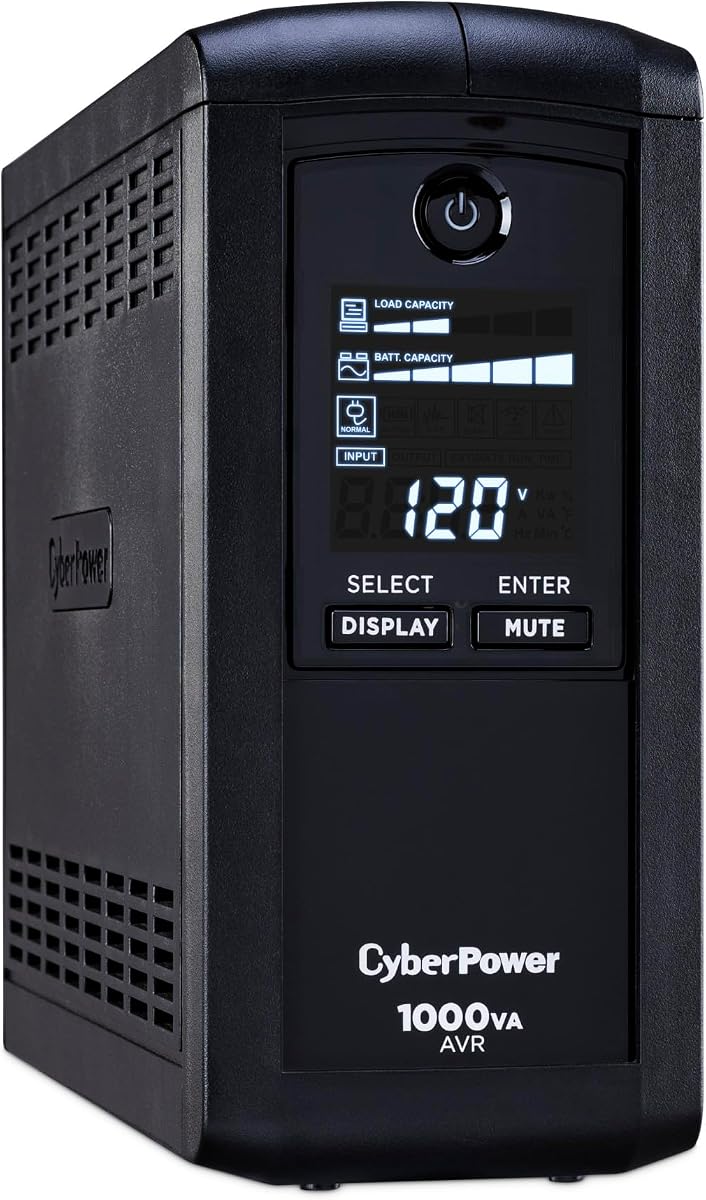
The CyberPower CP1000AVRLCD provides 1000VA and 600W of capacity, making it one of the more approachable options for a home theater with a television, receiver, streaming device, game console, and networking equipment. Its 4.5 rating reflects a balanced feature set that includes AVR, nine NEMA outlets, an informative LCD, free management software, and a three-year warranty that includes the battery.
We may earn a commission when you buy through this link, at no additional cost to you.
Five of the nine outlets provide both battery backup and surge protection, while four offer surge protection only. The multifunction display reports estimated runtime, battery capacity, load capacity, and other status details, helping owners judge how long critical equipment may operate. AVR corrects minor voltage fluctuations without switching to battery mode, which avoids unnecessary battery use and is beneficial in areas where small voltage variations are common.
The simulated sine wave format is the main technical limitation. It is listed for home entertainment equipment, but users with Active PFC electronics or those who specifically want a pure sine wave source should consider the CP1500PFCLCD or GOLDENMATE model instead. The 600W ceiling also requires careful load management, especially if a large television and several other components draw power simultaneously.
For a straightforward media-room installation, the CP1000AVRLCD balances capacity, protection, and outlet availability without the larger footprint of some alternatives. It is a strong choice for users who want an LCD, AVR, software monitoring, and several battery-backed connections but do not need the maximum output or outlet count available in this guide.
A 1000VA and 600W rating is a practical middle ground for many living-room entertainment systems. It can support multiple essential components when users monitor the load and prioritize which devices receive battery-backed power.
The LCD displays estimated runtime alongside battery and load capacity. These readings make it easier to decide whether a game console or peripheral should remain connected when the system moves to battery power.
We may earn a commission when you buy through this link, at no additional cost to you.
The CyberPower AVRG900LCD carries a 4.6 rating, tied for the highest among the ten products, and combines 900VA of capacity with 480W of supported load. It is designed for desktop computers, workstations, networking devices, and home entertainment equipment. The model offers 12 NEMA 5-15R outlets, including six with battery backup and surge protection and six with surge protection alone.
We may earn a commission when you buy through this link, at no additional cost to you.
A major point of distinction is data line protection, which helps prevent surges traveling through telephone lines from damaging electronics. That can be valuable where a media area includes connected telephone, network, or audiovisual cabling. AVR corrects minor voltage fluctuations without transferring to battery power, and the multifunction LCD gives users a central view of operating conditions. Management software is included for download, and the connected equipment guarantee is listed at $200,000.
The 480W load limit is modest compared with the 600W, 900W, 1000W, 1500W, and 1600W figures offered elsewhere in the list. It is most suitable for essential devices rather than every component in a heavily equipped theater. The absence of listed USB charging ports is a minor inconvenience in a room where phones, controllers, and accessories may regularly need charging.
Choose the AVRG900LCD when data-line surge protection, a high user rating, and an ample outlet count matter most. It is a sensible option for a modest entertainment system or a mixed office and media installation where a telephone or network connection is part of the equipment arrangement.
Data line protection addresses a different surge path from household wiring. This added defense is useful in rooms where connected communication cables run near entertainment equipment or through shared wall pathways.
With six battery-backed and six surge-only connections, the unit can support a receiver, display, streaming device, and several accessories. The model also has the highest listed customer rating in this roundup.
We may earn a commission when you buy through this link, at no additional cost to you.
The CyberPower CP850AVRLCD is a smaller 850VA, 510W UPS intended for workstations, network devices, and home entertainment equipment. Its 4.5 rating and familiar CyberPower feature set make it a practical choice for a compact theater or secondary media area where a full 1500VA system would not be needed.
We may earn a commission when you buy through this link, at no additional cost to you.
The unit has nine NEMA outlets: five with battery backup and surge protection, plus four with surge protection only. Its multifunction LCD shows estimated runtime, battery capacity, load capacity, and other operating information. Automatic voltage regulation corrects minor fluctuations without switching to battery mode, which helps preserve the battery and reduces unnecessary interruptions. A right-angle input plug, six-foot power cord, downloadable management software, and a three-year battery-inclusive warranty round out the package.
The main limitation is capacity. At 510W, it is intended for essential components rather than an entire room of high-draw entertainment equipment. The simulated sine wave output is also less broadly suited to modern Active PFC power supplies than the pure sine wave models in the guide. Runtime will be limited, particularly if multiple devices are left connected during an outage.
This UPS is a good fit for a smaller viewing area where the main goals are keeping a receiver or network device alive, protecting connected components from surges, and extending time for an orderly shutdown. Users should calculate their connected load and assign only essential equipment to the five battery-backed outlets.
A 510W supported load is most appropriate for a television, receiver, streaming device, and related essentials rather than every connected accessory. Keeping the load focused also helps the UPS provide more useful runtime.
The LCD provides estimated runtime, battery capacity, and load capacity directly from the unit. This gives owners a simple way to check whether the system can safely support the devices currently connected.
We may earn a commission when you buy through this link, at no additional cost to you.
The CyberPower PR1500LCD is unusual because it combines 1500VA with a stated 1500W supported load, giving it the highest wattage rating among the CyberPower models in this guide. Its pure sine wave output is designed for both Active PFC and conventional power supplies. With a 4.6 rating, it is a strong choice for a demanding home theater containing computers, network equipment, storage devices, and entertainment components.
We may earn a commission when you buy through this link, at no additional cost to you.
Eight NEMA 5-15R outlets provide both surge protection and battery backup, so important equipment can remain connected without relying on a separate surge strip. The extendable multifunction LCD can be removed and relocated using its attached 4.5-foot cable, making it easier to view when the UPS is installed behind a cabinet or in another hard-to-reach position. AVR corrects minor voltage variations without using the battery, and the product is UL safety certified.
The trade-off is outlet quantity. Eight protected outlets may be insufficient for a theater with numerous consoles, receivers, displays, and peripherals unless a surge-protected power strip is used for nonessential accessories. Remote management also requires an optional RMCARD205 card, which is sold separately. Management software is available for download, and the listed connected equipment guarantee is $375,000.
The PR1500LCD is best for users who prioritize high supported load and clean output over maximum outlet count. It can serve as a robust central unit for Active PFC electronics and a broad home-entertainment setup, provided the installer plans cable routing carefully and obtains the optional management card if remote control is important.
The 1500W rating provides substantial load headroom, while pure sine wave output supports Active PFC and conventional power supplies. This combination suits broad entertainment systems that include demanding electronics.
The removable LCD and attached cable allow status information to be positioned outside a cabinet or other concealed installation. Users can check battery and power conditions without moving the main UPS unit.
We may earn a commission when you buy through this link, at no additional cost to you.
The CyberPower ST900U is a 900VA, 500W standby UPS created for home offices and home entertainment, including computers, gaming consoles, and broadband routers. Its 4.5 rating, slim profile, and twelve-outlet layout make it a natural fit for a media cabinet or smaller room where physical depth is a concern.
We may earn a commission when you buy through this link, at no additional cost to you.
Six outlets include surge protection and battery backup, and the other six provide surge protection. Four of the outlets are widely spaced to accommodate larger plugs, a useful detail in entertainment setups where power bricks can crowd a conventional strip. The GreenPower high-efficiency design is intended to reduce power consumption by using a compact charger and inverter to create an efficient backup system. Management software is available for download, and the battery is covered by a three-year warranty.
The model uses simulated sine wave output and is described as a standby UPS rather than a line-interactive unit with the same AVR functionality found in many competing selections. It also lacks a listed multifunction LCD panel, so users cannot expect the same on-device runtime and load visibility. The 500W supported load remains sufficient for a router and several smaller devices but not a broad collection of high-draw components.
The ST900U is most attractive to owners with a small number of essential devices and a need for many conveniently spaced outlets. It is a good choice for keeping network access or a modest entertainment core alive during short outages, especially where a slim enclosure and abundant connections matter more than detailed local monitoring.
At 500W, the unit is best suited to a broadband router, streaming device, or modest collection of essential components. Prioritizing a small group of critical devices can improve the available backup time.
Four widely spaced outlets help prevent large power bricks from blocking adjacent connections. Combined with twelve total outlets, this makes the slim unit convenient for crowded entertainment cabinets.
We may earn a commission when you buy through this link, at no additional cost to you.
The CyberPower OR500LCDRM1U is a 500VA, 300W UPS in a one-unit rackmount enclosure. It is intended for servers, network devices, and telecom installations without Active PFC power supplies. In a home theater, that makes it most relevant to owners with a dedicated equipment rack containing a media server, network switch, storage appliance, or control system.
We may earn a commission when you buy through this link, at no additional cost to you.
The physical design is the defining advantage. A one-unit rackmount enclosure can be installed alongside other rack equipment rather than occupying a media cabinet shelf. Six NEMA outlets are provided: four with surge protection and battery backup, and two with surge protection only. The multifunction LCD reports runtime in minutes, battery status, and power conditions, while AVR corrects minor voltage fluctuations without transferring to battery mode.
The 300W capacity is small for a full home theater, and the simulated sine wave output does not support Active PFC supplies. Remote management requires the separately sold RMCARD205 card. While the ten-foot input cord provides flexibility, the product is still specialized equipment for a rack rather than a general-purpose living-room battery backup.
Choose this model when the home theater has a dedicated rack and the most important electronics are network, control, or server-based devices with modest power requirements. It is a niche but potentially valuable choice for owners who want organized rack integration, local status monitoring, and protection for essential infrastructure.
The one-unit rackmount format integrates neatly with servers, switches, and control equipment. It is especially useful in dedicated home-theater racks where keeping infrastructure within a single enclosure improves cable management.
The LCD displays runtime in minutes, battery status, and current power conditions. This local feedback helps administrators identify a developing issue before an outage affects the protected system.
We may earn a commission when you buy through this link, at no additional cost to you.
The GOLDENMATE 2000VA/1600W Lithium UPS is the most specialized premium option in the guide. It combines 2000VA, 1600W of supported load, pure sine wave output, and a 51.2V, 9Ah lithium iron phosphate battery. Its 4.4 rating reflects a feature-rich design aimed at users who prioritize battery longevity, clean output, and reduced maintenance over a smaller traditional enclosure.
We may earn a commission when you buy through this link, at no additional cost to you.
The LiFePO4 battery is stated to offer a lifespan of more than 10 years and more than 3,000 charge cycles. The manufacturer also states that it requires no routine battery replacement and can reduce total ownership cost by more than 40% compared with conventional lead-acid batteries. A built-in battery management system monitors the pack, while an automatic safety function stops charging or discharging if limits are exceeded. These are meaningful advantages for a permanently installed home-theater UPS.
Eight NEMA 5-15R outlets provide surge protection and battery backup, and their wider spacing helps accommodate varied power cords. The intelligent LCD reports real-time battery and power status, and the integrated controls include mute and display settings. A communication port and supplied USB cable allow automatic PC shutdown through Windows settings, while Type-C and Type-A front USB ports provide a combined 10W of charging for compatible devices.
The important caveat is input compatibility. The unit accepts 90–140V AC input for standard 110V household service, and the manufacturer warns that generator power may not satisfy its requirements for voltage, frequency, waveform, or grounding. If those conditions are not met, it may remain in battery mode and fail to recharge. Its larger battery and transformer also make the enclosure bigger and heavier than comparable lead-acid products. Buyers should verify their supply and installation space before selecting it.
The LiFePO4 pack is stated to deliver more than 3,000 charge cycles and a lifespan exceeding 10 years. For a permanently installed media-room system, that longevity can make the lithium design attractive.
The communication port and included USB cable enable automatic PC shutdown through Windows settings. This is useful when a home theater includes a computer that stores media, runs a server, or coordinates the entertainment system.
The UPS supports 90–140V AC input and is designed for standard 110V household power. Users should verify outlet voltage and avoid assuming that generator output will be accepted under every condition.
We may earn a commission when you buy through this link, at no additional cost to you.
Choosing a home theater UPS involves balancing runtime, electrical compatibility, outlet count, physical placement, and monitoring. The most important starting point is the equipment you want to keep running, followed by the type and quality of the power your devices require.
Capacity determines how much connected equipment the UPS can support. The models in this guide range from 300W to 1600W, with capacities commonly expressed in both VA and watts. A home theater with a large television, receiver, streaming devices, console, speakers, and network equipment may need substantially more capacity than a setup containing only a router and small streaming box. Calculate the combined wattage of the devices to be protected and keep a margin below the stated maximum. Runtime also matters because a higher-capacity battery generally provides more operating time when the load is manageable.
Prioritize sufficient headroom rather than selecting by VA alone. Confirm both the supported load and the number of devices that must remain active during an outage.
Pure sine wave output is the more refined waveform and is explicitly supported by the CP1500PFCLCD, PR1500LCD, and GOLDENMATE model. These are compelling choices for Active PFC computers, modern game consoles, and other sensitive electronics. Simulated sine wave models may still be appropriate for conventional home-entertainment equipment and are listed for that purpose. The distinction becomes more important as the number of modern connected devices increases. Users who are unsure should check the power requirements of their most demanding components and favor a pure sine wave model when compatibility is uncertain.
Choose pure sine wave for broad modern electronics compatibility. Choose simulated sine wave only after confirming it suits every critical device.
Runtime is the amount of time the UPS can operate after utility power fails. It depends on the battery's available energy, the total wattage, and the efficiency of the conversion process. A large television and receiver can consume power quickly, so a UPS intended mainly to keep a home cinema running may have a shorter runtime than its capacity suggests. Some displays report estimated runtime, while others require the user to interpret load information. Decide whether the goal is an orderly shutdown, continued router access, continued streaming, or several hours of operation, then reserve capacity for the most essential equipment first.
Prioritize the devices that matter during an outage, and use displayed runtime estimates to size the system for realistic loads.
A home theater often has more cables than available wall receptacles, so the UPS's outlet layout can be decisive. Five-, six-, nine-, and twelve-outlet configurations appear in this guide. Some models reserve half of their outlets for surge-only protection, while others make every outlet battery-backed. Consider the shape and size of power bricks as well as the number of plugs. The ST900U includes four widely spaced outlets, and the GOLDENMATE unit emphasizes wider spacing. A separate surge-protected strip can serve nonessential accessories, but essential equipment should remain directly connected to the UPS.
Count plugs and physical adapter sizes before buying. Keep critical connections direct, and use battery-backed outlets first.
AVR corrects minor input-voltage fluctuations without moving the system to battery power. In a home theater, this can help avoid unnecessary transfer to backup mode when the utility supply is low or high but still functional. The CP1500PFCLCD, CP1500AVRLCD3, CP1000AVRLCD, AVRG900LCD, CP850AVRLCD, PR1500LCD, OR500LCDRM1U, and GOLDENMATE model all list AVR. It is particularly useful for keeping uninterrupted entertainment when the power does not require a full battery transfer. AVR does not replace surge protection, however, and it should not be treated as a substitute for proper electrical grounding.
Look for AVR to handle everyday fluctuations, while also ensuring separate surge protection and sound grounding.
Local status displays make it easy to verify battery condition, load, and estimated runtime without opening an application. Color LCD panels provide more detailed information than simple indicator lights, and the PR1500LCD can be relocated on an attached cable for concealed installations. Some CyberPower products also offer downloadable management software. The GOLDENMATE model includes a communication port, a USB cable, and support for automatic shutdown through Windows settings, which is useful when a home theater includes a media server or always-on computer.
Choose visible monitoring for household installations and PC communication when automated shutdown support will be used.
Most options in this guide use conventional battery systems, while the GOLDENMATE model uses a 51.2V, 9Ah lithium iron phosphate pack. The manufacturer states that the lithium battery can last more than 10 years, withstand more than 3,000 charge cycles, and operate without routine battery replacement. Longer battery life is especially attractive for a permanently installed UPS. It does not guarantee unlimited runtime, and the model's larger transformer and battery make its enclosure heavier than comparable lead-acid designs.
For long service intervals, consider the stated cycle life and maintenance needs. Account for size and weight as well as longevity.
The CyberPower products listed here generally include a three-year warranty covering the battery, with connected equipment guarantees ranging from $125,000 to $500,000. Several models are UL safety certified, and the GOLDENMATE unit lists industrial safety certifications. A three-year battery-inclusive warranty is a meaningful support benefit because batteries are often the first major component to age. Placement also matters: some models are full-size desktop units, the ST900U has a slim profile, and the OR500LCDRM1U requires a one-unit rack enclosure. Confirm available space, cable reach, ventilation, and access to outlets before ordering.
Check the warranty terms, safety listings, physical dimensions, and ventilation needs. Make sure the chosen form factor fits its permanent location.
Begin by deciding which devices should remain powered during an outage. Place the television, receiver, streaming device, router, and other essential components on battery-backed outlets, while using surge-only outlets for accessories that can safely shut down. Confirm that the total connected load remains within the UPS rating and check the LCD for load, battery, and runtime information before relying on the system.
Install the unit on a stable, dry surface with adequate ventilation and keep the power cord and outlet connections secure. Do not exceed the rated capacity, and do not connect large heating appliances, power tools, or other high-draw equipment. A UPS is intended to protect electronics, not serve as a general-purpose extension of household power. Route cables so they do not create trip hazards or interfere with ventilation.
Test the setup by confirming that the display shows a healthy battery and normal utility power, then use the manufacturer's controls and software to perform any available self-test or diagnostic routine. Periodically check runtime estimates and battery condition, keep the vents clear, and respond to alerts. For lithium systems, follow the specified input-voltage and environmental requirements. If the unit is moved, reconnect only after checking the outlet, load, cord, and battery status.
The useful runtime depends on the connected load, battery condition, and UPS efficiency. A modest setup with a router and streaming device may receive considerably more operating time than a system running a large television, receiver, console, and speakers. Check the estimated runtime on the display after the equipment is connected, and prioritize critical devices if runtime is short. For extended operation, consider a model with a larger battery and plan for orderly shutdowns rather than assuming every component can run indefinitely.
A surge protector can divert sudden voltage spikes, but it does not provide a battery-backed source during a power failure. A UPS combines surge protection with temporary battery operation, allowing critical electronics to remain powered long enough to save settings, finish a task, or shut down safely. The right approach is to use a UPS for essential devices and a properly selected surge protector for nonessential accessories when a UPS lacks enough outlets.
Pure sine wave output provides a smoother waveform that is broadly compatible with modern and sensitive electronics. Simulated sine wave output is less refined but remains listed for many conventional home-entertainment devices. The concern rises with Active PFC power supplies found in some modern computers and other electronics. If your equipment includes such devices or compatibility is uncertain, a pure sine wave model is the safer choice.
You can do so if the combined power draw stays within the UPS's supported wattage and the essential equipment is connected to battery-backed outlets. Runtime will fall as the load increases, and some consoles may draw substantial power during startup or intensive use. Consult the display for load and runtime estimates, and keep nonessential peripherals off during an outage. If the setup approaches the maximum rating, move to a higher-capacity unit.
The CyberPower models in this guide carry three-year warranties that include the battery, but battery aging and operating conditions can still affect service life. Monitor the unit's battery status and investigate warnings rather than assuming a UPS will provide normal runtime indefinitely. The GOLDENMATE lithium model is specifically described as having a LiFePO4 pack with more than 3,000 charge cycles, a lifespan exceeding 10 years, and no routine battery replacement requirement.
Connecting a UPS to a surge protector is generally unnecessary and may create a chain that is harder to manage. Plug the UPS directly into a properly grounded wall outlet, then connect protected equipment to the UPS. Use the UPS's surge-protected outlets for devices that do not need battery backup. If the installation has questionable wiring or grounding, consult a qualified electrician rather than compensating with an extra adapter.
It depends on the generator's output and the UPS's input requirements. The GOLDENMATE lithium model accepts 90–140V AC input for standard 110V household service, and its manufacturer warns that generator output may not meet the required voltage, frequency, waveform, or grounding characteristics. In that situation, the UPS could remain in battery mode and fail to recharge. Check the specifications of both devices and test the system before relying on generator backup.
Place the UPS on a stable, dry, ventilated surface near the equipment it protects and close enough to a grounded outlet for the supplied cord to reach without tension. Avoid confined cabinets that restrict airflow, and keep the display visible or relocate it if the model permits. A rackmount model should be installed in a compatible enclosure, while larger desktop models need enough space for their size and weight.
The CyberPower CP1500PFCLCD is the strongest general recommendation because it combines 1500VA, 1000W, pure sine wave output, twelve outlets, a color LCD, USB charging, and AVR. The CyberPower PR1500LCD offers an even higher 1500W supported load and a relocatable display for high-capacity installations. For long-term ownership, the GOLDENMATE 2000VA lithium UPS stands apart with its LiFePO4 battery, 1600W rating, pure sine wave output, and automatic Windows shutdown communication.
Smaller and simpler systems may not need those capabilities. The CP1000AVRLCD is a balanced budget-focused option with 1000VA, 600W, nine outlets, AVR, and a useful runtime display, while the ST900U is attractive when a slim enclosure and widely spaced outlets matter most. Whichever model you choose, start with the required runtime, confirm the output type against your electronics, count physical outlets, and verify the input requirements at the installation location.
Product prices, availability, and configurations can change over time, so compare the current listing and specifications before purchasing. A backup is only as useful as the planning behind it: identify the devices that truly need to remain powered, keep the load within limits, and check the status display regularly. Those steps will make the selected battery backup a more dependable part of the home theater.