
MT-92H Light Meter
4.6Editor score
Measures up to 200,000 lux
Switchable backlit display
Lux and foot-candle modes
Fast half-second refresh
Our Analog Light Meter guide compares ten analog and digital options for photography, cinematography, studio lighting, and precise illuminance measurement.
An analog light meter provides a tactile, immediate way to understand ambient light, but the best model depends on whether you need photographic exposure data or general illuminance measurements. Traditional meters emphasize aperture, shutter speed, incident readings, and reflected light, while digital meters add numeric displays, temperature readings, and specialized functions.
This guide compares all ten supplied products on metering method, measurement range, display type, operating requirements, accessories, and practical use cases. It includes battery-free analog models for photographers and filmmakers, compact digital exposure meters, and handheld lux meters for studio, workplace, industrial, and environmental checks.
Each review reveals what makes a particular product useful, from the Sekonic Studio Deluxe III's mechanical dial to the Fluke 941's focused illuminance design. Ratings reflect the supplied customer feedback, and specifications are based on the available product information. Prices and availability can change, so confirm current listings before purchasing.
4.6Editor score

4.6Editor score

4.8Editor score
The comparison below covers traditional photographic meters, digital exposure meters, and general-purpose lux meters, clarifying each option's strongest use before detailed reviews begin.

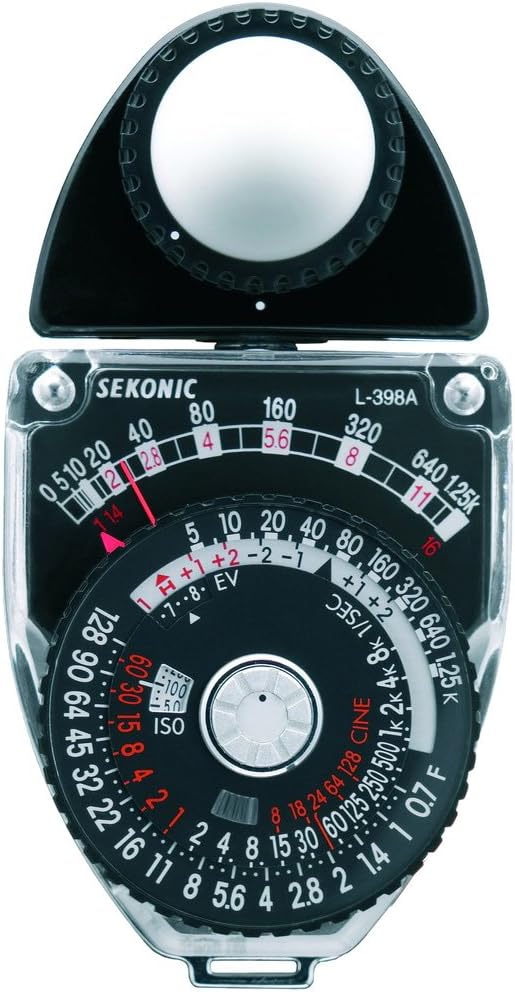


The Sekonic L-398A Studio Deluxe III combines a traditional analog exposure dial with the accessory ecosystem expected from a professional photographic light meter. Its 4.6 rating reflects strong customer satisfaction, and the defining attraction is its battery-free amorphous photocell. That feature makes it especially appealing to photographers and cinematographers who prefer dependable mechanical operation without managing batteries before or during a shoot.
We may earn a commission when you buy through this link, at no additional cost to you.
The full dial translates the measured light into combinations of aperture and shutter speed, allowing users to see the relationship between settings without cycling through a menu. A swivel head helps position the incident dome while keeping the scale visible. The included lumisphere, lumidisc, lumigrid, and high slide broaden the available measurement methods, covering general subject readings, selective area readings, and more controlled setups.
Its limitations are inherent to the analog format. There is no illuminated display, electronic logging, temperature reading, or direct numeric lux value. Precision therefore depends on reading the needle and dial correctly, and users accustomed to digital confirmation may need a little practice. Even so, these limitations can be positive for users seeking a simple tool that turns on instantly and does not depend on firmware, batteries, or display refresh behavior.
This is the strongest general recommendation for someone searching specifically for an analog light meter with genuine photographic exposure scales. It suits location work, studio portraits, still photography, and cinematography where incident readings and the relationship between aperture and shutter speed matter. Choose it for simplicity, durability, and the freedom to measure light without a power source.
The battery-free photocell removes one of the most common reasons a meter might be unavailable at a critical moment. The meter responds to ambient light without a separate power source, making it a practical companion for remote sets and travel.
The lumisphere supports broad incident measurements, while the lumidisc and lumigrid help narrow the reading to a selected area or grid. These accessories make the dial more versatile than a simple fixed-dome meter.
We may earn a commission when you buy through this link, at no additional cost to you.
This handheld digital illuminance meter is a versatile alternative for users who need raw light-level and temperature information rather than a photographic aperture-and-shutter scale. Its 4.4 rating indicates a generally positive reception, while the four-digit color LCD makes readings easy to inspect in offices, workshops, studios, and homes.
We may earn a commission when you buy through this link, at no additional cost to you.
Measurement capacity extends to 200,000 lux, allowing the instrument to handle both indoor and brighter conditions. The stated accuracy is ±3% plus eight digits below 10,000 lux and ±4% plus ten digits above that level. MIN and MAX functions help users identify changing readings, while data hold preserves a value for reference or recording.
Ambient temperature measurement sets it apart from basic lux meters, though that feature is more relevant to environmental inspections than exposure decisions. Its compact, lightweight construction also makes it convenient for checking work areas or light levels around a room. It does not provide the aperture, shutter, ISO, or flash information expected from a dedicated photography exposure meter.
Choose this model when your priority is an affordable general-purpose instrument with a wide range, readable display, and useful hold functions. It is less suitable for determining photographic exposure from flash or for reproducing the traditional analog workflow, but it is a strong fit for set design, offices, factories, home projects, and basic studio checks.
The combination of illuminance and ambient temperature provides a convenient way to evaluate a space more comprehensively. It can support general lighting audits, facility checks, and comparisons between work areas.
Data hold is useful when a reading must remain visible while the sensor is repositioned. MIN and MAX functions make it easier to identify the lowest and highest values during a sweep of the room.
We may earn a commission when you buy through this link, at no additional cost to you.
This listing for the Sekonic L-398A Studio Deluxe III emphasizes the same core strengths as the first product while highlighting compactness, portability, and a 180-degree lumisphere. It offers incident and reflected light readings for photographers who want a familiar mechanical meter and cinematographers who favor walking through a set to check light levels.
We may earn a commission when you buy through this link, at no additional cost to you.
The swivel head is particularly useful when the user wants to hold down the metering button and move around a location. That mobility makes it possible to compare a subject, background, and nearby practical lights without repeatedly placing the meter on a surface. The supplied case and strap support this portable workflow, while the lumidisc, lumigrid, and high slide provide additional measurement options.
As with any analog meter, visibility can be difficult under extremely dark or bright conditions when the dial is not illuminated. The reading also requires interpreting a needle and selecting the correct scale. Digital meters may be easier to use for exact numeric logging, but this Sekonic avoids batteries entirely and offers a direct, durable relationship between measured light and camera settings.
This option is best for users who prioritize compact analog operation, included accessories, and portability. It is especially attractive for photographers and cinematographers who already understand aperture and shutter scales and want a dependable meter that can be carried from location to location without routine battery management.
The swivel head and battery-free operation support a mobile metering routine. You can move among positions while keeping the instrument and its reading in active use.
The case, strap, lumidisc, lumigrid, and high slide reduce the need for separate accessories. Buyers can choose among general, selective, and controlled-area measurement approaches.
We may earn a commission when you buy through this link, at no additional cost to you.
The MT-92H offers an unusually broad set of measurements for a budget-oriented instrument. Its 4.6 rating places it among the stronger customer-rated products in the list. The 200,000-lux range, 0.1-lux resolution, temperature measurement, foot-candle mode, and switchable backlight make it more versatile than a basic lux reader.
We may earn a commission when you buy through this link, at no additional cost to you.
A split-sensor design separates the measuring probe from the main body, allowing the sensor to be positioned in confined or awkward locations while the display remains easier to view. The stated 0.5-second refresh rate can help users observe relatively quick changes in light level, and the glare-resistant backlit screen is intended to remain legible in darkness or direct sunlight.
Its main limitation is that it is not a photographic exposure meter. It does not present ISO, shutter speed, aperture, flash duration, or incident-versus-reflected creative metering scales. It also uses three AAA batteries, so it does not offer the entirely battery-free convenience of the Sekonic analog models. Those compromises matter most to cinema and still photographers but are less important for general lighting inspection.
For general users seeking a capable digital meter without moving to a professional photography model, the MT-92H is a practical budget choice. It is particularly useful for checking work areas, studio levels, outdoor illumination, and room brightness. Its combination of range, backlighting, temperature measurement, and dual units makes it more versatile than a simple one-function lux meter.
The separate probe reduces the need to place the entire instrument in a narrow space. It can be helpful beneath furniture, close to a wall, or inside a display cabinet while the readout remains visible.
The switchable backlight supports readings in dim rooms, while the glare-resistant screen is designed for outdoor conditions. Dual lux and foot-candle modes also serve different regional preferences.
We may earn a commission when you buy through this link, at no additional cost to you.
The Dr.meter Digital Illuminance Light Meter combines a broad 200,000-lux range with fast digital response and peak capture. Its 4.5 rating supports its reputation as a capable general-purpose instrument. Two readings per second make it practical for watching a changing light level, while the PEAK function preserves the highest detected pulse.
We may earn a commission when you buy through this link, at no additional cost to you.
Peak recording is the feature that distinguishes this model from basic digital lux meters. It can be useful when assessing brief bright events, laser-related light, or other transient sources. The display also supports conversion between lux and foot-candles, which helps users who work with either unit, and a low-battery indicator reduces the chance of continuing an inspection with inadequate power.
The product information specifically highlights growing environments, and its range is suitable for checking light reaching plants, windows, indoor growing areas, and other spaces. However, the measurement is simply illuminance. It does not interpret plant photobiology, calculate daily exposure, or recommend where a fixture should be positioned. The user must interpret the value in the context of the application.
This is a good choice for gardeners, facility workers, and general users who want fast readings plus peak measurement. It is less suitable as a dedicated camera exposure tool and requires a 9V battery, but its quick response, broad range, and useful data capture make it versatile for many routine light-level tasks.
The PEAK function locks the highest value detected, helping users identify short light pulses that a standard sampling mode might overlook. This is valuable for special-effect and technical checks.
The broad range and quick response suit repeated readings around plants and grow areas. The meter supplies the raw measurement, while the grower applies the relevant light target.
We may earn a commission when you buy through this link, at no additional cost to you.
The Extech LT300 stands out through its remote sensor, allowing the measuring element to be placed away from the display. Its 4.3 rating reflects a solid but less exceptional customer reception. The meter supports lux and foot-candle readings up to 40,000 lux, with peak and relative modes for capturing peaks and comparing readings.
We may earn a commission when you buy through this link, at no additional cost to you.
A large backlit LCD makes the result easier to inspect in dim locations, and one-handed operation suits field inspections. The cosine and color-corrected sensor is designed to support consistent measurements across daylight, fluorescent, LED, and industrial lighting. The protective sensor cover adds a practical safeguard during transport and storage.
The 40,000-lux ceiling is lower than the 200,000-lux capability of several competing digital meters, so it may not be the right instrument for very bright outdoor or high-output lighting conditions. It also lacks photographic exposure scales, flash timing, and camera-specific controls. Its remote sensor is most valuable when the measurement point is uncomfortable, obscured, or otherwise difficult to reach with a fixed sensor.
Choose the LT300 for facility maintenance, workplace lighting, studio inspection, and remote readings where the 40,000-lux range is sufficient. The relative and peak modes are useful for diagnostics, while the remote sensor provides flexibility that simpler handheld meters cannot match.
The remote sensor can enter spaces where keeping the full meter body visible and accessible is difficult. This makes it useful for checking cabinets, fixtures, and concealed corners.
Relative mode helps evaluate one location against another, while peak mode captures the highest detected value. Together they streamline repeated lighting inspections.
We may earn a commission when you buy through this link, at no additional cost to you.
The Gossen Luna Pro SBC combines an electronic exposure-value readout with a mechanical setting ring that reveals shutter-speed and aperture combinations. Its 3.7 rating is the lowest among the listed products, but the design remains appealing for users who want the familiarity of an analog exposure scale with a digital EV center reading.
We may earn a commission when you buy through this link, at no additional cost to you.
The ability to measure incident or reflected light gives it flexibility across portrait, product, and location work. The setting ring can translate the EV value into camera-setting combinations at a glance, which may be easier for some users than deciphering a screen or calculating equivalent exposures independently.
Beyond exposure measurement, the product includes a clock, alarm, timer, and temperature display. These are secondary benefits rather than reasons to choose a photography meter, but they can make the unit more useful during a full production day. The limited supplied specifications mean buyers should verify current operating details, included accessories, and compatibility before ordering.
The Luna Pro SBC is a distinctive option for photographers who want analog-style setting guidance without committing to a fully digital interface. Its lower customer rating warrants careful consideration, but photographers who value the physical setting ring and digital EV center may find that format especially intuitive. It is best treated as a specialized exposure tool rather than a general-purpose lux meter.
The setting ring places camera options around the digital EV reading. That layout bridges traditional analog meter's visual logic with an electronic center value.
The clock, alarm, timer, and temperature readout add convenience during longer workdays. They do not replace dedicated exposure functions, but they reduce the need for another simple timer or thermometer.
We may earn a commission when you buy through this link, at no additional cost to you.
The Fluke 941 is a dedicated digital illuminance meter from an established professional instrumentation brand. Its 4.8 rating is the highest among the ten listed products, making it a particularly attractive recommendation for buyers who prioritize customer feedback and focused light measurement rather than photographic exposure controls.
We may earn a commission when you buy through this link, at no additional cost to you.
The meter is designed for illuminance testing, providing a simpler purpose than a hybrid photographic instrument. That specialization can be an advantage in workplaces, studios, laboratories, and facilities where a quick numeric light-level check is the primary requirement. Its portable format also supports field inspections without the complexity of a full camera exposure meter.
The supplied product information is concise and does not enumerate the full technical specification set, so potential buyers should review the current listing for measurement range, accuracy, battery requirements, and included accessories. It also does not provide the ISO, aperture, shutter-speed, flash, or photo and cinema modes found in the Sekonic L-308X-U. Those omissions are appropriate for its general measurement role but limit its value for exposure work.
For users who want a dependable, well-reviewed dedicated illuminance meter, the Fluke 941 is the premium choice in this group. It is less compelling for photographers seeking a traditional analog dial or for filmmakers who need frame-rate-aware exposure tools. For facility and lighting checks, however, its clear purpose and strong customer reception are compelling advantages.
A dedicated illuminance meter removes camera-specific controls from the equation. That makes the Fluke 941 a natural fit for repeat measurements and straightforward lighting audits.
Fluke's established instrumentation identity and the 4.8 customer rating support confidence for professional or institutional use. Confirm the exact specifications and accessories available in the current listing.
We may earn a commission when you buy through this link, at no additional cost to you.
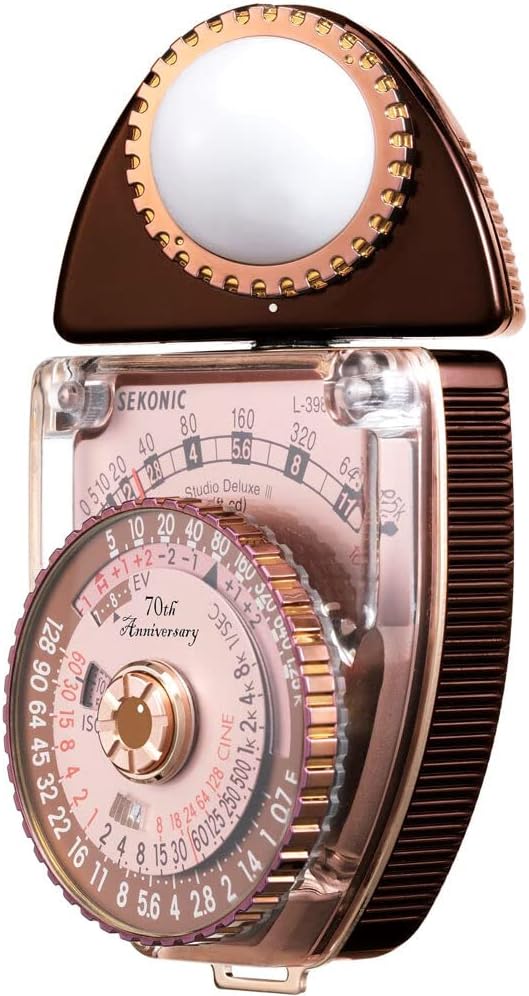
The Sekonic Studio Deluxe III 70th Anniversary edition is the highest-rated product in the group, with a 5.0 customer rating. Its core attraction is the instantly readable scale showing the full range of aperture and shutter combinations. It delivers a direct mechanical experience that remains distinct from the increasingly digital tool kit around modern cameras.
We may earn a commission when you buy through this link, at no additional cost to you.
For photographers accustomed to a physical exposure dial, this layout can make relationships easier to understand. The needle points to the measured exposure, and the surrounding scales show how that value translates into camera settings. That makes the meter useful for learning exposure fundamentals as well as making practical decisions on location.
The 70th Anniversary treatment adds collector and gift appeal to an otherwise practical instrument. The available information focuses on the exposure-scale feature, so buyers should verify the exact accessory package, incident and reflected capabilities, photocell design, and operating requirements for this particular edition before purchase. As a purely analog device, it will not offer illuminated data, electronic logging, or temperature measurements.
This is the best option in the roundup for a buyer who wants the strongest listed customer feedback and values a classic analog meter for regular use or collection. Photographers learning exposure, enthusiasts of traditional tools, and owners of film-oriented workflows may find the physical dial especially satisfying. It is less suitable for users requiring flash timing or video-specific exposure information.
The full aperture and shutter scale turns one measurement into several practical camera choices. Photographers can compare settings without reading a single electronic menu.
The commemorative model adds distinction for collectors and gift buyers. Its practical value remains grounded in the straightforward mechanical exposure display.
We may earn a commission when you buy through this link, at no additional cost to you.
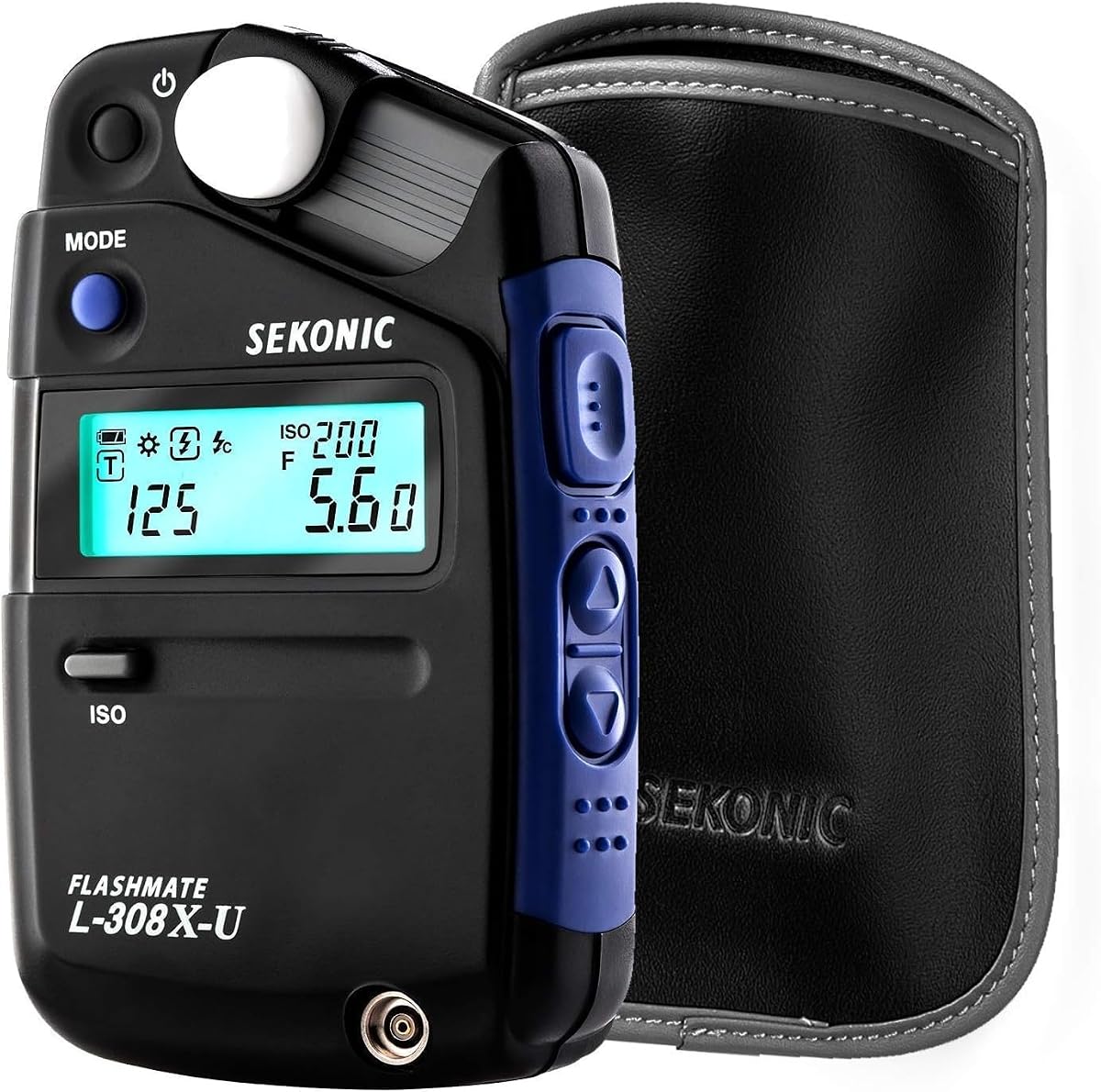
The Sekonic L-308X-U Flashmate is a compact digital exposure meter designed for photographers and filmmakers. Its 4.7 rating reflects strong customer satisfaction, while Photo, Cine, and HD Cine modes distinguish it from general-purpose lux meters. It supports incident and reflected readings and includes electronic flash measurement.
We may earn a commission when you buy through this link, at no additional cost to you.
Exposure accuracy extends to one-tenth of a stop in full-stop mode. At ISO 100, the ambient EV range is listed as 0 to 19.9, with flash f-stops from f/1.0 to f/90.9. Flash shutter speeds span one second to 1/500 second, while ambient settings extend from 60 seconds to 1/8000 second. These ranges make the meter useful across dim interiors, bright daylight, and flash-assisted work.
Photo Mode supports still-image workflows, including shutter or aperture priority displays and cord or cordless flash measurement. Cine Mode provides common frame rates and shutter angles for cinema cameras, while HD Cine Mode supports DSLR and mirrorless video workflows. The automatic LCD backlight improves visibility, and the pocket-sized design is easier to carry than a full studio meter.
The L-308X-U is the most complete hybrid for users who move between still photography and video. It is not a true analog meter, but it delivers the camera-relevant exposure data that basic digital lux meters omit. Choose it when reliable flash measurement, cinema-aware settings, and a compact format matter more than a mechanical dial or battery-free operation.
Dedicated modes keep still photography, conventional cinema, and HD video workflows distinct. The display provides settings appropriate to the production type rather than presenting only a generic lux value.
The meter supports cord and cordless electronic flash readings, with specified one-tenth-stop accuracy in full-stop mode. This makes it valuable for mixed ambient and flash setups.
We may earn a commission when you buy through this link, at no additional cost to you.
The right meter depends on your measurement target, workflow, and preferred display. Photographers should prioritize exposure scales, while facility users should focus on range, accuracy, and data functions.
An analog photographic light meter is not simply another name for a handheld lux meter. A photographic exposure meter translates ambient or flash measurements into aperture, shutter speed, ISO-related exposure values, or a combination of those settings. A general illuminance meter instead reports light intensity in lux or foot-candles for lighting design, workplace checks, plant measurements, or technical inspection. The Gossen Luna Pro SBC occupies an interesting middle ground with a digital EV center and physical setting ring.
First identify the output you need to record. If the result will guide a camera exposure, choose a photographic meter such as a Sekonic L-398A or L-308X-U. If the result needs to establish how brightly a room or work surface is illuminated, prioritize a digital lux meter with an appropriate range.
Incident metering places the sensor toward the light source and generally represents the illumination reaching a subject. Reflected metering points the sensor toward the subject and relies on assumed reflectance to estimate exposure. Both methods have valid uses, and having access to both makes a meter more adaptable across portraits, products, interiors, and high-contrast scenes.
Look for a model with a dome or flat diffuser for incident readings and a calibrated reflector or adjustable attachment for reflected readings. The Sekonic L-398A's accessory ecosystem is particularly useful because the lumisphere, lumidisc, lumigrid, and high slide support different measurement conditions without changing the core meter.
A useful meter should cover the light levels encountered in the intended environment. Several digital options reach 200,000 lux, making them suitable for outdoor sunlight and bright industrial spaces, while the Extech LT300 reaches 40,000 lux. For photography, raw lux range is less informative than the stated EV, flash range, shutter span, and f-stop coverage.
Review accuracy figures carefully, including any percentage or digit terms. Accuracy claims can differ across the operating range, and the digital illuminance meter in this guide uses two stated bands below and above 10,000 lux. Match the range and tolerance to the precision your work actually requires rather than selecting on maximum capacity alone.
Analog meters provide a direct visual relationship between a needle, the light level, and camera settings. They are tactile, immediate, and often more dependable because they do not require menus or display refresh rates. Digital meters offer exact numeric values, backlighting, min and max functions, and often additional modes such as temperature, peak capture, or flash timing.
Choose analog if you value simplicity, physical scale reading, and the ability to work without batteries. Choose digital if you require precise numeric logging, easy readings in dark conditions, temperature data, or specialty functions. There is no universally superior interface; the best meter is the one whose workflow fits your experience and the kind of evidence you need to record.
A flash meter needs to measure the brief output of an electronic flash and express that result in usable camera settings. The Sekonic L-308X-U supports cord and cordless flash measurement and provides specified flash f-stop and shutter-speed ranges. Standard lux meters may register a flash only as a transient illuminance event, which is not the same as producing a photographic exposure recommendation.
Video introduces frame rates and shutter angles that do not appear in a standard still-camera workflow. The L-308X-U includes Cine and HD Cine modes for these purposes. If you regularly shoot video, review shutter-angle, frame-rate, and time-code-related options before purchase, and confirm the camera settings your meter supports.
A meter that stays in a camera bag is more likely to be used. Compact construction, a protective case, a strap, and a simple sensor design can make field metering more convenient. A swivel head also helps when measuring in awkward positions or when walking around a set while holding the metering control.
Accessories determine how versatile a traditional meter becomes. Diffusers and domes support incident readings, while discs and grids restrict the measured area. The Studio Deluxe III listings include a substantial collection of these tools. Digital general-purpose meters may have fewer photographic accessories, so assess whether a separate remote sensor, tripod, or protective cover is important to your workflow.
For a digital meter, examine screen size, backlighting, units, resolution, response speed, and battery warning functions. A four-digit color LCD, switchable backlight, half-second refresh, and min/max tracking can each make repeated measurements easier. Resolution of 0.1 lux is useful when working with low levels, while a broader range is more valuable under intense lighting.
For an analog meter, examine the scale markings, incident attachments, swivel-head movement, and whether the photocell needs a battery. Mechanical operation is particularly appealing when the meter must work in cold, remote, or high-pressure conditions without preparation.
Ratings offer a useful summary of customer experience, but the most popular model is not automatically the right model for every task. The Fluke 941 has the highest supplied rating at 4.8, while the 70th Anniversary Sekonic is listed at 5.0. Other products fall between 4.3 and 4.7. Read the rating alongside the feature set, especially if you need flash, video, temperature, or remote-sensor functions.
Pay attention to whether the product is being valued as a tool, a collectible, or a specialized instrument. A high rating may reflect satisfaction with a classic design, while a lower rating may reflect limited expectations for a specialized model. The right comparison is between the product's actual strengths and your own priorities.
Before taking a reading, set your camera's ISO and identify whether you need incident or reflected measurement. For incident work, place the appropriate dome over the sensor and aim it toward the light reaching the subject. For reflected work, point the calibrated face toward the subject and avoid filling the frame with your own shadow. Allow the reading to settle before interpreting the needle or digital value.
Take several readings from relevant positions instead of relying on one number. A photographer may compare the subject, background, nearest practical light, and shadow areas to understand contrast. Digital users can use data hold, min/max, peak, or relative modes where appropriate, while analog users can walk the set with a swivel-head meter. Record the ISO and relevant accessories so each value remains reproducible.
Store the meter in its case with the sensor and dial protected from impact, dust, moisture, and excessive heat. Do not force a stuck analog needle or scratch a digital screen. Replace batteries before long storage periods, remove batteries from a meter that will remain unused for an extended time, and keep calibration accessories together. If readings seem inconsistent, clean the sensor gently, check the attachment, confirm the selected unit, and verify that the meter is functioning as intended.
It depends on the workflow. Analog meters provide a direct, tactile relationship between the measured light and camera settings, often without batteries. Digital meters are usually easier to read in darkness, support exact numeric values, and may add flash, temperature, peak, and video functions. Choose the format that matches the measurements you actually need to make.
A photographic light meter is designed to help set camera exposure, often using aperture, shutter speed, EV, or flash scales. A lux meter reports illuminance in lux or foot-candles for general lighting analysis. A lux reading can inform a lighting setup, but it does not automatically provide a complete camera exposure recommendation.
The supplied product information for the L-398A Studio Deluxe III states that no battery is required. Its integrated amorphous photocell generates the power needed for the analog reading from ambient light. This makes the model especially convenient for remote locations and shoots where battery availability may be limited.
The Sekonic L-308X-U Flashmate is the clearest option in this list because it explicitly supports electronic flash measurement in both cord and cordless configurations. It also provides a specified flash f-stop range and flash shutter-speed span. Traditional analog meters and basic lux meters may detect flash energy but do not necessarily convert it into practical exposure settings.
Yes, provided the meter offers the exposure scales and controls appropriate to your shooting workflow. The Sekonic L-398A can support ambient exposure decisions for cinematography, while the L-308X-U includes dedicated Cine and HD Cine modes for frame rates and shutter angles. Check the available settings before committing to a model.
The appropriate range depends on the environment. A meter reaching 200,000 lux offers broad coverage for daylight, bright fixtures, and industrial inspections, while a 40,000-lux model may be sufficient for many offices and indoor studios. Also review accuracy, low-light resolution, backlighting, and the specific units you need rather than considering maximum range alone.
Always confirm that the meter reads plausibly and that the sensor or diffuser is clean, undamaged, and correctly attached. If results conflict with trusted equipment, follow the manufacturer's verification procedure or have the meter checked professionally. Calibration accessories and a consistent testing method are particularly important when readings will be used for formal compliance work.
Yes. They remain useful for photographers who prefer physical exposure scales, want a meter that works without batteries, or enjoy the learning value of understanding aperture and shutter relationships. Digital meters remain more convenient for logged measurements, flash timing, video, and illuminated readings, so the two formats can complement rather than replace one another.
The strongest traditional recommendation is the Sekonic L-398A Studio Deluxe III because it combines a complete analog exposure dial, incident and reflected measurement, an adjustable swivel head, and battery-free operation. Its accessory package makes it especially capable for photographers and filmmakers who want several measurement methods in one package.
For a broader digital alternative, the MT-92H provides a 200,000-lux range, split-sensor design, temperature measurement, dual units, and a switchable backlight. The Fluke 941 is the premium option for focused illuminance work, while the Sekonic L-308X-U Flashmate is the most versatile choice for photographers and video makers who need camera-specific exposure, flash, and frame-rate-aware functions.
Regardless of the model, prioritize the output you need, sensor range, measurement method, display readability, and included accessories. Ratings can help identify customer satisfaction, but they should not replace feature matching. Check the current listing, confirmed specifications, availability, and price before making a final purchase, since both pricing and product details can change.